


2 Chronicles 13:10
- וַאֲנַחְנוּva·'a·Nach·nuand weH587Conj-w ¦ Pro-1cpPronoun Personal 1st Plural common genderוַandאֲנַחְנוּwe
- יְהוָהYah·wehYahwehH3068N-properNoun Proper Title
- אֱלֹהֵינוּ'e·lo·Hei·nu[is] our GodH430N-mpc ¦ 1cpNoun Plural Masculine Constructאֱלֹהֵי[is] Godנוּour
- וְלֹאve·Lo'and notH3808Conj-w ¦ NegParticle Negativeוְandלֹאnot
- עֲזַבְנֻהוּ'a·zav·Nu·huwe have forsaken himH5800V-Qal-Perf-1cp ¦ 3msVerb Qal Perfect 1st Plural common genderעֲזַבְנֻwe have forsakenהוּhim
- וְכֹהֲנִיםve·Kho·ha·Nimand [we are] priestsH3548Conj-w ¦ N-mpNoun Plural Masculine Absoluteוְandכֹהֲנִים[we are] priests
- מְשָׁרְתִיםme·sha·re·TimservingH8334V-Piel-Prtcpl-mpVerb Piel Participle Plural Masculine Absolute
- לַיהוָהla·Yah·weh<to> YahwehH3068Prep-l ¦ N-properNoun Proper Titleלַ<to>יהוָהYahweh
- בְּנֵיbe·Nei[the] descendants ofH1121N-mpcNoun Plural Masculine Construct
- אַהֲרֹן'a·ha·RonAaronH175N-proper-mNoun Proper Masculine
- וְהַלְוִיִּםve·hal·vi·Yimand the LevitesH3881Conj-w ¦ Art ¦ N-mpNoun Gentilic Plural Masculine AbsoluteוְandהַtheלְוִיִּםLevites
- בַּמְלָאכֶתbam·La·khet[are] in the workH4399Prep-b ¦ N-fsNoun Singular Feminine Absoluteבַּ[are] in theמְלָאכֶתwork
English is a literal word-by-word gloss of the Hebrew, not the KJV's wording. Why?
This is the original text the KJV's translators worked from — each Hebrew word with its own literal English meaning in this verse, prepared by scholars at Tyndale House, Cambridge. The KJV translates whole sentences, not word by word, so its wording differs: one Hebrew word can become several English words, and the KJV may choose “the LORD” where the gloss reads “Yahweh”. Both are faithful — they answer different questions. For the KJV's own rendering, switch to the KJV text.
Details
See on the biblical-era map
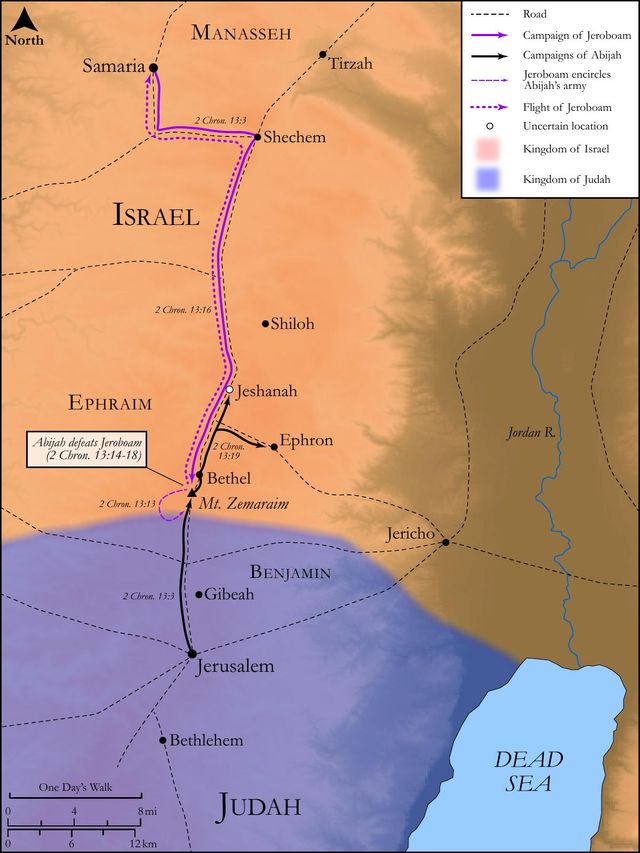
Study this verse
Public-domain commentary
Matthew Henry
From his Commentary on the Whole Bible. Henry comments on passages, not single verses — this entry covers 2 Chronicles 13:1–12. His four-level outline is real structure in the source text, so it is rendered as structure.
Abijah's mother was called Maachah, the daughter of Absalom, Ch2 11:20; here she is called Michaiah, the daughter of Uriel. It is most probable that she was a grand-daughter of Absalom, by his daughter Tamar (Sa2 14:27), and that her immediate father was this Uriel. But we are here to attend Abijah into the field of battle with Jeroboam king of Israel.
I.God gave him leave to engage with Jeroboam, and owned him in the conflict, though he would not permit Rehoboam to do it, Ch2 11:4.
1.Jeroboam, it is probable, was now the aggressor, and what Abijah did was in his own necessary defence. Jeroboam, it may be, happening to survive Rehoboam, claimed the crown of Judah be survivorship, at least hoped to get it from this young king, upon his accession to the throne. Against these impudent pretensions it was brave in Abijah to take up arms, and God stood by him.
2.When Rehoboam attempted to recover his ten tribes Jeroboam was upon his good behaviour, and there must be some trial of him; but now that he had discovered what manner of man he was, by setting up the calves and casting off the priests, Abijah is allowed to chastise him, and it does not appear that he intended any more; whereas Rehoboam aimed at no less than the utter reduction of the ten tribes, which was contrary to the counsel of God.
II.Jeroboam's army was double in number to that of Abijah (Ch2 13:3), for he had ten tribes to raise an army out of, while Abijah had but two.
Of the army on both sides it is said, they were mighty men, chosen men, and valiant; but the army of Judah consisted only of 400,000, while Jeroboam's army amounted to 800,000. The inferior number however proved victorious; for the battle is not always to the strong nor the cause to the majority.
III.Abijah, before he fought them, reasoned with them, to persuade them, though not to return to the house of David (that matter was settled by the divine determination and he acquiesced), yet to desist from fighting against the house of David. He would not have them withstand the kingdom of the Lord in the hands of the sons of David (Ch2 13:8), but at least to be content with what they had. Note, It is good to try reason before we use force. If the point may be gained by dint of argument, better so than by dint of sword. We must never fly to violent methods till all the arts of persuasion have been tried in vain. War must be the ultima ratio regum - the last resort of kings. Fair reasoning may do a great deal of good and prevent a good deal of mischief. How forcible are right words! Abijah had got with his army into the heart of their country; for he made this speech upon a hill in Mount Ephraim, where he might be heard by Jeroboam and the principal officers, with whom it is probable he desired to have a treaty, to which they consented. It has been usual for great generals to make speeches to their soldiers to animate them, and this speech of Abijah had some tendency to do this, but was directed to Jeroboam and all Israel. Two things Abijah undertakes to make out, for the satisfaction of his own men and the conviction of the enemy: -
1.That he had right on his side, a jus divinum - a divine right: "You know, or ought to know, that God gave the kingdom to David and his sons for ever" (Ch2 13:5), not by common providence, his usual way of disposing of kingdoms, but by a covenant of salt, a lasting covenant, a covenant made by sacrifice, which was always salted; so bishop Patrick. All Israel had owned that David was a king of God's making, and that God had entailed the crown upon his family; so that Jeroboam's taking the crown of Israel at first was not justifiable: yet it is not certain that Abijah referred chiefly to that, for he knew that Jeroboam had a grant from God of the ten tribes. His attempt, however, to disturb the peace and possession of the king of Judah was by no means excusable; for when the ten tribes were given to him two were reserved for the house of David. Abijah shows,
(1.)That there was a great deal of dishonesty and disingenuousness in Jeroboam's first setting himself up: He rebelled against his lord (Ch2 13:6) who had preferred him (Kg1 11:28), and basely took advantage of Rehoboam's weakness in a critical juncture, when, in gratitude to his old master and in justice to his title, he ought rather to have stood by him, and helped to secure the people in their allegiance to him, than to head a party against him and make a prey of him, which was unworthily done and what he could not expect to prosper in. Those that supported him are here called vain men (a character perhaps borrowed from Jdg 11:3), men that did not act from any steady principle, but were given to change, and men of Belial, that were for shaking off the yoke of government and setting those over them that would do just as they would have them do.
(2.)That there was a great deal of impiety in his present attempt; for, in fighting against the house of David, he fought against the kingdom of the Lord. Those who oppose right oppose the righteous God who sits in the throne judging right, and cannot promise themselves success in so doing. Right may indeed go by the worst for a time, but it will prevail at last.
2.That he had God on his side. This he insisted much upon, that the religion of Jeroboam and his army was false and idolatrous, but that he and his people, the men of Judah, had the pure worship of the true and living God among them. It appears from the character given of Abijah (Kg1 15:3) that he was not himself in this war chiefly from the religion of his kingdom. For,
(1.)Whatever he was otherwise, it should seem that he was no idolator, or, if he connived at the high places and images (Ch2 14:3, Ch2 14:5), yet he constantly kept up the temple-service.
(2.)Whatever corruptions there were in the kingdom of Judah, the state of religion among them was better than in the kingdom of Israel, with which they were now contending.
(3.)It is common for those that deny the power of godliness to boast of the form of it.
(4.)It was the cause of his kingdom that he was pleading; and, though he was not himself so good as he should have been, yet he hoped that, for the sake of the good men and good things that were in Judah, God would now appear for them. Many that have little religion themselves yet have so much sense and grace as to value it in others. See how he describes,
[1.]The apostasy of Israel from God. "You are a great multitude," said he, "far superior to us in number; but we need not fear you, for you have that among yourselves which is enough to ruin you. For," First, "You have calves for your gods (Ch2 13:8), that are unable to protect and help you and will certainly cause the true and living God to oppose you. Those will be Achans, troublers of your camp." Secondly, "You have base men for your priests, Ch2 13:9. You have cast off the tribes of Levi, and the house of Aaron, whom God appointed to minister in holy things; and, in conformity to the custom of the idolatrous nations, make any man a priest that has a mind to the office and will be at the charge of the consecration, though ever so much a scandal to the office." Yet such, though very unfit to be priests, were fittest of all to be their priests; for what more agreeable to gods that were no gods than priests that were no priests? Like to like, both pretenders and usurpers.
[2.]The adherence of Judah to God: "But as for us (Ch2 13:10) we have not forsaken God. Jehovah is our God, the God of our fathers, the God of Israel, who is able to protect us, and give us success. He is with us, for we are with him." First, "At home in his temple: We keep his charge, Ch2 13:10, Ch2 13:11. We worship no images, have no priests but what he has ordained, no rites of worship but what he has prescribed. Both the temple service and the temple furniture are of his appointing. His appointment we abide by, and neither add nor diminish. These we have the comfort of, these we now stand up in the defence of: so that upon a religious as well as a civil account we have the better cause. Secondly, Here in the camp; he is our captain, and we may therefore be sure that he is with us, because we are with him, Ch2 13:12. And, as a token of his presence, we have here with us his priests, sounding his trumpets according to the law, as a testimony against you, and an assurance to us that in the day of battle we shall be remembered before the Lord our God and saved from our enemies;" for so this sacred signal is explained, Num 10:9. Nothing is more effectual to embolden men, and put spirit into them, than to be sure that God is with them and fights for them. He concludes with fair warning to his enemies. "Fight not against the God of your fathers. It is folly to fight against the God of almighty power; but it is treachery and base ingratitude to fight against your fathers' God, and you cannot expect to prosper."
Continue studying 2 Chronicles 13:10 across the web’s major study libraries — every link below opens this exact verse, chapter, or book on the destination site.
Read & Compare
 BibleGatewayThis verse in more than 200 translations and 70 languages.
 Bible.comThe YouVersion reader — hundreds of translations, reading plans, and highlights.
 ESV.orgCrossway's official English Standard Version reader.
 NET BibleThe NET translation with 60,000+ translators' notes on every rendering decision.
 STEP BibleTyndale House's free study tool — original text, vocabulary, and scholarly resources.
 BibliaLogos Bible Software's free web reader.
 USCCBThe New American Bible (Revised Edition) with the U.S. bishops' study notes.
Commentaries
 BibleHub CommentariesDozens of classic commentaries on this verse, gathered on one page.
 StudyLightMore than 100 commentary sets — the largest collection on the web.
 BibleRefPlain-English commentary on what this verse means, verse by verse.
 Enduring WordDavid Guzik's free commentary on this chapter, widely used by Bible teachers.
 Bible Study ToolsVerse commentary alongside Greek and Hebrew study aids.
Original Language & Research
- BibleHub InterlinearThe verse word by word — original language, transliteration, and English.
- BibleHub LexiconEvery word's original-language definition and Strong's entry.
 Blue Letter BibleDeep-study tools — Strong's numbers, concordance, and word studies.
 SefariaThe Hebrew text with Rashi and centuries of Jewish commentary.
Sermons, Hymns & Audio


TrulyRandomVerse is not affiliated with these sites and doesn’t control their content. They’re linked because they’re genuinely useful.
Summary
2 Chronicles 13:10 encapsulates King Abijah of Judah's powerful declaration to Jeroboam I and the northern kingdom of Israel, affirming Judah's unwavering fidelity to the LORD and His divinely ordained system of worship. This verse stands as a stark contrast to Israel's apostasy and illegitimate religious innovations, proclaiming Judah's continued covenant faithfulness through the preservation of the legitimate Aaronic priesthood and the dedicated service of the Levites, all in strict accordance with God's commands. It serves as a theological cornerstone in Abijah's pre-battle address, emphasizing the sanctity of true worship and the dire consequences of abandoning God's established order.
Context
ShowHideLiterary Context
This verse is a central component of King Abijah's impassioned and theologically charged speech delivered to Jeroboam and the vast army of Israel, immediately preceding a decisive battle (2 Chronicles 13:4-12). Abijah's address transcends a mere military pep talk, functioning as a profound theological argument that meticulously contrasts Judah's steadfast adherence to the Davidic covenant and the Mosaic Law with Israel's rebellion and idolatry. The preceding verses in the chapter establish the historical backdrop of the kingdom's division and Jeroboam's establishment of alternative worship sites and the appointment of non-Levitical priests. Abijah's declaration in verse 10, therefore, solidifies Judah's spiritual high ground, setting the stage for his subsequent assertion of their reliance on the LORD and their confidence in divine victory, which ultimately culminates in God striking down Jeroboam and Israel (compare 2 Chronicles 13:15-18).
Historical & Cultural Context
The historical setting for this confrontation is the early period of the divided monarchy, specifically during the reigns of Abijah in Judah and Jeroboam I in Israel, roughly between 931-913 BC. Following the death of Solomon, ten northern tribes seceded from the Davidic dynasty, forming the kingdom of Israel under Jeroboam I, while Judah and Benjamin remained loyal to Rehoboam (Abijah's father) and the house of David. Jeroboam, fearing that his people's continued pilgrimages to Jerusalem for worship would lead them back to allegiance to Rehoboam, established golden calves in Bethel and Dan and appointed priests who were not of the tribe of Levi, thereby creating an illegitimate and apostate religious system (see 1 Kings 12:25-33). Abijah's speech directly confronts this religious apostasy, highlighting Judah's unique position as the preservers of the true worship of Yahweh, including the legitimate Aaronic priesthood and the divinely sanctioned Temple service in Jerusalem.
Key Themes
ShowHideThis verse powerfully contributes to several overarching themes within 2 Chronicles and the broader biblical narrative. It underscores Covenant Faithfulness, as Abijah asserts Judah's unwavering loyalty to the LORD and their adherence to the covenant established with Abraham, Moses, and David. This stands in stark contrast to Israel's defection, highlighting the enduring importance of remaining true to God's revealed will. The verse also champions Legitimate Worship, stressing the necessity of worshipping God according to His prescribed pattern, specifically through the divinely appointed Aaronic priests and Levites. This theme is central to the Chronicler's emphasis on proper temple worship and the dangers of syncretism or innovation, as vividly illustrated by Jeroboam's actions (compare Leviticus 10:1-2). Finally, it speaks to Divine Authority and Order, affirming that God has established a specific structure for His people's spiritual life and leadership, which Judah respects and maintains, unlike Israel, who "have broken the covenant of the LORD" (as implied in 2 Chronicles 13:11-12).
Exposition and Analysis
ShowHideKey Word Analysis
ShowHideThis is the personal, covenantal name of God, often rendered "Yahweh" or "Jehovah." It emphasizes God's self-existence, eternal nature, and His faithfulness to His covenant promises. In Abijah's declaration, asserting "the LORD is our God" (H3068 and H430), it signifies Judah's exclusive allegiance to the one true God of Israel, distinguishing Him from the false deities and idols worshipped by Jeroboam's kingdom. It is a profound statement of identity and unwavering commitment to the God who revealed Himself to Abraham, Isaac, and Jacob.
This primitive root means "to loosen, i.e. relinquish, permit, etc." It implies a deliberate act of abandoning, deserting, or turning away from something or someone. Abijah's claim that Judah has "not forsaken him" is a powerful assertion of their steadfastness and loyalty to the LORD. This stands in sharp contrast to Israel's spiritual betrayal through idolatry and the establishment of an illegitimate priesthood, highlighting the deep moral and spiritual chasm between the two kingdoms. It underscores Judah's conscious choice to remain in covenant fidelity.
This word properly denotes "deputyship, i.e. ministry," and more generally, "employment or work." When applied to the Levites, as in this verse ("wait upon their business"), it refers specifically to their divinely appointed duties and service within the Temple. These duties included assisting the priests, maintaining the sanctuary, preparing for sacrifices, and leading musical worship. This emphasizes the diligent and faithful performance of their sacred responsibilities, underscoring the order, legitimacy, and comprehensive nature of Judah's worship system, which adhered to God's prescribed ceremonial law.
Verse Breakdown
ShowHide"But as for us, the LORD [is] our God"
This opening clause establishes a direct and emphatic contrast ("But as for us") between the faithful kingdom of Judah and the apostate northern kingdom of Israel. It is a bold and foundational declaration of Judah's unwavering allegiance to Yahweh, the true covenant God of Israel, asserting their unique and possessive relationship with Him. This serves as the theological premise for Abijah's entire argument, highlighting Judah's distinct identity rooted in divine covenant.
"and we have not forsaken him"
This is a crucial assertion of Judah's steadfast faithfulness and loyalty. It claims that, unlike the northern kingdom which had abandoned its covenant obligations through idolatry and illegitimate worship, Judah has remained true to the LORD. This statement positions Judah as the legitimate inheritors and practitioners of the Mosaic covenant, emphasizing their active choice to remain in relationship with God despite the political and religious turmoil of the divided monarchy.
"and the priests, which minister unto the LORD, [are] the sons of Aaron"
This clause highlights the legitimacy and divine authorization of Judah's priesthood. The "sons of Aaron" refers exclusively to the lineage designated by God for priestly service, emphasizing the continuity, purity, and sanctity of their worship practices. This directly contrasts with Jeroboam's appointment of non-Levitical priests, underscoring Judah's adherence to God's established order for His sanctuary and the proper conduct of sacrificial worship.
"and the Levites [wait] upon [their] business"
This final clause further elaborates on the proper and orderly functioning of Judah's worship system. The Levites, who were distinct from the Aaronic priests but served alongside them, diligently performed their specific duties related to the Temple service, such as assisting the priests, maintaining the sanctuary, and leading music. This signifies Judah's comprehensive and orderly adherence to God's ceremonial law, reinforcing the idea that their worship was conducted according to divine prescription, unlike the chaotic and illegitimate practices of the northern kingdom.
Literary Devices
ShowHideAbijah's speech, particularly 2 Chronicles 13:10, masterfully employs several literary devices to enhance its persuasive power and theological impact. The most prominent is Contrast, which is central to the entire address. Abijah meticulously contrasts Judah's faithfulness, legitimate worship, and reliance on the LORD with Israel's apostasy, illegitimate priesthood, and reliance on golden calves. This stark juxtaposition serves to highlight Judah's righteousness and Israel's sin. The verse also utilizes Rhetorical Appeal, as Abijah's words are designed not just to inform but to persuade and condemn, invoking divine judgment against Israel while bolstering Judah's morale. There is a strong element of Emphasis through the clear and concise declaration of Judah's spiritual state and practices, underscoring their critical importance. Finally, the structure of the verse itself, listing the distinct components of Judah's faithfulness (their God, their own loyalty, the legitimate priests, the diligent Levites), creates a sense of Completeness and thorough adherence to God's revealed will and established order.
Theological and Thematic Connections
ShowHide2 Chronicles 13:10 powerfully articulates the theological principle that true worship is inseparable from covenant faithfulness and unwavering adherence to God's revealed will. Judah's declaration, "the LORD is our God, and we have not forsaken him," echoes the core tenets of the Mosaic covenant, where exclusive allegiance to Yahweh was paramount, as encapsulated in the Shema. The emphasis on the legitimate Aaronic priesthood and the diligent service of the Levites underscores the sanctity of God's prescribed order for worship, demonstrating that genuine devotion is not merely internal sentiment but also involves external conformity to divine commands and structures. This verse serves as a timeless reminder that spiritual integrity is maintained by upholding God's truth, resisting the temptation to innovate or compromise with illegitimate practices, and faithfully stewarding the sacred trusts He has given.
Reflection and Application
ShowHideIn a world constantly shifting its values and redefining truth, 2 Chronicles 13:10 offers a profound anchor for believers, calling us to examine the foundation of our faith and practice. It challenges us to declare with conviction, "the LORD is our God, and we have not forsaken him." This isn't merely a historical statement but a living, active commitment to exclusive allegiance to Jesus Christ, the one true God. Just as Judah was called to uphold legitimate worship, believers today are called to worship God "in spirit and truth" (John 4:24), ensuring that our devotion is rooted in His revealed Word, not in human traditions or fleeting cultural trends. The diligence of the priests and Levites reminds us of the importance of faithful service within the body of Christ, recognizing that every believer has a divinely appointed role in building up the church and proclaiming the gospel. This verse encourages us to resist spiritual compromise, to stand firm in our confession, and to remain steadfast in our obedience, even when surrounded by competing ideologies or pressures to conform to the world's patterns.
Questions for Reflection
ShowHideFAQ
ShowHideWhy was the Aaronic priesthood so important, and what is its relevance for Christians today?
ShowHideThe Aaronic priesthood, established by God through Moses, was critically important for Old Testament Israel because it was the divinely ordained means through which atonement for sin was made and access to God was granted. Only the sons of Aaron could serve as priests, mediating between God and His people through sacrifices and rituals in the Tabernacle and later the Temple. This strict adherence to lineage and prescribed duties underscored God's holiness and the necessity of approaching Him on His terms. For Christians today, the Aaronic priesthood's relevance lies in its profound foreshadowing of Jesus Christ. The Old Testament priests could only offer temporary atonement and had to repeatedly offer sacrifices. Jesus, however, is our ultimate and eternal High Priest, who offered Himself as the perfect, once-for-all sacrifice for sin (see Hebrews 7:27). Therefore, while the Aaronic priesthood is no longer active, it helps us understand the profound significance and superiority of Christ's priestly work, through whom we now have direct access to God (see Hebrews 4:14-16). It highlights the perfection of Christ's mediation compared to the imperfect, temporary system of the Old Covenant.
Christ-Centered Fulfillment
ShowHide2 Chronicles 13:10, with its emphasis on Judah's covenant faithfulness and adherence to God's legitimate worship system, finds its ultimate and glorious fulfillment in Jesus Christ and the New Covenant. The declaration, "the LORD [is] our God, and we have not forsaken him," points forward to the Church, the new Israel, whose very identity is defined by unwavering allegiance to Christ, our Lord and God (see John 20:28). The meticulous attention to the Aaronic priesthood and the Levites' dedicated service in the Temple prefigures the perfect and eternal high priesthood of Jesus. Unlike the Levitical priests who served temporarily and offered animal sacrifices, Christ, "a priest forever after the order of Melchizedek," offered Himself as the spotless Lamb of God, making a single, sufficient, and eternal atonement for sin (as explained in Hebrews 7:23-28). His sacrifice on the cross perfectly fulfilled all the requirements of the Old Testament sacrificial system, rendering the Aaronic priesthood obsolete in its mediatorial function (see Hebrews 10:1-18). Furthermore, the "business" of the Levites in maintaining the sanctuary and facilitating worship is now embodied in Christ, who is both the true Temple (see John 2:19-21) and the one through whom believers, as a "royal priesthood," offer spiritual sacrifices of praise and service (see 1 Peter 2:9). Thus, Judah's faithfulness in 2 Chronicles 13:10 points to the greater faithfulness of Christ and the new covenant community established in Him, where true worship is offered in spirit and truth through our Great High Priest.