


1 Timothy 4:11
Bible text: King James Version (1769 Blayney text) · Public domain
Bible text: Berean Standard Bible · Public domain
Bible text: American Standard Version (1901) · Public domain
Bible text: World English Bible, Messianic edition · Public domain
Bible text: Geneva Bible (1599) · Public domain
Bible text: Young's Literal Translation · Public domain
- ΠαράγγελλεParangelledo commandG3853V-PAM-2SVerb Present Active Imperative 2nd Singular
- ταῦταtautathese thingsG3778D-APNDemonstrative pronoun Accusative Plural Neuter
- καὶkaiandG2532CONJConjunction
- δίδασκεdidaskedo teachG1321V-PAM-2SVerb Present Active Imperative 2nd Singular
English is a literal word-by-word gloss of the Greek, not the KJV's wording. Why?
This is the original text the KJV's translators worked from — each Greek word with its own literal English meaning in this verse, prepared by scholars at Tyndale House, Cambridge. The KJV translates whole sentences, not word by word, so its wording differs: one Greek word can become several English words, and the KJV may choose “charity” where the gloss reads “love”. Both are faithful — they answer different questions. For the KJV's own rendering, switch to the KJV text.
Details
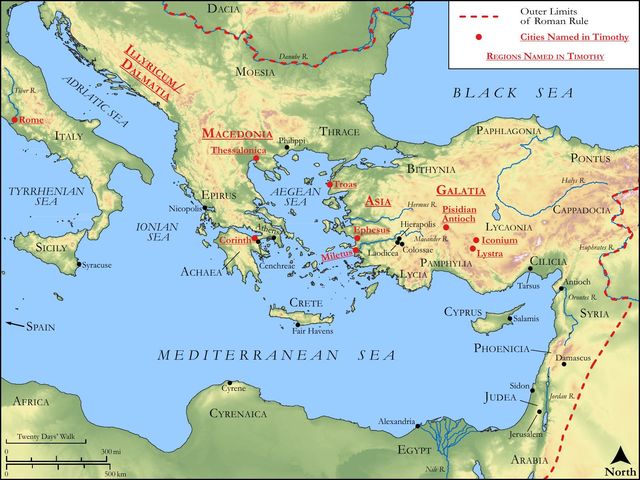
See on the biblical-era maps

Study this verse
Public-domain commentary
Matthew Henry
From his Commentary on the Whole Bible. Henry comments on passages, not single verses — this entry covers 1 Timothy 4:6–16. His four-level outline is real structure in the source text, so it is rendered as structure.
The apostle would have Timothy to instil into the minds of Christians such sentiments as might prevent their being seduced by the judaizing teachers. Observe, Those are good ministers of Jesus Christ who are diligent in their work; not that study to advance new notions, but that put the brethren in remembrance of those things which they have received and heard. Wherefore I will not be negligent to put you always in remembrance of these things, though you knew them, Pe2 1:12. And elsewhere, I stir up your pure minds by way of remembrance, Pe2 3:1. And, says the apostle Jude, I will therefore put you in remembrance, Jde 1:5. You see that the apostles and apostolical men reckoned it a main part of their work to put their hearers in remembrance; for we are apt to forget, and slow to learn and remember, the things of God. - Nourished up in the words of faith and good doctrine, whereunto thou hast attained. Observe, 1. Even ministers themselves have need to be growing and increasing in the knowledge of Christ and his doctrine: they must be nourished up in the words of faith. 2. The best way for ministers to grow in knowledge and faith is to put the brethren in remembrance; while we teach others, we teach ourselves. 3. Those whom ministers teach are brethren, and are to be treated like brethren; for ministers are not lords of God's heritage.
I.Godliness is here pressed upon him and others:
Refuse profane and old wives' sayings, Ti1 4:7, Ti1 4:8, The Jewish traditions, which some people fill their heads with, have nothing to do with them. But exercise thyself rather unto godliness; that is, mind practical religion. Those who would be godly must exercise themselves unto godliness; it requires a constant exercise. The reason is taken from the fain of godliness; bodily exercise profits little, or for a little time. Abstinence from meats and marriage, and the like, though they pass for acts of mortification and self-denial, yet profit little, they turn to little account. What will it avail us to mortify the body if we do not mortify sin? Observe,
1.There is a great deal to be got by godliness; it will be of use to us in the whole of our life, for it has the promise of the life that now is, and of that which is to come.
2.The gain of godliness lies much in the promise: and the promises made to godly people relate to the life that now is, but especially they relate to the life that is to come. Under the Old Testament the promises were mostly of temporal blessings, but under the New Testament of spiritual and eternal blessings. If godly people have but little of the good things of the life that now is, yet it shall be made up to them in the good things of the life that is to come.
3.There were profane and old wives' fables in the days of the apostles; and Timothy, though an excellent man, was not above such a word of advice, Refuse profane, etc.
4.It is not enough that we refuse profane and old wives' fables, but we must exercise ourselves to godliness; we must not only cease to do evil, but we must learn to do well (Isa 1:16, Isa 1:17), and we must make a practice of exercising ourselves to godliness. And,
5.Those who are truly godly shall not be losers at last, whatever becomes of those who content themselves with bodily exercise, for godliness has the promise, etc.
II.The encouragement which we have to proceed in the ways of godliness, and to exercise ourselves to it, notwithstanding the difficulties and discouragements that we meet with in it. He had said (Ti1 4:8) that it is profitable for all things, having the promise of the life which now is. But the question is, Will the profit balance the loss? For, if it will not, it is not profit. Yes, we are sure it will. Here is another of Paul's faithful sayings, worthy of all acceptation - that all our labours and losses in the service of God and the work of religion will be abundantly recompensed, so that though we lose for Christ we shall not lose by him. Therefore we labour and suffer reproach, because we trust in the living God, Ti1 4:10. Observe,
1.Godly people must labour and expect reproach; they must do well, and yet expect at the same time to suffer ill: toil and trouble are to be expected by us in this world, not only as men, but as saints.
2.Those who labour and suffer reproach in the service of God and the work of religion may depend upon the living God that they shall not lose by it. Let this encourage them, We trust in the living God. The consideration of this, that the God who has undertaken to be our pay-master is the living God, who does himself live for ever and is the fountain of life to all who serve him, should encourage us in all our services and in all our sufferings for him, especially considering that he is the Saviour of all men.
(1.)By his providences he protects the persons, and prolongs the lives, of the children of men.
(2.)He has a general good-will to the eternal salvation of all men thus far that he is not willing that any should perish, but that all should come to repentance. He desires not the death of sinners; he is thus far the Saviour of all men that none are left in the same desperate condition that fallen angels are in. Now, if he be thus the Saviour of all men, we may hence infer that much more he will be the rewarder of those who seek and serve him; if he has such a good-will for all his creatures, much more will he provide well for those who are new creatures, who are born again. He is the Saviour of all men, but especially of those that believe; and the salvation he has in store for those that believe is sufficient to recompense them for all their services and sufferings. Here we see,
[1.]The life of a Christian is a life of labour and suffering: We labour and suffer.
[2.]The best we can expect to suffer in the present life is reproach for our well-doing, for our work of faith and labour of love.
[3.]True Christians trust in the living God; for cursed is the man that trusts in man, or in any but the living God; and those that trust in him shall never be ashamed. Trust in him at all times.
[4.]God is the general Saviour of all men, as he has put them into a salvable state; but he is in a particular manner the Saviour of true believers; there is then a general and a special redemption.
III.He concludes the chapter with an exhortation to Timothy,
1.To command and teach these things that he had now been teaching him. "Command them to exercise themselves unto godliness, teach them the profit of it, and that if they serve God they serve one who will be sure to bear them out."
2.To conduct himself with that gravity and prudence which might gain him respect, notwithstanding his youth: "Let no man despise thy youth; that is, give no man an occasion to despise thy youth." Men's youth will not be despised if they do not by youthful vanities and follies make themselves despicable; and this men may do who are old, who may therefore thank themselves if they be despised.
3.To confirm his doctrine by a good example: Be thou an example of the believers, etc. Observe, Those who teach by their doctrine must teach by their live, else they pull down with one hand what they build up with the other: they must be examples both in word and conversation. Their discourse must be edifying, and this will be a good example: their conversation must be strict, and this will be a good example: they must be examples in charity, or love to God and all good men, examples in spirit, that is, in spiritual-mindedness, in spiritual worship, - in faith, that is, in the profession of Christian faith, - and in purity or chastity.
4.He charges him to study hard: Till I come, give attendance to reading, to exhortation, to doctrine, to meditation upon these things, Ti1 4:13. Though Timothy had extraordinary gifts, yet he must use ordinary means. Or it may be meant of the public reading of the scriptures; he must read and exhort, that is, read and expound, read and press what he read upon them; he must expound it both by way of exhortation and by way of doctrine; he must teach them both what to do and what to believe. Observe,
(1.)Ministers must teach and command the things that they are themselves taught and commanded to do; they must teach people to observe all things whatsoever Christ has commanded, Mat 28:20.
(2.)The best way for ministers to avoid being despised is to teach and practise the things that are given them in charge. No wonder if ministers are despised who do not teach these things, or who, instead of being examples of good to believers, act directly contrary to the doctrines they preach; for ministers are to be ensamples of their flock.
(3.)Those ministers that are the best accomplished for their work must yet mind their studies, that they may be improving in knowledge; and they must mind also their work; they are to give attendance to reading, to exhortation, to doctrine.
5.He charges him to beware of negligence: Neglect not the gift that is in thee, Ti1 4:14. The gifts of God will wither if they be neglected. It may be understood either of the office to which he was advanced, or of his qualifications for that office; if of the former, it was ordination in an ordinary way; if of the latter, it was extraordinary. It seems to be the former, for it was by laying on of hands, etc. Here see the scripture-way of ordination: it was by the laying on of hands, and the laying on of the hands of the presbytery. Observe, Timothy was ordained by men in office. It was an extraordinary gift that we read of elsewhere as being conferred on him by the laying on of Paul's hands, but he was invested in the office of the ministry by the laying on of the hands of the presbytery.
(1.)We may note, The office of the ministry is a gift, it is the gift of Christ; when he ascended on high, he received gifts for men, and he gave some apostles, and some pastors and teachers (Eph 4:8, Eph 4:11), and this was a very kind gift to his church.
(2.)Ministers ought not to neglect the gift bestowed upon them, whether by gift we are here to understand the office of the ministry or the qualifications for the office; neither the one nor the other must be neglected.
(3.)Though there was a prophecy in the case of Timothy (the gift was given by prophecy), yet this was accompanied by the laying on of the hands of the presbytery, that is, a number of presbyters; the office was conveyed to him this way; and I should think here is a sufficient warrant for ordination by presbyters, since it does not appear that Paul was concerned in Timothy's ordination. It is true, extraordinary gifts were conferred on him by the laying on of the apostle's hands (Ti2 1:6), but, if he was concerned in his ordination, the presbytery was not excluded, for that is particularly mentioned, whence it seems pretty evident that the presbytery have the inherent power of ordination.
6.Having this work committed to him, he must give himself wholly to it: "Be wholly in those things, that thy profiting may appear." He was a wise knowing man, and yet must still be profiting, and make it appear that he improved in knowledge. Observe,
(1.)Ministers are to be much in meditation. They are to consider beforehand how and what they must speak. They are to meditate on the great trust committed to them, on the worth and value of immortal souls, and on the account they must give at the last.
(2.)Ministers must be wholly in these things, they must mind these things as their principal work and business: Give thyself wholly to them.
(3.)By this means their profiting will appear in all things, as well a to all persons; this is the way for them to profit in knowledge and grace, and also to profit others.
7.He presses it upon him to be very cautious: "Take heed to thyself and to the doctrine, consider what thou preachest; continue in them, in the truths that thou hast received; and this will be the way to save thyself, and those that hear thee." Observe,
(1.)Ministers are engaged in saving work, which makes it a good work.
(2.)The care of ministers should be in the first place to save themselves: "Save thyself in the first place, so shalt thou be instrumental to save those that hear thee." (3.) Ministers in preaching should aim at the salvation of those that hear them, next to the salvation of their own souls. (4.) The best way to answer both these ends is to take heed to ourselves, etc.
Historical interpretation
Six Centuries of Reception
2 surviving comments on this verse. Each one is dated, so this reads as a timeline rather than a list.
Select a marker to jump to its quote. Markers stagger vertically where authors wrote within a few decades of each other.
In some cases it is necessary to command, in others to teach; if therefore you command in those cases where teaching is required, you will become ridiculous. Again, if you teach where you ought to command, you are exposed to the same reproach. For instance, it is not proper to teach a man not to be wicked, but to command; to forbid it with all authority. Not to profess Judaism, should be a command, but teaching is required, when you would lead men to part with their possessions, to profess virginity, or when you would discourse of faith. Therefore Paul mentions both: "Command and teach."
Command these things, and teach them. Let no one despise your youth, but be an example to the believers in word, in conduct, in love, in spirit, in faith, in purity.
Concerning those who err in knowledge, it is necessary to command them with authority; but concerning those who err in ignorance, to simply teach them. The one who encourages toward good, teaches; but the one who hinders evil, commands.
Let no one despise your youth. For the bishop must also speak more authoritatively. Therefore, "Let your forbearance be known to all men?" (Phil. 4:5) And we say that, when he himself is wronged, he ought to be gentle; but when the brothers are wronged by sinning, he ought to be strict.
Or thus. If you live a most modest life, youth, which is easily prone to contempt, will not be despised.
but be an example to the believers. Like a living image, and a standard of good living.
in word, he says, in speaking, what is necessary for a teacher. But see that the teacher must have preparation of speech.
in conduct. For example, in life and in the practice of living.
in love. Which is towards all.
in spirit. Either by spiritual rank or by the gift of the spirit, do not exalt yourself because of this.
in faith. The straight path by which one may unquestionably believe in God, even concerning the impossible.
in purity. That is, holiness, abstinence, and self-discipline.
Continue studying 1 Timothy 4:11 across the web’s major study libraries — every link below opens this exact verse, chapter, or book on the destination site.
Read & Compare
 BibleGatewayThis verse in more than 200 translations and 70 languages.
 Bible.comThe YouVersion reader — hundreds of translations, reading plans, and highlights.
 ESV.orgCrossway's official English Standard Version reader.
 NET BibleThe NET translation with 60,000+ translators' notes on every rendering decision.
 STEP BibleTyndale House's free study tool — original text, vocabulary, and scholarly resources.
 BibliaLogos Bible Software's free web reader.
 USCCBThe New American Bible (Revised Edition) with the U.S. bishops' study notes.
Commentaries
 BibleHub CommentariesDozens of classic commentaries on this verse, gathered on one page.
 StudyLightMore than 100 commentary sets — the largest collection on the web.
 BibleRefPlain-English commentary on what this verse means, verse by verse.
 Enduring WordDavid Guzik's free commentary on this chapter, widely used by Bible teachers.
 Bible Study ToolsVerse commentary alongside Greek and Hebrew study aids.
Original Language & Research
- BibleHub InterlinearThe verse word by word — original language, transliteration, and English.
- BibleHub LexiconEvery word's original-language definition and Strong's entry.
 Blue Letter BibleDeep-study tools — Strong's numbers, concordance, and word studies.
 CNTR CollationThe earliest Greek manuscripts of this verse, collated letter by letter.
Sermons, Hymns & Audio


TrulyRandomVerse is not affiliated with these sites and doesn’t control their content. They’re linked because they’re genuinely useful.
Summary
First Timothy 4:11 serves as a concise yet powerful mandate from the Apostle Paul to his protégé, Timothy, instructing him to authoritatively declare and thoroughly instruct the Ephesian church in the sound doctrines and godly practices previously outlined in the chapter. This verse underscores the critical responsibility of spiritual leadership to uphold truth and guide believers in faith and conduct, particularly in the face of encroaching false teachings.
Context
ShowHideLiterary Context
This verse concludes a significant section in Paul's first letter to Timothy, which began with warnings against false teachers and their deceptive doctrines in 1 Timothy 4:1-5. Paul then contrasts these errors with the pursuit of true godliness, emphasizing that "godliness is profitable unto all things, having promise of the life that now is, and of that which is to come" (1 Timothy 4:8). The immediate preceding verses, 1 Timothy 4:9-10, highlight the trustworthiness of the message concerning God as the Savior of all people, especially believers, and the labor involved in proclaiming this truth. Therefore, "these things" in 1 Timothy 4:11 directly refer to the sound doctrine, godly living, and unwavering commitment to the gospel that Paul has just expounded upon. Timothy is not merely to suggest but to firmly establish these truths within the church.
Historical & Cultural Context
Timothy was stationed in Ephesus, a prominent city in Asia Minor known for its diverse religious landscape, including the worship of Artemis and various philosophical schools. This environment was ripe for the emergence of syncretistic beliefs and Gnostic tendencies, which often led to ascetic practices and speculative myths, as described in 1 Timothy 1:4 and 1 Timothy 4:3. Paul's letters to Timothy (and Titus) are often called "Pastoral Epistles" because they provide guidance for church leadership in managing congregations, countering false teachings, and maintaining order and sound doctrine. The command to "command and teach" reflects the authoritative nature required of a leader in a challenging spiritual climate where the integrity of the gospel was under constant threat from internal and external pressures.
Key Themes
ShowHideFirst Timothy is replete with themes vital for church health and leadership. One prominent theme is the preservation of sound doctrine against heresy, which Paul addresses from the outset in 1 Timothy 1:3-7. This is intrinsically linked to the theme of godly living and spiritual discipline, as seen in Paul's exhortation to Timothy to "exercise thyself rather unto godliness" (1 Timothy 4:7). The letter also emphasizes pastoral authority and responsibility, empowering Timothy to lead effectively, set an example, and confront error, as highlighted in 1 Timothy 3:15 regarding the conduct in God's household. Finally, the universality of God's saving grace is a foundational truth that Timothy is to uphold, as underscored by the declaration that God is the "Saviour of all men, specially of those that believe" (1 Timothy 4:10).
Exposition and Analysis
ShowHideKey Word Analysis
ShowHideThis neuter plural demonstrative pronoun refers back to the preceding instructions and truths Paul has just laid out in 1 Timothy 4:6-10. It encompasses the sound doctrine concerning creation, the value of spiritual training, the trustworthiness of the gospel, and God's role as the Savior. The use of "these things" emphasizes that Timothy's mandate is not vague but specific, rooted in the foundational truths of the Christian faith.
Derived from pará (beside) and ággelos (messenger), this verb means "to transmit a message," or by implication, "to enjoin, charge, or command." It carries the weight of an authoritative order, a solemn charge, or even a military command. It implies that the truths Timothy is to convey are not optional suggestions but essential, non-negotiable doctrines and practices that must be proclaimed with conviction and enforced with pastoral authority.
This verb means "to teach" in a broad application, implying systematic instruction, explanation, and imparting of knowledge. While parangéllō emphasizes the authoritative declaration, didáskō focuses on the pedagogical aspect—the patient, thorough instruction that ensures understanding and application. Timothy's role involves not just issuing directives but also nurturing comprehension and growth through careful teaching.
Verse Breakdown
ShowHide"These things"
This phrase serves as the direct object of both verbs, specifying the content of Timothy's ministry. It points to the body of sound doctrine and practical godliness that Paul has just articulated, particularly the truths about the goodness of creation, the superiority of godliness over physical training, the trustworthiness of the Christian message, and God's universal redemptive purpose, culminating in salvation for believers. It highlights the concrete, actionable nature of Timothy's responsibilities.
"command"
This verb signifies the authoritative declaration of truth. Timothy is not merely to present options or share opinions, but to issue a solemn charge. This implies a certain level of pastoral authority and the expectation that the congregation will receive and adhere to these truths as divine mandates, not human suggestions. It speaks to the imperative nature of the gospel and its implications for life.
"and teach"
This second verb complements "command" by emphasizing the pedagogical aspect of ministry. It means to systematically instruct, explain, and impart knowledge. While commanding provides the divine imperative, teaching ensures understanding, conviction, and the ability for believers to live out "these things." It speaks to the necessity of patient, clear, and comprehensive instruction for spiritual formation and maturity.
Literary Devices
ShowHideThe verse employs a powerful use of Parallelism and Emphasis. The two verbs, "command" and "teach," are juxtaposed with the conjunction "and," creating a parallel structure that highlights the dual nature of Timothy's pastoral responsibility. This is not merely a repetition but a complementary pairing, where one verb (command) signifies authoritative declaration and the other (teach) denotes systematic instruction. This Juxtaposition underscores that effective spiritual leadership involves both firm proclamation of truth and patient, thorough explanation. The brevity and directness of the sentence also contribute to its Imperative Mood, conveying a sense of urgency and non-negotiable duty. Furthermore, the phrase "these things" acts as a Summary Device, encapsulating the entirety of Paul's preceding discourse and giving it a collective weight that Timothy is to faithfully transmit.
Theological and Thematic Connections
ShowHideThe mandate in 1 Timothy 4:11 is deeply rooted in the biblical understanding of divine revelation and the stewardship of truth. It underscores that the gospel is not a set of suggestions but a divine command, requiring both authoritative proclamation and diligent instruction. This dual responsibility reflects God's own character as both sovereign Lawgiver and patient Teacher, who reveals His will and then graciously illuminates it for His people. The verse emphasizes that the integrity of the church and the spiritual well-being of believers depend on leaders who faithfully uphold and transmit sound doctrine, guarding against the pervasive influence of error and fostering true godliness. It ties into the broader New Testament emphasis on the importance of faithful teaching for the building up of the body of Christ and for equipping believers for every good work.
Reflection and Application
ShowHideFor those in spiritual leadership, 1 Timothy 4:11 serves as a profound reminder of the solemn charge entrusted to them. It calls for a courageous and unwavering commitment to declaring God's truth with authority, even when it is unpopular or challenging to the prevailing culture. This isn't about personal opinion or preference, but about faithfully stewarding the revealed Word of God. Simultaneously, it demands a patient and diligent approach to teaching, ensuring that believers not only hear the truth but also understand its implications, internalize its principles, and are equipped to live it out. For all believers, this verse highlights the importance of submitting to sound biblical teaching and actively seeking to grow in understanding and application of "these things"—the core truths of our faith. It encourages us to discern carefully what we hear, aligning it with the unchanging Word of God, and to live lives that reflect the godliness we are taught.
Questions for Reflection
ShowHideFAQ
ShowHideWhat are "these things" that Timothy is commanded to teach?
ShowHide"These things" refers to the sound doctrines and principles Paul has just outlined in the preceding verses of 1 Timothy 4. Specifically, they include the goodness of God's creation (as opposed to ascetic denials), the value of spiritual discipline and godliness over mere physical training, the truth that God is the "Saviour of all men, specially of those that believe," and the absolute trustworthiness of this message (1 Timothy 4:4-10). Timothy is to uphold and transmit these foundational truths of the Christian faith.
What is the difference between "command" and "teach" in this context?
ShowHideThe two verbs, "command" (Greek: parangéllō) and "teach" (Greek: didáskō), represent distinct but complementary aspects of pastoral ministry. "Command" carries the weight of an authoritative directive or a solemn charge, implying that these truths are not optional but essential and must be proclaimed with conviction. "Teach," on the other hand, refers to the systematic instruction, explanation, and imparting of knowledge, ensuring that believers understand the meaning and application of these truths. Together, they emphasize that Timothy's role involves both the authoritative declaration of divine truth and the patient, thorough instruction of believers in its meaning and implications for their lives.
Christ-Centered Fulfillment
ShowHideWhile 1 Timothy 4:11 is a direct instruction to Timothy on pastoral leadership, its ultimate fulfillment and underlying authority rest entirely in Jesus Christ. The "these things" that Timothy is to command and teach are not arbitrary rules but divine truths revealed through Christ and centered on His person and work. Jesus Himself was the ultimate example of one who both commanded with authority and taught with profound insight. He declared the kingdom of God with unparalleled authority, saying, "You have heard that it was said... but I tell you" (Matthew 5:21-22), and He systematically taught His disciples the mysteries of the kingdom, preparing them to carry on His mission (Matthew 13:10-17). The trustworthy saying Paul refers to—that "Christ Jesus came into the world to save sinners" (1 Timothy 1:15)—is the very core of the message Timothy is to command and teach. Ultimately, all sound doctrine and godly living flow from Christ, who is "the way, the truth, and the life" (John 14:6), and the one in whom "are hid all the treasures of wisdom and knowledge" (Colossians 2:3). Thus, Timothy's mandate, and indeed all Christian ministry, is a participation in Christ's ongoing work of proclaiming and explaining the truth of salvation and discipleship to a lost world.