


1 Samuel 17:57
Bible text: King James Version (1769 Blayney text) · Public domain
Bible text: King James Version with Strong's numbers · Public domain
Bible text: Berean Standard Bible · Public domain
Bible text: American Standard Version (1901) · Public domain
Bible text: World English Bible, Messianic edition · Public domain
Bible text: Geneva Bible (1599) · Public domain
Bible text: Young's Literal Translation · Public domain
- וּכְשׁוּבu·khe·Shuvand just as returnedH7725Conj-w ¦ Prep-k ¦ V-Qal-InfVerb Qal Infinitive Constructוּandכְjust asשׁוּבreturned
- דָּוִדda·VidDavidH1732N-proper-mNoun Proper Masculine
- מֵהַכּוֹתme·ha·kOtfrom striking downH5221Prep-m ¦ V-Hiphil-InfVerb Hiphil Infinitive Constructמֵfromהַכּוֹתstriking down
- אֶת'et<obj.>H853DirObjMParticle Object Indicator
- הַפְּלִשְׁתִּיha·pe·lish·Tithe PhilistineH6430Art ¦ N-msNoun Gentilic Singular Masculine AbsoluteהַtheפְּלִשְׁתִּיPhilistine
- וַיִּקַּחvai·yi·Kachand he tookH3947Conj-w ¦ V-Qal-ConsecImperf-3msVerb Qal Consecutive Imperfect 3rd Singular Masculineוַandיִּקַּחhe took
- אֹתוֹ'o·To<obj.> himH853DirObjM ¦ 3msParticle Object Indicatorאֹת<obj.>וֹhim
- אַבְנֵר'av·NerAbnerH74N-proper-mNoun Proper Masculine
- וַיְבִאֵהוּvay·vi·'E·huand he brought himH935Conj-w ¦ V-Hiphil-ConsecImperf-3ms ¦ 3msVerb Hiphil Consecutive Imperfect 3rd Singular Masculineוַandיְבִאֵhe broughtהוּhim
- לִפְנֵיlif·Nei<to> beforeH6440Prep-l ¦ N-mpcNoun Plural Masculine Constructלִ<to>פְנֵיbefore
- שָׁאוּלsha·'UlSaulH7586N-proper-mNoun Proper Masculine
- וְרֹאשׁve·Roshand [the] head ofH7218Conj-w ¦ N-mscNoun Singular Masculine Constructוְandרֹאשׁ[the] head of
- הַפְּלִשְׁתִּיha·pe·lish·Tithe PhilistineH6430Art ¦ N-msNoun Gentilic Singular Masculine AbsoluteהַtheפְּלִשְׁתִּיPhilistine
- בְּיָדוֹbe·ya·Do[was] in his handH3027Prep-b ¦ N-csc ¦ 3msNoun Singular common gender Constructבְּ[was] inיָדhandוֹhis
English is a literal word-by-word gloss of the Hebrew, not the KJV's wording. Why?
This is the original text the KJV's translators worked from — each Hebrew word with its own literal English meaning in this verse, prepared by scholars at Tyndale House, Cambridge. The KJV translates whole sentences, not word by word, so its wording differs: one Hebrew word can become several English words, and the KJV may choose “the LORD” where the gloss reads “Yahweh”. Both are faithful — they answer different questions. For the KJV's own rendering, switch to the KJV text.
Details
See on the biblical-era map
Study this verse
Public-domain commentary
Matthew Henry
From his Commentary on the Whole Bible. Henry comments on passages, not single verses — this entry covers 1 Samuel 17:48–58.
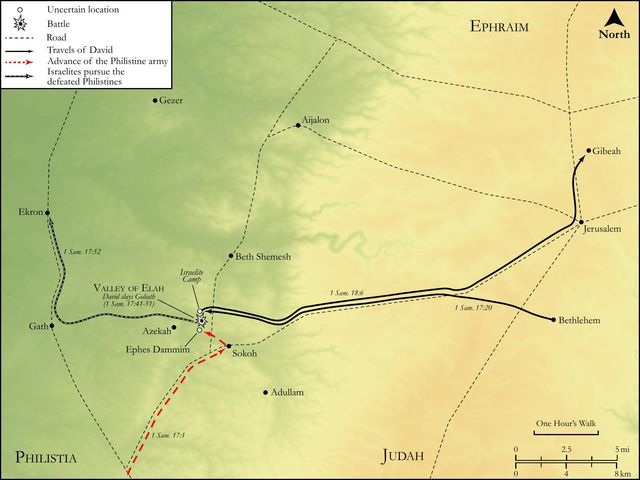
Here is 1. The engagement between the two champions, Sa1 17:48. To this engagement the Philistine advanced with a great deal of state and gravity; if he must encounter a pigmy, yet it shall be with the magnificence of a giant and a grandee. This is intimated in the manner of expression: He arose, and came, and drew nigh, like a stalking mountain, overlaid with brass and iron, to meet David. David advanced with no less activity and cheerfulness, as one that aimed more to do execution than to make a figure: He hasted, and ran, being lightly clad, to meet the Philistine. We may imagine with what tenderness and compassion the Israelites saw such a pleasing youth as this throwing himself into the mouth of destruction, but he knew whom he had believed and for whom he acted. 2. The fall of Goliath in this engagement. He was in no haste, because in no fear, but confident that he should soon at one stroke cleave his adversary's head; but, while he was preparing to do it solemnly, David did his business effectually, without any parade: he slang a stone which hit him in the forehead, and, in the twinkling of an eye, fetched him to the ground, Sa1 17:49. Goliath knew there were famous slingers in Israel (Jdg 20:16), yet was either so forgetful or presumptuous as to go with the beaver of his helmet open, and thither, to the only part left exposed, not so much David's art as God's providence directed the stone, and brought it with such force that it sunk into his head, notwithstanding the impudence with which his forehead was brazened. See how frail and uncertain life is, even when it thinks itself best fortified, and how quickly, how easily, and with how small a matter, the passage may be opened for life to go out and death to enter. Goliath himself has not power over the spirit to retain the spirit, Ecc 8:8. Let not the strong man glory in his strength, nor the armed man in his armour. See how God resists the proud and pours contempt upon those that bid defiance to him and his people. None ever hardened his heart against God and prospered. One of the Rabbin thinks that when Goliath said to David, Come, and I will give thy flesh to the fowls of the air, he threw up his head so hastily that his helmet fell off, and so left his broad forehead a fair mark for David. To complete the execution, David drew Goliath's own sword, a two-handed weapon for David, and with it cut off his head, Sa1 17:51. What need had David to take a sword of his own? his enemy's sword shall serve his purpose, when he has occasion for one. God is greatly glorified when his proud enemies are cut off with their own sword and he makes their own tongues to fall upon them, Psa 64:8. David's victory over Goliath was typical of the triumphs of the son of David over Satan and all the powers of darkness, whom he spoiled, and made a show of them openly (Col 2:15), and we through him are more than conquerors. 3. The defeat of the Philistines' army hereupon. They relied wholly upon the strength of their champion, and therefore, when they saw him slain, they did not, as Goliath had offered, throw down their arms and surrender themselves servants to Israel (Sa1 17:9), but took to their heels, being wholly dispirited, and thinking it to no purpose to oppose one before whom such a mighty man had fallen: They fled (Sa1 17:51), and this put life into the Israelites, who shouted and pursued them (David, it is probable, leading them on in the pursuit) even to the gates of their own cities, Sa1 17:52. In their return from the chase they seized all the baggage, plundered the tents (Sa1 17:53), and enriched themselves with the spoil. 4. David's disposal of his trophies, Sa1 17:54. He brought the head of the Philistine to Jerusalem, to be a terror to the Jebusites, who held the strong-hold of Sion: it is probable that he carried it in triumph to other cities. His armour he laid up in his tent; only the sword was preserved behind the ephod in the tabernacle, as consecrated to God, and a memorial of the victory to his honour, Sa1 21:9. 5. The notice that was taken of David. Though he had been at court formerly, yet, having been for some time absent (Sa1 17:15), Saul had forgotten him, being melancholy and mindless, and little thinking that his musician would have spirit enough to be his champion; and therefore, as if he had never seen him before, he asked whose son he was. Abner was a stranger to him, but brought him to Saul (Sa1 17:57), and he gave a modest account of himself, Sa1 17:58. And now he was introduced to the court with much greater advantages than before, in which he owned God's hand performing all things for him.
Continue studying 1 Samuel 17:57 across the web’s major study libraries — every link below opens this exact verse, chapter, or book on the destination site.
Read & Compare
 BibleGatewayThis verse in more than 200 translations and 70 languages.
 Bible.comThe YouVersion reader — hundreds of translations, reading plans, and highlights.
 ESV.orgCrossway's official English Standard Version reader.
 NET BibleThe NET translation with 60,000+ translators' notes on every rendering decision.
 STEP BibleTyndale House's free study tool — original text, vocabulary, and scholarly resources.
 BibliaLogos Bible Software's free web reader.
 USCCBThe New American Bible (Revised Edition) with the U.S. bishops' study notes.
Commentaries
 BibleHub CommentariesDozens of classic commentaries on this verse, gathered on one page.
 StudyLightMore than 100 commentary sets — the largest collection on the web.
 BibleRefPlain-English commentary on what this verse means, verse by verse.
 Enduring WordDavid Guzik's free commentary on this chapter, widely used by Bible teachers.
 Bible Study ToolsVerse commentary alongside Greek and Hebrew study aids.
Original Language & Research
- BibleHub InterlinearThe verse word by word — original language, transliteration, and English.
- BibleHub LexiconEvery word's original-language definition and Strong's entry.
 Blue Letter BibleDeep-study tools — Strong's numbers, concordance, and word studies.
 SefariaThe Hebrew text with Rashi and centuries of Jewish commentary.
Sermons, Hymns & Audio


TrulyRandomVerse is not affiliated with these sites and doesn’t control their content. They’re linked because they’re genuinely useful.
Summary
1 Samuel 17:57 vividly portrays the dramatic aftermath of David's victory over Goliath, detailing his formal presentation to King Saul by Abner, with the severed head of the Philistine giant serving as irrefutable proof of his extraordinary triumph. This pivotal moment not only confirms God's decisive deliverance but also marks David's abrupt transition from pastoral obscurity to national recognition, setting the stage for his indispensable, albeit complex, role in Israel's unfolding history.
Context
ShowHideLiterary Context
This verse serves as the immediate culmination of David's miraculous defeat of Goliath in the Valley of Elah, following a narrative that meticulously chronicles Goliath's forty-day challenge to Israel and the paralyzing fear that gripped Saul and his army. The preceding account details David's arrival at the camp, his zealous faith in the Lord of Hosts, and his bold declaration that the battle belongs to the Lord (1 Samuel 17:45-47). David's swift, divinely-empowered victory is fresh in the reader's mind, making his presentation to Saul a natural and necessary next step. Saul's earlier inquiry about David's lineage (1 Samuel 17:55-56) underscores the king's astonishment and his desire to understand the background of this unexpected champion. Abner, Saul's commander, is tasked with bringing David directly to the king, emphasizing the immediate and profound impact of David's feat on the entire Israelite camp and royal court. The verse thus acts as the formal bridge between David's heroic act and his integration into Saul's household, initiating the complex and often tumultuous relationship that will define much of the subsequent narrative in 1 Samuel.
Historical & Cultural Context
Among the nations, the display of a defeated enemy's head or other body parts was a common, albeit gruesome, practice. Such actions served as irrefutable proof of victory, a potent deterrent to future adversaries, and a stark symbol of the victor's power and the vanquished's utter humiliation. The "slaughter of the Philistine" refers to the decisive killing of Goliath, a champion who had challenged Israel to single combat, a practice sometimes employed to minimize casualties in larger conflicts. The presentation of David to Saul by Abner, the commander of the army, highlights the formality and immense significance of the event. Kings in this era were expected to reward great valor, and bringing the hero directly before the monarch was a standard protocol for acknowledging extraordinary service and integrating them into the royal retinue. David, a humble shepherd boy, would have been an anomaly in the royal court; his immediate summons underscores the gravity of the threat Goliath posed and the magnitude of David's deliverance. This public display would have solidified David's reputation among the Israelite populace and within the military hierarchy.
Key Themes
ShowHideThis verse powerfully contributes to several key themes within 1 Samuel and the broader biblical narrative. Firstly, it underscores the theme of Divine Sovereignty and Deliverance, demonstrating that God works through unexpected means and individuals to accomplish His purposes, as evidenced by David's victory despite his youth and lack of traditional military training (1 Samuel 17:37). Secondly, it highlights the theme of Humble Beginnings and Divine Elevation, as David, a seemingly insignificant shepherd from Bethlehem, is thrust into the national spotlight and the king's presence, foreshadowing his eventual anointing and reign as king over Israel. Thirdly, the verse starkly contrasts Faith vs. Fear, showcasing David's unwavering trust in God against the backdrop of Israel's widespread terror and Saul's inability to act decisively. Finally, it introduces the theme of Recognition and Integration, marking David's formal entry into the royal court, which will lead to both favor and eventual bitter conflict with Saul, shaping the future of the Israelite monarchy and the lineage of the promised Messiah.
Exposition and Analysis
ShowHideKey Word Analysis
ShowHideThis word (שׁוּב, H7725) signifies not merely coming back, but often implies a turning or a reversal. In this context, David is returning from the battlefield, but the term also subtly hints at the turning point this event represents for David's life and for Israel's fortunes. It marks the conclusion of the immediate conflict and the beginning of a new phase.
The verb (לָקַח, H3947) "took" implies a deliberate action of seizing or acquiring. Abner did not merely accompany David; he "took" him, suggesting a formal and purposeful escort. This highlights Abner's authoritative role in bringing David before Saul, emphasizing the official nature of the summons and David's immediate integration into the royal sphere.
The Hebrew word (רֹאשׁ, H7218) for "head" is profoundly significant. In ancient warfare, the head was the ultimate trophy of victory, symbolizing the complete subjugation and humiliation of the enemy. In this instance, it serves as undeniable, tangible proof of Goliath's death, validating David's extraordinary claim and God's powerful intervention. Its presentation before Saul is a public declaration of God's victory through David and a testament to the giant's utter defeat.
Verse Breakdown
ShowHide"And as David returned from the slaughter of the Philistine"
This clause establishes the immediate aftermath of the battle, with David coming directly from the field where he decisively defeated Goliath. The phrase "slaughter of the Philistine" emphasizes the completeness and finality of Goliath's demise, not just a wound but a death blow, underscoring the magnitude of David's achievement.
"Abner took him, and brought him before Saul"
This signifies the formal and official nature of David's presentation to the king. Abner, as the commander of Saul's army, acts on the king's behalf, ensuring David's direct audience with the monarch. This act marks David's transition from an anonymous shepherd to a figure of national importance, now formally introduced into the highest echelons of Israelite society and the royal court.
"with the head of the Philistine in his hand"
This graphic detail provides the irrefutable evidence of David's victory. The severed head of Goliath serves as a tangible, grisly trophy, confirming the death of the giant and the magnitude of David's achievement. It is a powerful visual testimony to the deliverance God wrought through David, leaving no doubt about the outcome of the single combat and solidifying David's status as Israel's champion.
Literary Devices
ShowHide1 Samuel 17:57 employs several potent literary devices to convey its profound meaning. Symbolism is prominent, with Goliath's severed head serving as a powerful symbol of God's decisive victory over the seemingly insurmountable enemy, and by extension, over all who defy the living God. It also symbolizes David's triumph and the transfer of power and authority from the defeated giant to the divinely appointed champion. Irony is evident in the stark contrast between the humble, youthful shepherd boy and the formidable giant he has defeated; the one thought least capable is the one whom God uses to deliver His people. This highlights God's choice of the weak to shame the strong. The verse also functions as a moment of Foreshadowing, as David's dramatic introduction to Saul's court sets the stage for his future rise to kingship, a destiny hinted at but not yet fully revealed. The immediate and public nature of David's presentation creates a sense of Dramatic Irony, as the reader knows David's anointing by Samuel (1 Samuel 16:13), while Saul remains ignorant of the divine hand on this young man who has just saved his kingdom.
Theological and Thematic Connections
ShowHide1 Samuel 17:57 is a profound theological statement on God's power to deliver His people through unexpected means and His sovereign choice of instruments. David's presentation with Goliath's head is not merely a display of human prowess but a public testament to the Lord's faithfulness and ability to grant victory against overwhelming odds. It underscores the principle that "the battle is the Lord's" (1 Samuel 17:47), and that true strength lies not in human might or weaponry, but in unwavering faith in God. This event marks a divine turning point, shifting the focus from Saul's failed leadership to God's chosen deliverer, David, thus paving the way for the establishment of a new, God-honoring monarchy.
Reflection and Application
ShowHideThe scene in 1 Samuel 17:57 offers powerful insights for contemporary believers, reminding us that when God works, His victory is often undeniable and publicly evident, serving as a powerful testimony to His power and faithfulness. Just as David's courage, rooted in his unwavering faith in God's ability to deliver, led to a dramatic and visible outcome, our faithfulness in confronting the "giants" in our own lives—whether they are personal struggles, spiritual battles, or societal injustices—can lead to remarkable breakthroughs and undeniable displays of God's grace. This verse also illustrates God's pattern of elevating the humble and unseen for His purposes, bringing their hidden gifts and godly character to light in His perfect timing. Our faithfulness in the small, often unseen tasks of life can prepare us for greater responsibilities and public acknowledgment, not for our glory, but for His. We are called to be courageous in faith, knowing that God can use anyone, regardless of their background or apparent qualifications, to accomplish His mighty works, and that our "trophies" of victory are ultimately testimonies to His power, not our own.
Questions for Reflection
ShowHideFAQ
ShowHideWhy did Abner bring David before Saul, and why was Saul still asking about David after the battle?
ShowHideAbner, as the commander of Saul's army, brought David before Saul as a formal presentation of the hero who had just saved Israel. This was standard protocol for acknowledging extraordinary valor and ensuring the king was fully apprised of such a significant event. Saul's continued inquiry about David's lineage, even after the battle, might seem puzzling given his earlier questions in 1 Samuel 17:55-56. However, it's plausible that Saul's initial inquiry was made in the chaos and urgency just before the battle, perhaps a quick question to his general without fully processing the answer or the identity of the volunteer. The KJV's "while David went to meet the Philistine" in 1 Samuel 17:55 suggests a hurried context. After the decisive victory, with David now a national hero, Saul's questions become more insistent and detailed, seeking to fully understand the background of this remarkable young man who had achieved what no one else dared. He likely wanted to know who David's father was so he could fulfill the promise of wealth and tax exemption made to the family of Goliath's vanquisher (1 Samuel 17:25). This deeper inquiry reflects Saul's astonishment and the gravity of David's accomplishment.
Christ-Centered Fulfillment
ShowHide1 Samuel 17:57, with David presenting the severed head of Goliath, powerfully foreshadows the ultimate victory of Jesus Christ over the forces of sin, death, and the devil. Just as David, the humble shepherd, triumphed over the seemingly invincible giant, so too did Christ, in His humility, conquer the spiritual "giant" that held humanity captive. The head of Goliath, a symbol of the enemy's power and defiance, in David's hand, anticipates Christ's decisive triumph over the "head" of the serpent, Satan, as prophesied in Genesis 3:15. On the cross, Jesus disarmed the principalities and powers, making a public spectacle of them, triumphing over them in it (Colossians 2:15). His resurrection, the ultimate proof of His victory, is His "head in hand" moment, presented before the Father and all creation, demonstrating His conquest over death and Hades, whose keys He now holds (Revelation 1:18). David's formal introduction to Saul's court prefigures Christ's exaltation and enthronement as King of kings and Lord of lords, having secured eternal deliverance for His people (Philippians 2:9-11). Thus, David's victory is a vibrant type of the greater, eternal victory achieved by the true Lamb of God, who takes away the sin of the world (John 1:29).