


1 Samuel 15:5
Bible text: King James Version (1769 Blayney text) · Public domain
Bible text: Berean Standard Bible · Public domain
Bible text: American Standard Version (1901) · Public domain
Bible text: World English Bible, Messianic edition · Public domain
Bible text: Geneva Bible (1599) · Public domain
Bible text: Young's Literal Translation · Public domain
- וַיָּבֹאvai·ya·Vo'and he cameH935Conj-w ¦ V-Qal-ConsecImperf-3msVerb Qal Consecutive Imperfect 3rd Singular Masculineוַandיָּבֹאhe came
- שָׁאוּלsha·'UlSaulH7586N-proper-mNoun Proper Masculine
- עַד'adtoH5704PrepPreposition
- עִיר'ir[the] city ofH5892N-fscNoun Singular Feminine Construct
- עֲמָלֵק'a·ma·LekAmalekH6002N-properNoun Proper Location
- וַיָּרֶבvai·Ya·revand he lay in waitH693Conj-w ¦ V-Hiphil-ConsecImperf-3msVerb Hiphil Consecutive Imperfect 3rd Singular Masculineוַandיָּרֶבhe lay in wait
- בַּנָּחַלba·Na·chalin the wadiH5158Prep-b ¦ N-msNoun Singular Masculine Absoluteבַּin theנָּחַלwadi
English is a literal word-by-word gloss of the Hebrew, not the KJV's wording. Why?
This is the original text the KJV's translators worked from — each Hebrew word with its own literal English meaning in this verse, prepared by scholars at Tyndale House, Cambridge. The KJV translates whole sentences, not word by word, so its wording differs: one Hebrew word can become several English words, and the KJV may choose “the LORD” where the gloss reads “Yahweh”. Both are faithful — they answer different questions. For the KJV's own rendering, switch to the KJV text.
Details
See on the biblical-era maps
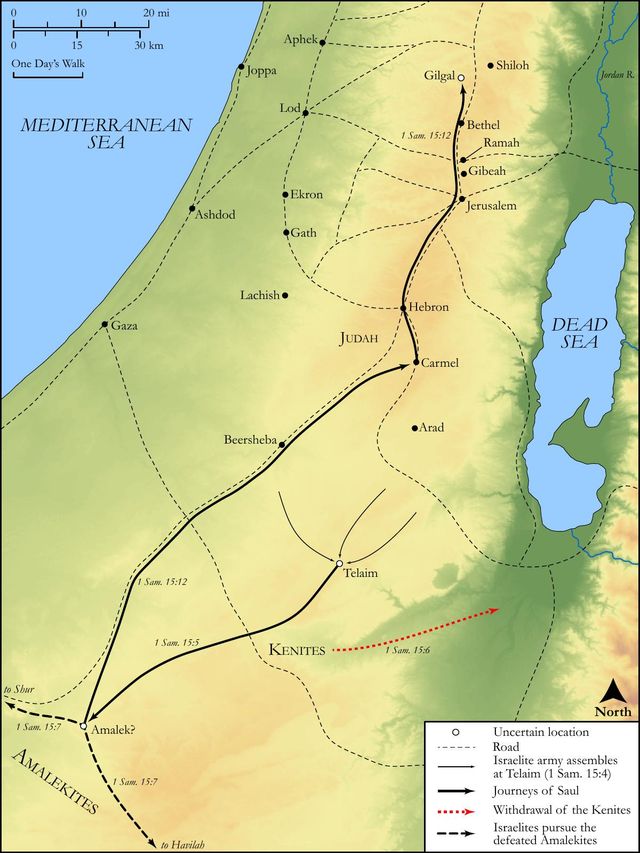
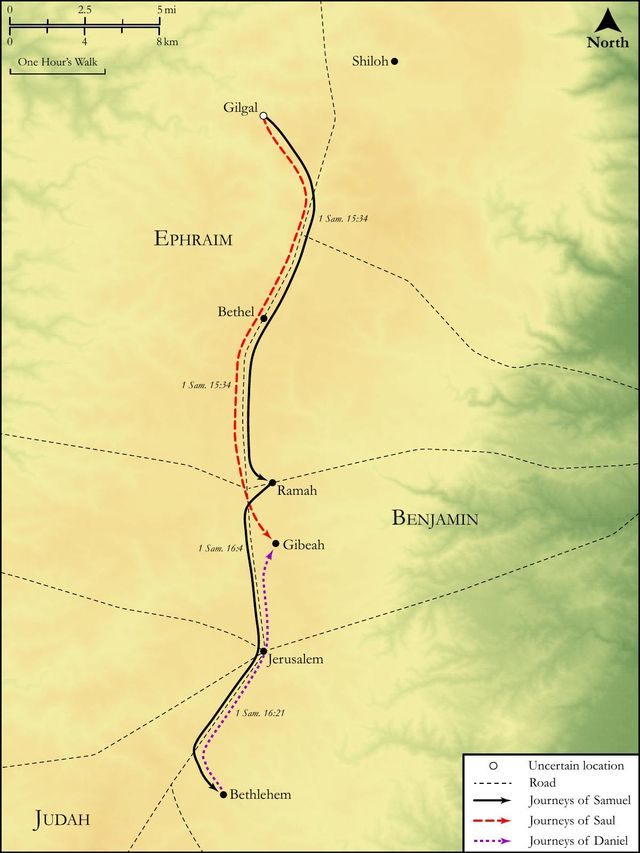
Study this verse
Public-domain commentary
Matthew Henry
From his Commentary on the Whole Bible. Henry comments on passages, not single verses — this entry covers 1 Samuel 15:1–9. His two-level outline is real structure in the source text, so it is rendered as structure.
Here, I. Samuel, in God's name, solemnly requires Saul to be obedient to the command of God, and plainly intimates that he was now about to put him upon a trial, in one particular instance, whether he would be obedient or no, Sa1 15:1. And the making of this so expressly the trial of his obedience did very much aggravate his disobedience. 1. He reminds him of what God had done for him: "The Lord sent me to anoint thee to be a king. God gave thee thy power, and therefore he expects thou shouldst use thy power for him. He put honour upon thee, and now thou must study how to do him honour. He made thee king over Israel, and now thou must plead Israel's cause and avenge their quarrels. Thou art advanced to command Israel, but know that thou art a subject to the God of Israel and must be commanded by him." Men's preferment, instead of releasing them from their obedience to God, obliges them so much the more to it. Samuel had himself been employed to anoint Saul, and therefore was the fitter to be send with these orders to him. 2. He tells him, in general, that, in consideration of this, whatever God commanded him to do he was bound to do it: Now therefore hearken to the voice of the Lord. Note, God's favours to us lay strong obligations upon us to be obedient to him. This we must render, Psa 116:12.
II.He appoints him a particular piece of service, in which he must now show his obedience to God more than in any thing he had done yet.
Samuel premises God's authority to the command: Thus says the Lord of hosts, the Lord of all hosts, of Israel's hosts. He also gives him a reason for the command, that the severity he must use might not seem hard: I remember that which Amalek did to Israel, Sa1 15:2. God had an ancient quarrel with the Amalekites, for the injuries they did to his people Israel when he brought them out of Egypt. We have the story, Exo 17:8, etc., and the crime is aggravated, Deu 25:18. He basely smote the hindmost of them, and feared not God. God then swore that he would have war with Amalek from generation to generation, and that in process of time he would utterly put out the remembrance of Amalek; this is the work that Saul is now appointed to do (Sa1 15:3): "Go and smite Amalek. Israel is now strong, and the measure of the iniquity of Amalek is now full; now go and make a full riddance of that devoted nation." He is expressly commanded to kill and slay all before him, man and woman, infant and suckling, and not spare them out of pity; also ox and sheep, camel and ass, and not spare them out of covetousness. Note,
1.Injuries done to God's Israel will certainly be reckoned for sooner or later, especially the opposition given them when they are coming out of Egypt.
2.God often bears long with those that are marked for ruin. The sentence passed is not executed speedily.
3.Though he bear long, he will not bear always. The year of recompence for the controversy of Israel will come at last. Though divine justice strikes slowly it strikes surely.
4.The longer judgment is delayed many times the more severe it is when it comes.
5.God chooses out instruments to do his work that are fittest for it. This was bloody work, and therefore Saul who was a rough and severe man must do it.
III.Saul hereupon musters his forces, and makes a descent upon the country of Amalek.
It was an immense army that he brought into the field (Sa1 15:4): 200,000 footmen. When he came to engage the Philistines, and the success was hazardous, he had but 600 attending him, Sa1 13:15. But now that he was to attack the Amalekites by express order from heaven, in which he was sure of victory, he had thousands at his call. But, whatever it was at other times, it was not now for the honour of Judah that their forces were numbered by themselves, for their quota was scandalously short (whatever was the reason), but a twentieth part of the whole, for they were by 10,000, when the other ten tribes (for I except Levi) brought into the field 200,000. The day of Judah's honour drew near, but had not yet come. Saul numbered them in Telaim, which signifies lambs. He numbered then like lambs (so the vulgar Latin), numbered them by the paschal lambs (so the Chaldee), allowing ten to a lamb, a way of numbering used by the Jews in the later times of their nation. Saul drew all his forces to the city of Amalek, that city that was their metropolis (Sa1 15:5), that he might provoke them to give him battle.
IV.He gave friendly advice to the Kenites to separate themselves from the Amalekites among whom they dwelt, while this execution was in doing, Sa1 15:6. Herein he did prudently and piously, and, it is probable, according to the direction Samuel gave him. The Kenites were of the family and kindred of Jethro, Moses's father-in-law, a people that dwelt in tents, which made it easy for them, upon every occasion, to remove to other lands not appropriated. Many of them, at this time, dwelt among the Amalekites, where, though they dwelt in tents, they were fortified by nature, for they put their nest in a rock, being hardy people that could live any where, and affected fastnesses, Num 24:21. Balaam had foretold that they should be wasted, Num 24:22. However, Saul must not waste them. But,
1.He acknowledges the kindness of their ancestors to Israel, when they came out of Egypt. Jethro and his family had been very helpful and serviceable to them in their passage through the wilderness, had been to them instead of eyes, and this is remembered to their posterity many ages after. Thus a good man leaves the divine blessing for an inheritance to his children's children; those that come after us may be reaping the benefit of our good works when we are in our graves. God is not unrighteous to forget the kindnesses shown to his people; but they shall be remembered another day, at furthest in the great day, and recompensed in the resurrection of the just. I was hungry, and you gave me meat. God's remembering the kindness of the Kenites' ancestors in favour to them, at the same time when he was punishing the injuries done by the ancestors of the Amalekites, helped to clear the righteousness of God in that dispensation. If he entail favours, why may he not entail frowns? He espouses his people's cause, so as to bless those that bless them; and therefore so as to curse those that curse them, Num 24:9; Gen 12:3. They cannot themselves requite the kindnesses nor avenge the injuries done them, but God will do both.
2.He desires them to remove their tents from among the Amalekites: Go, depart, get you down from among them. When destroying judgments are abroad God will take care to separate between the precious and the vile, and to hide the meek of the earth in the day of his anger. It is dangerous being found in the company of God's enemies, and it is our duty and interest to come out from among them, lest we share in their sins and plagues, Rev 18:4. The Jews have a saying, Woe to the wicked man and woe to his neighbour.
V.Saul prevailed against the Amalekites, for it was rather an execution of condemned malefactors than a war with contending enemies.
The issue could not be dubious when the cause was just and the call so clear: He smote them (Sa1 15:7), utterly destroyed them, Sa1 15:8. Now they paid dearly for the sin of their ancestors. God sometimes lays up iniquity for the children. They were idolaters, and were guilty of many other sins, for which they deserved to fall under the wrath of God; yet, when God would reckon with them, he fastened upon the sin of their ancestors in abusing his Israel as the ground of his quarrel. Lord, How unsearchable are thy judgments, yet how incontestable is thy righteousness!
VI.Yet he did his work by halves, Sa1 15:9.
1.He spared Agag, because he was a king like himself, and perhaps in hope to get a great ransom for him.
2.He spared the best of the cattle, and destroyed only the refuse, that was good for little. Many of the people, we may suppose, made their escape, and took their effects with them into other countries, and therefore we read of Amalekites after this; but that could not be helped. It was Saul's fault that he did not destroy such as came to his hands and were in his power. That which was now destroyed was in effect sacrificed to the justice of God, as the God to whom vengeance belongeth; and for Saul to think the torn and the sick, the lame and the lean, good enough for that, while he reserved for his own fields and his own table the firstlings and the fat, was really to honour himself more than God.
Historical interpretation
Historical reception
1 surviving comment on this verse from the historical church.
And when Saul had come to the city of Amalek, etc. The city of Amalek represents the densely packed array of temptations against the faithful, which now rages at us, stirred up either by demons, humans, or by our own desires. Certainly, near this city of tempting vices is a flooding torrent, that is, the turbulent drive of fluctuating thoughts, which, descending from the mountains of demonic pride, crashes against the walls of depravity more severely the more the winter of persecution exacerbates the favorable year of the Lord. Yet in this torrent we lay ambushes against Amalek when we strive to anticipate and overcome the enemy with the hidden virtues of the soul and the acts of devotion known only to the judge of our heart. For we almost meet him in open combat whenever we call upon the help of our Creator against him with alms, prayers, fasting, and other similar types of spiritual armor. But with faith, hope, and love, and similar apostolic arms, known fully only to Him who bestowed them upon us, we strive against humans and the evil spirits who lay in wait for us with care and diligence. When, I say, we are arrayed in these invisible weapons against the spiritual wickedness in high places, or amidst the very storms of temptations, we are almost laying ambushes in the torrent against Amalek; for we strike down the openly raging adversary where he cannot see it.
Continue studying 1 Samuel 15:5 across the web’s major study libraries — every link below opens this exact verse, chapter, or book on the destination site.
Read & Compare
 BibleGatewayThis verse in more than 200 translations and 70 languages.
 Bible.comThe YouVersion reader — hundreds of translations, reading plans, and highlights.
 ESV.orgCrossway's official English Standard Version reader.
 NET BibleThe NET translation with 60,000+ translators' notes on every rendering decision.
 STEP BibleTyndale House's free study tool — original text, vocabulary, and scholarly resources.
 BibliaLogos Bible Software's free web reader.
 USCCBThe New American Bible (Revised Edition) with the U.S. bishops' study notes.
Commentaries
 BibleHub CommentariesDozens of classic commentaries on this verse, gathered on one page.
 StudyLightMore than 100 commentary sets — the largest collection on the web.
 BibleRefPlain-English commentary on what this verse means, verse by verse.
 Enduring WordDavid Guzik's free commentary on this chapter, widely used by Bible teachers.
 Bible Study ToolsVerse commentary alongside Greek and Hebrew study aids.
Original Language & Research
- BibleHub InterlinearThe verse word by word — original language, transliteration, and English.
- BibleHub LexiconEvery word's original-language definition and Strong's entry.
 Blue Letter BibleDeep-study tools — Strong's numbers, concordance, and word studies.
 SefariaThe Hebrew text with Rashi and centuries of Jewish commentary.
Sermons, Hymns & Audio


TrulyRandomVerse is not affiliated with these sites and doesn’t control their content. They’re linked because they’re genuinely useful.
Summary
1 Samuel 15:5 chronicles King Saul's initial, seemingly obedient, and strategically astute movement into Amalekite territory. This verse depicts Saul leading his army to a specific city of Amalek and positioning them to "lay wait in the valley," marking the decisive commencement of his campaign to execute God's explicit command for the utter destruction of this long-standing enemy of Israel. It sets the immediate stage for a crucial test of his kingship and his commitment to divine authority, foreshadowing the profound implications of his subsequent actions.
Context
ShowHideLiterary Context
This verse is strategically placed at the very outset of the execution of God's severe and absolute command to Saul concerning the Amalekites, as delivered through the prophet Samuel in 1 Samuel 15:1-3. The divine directive was unequivocal: to utterly destroy every living thing—man, woman, child, infant, ox, sheep, camel, and donkey. Saul's immediate action in this verse, mobilizing his army (as detailed in 1 Samuel 15:4) and advancing into Amalekite territory, initially demonstrates a commendable level of compliance. However, this initial display of obedience will soon be starkly contrasted by his subsequent partial obedience and outright disobedience, which are meticulously detailed in 1 Samuel 15:7-9 and ultimately lead to God's definitive rejection of him as king in 1 Samuel 15:10-23. Therefore, 1 Samuel 15:5 serves as the critical starting point for Saul's tragic and pivotal failure as Israel's first monarch.
Historical & Cultural Context
The Amalekites were a persistent, nomadic, and deeply entrenched enemy of Israel, whose animosity dated back to the Exodus. Their initial treachery involved attacking the vulnerable and weary Israelites from the rear during their wilderness journey (Exodus 17:8-16). This unprovoked and cowardly act earned them a perpetual divine curse, with God swearing to blot out their remembrance (Deuteronomy 25:17-19). For Saul, Israel's newly anointed king, this campaign was far more than a mere military engagement; it was a profound and ultimate test of his obedience to Yahweh, who remained the true Sovereign of Israel. The "city of Amalek" likely refers to a significant settlement or stronghold, indicating a direct confrontation with their power base. The strategic choice to "lay wait in the valley" suggests a calculated military maneuver, possibly an ambush or a tactic to secure a decisive advantage over the enemy.
Key Themes
ShowHideThis concise verse, despite its brevity, introduces several profound themes that are meticulously developed throughout the remainder of 1 Samuel 15. Firstly, it immediately brings to the forefront the theme of Obedience, particularly distinguishing between superficial action and complete, wholehearted submission to divine command. Saul's initial military movement appears outwardly obedient, yet the unfolding narrative will tragically expose his fatal flaw of partial obedience. Secondly, the verse underscores the theme of Divine Judgment and Justice, as God, through Saul, initiates the long-decreed judgment against a nation characterized by persistent wickedness and unwavering opposition to His covenant people. This powerfully demonstrates God's absolute sovereignty over nations and His unwavering commitment to justice. Thirdly, it subtly touches upon the Nature of Kingship in Israel, emphasizing that the human king is not an autonomous ruler but is fundamentally intended to be God's faithful agent, governing strictly under divine authority. Saul's failure here will significantly redefine the expectations for Israel's future monarchy. Finally, the strategic act of "laying wait" subtly introduces the theme of Human Strategy vs. Divine Command, foreshadowing Saul's eventual reliance on his own fallible judgment and military cunning over God's explicit and non-negotiable instructions.
Exposition and Analysis
ShowHideKey Word Analysis
ShowHideThis verb (H935), while seemingly simple, signifies a purposeful and directed movement. In this context, it emphasizes Saul's intentional advance into the heart of Amalekite territory, indicating a direct and deliberate engagement with the divine command. It is not a casual journey but a decisive military march, underscoring his initial commitment to the mission.
Derived from the primitive root (H693) meaning "to lurk" or "to set an ambush," this term denotes a calculated and strategic military maneuver. It suggests Saul was not planning a direct, frontal assault but a surprise attack or a tactical positioning to encircle or trap the Amalekites. This reveals Saul's military acumen and his reliance on conventional warfare strategies.
This term (H5158) refers to a "stream" or "winter torrent," and by implication, a "narrow valley" through which such a brook runs. In ancient warfare, such a topographical feature was often a place of strategic importance, offering concealment, natural defenses, or pathways for flanking maneuvers. Saul's choice to "lay wait in the valley" indicates a deliberate selection of terrain for tactical advantage, highlighting his practical military leadership.
Verse Breakdown
ShowHide"And Saul came to a city of Amalek"
This initial clause describes Saul's immediate and physical act of obedience to God's command. He has successfully mobilized his army and advanced deep into the enemy's territory, specifically targeting a significant Amalekite settlement. This demonstrates a direct and prompt response to Samuel's divine directive, indicating that Saul has taken the first necessary and crucial step towards fulfilling God's will.
"and laid wait in the valley"
This second clause reveals Saul's tactical approach to the impending battle. Rather than immediately engaging in a direct confrontation, he strategically positions his forces in a concealed or topographically advantageous location within a valley. This action showcases his military prudence and his clear intention to execute the divine command through a well-planned ambush or strategic encirclement, aiming for maximum effectiveness against the Amalekites.
Literary Devices
ShowHideThe verse subtly employs several literary devices that enrich its meaning and foreshadow future developments. Foreshadowing is notably present in Saul's decision to "lay wait." While a perfectly sound military tactic in itself, it subtly hints at Saul's underlying reliance on human strategy and his own judgment, a characteristic that will later prove to be his fatal flaw when he selectively obeys God's explicit command. This tactical cunning, initially presented as a strength, thus becomes a precursor to his spiritual compromise and ultimate downfall. There is also a strong element of Setting at play, as the specific mentions of "a city of Amalek" and "the valley" meticulously establish the physical arena for the unfolding drama of obedience and disobedience. The choice of a valley for an ambush further adds a layer of Irony when contrasted with the absolute and non-negotiable nature of God's command; Saul's meticulous strategic planning, a hallmark of his human wisdom, will ultimately be overshadowed by his profound spiritual folly in failing to fully adhere to divine instruction.
Theological and Thematic Connections
ShowHide1 Samuel 15:5, though a simple descriptive verse, powerfully initiates a narrative that profoundly explores the nature of obedience to God. Saul's initial movement and strategic positioning appear to be acts of compliance, yet the broader context reveals that God demands not just outward conformity but complete, unreserved, and heart-felt obedience. This passage underscores that God's commands are not mere suggestions to be adapted by human wisdom or convenience, but absolute decrees that require full surrender. Saul's failure, stemming from his partial obedience, serves as a stark warning that even good intentions or partial fulfillment cannot compensate for outright disobedience in God's eyes. The theological implications extend to the understanding of divine authority: God's word is supreme, and true leadership, especially within a covenant relationship, is characterized by humble submission to His will, not by human negotiation or strategic modification.
Reflection and Application
ShowHideThis seemingly mundane verse offers profound and enduring lessons for contemporary believers. Saul's initial step of obedience, coming to the city and laying wait, serves as a powerful reminder that the journey of faith often begins with a decisive and outward act of compliance. However, the subsequent narrative in 1 Samuel 15 reveals a critical truth: initial obedience is never sufficient; true faithfulness demands complete, sustained, and wholehearted obedience, even when God's commands seem counter-intuitive, costly, or challenging from a human perspective. We are often tempted to "lay wait" in our own strategic "valleys," applying our own wisdom, modifying divine directives to fit our comfort, or prioritizing perceived efficiency over absolute adherence. This verse calls us to deeply examine the spirit of our obedience: Are we merely going through the motions, or are we truly submitting our will, our resources, our strategies, and our very hearts to God's explicit and uncompromised word? The ongoing spiritual battle against the "Amalek" in our lives – whether it be persistent sin, insidious idols, or worldly compromise – requires not just initial engagement but a relentless, full-orbed commitment to God's way, trusting implicitly that His commands are always for our ultimate good and His supreme glory.
Questions for Reflection
ShowHideFAQ
ShowHideWhy was God so harsh with the Amalekites, commanding their utter destruction?
ShowHideGod's command for the herem (utter destruction) of the Amalekites was a severe act of divine judgment rooted in their long and persistent history of wickedness and unprovoked hostility towards Israel. Their sin was not an isolated incident but a pattern of deep-seated opposition to God's people and, by extension, to God Himself. They first attacked the Israelites when they were weak and vulnerable after the Exodus, ambushing the stragglers and the weary (Exodus 17:8-16). This act demonstrated a profound lack of fear of God and a cruel disregard for human life. God had sworn to blot out the remembrance of Amalek (Deuteronomy 25:17-19), and this command to Saul was the culmination of that long-standing divine decree, serving as a powerful demonstration of God's justice against unrepentant evil and a protective measure for His covenant people.
Does "laid wait" imply a lack of faith on Saul's part, or was it a legitimate military tactic?
ShowHideAt this specific point in 1 Samuel 15:5, "laid wait" (Hebrew: ʼârab) describes a legitimate and common military tactic of the time, signifying a strategic ambush or a planned engagement. It does not inherently imply a lack of faith in God's power. In fact, it showcases Saul's practical leadership and military acumen. However, within the broader narrative of 1 Samuel 15, Saul's increasing reliance on his own judgment and strategy does become problematic. His later decision to spare Agag and the best of the livestock, thinking he could improve upon God's explicit command for total destruction (1 Samuel 15:3), demonstrates a preference for his own wisdom over divine instruction. Thus, while the tactic itself was sound, it subtly foreshadows Saul's ultimate failure to submit his human wisdom completely to God's absolute and non-negotiable word.
Christ-Centered Fulfillment
ShowHideThe narrative of Saul's initial obedience and subsequent catastrophic failure in 1 Samuel 15:5 and the surrounding context finds its profound and glorious Christ-centered fulfillment in the perfect, unwavering obedience of Jesus Christ. Saul, as an earthly king, was tested by divine command and found tragically wanting; his kingship was ultimately marked by partial obedience, self-will, and a preference for human wisdom, leading to his rejection. In stark contrast, Jesus is the true and eternal King, whose entire life, from incarnation to crucifixion, was characterized by flawless and complete obedience to the Father's will. Unlike Saul, who sought to preserve what he deemed valuable from the spoils of war, Jesus "emptied himself, by taking the form of a servant, being born in the likeness of men. And being found in human form, he humbled himself by becoming obedient to the point of death, even death on a cross" (Philippians 2:7-8). Where Saul failed to execute God's judgment perfectly against a physical enemy, Christ perfectly executed God's ultimate judgment against sin itself, not by destroying others, but by offering Himself as the perfect, unblemished sacrifice. He is the Lamb of God, who takes away the sin of the world, perfectly fulfilling the righteous demands of God's law and demonstrating the ultimate act of obedience. Through His perfect life, atoning death, and glorious resurrection, Jesus established a kingdom not based on human strategy or partial obedience, but on divine righteousness and complete submission to the Father, offering eternal life and true freedom to all who believe in Him.