


1 Kings 4:8
Bible text: King James Version (1769 Blayney text) · Public domain
Bible text: Berean Standard Bible · Public domain
Bible text: American Standard Version (1901) · Public domain
Bible text: World English Bible, Messianic edition · Public domain
Bible text: Geneva Bible (1599) · Public domain
Bible text: Young's Literal Translation · Public domain
- וְאֵלֶּהve·'E·lehand theseH428Conj-w ¦ PrtParticle Demonstrativeוְandאֵלֶּהthese
- שְׁמוֹתָםshe·mo·Tam[are] their namesH8034N-fpc ¦ 3mpNoun Plural Feminine Constructשְׁמוֹתָ[are] namesםtheir
- בֶּןbenBen-H1133N-mscNoun Singular Masculine Construct
- חוּרchurHurH1133N-proper-mNoun Proper Masculine
- בְּהַרbe·Harin [the] hill country ofH2022Prep-b ¦ N-mscNoun Singular Masculine Constructבְּinהַר[the] hill country of
- אֶפְרָיִם'ef·Ra·yimEphraimH669N-proper-mNoun Proper Masculine
English is a literal word-by-word gloss of the Hebrew, not the KJV's wording. Why?
This is the original text the KJV's translators worked from — each Hebrew word with its own literal English meaning in this verse, prepared by scholars at Tyndale House, Cambridge. The KJV translates whole sentences, not word by word, so its wording differs: one Hebrew word can become several English words, and the KJV may choose “the LORD” where the gloss reads “Yahweh”. Both are faithful — they answer different questions. For the KJV's own rendering, switch to the KJV text.
Details
See on the biblical-era maps

Study this verse
Public-domain commentary
Matthew Henry
From his Commentary on the Whole Bible. Henry comments on passages, not single verses — this entry covers 1 Kings 4:1–19. His two-level outline is real structure in the source text, so it is rendered as structure.
Here we have,
I.Solomon upon his throne (Kg1 4:1):
So king Solomon was king, that is, he was confirmed and established king over all Israel, and not, as his successors, only over two tribes. He was a king, that is, he did the work and duty of a king, with the wisdom God had given him. Those preserve the name and honour of their place that mind the business of it and make conscience of it.
II.The great officers of his court, in the choice of whom, no doubt, his wisdom much appeared. It is observable,
1.That several of them are the same that were in his father's time. Zadok and Abiathar were then priests (Sa2 20:25), so they were now; only then Abiathar had the precedency, now Zadok. Jehoshaphat was then recorder, or keeper of the great seal, so he was now. Benaiah, in his father's time, was a principal man in military affairs, and so he was now. Shisha was his father's scribe, and his sons were his, Kg1 4:3. Solomon, though a wise man, would not affect to be wiser than his father in this matter. When sons come to inherit their father's wealth, honour, and power, it is a piece of respect to their memory, caeteris paribus - where it can properly be done, to employ those whom they employed, and trust those whom they trusted. Many pride themselves in being the reverse of their good parents.
2.The rest were priests' sons. His prime-minister of state was Azariah the son of Zadok the priest. Two others of the first rank were the sons of Nathan the prophet, Kg1 4:5. In preferring them he testified the grateful respect he had for their good father, whom he loved in the name of a prophet.
III.The purveyors for his household, whose business it was to send in provisions from several parts of the country, for the king's tables and cellars (Kg1 4:7) and for his stables (Kg1 4:27, Kg1 4:28), that thus,
1.His house might always be well furnished at the best hand. Let great men learn hence good house-keeping, to be generous in spending according to their ability, but prudent in providing. It is the character of the virtuous woman that she bringeth her food from afar (Pro 31:14), not far-fetched and dear-bought, but the contrary, every thing bought where it is cheapest.
2.That thus he himself, and those who immediately attended him, might be eased of a great deal of care, and the more closely apply themselves to the business of the state, not troubled about much serving, provision for that being got ready to their hand.
3.That thus all the parts of the kingdom might be equally benefited by the taking off of the commodities that were the productions of their country and the circulating of the coin. Industry would hereby be encouraged, and consequently wealth increased, even in those tribes that lay most remote from the court. The providence of God extends itself to all places of his dominions (Psa 103:22); so should the prudence and care of princes.
4.The dividing of this trust into so many hands was prudent, that no man might be continually burdened with the care of it nor grow exorbitantly rich with the profit of it, but that Solomon might have those, in every district, who, having a dependence upon the court, would be serviceable to him and his interest as there was occasion. These commissioners of the victualling-office, not for the army or navy (Solomon was engaged in no war), but for the household, are here named, several of them only by their surnames, as great men commonly call their servants: Ben-hur, Ben-dekar, etc., though several of them have also their proper names prefixed. Two of them married Solomon's daughters, Ben-Abinadab (Kg1 4:11) and Ahimaaz (Kg1 4:15), and no disparagement to them to marry men of business. Better match with the officers of their father's court that were Israelites than with the sons of princes that were strangers to the covenant of promise. The son of Geber was in Ramoth-Gilead (Kg1 4:19), and Geber himself was in the country of Sihon and Og, which included that and Mahanaim, Kg1 4:14. He is therefore said to be the only officer in that land, because the other two, mentioned Kg1 4:13, Kg1 4:14, depended on him, and were subordinate to him.
Historical interpretation
Historical reception
1 surviving comment on this verse from the historical church.
The officials elected by Solomon designate the order of the chosen ones whom Christ affirmed in his grace and appointed as rulers of his people. Indeed, twelve prefects were selected to administer the incomes of this king and his house, because just as many apostles had to be distributed over the entire world and had to be appointed as treasures of the divine mysteries, so that they might nourish with living and immortal food the Israel of God and might administer the incomes of the house of the peaceful king. Therefore, also the limits of each prefecture were clearly denoted, because, in a similar way, each apostle received a certain province: Simon preached in Rome, John in Ephesus, Matthew in Palestine and Thomas in the region of India.
Continue studying 1 Kings 4:8 across the web’s major study libraries — every link below opens this exact verse, chapter, or book on the destination site.
Read & Compare
 BibleGatewayThis verse in more than 200 translations and 70 languages.
 Bible.comThe YouVersion reader — hundreds of translations, reading plans, and highlights.
 ESV.orgCrossway's official English Standard Version reader.
 NET BibleThe NET translation with 60,000+ translators' notes on every rendering decision.
 STEP BibleTyndale House's free study tool — original text, vocabulary, and scholarly resources.
 BibliaLogos Bible Software's free web reader.
 USCCBThe New American Bible (Revised Edition) with the U.S. bishops' study notes.
Commentaries
 BibleHub CommentariesDozens of classic commentaries on this verse, gathered on one page.
 StudyLightMore than 100 commentary sets — the largest collection on the web.
 BibleRefPlain-English commentary on what this verse means, verse by verse.
 Enduring WordDavid Guzik's free commentary on this chapter, widely used by Bible teachers.
 Bible Study ToolsVerse commentary alongside Greek and Hebrew study aids.
Original Language & Research
- BibleHub InterlinearThe verse word by word — original language, transliteration, and English.
- BibleHub LexiconEvery word's original-language definition and Strong's entry.
 Blue Letter BibleDeep-study tools — Strong's numbers, concordance, and word studies.
 SefariaThe Hebrew text with Rashi and centuries of Jewish commentary.
Sermons, Hymns & Audio


TrulyRandomVerse is not affiliated with these sites and doesn’t control their content. They’re linked because they’re genuinely useful.
Summary
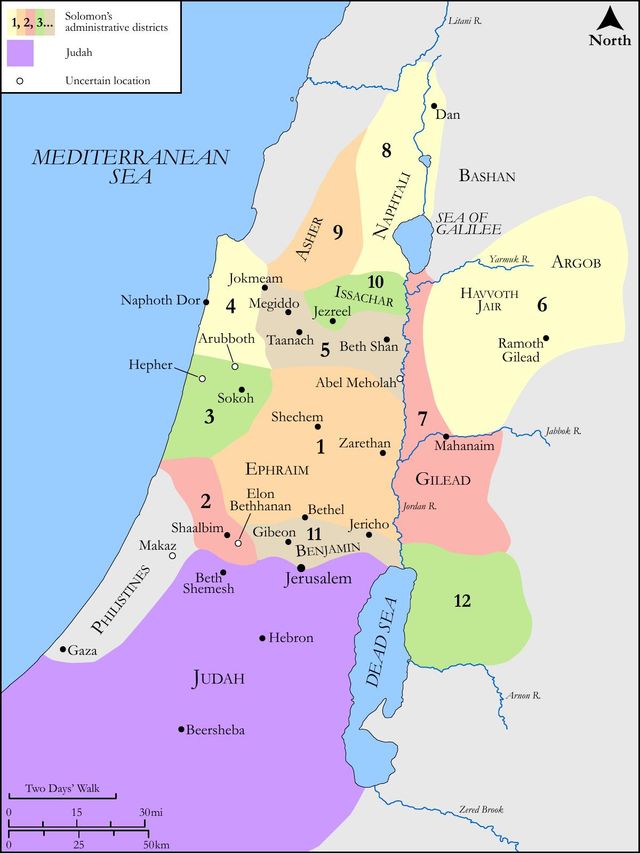
First Kings 4:8 introduces the initial entry in King Solomon's meticulously organized system of twelve district governors, identifying "the son of Hur" as the administrator responsible for the fertile region of Mount Ephraim. This verse is an integral part of a larger administrative record that meticulously details the sophisticated governmental structure Solomon established to provision his vast household and royal court. It serves as concrete evidence of the kingdom's widespread control, its unprecedented economic prosperity, and the practical outworking of the divine wisdom bestowed upon the king, enabling him to govern with remarkable efficiency and foresight.
Context
ShowHideLiterary Context
First Kings 4:8 is situated within a pivotal section of 1 Kings (4:1-19) that meticulously catalogues King Solomon's chief officials and the twelve district governors tasked with supplying the royal court. This chapter immediately follows the profound narrative of Solomon's prayer for wisdom at Gibeon and God's subsequent blessing of unparalleled wisdom, wealth, and honor (1 Kings 3). The detailed administrative lists in chapter 4 are not merely historical records; they serve as tangible proof of the practical manifestation of Solomon's divinely-granted wisdom and the unprecedented prosperity and organizational prowess that characterized his reign. The systematic listing of governors, each assigned a specific territory and a designated month for provision, powerfully underscores the extensive and systematic nature of Solomon's dominion over his kingdom. This administrative detail sets the stage for the subsequent descriptions of his immense daily provisions, the widespread peace, and the vastness of his kingdom that follow in 1 Kings 4:20-28.
Historical & Cultural Context
Among the kings of that day, the stability, power, and longevity of a monarchy were intrinsically linked to its ability to efficiently collect, manage, and distribute resources. Kings maintained extensive royal households, supported large armies, and undertook ambitious building projects, all of which demanded a consistent and substantial flow of provisions. Solomon's innovative system of twelve district governors, each responsible for one month's supply, represented an extraordinarily advanced and highly organized administrative structure for its era. This system ensured a predictable and continuous flow of goods to the capital, supporting the immense needs of the royal court. Mount Ephraim, specifically mentioned in this verse, was a historically significant tribal territory, renowned for its agricultural productivity and its strategically central location within the Israelite heartland. Its designation as a distinct administrative district highlights both its considerable economic importance and Solomon's firm, consolidated control over key regions of his dominion, reflecting the unified monarchy's strength.
Key Themes
ShowHideThis verse, as an integral part of the broader administrative record, contributes significantly to several overarching themes within the book of 1 Kings and the narrative of Solomon's reign. It powerfully illustrates the theme of Royal Administration and Organization, showcasing Solomon's sophisticated system of governance and his remarkable ability to effectively manage a large and complex kingdom. It also speaks directly to Economic Prosperity, as the very existence of such a detailed and efficient provisioning system implies a flourishing economy capable of supporting the immense daily needs of Solomon's court. This prosperity is consistently presented as a direct result of God's blessing, as explicitly stated in 1 Kings 4:20. Furthermore, the verse highlights the crucial principle of Delegation and Authority, demonstrating how effective leadership involves entrusting significant responsibilities to competent individuals to ensure the smooth and efficient functioning of a large enterprise. Finally, the specific mention of "Mount Ephraim" underscores the theme of Geographic Control and National Unity, indicating the king's firm grip over all parts of his territory, which contributed directly to the widespread peace and security described throughout 1 Kings 4.
Exposition and Analysis
ShowHideKey Word Analysis
ShowHideThis word, derived from a primitive root suggesting definite and conspicuous position, signifies an appellation, a mark, or a memorial of individuality. In this context, it emphasizes the official and formal nature of the list, highlighting that these are not merely individuals but appointed officials whose identities and roles are significant to the kingdom's administration. It conveys a sense of honor, authority, and established character associated with their positions.
This is a patronymic, literally meaning "son of Hur." The name "Hur" itself suggests "noble" or "white." In ancient Israelite society, identifying individuals by their father's name was a common practice, especially in official records. While the specific Hur who was this governor's father is not detailed, the patronymic serves as a clear identifier within the administrative structure, connecting the governor to a recognized lineage or family. It underscores the importance of family identity and perhaps social standing in the appointment of officials.
This term, meaning "double fruit," refers to the tribal territory of Ephraim, a central and historically powerful tribe descended from Joseph's son. "Mount Ephraim" specifically designates the mountainous region within this territory, known for its fertile hills and valleys, making it agriculturally productive and strategically vital. Its inclusion as a distinct administrative district underscores its economic significance for supplying the royal court and highlights Solomon's effective control over all key regions of his kingdom, extending his authority into the heartland of Israel.
Verse Breakdown
ShowHide"And these [are] their names"
This opening phrase functions as a formal introductory heading for the subsequent enumeration. It signals to the reader that a precise and systematic list of individuals, specifically the district governors, is about to follow. This emphasizes the meticulous and highly organized nature of record-keeping during Solomon's reign, reflecting an advanced administrative capacity characteristic of a powerful and well-managed kingdom.
"The son of Hur, in mount Ephraim"
This clause provides the first specific entry in the list of Solomon's twelve district governors. "The son of Hur" identifies the individual by his patronymic, a common and formal method of naming people in ancient Israel, often used when their personal name might be omitted or less pertinent than their lineage in an official context. His assigned territory, "Mount Ephraim," precisely specifies the geographical area for which he was responsible for collecting and delivering provisions for the royal court during his designated month. This pairing of an identified official with a specific territory highlights the organized delegation of authority and the extensive administrative reach of Solomon's kingdom.
Literary Devices
ShowHideThe primary literary device at play in 1 Kings 4:8, and indeed throughout the broader context of 1 Kings 4:7-19, is Catalog or List. This section functions as an administrative register, systematically enumerating Solomon's twelve district governors. The meticulous detail presented in these lists, including the specific territories assigned to each governor, serves to underscore the vastness, order, and highly organized nature of Solomon's kingdom. The use of a Patronymic ("the son of Hur") is also a notable feature, a common ancient literary and cultural convention for identifying individuals by their father's name, which often provided a crucial degree of social standing or lineage context. Furthermore, the verse exemplifies Administrative Detail, a literary choice that, while seemingly mundane, powerfully conveys the reality of Solomon's unparalleled wisdom and prosperity. This wisdom was not merely theoretical but expressed through practical, effective governance, serving as a direct fulfillment of God's promises to him.
Theological and Thematic Connections
ShowHideWhile 1 Kings 4:8 might initially appear as a mere administrative detail, it carries significant theological weight by demonstrating the practical outworking of God's blessing and wisdom upon King Solomon. The efficiency, extensive reach, and meticulous organization of Solomon's administration, as evidenced by this detailed list of governors, are a direct result of the divine wisdom God granted him in response to his humble request (compare 1 Kings 3:9-12). This verse, therefore, points to the profound principle that divine wisdom is not merely theoretical or spiritual; it translates into effective, practical governance that brings order, stability, and prosperity to a nation. It illustrates how God's favor can manifest in the meticulous organization and successful management of earthly affairs, ultimately ensuring the well-being and flourishing of His people. The divine order extends even to the mundane details of administration.
Reflection and Application
ShowHideFirst Kings 4:8, though seemingly a dry administrative record, offers profound insights into the nature of effective leadership, the intrinsic value of organization, and the practical outworking of divine wisdom in daily life. For leaders in any sphere—whether managing a household, leading a business, serving in a church, or contributing to a community—it underscores the vital importance of delegation, clearly defined roles, and meticulous planning. Solomon's remarkable ability to manage a vast kingdom and ensure its abundant provision through a structured, decentralized system reminds us that even the seemingly mundane details of administration contribute significantly to overall success, stability, and flourishing. This verse challenges us to consider how we can apply wisdom to bring greater order and efficiency to our own responsibilities, recognizing that good stewardship of both resources and people requires thoughtful organization, strategic planning, and the empowerment of others to fulfill their roles effectively.
Questions for Reflection
ShowHideFAQ
ShowHideWhy are these detailed administrative lists included in the biblical narrative of 1 Kings?
ShowHideThese seemingly mundane administrative lists are crucial for several profound reasons within the biblical narrative. Firstly, they serve as concrete, tangible evidence of the unparalleled prosperity, peace, and order that characterized Solomon's reign, directly fulfilling God's promises to him (e.g., 1 Kings 3:13). They demonstrate the practical outworking of Solomon's divinely-granted wisdom, showcasing how he was able to effectively organize, manage, and govern a vast and complex kingdom. Secondly, they highlight the meticulous and sophisticated nature of Israel's monarchical administration under Solomon, providing invaluable historical and cultural context for the period. Finally, and most importantly from a theological perspective, they underscore the overarching theme of God's blessing on His chosen king and nation, where even the logistical and administrative details of governance reflect divine favor, order, and provision for His people.
Christ-Centered Fulfillment
ShowHideThe administrative perfection and comprehensive provision evident under King Solomon's reign, as powerfully exemplified by the detailed system of governors described in 1 Kings 4, serve as a profound foreshadowing of the ultimate and perfect reign of Jesus Christ. Solomon's ability to bring order, peace, and abundant provision to his earthly kingdom, sustained by the meticulous work of his appointed officials, points forward to Christ, the true King, whose kingdom is eternal and whose administration is utterly flawless. Just as Solomon's governors ensured the sustenance of his court, Christ, as the head of His church and the sovereign Lord of all, perfectly provides for and sustains His people, fulfilling all their needs, both spiritual and physical, in His boundless grace (compare Philippians 4:19). The peace and security enjoyed under Solomon's wise governance prefigure the perfect shalom and eternal security found only in Christ's spiritual kingdom, where He rules with absolute wisdom, impeccable justice, and unwavering righteousness (see Isaiah 9:6-7). Ultimately, the earthly, temporal kingdom of Solomon, with all its organizational prowess and divinely-enabled prosperity, finds its glorious and eternal fulfillment in the reign of the "Son of David," Jesus, who is King of kings and Lord of lords, perfectly administering a kingdom that will have no end (as promised in Luke 1:32-33).