


1 Kings 11:22
Bible text: King James Version (1769 Blayney text) · Public domain
Bible text: King James Version with Strong's numbers · Public domain
Bible text: Berean Standard Bible · Public domain
Bible text: American Standard Version (1901) · Public domain
Bible text: World English Bible, Messianic edition · Public domain
Bible text: Geneva Bible (1599) · Public domain
Bible text: Young's Literal Translation · Public domain
- וַיֹּאמֶרvai·Yo·merand he saidH559Conj-w ¦ V-Qal-ConsecImperf-3msVerb Qal Consecutive Imperfect 3rd Singular Masculineוַandיֹּאמֶרhe said
- לוֹloto himPrep-l ¦ 3msSuffix Personal 3rd Singular Masculineלtoוֹhim
- פַרְעֹהfar·'OhPharaohH6547N-msNoun Title Singular Masculine Absolute
- כִּיkithatH3588PrtParticle Conditional
- מָהmahwhat?H4100InterrogPronoun Interrogative
- אַתָּה'a·Tah[are] youH859Pro-2msPronoun Personal 2nd Singular Masculine
- חָסֵרcha·SerlackingH2638Adj-msAdjective Singular Masculine Absolute
- עִמִּי'i·Miwith meH5973Prep ¦ 1csPrepositionעִמִּwithיme
- וְהִנְּךָve·hi·ne·Khaand here youH2005Conj-w ¦ Prt ¦ 2msParticle Interjectionוְandהִנְּhereךָyou
- מְבַקֵּשׁme·va·Kesh[are] seekingH1245V-Piel-Prtcpl-msVerb Piel Participle Singular Masculine Absolute
- לָלֶכֶתla·Le·khetto goH1980Prep-l ¦ V-Qal-InfVerb Qal Infinitive Constructלָtoלֶכֶתgo
- אֶל'eltoH413PrepPreposition
- אַרְצֶךָ'ar·Tze·khayour own landH776N-fsc ¦ 2msNoun Singular Feminine Constructאַרְצֶown landךָyour
- וַיֹּאמֶרvai·Yo·merand he saidH559Conj-w ¦ V-Qal-ConsecImperf-3msVerb Qal Consecutive Imperfect 3rd Singular Masculineוַandיֹּאמֶרhe said
- לֹאLo'In-H3808NegParticle Negative
- כִּיkideedH3588PrtParticle Conditional
- שַׁלֵּחַsha·Le·achreally <let go>H7971V-Piel-InfVerb Piel Infinitive Construct
- תְּשַׁלְּחֵנִיte·sha·le·Che·niyou will let go meH7971V-Piel-Imperf-2ms ¦ 1csVerb Piel Imperfect 2nd Singular Masculineתְּשַׁלְּחֵyou will let goנִיme
English is a literal word-by-word gloss of the Hebrew, not the KJV's wording. Why?
This is the original text the KJV's translators worked from — each Hebrew word with its own literal English meaning in this verse, prepared by scholars at Tyndale House, Cambridge. The KJV translates whole sentences, not word by word, so its wording differs: one Hebrew word can become several English words, and the KJV may choose “the LORD” where the gloss reads “Yahweh”. Both are faithful — they answer different questions. For the KJV's own rendering, switch to the KJV text.
Details
See on the biblical-era maps

Study this verse
Public-domain commentary
Matthew Henry
From his Commentary on the Whole Bible. Henry comments on passages, not single verses — this entry covers 1 Kings 11:14–25. His three-level outline is real structure in the source text, so it is rendered as structure.
While Solomon kept closely to God and to his duty there was no adversary nor evil occurrent (Kg1 5:4), nothing to create him any disturbance or uneasiness in the least; but here we have an account of two adversaries that appeared against him, inconsiderable, and that could not have done any thing worth taking notice of if Solomon had not first made God his enemy. What hurt could Hadad or Rezon have done to so great and powerful a king as Solomon was if he had not, by sin, made himself mean and weak? And then those little people menace and insult him. If God be on our side, we need not fear the greatest adversary; but, if he be against us, he can made us fear the least, and the very grasshopper shall be a burden. Observe,
I.Both these adversaries God stirred up, Kg1 11:14, Kg1 11:23.
Though they themselves were moved by principles of ambition or revenge, God made use of them to serve his design of correcting Solomon. The principal judgment threatened was deferred, namely, the rending of the kingdom from him, but he himself was made to fee the smart of the rod, for his greater humiliation. Note, Whoever are, in any way, adversaries to us, we must take notice of the hand of God stirring them up to be so, as he bade Shimei curse David; we must look through the instruments of our trouble to the author of it and hear the Lord's controversy in it.
II.Both these adversaries had the origin of their enmity to Solomon and Israel laid in David's time, and in his conquests of their respective countries, Kg1 11:15, Kg1 11:24. Solomon had the benefit and advantage of his father's successes both in the enlargement of his dominion and the increase of his treasure, and would never have known any thing but the benefit of them if he had kept closely to God; but now he finds evils to balance the advantages, and that David had made himself enemies, who were thorns in his sides. Those that are too free in giving provocation ought to consider that perhaps it may be remembered in time to come and returned with interest to theirs after them; having so few friends in this world, it is our wisdom not to make ourselves more enemies than we needs must.
1.Hadad, an Edomite, was an adversary to Solomon. We are not told what he did against him, nor which way he gave him disturbance, only, in general, that he was an adversary to him: but we are told,
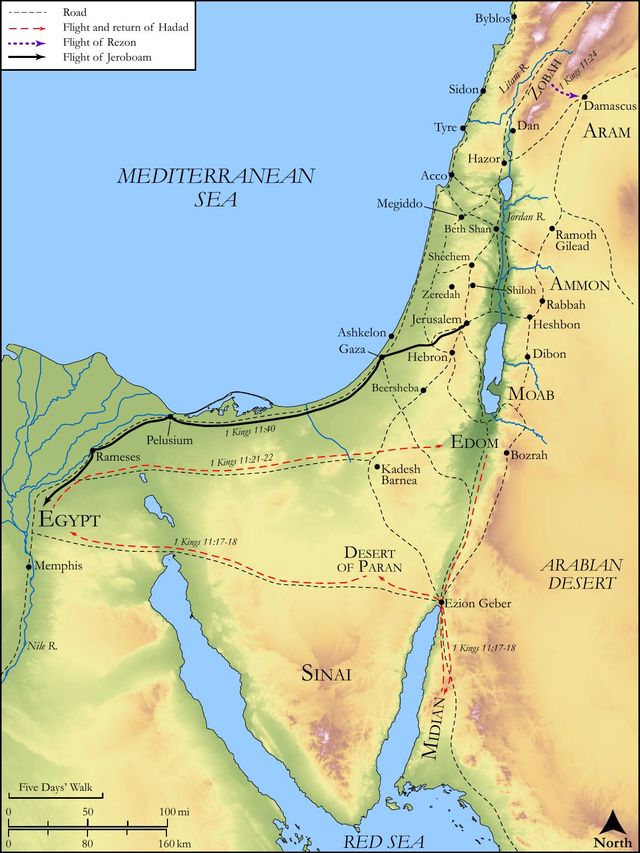
(1.)What induced him to bear Solomon a grudge. David had conquered Edom, Sa2 8:14. Joab put all the males to the sword, Kg1 11:15, Kg1 11:16. A terrible execution he made, avenging on Edom their old enmity to Israel, yet perhaps with too great a severity. From this general slaughter, while Joab was burying the slain (for he left not any alive of their own people to bury them, and buried they must be, or they would be an annoyance to the country, Eze 39:12), Hadad, a branch of the royal family, then a little child, was taken and preserved by some of the king's servants, and conveyed to Egypt, Kg1 11:17. They halted by the way, in Midian first, and then in Paran, where they furnished themselves with men, not to fight for them or force their passage, but to attend them, that their young master might go into Egypt with an equipage agreeable to his quality. There he was kindly sheltered and entertained by Pharaoh, as a distressed prince, as well provided for, and so recommended himself that, in process of time, he married the queen's sister (Kg1 11:19), and by her had a child, which the queen herself conceived such a kindness for that she brought him up in Pharaoh's house, among the king's children.
(2.)What enabled him to do Solomon a mischief. Upon the death of David and Joab, he returned to his own country, in which, it should seem, he settled and remained quiet while Solomon continued wise and watchful for the public good, but from which he had opportunity of making inroads upon Israel when Solomon, having sinned away his wisdom as Samson did his strength (and in the same way), grew careless of public affairs, was off his guard himself, and had forfeited the divine protection. What vexation Hadad gave to Solomon we are not here told, but only how loth Pharaoh was to part with him and how earnestly he solicited his stay (Kg1 11:22): What hast thou lacked with me? "Nothing," says Hadad; "but let me go to my own country, my native air, my native soil." Peter Martyr has a pious reflection upon this: "Heaven is our home, and we ought to keep up a holy affection to that, and desire towards it, even when the world, the place of our banishment, smiles most upon us." Does it ask, What have you lacked, that you are so willing to be gone? We may answer, "Nothing that the world can do for us; but still let us go thither, where our hope, and honour, and treasure are."
2.Rezon, a Syrian, was another adversary to Solomon. When David conquered the Syrians, he headed the remains, lived at large by spoil and rapine, till Solomon grew careless, and then he got possession of Damascus, reigned there (Kg1 11:24) and over the country about (Kg1 11:25), and he created troubles to Israel, probably in conjunction with Hadad, all the days of Solomon (namely, after his apostasy), or he was an enemy to Israel during all Solomon's reign, and upon all occasions vented his then impotent malice against them, but till Solomon's revolt, when his defence had departed from him, he could not do them any mischief. It is said of him that he abhorred Israel. Other princes loved and admired Israel and Solomon, and courted their friendship, but here was one that abhorred them. The greatest and best of princes and people, however much they may in general be respected, will yet perhaps be hated and abhorred by some.
Continue studying 1 Kings 11:22 across the web’s major study libraries — every link below opens this exact verse, chapter, or book on the destination site.
Read & Compare
 BibleGatewayThis verse in more than 200 translations and 70 languages.
 Bible.comThe YouVersion reader — hundreds of translations, reading plans, and highlights.
 ESV.orgCrossway's official English Standard Version reader.
 NET BibleThe NET translation with 60,000+ translators' notes on every rendering decision.
 STEP BibleTyndale House's free study tool — original text, vocabulary, and scholarly resources.
 BibliaLogos Bible Software's free web reader.
 USCCBThe New American Bible (Revised Edition) with the U.S. bishops' study notes.
Commentaries
 BibleHub CommentariesDozens of classic commentaries on this verse, gathered on one page.
 StudyLightMore than 100 commentary sets — the largest collection on the web.
 BibleRefPlain-English commentary on what this verse means, verse by verse.
 Enduring WordDavid Guzik's free commentary on this chapter, widely used by Bible teachers.
 Bible Study ToolsVerse commentary alongside Greek and Hebrew study aids.
Original Language & Research
- BibleHub InterlinearThe verse word by word — original language, transliteration, and English.
- BibleHub LexiconEvery word's original-language definition and Strong's entry.
 Blue Letter BibleDeep-study tools — Strong's numbers, concordance, and word studies.
 SefariaThe Hebrew text with Rashi and centuries of Jewish commentary.
Sermons, Hymns & Audio


TrulyRandomVerse is not affiliated with these sites and doesn’t control their content. They’re linked because they’re genuinely useful.
Summary
This verse captures a pivotal and paradoxical dialogue between Pharaoh, the Egyptian king, and Hadad the Edomite, a royal refugee who had been granted exceptional asylum and privilege in Egypt. Pharaoh, genuinely puzzled by Hadad's sudden and persistent desire to depart, inquires if he has lacked anything during his extended stay, implying a life of complete provision and comfort. Hadad's terse and unwavering reply, "Nothing: howbeit let me go in any wise," underscores his inexplicable determination to return to his homeland despite having every material need met. This seemingly simple exchange sets in motion Hadad's re-emergence as a divinely appointed adversary against King Solomon, fulfilling God's prophetic judgment against the apostate monarch.
Context
ShowHideLiterary Context
This verse is strategically placed within 1 Kings 11, a chapter that marks the tragic turning point in King Solomon's reign from unparalleled wisdom and prosperity to spiritual decline and divine retribution. The preceding verses detail Solomon's grave disobedience, as his numerous foreign wives lead his heart astray to idolatry, violating God's explicit commands (1 Kings 11:1-8). As a direct consequence, the Lord declares that He will tear the kingdom from Solomon's hand, though not entirely during his lifetime for David's sake (1 Kings 11:11-13). The narrative then introduces the first of these adversaries: "the Lord raised up an adversary against Solomon, Hadad the Edomite, of the royal house in Edom" (1 Kings 11:14). Verses 1 Kings 11:15-20 meticulously recount Hadad's escape from David's brutal conquest of Edom, his journey to Egypt, and his integration into Pharaoh's family through marriage. Verse 1 Kings 11:21 immediately precedes our verse, explaining Hadad's request to return home upon hearing of the deaths of David and Joab, the architects of Edom's subjugation. Thus, 1 Kings 11:22 serves as the crucial dialogue that facilitates Hadad's departure, directly setting the stage for his role as a divinely orchestrated instrument of judgment against Solomon.
Historical & Cultural Context
The historical setting for this exchange is the early 10th century BCE, a period when the united monarchy of Israel under Solomon was at its zenith, while Egypt, though still powerful, was navigating its relationship with this rising regional force. Edom, situated southeast of Judah, had been a long-standing rival, eventually subjugated by King David (2 Samuel 8:13-14). The "slaughter" mentioned in 1 Kings 11:15-16 refers to Joab's six-month campaign to eliminate any potential Edomite resistance, a brutal but effective consolidation of Israelite control. In that day, it was common for royal refugees from defeated nations to seek asylum in powerful neighboring kingdoms, and Egypt, with its long history and formidable military, was a prime destination. Pharaoh's lavish hospitality towards Hadad—providing him with a house, provisions, and even arranging his marriage to the queen's sister (1 Kings 11:18-19)—was not merely an act of kindness but a shrewd political maneuver. Such a gesture could cultivate a future ally, a puppet ruler, or at least a valuable intelligence asset. Pharaoh's question in 1 Kings 11:22 therefore reflects genuine surprise or perhaps a strategic probing, as Hadad was a highly integrated and valuable member of the Egyptian elite. His desire to leave, despite such comfort and prestige, would have seemed utterly illogical from a purely political or material standpoint, underscoring the profound cultural ties to one's homeland and royal lineage in that era.
Key Themes
ShowHideThis terse yet profound exchange illuminates several significant themes woven throughout 1 Kings and the broader biblical narrative. Firstly, it powerfully underscores the theme of Divine Sovereignty and Judgment. Despite Solomon's apparent power and Hadad's personal ambition, God is ultimately in control, raising up adversaries like Hadad to fulfill His declared word against a disobedient king (1 Kings 11:14). Hadad's seemingly personal decision to return home is, from a theological perspective, an integral part of God's overarching plan to discipline Solomon. Secondly, the verse explores the Nature of True Fulfillment and Identity. Hadad, despite lacking "nothing" materially in Egypt, felt an undeniable pull towards his ancestral land and the potential restoration of his royal heritage. This starkly contrasts material comfort with a deeper, perhaps divinely implanted, sense of purpose and belonging, foreshadowing humanity's spiritual longing for a true home and identity found ultimately only in God. Lastly, the passage subtly but powerfully reinforces the theme of the Consequences of Disobedience. Hadad's return and subsequent adversarial role are direct repercussions of Solomon's spiritual failings, illustrating how sin invites divine discipline and external threats, disrupting the peace and prosperity that God had initially promised for obedience (Deuteronomy 28:15-68).
Exposition and Analysis
ShowHideKey Word Analysis
ShowHideThe Hebrew verb חָסֵר (ḥāçêr) means "to lack," "to be wanting," or "to decrease." Pharaoh's question, "But what hast thou lacked with me?" employs this term to inquire if Hadad experienced any deficiency, want, or need—whether material, social, or personal—during his extensive stay in Egypt. It implies a comprehensive absence of any unmet need. Hadad's immediate and emphatic "Nothing" (אֵין, ʾên) directly negates any such lack, highlighting the profound paradox of his desire to depart despite having every conceivable provision.
The Hebrew verb בָּקַשׁ (bâqash) is a primitive root meaning "to search out (by any method, specifically in worship or prayer); by implication, to strive after; ask, beg, beseech, desire, enquire, get, make inquisition, procure, (make) request, require, seek (for)." In Pharaoh's question, "that, behold, thou seekest to go to thine own country?", bâqash conveys Hadad's earnest and determined pursuit of his return. It suggests an active, intentional, and persistent desire, not a fleeting thought, emphasizing the depth of his resolve to leave the comforts of Egypt for the uncertainties of his homeland.
The Hebrew verb שָׁלַח (shâlach) is a primitive root meaning "to send away, for, or out (in a great variety of applications); any wise, appoint, bring (on the way), cast (away, out), conduct, earnestly, forsake, give (up), grow long, lay, leave, let depart (down, go, loose), push away, put (away, forth, in, out), reach forth, send (away, forth, out), set, shoot (forth, out), sow, spread, stretch forth (out)." Hadad's plea, "howbeit let me go in any wise" (וְשַׁלְּחֵ֥נִי), is an urgent, almost desperate, imperative. The addition of "in any wise" (literally, "and send me away, please") intensifies the request, underscoring the unwavering and non-negotiable nature of his desire to return to Edom, overriding all other considerations of comfort, security, or political advantage.
Verse Breakdown
ShowHide"Then Pharaoh said unto him, But what hast thou lacked with me, that, behold, thou seekest to go to thine own country?"
This opening clause encapsulates Pharaoh's astonishment and inquiry. His question is rhetorical, designed to highlight the apparent absurdity of Hadad's request, implying that Hadad had enjoyed a life of complete provision and security under his patronage. The phrase "with me" emphasizes Pharaoh's personal responsibility for Hadad's welfare and the privileged position Hadad held within the Egyptian court. The interjection "behold" (הִנֵּה, hinnēh) conveys Pharaoh's surprise and perhaps a touch of disbelief at Hadad's seemingly inexplicable desire to abandon such a life for the uncertainties of his "own country," Edom, which had been devastated by David's campaigns.
"And he answered, Nothing: howbeit let me go in any wise."
Hadad's response is remarkably concise, resolute, and ultimately unyielding. His immediate "Nothing" directly and emphatically addresses Pharaoh's question, confirming that his decision is not born of dissatisfaction, material want, or mistreatment. This stark affirmation of contentment paradoxically highlights the depth of his internal drive. The subsequent phrase, "howbeit let me go in any wise," serves as a forceful, unwavering plea. It indicates that despite Pharaoh's immense hospitality and the comforts of Egypt, Hadad's desire to return to his homeland is paramount and non-negotiable. This determination is pivotal to the unfolding narrative, as it sets in motion the events that will lead to Hadad becoming a formidable adversary to Solomon, fulfilling God's prophetic word.
Literary Devices
ShowHideThe verse effectively employs Dialogue to reveal character, advance the plot, and heighten the dramatic tension. Pharaoh's bewildered question underscores his generosity and Hadad's privileged position, while Hadad's terse, unwavering reply highlights his deep-seated resolve. There is a clear Contrast between the lavish comfort and security Hadad enjoyed in Egypt ("lacked nothing") and his inexplicable, yet fervent, desire to return to his war-torn, subjugated homeland. This contrast creates a subtle sense of Irony, as Hadad, who seemingly possesses everything, chooses to abandon it all for a future fraught with danger and uncertainty. The dialogue also functions as powerful Foreshadowing, as Hadad's insistence on returning home directly precedes his emergence as a divinely appointed adversary against Solomon, thereby initiating the fulfillment of God's judgment, though neither Pharaoh nor Hadad are explicitly aware of this divine orchestration at this moment.
Theological and Thematic Connections
ShowHideThis brief exchange powerfully illustrates the sovereign hand of God at work, even through the seemingly mundane decisions and personal longings of individuals. Hadad's inexplicable desire for his homeland, despite unparalleled comfort and privilege in Egypt, is not merely a personal whim but a divinely orchestrated instrument in God's larger plan of judgment against Solomon's apostasy. It serves as a potent reminder that God can use unexpected means and desires—even turning the hearts of kings and refugees alike—to accomplish His righteous purposes. The narrative teaches that true fulfillment is not found in material abundance, earthly security, or human prestige, but in aligning with God's will and purpose, however uncomfortable or illogical that path may seem from a worldly perspective. Hadad's story, in a broader sense, speaks to the universal human longing for "home" and identity, a profound yearning that ultimately finds its true and lasting satisfaction only in God Himself, our ultimate origin and destination.
Reflection and Application
ShowHideHadad's story challenges us to deeply examine our own contentment, motivations, and priorities. Are we, like Hadad, in a place where we "lack nothing" materially, professionally, or socially, yet feel an undeniable pull towards a different path, a deeper purpose, or a sense of belonging that transcends earthly comforts and security? This verse prompts us to consider whether our pursuit of ease and stability might inadvertently distract us from a divine calling or a necessary, perhaps uncomfortable, journey. It reminds us that God often works through our deepest longings, our discontents, and even our seemingly irrational desires to guide us toward His perfect will. Sometimes, the greatest act of faith is to leave a place of comfort and familiarity, trusting that God has a specific purpose for us elsewhere, even if that path appears less secure or more challenging. Our true home and ultimate satisfaction are found not in earthly possessions, positions, or even relationships, but in pursuing God's kingdom and His righteousness above all else.
Questions for Reflection
ShowHideFAQ
ShowHideWhy was Pharaoh so surprised by Hadad's request to leave?
ShowHidePharaoh's surprise stemmed from the extraordinary hospitality and unparalleled privilege he had extended to Hadad. Hadad was not merely a refugee; he had been welcomed into Pharaoh's inner circle, given a house, provisions, and even married to the queen's sister, Tahpenes, with whom he had a son, Genubath (1 Kings 11:18-19). From Pharaoh's perspective, Hadad had achieved a life of unparalleled comfort, security, and status within the most powerful kingdom of the day, far exceeding what he could expect in his devastated homeland of Edom. His rhetorical question, "what hast thou lacked with me," implies that Hadad had every possible need met, making his desire to depart seem utterly irrational, ungrateful, and even foolish from a human standpoint. Pharaoh likely viewed Hadad as a valuable political asset, and his departure would have been a loss of influence or a potential disruption to regional stability, further contributing to his bewilderment.
Christ-Centered Fulfillment
ShowHideThe narrative of Hadad, a displaced royal heir yearning for his homeland despite earthly comfort and privilege, finds profound Christ-centered fulfillment. Just as Hadad was an adversary raised by God against King Solomon's unfaithfulness, Christ is the ultimate King, whose perfect reign stands in stark contrast to Solomon's tragic descent into idolatry and eventual failure. Solomon's pursuit of foreign alliances and his heart turning away from God led directly to the tearing of his kingdom, a consequence that Hadad's return helps to initiate. In Christ, we behold the perfect King, who did not cling to heavenly comfort and divine prerogative but "emptied himself, by taking the form of a servant, being born in the likeness of men" (Philippians 2:7). He willingly left His glorious "country"—the very presence of the Father—to reclaim His people, not through earthly conquest or political maneuvering like David or Hadad, but through self-sacrificial love on the cross. Furthermore, Hadad's deep longing for his earthly home, despite having "lacked nothing" in Egypt, powerfully foreshadows humanity's deeper spiritual longing for our true home in God. We, too, may find ourselves in situations of earthly comfort, security, or even great success, yet feel an unquenchable yearning for something more—a profound spiritual hunger that can only be satisfied by reconciliation with our Creator through Christ. He is the one who ultimately takes away our "lack" (John 1:29), offering true contentment, eternal belonging, and complete fulfillment in His kingdom, a kingdom that will never be torn away due to unfaithfulness, for He is "the King of kings and Lord of lords" (Revelation 19:16).