


1 Corinthians 5:10
Bible text: King James Version (1769 Blayney text) · Public domain
Bible text: King James Version with Strong's numbers · Public domain
Bible text: Berean Standard Bible · Public domain
Bible text: American Standard Version (1901) · Public domain
Bible text: World English Bible, Messianic edition · Public domain
Bible text: Geneva Bible (1599) · Public domain
Bible text: Young's Literal Translation · Public domain
- καὶkaiandG2532CONJConjunction
- οὐounotG3756PRT-NNegative Particle Negative
- πάντωςpantōsat allG3843ADVAdverb
- τοῖςtoiswith theG3588T-DPMDefinite article Dative Plural Masculine
- πόρνοιςpornoissexually immoralG4205N-DPMNoun Dative Plural Masculine
- τοῦtou<the>G3588T-GSMDefinite article Genitive Singular Masculine
- κόσμουkosmouworldG2889N-GSMNoun Genitive Singular Masculine
- τούτουtoutouof thisG3778D-GSMDemonstrative pronoun Genitive Singular Masculine
- ἢēorG2228CONJConjunction
- τοῖςtoiswith theG3588T-DPMDefinite article Dative Plural Masculine
- πλεονέκταιςpleonektaiscovetousG4123N-DPMNoun Dative Plural Masculine
- καὶkaiandG2532CONJConjunction
- ἅρπαξινharpaxinwith swindlersG727A-DPMAdjective Dative Plural Masculine
- ἢēorG2228CONJConjunction
- εἰδωλολάτραιςeidōlolatraiswith idolaters —G1496N-DPMNoun Dative Plural Masculine
- ἐπεὶepeisinceG1893CONJConjunction
- ὠφείλετεōpheileteyou have been obligedG3784V-IAI-2PVerb Imperfect Active Indicative 2nd Plural
- ἄραarathen wouldG686CONJConjunction
- ἐκekfromG1537PREPPreposition
- τοῦtoutheG3588T-GSMDefinite article Genitive Singular Masculine
- κόσμουkosmouworldG2889N-GSMNoun Genitive Singular Masculine
- ἐξελθεῖνexeltheinto departG1831V-2AANVerb 2nd Aorist Active Infinitive
English is a literal word-by-word gloss of the Greek, not the KJV's wording. Why?
This is the original text the KJV's translators worked from — each Greek word with its own literal English meaning in this verse, prepared by scholars at Tyndale House, Cambridge. The KJV translates whole sentences, not word by word, so its wording differs: one Greek word can become several English words, and the KJV may choose “charity” where the gloss reads “love”. Both are faithful — they answer different questions. For the KJV's own rendering, switch to the KJV text.
Details
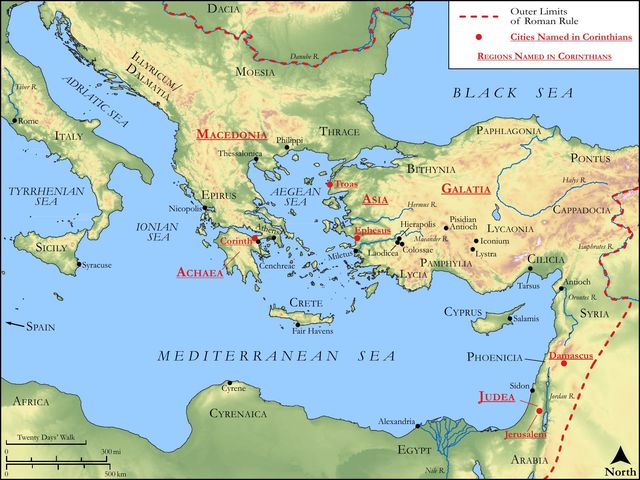
See on the biblical-era maps

Study this verse
Public-domain commentary
Matthew Henry
From his Commentary on the Whole Bible. Henry comments on passages, not single verses — this entry covers 1 Corinthians 5:9–13.
Here the apostle advises them to shun the company and converse of scandalous professors. Consider,
I.The advice itself:
I wrote to you in a letter not to company with fornicators, Co1 5:9. Some think this was an epistle written to them before, which is lost. Yet we have lost nothing by it, the Christian revelation being entire in those books of scripture which have come down to us, which are all that were intended by God for the general use of Christians, or he could and would in his providence have preserved more of the writings of inspired men. Some think it is to be understood of this very epistle, that he had written this advice before he had full information of their whole case, but thought it needful now to be more particular. And therefore on this occasion he tells them that if any man called a brother, any one professing Christianity, and being a member of a Christian church, were a fornicator, or covetous, or an idolater, or a railer, that they should not keep company with him, nor so much as eat with such a one. They were to avoid all familiarity with him; they were to have no commerce with him; they were to have no commerce with him: but, that they might shame him, and bring him to repentance, must disclaim and shun him. Note, Christians are to avoid the familiar conversation of fellow-christians that are notoriously wicked, and under just censure for their flagitious practices. Such disgrace the Christian name. They may call themselves brethren in Christ, but they are not Christian brethren. They are only fit companions for the brethren in iniquity; and to such company they should be left, till they mend their ways and doings.
II.How he limits this advice.
He does not forbid the Christians the like commerce with scandalously wicked heathens. He does not forbid their eating nor conversing with the fornicators of this world, etc. They know no better. They profess no better. The gods they serve, and the worship they render to many of them, countenance such wickedness. "You must needs go out of the world if you will have no conversation with such men. Your Gentile neighbours are generally vicious and profane; and it is impossible, as long as you are in the world, and have any worldly business to do, but you must fall into their company. This cannot be wholly avoided." Note, Christians may and ought to testify more respect to loose worldlings than to loose Christians. This seems a paradox. Why should we shun the company of a profane or loose Christian, rather than that of a profane or loose heathen?
III.The reason of this limitation is here assigned.
It is impossible the one should be avoided. Christians must have gone out of the world to avoid the company of loose heathens. But this was impossible, as long as they had business in the world. While they are minding their duty, and doing their proper business, God can and will preserve them from contagion. Besides, they carry an antidote against the infection of their bad example, and are naturally upon their guard. They are apt to have a horror at their wicked practices. But the dread of sin wears off by familiar converse with wicked Christians. Our own safety and preservation are a reason of this difference. But, besides, heathens were such as Christians had nothing to do to judge and censure, and avoid upon a censure passed; for they are without (Co1 5:12), and must be left to God's judgment, Co1 5:13. But, as to members of the church, they are within, are professedly bound by the laws and rules of Christianity, and not only liable to the judgment of God, but to the censures of those who are set over them, and the fellow-members of the same body, when they transgress those rules. Every Christian is bound to judge them unfit for communion and familiar converse. They are to be punished, by having this mark of disgrace put upon them, that they may be shamed, and, if possible, reclaimed thereby: and the more because the sins of such much more dishonour God than the sins of the openly wicked and profane can do. The church therefore is obliged to clear herself from all confederacy with them, or connivance at them, and to bear testimony against their wicked practices. Note, Though the church has nothing to do with those without, it must endeavour to keep clear of the guilt and reproach of those within.
IV.How he applies the argument to the case before him:
"Therefore put away from among yourselves that wicked person, Co1 5:13. Cast him out of your fellowship, and avoid his conversation."
Historical interpretation
Two Centuries of Reception
6 surviving comments on this verse. Each one is dated, so this reads as a timeline rather than a list.
Select a marker to jump to its quote. Markers stagger vertically where authors wrote within a few decades of each other.
Thus our "adversary" (therein mentioned ) is the heathen man, who is walking with us along the same road of life which is common to him and ourselves. Now "we must needs go out of the world," if it be not allowed us to have conversation with them.
No doubt he used to please them by celebrating the Saturnalia and New-year's day! [Was it so] or was it by moderation and patience? by gravity, by kindness, by integrity? In like manner, when he is saying, "I have become all things to all, that I may gain all," does he mean "to idolaters an idolater? ""to heathens a heathen? ""to the worldly worldly? "But albeit he does not prohibit us from having our conversation with idolaters and adulterers, and the other criminals, saying, "Otherwise ye would go out from the world," of course he does not so slacken those reins of conversation that, since it is necessary for us both to live and to mingle with sinners, we may be able to sin with them too.
All waves thereof whatsoever suffocate; every eddy thereof sucks down unto Hades. Let no one say, "Who will so safely foreguard himself? We shall have to go out of the world!" As if it were not as well worth while to go out, as to stand in the world as an idolater! Nothing can be easier than caution against idolatry, if the fear of it be our leading fear; any "necessity" whatever is too trifling compared to such a peril.
Immoral unbelievers cannot harm the church, but immoral believers corrupt it from within, which is why they must be avoided and expelled.
Paul means that it would be better to die than to mix with fellow believers who sin like the fornicator in question, because death would put an end to it sooner rather than later.
For since he had said, "Ye have not rather mourned, that such an one should be taken away;" and, "Purge out the old leaven;" and it was likely that they would surmise it to be their duty to avoid all fornicators: for if he that has sinned imparts some of his own mischief to those who have not sinned, much more is it meet to keep one's self away from those without: (for if one ought not to spare a friend on account of such mischief arising from him, much less any others;) and under this impression, it was probable that they would separate themselves from the fornicators among the Greeks also, and the matter thus turning out impossible, they would have taken it more to heart: he used this mode of correction, saying, "I wrote unto you to have no company with fornicators, yet not altogether with the fornicators of this world:" using the word "altogether," as if it were an acknowledged thing. For that they might not think that he charged not this upon them as being rather imperfect, and should attempt to do it under the erroneous impression that they were perfect, he shews that this were even impossible to be done, though they wished it ever so much. For it would be necessary to seek another world. Wherefore he added, "For ye must needs then go out of the world." Seest thou that he is no hard master, and that in his legislation he constantly regards not only what may be done, but also what may be easily done. For how is it possible, says he, for a man having care of a house and children, and engaged in the affairs of the city, or who is an artisan or a soldier, (the greater part of mankind being Greeks,) to avoid the unclean who are to be found every where? For by "the fornicators of the world," he means those who are among the Greeks. "But now I write unto you, If any brother" be of this kind, "with such an one no not to eat." Here also he glances at others who were living in wickedness.
But how can one "that is a brother" be an idolater? As was the case once in regard to the Samaritans who chose piety but by halves. And besides he is laying down his ground beforehand for the discourse concerning things offered in sacrifice to idols, which after this he intends to handle.
"Or covetous." For with these also he enters into conflict. Wherefore he said also, "Why not rather take wrong? Why not rather be defrauded? Nay, ye yourselves do wrong and defraud."
"Or a drunkard." For this also he lays to their charge further on; as when he says, "One is hungry and another is drunken:" and, "meats for the belly and the belly for meats."
"Or a reviler, or an extortioner:" for these too he had rebuked before.
Continue studying 1 Corinthians 5:10 across the web’s major study libraries — every link below opens this exact verse, chapter, or book on the destination site.
Read & Compare
 BibleGatewayThis verse in more than 200 translations and 70 languages.
 Bible.comThe YouVersion reader — hundreds of translations, reading plans, and highlights.
 ESV.orgCrossway's official English Standard Version reader.
 NET BibleThe NET translation with 60,000+ translators' notes on every rendering decision.
 STEP BibleTyndale House's free study tool — original text, vocabulary, and scholarly resources.
 BibliaLogos Bible Software's free web reader.
 USCCBThe New American Bible (Revised Edition) with the U.S. bishops' study notes.
Commentaries
 BibleHub CommentariesDozens of classic commentaries on this verse, gathered on one page.
 StudyLightMore than 100 commentary sets — the largest collection on the web.
 BibleRefPlain-English commentary on what this verse means, verse by verse.
 Enduring WordDavid Guzik's free commentary on this chapter, widely used by Bible teachers.
 Bible Study ToolsVerse commentary alongside Greek and Hebrew study aids.
Original Language & Research
- BibleHub InterlinearThe verse word by word — original language, transliteration, and English.
- BibleHub LexiconEvery word's original-language definition and Strong's entry.
 Blue Letter BibleDeep-study tools — Strong's numbers, concordance, and word studies.
 CNTR CollationThe earliest Greek manuscripts of this verse, collated letter by letter.
Sermons, Hymns & Audio


TrulyRandomVerse is not affiliated with these sites and doesn’t control their content. They’re linked because they’re genuinely useful.
Summary
In 1 Corinthians 5:10, the Apostle Paul clarifies a previous directive regarding association with immoral individuals. He explains that his instruction to avoid "fornicators" was not a call for complete withdrawal from all non-believers in the world who engage in such sins, but rather a specific injunction against unrepentant immoral behavior within the Christian community itself. Paul emphasizes that a total separation from the world's sinful population would be practically impossible, as it would necessitate believers physically leaving human society. This verse thus delineates the crucial balance between maintaining Christian distinctiveness and engaging with a fallen world for the sake of gospel witness.
Context
ShowHideLiterary Context
This verse serves as a crucial clarification within Paul's broader discourse on church purity and discipline in 1 Corinthians 5. The chapter begins with Paul confronting a severe case of sexual immorality within the Corinthian church—a man living with his stepmother (1 Corinthians 5:1). Paul unequivocally calls for the expulsion of this unrepentant individual from the fellowship (1 Corinthians 5:2-5). In 1 Corinthians 5:9, Paul references a previous letter where he had instructed them "not to company with fornicators." He anticipates a potential misunderstanding of this instruction, realizing that if taken literally to mean any fornicator, covetous person, extortioner, or idolater in the world, believers would be forced to "go out of the world" entirely. Verse 10, therefore, acts as an essential interpretive key, distinguishing between internal church discipline and external engagement with unredeemed society.
Historical & Cultural Context
Corinth was a major Roman port city, renowned for its wealth, diverse population, and notoriously permissive moral climate. The city hosted the Isthmian Games and was home to numerous temples, including one dedicated to Aphrodite, which reputedly employed sacred prostitutes. Idolatry, sexual immorality (including prostitution and various forms of fornication), and exploitative financial practices (covetousness and extortion) were pervasive aspects of Corinthian society. Christians in such an environment faced daily exposure to these behaviors and the challenge of living distinctly while still participating in civic and commercial life. Paul's letter addresses the practical dilemma of how believers should interact with a culture steeped in practices antithetical to their faith, particularly given the strong emphasis on communal purity in early Christian communities.
Key Themes
ShowHide1 Corinthians 5:10 contributes significantly to several major themes within the book of 1 Corinthians and Pauline theology. It highlights the critical distinction between separation from sin and isolation from sinners. While the church must maintain internal holiness and exercise discipline over its own members to preserve its purity and witness, it is not called to withdraw from the world entirely. This verse underscores the theme of Christian witness and engagement, implying that believers must interact with the world to fulfill their mission as salt and light. It also touches upon the pervasiveness of sin in the fallen world, acknowledging that immoral behaviors like fornication, covetousness, extortion, and idolatry are rampant outside the church, making complete avoidance of individuals who practice them an impossibility without leaving human society altogether. This sets the stage for Paul's further instructions on how Christians are to live "in" the world but not "of" it, as Jesus himself prayed in John 17:15-16.
Exposition and Analysis
ShowHideKey Word Analysis
ShowHideFrom the base meaning "to sell," this term refers to a (male) prostitute, and by analogy, a debauchee or libertine. It is a broad term encompassing all forms of sexual immorality outside of biblically defined marriage, including prostitution, adultery, and other illicit sexual acts. Paul's use here indicates the prevalence of such behavior in the broader Corinthian society.
Derived from "image" (εἴδωλον) and the base of "to serve" (λατρεύω), this word signifies an image-servant or worshipper, literally or figuratively. It refers to those who worship idols or false gods. Among the Greeks and Romans, idolatry was deeply integrated into daily life, often involving immoral practices and pagan festivals, making it a significant point of distinction for early Christians.
This term, likely from a root meaning "orderly arrangement," denotes decoration or, by implication, the world in a wide or narrow sense, including its inhabitants, literally or figuratively (morally). In this context, kósmos refers to the unredeemed human society, characterized by its fallen nature and moral standards that are contrary to God's will. Paul uses it to describe the sphere outside the church, where sin is the norm.
Verse Breakdown
ShowHide"Yet not altogether with the fornicators of this world"
Paul begins by clarifying his previous instruction. The phrase "not altogether" (G3843 pántōs) signifies "not by all means" or "not entirely." He is making it clear that his prohibition on associating with "fornicators" (G4205 pórnos) was not an absolute command to avoid all sexually immoral people who are part of "this world" (G5127 toútou G2889 kósmos), meaning the unredeemed society outside the church. This immediately sets up the distinction between behavior within the church and behavior in the broader society.
"or with the covetous, or extortioners, or with idolaters"
Paul expands the list of immoral people in "this world" with whom he is not forbidding all contact. "Covetous" (G4123 pleonéktēs) refers to those eager for gain, avaricious, or defrauding. "Extortioners" (G727 hárpax) are rapacious individuals who seize by force or plunder. "Idolaters" (G1496 eidōlolátrēs) are worshippers of false gods. The repeated "or" (G2228 ḗ) emphasizes that these are distinct categories of prevalent sin in the world, all of which Christians would inevitably encounter.
"for then must ye needs go out of the world"
This clause provides the logical consequence and justification for Paul's clarification. The conjunction "for" (G1893 epeí) introduces the reason. If the Corinthians were to completely avoid all such immoral individuals, they would "needs" (G3784 opheílō, implying necessity or obligation) "go out of" (G1831 exérchomai G1537 ek) "the world" (G2889 kósmos). This is a rhetorical hyperbole, highlighting the absurdity and impracticality of such a complete withdrawal. It underscores that Christians are called to live in the world, not to escape it.
Literary Devices
ShowHidePaul employs Rhetorical Questioning (implied) and Hyperbole in this verse to make his point. While not a direct question, the phrase "for then must ye needs go out of the world" functions as a rhetorical statement that anticipates and dismisses a misinterpretation. It's an implied question: "Do you think I meant you should leave the world entirely?" The answer, clearly, is no. This is further emphasized by Hyperbole, the deliberate exaggeration for effect. Paul uses the extreme scenario of "going out of the world" to underscore the impracticality and theological error of attempting complete physical isolation from all non-believers. This exaggeration effectively highlights the true intent of his previous instruction: not a call for monastic separation, but for moral and spiritual distinctiveness within society. The Enumeration of specific vices (fornicators, covetous, extortioners, idolaters) also serves to illustrate the pervasive nature of sin in the world, reinforcing the impossibility of total physical withdrawal.
Theological and Thematic Connections
ShowHide1 Corinthians 5:10 offers profound theological insight into the nature of the church's engagement with the world. It asserts that while believers are called to be morally distinct and holy, reflecting God's character, this separation is not to be achieved through physical isolation from society. Instead, the church is meant to exist within the world, acting as a transformative presence. This requires a careful discernment between the necessary internal discipline for unrepentant sin within the community of faith and the unavoidable interaction with the pervasive sinfulness of the unredeemed world. Paul implies that the church's mission to evangelize and bear witness to Christ necessitates its presence among those who are lost, even if they are engaged in practices contrary to God's will.
Reflection and Application
ShowHide1 Corinthians 5:10 provides timeless wisdom for Christians navigating a world that often stands in stark contrast to biblical values. It challenges us to embrace a nuanced approach to Christian living: we are called to be "in" the world but not "of" it. This means actively participating in society—working, shopping, engaging in community life, and building relationships—without adopting the world's sinful practices or compromising our moral integrity. Our presence in the world, marked by Christ-like character and distinct ethical standards, becomes a powerful testimony to the transforming power of the Gospel. We are to be agents of light and truth, not cloistered observers. This verse compels us to cultivate discernment, understanding that while we must distance ourselves from unrepentant sin within the church, our mission requires us to lovingly engage with those outside the faith, offering them the hope and redemption found only in Christ.
Questions for Reflection
ShowHideFAQ
ShowHideDoes Paul's instruction mean Christians should never have friends or interact with non-believers who engage in sinful activities?
ShowHideNo, quite the opposite. Paul explicitly clarifies in 1 Corinthians 5:10 that his previous instruction in 1 Corinthians 5:9 was not a call for complete social isolation from non-believers. He states that if Christians were to avoid all "fornicators of this world, or with the covetous, or extortioners, or with idolaters," they would "needs go out of the world." This highlights the practical impossibility and theological error of such an approach. Instead, Paul is distinguishing between the need for strict discipline within the church community concerning professing believers who persist in unrepentant sin (addressed in 1 Corinthians 5:11-13) and the necessary engagement with the broader, unredeemed world. Christians are called to be a transformative presence in the world, which requires interaction and relationship, not withdrawal.
Christ-Centered Fulfillment
ShowHide1 Corinthians 5:10, while addressing practical church discipline, finds its ultimate fulfillment and theological grounding in the person and mission of Jesus Christ. Jesus himself perfectly embodied the principle of being "in the world" but not "of the world." He constantly engaged with sinners, tax collectors, and outcasts, dining with them and demonstrating radical love and compassion, as seen in his interactions with figures like Zacchaeus or the woman caught in adultery. Yet, in all His interactions, Jesus remained utterly pure and undefiled, never compromising His holiness or succumbing to the world's sin. His mission was to seek and save the lost, a mission that necessitated His presence among them (Luke 19:10). The church, as the body of Christ, is called to continue this mission. We are to be the "salt of the earth" and "light of the world" (Matthew 5:13-16), preserving and illuminating a decaying world, not by escaping it, but by penetrating it with the transforming power of the Gospel. Our ability to engage with the world's brokenness without being consumed by it is a direct result of Christ's redemptive work, which empowers us to live righteously and bear witness to His saving grace.