


1 Chronicles 6:48
Bible text: King James Version (1769 Blayney text) · Public domain
Bible text: Berean Standard Bible · Public domain
Bible text: American Standard Version (1901) · Public domain
Bible text: World English Bible, Messianic edition · Public domain
Bible text: Geneva Bible (1599) · Public domain
Bible text: Young's Literal Translation · Public domain
- וַאֲחֵיהֶםva·'a·chei·Hemand their relativesH251Conj-w ¦ N-mpc ¦ 3mpNoun Plural Masculine Constructוַandאֲחֵיrelativesהֶםtheir
- הַלְוִיִּםhal·vi·Yimthe LevitesH3881Art ¦ N-mpNoun Gentilic Plural Masculine AbsoluteהַtheלְוִיִּםLevites
- נְתוּנִיםne·tu·Nim[were] assignedH5414V-Qal-PassPrtcpl-mpVerb Qal Participle Passive Plural Masculine Absolute
- לְכָלle·kholto allH3605Prep-l ¦ N-mscNoun Singular Masculine Constructלְtoכָלall
- עֲבוֹדַתa·vo·Dat[the] service ofH5656N-fscNoun Singular Feminine Construct
- מִשְׁכַּןmish·Kan[the] tabernacle ofH4908N-mscNoun Singular Masculine Construct
- בֵּיתbeit[the] house ofH1004N-mscNoun Singular Masculine Construct
- הָאֱלֹהִיםha·'E·lo·Him<the> GodH430Art ¦ N-mpNoun Plural Masculine Absoluteהָ<the>אֱלֹהִיםGod
English is a literal word-by-word gloss of the Hebrew, not the KJV's wording. Why?
This is the original text the KJV's translators worked from — each Hebrew word with its own literal English meaning in this verse, prepared by scholars at Tyndale House, Cambridge. The KJV translates whole sentences, not word by word, so its wording differs: one Hebrew word can become several English words, and the KJV may choose “the LORD” where the gloss reads “Yahweh”. Both are faithful — they answer different questions. For the KJV's own rendering, switch to the KJV text.
Details
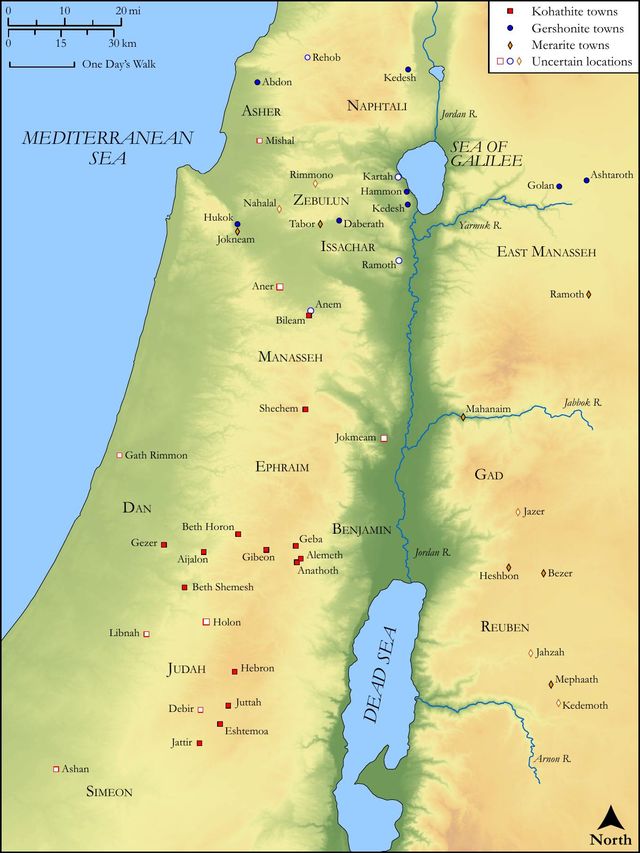
See on the biblical-era map
Study this verse
Public-domain commentary
Matthew Henry
From his Commentary on the Whole Bible. Henry comments on passages, not single verses — this entry covers 1 Chronicles 6:31–53. His two-level outline is real structure in the source text, so it is rendered as structure.
When the Levites were first ordained in the wilderness much of the work then appointed them lay in carrying and taking care of the tabernacle and the utensils of it, while they were in their march through the wilderness. In David's time their number was increased; and, though the greater part of them was dispersed all the nation over, to teach the people the good knowledge of the Lord, yet those that attended the house of God were so numerous that there was not constant work for them all; and therefore David, by special commission and direction from God, new-modelled the Levites, as we shall find in the latter part of this book. Here we are told what the work was which he assigned them.
I.Singing-work, Ch1 6:31.
David was raised up on high to be the sweet psalmist of Israel (Sa2 23:1), not only to pen psalms, but to appoint the singing of them in the house of the Lord (not so much because he was musical as because he was devout), and this he did after that the ark had rest. While that was in captivity, obscure, and unsettled, the harps were hung upon the willow-trees: singing was then thought unseasonable (when the bridegroom is taken away they shall fast); but the harps being resumed, and the songs revived, at the bringing up of the ark, they were continued afterwards. For we should rejoice as much in the prolonging of our spiritual privileges as in the restoring of them. When the service of the ark was much superseded by its rest they had other work cut out for them (for Levites should never be idle) and were employed in the service of song. Thus when the people of God come to the rest which remains for them above they shall take leave of all their burdens and be employed in everlasting songs. These singers kept up that service in the tabernacle till the temple was built, and then they waited on their office there, Ch1 6:32. When they came to that stately magnificent house they kept as close both to their office and to their order as they had done in the tabernacle. It is a pity that the preferment of the Levites should ever make them remiss in their business. We have here an account of the three great masters who were employed in the service of the sacred song, with their respective families; for they waited with their children, that is, such as descended from them or were allied to them, Ch1 6:33. Heman, Asaph, and Ethan, were the three that were appointed to this service, one of each of the three houses of the Levites, that there might be an equality in the distribution of this work and honour, and that every one might know his post, such an admirable order was there in this choir service.
1.Of the house of Kohath was Heman with his family (Ch1 6:33), a man of a sorrowful spirit, if it be the same Heman that penned the 88th psalm, and yet a singer. He was the grandson of Samuel the prophet, the son of Joel, of whom it is said that he walked not in the ways of Samuel (Sa1 8:2, Sa1 8:3); but it seems, though the son did not, the grandson did. Thus does the blessing entailed on the seed of the upright sometimes pass over one generation and fasten upon the next. And this Heman, though the grandson of that mighty prince, did not think it below him to be a precentor in the house of God. David himself was willing to be a door-keeper. Rather we may look upon this preferment of the grandson in the church as a recompense for the humble modest resignation which the grandfather made of his authority in the state. Many such ways God has of making up his people's losses and balancing their disgraces. Perhaps David, in making Heman the chief, had some respect to his old friend Samuel.
2.Of the house of Gershom was Asaph, called his brother, because in the same office and of the same tribe, though of another family. He was posted on Heman's right hand in the choir, Ch1 6:39. Several of the psalms bear his name, being either penned by him or tuned by him as the chief musician. It is plain that he was the penman of some psalms; for we read of those that praised the Lord in the words of David and of Asaph. He was a seer as well as a singer, Ch2 29:30. His pedigree is traced up here, through names utterly unknown, as high as Levi, Ch1 6:39-43.
3.Of the house of Merari was Ethan (Ch1 6:44), who was appointed to Heman's left hand. His pedigree is also traced up to Levi, Ch1 6:47. If these were the Heman and Ethan that penned the 88th and 89th psalms, there appears no reason here why they should be called Ezrahites (see the titles of those psalms), as there does why those should be called so who are mentioned Ch1 2:6, and who were the sons of Zerah.
II.There was serving-work, abundance of service to be done in the tabernacle of the house of God (Ch1 6:48), to provide water and fuel, - to wash and sweep, and carry out ashes, - to kill, and flay, and boil the sacrifices; and to all such services there were Levites appointed, those of other families, or perhaps those that were not fit to be singers, that had either no good voice or no good ear. As every one has received the gift, so let him minister. Those that could not sing must not therefore be laid aside as good for nothing; though they were not fit for that service, there was other service they might be useful in.
III.There was sacrificing-work, and that was to be done by the priests only, Ch1 6:49.
They only were to sprinkle the blood and burn the incense; as for the work of the most holy place, that was to be done by the high priest only. Each had his work, and they both needed one another and both helped one another in it. Concerning the work of the priests we are here told,
1.What was the end they were to have in their eye. They were to make an atonement for Israel, to mediate between the people and God; not to magnify and enrich themselves, but to serve the public. They were ordained for men.
2.What was the rule they were to have in their eye. They presided in God's house, yet must do as they were bidden, according to all that God commanded. That law the highest are subject to.
Historical interpretation
Historical reception
3 surviving comments on this verse. Each one is dated, so this reads as a timeline rather than a list.
The Chronicles also speak about the tabernacle because a temple of the Lord had not yet been built by either Samuel or David. The text also adds that that the holy services were held in the tabernacle. Worship was observed at that time according to the number of the days of the week. For it also says, “and their kindred who were in their villages were obliged to come in every seven days, in turn, to be with them.” With regard to the holy utensils it says, “Some of them had charge of the utensils of service, for they were required to count them when they were brought in and taken out. Others of them were appointed over the furniture, and over all the holy utensils, also over the choice flour, the wine, the oil, the incense and the spices.” And about the priests it says, “Others, of the sons of the priests, prepared the mixing of the spices.” With regard to the tomb of Saul the Chronicles gives us much information, and in the Book of Kings itself we read that his bones were gathered and buried in the land of Jabesh.
There is abundant information in the books of Chronicles which were written to continue the books of the Kings and to preserve the memory of such important events. The first book begins with a genealogy that sets out to demonstrate how the human race came from a single man. Since it focuses only on the single kingdom of Judah, it can tell us about its cities and the villages, and from where they took their names. Here we come to know Nathan, from whom the blessed Luke constructed the beginning of his genealogy of our Lord and Savior, Son of David and Solomon’s brother4 on his mother’s side: “The following children were born to him in Jerusalem: Shimeah, Shobab, Nathan and Solomon, that is, the four children he fathered with Bersabea, daughter of Ammiel.” And Rechab6 herself, who is mentioned in many books of Scripture, is said to have come from the tribe of Judah.It also clearly explains why Reuben lost his birthright and Joseph gained it and also, finally, the reason why the tribe of Judah obtained the highest honor: “The sons of Reuben the firstborn of Israel. He was the firstborn, but because he defiled his father’s bed his birthright was given to the sons of Joseph son of Israel, so that he is not enrolled in the genealogy according to the birthright; though Judah became prominent among his brothers and a ruler came from him, yet the birthright belonged to Joseph.” It also explains the reason why such a great honor was conceded to Joseph. By the will of God Judah had the dignity of receiving the Lord who was born from him according to the flesh. This is the sense tacitly expressed with the words “a leader from him.” Indeed the passage seems to assert that not only the kings of the earth derived from Judah, but also the eternal king himself who had no beginning and will never end.
It also describes the situation of the tribes beyond the Jordan, those of Reuben and Gad, and even the tribes of Manasseh which later were received into those of the Hagarites and the Itureans, and talks about the tribes of the Naphiseans, and all those peoples who entered into conflict with them. In addition the text relates how they fought and won, and made the Hagarites flee. And it also reports the reason for the victory: “When they received help against them, the Hagarites and all who were with them were given into their hands, for they cried to God in the battle, and he granted their entreaty because they trusted in him.” It also describes the amount of the spoils of war: “They captured their livestock: 50, of their camels, 250, sheep, 2, donkeys and 100, captives. Many were slain because the war was from God. And they lived in their territory until the exile.”
The genealogy of the priests and the Levites comes after this. It relates that Zadok, who was high priest at the time of David, had been the eleventh from Aaron; that Azariah, nephew of Zadok, had been the first to receive the priestly anointing in the temple built by Solomon. Among them there was also Jehozadak, who was brought to Babylon as a war prisoner. Jesus9 was his son, a high priest as well, who delivered the people from bondage together with Zerubbabel, and built a temple for the Lord. Here we also learn that Korah, who revolted against the great Moses, was a nephew of Isaar, son of Caath and brother of Amram, Aaron’s and Moses’ father. According to this lineage he was related to the first legislator. But he himself paid in the desert for his errors, although his children did not share the punishment of their father. From here Samuel13 came and then Aeman, who intoned Psalms and was a nephew of the prophet Samuel. In fact he was the son of Joel, son of Samuel. On the other hand, Asaph, one of the singers, came from the lineage of Gerson, son of Levi and brother of Caath. Aetham, who also belonged to the group of the singers, had Merari, the third son of Levi, as great-grandfather.The text also explains the difference between the priests and the Levites. It relates that the Levites were initiated into all the ministries of the holy altar of God: “But Aaron and his sons made offerings on the altar of burnt offering and on the altar of incense, doing all the work of the most holy place, to make atonement for Israel, according to all that Moses the servant of God had commanded.” It seems to me, in fact, that this book was written after the return from Babylon. For this reason it also talks about the bondage and explains its cause: “So all Israel was enrolled by genealogies; and these are written in the book of the Kings of Israel. And Judah was taken into exile in Babylon because of their unfaithfulness. Now the first to live again in their possessions in their towns were Israelites, priests, Levites, and temple servants.” These accounts show that the book was begun after the captivity. Indeed no historian ever relates facts that happened afterwards, but what happened before or during his times. And actually only the prophets have the power to foretell the future. In addition it says that also those who had inhabited that land before them had been enslaved. And actually many of them still live with them: the Canaanites, Chettites, Jebusites, who had been their companions in such a misfortune. Also the priests and the Levites were brought into captivity with the Israelites. I believe that those who were called “the saints’ servants” were then called Nathinim. Many of them, in fact, consecrated themselves to the ministries of the priests and the Levites. There were among them also those who were entrusted with the carrying of the water, the gathering of wood and other necessary duties. Indeed, if it was imposed to the Gabaonites, who were foreigners, to follow Joshua in the praises and to perform some works as porters or carpenters, this task was even more the duty of the Israelites. As a proof of this I have found in the interpretation of Hebrew names that this name means “house of Iaō,” that is, “of the God who is.” The text, in fact, mentions the children of Israel and among them Judah and Benjamin, and Ephraim18 and Manasseh. It also mentions the priests and the Levites, who inhabited those cities. About the Korēnites it says that they derived from Korah. It also says that among them there had been the guardians of the temple of God as well, and it seems that this custom had been introduced by Samuel and David. “All these, who were chosen as gatekeepers at the thresholds, were two hundred twelve. They were enrolled by genealogies in their villages. David and the prophet Samuel established them in their office of trust. So they and their descendants were in charge of the gates of the house of the Lord, that is, the house of the tent, as guards. The gatekeepers were on the four sides, east, west, north, and south.”
Continue studying 1 Chronicles 6:48 across the web’s major study libraries — every link below opens this exact verse, chapter, or book on the destination site.
Read & Compare
 BibleGatewayThis verse in more than 200 translations and 70 languages.
 Bible.comThe YouVersion reader — hundreds of translations, reading plans, and highlights.
 ESV.orgCrossway's official English Standard Version reader.
 NET BibleThe NET translation with 60,000+ translators' notes on every rendering decision.
 STEP BibleTyndale House's free study tool — original text, vocabulary, and scholarly resources.
 BibliaLogos Bible Software's free web reader.
 USCCBThe New American Bible (Revised Edition) with the U.S. bishops' study notes.
Commentaries
 BibleHub CommentariesDozens of classic commentaries on this verse, gathered on one page.
 StudyLightMore than 100 commentary sets — the largest collection on the web.
 BibleRefPlain-English commentary on what this verse means, verse by verse.
 Enduring WordDavid Guzik's free commentary on this chapter, widely used by Bible teachers.
 Bible Study ToolsVerse commentary alongside Greek and Hebrew study aids.
Original Language & Research
- BibleHub InterlinearThe verse word by word — original language, transliteration, and English.
- BibleHub LexiconEvery word's original-language definition and Strong's entry.
 Blue Letter BibleDeep-study tools — Strong's numbers, concordance, and word studies.
 SefariaThe Hebrew text with Rashi and centuries of Jewish commentary.
Sermons, Hymns & Audio


TrulyRandomVerse is not affiliated with these sites and doesn’t control their content. They’re linked because they’re genuinely useful.
Summary
This verse from 1 Chronicles 6:48 succinctly describes the divinely appointed and comprehensive responsibilities of the non-priestly Levites, distinguishing them from the Aaronite priests. It highlights their essential, mandated roles in maintaining and serving God's dwelling place, whether the portable Tabernacle or the more permanent Temple, underscoring the meticulous divine order established for Israelite worship.
Context
ShowHideLiterary Context
This verse is strategically placed within a lengthy and detailed genealogical record in 1 Chronicles 6, specifically focusing on the lineage and roles of the Levites. The Chronicler, writing for a post-exilic community, meticulously traces the priestly line of Aaron (e.g., 1 Chronicles 6:1-15 and 1 Chronicles 6:50-53). Following this, he elaborates on the other Levitical families—Kohath, Gershon, and Merari—and their designated functions (e.g., 1 Chronicles 6:16-49). Verse 48 serves as a concise summary statement for the broader Levitical duties, following the detailed listing of their ancestors and their specific assignments related to the sanctuary. It broadens the scope beyond the sacrificial duties of the priests to encompass the vital, comprehensive support services performed by their "brethren," emphasizing that all aspects of temple service were divinely ordered and essential for proper worship.
Historical & Cultural Context
The book of 1 Chronicles was likely composed during the Persian period, after the return of the exiles to Judah. At this time, there was a strong emphasis on re-establishing proper worship, rebuilding the Temple, and restoring the divinely ordained roles of the priesthood and the Levites. The Chronicler's detailed genealogies and descriptions of temple service served to legitimize the returning community's claims to their heritage and roles, providing a blueprint for proper worship based on ancient Mosaic patterns. Culturally, the distinction between priests (descendants of Aaron, performing sacrificial rites) and Levites (descendants of Levi, but not Aaron, performing various support roles) was crucial for the orderly functioning of the sanctuary. The phrase "tabernacle of the house of God" is particularly significant, bridging the historical reality of the portable wilderness Tabernacle with the more permanent Temple in Jerusalem, emphasizing the continuity of divine presence and prescribed worship practices across generations. This continuity was vital for a community seeking to reconnect with its spiritual heritage.
Key Themes
ShowHideThe verse powerfully underscores several major theological and narrative themes prevalent in 1 Chronicles and the broader Old Testament. Firstly, it highlights Divine Appointment and Order, emphasizing that the Levites' roles were not self-selected but specifically "appointed" by God, reflecting the meticulous divine ordering of worship and service in ancient Israel. This divine blueprint ensured that the worship of God was carried out with dignity, precision, and holiness, reflecting His character (compare the detailed instructions in Numbers 3). Secondly, the phrase "all manner of service" speaks to the Comprehensive Nature of Worship and Service. The non-priestly Levites performed a wide array of duties, from caring for sanctuary furnishings, transporting its components during journeys, maintaining the grounds, preparing elements for sacrifice, to serving as musicians, gatekeepers, and treasurers in the later Temple period (e.g., 1 Chronicles 9:26-32). Their work was foundational, enabling the priests to perform their sacred rites. Lastly, the mention of "the tabernacle of the house of God" emphasizes the Continuity of Worship and God's Dwelling. The Chronicler often bridges the wilderness Tabernacle and the Jerusalem Temple, showing that the principles established under Moses were carried forward and expanded in the permanent "house of God" built by Solomon (see 1 Kings 6:1). The Levites' roles were crucial in both phases of Israel's worship life, providing a consistent framework for approaching a holy God.
Exposition and Analysis
ShowHideKey Word Analysis
ShowHideThe Hebrew verb נָתַן (H5414, nâthan), meaning "to give, put, set, appoint," carries the strong connotation of divine initiative and authorization. It implies that the Levites' roles were not a matter of human choice, tradition, or convenience, but rather a direct divine mandate. This highlights the sacred nature of their service and its rootedness in God's sovereign will for His people's worship. The passive voice ("were appointed") further emphasizes that God was the one who "gave" or "set" them in this position.
The term לֵוִיִּים (H3881, Lêvîyîy) refers to the descendants of Levi, one of Jacob's twelve sons. While the priests were a specific subset of the Levites (descendants of Aaron, from the Kohathite clan), "Levites" in this context refers to the broader tribe, excluding the Aaronite priests. This distinction is crucial, as it clarifies that beyond the priestly sacrificial duties, there was a vast and diverse range of other essential services performed by the rest of the Levitical tribe, all dedicated to the sanctuary.
The Hebrew word עֲבֹדָה (H5656, ʻăbôdâh), meaning "work of any kind; act, labour, ministering(-try), office, service," emphasizes the comprehensive and exhaustive nature of their duties. The phrase "all manner of service" (Hebrew: kol-ʻăbôdâh) signifies that no task related to the sanctuary was outside their purview, from the most visible to the most mundane. This underscores the holistic commitment required for the proper functioning of God's house and the foundational importance of every role, regardless of its perceived prominence.
Verse Breakdown
ShowHide"Their brethren also the Levites"
This opening phrase immediately establishes the relationship of the non-priestly Levites to the priests, who were also descendants of Levi (their "brethren"). It clarifies that while the priests had specific, unique duties related to sacrifice and atonement, the broader Levitical family had their own distinct, yet equally vital, roles within the sacred economy of Israel's worship. This highlights the comprehensive nature of the Levitical tribe's dedication to God's service, emphasizing that the entire tribe of Levi was set apart for sanctuary duties, though with different functions.
"[were] appointed unto all manner of service"
The passive voice "were appointed" (implied from the Hebrew nātan) powerfully conveys that their roles were not self-chosen or merely traditional, but divinely mandated and established. This divine appointment underscores the sacredness and authority behind their tasks. The phrase "all manner of service" underscores the breadth and depth of their responsibilities, encompassing everything from the physical maintenance of the sanctuary, its furnishings, and grounds, to logistical support, musical worship, gatekeeping, and treasury management. This emphasizes that every task, no matter how seemingly minor, was part of God's holy design for worship.
"of the tabernacle of the house of God"
This crucial phrase connects the Levites' service directly to God's dwelling place. By combining "tabernacle" (Hebrew: H4908, mishkân, the portable sanctuary used during the wilderness wanderings and early settlement) with "house of God" (Hebrew: H1004, bayith, and H430, ʼĕlôhîym, typically referring to the more permanent Temple in Jerusalem), the Chronicler stresses the unbroken continuity of their service across different historical periods and architectural forms. It signifies that the core purpose of their appointment was to facilitate and maintain the sacred space where God's presence resided among His people, ensuring that worship could be conducted according to divine specifications, whether in the wilderness or in Jerusalem.
Literary Devices
ShowHideThe Chronicler's writing in 1 Chronicles 6:48 employs several literary devices to convey its message with precision and theological depth. The use of Emphasis is clear in the concise yet comprehensive statement of Levitical duties, underscoring their importance within the divine economy. The phrase "all manner of service" functions as a form of Synecdoche, where a part (all types of service) represents the whole (the entire scope of their duties), or even a mild Hyperbole, to stress the exhaustive nature of their responsibilities. More significantly, the unique combination "tabernacle of the house of God" serves as a powerful instance of Merism or Bridging Language. By conjoining two distinct historical realities—the portable Tabernacle and the permanent Temple—into a single concept, the Chronicler emphasizes the Continuity of God's dwelling place and the unchanging nature of the Levites' service across generations. This linguistic bridge reinforces the Chronicler's broader theological agenda of establishing the legitimacy and enduring relevance of Israel's divinely ordained worship practices from the Mosaic era to the post-exilic community.
Theological and Thematic Connections
ShowHideThe divine appointment of the Levites to "all manner of service" in God's dwelling place carries profound theological implications that extend beyond ancient Israel. It underscores the biblical principle that all service rendered to God and His community is valuable and divinely ordained, regardless of its visibility or perceived status. Just as the Levites' "behind-the-scenes" work enabled the priests to perform their sacred rites, so too in the New Covenant, every member of the body of Christ is gifted and called to contribute to the functioning and flourishing of God's spiritual house, the church. This highlights God's meticulous design for corporate worship and community life, where diverse gifts and roles are harmoniously integrated for His glory. It challenges believers to recognize the sacredness of every task performed in faith, understanding that true worship extends beyond ritual to encompass every act of obedient service, reflecting God's order and purpose for His people.
Reflection and Application
ShowHide1 Chronicles 6:48 offers a timeless truth about the nature of service within God's economy. It reminds us that God is a God of order, and He meticulously appoints individuals to specific roles within His "house," whether it was the ancient Tabernacle/Temple or the contemporary church, which is often described as God's household or spiritual temple. The "all manner of service" performed by the Levites teaches us that every task, from the most visible leadership roles to the seemingly mundane acts of maintenance, administration, or hospitality, is vital and contributes to the overall health and effectiveness of the community of faith. This verse encourages us to value and affirm those who serve faithfully in less prominent roles, recognizing that their contributions are as essential as any other. It also prompts us to consider our own "appointment" by God—what gifts and callings has He given us, and how are we faithfully employing them for the service of His kingdom? Our service, like that of the Levites, should be characterized by diligence, humility, and a recognition that we are serving the Lord Himself, not merely people.
Questions for Reflection
ShowHideFAQ
ShowHideWhat was the primary difference between the priests and the Levites in ancient Israel?
ShowHideThe primary difference lay in their lineage and their specific, divinely appointed duties related to the sanctuary. The priests were a specific subset of the Levites, descended exclusively from Aaron, the brother of Moses. Their unique role was to perform the sacrificial rites, offer incense, bless the people, and mediate between God and Israel, entering the most holy places of the Tabernacle and later the Temple. The broader group of Levites, while also descendants of Levi, were not from the direct line of Aaron. Their "all manner of service" involved a wide range of support roles for the sanctuary, including carrying and assembling the Tabernacle, guarding its precincts, maintaining its furnishings, preparing elements for sacrifice, serving as musicians, gatekeepers, treasurers, and scribes. Essentially, the priests handled the sacred rituals directly, while the other Levites managed the logistics, maintenance, and various support functions that enabled the priests to perform their duties and the sanctuary to operate effectively.
Why does the Chronicler emphasize the roles of the Levites so heavily in 1 Chronicles?
ShowHideThe Chronicler, writing for a post-exilic community, had several key purposes for emphasizing the roles of the Levites. Firstly, it was crucial for re-establishing proper worship in Jerusalem after the return from Babylonian exile. The detailed genealogies and descriptions of service provided a blueprint for restoring the divinely ordained order of the Tabernacle/Temple worship, ensuring that practices adhered to Mosaic law. Secondly, it served to legitimize the roles and claims of the returning priests and Levites, tracing their lineage back to their divinely appointed ancestors. This was vital for a community seeking to re-establish its identity and authority. Thirdly, the Chronicler sought to highlight the continuity of God's covenant and presence from the wilderness Tabernacle through the Temple to their present day, emphasizing that the Levites' service was an enduring aspect of God's plan for His people. By detailing their "all manner of service," the Chronicler underscored that every role, no matter how seemingly mundane, was essential for the functioning of God's house and was part of His meticulous design for His people's worship.
Christ-Centered Fulfillment
ShowHideThe comprehensive and divinely appointed service of the Levites in 1 Chronicles 6:48 powerfully foreshadows the ultimate and perfect service of Jesus Christ. While the Levites served in a physical tabernacle and temple, Christ is the true and ultimate Temple of God, in whom God's presence fully dwells. The Levites' diligent service of maintenance, preparation, and guardianship pointed to the One who would perfectly fulfill all righteousness and establish a new covenant. Jesus, as our great High Priest, transcends the Levitical priesthood, offering a once-for-all sacrifice that truly cleanses from sin, unlike the repeated sacrifices the Levites helped facilitate (compare Hebrews 7:23-27). Moreover, Christ's entire life was the epitome of service; He did not come to be served, but "to serve, and to give his life as a ransom for many" (Matthew 20:28). His humble act of washing His disciples' feet (see John 13:1-17) exemplifies the "all manner of service" He undertook for humanity. Through His perfect obedience and sacrifice, Christ has inaugurated a new order where all believers, by virtue of their union with Him, become a "royal priesthood" (1 Peter 2:9), called to offer spiritual sacrifices and engage in "all manner of service" for the building up of His church and the glory of God, empowered by the Holy Spirit.