


1 Chronicles 16:19
- בִּהְיוֹתְכֶםbih·yot·Khemwhen were youH1961Prep-b ¦ V-Qal-Inf ¦ 2mpVerb Qal Infinitive Constructבִּwhenהְיוֹתְwereכֶםyou
- מְתֵיme·Teimen ofH4962N-mpcNoun Plural Masculine Construct
- מִסְפָּרmis·ParnumberH4557N-msNoun Singular Masculine Absolute
- כִּמְעַטkim·'Atlike a fewH4592Prep-k ¦ N-msNoun Singular Masculine Absoluteכִּlikeמְעַטa few
- וְגָרִיםve·ga·Rimand sojournersH1481Conj-w ¦ V-Qal-Prtcpl-mpVerb Qal Participle Plural Masculine Absoluteוְandגָרִיםsojourners
- בָּהּBahin itPrep-b ¦ 3fsSuffix Personal 3rd Singular Feminineבָּinהּit
English is a literal word-by-word gloss of the Hebrew, not the KJV's wording. Why?
This is the original text the KJV's translators worked from — each Hebrew word with its own literal English meaning in this verse, prepared by scholars at Tyndale House, Cambridge. The KJV translates whole sentences, not word by word, so its wording differs: one Hebrew word can become several English words, and the KJV may choose “the LORD” where the gloss reads “Yahweh”. Both are faithful — they answer different questions. For the KJV's own rendering, switch to the KJV text.
Details
See on the biblical-era map
Study this verse
Public-domain commentary
Matthew Henry
From his Commentary on the Whole Bible. Henry comments on passages, not single verses — this entry covers 1 Chronicles 16:7–36.
We have here the thanksgiving psalm which David, by the Spirit, composed, and delivered to the chief musician, to be sung upon occasion of the public entry the ark made into the tent prepared for it. Some think he appointed this hymn to be daily used in the temple service, as duly as the day came; whatever other psalms they sung, they must not omit this. David had penned many psalms before this, some in the time of his trouble by Saul. This was composed before, but was now first delivered into the hand of Asaph, for the use of the church. It is gathered out of several psalms (from the beginning to Ch1 16:23 is taken from Psa 105:1, etc.; and then Ch1 16:23 is the whole 96th psalm, with little variation; Ch1 16:34 is taken from Psa 136:1 and divers others; and then the last two verses are taken from the close of Ps. 106), which some think warrants us to do likewise, and make up hymns out of David's psalms, a part of one and a part of another put together so as may be most proper to express and excite the devotion of Christians. These psalms will be best expounded in their proper places (if the Lord will); here we take them as they are put together, with a design to thank the Lord (Ch1 16:7), a great duty, to which we need to be excited and in which we need to be assisted. 1. Let God be glorified in our praises; let his honour be the centre in which all the lines meet. Let us glorify him by our thanksgivings (Give thanks to the Lord), by our prayers (Call on his name, Ch1 16:8), by our songs (Sing psalms unto him), by our discourse - Talk of all his wondrous works, Ch1 16:9. Let us glorify him as a great God, and greatly to be praised (Ch1 16:25), as supreme God (above all gods), as sole God, for all others are idols, Ch1 16:26. Let us glorify him as most bright and blessed in himself (Glory and honour are in his presence, Ch1 16:27), as creator (The Lord made the heavens), as the ruler of the whole creation (His judgments are in all the earth, Ch1 16:14), and as ours - He is the Lord our God. Thus must we give unto the Lord the glory due to his name (Ch1 16:28, Ch1 16:29), and own it, and much more, his due. 2. Let other be edified and instructed: Make known his deeds among the people (Ch1 16:8), declare his glory among the heathen (Ch1 16:24), that those who are strangers to him may be led into acquaintance with him, allegiance to him, and the adoration of him. Thus must we serve the interests of his kingdom among men, that all the earth may fear before him, Ch1 16:30. 3. Let us be ourselves encouraged to triumph and trust in God. Those that give glory to God's name are allowed to glory in it (Ch1 16:10), to value themselves upon their relation to God and venture themselves upon his promise to them. Let the heart of those rejoice that seek the Lord, much more of those that have found him. Seek him, and his strength, and his face: that is, seek him by the ark of his strength, in which he manifests himself. 4. Let the everlasting covenant be the great matter of our joy and praise (Ch1 16:15): Be mindful of his covenant. In the parallel place it is, He will be ever mindful of it, Psa 105:8. Seeing God never will forget it, we never must. The covenant is said to be commanded, because God has obliged us to obey the conditions of it, and because he has both authority to make the promise and ability to make it good. This covenant was ancient, yet never to be forgotten. It was made with Abraham, Isaac, and Jacob, who were long since dead (Ch1 16:16-18), yet still sure to the spiritual seed, and the promises of it pleadable. 5. Let God's former mercies to his people of old, to our ancestors and our predecessors in profession, be commemorated by us now with thankfulness to his praise. Let it be remembered how God protected the patriarchs in their unsettled condition. When they came strangers to Canaan and were sojourners in it, when they were few and might easily have been swallowed up, when they were continually upon the remove and so exposed, when there were many that bore them ill-will and sought to do them mischief, yet no man was suffered to do them wrong - not the Canaanites, Philistines, Egyptians. Kings were reproved and plagued for their sakes. Pharaoh was so, and Abimelech. They were the anointed of the Lord, sanctified by his grace, sanctified by his glory, and had received the unction of the Spirit. They were his prophets, instructed in the things of God themselves and commissioned to instruct others (and prophets are said to be anointed, Kg1 19:16; Isa 61:1); therefore, if any touch them, they touch the apple of God's eye; if any harm them, it is at their peril, Ch1 16:19-22. 6. Let the great salvation of the Lord be especially the subject of our praises (Ch1 16:23): Show forth from day to day his salvation, that is (says bishop Patrick), his promised salvation by Christ. We have reason to celebrate that from day to day; for we daily receive the benefits of it, and it is a subject that can never be exhausted. 7. Let God be praised by a due and constant attendance upon him in the ordinances he has appointed: Bring an offering, then the fruit of the ground, now the fruit of the lips, of the heart (Heb 13:15), and worship him in the beauty of holiness, in the holy places and in a holy manner, Ch1 16:29. Holiness is the beauty of the Lord, the beauty of all sanctified souls and all religious performances. 8. Let God's universal monarchy be the fear and joy of all people. Let us reverence it: Fear before him, all the earth. And let us rejoice in it: Let the heavens be glad and rejoice, because the Lord reigns, and by his providence establishes the world, so that, though it be moved, it cannot be removed, nor the measures broken which Infinite Wisdom has taken in the government of it, Ch1 16:30, Ch1 16:31. 9. Let the prospect of the judgment to come inspire us with an awful pleasure, Let earth and sea, fields and woods, though in the great day of the Lord they will all be consumed, yet rejoice that he will come, doth come, to judge the earth, Ch1 16:32, Ch1 16:33. 10. In the midst of our praises we must not forget to pray for the succour and relief of those saints and servants of God that are in distress (Ch1 16:35): Save us, gather us, deliver us from the heathen, those of us that are scattered and oppressed. When we are rejoicing in God's favours to us we must remember our afflicted brethren, and pray for their salvation and deliverance as our own. We are members one of another; and therefore when we mean, "Lord, save them," it is not improper to say, "Lord, save us." Lastly, Let us make God the Alpha and Omega of our praises. David begins with (Ch1 16:8), Give thanks to the Lord; he concludes (Ch1 16:36), Blessed be the Lord. And whereas in the place whence this doxology is taken (Psa 106:48) it is added, Let all the people say, Amen, Hallelujah, here we find they did according to that directory: All the people said, Amen, and praised the Lord. When the Levites had finished this psalm or prayer and praise, then, and not till then, the people that attended signified their consent and concurrence by saying, Amen, And so they praised the Lord, much affected no doubt with this newly instituted way of devotion, which had been hitherto used in the schools of the prophets only, Sa1 10:5. And, if this way of praising God please the Lord better than an ox or a bullock that has horns and hoofs, the humble shall see it and be glad, Psa 69:31, Psa 69:32.
Continue studying 1 Chronicles 16:19 across the web’s major study libraries — every link below opens this exact verse, chapter, or book on the destination site.
Read & Compare
 BibleGatewayThis verse in more than 200 translations and 70 languages.
 Bible.comThe YouVersion reader — hundreds of translations, reading plans, and highlights.
 ESV.orgCrossway's official English Standard Version reader.
 NET BibleThe NET translation with 60,000+ translators' notes on every rendering decision.
 STEP BibleTyndale House's free study tool — original text, vocabulary, and scholarly resources.
 BibliaLogos Bible Software's free web reader.
 USCCBThe New American Bible (Revised Edition) with the U.S. bishops' study notes.
Commentaries
 BibleHub CommentariesDozens of classic commentaries on this verse, gathered on one page.
 StudyLightMore than 100 commentary sets — the largest collection on the web.
 BibleRefPlain-English commentary on what this verse means, verse by verse.
 Enduring WordDavid Guzik's free commentary on this chapter, widely used by Bible teachers.
 Bible Study ToolsVerse commentary alongside Greek and Hebrew study aids.
Original Language & Research
- BibleHub InterlinearThe verse word by word — original language, transliteration, and English.
- BibleHub LexiconEvery word's original-language definition and Strong's entry.
 Blue Letter BibleDeep-study tools — Strong's numbers, concordance, and word studies.
 SefariaThe Hebrew text with Rashi and centuries of Jewish commentary.
Sermons, Hymns & Audio


TrulyRandomVerse is not affiliated with these sites and doesn’t control their content. They’re linked because they’re genuinely useful.
Summary
1 Chronicles 16:19, a poignant line from David's psalm of thanksgiving, celebrates God's profound and enduring faithfulness to Israel during their most vulnerable and nascent period. It vividly recalls the time when the nascent nation was merely a small, nomadic family, sojourning without a permanent home in a land not yet fully theirs, highlighting God's miraculous preservation and covenant keeping despite their numerical insignificance and precarious status.
Context
ShowHideLiterary Context
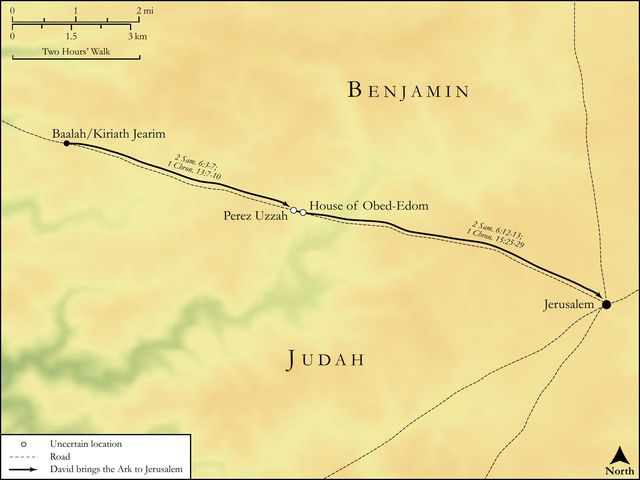
This verse is embedded within a lengthy psalm of thanksgiving 1 Chronicles 16:8-36 that King David proclaimed when the Ark of the Covenant was brought to Jerusalem. This psalm parallels much of Psalm 105, serving as a historical recounting of God's mighty acts and covenant promises to Israel from their earliest beginnings. The specific section from 1 Chronicles 16:15-22 focuses on God's covenant with Abraham, Isaac, and Jacob, and His protective care over them as they journeyed through various lands. Verse 19, therefore, serves as a crucial reminder of Israel's humble origins, setting the stage for the subsequent recounting of God's miraculous interventions on their behalf.
Historical & Cultural Context
The verse directly refers to the patriarchal era, encompassing the lives of Abraham, Isaac, and Jacob. During this period, the descendants of Abraham were indeed "but few, even a few"—a small, extended family unit rather than a numerous nation. They were "strangers" (Hebrew: gerim) because they were sojourners in the land of Canaan, which was promised to them but not yet possessed. They did not own significant territory, held no political power, and were often at the mercy of more powerful local inhabitants, as seen in accounts like Abraham's sojourn in Egypt or Isaac's interactions in Gerar. Their existence was precarious, marked by constant movement and reliance on divine provision and protection in a culturally and religiously diverse region.
Key Themes
ShowHideThe primary message conveyed by this verse is God's unwavering faithfulness to His covenant people, even when they were numerically insignificant and utterly vulnerable. It underscores the theme of divine protection and providence, demonstrating God's sovereign control over nations and circumstances to safeguard His chosen few, as highlighted in 1 Chronicles 16:21-22. Furthermore, it emphasizes Israel's humble beginnings, a recurring motif in biblical theology that God often chooses and works through the seemingly weak or insignificant to accomplish His great purposes, echoing the sentiment found in Deuteronomy 7:7. This historical reflection also serves as a powerful reminder of God's covenant remembrance, assuring the people of David's time—and us—that God remembers and fulfills His promises across generations.
Exposition and Analysis
ShowHideKey Word Analysis
ShowHideFrom the root meaning "to number," this word denotes a definite or indefinite number, often implying scarcity. In this context, it emphasizes the quantitative insignificance of the early Israelite family units, highlighting their numerical smallness and the miraculous nature of their survival and growth into a nation.
This term signifies "a little or few," often used adverbially to emphasize scarcity or smallness. Its repetition in the phrase "even a few" intensifies the sense of numerical scarcity, underscoring the extreme vulnerability of the patriarchs and their families.
This primitive root means "to turn aside from the road," implying sojourning as a guest or alien. It refers to their transient status in the land of Canaan, which was promised to them but not yet fully inherited. As gerim, they lacked permanent land ownership, political rights, and often social standing, making them dependent on the goodwill of local inhabitants or, more profoundly, on the direct protection and provision of God.
Verse Breakdown
ShowHide"When ye were but few, even a few"
This clause vividly recalls the early stages of Israel's history, specifically the patriarchal period. It emphasizes the numerical insignificance of Abraham, Isaac, Jacob, and their immediate families. This smallness highlights that Israel's existence and future growth were not due to their own strength or numbers, but solely to God's sovereign choice and promise. The repetition of "few" serves to underscore this profound numerical scarcity, setting the stage for God's miraculous intervention.
"and strangers in it"
This phrase describes their status as sojourners or temporary residents in the land of Canaan. They did not possess the land as a nation, but moved within it, often at the mercy of more powerful local populations. This precarious, non-landed status further emphasizes their complete dependence on God for protection, provision, and the eventual fulfillment of the land promise. It sets the stage for God's miraculous interventions on behalf of His vulnerable covenant people, who had no inherent claim or power in the land.
Literary Devices
ShowHideThe verse employs several literary devices to enhance its impact and convey its profound theological message. Repetition is prominently featured with "few, even a few," serving to emphasize the extreme numerical insignificance of early Israel and thereby magnify the greatness of God's protective power. This also functions as a form of hyperbole, stressing their smallness to highlight the vastness of God's faithfulness and the miraculous nature of their preservation. The verse uses historical allusion, referencing the patriarchal era without explicitly naming the patriarchs, relying on the audience's familiarity with their foundational history. Furthermore, there's an element of understatement in describing their vulnerability; being "strangers" and "few" paints a picture of extreme weakness, making God's subsequent acts of protection and covenant fulfillment all the more profound and miraculous.
Theological and Thematic Connections
ShowHide1 Chronicles 16:19 profoundly illustrates God's unwavering commitment to His covenant promises, irrespective of human strength or circumstances. It establishes a foundational theological truth: God's faithfulness is not contingent on the power, numbers, or resources of His people, but solely on His own character and word. He often chooses the weak and the few to demonstrate His omnipotence, ensuring that His glory is magnified through their preservation and growth. This pattern of divine election and protection for the vulnerable is a recurring motif throughout biblical history, reminding believers that their security and success rest entirely in God's sovereign hand, not in their own perceived strength or societal standing.
Reflection and Application
ShowHideThis verse offers profound encouragement for believers today, reminding us that God's power and faithfulness are not limited by our perceived weaknesses, numerical insignificance, or transient circumstances. When we feel overwhelmed, small, or like "strangers" in a hostile world, 1 Chronicles 16:19 calls us to remember God's steadfast care for His people from their very beginnings. It encourages us not to despise humble beginnings in our personal lives, ministries, or callings, but to trust that God often works through the seemingly insignificant to accomplish His grand purposes. Recounting God's past faithfulness, both in biblical history and in our own lives, builds confidence and hope for the future, fostering a deeper reliance on His provision and protection, knowing that His promises are sure.
Questions for Reflection
ShowHideFAQ
ShowHideWhat period of Israelite history does this verse primarily refer to?
ShowHideThis verse primarily refers to the patriarchal period of Israel's history, encompassing the lives of Abraham, Isaac, and Jacob. During this time, the descendants of Abraham were a small, nomadic family unit, not yet a numerous nation, and they dwelt as sojourners or "strangers" in the land of Canaan, which God had promised to them but they did not yet fully possess.
Why is it important for David's psalm to highlight Israel's humble beginnings?
ShowHideHighlighting Israel's humble beginnings serves several crucial purposes. Firstly, it underscores God's sovereign choice and faithfulness, demonstrating that Israel's very existence, survival, and future success were solely due to divine promise and protection, not their own strength or numbers. This reinforces the theme of utter dependence on God from the very start. Secondly, it provides a powerful historical foundation for the covenant relationship, reminding the people that God remembers and fulfills His promises across generations, even when circumstances seem impossible. It sets a precedent for God working through the weak to display His power, as seen throughout the biblical narrative, for example, in Gideon's small army.
How does this verse connect with the broader narrative of God's covenant with Israel?
ShowHideThis verse is deeply connected to the broader narrative of God's covenant with Israel, particularly the Abrahamic covenant established in Genesis 12:1-3. God promised to make a great nation from Abraham, even though he was childless and old. This verse reminds the audience that God began fulfilling that promise when Abraham's descendants were still "few" and "strangers," without a homeland. It emphasizes God's unwavering commitment to His covenant, demonstrating His power to bring about His promises despite human limitations, and setting the stage for the miraculous growth and deliverance that would follow, leading to the establishment of the nation of Israel. It serves as a powerful reminder that God's promises are not dependent on human capacity but on His divine power and unwavering faithfulness.
Christ-Centered Fulfillment
ShowHideThe profound truth of God's faithfulness to the "few" and "strangers" in 1 Chronicles 16:19 finds its ultimate and most glorious fulfillment in Jesus Christ and the establishment of His kingdom. Just as ancient Israel began as an insignificant, vulnerable family, the Kingdom of God inaugurated by Christ also began in humble, seemingly weak circumstances. Jesus Himself came not as a mighty king but as a humble servant, born in obscurity, described by Isaiah 53:2-3 as having "no beauty or majesty to attract us to him, nothing in his appearance that we should desire him." His first followers were a small band of ordinary people, yet from this "few" would grow a movement that would transform the world, much like the mustard seed growing into the largest of garden plants as described in Matthew 13:31-32. Furthermore, believers in Christ are often described as "strangers" and "sojourners" in this world (1 Peter 2:11), whose true citizenship is in heaven (Philippians 3:20). Yet, through Christ, these former "strangers" and "aliens" have been brought near and made fellow citizens with God's people (Ephesians 2:19), becoming the new spiritual Israel. God's faithfulness to His covenant, which began with the patriarchs, finds its ultimate "Yes" and "Amen" in Christ (2 Corinthians 1:20), who ensures the protection and ultimate inheritance for all who are "in Him," regardless of their earthly power or numbers.