


1 Chronicles 11:34
Bible text: King James Version (1769 Blayney text) · Public domain
Bible text: Berean Standard Bible · Public domain
Bible text: American Standard Version (1901) · Public domain
Bible text: World English Bible, Messianic edition · Public domain
Bible text: Geneva Bible (1599) · Public domain
Bible text: Young's Literal Translation · Public domain
- בְּנֵיbe·Nei[the] sons ofH1121N-mpcNoun Plural Masculine Construct
- הָשֵׁםha·ShemHashemH2044N-proper-mNoun Proper Masculine
- הַגִּזוֹנִיha·Gi·zo·Nithe GizoniteH1493Art ¦ N-msNoun Gentilic Singular Masculine AbsoluteהַtheגִּזוֹנִיGizonite
- יוֹנָתָןyo·na·TanJonathanH3129N-proper-mNoun Proper Masculine
- בֶּןben[the] son ofH1121N-mscNoun Singular Masculine Construct
- שָׁגֵהsha·GehShagehH7681N-proper-mNoun Proper Masculine
- הַהֲרָרִיha·ha·ra·Rithe HarariteH2043Art ¦ N-msNoun Gentilic Singular Masculine AbsoluteהַtheהֲרָרִיHararite
English is a literal word-by-word gloss of the Hebrew, not the KJV's wording. Why?
This is the original text the KJV's translators worked from — each Hebrew word with its own literal English meaning in this verse, prepared by scholars at Tyndale House, Cambridge. The KJV translates whole sentences, not word by word, so its wording differs: one Hebrew word can become several English words, and the KJV may choose “the LORD” where the gloss reads “Yahweh”. Both are faithful — they answer different questions. For the KJV's own rendering, switch to the KJV text.
Details
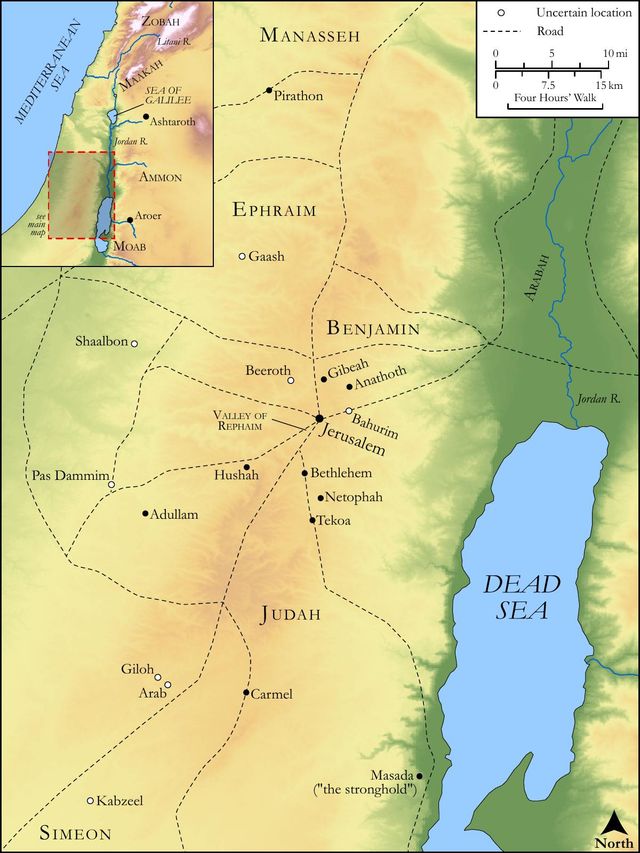
See on the biblical-era map
Study this verse
Public-domain commentary
Matthew Henry
From his Commentary on the Whole Bible. Henry comments on passages, not single verses — this entry covers 1 Chronicles 11:10–47. His two-level outline is real structure in the source text, so it is rendered as structure.
We have here an account of David's worthies, the great men of his time that served him and were preferred by him. The first edition of this catalogue we had, Sa2 23:8, etc. This is much the same, only that those named here from Ch1 11:41 to the end are added. Observe,
I.The connexion of this catalogue with that which is said concerning David, Ch1 11:9.
1.David waxed greater and greater, and these were his mighty men. Much of the strength and honour of great men is borrowed from their servants and depends upon them, which cannot but somewhat diminish pomp and power in the opinion of those that are wise. David is great because he has great men about him; take these away, and he is where he was.
2.The Lord of hosts was with him, and these were the mighty men which he had. God was with him and wrought for him, but by men and means and the use of second causes. By this it appeared that God was with him, that he inclined the hearts of those to come over to him that were able to serve his interest. As, if God be for us none can be against us, so, if God be for us, all shall be for us that we have occasion for. Yet David ascribed his success and increase, not to the hosts he had, but to the Lord of hosts, not to the mighty men that were with him, but to the mighty God whose presence with us is all in all.
II.The title of this catalogue (Ch1 11:10):
These are the men who strengthened themselves with him. In strengthening him they strengthened themselves and their own interest; for his advancement was theirs. What we do in our places for the support of the kingdom of the Son of David we shall be gainers by. In strengthening it we strengthen ourselves. It may be read, They held strongly with him and with all Israel. Note, When God has work to do he will not want fit instruments to do it with. If it be work that requires mighty men, mighty men shall either be found or made to effect it, according to the word of the Lord.
III.That which made all these men honourable was the good service that they did to their king and country; they helped to make David king (Ch1 11:10) - a good work. They slew the Philistines, and other public enemies, and were instrumental to save Israel. Note, The way to be great is to do good. Nor did they gain this honour without labour and the hazard of their lives. The honours of Christ's kingdom are prepared for those that fight the good fight of faith, that labour and suffer, and are willing to venture all, even life itself, for Christ and a good conscience. It is by a patient continuance in well-doing that we must seek for glory, and honour, and immortality; and those that are faithful to the Son of David shall find their names registered and enrolled much more to their honour than these are in the records of fame.
IV.Among all the great exploits of David's mighty men, here is nothing great mentioned concerning David himself but his pouring out water before the Lord which he had longed for, Ch1 11:18, Ch1 11:19. Four very honourable dispositions of David appeared in that action, which, for aught I know, made it as great as any of the achievements of those worthies.
1.Repentance for his own weakness. It is really an honour to a man, when he is made sensible that he has said or done any thing unadvisedly, to unsay it and undo it again by repentance, as it is a shame to a man when he has said or done amiss to stand to it.
2.Denial of his own appetite. He longed for the water of the well of Bethlehem; but, when he had it, he would not drink it, because he would not so far humour himself and gratify a foolish fancy. He that has such a rule as this over his own spirit is better than the mighty. It is an honour to a man to have the command of himself; but he that will command himself must sometimes cross himself.
3.Devotion towards God. That water which he thought too good, too precious, for his own drinking, he poured out to the Lord for a drink offering. If we have any thing better than another, let God be honoured with it, who is the best, and should have the best.
4.Tenderness of his servants. It put him into the greatest confusion imaginable to think that three brave men should hazard their lives to fetch water for him. In his account it turns the water into blood. It is the honour of great men not to be prodigal of the blood of those they employ, but, in all the commands they give them, to put their own souls into their souls' stead.
V.In the wonderful achievements of these heroes the power of God must be acknowledged.
How could one slay 300 and another the same number (Ch1 11:11, Ch1 11:20), another two lion-like men (Ch1 11:22), and another an Egyptian giant (Ch1 11:23), if they had not had the extraordinary presence of God with them, according to that promise, Jos 23:10, One man of you shall chase a thousand, for the Lord your God fighteth for you?
VI.One of these worthies is said to be an Ammonite (Ch1 11:39), another a Moabite (Ch1 11:46), and yet the law was that an Ammonite and a Moabite should not enter into the congregation of the Lord, Deu 23:3. These, it is likely, had approved themselves so hearty for the interest of Israel that in their case it was thought fit to dispense with that law, and the rather because it was an indication that the Son of David would have worthies among the Gentiles: with him there is neither Greek nor Jew.
Continue studying 1 Chronicles 11:34 across the web’s major study libraries — every link below opens this exact verse, chapter, or book on the destination site.
Read & Compare
 BibleGatewayThis verse in more than 200 translations and 70 languages.
 Bible.comThe YouVersion reader — hundreds of translations, reading plans, and highlights.
 ESV.orgCrossway's official English Standard Version reader.
 NET BibleThe NET translation with 60,000+ translators' notes on every rendering decision.
 STEP BibleTyndale House's free study tool — original text, vocabulary, and scholarly resources.
 BibliaLogos Bible Software's free web reader.
 USCCBThe New American Bible (Revised Edition) with the U.S. bishops' study notes.
Commentaries
 BibleHub CommentariesDozens of classic commentaries on this verse, gathered on one page.
 StudyLightMore than 100 commentary sets — the largest collection on the web.
 BibleRefPlain-English commentary on what this verse means, verse by verse.
 Enduring WordDavid Guzik's free commentary on this chapter, widely used by Bible teachers.
 Bible Study ToolsVerse commentary alongside Greek and Hebrew study aids.
Original Language & Research
- BibleHub InterlinearThe verse word by word — original language, transliteration, and English.
- BibleHub LexiconEvery word's original-language definition and Strong's entry.
 Blue Letter BibleDeep-study tools — Strong's numbers, concordance, and word studies.
 SefariaThe Hebrew text with Rashi and centuries of Jewish commentary.
Sermons, Hymns & Audio


TrulyRandomVerse is not affiliated with these sites and doesn’t control their content. They’re linked because they’re genuinely useful.
Summary
1 Chronicles 11:34 serves as a concise yet significant entry within the extensive register of King David's elite warriors, known as his "mighty men." This verse specifically names "The sons of Hashem the Gizonite" and "Jonathan the son of Shage the Hararite," highlighting individuals whose unwavering loyalty and dedicated service, though not detailed with specific heroic exploits in this particular passage, were foundational to the establishment and security of David's divinely appointed kingdom. Their inclusion underscores the Chronicler's meticulous record-keeping and the profound theological emphasis on the collective effort that underpinned God's work through His chosen leader.
Context
ShowHideLiterary Context
This verse is strategically placed within the larger narrative of 1 Chronicles 11:10-47, which provides a detailed and comprehensive roster of David's most valiant and loyal soldiers. This extensive list immediately follows the pivotal account of David's anointing as king over all Israel in Hebron and his subsequent capture of Jerusalem, which he established as his capital city. The Chronicler's deliberate inclusion of such a thorough enumeration serves to underscore the strength, legitimacy, and divine backing of David's reign, showcasing the exceptional caliber of men who rallied to his cause. It stands as a powerful testament to the collective effort and unwavering dedication that were instrumental in David's successful consolidation of power and the secure establishment of the Davidic kingdom. This specific list finds a significant parallel in 2 Samuel 23:8-39, though with minor variations typical of ancient textual transmission, further reinforcing its historical significance and the profound importance attributed to these foundational warriors.
Historical & Cultural Context
Among the kings of that day, the meticulous compilation of military rosters and records of loyal retainers was a crucial practice for legitimizing a king's rule, demonstrating his power, and showcasing his broad base of support. David's "mighty men" were far more than ordinary soldiers; they constituted an elite corps, often functioning as his personal guard, trusted advisors, and key military commanders. Their unwavering loyalty was paramount, especially considering David's tumultuous journey from a fugitive to the anointed king of Israel. The designations "Gizonite" and "Hararite" are gentilics, indicating the geographical origin or tribal affiliation of Hashem and Shage, respectively. This practice of identifying individuals by their place of origin was a common cultural norm in ancient Israel, providing a vital marker of identity and often implying specific regional ties, allegiances, or even particular fighting styles. While the precise locations of Gizo or Harar are not extensively detailed elsewhere in biblical or extra-biblical sources, their inclusion adds to the historical verisimilitude and meticulous nature of the Chronicler's account, firmly grounding these figures within the specific socio-geographical landscape of ancient Israel.
Key Themes
ShowHideThe inclusion of 1 Chronicles 11:34 within the detailed list of David's mighty men contributes significantly to several overarching themes present throughout 1 Chronicles and the broader biblical narrative. Firstly, it powerfully highlights the theme of Divine Recognition and Honor, demonstrating that God, through the sacred biblical record, meticulously remembers and profoundly values the faithful service of all who contribute to His purposes, even those whose specific heroic deeds are not individually elaborated upon. Secondly, it underscores the vital theme of Loyalty and Service, as these men exemplified unwavering dedication to King David, serving faithfully through his numerous struggles and triumphs. Such steadfast commitment was absolutely crucial for the stability and defense of the divinely appointed kingdom. Finally, the meticulous record of these seemingly minor individuals points to the overarching theme of Divine Providence, illustrating God's sovereign hand in raising up and equipping a diverse array of individuals—from the most celebrated to the least known—to serve His chosen leader and fulfill His larger redemptive plan for the Davidic dynasty, which ultimately points towards the Messiah. The collective strength and unwavering faithfulness of these men were instrumental in the unfolding of God's redemptive history, echoing the sentiment of divine protection and empowerment found in passages like Psalm 18:32-34.
Exposition and Analysis
ShowHideKey Word Analysis
ShowHideFrom the root meaning "to build," this term signifies a son or descendant, often implying a builder of the family name or lineage. In this context, "the sons of Hashem" indicates not just biological offspring but potentially a family or clan associated with Hashem, suggesting a collective contribution or a recognized family unit within David's elite forces. Its use here underscores the importance of family continuity and inherited loyalty in ancient Israelite society.
This is a gentilic, a designation indicating origin from a specific place named Gizo. While the exact location of Gizo remains obscure to modern scholarship, its inclusion provides a precise geographical identifier for Hashem. In ancient Israel, such gentilics were crucial for establishing identity, tribal affiliation, and regional ties, often implying specific characteristics or loyalties associated with that locale. Its presence authenticates the individual as a real figure from a known (at the time) region.
Similar to "Gizonite," this is a gentilic derived from "Harar," meaning "mountaineer" or "mountain dweller." This designation for Shage (and thus Jonathan, his son) suggests their origin from a mountainous region. This could imply certain qualities, such as hardiness, resilience, or a particular fighting prowess associated with people from rugged terrain. Like other gentilics, it grounds the individual in a specific socio-geographical context, adding historical depth to the Chronicler's record.
Verse Breakdown
ShowHide"The sons of Hashem the Gizonite"
This clause introduces a group of individuals identified by their paternal lineage to Hashem and their geographical origin from Gizo. The plural "sons" (בְּנֵי, bĕnê) suggests either multiple direct descendants of Hashem serving among David's elite or, more broadly, a family or clan associated with Hashem who collectively contributed to David's military strength. This highlights the significance of family and lineage in ancient Israelite society and the potential for loyalty and service to extend across generations. Their association with "Gizon" further specifies their identity and perhaps hints at their regional influence or particular skills.
"Jonathan the son of Shage the Hararite"
This clause introduces a specific individual, Jonathan, whose identity is established through his father, Shage, and their geographical origin from Harar. The singular "Jonathan" indicates a distinct person, contrasting with the collective "sons" in the preceding phrase. This formula of "Name the son of Name the Place-ite" is a common biblical genealogical and biographical structure, emphasizing paternal lineage as a primary identifier. Jonathan's inclusion, like that of Hashem's sons, signifies his personal valor and unwavering loyalty, even though his specific deeds are not detailed in this particular verse.
Literary Devices
ShowHideThe primary literary device employed in 1 Chronicles 11:34, and indeed throughout the entire list of David's mighty men, is Cataloging or Roster. This is a pervasive literary technique of Scripture, as in the muster rolls of Numbers, used to meticulously document and legitimize power structures, military strength, and the extensive support base of a ruler. The precise listing of names, even those that appear obscure to modern readers, serves to underscore the breadth and depth of David's loyal following, emphasizing the collective strength that enabled his successful reign. Another subtle yet significant device is Emphasis by Inclusion. By simply listing these names, the Chronicler implicitly highlights their importance and the profound value placed on their service, even without recounting specific heroic deeds. Their mere presence in this sacred historical record is a powerful act of honor and remembrance, ensuring their contribution is not forgotten. Furthermore, the Repetition of the "son of" (בֶּן, ben) formula throughout the list reinforces the patriarchal and lineage-based nature of Israelite society and the continuity of service within families and clans.
Theological and Thematic Connections
ShowHideThe inclusion of seemingly minor figures like those in 1 Chronicles 11:34 carries profound theological weight, extending beyond mere historical record-keeping. It speaks powerfully to God's meticulous attention to detail and His perfect remembrance of all who faithfully serve His purposes, regardless of their public prominence or the magnitude of their recorded exploits. Just as David's divinely appointed kingdom was built not solely on the grand exploits of its most famous heroes but also on the steadfast loyalty and quiet dedication of countless unsung individuals, so too is God's eternal kingdom advanced by the faithful, often unseen, service of every single believer. This verse serves as a profound reminder that every contribution, every act of faithfulness, no matter how small or unheralded by human standards, is seen, valued, and remembered by God. It underscores the profound principle that divine success is often a collective endeavor, where diverse gifts, varying roles, and different levels of prominence coalesce under God's sovereign hand to achieve His perfect will.
Reflection and Application
ShowHide1 Chronicles 11:34, though a simple enumeration of names, offers a profoundly powerful spiritual lesson for contemporary believers. It challenges us to fundamentally reconsider our definition of "significance" within the context of God's kingdom. In a world that often celebrates only the highly visible, the overtly heroic, and the publicly acclaimed, this verse quietly but firmly affirms the eternal value of faithful, consistent, and often unseen service. It encourages us to wholeheartedly embrace our unique roles, however humble or ordinary they may seem in human eyes, within the larger, interconnected body of Christ, trusting implicitly that God sees, knows, and remembers every single act of devotion. Our quiet faithfulness in our families, our diligent work in our workplaces, and our consistent service in our local communities contribute to the ongoing, glorious work of God's kingdom just as surely as the grand exploits of biblical heroes. It serves as a vital reminder that God's work is a collective enterprise, requiring the unique and indispensable contributions of every single member, and that true honor and lasting significance come not from human applause or public recognition, but from divine acknowledgment and remembrance.
Questions for Reflection
ShowHideFAQ
ShowHideWhy are these specific names listed without any accompanying heroic deeds?
ShowHideThe Chronicler's purpose in listing these names, even without detailing specific heroic deeds, is multifaceted and deeply significant. Firstly, it serves as a crucial historical record, authenticating the vast network of loyal supporters that King David had, which was absolutely essential for the legitimacy and stability of his reign. Secondly, and perhaps more profoundly, it underscores a vital theological principle: God values and meticulously remembers all who faithfully serve His divine purposes, not just the most prominent or those whose actions are recorded in dramatic narratives. The mere act of inclusion in this sacred text confers honor and signifies that their loyalty, their presence, and their support were vital to David's success and, by extension, to God's unfolding plan for the Davidic dynasty. It powerfully emphasizes the collective effort required to build and sustain God's kingdom, where every member's contribution, no matter how seemingly small, is significant and indispensable, as seen in the broader context of 1 Chronicles 11.
Are the lists of David's mighty men in 1 Chronicles and 2 Samuel identical?
ShowHideNo, while there is significant overlap and parallelism between the list in 1 Chronicles 11 and its counterpart in 2 Samuel 23, they are not entirely identical. There are minor differences in names, spellings, the order of some individuals, and occasional omissions or additions. Such variations are common in ancient textual traditions and do not undermine the historical authenticity of the accounts. They may reflect different sources used by the biblical authors, different periods of compilation, or simply variations in transcription over time. Both lists, however, serve the same primary purpose: to honor David's elite warriors and to emphasize the strength, loyalty, and divine support that underpinned his divinely appointed kingship.
Christ-Centered Fulfillment
ShowHideWhile 1 Chronicles 11:34 meticulously lists the loyal warriors of an earthly king, it profoundly foreshadows the ultimate King, Jesus Christ, and the eternal nature of His spiritual kingdom. Just as King David's reign was established, maintained, and secured by the collective faithfulness and diverse contributions of his mighty men, Christ's spiritual kingdom is likewise built upon the varied, dedicated, and often unseen service of His followers, who constitute His Church. Every name in David's ancient roster, whether celebrated for grand exploits or merely noted for their presence, contributed to the stability and success of his earthly throne. Similarly, in the new covenant, every believer, regardless of their perceived prominence or the public recognition they receive, is an absolutely vital and indispensable member of Christ's body, contributing uniquely to the advancement and flourishing of His eternal kingdom (see 1 Corinthians 12:27). The divine remembrance of Hashem's sons and Jonathan in this ancient list prefigures God's perfect knowledge, meticulous care, and infinite valuing of every single one of His children, whose names are eternally inscribed in the Lamb's Book of Life (Revelation 21:27). Christ, as the true and greater David, gathers to Himself not merely mighty warriors, but all who believe in Him, empowering them by His Holy Spirit to participate actively in His redemptive mission. This demonstrates unequivocally that even the "least" among us are precious, beloved, and indispensable in His eyes (Matthew 25:40). The unwavering loyalty these men demonstrated to David finds its ultimate, perfected expression in the steadfast devotion believers are called to offer to their Savior and Lord, Jesus Christ, who is eternally proclaimed as King of kings and Lord of lords (Revelation 19:16).