


1 Chronicles 11:35
Bible text: King James Version (1769 Blayney text) · Public domain
Bible text: Berean Standard Bible · Public domain
Bible text: American Standard Version (1901) · Public domain
Bible text: World English Bible, Messianic edition · Public domain
Bible text: Geneva Bible (1599) · Public domain
Bible text: Young's Literal Translation · Public domain
- אֲחִיאָם'a·chi·'AmAhiamH279N-proper-mNoun Proper Masculine
- בֶּןben[the] son ofH1121N-mscNoun Singular Masculine Construct
- שָׂכָרsa·KharSakarH7940N-proper-mNoun Proper Masculine
- הַהֲרָרִיha·ha·ra·Rithe HarariteH2043Art ¦ N-msNoun Gentilic Singular Masculine AbsoluteהַtheהֲרָרִיHararite
- אֱלִיפַל'e·li·FalEliphalH465N-proper-mNoun Proper Masculine
- בֶּןben[the] son ofH1121N-mscNoun Singular Masculine Construct
- אוּר'UrUrH218N-proper-mNoun Proper Masculine
English is a literal word-by-word gloss of the Hebrew, not the KJV's wording. Why?
This is the original text the KJV's translators worked from — each Hebrew word with its own literal English meaning in this verse, prepared by scholars at Tyndale House, Cambridge. The KJV translates whole sentences, not word by word, so its wording differs: one Hebrew word can become several English words, and the KJV may choose “the LORD” where the gloss reads “Yahweh”. Both are faithful — they answer different questions. For the KJV's own rendering, switch to the KJV text.
Details
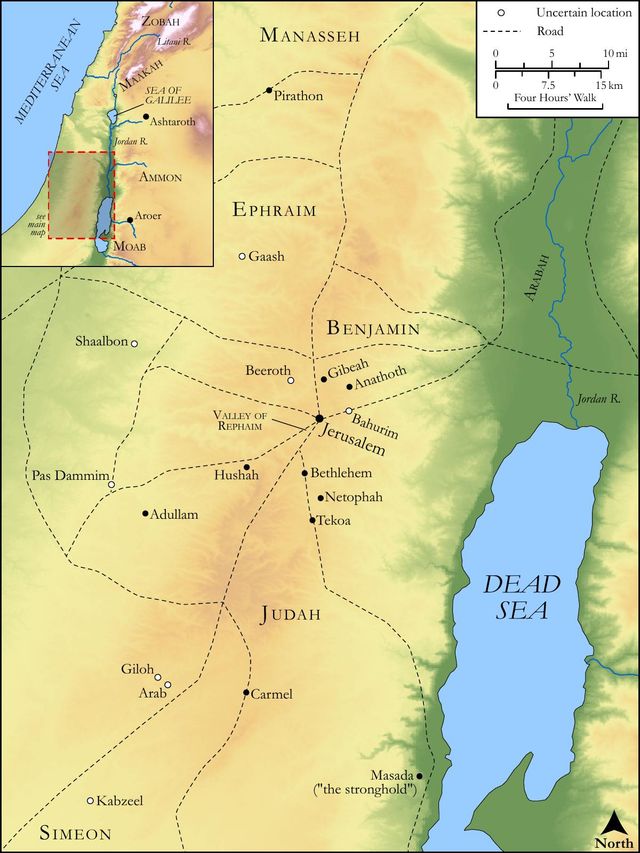
See on the biblical-era map
Study this verse
Public-domain commentary
Matthew Henry
From his Commentary on the Whole Bible. Henry comments on passages, not single verses — this entry covers 1 Chronicles 11:10–47. His two-level outline is real structure in the source text, so it is rendered as structure.
We have here an account of David's worthies, the great men of his time that served him and were preferred by him. The first edition of this catalogue we had, Sa2 23:8, etc. This is much the same, only that those named here from Ch1 11:41 to the end are added. Observe,
I.The connexion of this catalogue with that which is said concerning David, Ch1 11:9.
1.David waxed greater and greater, and these were his mighty men. Much of the strength and honour of great men is borrowed from their servants and depends upon them, which cannot but somewhat diminish pomp and power in the opinion of those that are wise. David is great because he has great men about him; take these away, and he is where he was.
2.The Lord of hosts was with him, and these were the mighty men which he had. God was with him and wrought for him, but by men and means and the use of second causes. By this it appeared that God was with him, that he inclined the hearts of those to come over to him that were able to serve his interest. As, if God be for us none can be against us, so, if God be for us, all shall be for us that we have occasion for. Yet David ascribed his success and increase, not to the hosts he had, but to the Lord of hosts, not to the mighty men that were with him, but to the mighty God whose presence with us is all in all.
II.The title of this catalogue (Ch1 11:10):
These are the men who strengthened themselves with him. In strengthening him they strengthened themselves and their own interest; for his advancement was theirs. What we do in our places for the support of the kingdom of the Son of David we shall be gainers by. In strengthening it we strengthen ourselves. It may be read, They held strongly with him and with all Israel. Note, When God has work to do he will not want fit instruments to do it with. If it be work that requires mighty men, mighty men shall either be found or made to effect it, according to the word of the Lord.
III.That which made all these men honourable was the good service that they did to their king and country; they helped to make David king (Ch1 11:10) - a good work. They slew the Philistines, and other public enemies, and were instrumental to save Israel. Note, The way to be great is to do good. Nor did they gain this honour without labour and the hazard of their lives. The honours of Christ's kingdom are prepared for those that fight the good fight of faith, that labour and suffer, and are willing to venture all, even life itself, for Christ and a good conscience. It is by a patient continuance in well-doing that we must seek for glory, and honour, and immortality; and those that are faithful to the Son of David shall find their names registered and enrolled much more to their honour than these are in the records of fame.
IV.Among all the great exploits of David's mighty men, here is nothing great mentioned concerning David himself but his pouring out water before the Lord which he had longed for, Ch1 11:18, Ch1 11:19. Four very honourable dispositions of David appeared in that action, which, for aught I know, made it as great as any of the achievements of those worthies.
1.Repentance for his own weakness. It is really an honour to a man, when he is made sensible that he has said or done any thing unadvisedly, to unsay it and undo it again by repentance, as it is a shame to a man when he has said or done amiss to stand to it.
2.Denial of his own appetite. He longed for the water of the well of Bethlehem; but, when he had it, he would not drink it, because he would not so far humour himself and gratify a foolish fancy. He that has such a rule as this over his own spirit is better than the mighty. It is an honour to a man to have the command of himself; but he that will command himself must sometimes cross himself.
3.Devotion towards God. That water which he thought too good, too precious, for his own drinking, he poured out to the Lord for a drink offering. If we have any thing better than another, let God be honoured with it, who is the best, and should have the best.
4.Tenderness of his servants. It put him into the greatest confusion imaginable to think that three brave men should hazard their lives to fetch water for him. In his account it turns the water into blood. It is the honour of great men not to be prodigal of the blood of those they employ, but, in all the commands they give them, to put their own souls into their souls' stead.
V.In the wonderful achievements of these heroes the power of God must be acknowledged.
How could one slay 300 and another the same number (Ch1 11:11, Ch1 11:20), another two lion-like men (Ch1 11:22), and another an Egyptian giant (Ch1 11:23), if they had not had the extraordinary presence of God with them, according to that promise, Jos 23:10, One man of you shall chase a thousand, for the Lord your God fighteth for you?
VI.One of these worthies is said to be an Ammonite (Ch1 11:39), another a Moabite (Ch1 11:46), and yet the law was that an Ammonite and a Moabite should not enter into the congregation of the Lord, Deu 23:3. These, it is likely, had approved themselves so hearty for the interest of Israel that in their case it was thought fit to dispense with that law, and the rather because it was an indication that the Son of David would have worthies among the Gentiles: with him there is neither Greek nor Jew.
Continue studying 1 Chronicles 11:35 across the web’s major study libraries — every link below opens this exact verse, chapter, or book on the destination site.
Read & Compare
 BibleGatewayThis verse in more than 200 translations and 70 languages.
 Bible.comThe YouVersion reader — hundreds of translations, reading plans, and highlights.
 ESV.orgCrossway's official English Standard Version reader.
 NET BibleThe NET translation with 60,000+ translators' notes on every rendering decision.
 STEP BibleTyndale House's free study tool — original text, vocabulary, and scholarly resources.
 BibliaLogos Bible Software's free web reader.
 USCCBThe New American Bible (Revised Edition) with the U.S. bishops' study notes.
Commentaries
 BibleHub CommentariesDozens of classic commentaries on this verse, gathered on one page.
 StudyLightMore than 100 commentary sets — the largest collection on the web.
 BibleRefPlain-English commentary on what this verse means, verse by verse.
 Enduring WordDavid Guzik's free commentary on this chapter, widely used by Bible teachers.
 Bible Study ToolsVerse commentary alongside Greek and Hebrew study aids.
Original Language & Research
- BibleHub InterlinearThe verse word by word — original language, transliteration, and English.
- BibleHub LexiconEvery word's original-language definition and Strong's entry.
 Blue Letter BibleDeep-study tools — Strong's numbers, concordance, and word studies.
 SefariaThe Hebrew text with Rashi and centuries of Jewish commentary.
Sermons, Hymns & Audio


TrulyRandomVerse is not affiliated with these sites and doesn’t control their content. They’re linked because they’re genuinely useful.
Summary
1 Chronicles 11:35 meticulously identifies Ahiam, son of Sacar the Hararite, and Eliphal, son of Ur, as two distinguished members of King David's elite corps of "mighty men." This verse, situated within a comprehensive roster of David's most valiant warriors, serves to underscore the Chronicler's dedication to preserving the historical record of those who faithfully served God's chosen king, highlighting the individual contributions that collectively established and defended the burgeoning kingdom of Israel. It profoundly emphasizes the importance of loyal service and the divine orchestration behind David's successful and unified reign.
Context
ShowHideLiterary Context
1 Chronicles 11:35 is embedded within a pivotal section of the book, detailing King David's rise to power and the establishment of his kingdom. The chapter commences with the momentous anointing of David as king over all Israel at Hebron, a fulfillment of God's covenant promises. Immediately following this foundational event, the Chronicler shifts focus to David's "mighty men" (גִּבֹּרִים, gibborim), an elite cadre of warriors whose unwavering loyalty and exceptional bravery were indispensable to David's military victories and the consolidation of his reign. Verses 10-47 provide a detailed, almost genealogical, enumeration of these individuals, often including their paternal lineage and geographical origins. This meticulous listing underscores the historical precision the Chronicler sought to convey and emphasizes the collective effort that underpinned David's success. The inclusion of specific names like Ahiam and Eliphal in 1 Chronicles 11:35 places them firmly within this distinguished military hierarchy, highlighting their recognized status and contribution to the national narrative.
Historical & Cultural Context
In the days when the Israelite monarchy was forming, military prowess and loyal service were paramount for any ruler seeking to consolidate power and defend national borders. King David's reign marked a significant transition from a loose tribal confederacy to a unified, centralized kingdom, a process heavily reliant on a disciplined and devoted standing army. The concept of "mighty men" was not unique to Israel; similar elite warrior groups existed in other regional powers. Genealogical records, such as "son of Sacar" or "son of Ur," were crucial for establishing identity, social standing, tribal affiliation, and even land rights within Israelite society. The geographical designation "the Hararite" (meaning "the mountaineer") for Ahiam further specifies his origin, likely indicating a connection to a mountainous region. Such regional identifiers could imply specific tribal ties, characteristics, or military reputations, as inhabitants of rugged terrain were often considered hardy and formidable. These detailed records served not only as historical archives but also as a testament to the honor, legacy, and enduring contribution of those who secured the nation's stability and the king's authority.
Key Themes
ShowHideThe meticulous listing of individuals such as Ahiam and Eliphal in 1 Chronicles 11:35 significantly contributes to several overarching themes woven throughout the book of Chronicles. Firstly, it powerfully illustrates the theme of Loyalty and Service, showcasing the unwavering commitment of these warriors to King David, God's divinely appointed leader. Their names are preserved as an enduring testament to their faithful dedication to the kingdom, mirroring the broader biblical call to serve God's purposes with devotion. Secondly, this detailed enumeration subtly highlights the interplay between Divine Election and Human Agency in the establishment of the monarchy; while God sovereignly chose David, He accomplished His purposes through the faithful obedience, valor, and skill of these men. The Chronicler emphasizes that David's remarkable success was not a solitary achievement but a collective endeavor, divinely orchestrated and humanly executed. Finally, this verse reinforces the profound theme of the Value of Every Individual Contribution to God's grand redemptive narrative. Even seemingly minor or less prominent figures are remembered and honored, emphasizing that every person's role, no matter how humble or behind-the-scenes, is significant in building God's kingdom. This principle resonates throughout the biblical narrative, from the detailed genealogies in Genesis 10 to the comprehensive lists of those who returned from Babylonian exile in Ezra 2.
Exposition and Analysis
ShowHideKey Word Analysis
ShowHideThis personal name is a compound of two Hebrew elements: אָח (ʼaḥ), meaning "brother," and אֵם (ʼēm), meaning "mother." The combination can be interpreted as "brother of the mother" or "my brother is a mother." While its precise nuance in ancient Israelite naming is debated, it often suggests a strong familial or communal bond, perhaps indicating a person who was a protector, provider, or source of comfort and care for his brethren or community, akin to a mother figure. Its inclusion here points to a character of loyalty and deep connection within his social unit or to David's inner circle.
This gentilic (designation of origin) literally means "the mountaineer" or "from the mountain region." It is derived from the Hebrew word הַר (har), meaning "mountain." This geographical identifier was common in ancient Israelite society to specify a person's place of origin or tribal affiliation. Being from a mountainous region often implied certain characteristics such as hardiness, resilience, and perhaps a reputation for being formidable warriors, as such terrain typically bred strong, independent individuals accustomed to difficult conditions. It provides a specific, distinguishing detail about Ahiam's background.
Verse Breakdown
ShowHide"Ahiam the son of Sacar the Hararite"
This initial clause meticulously identifies one of David's "mighty men," Ahiam, by his personal name, his paternal lineage ("son of Sacar"), and his geographical or tribal affiliation ("the Hararite"). This tripartite identification was a standard convention in Israel's records, serving to uniquely distinguish individuals within a large population. The inclusion of the father's name, Sacar, firmly grounds Ahiam within a specific family unit, while "the Hararite" provides a regional or possibly tribal context, suggesting his origin from a mountainous area. This level of detail underscores the Chronicler's commitment to historical accuracy and the importance of each individual's identity and contribution within the national narrative.
"Eliphal the son of Ur"
Following the same established pattern, this clause introduces another of David's elite warriors, Eliphal, identifying him by name and his father, Ur. The absence of an additional geographical or tribal designation for Eliphal, unlike Ahiam, is not uncommon in such ancient lists, as sometimes only the most pertinent identifying details were included. This concise identification nonetheless firmly places Eliphal within the esteemed roster of those who served King David with valor. The parallel structure with the preceding identification highlights the consistent and systematic methodology employed by the Chronicler in documenting these crucial figures, emphasizing their collective significance to David's reign.
Literary Devices
ShowHideThe primary literary device employed in 1 Chronicles 11:35, characteristic of the entire chapter, is Cataloging or Listing. This meticulous enumeration of names, lineages, and origins serves to provide a comprehensive and authoritative record of King David's elite warriors. This device is far from a dry historical account; it functions to underscore the breadth of support David commanded and the collective strength that undergirded and built his kingdom. Closely related is the pervasive use of Genealogy, evident in the repeated phrase "the son of," which establishes the identity and familial connections of each individual. This genealogical structure reinforces the historical authenticity of the account and highlights the profound importance of lineage and family identity in ancient Israelite society. Furthermore, the very act of naming each man, rather than simply stating a number or a general group, serves as a powerful form of Emphasis. It elevates the individual contributions of these warriors, transforming them from anonymous soldiers into recognized heroes whose loyalty, valor, and service were deemed worthy of perpetual remembrance in the sacred text. This deliberate act of recording each name underscores the Chronicler's theological point: that God remembers and values the service of every one of His people, no matter their perceived prominence.
Theological and Thematic Connections
ShowHideThe inclusion of individuals like Ahiam and Eliphal in this esteemed list carries profound theological weight. It powerfully demonstrates that while God sovereignly chooses and anoints leaders like David, the establishment, defense, and success of His kingdom on earth invariably involve the faithful, courageous, and often sacrificial participation of His people. These "mighty men" represent the essential human agency that cooperates with divine will, serving as indispensable instruments in God's unfolding redemptive plan. Their names, preserved for millennia within the sacred Scriptures, testify to the enduring value God places on individual loyalty, skill, and dedicated service to His anointed. This passage serves as a timeless reminder that every contribution, no matter how seemingly small or behind-the-scenes, is recognized, honored, and intricately woven into God's grand narrative of salvation and kingdom building.
Reflection and Application
ShowHideWhile 1 Chronicles 11:35 might initially appear to be a mere historical record, it offers profound and enduring lessons for contemporary believers. It challenges us to deeply consider the significance of our own contributions within the larger body of Christ. Just as Ahiam and Eliphal were integral, indispensable components of David's earthly kingdom, every believer is called to play a vital, unique role in God's ongoing work, whether in prominent leadership positions or in quiet, consistent, and often unseen service. This verse powerfully reminds us that true strength and effectiveness in God's kingdom come not from individual renown, but from unity, mutual support, and unwavering loyalty to Christ and His divine purposes. Our faithfulness, even in seemingly ordinary or mundane tasks, is never overlooked by God; rather, it contributes to a collective testimony that endures through generations, shaping the spiritual landscape and advancing the Gospel. We are part of a grand, eternal narrative, and our dedicated service, no matter its scale, leaves an indelible mark in the eyes of our sovereign God.
Questions for Reflection
ShowHideFAQ
ShowHideWhy does the Bible include such detailed lists of names, like the one in 1 Chronicles 11:35?
ShowHideThe inclusion of detailed lists of names and genealogies in biblical texts serves multiple crucial purposes. Historically, they provided authentic and verifiable records for lineage, tribal affiliation, land inheritance, and social standing in ancient Israel. Theologically, they underscore God's meticulous attention to detail and His divine remembrance of every individual who participates in His unfolding plan. These lists emphasize the profound value God places on human agency and faithful service, ensuring that even those who might seem "minor" or less prominent are remembered for their significant contributions to His kingdom. They also powerfully demonstrate the continuity and faithfulness of God's covenant promises through generations, as seen in the extensive genealogies from Genesis 5 or the comprehensive lists of returnees from exile in Ezra 2.
Do the specific names in 1 Chronicles 11:35, like Ahiam and Eliphal, carry hidden spiritual meanings?
ShowHideWhile some biblical names certainly carry prophetic or symbolic significance (e.g., "Jesus" meaning "Yahweh saves," or "Immanuel" meaning "God with us"), the names Ahiam, Sacar, Hararite, Eliphal, and Ur in 1 Chronicles 11:35 primarily function as precise historical identifiers. "Ahiam" (meaning "my brother is a mother") might suggest a character trait of care or communal connection, and "Hararite" simply denotes a geographical origin ("from the mountain"). Their primary spiritual significance lies not in the specific etymology of the names themselves, but in the profound fact that these individuals were recorded as faithful and valiant servants of God's anointed king, David. Their inclusion in the sacred text highlights the overarching biblical principle that God values and remembers the loyal service of all His people, regardless of their earthly prominence, as evidenced by the comprehensive record of David's mighty men found throughout 1 Chronicles 11.
Christ-Centered Fulfillment
ShowHideThe detailed list of David's mighty men, including Ahiam and Eliphal, serves as a powerful Old Testament type, richly foreshadowing the ultimate King and His devoted followers. Just as David, God's anointed king, gathered around him a loyal band of warriors who fought valiantly for the establishment and defense of his earthly kingdom, so too does Jesus Christ, the true King of Kings and Lord of Lords, call forth a company of disciples to advance His eternal, spiritual kingdom. These mighty men faced physical battles and earthly adversaries, but Christ's followers are equipped for a far greater spiritual warfare, fighting against sin, death, and the unseen powers of darkness (as vividly described in Ephesians 6:12). Every believer, like Ahiam and Eliphal, is called to be a "mighty one" in Christ, contributing their unique spiritual gifts and unwavering loyalty to the flourishing body of Christ (as beautifully articulated in 1 Corinthians 12:12-27) and to the global spread of the Gospel (as commanded in Matthew 28:19-20). Their names are recorded not for fleeting earthly fame, but for their faithful service to the King, much like the "book of life" where the names of Christ's true followers are eternally inscribed (see Revelation 20:12). Thus, 1 Chronicles 11:35 ultimately points beyond itself to the greater reality of Christ's kingdom, a kingdom built not by human might alone, but by the Spirit-empowered faithfulness and dedicated service of His redeemed people from every tribe, tongue, and nation.