


Ruth 2:22
Bible text: King James Version (1769 Blayney text) · Public domain
Bible text: King James Version with Strong's numbers · Public domain
Bible text: Berean Standard Bible · Public domain
Bible text: American Standard Version (1901) · Public domain
Bible text: World English Bible, Messianic edition · Public domain
Bible text: Geneva Bible (1599) · Public domain
Bible text: Young's Literal Translation · Public domain
- וַתֹּאמֶרva·To·merand she saidH559Conj-w ¦ V-Qal-ConsecImperf-3fsVerb Qal Consecutive Imperfect 3rd Singular Feminineוַandתֹּאמֶרshe said
- נָעֳמִיno·'o·MiNaomiH5281N-proper-fNoun Proper Feminine
- אֶל'eltoH413PrepPreposition
- רוּתrutRuthH7327N-proper-fNoun Proper Feminine
- כַּלָּתָהּka·la·Tahher daughter-in-lawH3618N-fsc ¦ 3fsNoun Singular Feminine Constructכַּלָּתָdaughter-in-lawהּher
- טוֹבTov[is] goodH2896Adj-msAdjective Singular Masculine Absolute
- בִּתִּיbi·Timy O daughterH1323N-fsc ¦ 1csNoun Singular Feminine ConstructבִּתִּO daughterיmy
- כִּיkithatH3588PrtParticle Conditional
- תֵצְאִיte·tze·'Iyou will go outH3318V-Qal-Imperf-2fsVerb Qal Imperfect 2nd Singular Feminine
- עִם'imwithH5973PrepPreposition
- נַעֲרוֹתָיוna·'a·ro·Tavhis female servantsH5291N-fpc ¦ 3msNoun Plural Feminine Constructנַעֲרוֹתָיfemale servantsוhis
- וְלֹאve·Lo'and notH3808Conj-w ¦ NegParticle Negativeוְandלֹאnot
- יִפְגְּעוּyif·ge·'upeople will molestH6293V-Qal-Imperf-3mpVerb Qal Imperfect 3rd Plural Masculine
- בָךְvakh<in> <the> youPrep-b ¦ 2fsSuffix Personal 2nd Singular Feminineבָ<in> <the>ךְyou
- בְּשָׂדֶהbe·sa·Dehin a fieldH7704Prep-b ¦ N-msNoun Singular Masculine Absoluteבְּinשָׂדֶהa field
- אַחֵר'a·CheranotherH312Adj-msAdjective Singular Masculine Absolute
English is a literal word-by-word gloss of the Hebrew, not the KJV's wording. Why?
This is the original text the KJV's translators worked from — each Hebrew word with its own literal English meaning in this verse, prepared by scholars at Tyndale House, Cambridge. The KJV translates whole sentences, not word by word, so its wording differs: one Hebrew word can become several English words, and the KJV may choose “the LORD” where the gloss reads “Yahweh”. Both are faithful — they answer different questions. For the KJV's own rendering, switch to the KJV text.
Details
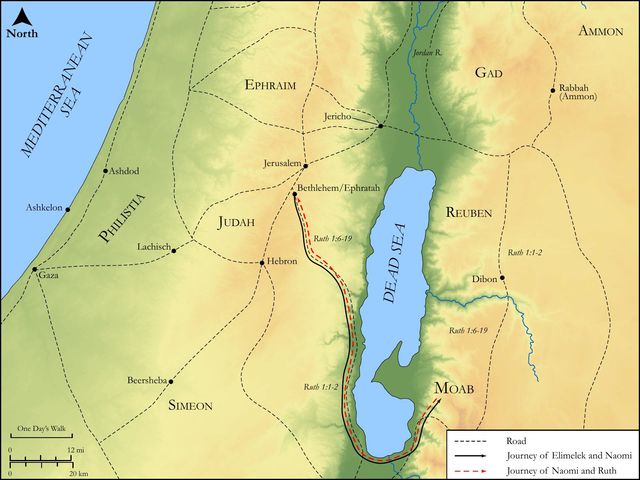
See on the biblical-era map
Study this verse
Public-domain commentary
Matthew Henry
From his Commentary on the Whole Bible. Henry comments on passages, not single verses — this entry covers Ruth 2:17–23. His two-level outline is real structure in the source text, so it is rendered as structure.
Here, I. Ruth finishes her day's work, Rut 2:17. 1. She took care not to lose time, for she gleaned until evening. We must not be weary of well-doing, because in due season we shall reap. She did not make an excuse to sit still, or go home, till the evening. Let us work the works of him that sent us, while it is day. She scarcely used, much less did she abuse, the kindness of Boaz; for, though he ordered his servants to leave handfuls for her, she continued to glean the scattered ears. 2. She took care not to lose what she had gathered, but threshed it herself, that she might the more easily carry it home, and might have it ready for use. The slothful man roasteth not that which he took in hunting, and so loseth the benefit of it, but the substance of a diligent man is precious, Pro 12:27. Ruth had gathered it ear by ear, but, when she had put it all together, it was an ephah of barley, about four pecks. Many a little makes a great deal. It is an encouragement to industry that in all labour, even that of gleaning, there is profit, but the talk of the lips tendeth only to penury. When she had got her corn into as little compass as she could, she took it up herself, and carried it into the city, though, had she asked them, it is likely some of Boaz's servants would have done that for her. We should study to be as little as possible troublesome to those that are kind to us. She did not think it either too hard or too mean a service to carry her corn herself into the city, but was rather pleased with what she had gotten by her own industry, and careful to secure it; and let us thus take care that we lose not those things which we have wrought, which we have gained, Jo2 1:8.
II.She paid her respects to her mother-in-law, went straight home to her and did not go to converse with Boaz's servants, showed her what she had gleaned, that she might see she had not been idle.
1.She entertained her with what she had left of the good dinner Boaz had given her. She gave to her what she had reserved, after she was sufficed (Rut 2:18), which refers to Rut 2:14. If she had any thing better than another, her mother should have part with her. Thus, having shown industry abroad, she showed piety at home; so children's maintaining their parents is called (Ti1 5:4), and it is part of the honour due to them by the fifth commandment, Mat 15:6.
2.She gave her an account of her day's work, and how a kind providence had favoured her in it, which made it very comfortable to her; for the gleanings that a righteous man hath are better than the harvests of many wicked, Psa 37:16. (1.) Naomi asked her where she had been: Where hast thou gleaned today? Note, Parents should take care to enquire into the ways of their children, how, and where, and in what company they spend their time. This may prevent many extravagancies which children, left to themselves, run into, by which they bring both themselves and their parents to shame. If we are not our brethren's, yet surely we are our children's keepers: and we know what a son Adonijah proved, that had never been chidden. Parents should examine their children, not to frighten nor discourage them, not so as to make them hate home or tempt them to tell a lie, but to commend them if they have done well, and with mildness to reprove and caution them if they have done otherwise. It is a good question for us to ask ourselves in the close of every day, "Where have I gleaned today? What improvements have I made in knowledge and grace? What have I done or obtained that will turn to a good account?" (2.) Ruth gave her a particular account of the kindness she had received from Boaz (Rut 2:19) and the hopes she had of further kindness from him, he having ordered her to attend his servants throughout all the harvest, Rut 2:21. Note, Children should look upon themselves as accountable to their parents and to those that are over them, and not think it a disparagement to them to be examined; let them do that which is good, and they shall have praise of the same. Ruth told her mother what kindness Boaz had shown her, that she might take some occasion or another to acknowledge it and return him thanks; but she did not tell her how Boaz had commended her, v. 11. Humility teaches us, not only not to praise ourselves, but not to be forward to publish others' praises of us. (3.) We are here told what Naomi said to it. [1.] She prayed heartily for him that had been her daughter's benefactor, even before she knew who it was (Rut 2:19): Blessed be he, whoever he was, that did take knowledge of thee, shooting the arrow of prayer at a venture. But more particularly when she was told who it was (Rut 2:20): Blessed be he of the Lord. Note, The poor must pray for those that are kind and liberal to them, and thus requite them, when they are not capable of making them any other requital. Let the loins of the poor bless those that refresh them, Job 29:13; Job 31:20. And he that hears the cries of the poor against their oppressors (Exo 22:27), it may be hoped, will hear the prayers of the poor for their benefactors. She now remembered the former kindnesses Boaz had shown to her husband and sons, and joins those to this: he has not left off his kindness to the living and to the dead. If we generously show kindness even to those that seem to have forgotten our former favours, perhaps it may help to revive the remembrance even of those which seem buried. [2.] She acquainted Ruth with the relation their family was in to Boaz: The man is near of kin to us. It should seem she had been so long in Moab that she had forgotten her kindred in the land of Israel, till by this providence God brought it to her mind. At least she had not told Ruth of it, though it might have been some encouragement to a young proselyte. Unlike to humble Naomi are many, who, though fallen into decay themselves, are continually boasting of their great relations. Nay, Observe the chain of thought here, and in it a chain of providences, bringing about what was designed concerning Ruth. Ruth names Boaz as one that had been kind to her. Naomi bethinks herself who that should be, and presently recollects herself: "The man is near of kin to us; now that I hear his name, I remember him very well." This thought brings in another: "He is our next kinsman, our goel, that has the right to redeem our estate that was mortgaged, and therefore from him we may expect further kindness. He is the likeliest man in all Bethlehem to set us up." Thus God brings things to our mind, sometimes on a sudden, that prove to have a wonderful tendency to our good. [3.] She appointed Ruth to continue her attendance in the fields of Boaz (Rut 2:22): "Let them not meet thee in any other field, for that will be construed a contempt of his courtesy." Our blessed Saviour is our Goel; it is he that has a right to redeem. If we expect to receive benefit by him, let us closely adhere to him, and his fields, and his family; let us not go to the world and its fields for that which is to be had with him only, and which he has encouraged us to expect from him. Has the Lord dealt bountifully with us? Let us not be found in any other field, nor seek for happiness and satisfaction in the creature. Tradesmen take it ill if those that are in their books go to another shop. We lose divine favours if we slight them. Some think Naomi gave her daughter-in-law a tacit rebuke; she had spoken (Rut 2:21) of keeping fast by the young men. "Nay," said Naomi (Rut 2:22), "It is good that thou go out with his maidens; they are fitter company for thee than the young men." But they are too critical. Ruth spoke of the young men because they were the principal labourers, and to them Boaz had given directions concerning her; and Naomi takes it for granted that, while she attended the young men, her society would be with the maidens, as was fit. Ruth dutifully observed her mother's directions; she continued to glean, to the end, not only of barley-harvest, but of the wheat-harvest, which followed it, that she might gather food in harvest to serve for winter, Pro 6:6-8. She also kept fast by the maidens of Boaz, with whom she afterwards cultivated an acquaintance, which might do her service, Rut 2:23. But she constantly came to her mother at night in due time, as became a virtuous woman, that was for working days, and not for merry nights. And when the harvest was ended (as bishop Patrick expounds it) she did not gad abroad, but kept her aged mother company at home. Dinah went out to see the daughters of the land, and we know what a disgrace her vanity ended in. Ruth kept at home, and helped to maintain her mother, and went out on no other errand than to get provision for her, and we shall find afterwards what preferment her humility and industry ended in. Seest thou a man diligent in his business? Honour is before him.
Continue studying Ruth 2:22 across the web’s major study libraries — every link below opens this exact verse, chapter, or book on the destination site.
Read & Compare
 BibleGatewayThis verse in more than 200 translations and 70 languages.
 Bible.comThe YouVersion reader — hundreds of translations, reading plans, and highlights.
 ESV.orgCrossway's official English Standard Version reader.
 NET BibleThe NET translation with 60,000+ translators' notes on every rendering decision.
 STEP BibleTyndale House's free study tool — original text, vocabulary, and scholarly resources.
 BibliaLogos Bible Software's free web reader.
 USCCBThe New American Bible (Revised Edition) with the U.S. bishops' study notes.
Commentaries
 BibleHub CommentariesDozens of classic commentaries on this verse, gathered on one page.
 StudyLightMore than 100 commentary sets — the largest collection on the web.
 BibleRefPlain-English commentary on what this verse means, verse by verse.
 Enduring WordDavid Guzik's free commentary on this chapter, widely used by Bible teachers.
 Bible Study ToolsVerse commentary alongside Greek and Hebrew study aids.
Original Language & Research
- BibleHub InterlinearThe verse word by word — original language, transliteration, and English.
- BibleHub LexiconEvery word's original-language definition and Strong's entry.
 Blue Letter BibleDeep-study tools — Strong's numbers, concordance, and word studies.
 SefariaThe Hebrew text with Rashi and centuries of Jewish commentary.
Sermons, Hymns & Audio


TrulyRandomVerse is not affiliated with these sites and doesn’t control their content. They’re linked because they’re genuinely useful.
Summary
Ruth 2:22 presents Naomi's crucial and protective counsel to her daughter-in-law, Ruth, advising her to continue gleaning exclusively within the fields of Boaz and alongside his female servants. This instruction, given after Ruth's remarkably successful first day of gleaning, stems from Naomi's profound concern for Ruth's safety and well-being as a vulnerable foreign widow, aiming to shield her from potential harm or exploitation in less reputable fields. The verse underscores the vital importance of prudent choices and abiding within a sphere of known protection and divine favor, strategically setting the stage for the unfolding of God's redemptive plan in their lives.
Context
ShowHideLiterary Context
This verse immediately follows Ruth's remarkable return from her first day of gleaning in Boaz's fields, where she gathered an astonishing ephah of barley, far exceeding typical gleaning yields. Ruth's detailed account of Boaz's exceptional kindness—his provision of water and food, and explicit instructions to his reapers to protect her and allow her to glean freely—prompts Naomi's profound realization. Naomi discerns that Boaz is not merely a kind landowner but a close kinsman, a "redeemer" (though the term is fully articulated later in Ruth 3:9), and a man of integrity. Her counsel in Ruth 2:22 is therefore a strategic and protective response, solidifying Ruth's continued presence in Boaz's domain and safeguarding her from the inherent dangers of gleaning in unfamiliar or less honorable environments. This moment marks a pivotal shift from Ruth's independent initiative to Naomi's guided strategy, propelling the narrative toward the eventual resolution of their dire plight and the unfolding of God's redemptive plan.
Historical & Cultural Context
Gleaning was a divinely ordained provision for the poor, widows, and foreigners in ancient Israel, as stipulated in the Mosaic Law (e.g., Leviticus 19:9-10 and Deuteronomy 24:19-22). While it offered a means of sustenance, it simultaneously exposed vulnerable women to significant risks. Fields could be dangerous, with unscrupulous men potentially harassing or exploiting lone female gleaners. Naomi's advice reflects a keen awareness of these harsh societal realities and the precarious position of Ruth, a Moabite widow, in a foreign land. By insisting Ruth stay with Boaz's "maidens" and within his fields, Naomi ensured she was under the direct protection of a reputable and powerful landowner, thereby mitigating the very real threats of assault or abuse. This context highlights the practical wisdom essential for survival and the critical importance of communal protection in a society with limited formal safeguards for its most vulnerable members.
Key Themes
ShowHideRuth 2:22 powerfully reinforces several overarching themes within the Book of Ruth. Protection and Security are paramount, as Naomi's advice directly addresses the physical and social vulnerability of Ruth. Her counsel is an act of proactive care, ensuring Ruth remains in a safe and honorable environment. This deeply intertwines with the theme of Divine Providence, as God's unseen hand guides events through the practical wisdom of Naomi and the exceptional kindness of Boaz, orchestrating circumstances for Ruth's immediate well-being and her future. The verse also highlights the theme of Wise Counsel, demonstrating the invaluable role of experienced mentors (like Naomi) in guiding the less experienced (Ruth) through challenging circumstances. Finally, it underscores the importance of Prudence and Discernment, encouraging careful choices about one's associations and environment to avoid unnecessary risks, a principle echoed throughout the wisdom literature of the Old Testament (e.g., Proverbs 13:20 and Proverbs 22:3).
Exposition and Analysis
ShowHideKey Word Analysis
ShowHideFrom the root meaning "to be perfect" or "complete," this term signifies a bride or a son's wife. In this context, it highlights the intimate and familial bond between Naomi and Ruth, transcending the mere legal relationship. Naomi's use of this term underscores her deep affection and responsibility for Ruth, reinforcing the nurturing and protective nature of her counsel.
This word encompasses a wide range of meanings including suitability, advantage, benefit, pleasantness, and moral uprightness. When Naomi declares, "It is good, my daughter," she is affirming that this course of action is not merely acceptable but is supremely advantageous, prudent, and beneficial for Ruth's safety, reputation, and future prospects. It conveys a strong sense of approval and sound judgment, indicating that this is the wisest and most favorable path forward given their precarious circumstances.
While literally meaning "to meet" or "to encounter," in this specific context, especially with the negative "that they meet thee not," it carries a strong and ominous connotation of a hostile, violent, or harmful encounter. It can imply to "fall upon," "assault," "interfere with," or even to "entreat" in a forceful, potentially abusive manner. Naomi's deliberate choice of this word reveals her acute awareness of Ruth's extreme vulnerability as a lone, foreign woman and the very real threat of exploitation or abuse from unscrupulous men in other fields where Boaz's protective oversight would not extend.
Verse Breakdown
ShowHide"And Naomi said unto Ruth her daughter in law"
This opening clause establishes the speaker and recipient, highlighting the significant relationship between them. Naomi, having gained critical insight into Boaz's character and kinship, now assumes a guiding role. Her counsel is presented not as a casual suggestion but as an authoritative directive, born of experience, love, and strategic foresight for their desperate situation.
"[It is] good, my daughter, that thou go out with his maidens"
Naomi affirms the wisdom of Ruth's initial choice to glean in Boaz's field but refines and strengthens it. The instruction to "go out with his maidens" (Boaz's female servants) is crucial. It provides Ruth with a protective social circle, ensuring she is not alone and is formally associated with the reputable household of Boaz. This association significantly reduces her vulnerability to harassment and ensures she receives the same favorable treatment and protection as Boaz's own workers.
"that they meet thee not in any other field"
This clause serves as the explicit warning and the primary motivation behind Naomi's counsel. The "they" implicitly refers to other young men or reapers in fields beyond Boaz's property who might not be as honorable or restrained. The phrase "meet thee not" (using the potent word pāgaʿ) implies a potentially negative, aggressive, or even violent encounter. Naomi, understanding the profound dangers faced by a lone, foreign, and vulnerable woman in such environments, seeks to prevent any harm, exploitation, or damage to Ruth's reputation by confining her gleaning activities strictly to the known safety and integrity of Boaz's property.
Literary Devices
ShowHideThe verse employs Foreshadowing by subtly hinting at the potential dangers Ruth avoids, thereby emphasizing the security and exceptional favor she finds under Boaz's protection, which ultimately leads to their redemption. There is also a clear element of Contrast established between the potential perils and dishonor of "any other field" and the safety, provision, and honor found exclusively within Boaz's domain. Naomi's counsel itself functions as a powerful example of Practical Wisdom, guiding Ruth towards a path of safety, provision, and ultimate blessing. The phrase "that they meet thee not" functions as a significant Understatement or Euphemism for potentially severe harm or assault, effectively communicating the gravity of the threat without explicitly detailing its horrific nature, thereby making the advice more impactful and urgent.
Theological and Thematic Connections
ShowHideRuth 2:22 beautifully illustrates God's providential care working through human wisdom and kindness. Naomi's counsel is not merely practical; it's a divinely inspired strategy that keeps Ruth within the sphere of God's unfolding plan for her and Naomi's redemption. It highlights how God often uses the discernment of others and the establishment of safe, godly environments to protect His people and advance His purposes. This verse underscores the biblical principle that seeking and heeding wise counsel is a vital pathway to blessing and protection, allowing believers to navigate life's challenges with prudence and faith, trusting that God is actively at work even in the mundane details of daily provision and personal safety.
Reflection and Application
ShowHideNaomi's counsel to Ruth transcends its ancient context, offering timeless wisdom for believers today. In a world fraught with various forms of "other fields"—environments, relationships, or ideologies that can lead to spiritual, emotional, or physical harm—the principle of seeking safe and wholesome communities remains paramount. Just as Ruth benefited immensely from staying within Boaz's protective sphere, we are called to exercise profound discernment in our relationships and choices, intentionally aligning ourselves with godly influences and environments that foster spiritual growth, moral integrity, and genuine security. This verse reminds us that God's providence often works through the practical wisdom of others and the conscious choices we make to position ourselves for His blessing. It encourages us to value and actively seek out the counsel of mature believers, recognizing that their guidance can be a vital safeguard and a clear pathway to flourishing in God's will and purpose for our lives.
Questions for Reflection
ShowHideFAQ
ShowHideWhy was it dangerous for Ruth to glean in "any other field"?
ShowHideIn ancient Israel, while gleaning was a legal right for the poor, it was also a highly vulnerable activity, especially for women. Fields could be unsupervised, and foreign widows like Ruth were particularly susceptible to harassment, exploitation, or even physical assault from unscrupulous men among the reapers or other landowners. Naomi's concern was not just about inconvenience or a lack of provision, but about the very real threat of severe harm, as the Hebrew word for "meet" (פגע - pāgaʿ) in this context implies a hostile, aggressive, or violent encounter. By staying in Boaz's fields and specifically with his maidens, Ruth was under the direct protection and oversight of a reputable and powerful man, mitigating these significant dangers. This protection was explicitly promised by Boaz himself in Ruth 2:8-9.
How does Naomi's advice demonstrate her wisdom and care?
ShowHideNaomi's advice is a profound testament to her practical wisdom, born of life experience and a deep understanding of societal norms and inherent dangers. Having lived longer and faced immense hardship, she knew the precarious position of a young, foreign widow. Her counsel to stay with Boaz's maidens and within his fields was not just about securing food but about ensuring Ruth's physical safety, preserving her reputation, and strategically positioning her for future blessing. It demonstrates her profound love and selfless concern for Ruth's welfare, guiding her towards the most secure and advantageous path available, ultimately leading to their communal redemption. This strategic guidance also shows Naomi's growing faith in God's providential hand, working through the kindness of Boaz, as evidenced by her blessing in Ruth 2:20.
Christ-Centered Fulfillment
ShowHideNaomi's protective counsel to Ruth, guiding her to remain within the safe and provision-filled fields of Boaz, beautifully foreshadows the ultimate protection and abundant provision found in Christ. Just as Ruth found refuge from danger and a clear pathway to redemption by staying close to Boaz, believers find their ultimate security and eternal salvation by abiding in Jesus. He is our true Kinsman-Redeemer, who not only protects us from the "other fields" of sin, spiritual danger, and worldly entanglements but also provides for our every need, both temporal and eternal. The dangers Naomi warned against—exploitation and harm—find their spiritual parallel in the schemes of the enemy and the perils of a fallen world from which Christ delivers us, as He promises to keep His sheep safe in His hand (e.g., John 10:28). Moreover, Christ is the embodiment of divine wisdom, offering perfect counsel that always leads to life and flourishing, far surpassing the limited, though vital, human wisdom of Naomi (e.g., 1 Corinthians 1:30). In Him, we find not just a temporary field of safety but an eternal dwelling where we are forever secure, abundantly provided for, and fully redeemed by the ultimate "good" Shepherd who lays down His life for His sheep (John 10:11).