


Ruth 2:19
Bible text: King James Version (1769 Blayney text) · Public domain
Bible text: King James Version with Strong's numbers · Public domain
Bible text: Berean Standard Bible · Public domain
Bible text: American Standard Version (1901) · Public domain
Bible text: World English Bible, Messianic edition · Public domain
Bible text: Geneva Bible (1599) · Public domain
Bible text: Young's Literal Translation · Public domain
- וַתֹּאמֶרva·to·Merand she saidH559Conj-w ¦ V-Qal-ConsecImperf-3fsVerb Qal Consecutive Imperfect 3rd Singular Feminineוַandתֹּאמֶרshe said
- לָהּlahto <the> herPrep-l ¦ 3fsSuffix Personal 3rd Singular Feminineלָto <the>הּher
- חֲמוֹתָהּcha·mo·Tahher mother-in-lawH2545N-fsc ¦ 3fsNoun Singular Feminine Constructחֲמוֹתָmother-in-lawהּher
- אֵיפֹה'ei·Fohwhere?H375InterrogParticle Interrogative
- לִקַּטְתְּli·Kattdid you gleanH3950V-Piel-Perf-2fsVerb Piel Perfect 2nd Singular Feminine
- הַיּוֹםhai·yOmthis dayH3117Art ¦ N-msNoun Singular Masculine Absoluteהַthisיּוֹםday
- וְאָנָהve·'A·nahand where?H575Conj-w ¦ InterrogParticle Interrogativeוְandאָנָהwhere?
- עָשִׂית'a·Sitdid you workH6213V-Qal-Perf-2fsVerb Qal Perfect 2nd Singular Feminine
- יְהִיye·Himay he beH1961V-Qal-Imperf-3msVerb Qal Imperfect 3rd Singular Masculine
- מַכִּירֵךְma·ki·Rekh[the one who] paid regard to youH5234V-Hiphil-Prtcpl-ms ¦ 2fsVerb Hiphil Participle Singular Masculine Constructמַכִּירֵ[the one who] paid regard toךְyou
- בָּרוּךְba·RukhblessedH1288V-Qal-PassPrtcpl-msVerb Qal Participle Passive Singular Masculine Absolute
- וַתַּגֵּדva·ta·Gedand she toldH5046Conj-w ¦ V-Hiphil-ConsecImperf-3fsVerb Hiphil Consecutive Imperfect 3rd Singular Feminineוַandתַּגֵּדshe told
- לַחֲמוֹתָהּla·cha·mo·Tahto her mother-in-lawH2545Prep-l ¦ N-fsc ¦ 3fsNoun Singular Feminine Constructלַtoחֲמוֹתָmother-in-lawהּher
- אֵת'et<obj.>H853DirObjMParticle Object Indicator
- אֲשֶׁר'a·SherwhomH834RelParticle Relative
- עָשְׂתָה'a·se·Tahshe had workedH6213V-Qal-Perf-3fsVerb Qal Perfect 3rd Singular Feminine
- עִמּוֹi·Mowith himH5973Prep ¦ 3msPreposition Definiteעִמּwithוֹhim
- וַתֹּאמֶרva·To·merand she saidH559Conj-w ¦ V-Qal-ConsecImperf-3fsVerb Qal Consecutive Imperfect 3rd Singular Feminineוַandתֹּאמֶרshe said
- שֵׁםshem[the] name ofH8034N-mscNoun Singular Masculine Construct
- הָאִישׁha·'Ishthe manH376Art ¦ N-msNoun Singular Masculine Absoluteהָtheאִישׁman
- אֲשֶׁר'a·SherwhomH834RelParticle Relative
- עָשִׂיתִי'a·Si·tiI workedH6213V-Qal-Perf-1csVerb Qal Perfect 1st Singular common gender
- עִמּוֹi·Mowith himH5973Prep ¦ 3msPreposition Definiteעִמּwithוֹhim
- הַיּוֹםhai·Yomthis dayH3117Art ¦ N-msNoun Singular Masculine Absoluteהַthisיּוֹםday
- בֹּעַזBo·'az[is] BoazH1162N-proper-mNoun Proper Masculine
English is a literal word-by-word gloss of the Hebrew, not the KJV's wording. Why?
This is the original text the KJV's translators worked from — each Hebrew word with its own literal English meaning in this verse, prepared by scholars at Tyndale House, Cambridge. The KJV translates whole sentences, not word by word, so its wording differs: one Hebrew word can become several English words, and the KJV may choose “the LORD” where the gloss reads “Yahweh”. Both are faithful — they answer different questions. For the KJV's own rendering, switch to the KJV text.
Details
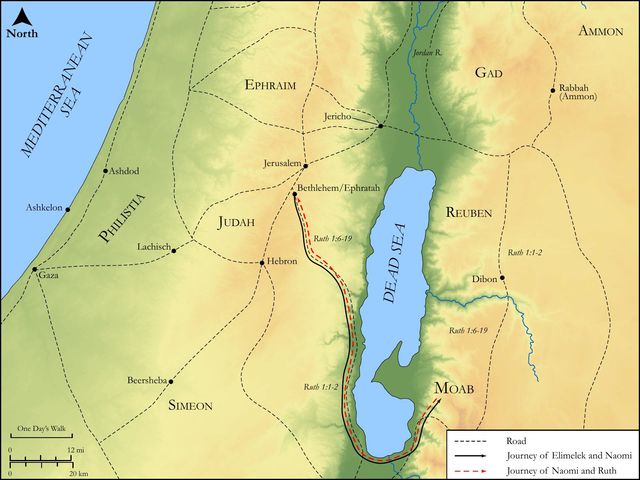
See on the biblical-era map
Study this verse
Public-domain commentary
Matthew Henry
From his Commentary on the Whole Bible. Henry comments on passages, not single verses — this entry covers Ruth 2:17–23. His two-level outline is real structure in the source text, so it is rendered as structure.
Here, I. Ruth finishes her day's work, Rut 2:17. 1. She took care not to lose time, for she gleaned until evening. We must not be weary of well-doing, because in due season we shall reap. She did not make an excuse to sit still, or go home, till the evening. Let us work the works of him that sent us, while it is day. She scarcely used, much less did she abuse, the kindness of Boaz; for, though he ordered his servants to leave handfuls for her, she continued to glean the scattered ears. 2. She took care not to lose what she had gathered, but threshed it herself, that she might the more easily carry it home, and might have it ready for use. The slothful man roasteth not that which he took in hunting, and so loseth the benefit of it, but the substance of a diligent man is precious, Pro 12:27. Ruth had gathered it ear by ear, but, when she had put it all together, it was an ephah of barley, about four pecks. Many a little makes a great deal. It is an encouragement to industry that in all labour, even that of gleaning, there is profit, but the talk of the lips tendeth only to penury. When she had got her corn into as little compass as she could, she took it up herself, and carried it into the city, though, had she asked them, it is likely some of Boaz's servants would have done that for her. We should study to be as little as possible troublesome to those that are kind to us. She did not think it either too hard or too mean a service to carry her corn herself into the city, but was rather pleased with what she had gotten by her own industry, and careful to secure it; and let us thus take care that we lose not those things which we have wrought, which we have gained, Jo2 1:8.
II.She paid her respects to her mother-in-law, went straight home to her and did not go to converse with Boaz's servants, showed her what she had gleaned, that she might see she had not been idle.
1.She entertained her with what she had left of the good dinner Boaz had given her. She gave to her what she had reserved, after she was sufficed (Rut 2:18), which refers to Rut 2:14. If she had any thing better than another, her mother should have part with her. Thus, having shown industry abroad, she showed piety at home; so children's maintaining their parents is called (Ti1 5:4), and it is part of the honour due to them by the fifth commandment, Mat 15:6.
2.She gave her an account of her day's work, and how a kind providence had favoured her in it, which made it very comfortable to her; for the gleanings that a righteous man hath are better than the harvests of many wicked, Psa 37:16. (1.) Naomi asked her where she had been: Where hast thou gleaned today? Note, Parents should take care to enquire into the ways of their children, how, and where, and in what company they spend their time. This may prevent many extravagancies which children, left to themselves, run into, by which they bring both themselves and their parents to shame. If we are not our brethren's, yet surely we are our children's keepers: and we know what a son Adonijah proved, that had never been chidden. Parents should examine their children, not to frighten nor discourage them, not so as to make them hate home or tempt them to tell a lie, but to commend them if they have done well, and with mildness to reprove and caution them if they have done otherwise. It is a good question for us to ask ourselves in the close of every day, "Where have I gleaned today? What improvements have I made in knowledge and grace? What have I done or obtained that will turn to a good account?" (2.) Ruth gave her a particular account of the kindness she had received from Boaz (Rut 2:19) and the hopes she had of further kindness from him, he having ordered her to attend his servants throughout all the harvest, Rut 2:21. Note, Children should look upon themselves as accountable to their parents and to those that are over them, and not think it a disparagement to them to be examined; let them do that which is good, and they shall have praise of the same. Ruth told her mother what kindness Boaz had shown her, that she might take some occasion or another to acknowledge it and return him thanks; but she did not tell her how Boaz had commended her, v. 11. Humility teaches us, not only not to praise ourselves, but not to be forward to publish others' praises of us. (3.) We are here told what Naomi said to it. [1.] She prayed heartily for him that had been her daughter's benefactor, even before she knew who it was (Rut 2:19): Blessed be he, whoever he was, that did take knowledge of thee, shooting the arrow of prayer at a venture. But more particularly when she was told who it was (Rut 2:20): Blessed be he of the Lord. Note, The poor must pray for those that are kind and liberal to them, and thus requite them, when they are not capable of making them any other requital. Let the loins of the poor bless those that refresh them, Job 29:13; Job 31:20. And he that hears the cries of the poor against their oppressors (Exo 22:27), it may be hoped, will hear the prayers of the poor for their benefactors. She now remembered the former kindnesses Boaz had shown to her husband and sons, and joins those to this: he has not left off his kindness to the living and to the dead. If we generously show kindness even to those that seem to have forgotten our former favours, perhaps it may help to revive the remembrance even of those which seem buried. [2.] She acquainted Ruth with the relation their family was in to Boaz: The man is near of kin to us. It should seem she had been so long in Moab that she had forgotten her kindred in the land of Israel, till by this providence God brought it to her mind. At least she had not told Ruth of it, though it might have been some encouragement to a young proselyte. Unlike to humble Naomi are many, who, though fallen into decay themselves, are continually boasting of their great relations. Nay, Observe the chain of thought here, and in it a chain of providences, bringing about what was designed concerning Ruth. Ruth names Boaz as one that had been kind to her. Naomi bethinks herself who that should be, and presently recollects herself: "The man is near of kin to us; now that I hear his name, I remember him very well." This thought brings in another: "He is our next kinsman, our goel, that has the right to redeem our estate that was mortgaged, and therefore from him we may expect further kindness. He is the likeliest man in all Bethlehem to set us up." Thus God brings things to our mind, sometimes on a sudden, that prove to have a wonderful tendency to our good. [3.] She appointed Ruth to continue her attendance in the fields of Boaz (Rut 2:22): "Let them not meet thee in any other field, for that will be construed a contempt of his courtesy." Our blessed Saviour is our Goel; it is he that has a right to redeem. If we expect to receive benefit by him, let us closely adhere to him, and his fields, and his family; let us not go to the world and its fields for that which is to be had with him only, and which he has encouraged us to expect from him. Has the Lord dealt bountifully with us? Let us not be found in any other field, nor seek for happiness and satisfaction in the creature. Tradesmen take it ill if those that are in their books go to another shop. We lose divine favours if we slight them. Some think Naomi gave her daughter-in-law a tacit rebuke; she had spoken (Rut 2:21) of keeping fast by the young men. "Nay," said Naomi (Rut 2:22), "It is good that thou go out with his maidens; they are fitter company for thee than the young men." But they are too critical. Ruth spoke of the young men because they were the principal labourers, and to them Boaz had given directions concerning her; and Naomi takes it for granted that, while she attended the young men, her society would be with the maidens, as was fit. Ruth dutifully observed her mother's directions; she continued to glean, to the end, not only of barley-harvest, but of the wheat-harvest, which followed it, that she might gather food in harvest to serve for winter, Pro 6:6-8. She also kept fast by the maidens of Boaz, with whom she afterwards cultivated an acquaintance, which might do her service, Rut 2:23. But she constantly came to her mother at night in due time, as became a virtuous woman, that was for working days, and not for merry nights. And when the harvest was ended (as bishop Patrick expounds it) she did not gad abroad, but kept her aged mother company at home. Dinah went out to see the daughters of the land, and we know what a disgrace her vanity ended in. Ruth kept at home, and helped to maintain her mother, and went out on no other errand than to get provision for her, and we shall find afterwards what preferment her humility and industry ended in. Seest thou a man diligent in his business? Honour is before him.
Continue studying Ruth 2:19 across the web’s major study libraries — every link below opens this exact verse, chapter, or book on the destination site.
Read & Compare
 BibleGatewayThis verse in more than 200 translations and 70 languages.
 Bible.comThe YouVersion reader — hundreds of translations, reading plans, and highlights.
 ESV.orgCrossway's official English Standard Version reader.
 NET BibleThe NET translation with 60,000+ translators' notes on every rendering decision.
 STEP BibleTyndale House's free study tool — original text, vocabulary, and scholarly resources.
 BibliaLogos Bible Software's free web reader.
 USCCBThe New American Bible (Revised Edition) with the U.S. bishops' study notes.
Commentaries
 BibleHub CommentariesDozens of classic commentaries on this verse, gathered on one page.
 StudyLightMore than 100 commentary sets — the largest collection on the web.
 BibleRefPlain-English commentary on what this verse means, verse by verse.
 Enduring WordDavid Guzik's free commentary on this chapter, widely used by Bible teachers.
 Bible Study ToolsVerse commentary alongside Greek and Hebrew study aids.
Original Language & Research
- BibleHub InterlinearThe verse word by word — original language, transliteration, and English.
- BibleHub LexiconEvery word's original-language definition and Strong's entry.
 Blue Letter BibleDeep-study tools — Strong's numbers, concordance, and word studies.
 SefariaThe Hebrew text with Rashi and centuries of Jewish commentary.
Sermons, Hymns & Audio


TrulyRandomVerse is not affiliated with these sites and doesn’t control their content. They’re linked because they’re genuinely useful.
Summary
Ruth 2:19 vividly portrays the evening exchange between Ruth and Naomi, a pivotal moment after Ruth's first day of gleaning in Bethlehem. Naomi's probing questions, driven by both concern and burgeoning hope, seek to understand the source of Ruth's unusual bounty. Ruth's straightforward declaration, identifying Boaz as her benefactor, serves as a dramatic turning point, igniting Naomi's strategic insight and setting the stage for the unfolding of God's redemptive plan through the institution of the kinsman-redeemer.
Context
ShowHideLiterary Context
This verse serves as the narrative climax of Ruth's initial foray into the fields and a crucial bridge to the unfolding plot. It immediately follows Boaz's extraordinary kindness and generosity towards Ruth, which went far beyond the customary gleaning laws, as detailed in Ruth 2:8-16. Ruth's return home, laden with an ephah of barley—an astonishing amount for a single day's gleaning—naturally triggers Naomi's inquisitive and hopeful interrogation. The dialogue in this verse shifts the focus from Ruth's diligent labor and Boaz's benevolence to Naomi's strategic thinking and her dawning realization of a potential kinsman-redeemer. The revelation of Boaz's name directly precedes Naomi's excited pronouncement and blessing in Ruth 2:20, setting the stage for the book's resolution.
Historical & Cultural Context
The practice of gleaning was a divinely mandated provision for the vulnerable in ancient Israel, specifically for the poor, sojourners, orphans, and widows, as commanded in Leviticus 19:9-10 and Deuteronomy 24:19-22. This system was a vital form of care for the needy, ensuring basic sustenance for the most precarious members of society. For Ruth, a Moabitess and a double-widow in a foreign land, gleaning was her sole immediate means of survival. Naomi's questions reflect the inherent precariousness of their situation; a widow without male protection was exceedingly vulnerable. Her inquiry, "where wroughtest thou?", extends beyond mere curiosity, subtly probing the character and reputation of the landowner, as a just and kind owner would ensure the safety and fair treatment of gleaners. The identification of Boaz carries immense weight, as he is not only a wealthy and respected landowner but also a relative of Naomi's late husband, thereby introducing the critical concept of the go'el or kinsman-redeemer.
Key Themes
ShowHideRuth 2:19 powerfully illuminates several foundational themes within the book of Ruth. Divine Providence is central, subtly at work as Ruth "happened" to come to Boaz's field (Ruth 2:3). Naomi's blessing upon the one who "did take knowledge of thee" underscores the unseen hand of God orchestrating seemingly coincidental events for His purposes. Loyalty and Diligence are exemplified by Ruth's unwavering commitment to Naomi and her strenuous efforts in the field, showcasing her virtuous character (Ruth 3:11). Naomi's Hope and Strategic Insight emerge as she begins to perceive the potential for redemption and security through Boaz, a kinsman-redeemer, a concept that will be fully developed in Ruth chapter 4. Finally, the verse subtly introduces Boaz's Righteous Character, as Naomi's immediate positive reaction to his name suggests his established reputation for integrity, kindness, and adherence to covenantal responsibilities within the community of Bethlehem.
Exposition and Analysis
ShowHideKey Word Analysis
ShowHideThis primitive root means "to do or make, in the broadest sense and widest application." In Naomi's question, "where wroughtest thou?", it emphasizes Ruth's active, diligent, and productive labor. It highlights the physical exertion and the successful outcome of her work, prompting Naomi to inquire about the specific conditions or individual responsible for such a fruitful day. This word underscores Ruth's commitment to providing for herself and Naomi through honest, strenuous effort.
This primitive root means "to scrutinize, i.e. look intently at; hence (with recognition implied), to acknowledge, be acquainted with, care for, respect, revere." Naomi's blessing, "blessed be he that did take knowledge of thee," expresses profound gratitude that someone not only recognized Ruth's presence but also showed her special favor, consideration, and active benevolence. This goes beyond mere acquaintance, implying a deliberate act of care and kindness, precisely what Boaz had extended to Ruth throughout the day. Naomi's use of this phrase indicates her immediate understanding that Ruth was treated exceptionally well, prompting her to seek the identity of this benevolent individual.
This proper noun, derived from an unused root of uncertain meaning, identifies the wealthy and respected landowner, a relative of Naomi's deceased husband, Elimelech. The revelation of his name is the narrative's turning point, as it immediately connects Ruth's providential encounter to Naomi's family lineage and the potential for a kinsman-redeemer (go'el). Boaz's name, signifying strength or quickness (as suggested by some etymologies related to "in him is strength"), foreshadows his pivotal role in restoring the strength and future of Naomi's family line.
Verse Breakdown
ShowHide"And her mother in law said unto her, Where hast thou gleaned to day? and where wroughtest thou?"
Naomi's immediate and insistent questions upon Ruth's return reveal her deep concern, practical acumen, and burgeoning hope. The sight of the abundant barley Ruth brought back (an ephah, approximately 22 liters, an exceptionally large amount for a single day's gleaning) would have been astonishing and prompted an urgent inquiry. Naomi wants to know not just the location ("where hast thou gleaned") but also the specific person or conditions that facilitated such an extraordinary harvest ("where wroughtest thou?"). This implies a search for a patron or a particularly generous field owner, indicating Naomi's practical and hopeful outlook for their future provision and safety in a precarious situation.
"blessed be he that did take knowledge of thee."
Before Ruth even names him, Naomi pronounces a spontaneous blessing upon the anonymous benefactor. This immediate blessing highlights Naomi's profound recognition that Ruth's success was due to extraordinary kindness and favor, not merely her diligent hard work. It reflects Naomi's deep gratitude and her understanding that such benevolence was a clear sign of divine favor working through a human agent. This blessing serves as an anticipatory affirmation of Boaz's character and actions, underscoring his reputation for integrity and generosity.
"And she shewed her mother in law with whom she had wrought, and said, The man's name with whom I wrought to day [is] Boaz."
Ruth's direct and simple answer provides the crucial piece of information that propels the narrative forward. The phrase "shewed her mother in law" suggests a detailed recounting of the day's events, likely including Boaz's specific instructions, provisions, and the general kindness shown. The revelation of Boaz's name is the dramatic turning point of the chapter, as it immediately connects Ruth's providential experience to Naomi's family lineage and the potential for a kinsman-redeemer. This name unlocks Naomi's strategic thinking and renewed hope for their future and the continuation of Elimelech's line.
Literary Devices
ShowHideThe verse masterfully employs Dialogue to advance the plot and reveal character. Naomi's questions are not merely inquisitive but are laden with hope, concern, and a strategic mind, highlighting her role as a protective and insightful figure. Ruth's concise and direct answer, "The man's name... is Boaz," functions as a powerful moment of Anagnorisis (recognition or discovery), which dramatically shifts the narrative's trajectory from uncertainty to the dawning of a redemptive possibility. The use of Foreshadowing is also evident; Naomi's spontaneous blessing upon the unknown benefactor and her immediate, energized reaction to Boaz's name subtly hint at his crucial and divinely appointed role as the kinsman-redeemer, a role that will become central to the story's resolution. The phrase "blessed be he that did take knowledge of thee" also functions as a form of Prolepsis, anticipating the full extent of Boaz's kindness and his ultimate role in their redemption and restoration.
Theological and Thematic Connections
ShowHideRuth 2:19 profoundly illustrates the theme of divine providence working through human kindness and diligence. Naomi's spontaneous blessing upon the one who "took knowledge" of Ruth underscores the biblical truth that God's favor is often mediated through the righteous actions of individuals. This verse sets in motion the unfolding of God's redemptive plan for Naomi and Ruth, demonstrating how seemingly ordinary daily events are meticulously woven into the fabric of God's sovereign purposes. It highlights the essential interplay between human responsibility (Ruth's unwavering diligence and loyalty) and divine orchestration (Boaz's presence and extraordinary kindness), leading to unexpected blessings, the restoration of hope, and the continuation of the lineage that would ultimately lead to King David and, centuries later, to the Messiah.
Reflection and Application
ShowHideRuth 2:19 serves as a profound reminder that God is intimately involved in the seemingly mundane details of our lives, often working through the kindness of others and our own diligent efforts. It encourages us to cultivate a heightened awareness of God's providential hand, even when circumstances appear coincidental or merely fortunate. Like Naomi, we are called to discern and give thanks for the blessings that come our way, recognizing that every good and perfect gift, whether directly from God or mediated through human benevolence, ultimately descends from above (James 1:17). Furthermore, Ruth's example of unwavering loyalty and strenuous hard work, even in a foreign and challenging environment, challenges us to embrace our responsibilities with faithfulness and integrity, trusting that our labor, when offered to God, can become a conduit for His purposes. The verse also underscores the value of wise counsel and mentorship, as Naomi's perceptive questions guide Ruth toward recognizing the profound significance of her encounter and the potential for a future beyond mere survival.
Questions for Reflection
ShowHideFAQ
ShowHideWhy was Naomi so curious about where Ruth gleaned?
ShowHideNaomi's intense curiosity stemmed from a combination of their desperate economic situation and the extraordinary bounty Ruth brought home. As two widows, they were entirely dependent on gleaning for survival, making every day's harvest critical. The sheer amount of barley Ruth returned with (an ephah, a remarkably large quantity for a single day) was astonishing and immediately suggested unusual favor or exceptional generosity from the landowner. Naomi's questions, "Where hast thou gleaned to day? and where wroughtest thou?", were not merely about location but were deeply probing the character of the person who allowed such abundance. She was strategically discerning if Ruth had found a benevolent patron, which was crucial for their ongoing safety, provision, and potential future security in a society where vulnerable women faced immense challenges. Her questions reveal her deep concern for Ruth's well-being and her strategic hope for their future.
What is the significance of Naomi's blessing, "blessed be he that did take knowledge of thee," before knowing it was Boaz?
ShowHideNaomi's spontaneous blessing is highly significant for several reasons. First, it demonstrates her immediate recognition that Ruth's success was not solely due to her hard work but to exceptional kindness and favor shown by an anonymous individual. This blessing highlights Naomi's deep faith and her understanding that God's provision often comes through human agents, underscoring the theme of divine providence. Second, it serves as an anticipatory affirmation of Boaz's character, indicating that his reputation for benevolence and integrity was already well-known and respected within the community. Her blessing, offered before the identity of the benefactor is revealed, shows that God was already at work, orchestrating events for their good, and sets the stage for the unfolding of His redemptive plan for her family through the kinsman-redeemer.
Christ-Centered Fulfillment
ShowHideRuth 2:19, while narrating a seemingly simple domestic scene, deeply foreshadows the greater Kinsman-Redeemer, Jesus Christ. Naomi's desperate hope for a redeemer, ignited by the providential mention of Boaz's name, points to humanity's ultimate and profound need for a Savior. Just as Boaz, a wealthy and respected kinsman, "took knowledge" of Ruth, a vulnerable outsider and Moabitess, and showed her extraordinary favor far beyond what was required by law, so too does Christ, our divine Kinsman, "take knowledge" of us in our spiritual poverty, alienation, and helplessness, extending grace and mercy far beyond what we could ever deserve (Ephesians 2:4-5). Boaz's provision of abundant grain for Ruth, ensuring her sustenance and security, powerfully mirrors Christ as the true Bread of Life, who provides spiritual nourishment, eternal life, and complete satisfaction for our souls. Furthermore, Boaz's willingness to go beyond the letter of the law to redeem Ruth and Naomi's lineage anticipates Christ's sacrificial and unparalleled love, who, though rich in divine glory, became poor for our sakes (2 Corinthians 8:9), taking on human flesh to become our brother and redeem us from the curse and bondage of sin (Hebrews 2:14-17). The divine providence evident in Ruth "happening" upon Boaz's field ultimately points to God's meticulously sovereign plan of salvation, orchestrated from eternity to bring about the redemption of His people through His Son, Jesus Christ, the ultimate and perfect Redeemer and Lord.