


Ruth 2:10
Bible text: King James Version (1769 Blayney text) · Public domain
Bible text: King James Version with Strong's numbers · Public domain
Bible text: Berean Standard Bible · Public domain
Bible text: American Standard Version (1901) · Public domain
Bible text: World English Bible, Messianic edition · Public domain
Bible text: Geneva Bible (1599) · Public domain
Bible text: Young's Literal Translation · Public domain
- וַתִּפֹּלva·ti·Poland she fellH5307Conj-w ¦ V-Qal-ConsecImperf-3fsVerb Qal Consecutive Imperfect 3rd Singular Feminineוַandתִּפֹּלshe fell
- עַל'alonH5921PrepPreposition
- פָּנֶיהָpa·Nei·haher faceH6440N-mpc ¦ 3fsNoun Plural Masculine Constructפָּנֶיfaceהָher
- וַתִּשְׁתַּחוּva·tish·Ta·chuand she bowed downH7812Conj-w ¦ V-Hishtaphel-ConsecImperf-3fsVerb Hishtaphel Consecutive Imperfect 3rd Singular Feminineוַandתִּשְׁתַּחוּshe bowed down
- אָרְצָה'A·re·tzah[the] ground towardsH776N-fs ¦ SfxNoun Singular Feminine Absoluteאָרְצָ[the] groundהtowards
- וַתֹּאמֶרva·To·merand she saidH559Conj-w ¦ V-Qal-ConsecImperf-3fsVerb Qal Consecutive Imperfect 3rd Singular Feminineוַandתֹּאמֶרshe said
- אֵלָיו'e·Lavto himH413Prep ¦ 3msPreposition Definiteאֵלָיtoוhim
- מַדּוּעַma·du·a'why?H4069InterrogParticle Interrogative
- מָצָאתִיma·Tza·tihave I foundH4672V-Qal-Perf-1csVerb Qal Perfect 1st Singular common gender
- חֵןchenfavorH2580N-msNoun Singular Masculine Absolute
- בְּעֵינֶיךָbe·'ei·Nei·khain your viewH5869Prep-b ¦ N-fdc ¦ 2msNoun Dual Feminine Constructבְּinעֵינֶיviewךָyour
- לְהַכִּירֵנִיle·ha·ki·Re·nito pay regard to meH5234Prep-l ¦ V-Hiphil-Inf ¦ 1csVerb Hiphil Infinitive Constructלְtoהַכִּירֵpay regard toנִיme
- וְאָּנֹכִיve·'a·no·Khiand IH595Conj-w ¦ Pro-1csPronoun Personal 1st Singular common genderוְandאָּנֹכִיI
- נָכְרִיָּהna·khe·ri·Yah[am] a foreignerH5237Adj-fsAdjective Singular Feminine Absolute
English is a literal word-by-word gloss of the Hebrew, not the KJV's wording. Why?
This is the original text the KJV's translators worked from — each Hebrew word with its own literal English meaning in this verse, prepared by scholars at Tyndale House, Cambridge. The KJV translates whole sentences, not word by word, so its wording differs: one Hebrew word can become several English words, and the KJV may choose “the LORD” where the gloss reads “Yahweh”. Both are faithful — they answer different questions. For the KJV's own rendering, switch to the KJV text.
Details
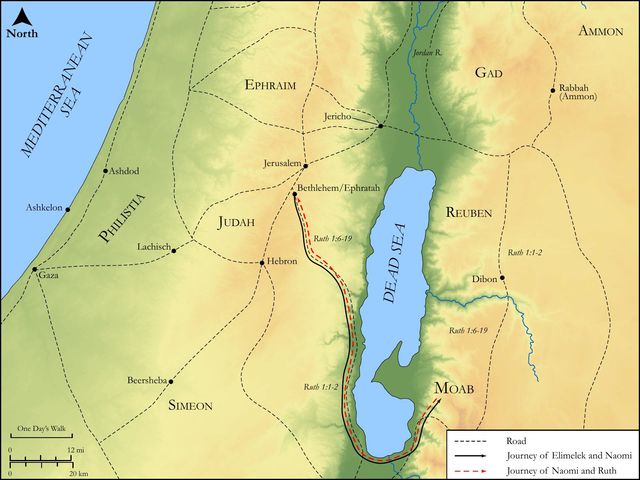
See on the biblical-era map
Study this verse
Public-domain commentary
Matthew Henry
From his Commentary on the Whole Bible. Henry comments on passages, not single verses — this entry covers Ruth 2:4–16. His four-level outline is real structure in the source text, so it is rendered as structure.
Now Boaz himself appears, and a great deal of decency there appears in his carriage both towards his own servants and towards this poor stranger.
I.Towards his own servants, and those that were employed for him in reaping and gathering in his corn.
Harvest-time is busy time, many hands must then be at work. Boaz that had much, being a mighty man of wealth, had much to do, and consequently many to work under him and to live upon him. As goods are increased those are increased that eat them, and what good has the owner thereof save the beholding of them with his eyes? Boaz is here an example of a good master.
1.He had a servant that was set over the reapers, Rut 2:6. In great families it is requisite there should be one to oversee the rest of the servants, and appoint to each their portion both of work and meat. Ministers are such servants in God's house, and it is requisite that they be both wise and faithful, and show their Lord all things, as he here, Rut 2:6.
2.Yet he came himself to his reapers, to see how the work went forward, if he found any thing amiss to rectify it, and to give further orders what should be done. This was both for his own interest (he that wholly leaves his business to others will have it done by the halves; the master's eye makes a fat horse) and it was also for the encouragement of his servants, who would go on the more cheerfully in their work when their master countenanced them so far as to make them a visit. Masters that live at ease should think with tenderness of those that toil for them and bear the burden and heat of the day.
3.Kind and pious salutations were interchanged between Boaz and his reapers.
(1.)He said to them, The Lord be with you; and they replied, The Lord bless thee, Rut 2:4. Hereby they expressed,
[1.]Their mutual respect to each other; he to them as good servants, and they to him as a good master. When he came to them he did not fall a chiding them, as if he came only to find fault and exercise his authority, but he prayed for them: "The Lord be with you, prosper you, and give you health and strength, and preserve you from any disaster." Nor did they, as soon as ever he was out of hearing, fall a cursing him, as some ill-natured servants that hate their master's eye, but they returned his courtesy: "The Lord bless thee, and make our labours serviceable to thy prosperity." Things are likely to go on well in a house where there is such good-will as this between master and servants.
[2.]Their joint-dependence upon the divine providence. They express their kindness to each other by praying one for another. They show not only their courtesy, but their piety, and acknowledgement that all good comes from the presence and blessing of God, which therefore we should value and desire above any thing else both for ourselves and others.
(2.)Let us hence learn to use,
[1.]Courteous salutations, as expressions of a sincere good-will to our friends.
[2.]Pious ejaculations, lifting up our hearts to God for his favour, in such short prayers as these. Only we must take heed that they do not degenerate into formality, lest in them we take the name of the Lord our God in vain; but, if we be serious in them, we may in them keep up our communion with God, and fetch in mercy and grace from him. It appears to have been the usual custom thus to wish reapers good speed, Psa 129:7, Psa 129:8.
4.He took an account from his reapers concerning a stranger he met with in the field, and gave necessary orders concerning her, that they should not touch her (Rut 2:9) nor reproach her, Rut 2:15. Masters must take care, not only that they do no hurt themselves, but that they suffer not their servants and those under them to do hurt. He also ordered them to be kind to her, and let fall some of the handfuls on purpose for her. Though it is fit that masters should restrain and rebuke their servants' wastefulness, yet they should not tie them up from being charitable, but give them allowance for that, with prudent directions.
II.Boaz was very kind to Ruth, and showed her a great deal of favour, induced to it by the account he had of her, and what he observed concerning her, God also inclining his heart to countenance her. Coming among his reapers, he observed this stranger among them, and got intelligence from his steward who she was, and here is a very particular account of what passed concerning her.
1.The steward gave to Boaz a very fair account of her, proper to recommend her to his favour, Rut 2:6, Rut 2:7.
(1.)That she was a stranger, and therefore one of those that by the law of God were to gather the gleanings of the harvest, Lev 19:9, Lev 19:10. She is the Moabitish damsel.
(2.)That she was allied to his family; she came back with Naomi, the wife of Elimelech, a kinsman of Boaz.
(3.)That she was a proselyte, for she came out of the country of Moab to settle in the land of Israel.
(4.)That she was very modest, and had not gleaned till she had asked leave.
(5.)That she was very industrious, and had continued close to her work from morning even until now. And the poor that are industrious and willing to take pains are fit to be encouraged. Now, in the heat of the day, she tarried a little in the house or booth that was set up in the field for shelter from the weather to repose herself, and some suggest that it is probably she retired for her devotion. But she soon came back to her work, and, except that little intermission, kept close to it all day, though it was not what she had been used to. Servants should be just in the character and reports they give to their masters, and take heed they do not misrepresent any person, nor without cause discourage their master's charity.
2.Boaz was hereupon extremely civil to her in divers instances.
(1.)He ordered her to attend his reapers in every field they gathered in and not to glean in the field of another, for she should not need to go any where else to better herself (Rut 2:8): Abide here fast by my maidens; for those of her own sex were the fittest company for her.
(2.)He charged all his servants to be very tender of her and respectful to her, and no doubt they would be so to one to whom they saw their master kind. She was a stranger, and it is probably her language, dress, and mien differed much from theirs; but he charged them that they should not in any thing affront her, or be abusive to her, as rude servants are too apt to be to strangers.
(3.)He bade her welcome to the entertainment he had provided for his own servants. He ordered her, not only to drink of the water which was drawn for them (for that seems to be the liquor he means, Rut 2:9, drawn from the famous well of Beth-lehem which was by the gate, the water of which David longed for, Sa2 23:15), but at meal-time to come and eat of their bread (Rut 2:14), yea, and she should be welcome to their sauce too: Come, dip thy morsel in the vinegar, to make it savoury; for God allows us not only nourishing but relishing food, not for necessity only, but for delight. And for encouragement o her, and direction to the servants, he himself, happening to be present when the reapers sat down to meat, reached her parched corn to eat. It is no disparagement to the finest hand to be reached forth to the needy (Pro 31:20), and to be employed in serving the poor. Observe, Boaz was not scanty in his provision for his reapers, but sent them so much more than enough for themselves as would be entertainment for a stranger. Thus there is that scattereth and yet increaseth.
(4.)He commended her for her dutiful respect to her mother-in-law, which, though he did not know her by sight, yet he had heard of (Rut 2:11): It has been fully shown me all that thou hast done unto thy mother-in-law. Note, Those that do well ought to have the praise of it. But that which especially he commended her for was that she had left her own country, and had become a proselyte to the Jewish religion; for so the Chaldee expounds it: "Thou hast come to be proselyted, and to dwell among a people whom thou knowest not." Those that leave all, to embrace the true religion, are worthy of double honour.
(5.)He prayed for her (Rut 2:12): The Lord recompense thy work. Her strong affection to the commonwealth of Israel, to which she was by birth an alien, was such a work of the divine grace in her as would certainly be crowned with a full reward by him under whose wings she had come to trust. Note, Those that by faith come under the wings of the divine grace, and have a full complacency and confidence in that grace, may be sure of a full recompence of reward for their so doing. From this expression, the Jews describe a proselyte to be one that is gathered under the wings of the divine majesty.
(6.)He encouraged her to go on in her gleaning, and did not offer to take her off from that; for the greatest kindness we can do our poor relations is to assist and encourage their industry. Boaz ordered his servants to let her glean among the sheaves, where other gleaners were not allowed to come, and not to reproach her, that is, not to call her thief, or to suspect her of taking more than was allowed her, Rut 2:15. All this shows Boaz to have been a man of a generous spirit, and one that, according to the law, considered the heart of a stranger.
3.Ruth received his favours with a great deal of humility and gratitude, and conducted herself with as much propriety in her place as he did himself in his, but little thinking that she should shortly be the mistress of that field she was now gleaning in.
(1.)She paid all possible respect to him, and gave him honour, according to the usage of the country (Rut 2:10): She fell on her face, and bowed herself to the ground. Note, Good breeding is a great ornament to religion; and we must render honour to whom honour is due.
(2.)She humbly owned herself unworthy of his favours: "I am a stranger (Rut 2:10) and not like one of thy handmaids (Rut 2:13), not so well dressed nor so well taught, not so neat nor so handy." Note, It well becomes us all to think meanly of ourselves, and to take notice of that in ourselves which is diminishing, esteeming others better than ourselves.
(3.)She gratefully acknowledged his kindness to her; though it was no great expense to him, nor much more than what he was obliged to by the divine law, yet she magnifies and admires it: Why have I found grace in thy eyes? Rut 2:10.
(4.)She begs the continuance of his good-will: Let me find favour in they sight (Rut 2:13), and owns that what he had said had been a cordial to her: Thou hast comforted me, for that thou hast spoken friendly to me. Those that are great, and in high places, know not how much good they may do to their inferiors with a kind look or by speaking friendly to them; and so small an expense, one would think, they should not grudge, when it shall be put upon the score of their charity.
(5.)When Boaz gave her her dinner with his reapers she only ate so much as would suffice her, and left the rest, and immediately rose up to glean, Rut 2:14, Rut 2:15. She did not, under pretence either of her want or of her labour, eat more than was convenient for her, nor so much as to unfit her for work in the afternoon. Temperance is a friend to industry; and we must eat and drink to strengthen us for business, not to indispose us to it.
Continue studying Ruth 2:10 across the web’s major study libraries — every link below opens this exact verse, chapter, or book on the destination site.
Read & Compare
 BibleGatewayThis verse in more than 200 translations and 70 languages.
 Bible.comThe YouVersion reader — hundreds of translations, reading plans, and highlights.
 ESV.orgCrossway's official English Standard Version reader.
 NET BibleThe NET translation with 60,000+ translators' notes on every rendering decision.
 STEP BibleTyndale House's free study tool — original text, vocabulary, and scholarly resources.
 BibliaLogos Bible Software's free web reader.
 USCCBThe New American Bible (Revised Edition) with the U.S. bishops' study notes.
Commentaries
 BibleHub CommentariesDozens of classic commentaries on this verse, gathered on one page.
 StudyLightMore than 100 commentary sets — the largest collection on the web.
 BibleRefPlain-English commentary on what this verse means, verse by verse.
 Enduring WordDavid Guzik's free commentary on this chapter, widely used by Bible teachers.
 Bible Study ToolsVerse commentary alongside Greek and Hebrew study aids.
Original Language & Research
- BibleHub InterlinearThe verse word by word — original language, transliteration, and English.
- BibleHub LexiconEvery word's original-language definition and Strong's entry.
 Blue Letter BibleDeep-study tools — Strong's numbers, concordance, and word studies.
 SefariaThe Hebrew text with Rashi and centuries of Jewish commentary.
Sermons, Hymns & Audio


TrulyRandomVerse is not affiliated with these sites and doesn’t control their content. They’re linked because they’re genuinely useful.
Summary
Ruth 2:10 powerfully captures Ruth's profound humility and astonished gratitude in response to Boaz's unexpected and exceptional kindness. Having arrived in Bethlehem as a vulnerable Moabite widow and stranger, Ruth is overwhelmed by the preferential treatment extended to her by Boaz, a wealthy and respected kinsman. Her prostration and heartfelt question, "Why have I found grace in thine eyes, that thou shouldest take knowledge of me, seeing I am a stranger?", underscore the unmerited nature of the favor she receives, highlighting themes of divine providence, grace, and the welcome of an outsider who had come to trust under the wings of the God of Israel, within His unfolding redemptive plan.
Context
ShowHideLiterary Context
Ruth 2:10 marks a pivotal moment during Ruth's first day of gleaning in Boaz's field. The preceding verses establish Ruth's diligent work ethic and Boaz's immediate notice of her. Boaz has already shown extraordinary favor by instructing his young men not to bother her, allowing her to glean among the sheaves, and even inviting her to drink from his servants' water vessels, as detailed in Ruth 2:8-9. This verse records Ruth's direct, humble, and astonished response to this unprecedented kindness from a man of stature whom she has just met. Her reaction sets the stage for the deepening relationship between Ruth and Boaz, and for Boaz's subsequent recognition of Ruth's loyalty to Naomi, as elaborated in Ruth 2:11-12.
Historical & Cultural Context
In ancient Israel, the Mosaic Law provided for the poor and vulnerable through the practice of gleaning, where landowners were commanded to leave the edges of their fields unharvested for the needy, including the sojourner, the fatherless, and the widow (Leviticus 19:9-10 and Deuteronomy 24:19). While gleaning was a legal right, the level of personal care and protection Boaz extends to Ruth goes far beyond mere legal obligation. Ruth's identity as a "stranger" (a Moabite) is crucial; Moabites were often viewed with suspicion due to historical animosity and their idolatrous practices. Her status as a widow further compounded her vulnerability in a patriarchal society where women depended on male relatives for protection and provision. Boaz's actions, therefore, represent a radical act of hospitality and hesed (loyal love/kindness) that transcends societal norms and prejudices.
Key Themes
ShowHideThis verse powerfully contributes to several key themes within the Book of Ruth. It highlights the theme of grace and unmerited favor, as Ruth explicitly recognizes that Boaz's kindness is not something she has earned but is freely given. It underscores humility and gratitude, exemplified by Ruth's prostration and sincere question. The emphasis on Ruth's status as a "stranger" brings forth the theme of inclusion of the outsider, demonstrating God's heart for the lowly and how His people are called to reflect that care. Furthermore, Boaz's actions subtly reveal the theme of divine providence, as the narrative consistently shows God's guiding hand bringing Ruth to Boaz's field and moving Boaz's heart to act with compassion, ultimately leading to the fulfillment of God's redemptive plan through the line of David, as foreshadowed in Ruth 4:17. The entire narrative of Ruth is a testament to God's faithfulness even in times of hardship.
Exposition and Analysis
ShowHideKey Word Analysis
ShowHideThis word (H2580, חֵן) denotes favor, kindness, charm, or graciousness. It implies an unmerited benevolence, often extended by a superior to an inferior, or by one who has the power to bless. Ruth's use of this term signifies her understanding that Boaz's actions are not due to any inherent claim or merit on her part, but rather stem from his generous disposition and compassionate heart. It is a recognition of favor that is freely given, not earned, and speaks to the pleasantness and preciousness of the kindness received.
The Hebrew verb (H5234, נָכַר) means to scrutinize, look intently at, and, with recognition implied, to acknowledge, be acquainted with, or care for. For a wealthy and respected landowner like Boaz to "take knowledge" of a humble, foreign gleaner was a significant act of personal recognition and respect. It implies more than just seeing her; it suggests a deliberate act of noticing, understanding her situation, and extending personal care, rather than merely allowing her to exercise her legal right to glean. This goes beyond simple perception to a deeper, caring acknowledgment.
This term (H5237, נָכְרִיָּה) specifically refers to a foreign woman, an outsider. Ruth's self-identification as a "stranger" emphasizes her vulnerable and lowly status in Israelite society. It highlights her lack of family protection, social standing, and inherent rights within the community, making Boaz's extraordinary kindness all the more remarkable and demonstrating a profound act of hospitality towards one who had no claim on him. Her foreignness underscores the unlikeliness of her receiving such favor.
Verse Breakdown
ShowHide"Then she fell on her face, and bowed herself to the ground"
This physical posture signifies extreme humility, reverence, and profound astonishment. It is a gesture of deep respect and submission, common in Scripture when approaching a superior or someone of high status, as when Abigail fell before David on her face and bowed herself to the ground. Ruth's immediate and dramatic reaction underscores her overwhelming sense of unworthiness in the face of such unexpected and generous favor, highlighting her complete deference to Boaz.
"and said unto him, Why have I found grace in thine eyes"
This is a rhetorical question expressing profound surprise and a recognition of unmerited favor. Ruth is not questioning Boaz's right to show kindness, but rather expressing her bewilderment as to why she, specifically, would be singled out for such benevolence. It highlights the theme of grace—favor given without expectation of return or based on the recipient's merit, emphasizing the gratuitous nature of Boaz's actions.
"that thou shouldest take knowledge of me"
This clause elaborates on the nature of the "grace" she has found. It's not just a general kindness, but a personal acknowledgment and recognition from Boaz. For a man of his standing to notice, address, and provide for a lowly gleaner like Ruth was an act that elevated her status and provided her with a sense of security and belonging she had not expected, transforming her anonymity into personal recognition.
"seeing I [am] a stranger?"
This final clause provides the reason for Ruth's astonishment. Her status as a Moabite, an outsider with no familial ties or social standing in Bethlehem, makes Boaz's kindness all the more extraordinary. She emphasizes her foreignness, highlighting her perceived lack of entitlement to such favor, and thereby magnifying the magnanimity of Boaz's character and actions, and underscoring the radical nature of his hospitality.
Literary Devices
ShowHideThe verse employs several powerful literary devices to convey Ruth's emotional state and the significance of Boaz's actions. Hyperbole is evident in Ruth's extreme physical reaction of falling on her face and bowing to the ground, emphasizing the depth of her humility and astonishment. Her rhetorical question, "Why have I found grace... seeing I am a stranger?", functions as Irony, as the narrative subtly reveals that it is precisely her loyalty and vulnerability as a stranger that God is using to bring about His redemptive plan. The Dialogue is direct and emotionally charged, allowing Ruth's character to express profound gratitude and humility, making the scene vivid and relatable. Furthermore, Boaz's actions and Ruth's response serve as Foreshadowing of the deeper redemptive relationship that will unfold, with Boaz acting as a kinsman-redeemer, mirroring divine grace and the inclusion of the outsider into God's covenant family.
Theological and Thematic Connections
ShowHideRuth's experience in Boaz's field is a profound illustration of God's unmerited favor, or grace, extended to the undeserving. Her status as a "stranger" from Moab, a nation historically antagonistic to Israel, underscores the radical nature of the kindness she receives. This narrative beautifully demonstrates how God works through human agents, like Boaz, to extend His hesed (loyal love) and provide for the vulnerable, often in unexpected ways. It is a testament to divine providence, showing that even in seemingly ordinary circumstances, God is actively orchestrating events to fulfill His purposes, bringing an outsider into the very lineage of the Messiah. This act of grace in Ruth's life foreshadows the broader theological truth that God's favor is not earned by human merit or national identity, but is freely given to those He chooses to bless, drawing them into His covenant family and demonstrating His universal love.
Reflection and Application
ShowHideRuth's humble and grateful response to Boaz's unexpected kindness offers a powerful paradigm for our own lives, particularly in how we receive God's grace. Like Ruth, we are often "strangers" or outsiders in need of favor, utterly undeserving of the profound love and redemption offered to us through Christ. Her prostration and question, "Why have I found grace?", should resonate deeply within our hearts as we contemplate the immeasurable gift of salvation. This verse calls us to cultivate a spirit of profound humility and genuine gratitude, recognizing that all good things, especially our spiritual blessings, are unmerited gifts from a gracious God. Furthermore, Boaz's example challenges us to embody this same grace in our interactions with others. Just as he "took knowledge" of a vulnerable stranger, we are called to see, acknowledge, and extend kindness and hospitality to those who are despised, overlooked, or considered "outsiders" in our communities, reflecting God's own heart for the sojourner and the needy, and becoming channels of His hesed to a world in need.
Questions for Reflection
ShowHideFAQ
ShowHideWhy was Ruth's reaction so extreme, falling on her face and bowing to the ground?
ShowHideRuth's physical reaction was a culturally appropriate and deeply significant expression of profound humility, reverence, and astonishment. In Israel, such prostration was common when approaching a superior, a king, or someone of great authority and status, as when Bathsheba bowed herself before King David. For Ruth, a poor, foreign widow, to receive such personal attention and generous favor from Boaz, a wealthy and respected landowner, was utterly unexpected and overwhelming. Her extreme humility underscored her recognition that she had no inherent claim to such kindness and that it was a pure act of unmerited grace, prompting an equally extreme display of gratitude and respect for the one who showed her such unexpected favor.
What does Ruth mean by "take knowledge of me"?
ShowHideThe phrase "take knowledge of me" (from the Hebrew nakar, H5234) means more than just a casual glance or recognition of her presence. It implies a deliberate act of noticing, acknowledging, and showing personal interest in her specific situation. For a man of Boaz's stature to "take knowledge" of a humble gleaner meant he was singling her out, understanding her vulnerability, and extending a personal, protective concern that went beyond the general provisions of the law. It was an act of dignifying her and treating her as a person worthy of attention and care, despite her low social standing and foreign origin, demonstrating a profound level of personal engagement.
What is the significance of Ruth calling herself a "stranger"?
ShowHideRuth's self-identification as a "stranger" (nokrîy, H5237) is highly significant because it highlights her status as an outsider, a Moabite woman in Israelite society. Moabites were often viewed with suspicion or hostility by Israelites, and Ruth had no family or social network in Bethlehem to protect or provide for her. By emphasizing her foreignness, Ruth underscores her perceived lack of entitlement to Boaz's kindness. This accentuates the extraordinary nature of Boaz's grace and hospitality, demonstrating a radical inclusion that transcends ethnic and social barriers. It also subtly points to God's broader redemptive plan, which often includes those who are considered outsiders, drawing them into His covenant family, as seen throughout the biblical narrative.
Christ-Centered Fulfillment
ShowHideRuth 2:10, with its profound display of unmerited favor shown to a vulnerable stranger, beautifully prefigures the ultimate grace extended through Jesus Christ. Ruth, as a Moabite outsider, represents humanity alienated from God by sin, having no claim or merit to receive divine favor. Yet, just as Boaz, a kinsman-redeemer figure, "took knowledge" of Ruth and extended extraordinary grace, so too does Christ, our ultimate Kinsman-Redeemer, reach out to us in our estranged state. The "grace" Ruth found in Boaz's eyes is a shadow of the boundless, undeserved favor God lavishes upon us through His Son. We, who were once "strangers and foreigners" to the covenants of promise, are now, by God's grace through faith in Christ, "fellow citizens with the saints and members of the household of God" (Ephesians 2:12-19). Boaz's compassionate inclusion of Ruth, an act of hesed, points directly to God's faithful love in Christ, who not only acknowledges our need but fully redeems us, bringing us into His family and providing for our every need, making us heirs according to the promise (Galatians 3:29). Indeed, the very lineage of Christ traces back through this Moabite woman, demonstrating God's universal reach and His plan to save people from every tribe and nation (Revelation 7:9-10).