


Ruth 2:18
Bible text: King James Version (1769 Blayney text) · Public domain
Bible text: King James Version with Strong's numbers · Public domain
Bible text: Berean Standard Bible · Public domain
Bible text: American Standard Version (1901) · Public domain
Bible text: World English Bible, Messianic edition · Public domain
Bible text: Geneva Bible (1599) · Public domain
Bible text: Young's Literal Translation · Public domain
- וַתִּשָּׂאva·ti·Sa'and she lifted [it] upH5375Conj-w ¦ V-Qal-ConsecImperf-3fsVerb Qal Consecutive Imperfect 3rd Singular Feminineוַandתִּשָּׂאshe lifted [it] up
- וַתָּבוֹאva·ta·Vo'and she wentH935Conj-w ¦ V-Qal-ConsecImperf-3fsVerb Qal Consecutive Imperfect 3rd Singular Feminineוַandתָּבוֹאshe went
- הָעִירha·'Irthe cityH5892Art ¦ N-fsNoun Singular Feminine Absoluteהָtheעִירcity
- וַתֵּרֶאva·Te·re'and she sawH7200Conj-w ¦ V-Qal-ConsecImperf-3fsVerb Qal Consecutive Imperfect 3rd Singular Feminineוַandתֵּרֶאshe saw
- חֲמוֹתָהּcha·mo·Tahher mother-in-lawH2545N-fsc ¦ 3fsNoun Singular Feminine Constructחֲמוֹתָmother-in-lawהּher
- אֵת'et<obj.>H853DirObjMParticle Object Indicator
- אֲשֶׁר'a·Sher[that] whichH834RelParticle Relative
- לִקֵּטָהli·Ke·tahshe had gleanedH3950V-Piel-Perf-3fsVerb Piel Perfect 3rd Singular Feminine
- וַתּוֹצֵאva·to·Tze'and she took [it] outH3318Conj-w ¦ V-Hiphil-ConsecImperf-3fsVerb Hiphil Consecutive Imperfect 3rd Singular Feminineוַandתּוֹצֵאshe took [it] out
- וַתִּתֶּןva·ti·tenand she gaveH5414Conj-w ¦ V-Qal-ConsecImperf-3fsVerb Qal Consecutive Imperfect 3rd Singular Feminineוַandתִּתֶּןshe gave
- לָהּLahto <the> herPrep-l ¦ 3fsSuffix Personal 3rd Singular Feminineלָto <the>הּher
- אֵת'et<obj.>H853DirObjMParticle Object Indicator
- אֲשֶׁר'a·Sher[that] whichH834RelParticle Relative
- הוֹתִרָהho·Ti·rahshe had left overH3498V-Hiphil-Perf-3fsVerb Hiphil Perfect 3rd Singular Feminine
- מִשָּׂבְעָהּmi·sa·ve·'Ahfrom her abundanceH7648Prep-m ¦ N-msc ¦ 3fsNoun Singular Masculine Constructמִfromשָּׂבְעָabundanceהּher
English is a literal word-by-word gloss of the Hebrew, not the KJV's wording. Why?
This is the original text the KJV's translators worked from — each Hebrew word with its own literal English meaning in this verse, prepared by scholars at Tyndale House, Cambridge. The KJV translates whole sentences, not word by word, so its wording differs: one Hebrew word can become several English words, and the KJV may choose “the LORD” where the gloss reads “Yahweh”. Both are faithful — they answer different questions. For the KJV's own rendering, switch to the KJV text.
Details
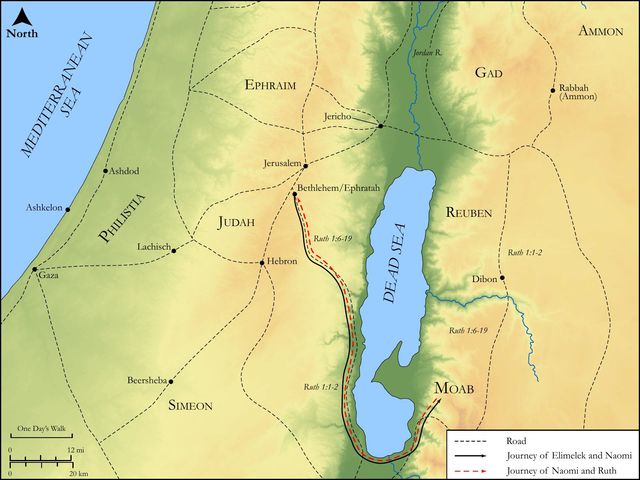
See on the biblical-era map
Study this verse
Public-domain commentary
Matthew Henry
From his Commentary on the Whole Bible. Henry comments on passages, not single verses — this entry covers Ruth 2:17–23. His two-level outline is real structure in the source text, so it is rendered as structure.
Here, I. Ruth finishes her day's work, Rut 2:17. 1. She took care not to lose time, for she gleaned until evening. We must not be weary of well-doing, because in due season we shall reap. She did not make an excuse to sit still, or go home, till the evening. Let us work the works of him that sent us, while it is day. She scarcely used, much less did she abuse, the kindness of Boaz; for, though he ordered his servants to leave handfuls for her, she continued to glean the scattered ears. 2. She took care not to lose what she had gathered, but threshed it herself, that she might the more easily carry it home, and might have it ready for use. The slothful man roasteth not that which he took in hunting, and so loseth the benefit of it, but the substance of a diligent man is precious, Pro 12:27. Ruth had gathered it ear by ear, but, when she had put it all together, it was an ephah of barley, about four pecks. Many a little makes a great deal. It is an encouragement to industry that in all labour, even that of gleaning, there is profit, but the talk of the lips tendeth only to penury. When she had got her corn into as little compass as she could, she took it up herself, and carried it into the city, though, had she asked them, it is likely some of Boaz's servants would have done that for her. We should study to be as little as possible troublesome to those that are kind to us. She did not think it either too hard or too mean a service to carry her corn herself into the city, but was rather pleased with what she had gotten by her own industry, and careful to secure it; and let us thus take care that we lose not those things which we have wrought, which we have gained, Jo2 1:8.
II.She paid her respects to her mother-in-law, went straight home to her and did not go to converse with Boaz's servants, showed her what she had gleaned, that she might see she had not been idle.
1.She entertained her with what she had left of the good dinner Boaz had given her. She gave to her what she had reserved, after she was sufficed (Rut 2:18), which refers to Rut 2:14. If she had any thing better than another, her mother should have part with her. Thus, having shown industry abroad, she showed piety at home; so children's maintaining their parents is called (Ti1 5:4), and it is part of the honour due to them by the fifth commandment, Mat 15:6.
2.She gave her an account of her day's work, and how a kind providence had favoured her in it, which made it very comfortable to her; for the gleanings that a righteous man hath are better than the harvests of many wicked, Psa 37:16. (1.) Naomi asked her where she had been: Where hast thou gleaned today? Note, Parents should take care to enquire into the ways of their children, how, and where, and in what company they spend their time. This may prevent many extravagancies which children, left to themselves, run into, by which they bring both themselves and their parents to shame. If we are not our brethren's, yet surely we are our children's keepers: and we know what a son Adonijah proved, that had never been chidden. Parents should examine their children, not to frighten nor discourage them, not so as to make them hate home or tempt them to tell a lie, but to commend them if they have done well, and with mildness to reprove and caution them if they have done otherwise. It is a good question for us to ask ourselves in the close of every day, "Where have I gleaned today? What improvements have I made in knowledge and grace? What have I done or obtained that will turn to a good account?" (2.) Ruth gave her a particular account of the kindness she had received from Boaz (Rut 2:19) and the hopes she had of further kindness from him, he having ordered her to attend his servants throughout all the harvest, Rut 2:21. Note, Children should look upon themselves as accountable to their parents and to those that are over them, and not think it a disparagement to them to be examined; let them do that which is good, and they shall have praise of the same. Ruth told her mother what kindness Boaz had shown her, that she might take some occasion or another to acknowledge it and return him thanks; but she did not tell her how Boaz had commended her, v. 11. Humility teaches us, not only not to praise ourselves, but not to be forward to publish others' praises of us. (3.) We are here told what Naomi said to it. [1.] She prayed heartily for him that had been her daughter's benefactor, even before she knew who it was (Rut 2:19): Blessed be he, whoever he was, that did take knowledge of thee, shooting the arrow of prayer at a venture. But more particularly when she was told who it was (Rut 2:20): Blessed be he of the Lord. Note, The poor must pray for those that are kind and liberal to them, and thus requite them, when they are not capable of making them any other requital. Let the loins of the poor bless those that refresh them, Job 29:13; Job 31:20. And he that hears the cries of the poor against their oppressors (Exo 22:27), it may be hoped, will hear the prayers of the poor for their benefactors. She now remembered the former kindnesses Boaz had shown to her husband and sons, and joins those to this: he has not left off his kindness to the living and to the dead. If we generously show kindness even to those that seem to have forgotten our former favours, perhaps it may help to revive the remembrance even of those which seem buried. [2.] She acquainted Ruth with the relation their family was in to Boaz: The man is near of kin to us. It should seem she had been so long in Moab that she had forgotten her kindred in the land of Israel, till by this providence God brought it to her mind. At least she had not told Ruth of it, though it might have been some encouragement to a young proselyte. Unlike to humble Naomi are many, who, though fallen into decay themselves, are continually boasting of their great relations. Nay, Observe the chain of thought here, and in it a chain of providences, bringing about what was designed concerning Ruth. Ruth names Boaz as one that had been kind to her. Naomi bethinks herself who that should be, and presently recollects herself: "The man is near of kin to us; now that I hear his name, I remember him very well." This thought brings in another: "He is our next kinsman, our goel, that has the right to redeem our estate that was mortgaged, and therefore from him we may expect further kindness. He is the likeliest man in all Bethlehem to set us up." Thus God brings things to our mind, sometimes on a sudden, that prove to have a wonderful tendency to our good. [3.] She appointed Ruth to continue her attendance in the fields of Boaz (Rut 2:22): "Let them not meet thee in any other field, for that will be construed a contempt of his courtesy." Our blessed Saviour is our Goel; it is he that has a right to redeem. If we expect to receive benefit by him, let us closely adhere to him, and his fields, and his family; let us not go to the world and its fields for that which is to be had with him only, and which he has encouraged us to expect from him. Has the Lord dealt bountifully with us? Let us not be found in any other field, nor seek for happiness and satisfaction in the creature. Tradesmen take it ill if those that are in their books go to another shop. We lose divine favours if we slight them. Some think Naomi gave her daughter-in-law a tacit rebuke; she had spoken (Rut 2:21) of keeping fast by the young men. "Nay," said Naomi (Rut 2:22), "It is good that thou go out with his maidens; they are fitter company for thee than the young men." But they are too critical. Ruth spoke of the young men because they were the principal labourers, and to them Boaz had given directions concerning her; and Naomi takes it for granted that, while she attended the young men, her society would be with the maidens, as was fit. Ruth dutifully observed her mother's directions; she continued to glean, to the end, not only of barley-harvest, but of the wheat-harvest, which followed it, that she might gather food in harvest to serve for winter, Pro 6:6-8. She also kept fast by the maidens of Boaz, with whom she afterwards cultivated an acquaintance, which might do her service, Rut 2:23. But she constantly came to her mother at night in due time, as became a virtuous woman, that was for working days, and not for merry nights. And when the harvest was ended (as bishop Patrick expounds it) she did not gad abroad, but kept her aged mother company at home. Dinah went out to see the daughters of the land, and we know what a disgrace her vanity ended in. Ruth kept at home, and helped to maintain her mother, and went out on no other errand than to get provision for her, and we shall find afterwards what preferment her humility and industry ended in. Seest thou a man diligent in his business? Honour is before him.
Continue studying Ruth 2:18 across the web’s major study libraries — every link below opens this exact verse, chapter, or book on the destination site.
Read & Compare
 BibleGatewayThis verse in more than 200 translations and 70 languages.
 Bible.comThe YouVersion reader — hundreds of translations, reading plans, and highlights.
 ESV.orgCrossway's official English Standard Version reader.
 NET BibleThe NET translation with 60,000+ translators' notes on every rendering decision.
 STEP BibleTyndale House's free study tool — original text, vocabulary, and scholarly resources.
 BibliaLogos Bible Software's free web reader.
 USCCBThe New American Bible (Revised Edition) with the U.S. bishops' study notes.
Commentaries
 BibleHub CommentariesDozens of classic commentaries on this verse, gathered on one page.
 StudyLightMore than 100 commentary sets — the largest collection on the web.
 BibleRefPlain-English commentary on what this verse means, verse by verse.
 Enduring WordDavid Guzik's free commentary on this chapter, widely used by Bible teachers.
 Bible Study ToolsVerse commentary alongside Greek and Hebrew study aids.
Original Language & Research
- BibleHub InterlinearThe verse word by word — original language, transliteration, and English.
- BibleHub LexiconEvery word's original-language definition and Strong's entry.
 Blue Letter BibleDeep-study tools — Strong's numbers, concordance, and word studies.
 SefariaThe Hebrew text with Rashi and centuries of Jewish commentary.
Sermons, Hymns & Audio


TrulyRandomVerse is not affiliated with these sites and doesn’t control their content. They’re linked because they’re genuinely useful.
Summary
Ruth 2:18 vividly portrays Ruth's return to Bethlehem with a remarkably abundant harvest of gleaned grain, far surpassing typical expectations. This pivotal moment underscores the immediate fruit of Ruth's diligent labor and, more profoundly, the extraordinary kindness extended by Boaz. It serves as a crucial transition in the narrative, setting the stage for Naomi's astonished inquiry and the subsequent unfolding of God's providential plan, which transforms their dire circumstances into a burgeoning hope for provision and restoration.
Context
ShowHideLiterary Context
This verse marks the culmination of Ruth's first day of gleaning and acts as a significant turning point in the book's narrative. Prior to this, Ruth, a Moabite widow, arrives in Bethlehem with her impoverished mother-in-law, Naomi. Ruth's courageous initiative to glean for their sustenance, as described in Ruth 2:2, providentially leads her to the fields of Boaz, a wealthy kinsman of Naomi's late husband. Throughout the day, Boaz demonstrates exceptional favor towards Ruth, instructing his reapers to leave extra grain for her (Ruth 2:15-16) and inviting her to share a meal with his workers (Ruth 2:14). Ruth 2:18 details the conclusion of this day's activity, as she brings her substantial gleanings home. It immediately precedes Naomi's astonished inquiry about the source of such abundance (Ruth 2:19), which then leads to the revelation of Boaz's identity and Naomi's strategic plan for their future.
Historical & Cultural Context
The practice of gleaning was a divinely mandated provision for the vulnerable in ancient Israel, including the poor, the sojourner, the fatherless, and the widow, as commanded in the Mosaic Law (e.g., Leviticus 19:9-10 and Deuteronomy 24:19-22). This legal framework provided a basic provision for the needy, enabling the lowly to sustain themselves through their own labor. However, Boaz's actions transcended mere legal compliance; his instructions to his reapers to purposefully leave extra grain and even pull out stalks for Ruth (Ruth 2:16) were acts of extraordinary generosity and compassion. For Ruth, a Moabite woman in a foreign land, this kindness was particularly significant, highlighting the precariousness of foreign widows and the profound impact of a righteous landowner's benevolence. The act of bringing the gleanings home to Naomi underscores the strong familial bond and mutual dependence within their household, especially given their status as widows without male protectors.
Key Themes
ShowHideRuth 2:18 powerfully contributes to several overarching themes within the book of Ruth. Firstly, it exemplifies Diligence and Provision, showcasing how Ruth's hard work, combined with Boaz's exceptional generosity, resulted in a bountiful harvest, far exceeding what a typical gleaner might expect. This abundance points to God's faithful provision, often mediated through human kindness, as seen in principles like those found in Proverbs 10:4. Secondly, the verse highlights God's Providence and Human Kindness. While Ruth simply went to glean, it was God's unseen hand that guided her to Boaz's field (Ruth 2:3), and Boaz's actions reflect a divinely inspired compassion, echoing the Lord's care for the vulnerable. Thirdly, it underscores Filial Devotion and Mutual Care, as Ruth's primary motivation for gleaning was to provide for Naomi, demonstrating her unwavering loyalty and love (Ruth 1:16-17). The detail that Naomi had "reserved after she was sufficed" yet still received Ruth's bounty further emphasizes the deep bond and shared life between them, pointing towards a theme of Restoration and Hope emerging from their initial despair.
Exposition and Analysis
ShowHideKey Word Analysis
ShowHideThis feminine noun, translated "mother in law," refers to a husband's mother. In the context of Ruth 2:18, it specifically denotes Naomi, highlighting the familial relationship between her and Ruth. The mention of "her mother in law" seeing what Ruth had gleaned emphasizes the domestic sphere and the direct impact of Ruth's actions on Naomi's well-being. This word underscores the central relationship in the book, which is foundational to the unfolding narrative of loyalty, provision, and eventual redemption.
This primitive root, translated "reserved" in the KJV, means "to jut over or exceed; by implication, to excel; (intransitively) to remain or be left." In this verse, it implies that Naomi had food remaining or in surplus after she had eaten her fill. This detail is crucial because it highlights that Ruth's bringing of the grain was not merely to prevent starvation, but an act of profound generosity and sharing of an unexpected bounty, even when the recipient (Naomi) was not in dire need at that precise moment. It underscores the spirit of communal sharing and abundance, rather than mere survival, setting the stage for the dramatic revelation of the source of such provision.
This noun, derived from a verb meaning "to be satisfied, full, have enough, be sated," is translated "sufficed" in the KJV. It confirms that Naomi had eaten to her fill before Ruth arrived. Coupled with yâthar, it paints a picture of Naomi being adequately provided for, perhaps from a small store of food she possessed or from a previous meal. This detail amplifies the significance of Ruth's immense gleaning; it wasn't just needed but represented an overflow of blessing, an unexpected surplus that would change their living conditions from subsistence to abundance. It sets up the dramatic reveal of the quantity and source of the grain, making Naomi's astonishment in the following verse even more pronounced.
Verse Breakdown
ShowHide"And she took [it] up, and went into the city:"
This clause describes Ruth's physical action of gathering her substantial gleanings, which, as Ruth 2:17 clarifies, amounted to "about an ephah of barley"—a significant quantity (roughly 45 pounds or 22 liters). The simple act of "taking it up" implies the weight and volume of her harvest, a testament to both her diligent labor and Boaz's exceptional generosity. Her journey back into "the city" (Bethlehem) signifies the completion of her day's work and the anticipation of sharing her success with Naomi.
"and her mother in law saw what she had gleaned:"
Naomi's observation is a pivotal moment. The sight of Ruth's abundant gleanings immediately triggers her surprise and curiosity, setting up the dialogue that follows in Ruth 2:19. This visual impact emphasizes the extraordinary nature of Ruth's yield, far beyond what a typical gleaner would gather, and thus signals a significant shift in their circumstances. It is a moment of revelation and dawning hope for Naomi, who had previously expressed bitterness about her empty-handed return from Moab (Ruth 1:21).
"and she brought forth, and gave to her that she had reserved after she was sufficed."
This final clause reveals Ruth's continued devotion and Naomi's unexpected act of reciprocal generosity. "She brought forth" refers to Ruth presenting her immense gleanings to Naomi. The phrase "that she had reserved after she was sufficed" indicates that Ruth also brought out some of the roasted grain Boaz had given her for lunch (Ruth 2:14), which she had saved. This act of sharing her own portion, even after a long day of work and having eaten, underscores Ruth's selflessness and unwavering commitment to Naomi. It demonstrates that the provision was not just for survival, but for shared blessing and mutual care, embodying the deep spirit of their bond and foreshadowing the full restoration to come.
Literary Devices
ShowHideRuth 2:18 employs several effective literary devices that enrich its meaning and impact. Juxtaposition is powerfully evident in the stark contrast between Ruth and Naomi's initial impoverished and desolate state at the beginning of chapter 2 and the overflowing abundance Ruth brings home in this verse. This immediate shift from scarcity to surplus highlights the dramatic change in their fortunes, largely due to Boaz's kindness. Symbolism is also at play, as the overflowing measure of grain Ruth brings home is not merely food; it symbolizes God's providential care, Boaz's extraordinary generosity, and the blossoming hope for the future. It represents a tangible manifestation of blessing and the reversal of their fortunes. Furthermore, the scene creates a subtle Dramatic Irony and Suspense for the reader, as Naomi is initially unaware of the source of Ruth's bounty, while the reader knows it came from Boaz, a kinsman-redeemer. This builds anticipation for the subsequent reveal and Naomi's strategic response. Finally, the verse functions as a Turning Point, marking the end of Ruth's initial period of independent struggle and the beginning of Naomi's active strategizing to secure their future through Boaz.
Theological and Thematic Connections
ShowHideRuth 2:18 serves as a profound testament to God's faithful provision, often mediated through the kindness and generosity of His people. It illustrates that divine providence is not always a miraculous, direct intervention but frequently works through the ordinary means of human diligence and compassion. Boaz's actions, which go beyond the letter of the law, reflect a heart attuned to God's commands regarding care for the vulnerable, embodying the very character of God who provides abundantly for His children. This verse underscores the theological principle that God delights in blessing those who are diligent and who extend grace to others. The surprising abundance Ruth brings home is a tangible sign of God's favor resting upon the desolate, transforming their circumstances from mere survival to a burgeoning hope for full restoration. It reminds us that even in seasons of scarcity, God is at work, orchestrating encounters and opening doors for unexpected blessings.
Reflection and Application
ShowHideRuth 2:18 offers rich insights for contemporary believers, encouraging a holistic approach to faith that integrates diligent effort, generous spirit, and unwavering trust in God's provision. Ruth's commitment to hard work, even in challenging circumstances, demonstrates that our active participation is often the channel through which God's blessings flow. Her selfless act of bringing all her gleanings and even her reserved portion to Naomi teaches us the profound joy and spiritual richness found in sharing our blessings, even when we ourselves might be in need. Boaz's extraordinary kindness reminds us that we are called to be conduits of God's grace, extending generosity beyond mere obligation, especially to those who are vulnerable or overlooked. This verse challenges us to look for opportunities to be a "Boaz" in someone else's life, to go the extra mile in our compassion and provision. Ultimately, it invites us to cultivate a heart of gratitude, recognizing that every good and perfect gift comes from above, and to trust that God, in His perfect timing and through unexpected means, will always provide for His children, often in ways that far exceed our expectations.
Questions for Reflection
ShowHideFAQ
ShowHideWhy did Ruth bring food to Naomi if Naomi was already 'sufficed' or had 'reserved' food?
ShowHideThe phrase "reserved after she was sufficed" indicates that Naomi had already eaten her fill and perhaps had some food left over from her own meager stores. Ruth's act of bringing her immense gleanings, and even her own portion of roasted grain that she had saved (from Boaz's lunch invitation in Ruth 2:14), was not out of Naomi's immediate hunger, but out of Ruth's profound devotion, gratitude, and desire to share the extraordinary blessing she had received. It highlights the depth of their mutual care and the overflowing nature of the provision. It also sets up the dramatic reveal of the source of the abundance, as Naomi's surprise (Ruth 2:19) is amplified by the fact that she wasn't expecting such a large quantity. This act of sharing, even when not strictly necessary for survival, underscores the deep bond and mutual care between them, transforming their situation from subsistence to abundance.
How much grain did Ruth glean on this single day?
ShowHideWhile Ruth 2:18 itself doesn't specify the exact amount, the preceding verse, Ruth 2:17, states that Ruth gleaned "about an ephah of barley." An ephah was a significant measure, roughly equivalent to 22 liters or approximately 45 pounds (20 kg) of grain. This was an exceptionally large amount for a single day's gleaning, especially for a lone woman. A typical gleaner might gather only a few pounds. This extraordinary yield was a direct result of Boaz's specific instructions to his reapers to intentionally leave extra grain for Ruth and even pull out stalks for her (Ruth 2:16), demonstrating his profound and intentional kindness. This abundance was a clear sign of divine favor and a turning point for Ruth and Naomi's survival.
Christ-Centered Fulfillment
ShowHideRuth 2:18, with its depiction of abundant provision and unexpected kindness, beautifully foreshadows the ultimate provision and redemption found in Jesus Christ. Boaz, the generous kinsman-redeemer, who goes beyond the letter of the law to lavish grace upon Ruth, serves as a powerful type of Christ. Just as Ruth, a destitute foreigner, found an overflowing supply of sustenance and security in Boaz's field, so too do believers, once alienated from God and spiritually impoverished, find an inexhaustible supply of grace, mercy, and spiritual nourishment in Christ. The abundance of barley Ruth brings home points to the spiritual abundance available in Christ, who declares, "I am the bread of life; whoever comes to me shall not hunger" (John 6:35). Moreover, the act of Ruth bringing her bounty to Naomi, ensuring her mother-in-law's sustenance, mirrors Christ's self-giving love and provision for His Church, His spiritual bride. Through His ultimate sacrifice, Christ has "reserved" for us an inheritance that is imperishable, undefiled, and unfading (1 Peter 1:4), providing not just enough to be "sufficed" but an overflow of eternal life and blessing. The story of Ruth's provision through Boaz is a testament to God's faithful, redemptive plan, culminating in the person and work of Jesus, our true Kinsman-Redeemer, who brings us into His abundant harvest of salvation and eternal rest (Matthew 11:28).