


Psalms 87:2
Bible text: King James Version (1769 Blayney text) · Public domain
Bible text: Berean Standard Bible · Public domain
Bible text: American Standard Version (1901) · Public domain
Bible text: World English Bible, Messianic edition · Public domain
Bible text: Geneva Bible (1599) · Public domain
Bible text: Young's Literal Translation · Public domain
- אֹהֵב'o·Hev[is] lovingH157V-Qal-Prtcpl-msVerb Qal Participle Singular Masculine Absolute
- יְהוָהYah·wehYahwehH3068N-properNoun Proper Title
- שַׁעֲרֵיsha·'a·Rei[the] gates ofH8179N-mpcNoun Plural Masculine Construct
- צִיּוֹןtzi·YonZionH6726N-properNoun Proper Location
- מִכֹּלmi·Kolmore than allH3605Prep-m ¦ N-mscNoun Singular Masculine Constructמִmore thanכֹּלall
- מִשְׁכְּנוֹתmish·ke·Not[the] dwelling places ofH4908N-fpcNoun Plural Feminine Construct
- יַעֲקֹבya·'a·KoJacobH3290N-proper-mNoun Proper Masculine
English is a literal word-by-word gloss of the Hebrew, not the KJV's wording. Why?
This is the original text the KJV's translators worked from — each Hebrew word with its own literal English meaning in this verse, prepared by scholars at Tyndale House, Cambridge. The KJV translates whole sentences, not word by word, so its wording differs: one Hebrew word can become several English words, and the KJV may choose “the LORD” where the gloss reads “Yahweh”. Both are faithful — they answer different questions. For the KJV's own rendering, switch to the KJV text.
Details
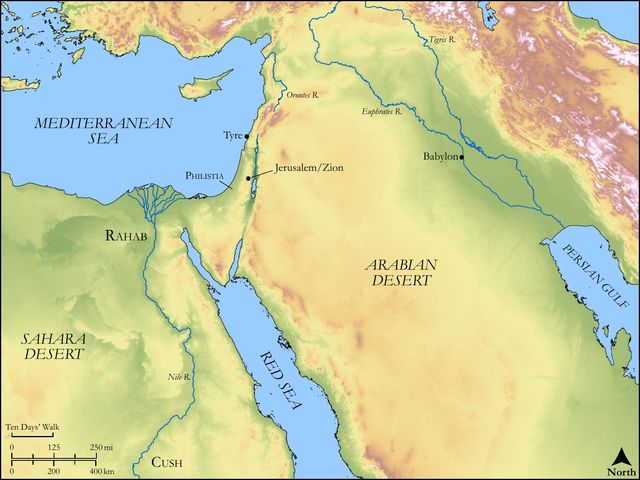
See on the biblical-era map
Study this verse
Public-domain commentary
Matthew Henry
From his Commentary on the Whole Bible. Henry comments on passages, not single verses — this entry covers Psalms 87:1–3.
Some make the first words of the psalm to be part of the title; it is a psalm or song whose subject is the holy mountains - the temple built in Zion upon Mount Moriah. This is the foundation of the argument, or beginning of the psalm. Or we may suppose the psalmist had now the tabernacle or temple in view and was contemplating the glories of it, and at length he breaks out into this expression, which has reference, though not to what he had written before, yet to what he had thought of; every one knew what he meant when he said thus abruptly, Its foundation is in the holy mountains. Three things are here observed, in praise of the temple: - 1. That it was founded on the holy mountains, Psa 87:1. The church has a foundation, so that it cannot sink or totter; Christ himself is the foundation of it, which God has laid. The Jerusalem above is a city that has foundations. The foundation is upon the mountains. It is built high; the mountain of the Lord's house is established upon the top of the mountains, Isa 2:2. It is built firmly; the mountains are rocky, and on a rock the church is built. The world is founded upon the seas (Psa 24:2), which are continually ebbing and flowing, and are a very weak foundation; Babel was built in a plain, where the ground was rotten. But the church is built upon the everlasting mountains and the perpetual hills; for sooner shall the mountains depart, and the hills be removed, than the covenant of God's peace shall be disannulled, and on that the church is built, Isa 54:10. The foundation is upon the holy mountains. Holiness is the strength and stability of the church: it is this that will support it and keep it from sinking; not so much that it is built upon mountains as that it is built upon holy mountains - upon the promise of God, for the confirming of which he has sworn by his holiness, upon the sanctification of the Spirit, which will secure the happiness of all the saints. 2. That God had expressed a particular affection for it (Psa 87:2): The Lord loveth the gates of Zion, of the temple, of the houses of doctrine (so the Chaldee), more than all the dwellings of Jacob, whether in Jerusalem or any where else in the country. God had said concerning Zion, This is my rest for ever; here will I dwell. There he met his people, and conversed with them, received their homage, and showed them the tokens of his favour, and therefore we may conclude how well he loves those gates. Note, (1.) God has a love for the dwellings of Jacob, has a gracious regard to religious families and accepts their family-worship. (2.) Yet he loves the gates of Zion better, not only better than any, but better than all, of the dwellings of Jacob. God was worshipped in the dwellings of Jacob, and family-worship is family-duty, which must by no means be neglected; yet, when they come in competition, public worship (caeteris paribus - other things being equal) is to be preferred before private. 3. That there was much said concerning it in the word of God (Psa 87:3): Glorious things are spoken of thee, O city of God! We are to judge of things and persons by the figure they make and the estimate put upon them in and by the scripture. Many base things were spoken of the city of God by the enemies of it, to render it mean and odious; but by him whose judgment we are sure is according to truth glorious things are spoken of it. God said of the temple, My eyes and my heart shall be there perpetually; I have sanctified this house, that my name may be there for ever, Ch2 7:16. Beautiful for situation is Mount Zion, Psa 48:2. These are glorious things. Yet more glorious things are spoken of the gospel-church. It is the spouse of Christ, the purchase of his blood; it is a peculiar people, a holy nation, a royal priesthood, and the gates of hell shall not prevail against it. Let us not be ashamed of the church of Christ in its meanest condition, nor of any that belong to it, nor disown our relation to it, though it be turned ever so much to our reproach, since such glorious things are spoken of it, and not on iota or tittle of what is said shall fall to the ground.
Historical interpretation
Historical reception
1 surviving comment on this verse from the historical church.
"The Lord loves the gates of Sion more than all the dwellings of Jacob" [Psalm 87:2]. I have made the foregoing remarks, that you may not imagine the gates are one thing, the foundations another. Why are the Apostles and Prophets foundations? Because their authority is the support of our weakness. Why are they gates? Because through them we enter the kingdom of God: for they proclaim it to us: and while we enter by their means, we enter also through Christ, Himself being the Gate. And twelve gates of Jerusalem are spoken of, [Revelation 21:12] and the one gate is Christ, and the twelve gates are Christ for Christ dwells in the twelve gates, hence was twelve the number of the Apostles. There is a deep mystery in this number of twelve: "You shall sit," says our Saviour, "on twelve thrones, judging the twelve tribes of Israel." [Matthew 19:28] If there are twelve thrones there, there will be no room for the judgment-seat of Paul, the thirteenth Apostle, though he says that he shall judge not men only, but even Angels; which, but the fallen Angels? "Do you not know, that we shall judge Angels," [1 Corinthians 6:3] he writes. The world would answer, Why do you boast that you shall be a judge? Where will be your throne? Our Lord spoke of twelve thrones for the twelve Apostles: one, Judas, fell, and his place being supplied by Matthias, the number of twelve thrones was made up: [Acts 1:15-26] first, then, discover room for your judgment-seat; then threaten that you will judge. Let us, therefore, reflect upon the meaning of the twelve thrones. The expression is typical of a sort of universality, as the Church was destined to prevail throughout the whole world: whence this edifice is styled a building together into Christ: and because judges come from all quarters, the twelve thrones are spoken of, just as the twelve gates, from the entering in from all sides into that city. Not only therefore have those twelve, and the Apostle Paul, a claim to the twelve thrones, but, from the universal signification, all who are to sit in judgment: in the same manner as all who enter the city, enter by one or the other of the twelve gates. There are four quarters of the globe: East, West, North, and South: and they are constantly alluded to in the Scriptures. From all those four winds; our Lord declares in the Gospel that He will call his sheep "from the four winds;" [Mark 13:27] therefore from all those four winds is the Church called. And how called? On every side it is called in the Trinity: no otherwise is it called than by Baptism in the name of the Father, the Son, and the Holy Ghost: four then being thrice taken, twelve are found. Knock, therefore, with all your hearts at these gates: and let Christ cry within you: "Open me the gates of righteousness." For He went before us the Head: He follows Himself in His Body....
Continue studying Psalms 87:2 across the web’s major study libraries — every link below opens this exact verse, chapter, or book on the destination site.
Read & Compare
 BibleGatewayThis verse in more than 200 translations and 70 languages.
 Bible.comThe YouVersion reader — hundreds of translations, reading plans, and highlights.
 ESV.orgCrossway's official English Standard Version reader.
 NET BibleThe NET translation with 60,000+ translators' notes on every rendering decision.
 STEP BibleTyndale House's free study tool — original text, vocabulary, and scholarly resources.
 BibliaLogos Bible Software's free web reader.
 USCCBThe New American Bible (Revised Edition) with the U.S. bishops' study notes.
Commentaries
 BibleHub CommentariesDozens of classic commentaries on this verse, gathered on one page.
 StudyLightMore than 100 commentary sets — the largest collection on the web.
 BibleRefPlain-English commentary on what this verse means, verse by verse.
 Enduring WordDavid Guzik's free commentary on this chapter, widely used by Bible teachers.
 Bible Study ToolsVerse commentary alongside Greek and Hebrew study aids.
Original Language & Research
- BibleHub InterlinearThe verse word by word — original language, transliteration, and English.
- BibleHub LexiconEvery word's original-language definition and Strong's entry.
 Blue Letter BibleDeep-study tools — Strong's numbers, concordance, and word studies.
 SefariaThe Hebrew text with Rashi and centuries of Jewish commentary.
Sermons, Hymns & Audio


TrulyRandomVerse is not affiliated with these sites and doesn’t control their content. They’re linked because they’re genuinely useful.
Summary
Psalms 87:2 profoundly declares God's unique and deep affection for Zion, stating, "The LORD loveth the gates of Zion more than all the dwellings of Jacob." This verse establishes Zion, often synonymous with Jerusalem and particularly the Temple Mount, as a place of unparalleled significance in God's heart and redemptive purpose. It underscores God's sovereign choice of this specific location as His dwelling place, distinguishing it from all other settlements of Israel and foreshadowing its future role as a spiritual center from which His truth and salvation would emanate to all nations.
Context
ShowHideLiterary Context
Psalm 87 is a "Song of Zion," a unique and highly poetic psalm celebrating the glory and future of Jerusalem. It is attributed to the Sons of Korah, known for their psalms emphasizing God's dwelling place and the beauty of His sanctuary. Verse 2 serves as the foundational declaration, immediately establishing the divine basis for Zion's preeminence and setting the tone for the psalm's grand vision. The psalm then expands on this divine preference, envisioning a future where people from all nations are spiritually "born" in Zion, signifying their inclusion in God's covenant community. This initial statement of God's profound love for Zion sets the stage for the psalm's triumphant affirmation of God's presence and the universal scope of His redemptive plan centered on this chosen city.
Historical & Cultural Context
"Zion" originally referred to the Jebusite fortress conquered by King David, which subsequently became the "City of David" and later encompassed the Temple Mount and the broader city of Jerusalem. In ancient Israelite culture, city "gates" were far more than mere physical entrances; they were the vibrant nerve centers of urban life. They served as places where justice was administered, commercial transactions occurred, public announcements were made, and elders gathered to discuss communal affairs. Therefore, God loving the "gates of Zion" signifies His love for the entire city—its strength, its governance, its people, its institutions, and its very essence as a divinely ordained center of worship and authority. The "dwellings of Jacob" refer to all other towns, villages, and settlements throughout Israel, emphasizing that while God loved all His people, Zion held a uniquely chosen status as the capital and the seat of His covenant presence, particularly after the construction of the Temple.
Key Themes
ShowHideThis verse powerfully contributes to several overarching themes within the Psalter and the broader Old Testament narrative. Firstly, it underscores Divine Election and Favor, highlighting God's sovereign and preferential choice of Zion as His holy city and dwelling place, a theme echoed in passages like Psalms 132:13. Secondly, it emphasizes the Centrality of God's Presence, as Zion was the chosen location for the Temple, the earthly embodiment of God's covenant presence among His people, where His glory resided, as powerfully depicted in the dedication of Solomon's Temple in 1 Kings 8:13. Lastly, the verse points to the Universal Spiritual Significance of Jerusalem, portraying it not just as a physical capital but as the spiritual heart from which salvation and divine truth would eventually emanate to the entire world, foreshadowing the universal scope of God's redemptive plan, a vision beautifully articulated in Isaiah 2:2-3.
Exposition and Analysis
ShowHideKey Word Analysis
ShowHideThis verb (H157) denotes a deep, abiding, and committed affection. It signifies more than a casual preference; it is an intentional, covenantal love. When applied to God, it speaks of His sovereign choice and unwavering devotion to Zion, reflecting His faithfulness to His promises regarding this city as His chosen habitation and the place where He would establish His name.
This noun (H8179) refers to an opening, specifically a door or gate. However, in the context of ancient cities, "gates" symbolized the city's strength, security, authority, and public life. They were the places of judgment, commerce, and social gathering. To love the "gates" means to love the very essence, vitality, and institutional life of the city, encompassing its people, its governance, its protection, and its purpose as a center of justice and worship.
This proper noun (H6726) originally referred to a specific hill in Jerusalem, but it quickly became synonymous with the entire city, especially the Temple Mount. By extension, it came to represent the spiritual and governmental heart of Israel. It signifies the chosen place of God's dwelling, the locus of His presence, blessing, and redemptive activity for His people and, ultimately, for all nations.
Verse Breakdown
ShowHide"The LORD loveth"
The subject is Yahweh (H3068, Yᵉhôvâh), the covenant God of Israel, emphasizing that this love is divine, sovereign, and deeply personal. It is an active, intentional love, signifying His deliberate choice and unwavering commitment to a specific place and its associated purposes.
"the gates of Zion"
This phrase specifies the primary object of God's profound love. By using "gates," the text implies a comprehensive love for the entire city of Zion—its people, its institutions, its spiritual significance, and its role as the center of His worship and governance. Zion is singled out as the unique recipient of this special divine affection, set apart from all other places.
"more than all the dwellings of Jacob"
This comparative clause highlights Zion's preeminence. It does not suggest a lack of love for the rest of Israel (H3290, Yaʻăqôb), but rather an unparalleled, distinctive love for Zion. This distinction underscores Zion's unique election as God's chosen dwelling place and the focal point of His redemptive plan for the world, setting it apart from all other Israelite settlements (H4908, mishkân).
Literary Devices
ShowHideThe verse employs several potent literary devices to convey its profound message. Hyperbole or Emphasis is clearly evident in the phrase "more than all the dwellings of Jacob," which dramatically underscores Zion's unparalleled significance in God's eyes, elevating it above every other place inhabited by His chosen people. This emphasizes the unique status God has bestowed upon Zion. Metonymy is present in "the gates of Zion," where "gates" stand for the entire city, encompassing its inhabitants, its administration, its strength, and its very essence. This allows for a concise yet comprehensive reference to the beloved city. Furthermore, the verse uses powerful Contrast by juxtaposing "the gates of Zion" with "all the dwellings of Jacob," thereby highlighting Zion's unique, chosen status through direct comparison. Finally, the concept of God "loving" a city can be seen as a subtle form of Personification, imbuing Zion with a quality that can be the object of divine affection, emphasizing its special, living relationship with God and its role in His redemptive purposes.
Theological and Thematic Connections
ShowHideThis verse profoundly articulates God's particular election and affection for Zion, a theme that reverberates throughout biblical theology. It underscores the concept of a chosen place, mirroring the chosen people, through which God would manifest His presence and enact His redemptive purposes. Zion, as the seat of the Temple and the Davidic monarchy, became the earthly embodiment of God's kingdom, a beacon of hope and a source of divine revelation. This divine preference for Zion is not exclusive but preeminent, serving as the focal point for God's universal plan of salvation, ultimately pointing beyond its physical boundaries to a spiritual reality where God's presence would be accessible to all who believe.
Reflection and Application
ShowHidePsalms 87:2, while rooted in the historical and geographical reality of ancient Jerusalem, offers timeless principles for believers today. God's profound love for Zion, His chosen dwelling place, beautifully illustrates His deep affection for His people and the community He establishes. For us, the spiritual "Zion" is the Church—the body of Christ, His redeemed people, in whom He now dwells by His Spirit. Just as God cherished Zion, He cherishes His Church, having purchased it with the blood of His Son. This verse calls us to value the spiritual community we belong to, to cherish God's presence among us, and to participate actively in the life and mission of the Church. It reminds us that our spiritual heritage is rooted in God's sovereign love and choice, empowering us to live as citizens of the heavenly Jerusalem, from which God's truth and salvation continue to flow to the world, inviting others into this beloved community.
Questions for Reflection
ShowHideFAQ
ShowHideWhat is the significance of "gates" in ancient Israelite cities?
ShowHideIn ancient Israel, city gates were far more than mere points of entry or exit. They served as the central hub of public life. This was where legal proceedings and judicial decisions took place, as seen in Ruth 4:1-2, where Boaz conducts business at the gate. They were also centers for commerce and trade, public announcements, and social gatherings. Elders and leaders would often sit at the gates to discuss matters of importance and administer justice, as highlighted in Proverbs 31:23. Therefore, "the gates of Zion" symbolically represent the entire city's strength, authority, governance, and the totality of its public life and spiritual essence.
How does God's love for Zion relate to His love for all Israel?
ShowHideGod's love for Zion, as expressed in Psalms 87:2, does not diminish or negate His love for all the "dwellings of Jacob" (i.e., the rest of Israel). Rather, it signifies a unique, preeminent, and particular love for Zion as His chosen dwelling place and the focal point of His redemptive plan. Zion was the location of His Temple, the place where His glory resided and from which His covenant blessings would flow to all His people and, ultimately, to the nations. It's a love that prioritizes a specific location for a specific redemptive purpose, which ultimately benefits all of Israel and the world. It's akin to a parent having a special affection for the family home, which serves as the heart of the family, without loving their other children any less.
Christ-Centered Fulfillment
ShowHideThe earthly Zion, beloved by the LORD, finds its ultimate and perfect fulfillment in Jesus Christ. While God's love for the physical city of Jerusalem was profound, it ultimately pointed to a greater reality: God's desire to dwell among His people. This desire is perfectly realized in the incarnation of Jesus, who is the true and ultimate Temple, the very presence of God "tabernacling" among humanity (John 1:14). Jesus Himself declared, "Destroy this temple, and in three days I will raise it up," speaking of the temple of His body (John 2:19-21). Furthermore, the spiritual "gates of Zion" are now open to all who come to Christ, for He is the "gate" through whom salvation is found (John 10:9). The New Testament portrays the Church as the spiritual "Zion," the "city of the living God, the heavenly Jerusalem," where believers have come to Mount Zion through Christ (Hebrews 12:22-24). Thus, God's profound love for Zion culminates in His eternal love for His Church, the bride of Christ, which He "loved and gave himself up for her" (Ephesians 5:25). In Christ, the promise of God's dwelling among His people is fully realized, and the spiritual blessings once associated with earthly Zion are now universally accessible through Him.