


Psalms 87:1
Bible text: King James Version (1769 Blayney text) · Public domain
Bible text: Berean Standard Bible · Public domain
Bible text: American Standard Version (1901) · Public domain
Bible text: World English Bible, Messianic edition · Public domain
Bible text: Geneva Bible (1599) · Public domain
Bible text: Young's Literal Translation · Public domain
- Superscription
- לִבְנֵיliv·neiof [the] sons ofH1121Prep-l ¦ N-mpcNoun Plural Masculine Constructלִofבְנֵי[the] sons of
- קֹרַחKo·rachKorahH7141N-proper-mNoun Proper Masculine
- מִזְמוֹרmiz·Mora psalmH4210N-msNoun Singular Masculine Absolute
- שִׁירShira songH7892N-msNoun Singular Masculine Absolute
- Verse
- יְסוּדָתוֹye·su·da·Tohis foundationH3248N-fsc ¦ 3msNoun Singular Feminine Constructיְסוּדָתfoundationוֹhis
- בְּהַרְרֵיbe·ha·rei[is] among [the] mountains ofH2042Prep-b ¦ N-mpcNoun Plural Masculine Constructבְּ[is] amongהַרְרֵי[the] mountains of
- קֹדֶשׁKo·deshholinessH6944N-msNoun Singular Masculine Absolute
English is a literal word-by-word gloss of the Hebrew, not the KJV's wording. Why?
This is the original text the KJV's translators worked from — each Hebrew word with its own literal English meaning in this verse, prepared by scholars at Tyndale House, Cambridge. The KJV translates whole sentences, not word by word, so its wording differs: one Hebrew word can become several English words, and the KJV may choose “the LORD” where the gloss reads “Yahweh”. Both are faithful — they answer different questions. For the KJV's own rendering, switch to the KJV text.
Details
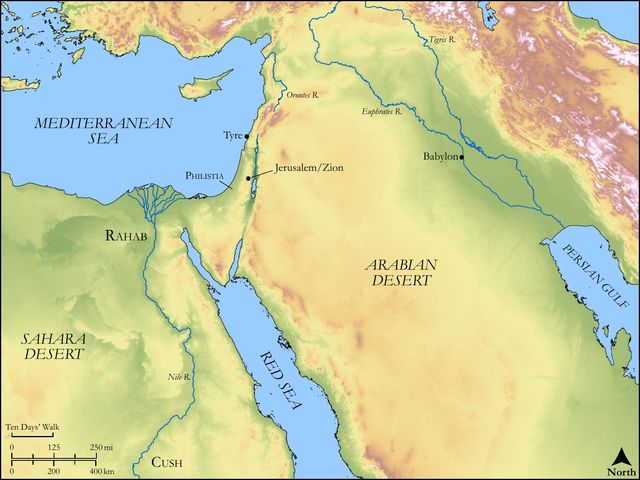
See on the biblical-era map
Study this verse
Public-domain commentary
Matthew Henry
From his Commentary on the Whole Bible. Henry comments on passages, not single verses — this entry covers Psalms 87:1–3.
Some make the first words of the psalm to be part of the title; it is a psalm or song whose subject is the holy mountains - the temple built in Zion upon Mount Moriah. This is the foundation of the argument, or beginning of the psalm. Or we may suppose the psalmist had now the tabernacle or temple in view and was contemplating the glories of it, and at length he breaks out into this expression, which has reference, though not to what he had written before, yet to what he had thought of; every one knew what he meant when he said thus abruptly, Its foundation is in the holy mountains. Three things are here observed, in praise of the temple: - 1. That it was founded on the holy mountains, Psa 87:1. The church has a foundation, so that it cannot sink or totter; Christ himself is the foundation of it, which God has laid. The Jerusalem above is a city that has foundations. The foundation is upon the mountains. It is built high; the mountain of the Lord's house is established upon the top of the mountains, Isa 2:2. It is built firmly; the mountains are rocky, and on a rock the church is built. The world is founded upon the seas (Psa 24:2), which are continually ebbing and flowing, and are a very weak foundation; Babel was built in a plain, where the ground was rotten. But the church is built upon the everlasting mountains and the perpetual hills; for sooner shall the mountains depart, and the hills be removed, than the covenant of God's peace shall be disannulled, and on that the church is built, Isa 54:10. The foundation is upon the holy mountains. Holiness is the strength and stability of the church: it is this that will support it and keep it from sinking; not so much that it is built upon mountains as that it is built upon holy mountains - upon the promise of God, for the confirming of which he has sworn by his holiness, upon the sanctification of the Spirit, which will secure the happiness of all the saints. 2. That God had expressed a particular affection for it (Psa 87:2): The Lord loveth the gates of Zion, of the temple, of the houses of doctrine (so the Chaldee), more than all the dwellings of Jacob, whether in Jerusalem or any where else in the country. God had said concerning Zion, This is my rest for ever; here will I dwell. There he met his people, and conversed with them, received their homage, and showed them the tokens of his favour, and therefore we may conclude how well he loves those gates. Note, (1.) God has a love for the dwellings of Jacob, has a gracious regard to religious families and accepts their family-worship. (2.) Yet he loves the gates of Zion better, not only better than any, but better than all, of the dwellings of Jacob. God was worshipped in the dwellings of Jacob, and family-worship is family-duty, which must by no means be neglected; yet, when they come in competition, public worship (caeteris paribus - other things being equal) is to be preferred before private. 3. That there was much said concerning it in the word of God (Psa 87:3): Glorious things are spoken of thee, O city of God! We are to judge of things and persons by the figure they make and the estimate put upon them in and by the scripture. Many base things were spoken of the city of God by the enemies of it, to render it mean and odious; but by him whose judgment we are sure is according to truth glorious things are spoken of it. God said of the temple, My eyes and my heart shall be there perpetually; I have sanctified this house, that my name may be there for ever, Ch2 7:16. Beautiful for situation is Mount Zion, Psa 48:2. These are glorious things. Yet more glorious things are spoken of the gospel-church. It is the spouse of Christ, the purchase of his blood; it is a peculiar people, a holy nation, a royal priesthood, and the gates of hell shall not prevail against it. Let us not be ashamed of the church of Christ in its meanest condition, nor of any that belong to it, nor disown our relation to it, though it be turned ever so much to our reproach, since such glorious things are spoken of it, and not on iota or tittle of what is said shall fall to the ground.
Historical interpretation
Historical reception
1 surviving comment on this verse from the historical church.
"Her foundations are upon the holy hills" [Psalm 87:1]. The Psalm had as yet said nothing of the city: it begins thus, and says, "Her foundations are upon the holy hills." Whose? There can be no doubt that foundations, especially among the hills, belong to some city. Thus filled with the Holy Spirit, and with many thoughts of love and longing for that city, as if after long internal meditation, that citizen bursts out, "Her foundations are upon the holy hills;" as if he had already said something concerning it. And how could he have said nothing on a subject, respecting which in his heart he had never been silent? For how could "her foundations" have been written, of which nothing had been said before? But, as I said, after long and silent travailing in contemplation of that city in his mind, crying to God, he bursts out into the ears of men thus: "Her foundations are upon the holy hills." And, supposing persons who heard to enquire of what city he spoke he adds, "the Lord loves the gates of Sion." Behold, then, a city whose foundations are upon the holy hills, a city called Sion, whose gates the Lord loves, as he adds, "above all the dwellings of Jacob." But what does this mean, "her foundations on the holy hills"? What are the holy hills upon which this city is built? Another citizen tells us this more explicitly, the Apostle Paul: of this was the Prophet a citizen, of this the Apostle citizen: and they spoke to exhort the other citizens. But how are these, I mean the Prophets and Apostles, citizens? Perhaps in this sense; that they are themselves the hills, upon which are the foundations of this city, whose gates the Lord loves. Let then another citizen state this clearly, that I may not seem to guess. Speaking to the Gentiles, and telling them how they were returning, and being, as it were, framed together into the holy structure, "built," he says, "upon the foundations of the Apostles and Prophets:" and because neither the Apostles nor Prophets, upon whom the foundations of that city rest, could stand by their own power, he adds, "Jesus Christ Himself being the head comer stone." [Ephesians 2:20] That the Gentiles, therefore, might not think they had no relation to Sion: for Sion was a certain city of this world, which bore a typical resemblance as a shadow to that Sion of which he presently speaks, that Heavenly Jerusalem, of which the Apostle says, "which is the mother of us all;" [Galatians 4:26] they might not be said to bear no relation to Sion, on the ground that they did not belong to the Jewish people, he addresses them thus: "Now therefore you are no more strangers and foreigners, but fellow citizens with the saints, and of the household of God, and are built upon the foundation of the Apostles and Prophets." [Ephesians 2:19-20] You see the structure of so great a city: yet whereon does all that edifice repose, where does it rest, that it may never fall? "Jesus Christ Himself," he says, "being the head corner stone."
Continue studying Psalms 87:1 across the web’s major study libraries — every link below opens this exact verse, chapter, or book on the destination site.
Read & Compare
 BibleGatewayThis verse in more than 200 translations and 70 languages.
 Bible.comThe YouVersion reader — hundreds of translations, reading plans, and highlights.
 ESV.orgCrossway's official English Standard Version reader.
 NET BibleThe NET translation with 60,000+ translators' notes on every rendering decision.
 STEP BibleTyndale House's free study tool — original text, vocabulary, and scholarly resources.
 BibliaLogos Bible Software's free web reader.
 USCCBThe New American Bible (Revised Edition) with the U.S. bishops' study notes.
Commentaries
 BibleHub CommentariesDozens of classic commentaries on this verse, gathered on one page.
 StudyLightMore than 100 commentary sets — the largest collection on the web.
 BibleRefPlain-English commentary on what this verse means, verse by verse.
 Enduring WordDavid Guzik's free commentary on this chapter, widely used by Bible teachers.
 Bible Study ToolsVerse commentary alongside Greek and Hebrew study aids.
Original Language & Research
- BibleHub InterlinearThe verse word by word — original language, transliteration, and English.
- BibleHub LexiconEvery word's original-language definition and Strong's entry.
 Blue Letter BibleDeep-study tools — Strong's numbers, concordance, and word studies.
 SefariaThe Hebrew text with Rashi and centuries of Jewish commentary.
Sermons, Hymns & Audio


TrulyRandomVerse is not affiliated with these sites and doesn’t control their content. They’re linked because they’re genuinely useful.
Summary
Psalms 87:1 serves as a profound declaration of God's sovereign establishment of Zion (Jerusalem) upon the sacred mountains. This foundational verse immediately sets the theological stage for the entire psalm, celebrating the unique status, divine origin, and spiritual significance of God's chosen dwelling place on earth, anticipating its pivotal role in God's redemptive plan for all nations.
Context
ShowHideLiterary Context
This psalm opens with a superscription, "A Psalm [or] Song for the sons of Korah," identifying it as part of a collection attributed to this prominent family of Levite musicians and gatekeepers who served in the Temple. Their psalms often express deep longing for God's presence, trust in His sovereignty, and praise for His dwelling place. Psalm 87 is notably one of the "Songs of Zion" (alongside others like Psalm 46 and Psalm 48), a genre of hymns that exalt Jerusalem as the holy city of God. Verse 1 lays the groundwork by asserting God's direct involvement in establishing Zion, preparing the reader for the astonishing theological claims that follow, particularly the idea that all nations will ultimately be "born" in Zion, as seen in Psalm 87:4-6.
Historical & Cultural Context
Jerusalem, also known as Zion, was the capital of the Southern Kingdom of Judah and the spiritual center of Israel. Geographically, it is situated on a series of hills, including Mount Zion and Mount Moriah, where the Temple was built. The phrase "holy mountains" refers to these elevated landforms upon which the city and its sacred structures were established. In that day, cities were often built on high ground for defensive purposes. However, Jerusalem's significance transcended mere strategic location; it was the city that God explicitly chose as His dwelling place among His people, as recounted in 2 Samuel 5:7 and 1 Kings 8:13. This divine election imbued the city with a unique sanctity, distinguishing it from all other cities and making it the focal point of Israelite worship and national identity.
Key Themes
ShowHideThe opening verse of Psalm 87 introduces several profound theological themes. Firstly, it highlights Divine Establishment and Sovereignty, emphasizing that Jerusalem's existence and significance are not merely human achievements but are divinely ordained and secured by God Himself. This underscores God's active role as the architect and builder of His spiritual center, a theme echoed in Psalm 127:1. Secondly, the mention of "holy mountains" emphasizes the Sanctity of Zion. This sacredness is derived directly from God's presence and choice to dwell there, setting Jerusalem apart as a consecrated space, much like the ground where Moses encountered God was deemed holy in Exodus 3:5. Finally, the concept of a "foundation" implies Security and Stability. Because God is the ultimate builder, Zion enjoys an unparalleled permanence and resilience, not reliant on human strength or political fortunes, but on the unwavering divine will, providing a sense of unshakeable hope for its inhabitants, as suggested in Isaiah 28:16.
Exposition and Analysis
ShowHideKey Word Analysis
ShowHideThis feminine noun, derived from a root meaning "to found" or "to establish," refers to the base or groundwork upon which something is built. In this context, it signifies not merely a physical structure but the act of divine establishment, implying that Zion's existence and enduring stability are rooted in God's deliberate purpose and sovereign will. It conveys a sense of permanence and divine initiation.
Derived from a root meaning "to be set apart" or "to be consecrated," qôdesh denotes something that is distinct, sacred, and dedicated exclusively to God. When applied to the mountains, it indicates that these geographical features are not ordinary but have been divinely sanctified and made sacred by God's presence and choice to establish His dwelling place there. This holiness is a reflection of God's own character and His unique relationship with Zion.
This word refers to hills or mountains, specifically the elevated terrain upon which Jerusalem is built (e.g., Mount Zion, Mount Moriah). In biblical literature, mountains often symbolize strength, elevation, and permanence, frequently serving as sites of divine encounter and revelation. Here, "holy mountains" underscore both the physical prominence of Zion and its spiritual elevation as a place uniquely chosen and established by God.
Verse Breakdown
ShowHide"¶ A Psalm [or] Song for the sons of Korah."
This superscription serves as an introductory title, identifying the genre of the composition ("Psalm" or "Song") and its attribution to the "sons of Korah." The Korahites were a prominent Levitical family known for their musical and liturgical roles in the Temple, indicating that this psalm was likely composed or collected for use in public worship, reinforcing its connection to the sacred space of Jerusalem.
"His foundation"
The possessive pronoun "His" implicitly refers to God, the divine subject whose actions are central to the psalm's message. This phrase declares that the very basis or establishment of Zion (Jerusalem) originates directly from God. It highlights divine agency and ownership in the city's inception, implying that its stability, significance, and sacred character are not human-derived but divinely ordained and secured.
"[is] in the holy mountains."
This clause specifies the location of God's foundation: the sacred hills of Jerusalem. The term "holy mountains" signifies that these geographical features are consecrated not by human decree but by God's explicit choice to establish His dwelling place there. This elevates Jerusalem beyond a mere political capital to a uniquely sacred site, set apart for God's purposes and imbued with His presence and blessing.
Literary Devices
ShowHidePsalm 87:1 employs several literary devices to convey its profound message. Personification is subtly present as Zion is implicitly given a "foundation," akin to a living entity being established by a divine builder. Symbolism is prominent, with "mountains" symbolizing strength, permanence, and elevation, and "foundation" symbolizing stability, divine establishment, and security. The "holy mountains" function as metonymy, where the physical location stands for the entire city of Jerusalem/Zion, emphasizing its sacred geography as the source of its unique identity and significance. Furthermore, the language itself contributes to an overall tone of exaltation and veneration, elevating Jerusalem to a status of unparalleled importance and divine favor.
Theological and Thematic Connections
ShowHidePsalm 87:1 profoundly asserts that Jerusalem's significance is rooted in God's sovereign choice and active establishment. This is not merely a statement about geography or architecture, but a theological declaration about God's faithfulness to His covenant promises and His unfolding plan for humanity. The city's foundation on "holy mountains" signifies that its sanctity and security derive directly from God's presence and purpose, making it a unique locus of divine activity and revelation. This divine establishment of Zion foreshadows God's ultimate intention to create a dwelling place for Himself among His people, a place where His glory would be revealed and from which His salvation would extend to all nations.
Reflection and Application
ShowHideWhile Psalm 87:1 speaks of a literal city, its spiritual implications extend deeply to God's dwelling place today: the Church. Just as God meticulously established Zion, He has also established His spiritual kingdom and the community of believers. This verse serves as a powerful reminder that our ultimate foundation is not in human institutions, fleeting earthly powers, or our own efforts, but in the divine, unshakeable work of God. As believers, we are built upon the foundation of the apostles and prophets, with Christ Jesus Himself as the chief cornerstone, ensuring our spiritual security and permanence. Moreover, where God's presence resides, there is holiness; thus, as individual believers and as the collective Church, we are called to embody this holiness, reflecting the divine presence within us. In a world characterized by instability and change, the spiritual "foundation" laid by God in Christ provides ultimate peace and security, knowing that His kingdom is eternal and unshakeable.
Questions for Reflection
ShowHideFAQ
ShowHideWhat is the significance of the "sons of Korah" in this psalm?
ShowHideThe "sons of Korah" were a prominent family of Levites, specifically designated as Temple musicians and gatekeepers (see 1 Chronicles 9:19). Their association with this psalm indicates its likely liturgical purpose, composed or collected for use in public worship and Temple services. The psalms attributed to the Korahites often express deep spiritual longing for God's presence, trust in His sovereignty, and profound praise for His dwelling place, aligning perfectly with the themes of Zion's divine establishment and glory in Psalm 87.
How can a physical location like Jerusalem be "holy"?
ShowHideHoliness is primarily an attribute of God Himself. A place, object, or person becomes "holy" not by its inherent nature but by being set apart by God for His divine purposes and by His presence. For Jerusalem, its holiness stems from God's explicit choice to establish His Temple there and to dwell among His people (as seen in Exodus 29:43). It was consecrated by divine election and presence, making it a sacred space distinct from all other places.
Does this verse imply that Jerusalem is superior to other cities?
ShowHidePsalm 87:1 certainly exalts Jerusalem as uniquely chosen and established by God for His dwelling and as a center for His redemptive plan. It highlights its special status as the place where God chose to reveal Himself and gather His people. However, the subsequent verses of Psalm 87 broaden this perspective significantly, proclaiming that all nations will ultimately be "born" in Zion (see Psalm 87:4-6). This suggests that while Jerusalem holds a unique place in God's plan, its ultimate purpose is not exclusive superiority but universal inclusion, serving as the spiritual birthplace for people from every nation who come to acknowledge God.
Christ-Centered Fulfillment
ShowHidePsalm 87:1, with its declaration of Zion's divine foundation on "holy mountains," finds its ultimate and most profound fulfillment in Jesus Christ and the New Testament Church. While the earthly Zion was God's chosen dwelling place, it was but a shadow of the true spiritual reality. Jesus Christ Himself is the ultimate and unshakeable foundation upon which God's eternal kingdom is built, as the Apostle Paul declares that "no one can lay a foundation other than that which is laid, which is Jesus Christ" (1 Corinthians 3:11). The Church, comprised of all believers, is now the spiritual "holy mountain," the living temple of God, built upon the foundation of the apostles and prophets, with Christ Jesus as the chief cornerstone (Ephesians 2:20-22). We, as individual believers, are living stones being built into a spiritual house, a holy priesthood, to offer spiritual sacrifices acceptable to God through Jesus Christ (1 Peter 2:5). The vision of all nations being "born" in Zion (Psalm 87:4-6) is gloriously fulfilled in Christ's Great Commission, where disciples are made from all nations (Matthew 28:19), bringing them into the spiritual citizenship of the heavenly Jerusalem, the true Mount Zion, where countless angels and the assembly of the firstborn are gathered (Hebrews 12:22-24). Thus, the security, holiness, and universal scope envisioned for Zion in Psalm 87:1 are fully realized in the person and work of Christ and His global Church.