


Psalms 87:3
Bible text: King James Version (1769 Blayney text) · Public domain
Bible text: Berean Standard Bible · Public domain
Bible text: American Standard Version (1901) · Public domain
Bible text: World English Bible, Messianic edition · Public domain
Bible text: Geneva Bible (1599) · Public domain
Bible text: Young's Literal Translation · Public domain
- נִכְבָּדוֹתNikh·ba·dotglorious [things]H3513V-Niphal-Prtcpl-fpVerb Niphal Participle Plural Feminine Absolute
- מְדֻבָּרme·du·Bar[is] spokenH1696V-Pual-PassPrtcpl-msVerb Pual Participle Passive Singular Masculine Absolute
- בָּךְBakhin youPrep-b ¦ 2fsSuffix Personal 2nd Singular Feminineבָּinךְyou
- עִיר'irO city ofH5892N-fscNoun Singular Feminine Construct
- הָאֱלֹהִיםha·'E·lo·Him<the> GodH430Art ¦ N-mpNoun Plural Masculine Absoluteהָ<the>אֱלֹהִיםGod
- סֶלָהSe·lahSelahH5542PrtParticle Interjection
English is a literal word-by-word gloss of the Hebrew, not the KJV's wording. Why?
This is the original text the KJV's translators worked from — each Hebrew word with its own literal English meaning in this verse, prepared by scholars at Tyndale House, Cambridge. The KJV translates whole sentences, not word by word, so its wording differs: one Hebrew word can become several English words, and the KJV may choose “the LORD” where the gloss reads “Yahweh”. Both are faithful — they answer different questions. For the KJV's own rendering, switch to the KJV text.
Details
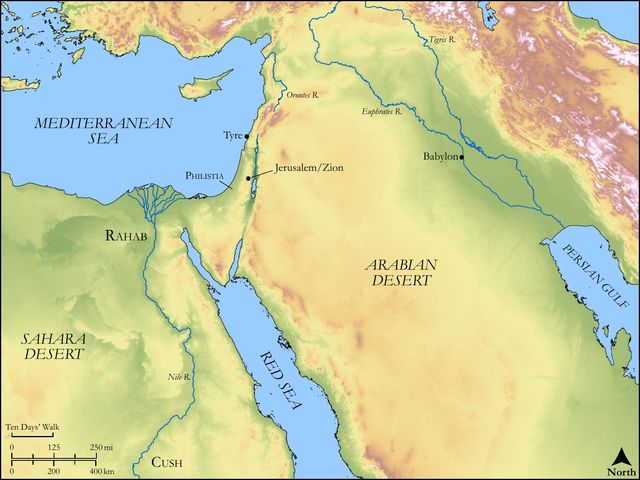
See on the biblical-era map
Study this verse
Public-domain commentary
Matthew Henry
From his Commentary on the Whole Bible. Henry comments on passages, not single verses — this entry covers Psalms 87:1–3.
Some make the first words of the psalm to be part of the title; it is a psalm or song whose subject is the holy mountains - the temple built in Zion upon Mount Moriah. This is the foundation of the argument, or beginning of the psalm. Or we may suppose the psalmist had now the tabernacle or temple in view and was contemplating the glories of it, and at length he breaks out into this expression, which has reference, though not to what he had written before, yet to what he had thought of; every one knew what he meant when he said thus abruptly, Its foundation is in the holy mountains. Three things are here observed, in praise of the temple: - 1. That it was founded on the holy mountains, Psa 87:1. The church has a foundation, so that it cannot sink or totter; Christ himself is the foundation of it, which God has laid. The Jerusalem above is a city that has foundations. The foundation is upon the mountains. It is built high; the mountain of the Lord's house is established upon the top of the mountains, Isa 2:2. It is built firmly; the mountains are rocky, and on a rock the church is built. The world is founded upon the seas (Psa 24:2), which are continually ebbing and flowing, and are a very weak foundation; Babel was built in a plain, where the ground was rotten. But the church is built upon the everlasting mountains and the perpetual hills; for sooner shall the mountains depart, and the hills be removed, than the covenant of God's peace shall be disannulled, and on that the church is built, Isa 54:10. The foundation is upon the holy mountains. Holiness is the strength and stability of the church: it is this that will support it and keep it from sinking; not so much that it is built upon mountains as that it is built upon holy mountains - upon the promise of God, for the confirming of which he has sworn by his holiness, upon the sanctification of the Spirit, which will secure the happiness of all the saints. 2. That God had expressed a particular affection for it (Psa 87:2): The Lord loveth the gates of Zion, of the temple, of the houses of doctrine (so the Chaldee), more than all the dwellings of Jacob, whether in Jerusalem or any where else in the country. God had said concerning Zion, This is my rest for ever; here will I dwell. There he met his people, and conversed with them, received their homage, and showed them the tokens of his favour, and therefore we may conclude how well he loves those gates. Note, (1.) God has a love for the dwellings of Jacob, has a gracious regard to religious families and accepts their family-worship. (2.) Yet he loves the gates of Zion better, not only better than any, but better than all, of the dwellings of Jacob. God was worshipped in the dwellings of Jacob, and family-worship is family-duty, which must by no means be neglected; yet, when they come in competition, public worship (caeteris paribus - other things being equal) is to be preferred before private. 3. That there was much said concerning it in the word of God (Psa 87:3): Glorious things are spoken of thee, O city of God! We are to judge of things and persons by the figure they make and the estimate put upon them in and by the scripture. Many base things were spoken of the city of God by the enemies of it, to render it mean and odious; but by him whose judgment we are sure is according to truth glorious things are spoken of it. God said of the temple, My eyes and my heart shall be there perpetually; I have sanctified this house, that my name may be there for ever, Ch2 7:16. Beautiful for situation is Mount Zion, Psa 48:2. These are glorious things. Yet more glorious things are spoken of the gospel-church. It is the spouse of Christ, the purchase of his blood; it is a peculiar people, a holy nation, a royal priesthood, and the gates of hell shall not prevail against it. Let us not be ashamed of the church of Christ in its meanest condition, nor of any that belong to it, nor disown our relation to it, though it be turned ever so much to our reproach, since such glorious things are spoken of it, and not on iota or tittle of what is said shall fall to the ground.
Historical interpretation
Historical reception
3 surviving comments on this verse. Each one is dated, so this reads as a timeline rather than a list.
Select a marker to jump to its quote. Markers stagger vertically where authors wrote within a few decades of each other.
Pass now, pray, to the others who were saved by repentance. Perhaps even among the women someone will say, “I have committed fornication and adultery. I have defiled my body with every excess. Can there be salvation for me?” Fix your eyes, woman, on Rahab, and look for salvation for yourself too. For if she who openly and publicly practiced fornication was saved through repentance, will not she whose fornication preceded the gift of grace be saved by repentance and fasting? For observe how she was saved. She said only this: “Since the Lord, your God, is God in heaven above and on earth below.” “Your God,” she said, for she did not dare call him her God, because of her wantonness. If you want scriptural testimony of her salvation, you have it recorded in the Psalms: “I will think of Rahab and Babylon among those who know me.” O the great loving-kindness of God, which is mindful even of harlots in Scripture. He did not say merely, “I shall think of Rahab and Babylon,” but added, “among those who know me.” The salvation procured by repentance is open to men and women alike.
“I will be mindful of Rahab and Babylon among those that know me.” Since the psalmist said, “Glorious things are said of you, O city of God,” and we understand this city to be the church gathered together from the nations, the psalm now speaks of the calling of the Gentiles: “I will be mindful of Rahab and Babylon among those that know me.” Let the sinner be at peace; the Lord was mindful of Rahab. I mean, at peace, if the sinner returns to the Lord; otherwise, there is no healing peace in a tearless security. “I will be mindful of Rahab,” of Rahab, that harlot who lodged Jesus’ secret agents, who lived in Jericho, where Joshua had come and had dispatched the two spies. Jericho, that collapsed in seven days, is a type of this world, and as such is determined to kill the secret agents. Because, therefore, Jericho is bent on killing the spies, Rahab, the harlot, alone received them, lodged them not on the ground floor but in the upper story of the roof—or, in other words, in the sublimity of her faith. She hid them under her stalks of flax.
"Very excellent things are said of you, thou city of God" [Psalm 87:3]. He was, as it were, contemplating that city of Jerusalem on earth: for consider what city he alludes to, of which certain very excellent things are spoken. Now the earthly city has been destroyed: after suffering the enemy's rage, it fell to the earth; it is no longer what it was: it exhibited the emblem, and the shadow has passed away. Whence then are "very excellent things spoken of you, thou city of God"? Listen whence: "I will think upon Rahab and Babylon, with them that know Me" [Psalm 87:4]. In that city, the Prophet, in the person of God, says, "I will think upon Rahab and Babylon." Rahab belongs not to the Jewish people; Babylon belongs not to the Jewish people; as is clear from the next verse: "For the Philistines also, and Tyre, with the Ethiopians, were there." Deservedly then, "very excellent things are spoken of you, thou city of God:" for not only is the Jewish nation, born of the flesh of Abraham, included therein, but all nations also, some of which are named that all may be understood. "I will think," he says, "upon Rahab:" who is that harlot? That harlot in Jericho, who received the spies and conducted them out of the city by a different road: who trusted beforehand in the promise, who feared God, who was told to hang out of the window a line of scarlet thread, that is, to bear upon her forehead the sign of the blood of Christ. She was saved there, and thus represented the Church of the Gentiles: whence our Lord said to the haughty Pharisees, "Verily I say unto you, that the publicans and the harlots go into the kingdom of God before you." [Matthew 21:31] They go before, because they do violence: they push their way by faith, and to faith a way is made, nor can any resist, since they who are violent take it by force. For it is written, "The kingdom of Heaven suffers violence, and the violent take it by force." [Matthew 11:12] Such was the conduct of the robber, more courageous on the cross than in the place of ambush. "I will think upon Rahab and Babylon." By Babylon is meant the city of this world: as there is one holy city, Jerusalem; one unholy, Babylon: all the unholy belong to Babylon, even as all the holy to Jerusalem. But he slides from Babylon to Jerusalem. How, but by Him who justifies the ungodly: Jerusalem is the city of the saints; Babylon of the wicked: but He comes who justifies the ungodly: since it is said, "I will think" not only "upon Rahab," but "upon Babylon," but with whom? "with them that know Me."...
Continue studying Psalms 87:3 across the web’s major study libraries — every link below opens this exact verse, chapter, or book on the destination site.
Read & Compare
 BibleGatewayThis verse in more than 200 translations and 70 languages.
 Bible.comThe YouVersion reader — hundreds of translations, reading plans, and highlights.
 ESV.orgCrossway's official English Standard Version reader.
 NET BibleThe NET translation with 60,000+ translators' notes on every rendering decision.
 STEP BibleTyndale House's free study tool — original text, vocabulary, and scholarly resources.
 BibliaLogos Bible Software's free web reader.
 USCCBThe New American Bible (Revised Edition) with the U.S. bishops' study notes.
Commentaries
 BibleHub CommentariesDozens of classic commentaries on this verse, gathered on one page.
 StudyLightMore than 100 commentary sets — the largest collection on the web.
 BibleRefPlain-English commentary on what this verse means, verse by verse.
 Enduring WordDavid Guzik's free commentary on this chapter, widely used by Bible teachers.
 Bible Study ToolsVerse commentary alongside Greek and Hebrew study aids.
Original Language & Research
- BibleHub InterlinearThe verse word by word — original language, transliteration, and English.
- BibleHub LexiconEvery word's original-language definition and Strong's entry.
 Blue Letter BibleDeep-study tools — Strong's numbers, concordance, and word studies.
 SefariaThe Hebrew text with Rashi and centuries of Jewish commentary.
Sermons, Hymns & Audio


TrulyRandomVerse is not affiliated with these sites and doesn’t control their content. They’re linked because they’re genuinely useful.
Summary
Psalms 87:3 is a powerful declaration celebrating the unique, divinely ordained honor and destiny of Jerusalem, often referred to as Zion, the "city of God." It emphatically proclaims that "glorious things" are spoken of this sacred metropolis, underscoring its unparalleled status not merely as a geographical location, but as God's chosen dwelling place, the epicenter of His redemptive purposes, and a spiritual beacon for all nations. This verse serves as a profound affirmation of God's special favor upon Zion, inviting deep theological reflection on its multifaceted significance both for ancient Israel and as a prophetic foreshadowing of the New Jerusalem.
Context
ShowHideLiterary Context
Psalms 87 belongs to a distinct genre known as the "Songs of Zion" (e.g., Psalm 46 and Psalm 48), which exalt Jerusalem's unique standing as the Lord's chosen city. The psalm opens by establishing God's profound personal investment in Zion, declaring, "His foundation is in the holy mountains. The LORD loveth the gates of Zion more than all the dwellings of Jacob" (Psalms 87:1-2). This immediate assertion of divine affection and preference sets a tone of unparalleled significance for the city. Verse 3, "Glorious things are spoken of thee, O city of God. Selah," functions as a direct, emphatic address and a foundational statement, upon which the subsequent verses build, describing various nations being "born" in Zion, thereby signifying its universal spiritual significance and future inclusion of Gentiles.
Historical & Cultural Context
Jerusalem, known interchangeably as Zion, was far more than just the political capital of the Israelite kingdom; it was the spiritual heartland, housing the Temple, which was believed to be the earthly dwelling place of God's presence. Its strategic location on the Judean mountains offered natural defenses, yet its true security was understood to be rooted in divine protection and election. The concept of Zion as the "city of God" was deeply interwoven with Israelite national and religious identity, symbolizing God's covenant faithfulness, His abiding presence among His people, and the locus of His redemptive activity. This psalm likely reflects a period of national pride and spiritual confidence, possibly composed for a pilgrimage festival or in celebration of a significant deliverance, when the people gathered to acknowledge Jerusalem's unique role as the center of their faith and the place where God's glory resided. The term "Selah" at the verse's conclusion, common in the Psalms, suggests a musical interlude or a call for meditative reflection, underscoring the profound weight of the preceding declaration.
Key Themes
ShowHideThis verse powerfully encapsulates several core themes central to the psalm and broader biblical theology. Firstly, it highlights the theme of Divine Election and Favor, emphasizing that Zion's inherent glory and honor are not self-derived but spring entirely from God's deliberate choice and profound love for it, a concept echoed in God's choosing of Israel as His treasured possession, as seen in Deuteronomy 7:6. Secondly, it underscores Inherent Glory and Honor, asserting that the "glorious things" spoken of Zion are not fleeting compliments but weighty, substantial declarations of divine truth, reflecting its intrinsic value as God's chosen dwelling place. This theme resonates with the descriptions of the glory filling the Tabernacle and Temple (e.g., 1 Kings 8:11). Finally, the verse introduces a strong element of Prophetic Foreshadowing, hinting at a universal spiritual significance for Zion that transcends its physical boundaries, pointing towards the future inclusion of all nations in God's kingdom and ultimately to the New Jerusalem, the eternal city of God where His people will dwell.
Exposition and Analysis
ShowHideKey Word Analysis
ShowHideThis primitive root means "to be heavy," "to be weighty," "to be honored," or "to be glorious." In the context of "glorious things," it conveys a sense of substantiality, dignity, and inherent worth. It implies that the declarations concerning Zion are not trivial or superficial, but possess immense gravity, significance, and honor, stemming from God's own character and purpose. These are not merely admirable qualities, but profound, enduring truths that command respect and reverence.
This primitive root means "to arrange," "to speak," "to declare," or "to utter." The passive voice ("are spoken") indicates that the "glorious things" originate from an external, authoritative source—namely, God Himself or those divinely inspired. This verb emphasizes the declarative nature of the statement, highlighting that these truths about Zion are not mere human opinions or aspirations, but divinely pronounced realities, carrying the weight of God's own word and promise.
This term, appearing frequently in the Psalms, signifies a "suspension (of music)" or a "pause." While its precise musical or liturgical function is debated, it consistently serves as an emphatic marker, prompting the reader or singer to pause, reflect, and meditate deeply on the preceding words. In Psalms 87:3, "Selah" draws attention to the profound weight and eternal significance of the declaration that "glorious things are spoken of thee, O city of God," inviting a moment of spiritual contemplation and internalization of this divine truth.
Verse Breakdown
ShowHide"Glorious things are spoken of thee"
This opening clause serves as a powerful declarative statement, asserting that the city of Zion is the subject of weighty, honorable, and divinely significant pronouncements. The passive construction ("are spoken") implicitly points to the ultimate author of these declarations—God Himself. It conveys that Zion's reputation and destiny are not self-made but are divinely ordained, celebrated, and affirmed by the Almighty, reflecting its intrinsic value and purpose in His plan.
"O city of God"
This is a direct, intimate address to Jerusalem, identifying it by its most profound and unique title. Calling it the "city of God" (ʻîyr ʼĕlôhîym) underscores its exclusive relationship with the Almighty. This designation signifies divine ownership, protection, and the manifest presence of God within its gates, setting Jerusalem apart from all other cities as the chosen place where God has elected to dwell and reveal His glory among His people.
"Selah"
As a liturgical and meditative marker, "Selah" punctuates this profound declaration about Zion's glory. It serves as a deliberate pause, inviting the worshiper or reader to halt, absorb, and internalize the weighty truth that Jerusalem is indeed the recipient of such "glorious things" from God. It amplifies the impact of the preceding statement, encouraging a moment of deep reflection on the divine favor and destiny bestowed upon the city.
Literary Devices
ShowHideThe verse employs several powerful literary devices that enhance its theological and emotional impact. Apostrophe is prominently featured, as the psalmist directly addresses "O city of God," personifying Jerusalem and imbuing it with a living presence capable of being spoken to and about. This direct address heightens the intimate and profound nature of the declaration. The phrase "Glorious things are spoken of thee" utilizes Hyperbole to emphasize the extraordinary nature of God's favor and the city's divinely conferred honor, suggesting an abundance of praise and future promise that transcends ordinary human commendation. Furthermore, the entire verse functions as a Declarative Statement, asserting a profound and undeniable truth about Zion's identity and destiny. The inclusion of "Selah" acts as a Rhetorical Pause, strategically placed to compel the listener or reader to meditate deeply on the weighty implications of the "glorious things" affirmed, amplifying the verse's spiritual resonance and encouraging contemplative worship.
Theological and Thematic Connections
ShowHidePsalms 87:3 profoundly speaks to God's sovereign election and the inherent value He places on His chosen dwelling place and, by extension, His people. The "glorious things" spoken of Zion are not mere human accolades but divine declarations of its unique status as the "city of God." This highlights God's particular love for Zion, a love that extends beyond the physical city to encompass the spiritual community of His people, whether ancient Israel or the Church. It foreshadows a future where God's presence and glory will be fully realized, not just in a specific geographical location, but in a redeemed community that transcends earthly boundaries. This verse assures believers of God's faithfulness to His promises and His ultimate plan for His people, fostering hope in the divine blueprint for an eternal dwelling place of righteousness and peace.
Reflection and Application
ShowHidePsalms 87:3 invites contemporary believers to consider their identity and ultimate hope within God's unfolding eternal plan. Just as ancient Zion was the recipient of divine favor and glorious pronouncements, so too is the Church, as the spiritual "city of God" in the present age, and ultimately the New Jerusalem. This verse reminds us that our true citizenship is not bound by earthly borders but is heavenly, rooted in God's divine election and promises. It encourages us to recognize the profound value God places on His people and His dwelling place, both individually as temples of the Holy Spirit and corporately as the body of Christ. Despite present imperfections or challenges, the Church, as God's chosen assembly, is destined for glory because of His indwelling presence and the "glorious things" He has spoken concerning its ultimate future. This truth should inspire unwavering confidence, profound gratitude, and a renewed commitment to living in light of our divine heritage and eternal destiny, knowing that we are part of a city of which glorious things are spoken.
Questions for Reflection
ShowHideFAQ
ShowHideWhat makes Jerusalem "the city of God" and why are "glorious things" spoken of it in Psalms 87:3?
ShowHideJerusalem earned the profound title "city of God" primarily because it was the divinely chosen location for the Temple, the central sanctuary where God's presence (Shekinah glory) was believed to dwell among His people. It served as the spiritual and political capital of Israel, the place where God established His enduring covenant with David and where His laws and ordinances were proclaimed. The "glorious things" spoken of it refer to the multitude of divine blessings, promises, and declarations concerning its unique and sacred status. These include God's sovereign election of the city, His unwavering love and protection for it (as vividly portrayed in psalms like Psalm 46 and Psalm 48), and the rich prophetic promises of its future role in God's redemptive plan, encompassing the gathering of nations and the ultimate establishment of His eternal kingdom. These are not merely human praises but weighty, divine pronouncements affirming its unparalleled significance in salvation history.
Christ-Centered Fulfillment
ShowHidePsalms 87:3, with its declaration of "glorious things" spoken of the "city of God," finds its ultimate and most profound fulfillment in the person and work of Jesus Christ and the spiritual reality of the Church. While ancient Jerusalem served as a tangible, physical representation of God's dwelling among His people, it was a shadow pointing to a greater, spiritual reality to come. Jesus Himself is the true and ultimate Temple, the perfect dwelling place of God, in whom "all the fullness of the Deity lives in bodily form" (Colossians 2:9). The "city of God" now extends beyond a physical location to encompass all who are "born again" into God's family through faith in Christ, thereby becoming citizens of a heavenly kingdom whose true allegiance is not to earthly powers but to God (as seen in Philippians 3:20). The Church, as the body of Christ, is the spiritual Zion, a holy dwelling place built upon the foundation of the apostles and prophets, with Christ Jesus Himself as the chief cornerstone (Ephesians 2:20). The "glorious things" spoken of this spiritual city include the promise of eternal life, the indwelling of the Holy Spirit, the assurance of God's abiding presence, and the call to be a light to the nations (Matthew 5:14). Ultimately, this psalm's vision points to the New Jerusalem, the heavenly city where God will dwell with His redeemed people for eternity, a city whose glory is the very glory of God, illuminated not by sun or moon, but by the Lamb who is its lamp (Revelation 21:23). Thus, the psalm's profound vision of a glorious city finds its perfect consummation in the person and redemptive work of Christ, and in the eternal destiny of His Church.