TRV
TRV
- English
- King James KJV
- Complete Jewish CJB
- World English WEBM
- Berean Standard BSB
- American Standard ASV
- Geneva GNV
- Young's Literal YLT
- Douay-Rheims DRC
- International
- Shqip ALB
- العربية SVD
- বাংলা BN-IRV
- မြန်မာ Judson
- 简体文 CUV-S
- 繁體中文 CUV-T
- Čeština BKR
- Nederlands STVE
- Français LSG
- Deutsch SCH
- Ελληνικά Vamvas
- ગુજરાતી GU-IRV
- Hausa HCB
- עברית Hebrew
- हिन्दी HCV
- Magyar KAROLI
- Bahasa Indonesia INDO-TB
- Italiano Diodati
- 日本語 Kougo
- 한국어 Korean
- മലയാളം MAL
- मराठी MRCV
- Norsk DNB
- فارسی OPV
- Polski BG
- Português Almeida
- Română Cornilescu
- Русский Synodal
- Español RVG
- Kiswahili Neno
- Svenska SV1917
- Tagalog TAG-ADB
- தமிழ் TCV
- తెలుగు TSA
- ภาษาไทย THAI-KJV
- Українська Ohienko
- Tiếng Việt CADMAN
- Yorùbá YCB
The Sacrifices and Feast of Dedication
The Sacrifices and Feast of Dedication
Study this passage
Commentary written on this passage, not on a single verse.
- Who
- Where
- When
- About
Where else Scripture says this.
Numbers 34:5
Then the border turns and goes from 'Atzmon to the Vadi of Egypt and along it to the Sea.from verse 65Ezra 6:16
The people of Isra'el, the cohanim, the L'vi'im and the other people from the exile joyfully dedicated this house of God.from verse 62Ezra 6:17
At the dedication of this house of God they offered 100 young bulls, 200 rams, 400 lambs, and, as a sin offering for all Isra'el, twelve male goats, corresponding to the number of the tribes of Isra'el.from verse 622 Chronicles 4:1
He made an altar of bronze thirty-five feet long, thirty-five feet wide and seventeen-and-a-half feet high.from verse 641 Kings 8:2
All the men of Isra'el assembled before King Shlomo at the festival in the month of Etanim, the seventh month.from verse 65Numbers 34:8
and from Mount Hor mark a line to the entrance of Hamat. The border goes out to Tz'dad.from verse 652 Samuel 6:17
They brought the ark of ADONAI in and put it in its place inside the tent that David had set up for it. David offered burnt offerings and peace offerings before ADONAI.from verse 622 Samuel 6:19
Then he distributed to all the people of Isra'el, to everyone there, both men and women, a loaf of bread, a portion of meat and a raisin cake, after which the people all left for their homes.from verse 622 Chronicles 7:8
So Shlomo celebrated the festival at that time for seven days, together with all Isra'el, an enormous gathering; [they had come all the way] from the entrance of Hamat to the Vadi [of Egypt].from verse 652 Chronicles 7:9
On the eighth day they held a solemn assembly, having observed the dedication of the altar for seven days and the festival for seven days.from verse 652 Kings 14:25
He recovered the territory of Isra'el between the entrance of Hamat and the sea of the 'Aravah, in keeping with the word of ADONAI the God of Isra'el, which he spoke through his servant Yonah the son of Amitai, the prophet from Gat-Hefer.from verse 65Genesis 15:18
That day ADONAI made a covenant with Avram: "I have given this land to your descendants - from the Vadi of Egypt to the great river, the Euphrates River -from verse 65
Public-domain commentary
Matthew Henry
From his Commentary on the Whole Bible. Henry comments on passages, not single verses — this entry covers 1 Kings 8:62–66. His two-level outline is real structure in the source text, so it is rendered as structure.
We read before that Judah and Israel were eating and drinking, and very cheerful under their own vines and fig-trees; here we have them so in God's courts. Now they found Solomon's words true concerning Wisdom's ways, that they are ways of pleasantness.
I.They had abundant joy and satisfaction while they attended at God's house, for there,
1.Solomon offered a great sacrifice, 22,000 oxen and 120,000 sheep, enough to have drained the country of cattle if it had not been a very fruitful land. The heathen thought themselves very generous when they offered sacrifices by hundreds (hecatombs they called them), but Solomon out-did them: he offered them by thousands. When Moses dedicated his altar, the peace-offerings were twenty-four bullocks, and of rams, goats, and lambs, 180 (Num 7:88); then the people were poor, but now that they had increased in wealth more was expected from them. Where God sows plentifully he must reap accordingly. All these sacrifices could not be offered in one day, but in the several days of the feast. Thirty oxen a day served Solomon's table, but thousands shall go to God's altar. Few are thus minded, to spend more on their souls than on their bodies. The flesh of the peace-offerings, which belonged to the offerer, it is likely, Solomon treated the people with. Christ fed those who attended him. The brazen altar was not large enough to receive all these sacrifices, so that, to serve the present occasion, they were forced to offer many of them in the middle of the court, (Kg1 8:64), some think on altars, altars of earth or stone, erected for the purpose and taken down when the solemnity was over, others think on the bare ground. Those that will be generous in serving God need not stint themselves for want of room and occasion to be so.
2.He kept a feast, the feast of tabernacles, as it should seem, after the feast of dedication, and both together lasted fourteen days (Kg1 8:65), yet they said not, Behold, what a weariness is this!
II.They carried this joy and satisfaction with them to their own houses.
When they were dismissed they blessed the king (Kg1 8:66), applauded him, admired him, and returned him the thanks of the congregation, and then went to their tents joyful and glad of heart, all easy and pleased. God's goodness was the matter of their joy, so it should be of ours at all times. They rejoiced in God's blessing both on the royal family and on the kingdom; thus should we go home rejoicing from holy ordinances, and go on our way rejoicing for God's goodness to our Lord Jesus (of whom David his servant was a type, in the advancement and establishment of his throne, pursuant to the covenant of redemption), and to all believers, his spiritual Israel, in their sanctification and consolation, pursuant to the covenant of grace. If we rejoice not herein always it is our own fault.
Historical interpretation
Two Centuries of Reception
3 surviving comments on this passage. Each one is dated, so this reads as a timeline rather than a list.
Select a marker to jump to its quote. Markers stagger vertically where authors wrote within a few decades of each other.
We read that two altars were set up in the temple built by Solomon, one outside and one within. On the one that was outside, the sacrifice of animals took place, while on the one inside, the burning of incense was offered. Let us see, brothers, whether there are two altars set up in ourselves, the one that is of the body and the other that is of the heart. God, finally, asks a twofold sacrifice of us: the one, that we be chaste in body; the other, that we should be pure of heart. For this reason good works are offered on the exterior altar, that is, in our body. May holy thoughts emit a sweet fragrance in our hearts, and let us continually do what is pleasing to God on the altar or our heart. We celebrate the consecration of an altar with joy and in right order of things at the time when we offer the altars of our heart and body purified in the sight of the divine majesty and with a good conscience.
But we should note this too: having explained the dedication and subsequent festival, Scripture concludes, “And Solomon dismissed the people, who blessed the king and set out for their own dwellings joyfully and glad of heart for all the goodness the Lord had done for David his servant and for his people Israel.” When he has brought to completion the gift of resurrection, our Lord dismisses his elect joyfully to their eternal dwelling places. Surely he does not move them further away from his presence but lets them pass into the dwelling place of the heavenly fatherland after the division at the final judgment (which, according to the saying of the apostle, we know will take place in the air), so that each may receive his promised seat in the kingdom in proportion to his deserts. What is said here, that the people set out for their own dwellings, refers to the setting-out of which our Lord speaks in the Gospel: “In my Father’s house are many mansions.” And it is well said that the people set out for their own dwellings while blessing the king, because this is the single supremely tranquil and joyful action of the heavenly citizens, singing hymns of thanksgiving to their Maker. Thus is it written, “Happy are they who dwell in your house; they will praise you forever.” Thus the same prophet [David] has filled the final seven psalms with the sweetness of the divine praises; moreover, in the eighth psalm before the end of the psalter, he commemorates by blessing the Lord for his victory in the fight in which he killed the giant [Goliath]. In this he clearly indicates that all who triumph in their contests against the malignant enemy here below will sing the praises of their Maker and Helper there, where they will have true rest. “They blessed the king and set out for their own dwellings joyfully and glad of heart for all the goodness the Lord had done for David his servant and for his people Israel.” The just do indeed go into the dwellings of the heavenly mansions joyfully because of the goodness they have received from the Lord. Although the labors of this age are burdensome and prolonged, whatever ends in eternal blessedness seems short-lived and trifling. Hence each one of us, dearly loved, must press on with his devout actions by exerting himself to the extent of his ability by encouraging, entreating and rebuking in the building up of the house of God, lest, if the heavenly King catches sight of anyone slothful now in the work [of building] his temple, he may make him an outcast from his great solemn celebration at the time of the dedication.
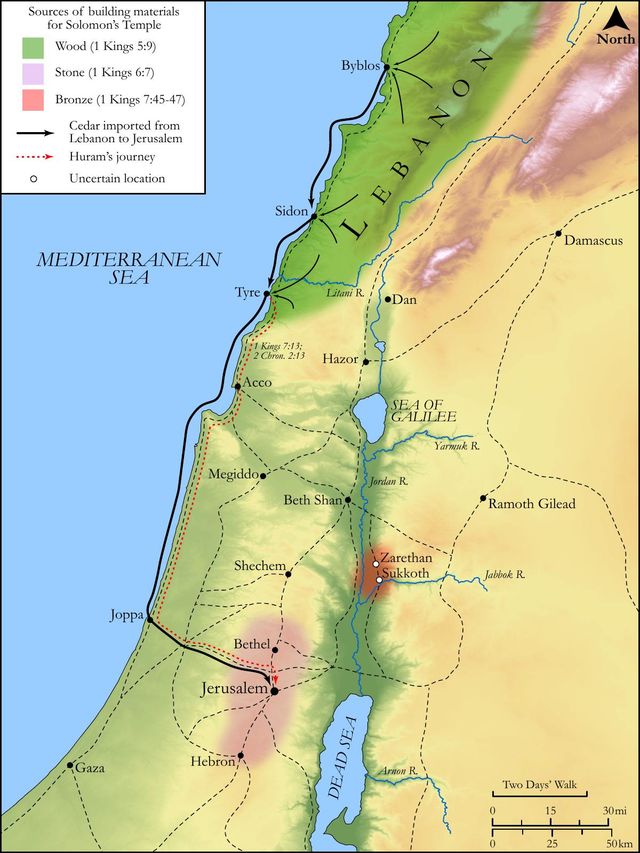
"Solomon held a great feast, etc." [1 Kings 8:65] It is said that Solomon held a great feast, and all Israel with him; a great multitude from the entrance of Hamath unto the brook of Egypt before the Lord; by the entrance of Hamath, it means the northern region of the promised land; by the brook or torrent of Egypt, as the Chronicles name it, it designates the southern. I think the reader will be pleased to quote some passages more extensively from the words of Saint Jerome. It is written in the book of Numbers, in which the entire promised land is divided in a brief speech by the four regions: The southern part shall begin from the wilderness of Sin, which is near Edom, and shall have its boundaries against the east at the Salt Sea, and shall circle the southern region by the ascent of Scorpions, so that they pass through Zin, and reach as far as the south to Kadesh-Barnea. From there the boundaries will proceed to the village called Adar, and extend to Azmon, and the border will go round from Azmon to the brook of Egypt and shall end at the Great Sea shore. Concerning which in the last vision of the prophet Ezekiel it is thus said: The southern boundary southward from Tamar unto the waters of Meribah (Ezek. 47), that is, of contradiction. Also Kadesh, and the brook until the Great Sea, which means the broad wilderness of Sin, which is near Edom, and in the Red Sea to circle its boundary, and by the ascent of Scorpions, and by Zin, and Kadesh-Barnea, and the courtyard or village of Adar, and from Azmon to reach up to the brook of Egypt, which flows into the sea near the city Rhinocorura. Here indeed, the boundary of the southern region begins at Thamar, which is a city in the wilderness, which Solomon built with remarkable works, and today is called Palmyra, and in the Hebrew language is called Thamar, which in our language sounds as "palm"; up to the waters of the dispute of Kadesh, which is undoubtedly in the desert. And the stream enters the Great Sea, which extends along the shores of Egypt and Palestine. It follows in the book of Numbers: But the western region will begin at the Great Sea, and will be closed by that end (Num. XXXIV): that is, from sea to sea, from the stream namely of Rhinocorure, which flows into the sea, up to the place where the city of Hemath of Syria is. Whose name Ezekiel puts in this region: And the border, he says, of the sea, the Great Sea from the boundary straight on, until you come to Hemath (Ezek. XLVII), which is now called Epiphania, with the name changed from the cruelest tyrant Antiochus; for he had the surname Epiphanes. Moreover, to the northern part, he says, the boundaries will begin from the Great Sea, reaching to the highest mountain, from which they will come to Hemath up to the borders of Sedada, and the boundaries will go up to Zephron and the village of Enan. These will be the boundaries in the northern part (Num. XXXIV). The Hebrews say that the northern region begins from the Great Sea, which extends along the shores of Palestine, Phoenicia, and Syria, which is called Coele, and Cilicia, and through Egypt extends to Libya. But what he says, reaching the boundaries up to the highest mountain, the same Hebrews consider it to mean either Mount Amanus or Taurus, which seems more likely to us. And the boundaries will go, he says, up to Zephron, which city today is called Zephyrium, a town of Cilicia. What follows, and the village of Enan, for which in Hebrew is written Haser Enan, which means the atrium of the fountain, is the boundary of Damascus. Hence Ezekiel says: And the boundary will be from the sea to the atrium of Enan, or Haser Enan, the boundary of Damascus, and from the north to the north, the northern region (Ezek. XLVII). From there, he says, they will measure the boundaries toward the eastern region from the village of Enan to Sephama, and from Sephama the boundaries will descend to Rebla opposite the fountain. From there they will reach toward the east to the sea of Chinnereth, and extend to Jordan, and finally end at the most salty sea (Num. XXXIV). Thus from the boundary of the northern region, that is, the atrium of Enan, the boundaries extend to Sephama, which the Hebrews name Apamea. And from Apamea the boundaries descend to Rebla, which is now called Antioch in Syrian. And so you may know that this Rebla signifies the city which now in Coele Syria is the most famous, it follows, opposite the fountain, which is clear to signify Daphne, from which the above-mentioned city enjoys abundant waters. From there, he says, the boundaries will reach toward the east to the sea of Chinnereth, that is, the lake of Tiberias. However, it is called a sea, though it has sweet waters, according to the idiom of Scripture, where gatherings of waters are called seas. And the boundaries will extend, he says, to the Jordan, and finally be closed by the sea, either the Dead Sea or (as some think) the tongue of the Red Sea, on whose shore Aila is situated.