

 TRV
TRV
- English
- King James KJV
- Complete Jewish CJB
- World English WEBM
- Berean Standard BSB
- American Standard ASV
- Geneva GNV
- Young's Literal YLT
- Douay-Rheims DRC
- International
- Shqip ALB
- العربية SVD
- বাংলা BN-IRV
- မြန်မာ Judson
- 简体文 CUV-S
- 繁體中文 CUV-T
- Čeština BKR
- Nederlands STVE
- Français LSG
- Deutsch SCH
- Ελληνικά Vamvas
- ગુજરાતી GU-IRV
- Hausa HCB
- עברית Hebrew
- हिन्दी HCV
- Magyar KAROLI
- Bahasa Indonesia INDO-TB
- Italiano Diodati
- 日本語 Kougo
- 한국어 Korean
- മലയാളം MAL
- मराठी MRCV
- Norsk DNB
- فارسی OPV
- Polski BG
- Português Almeida
- Română Cornilescu
- Русский Synodal
- Español RVG
- Kiswahili Neno
- Svenska SV1917
- Tagalog TAG-ADB
- தமிழ் TCV
- తెలుగు TSA
- ภาษาไทย THAI-KJV
- Українська Ohienko
- Tiếng Việt CADMAN
- Yorùbá YCB
Apostolic Boundaries and True Boasting
Apostolic Boundaries and True Boasting
In this passage
- Who
- Where
- When
- About
See also
Where else Scripture says this.
Proverbs 27:2
Let another man praise thee, and not thine own mouth; A stranger, and not thine own lips.from verse 12Jeremiah 9:23
Thus saith Jehovah, Let not the wise man glory in his wisdom, neither let the mighty man glory in his might, let not the rich man glory in his riches;from verse 17Jeremiah 9:24
but let him that glorieth glory in this, that he hath understanding, and knoweth me, that I am Jehovah who exerciseth lovingkindness, justice, and righteousness, in the earth: for in these things I delight, saith Jehovah.from verse 17Proverbs 26:12
Seest thou a man wise in his own conceit? There is more hope of a fool than of him.from verse 12Luke 18:11
The Pharisee stood and prayed thus with himself, God, I thank thee, that I am not as the rest of men, extortioners, unjust, adulterers, or even as this publican.from verse 122 Corinthians 10:18
For not he that commendeth himself is approved, but whom the Lord commendeth.from verse 12Luke 16:15
And he said unto them, Ye are they that justify yourselves in the sight of men; but God knoweth your hearts: for that which is exalted among men is an abomination in the sight of God.from verse 18Proverbs 21:2
Every way of a man is right in his own eyes; But Jehovah weigheth the hearts.from verse 18Romans 15:18
For I will not dare to speak of any things save those which Christ wrought through me, for the obedience of the Gentiles, by word and deed,from verse 121 Corinthians 4:5
Wherefore judge nothing before the time, until the Lord come, who will both bring to light the hidden things of darkness, and make manifest the counsels of the hearts; and then shall each man have his praise from God.from verse 18Romans 2:29
but he is a Jew who is one inwardly; and circumcision is that of the heart, in the spirit not in the letter; whose praise is not of men, but of God.from verse 182 Corinthians 3:1
Are we beginning again to commend ourselves? or need we, as do some, epistles of commendation to you or from you?from verse 12
Where this happens

Study this passage
Commentary written on this passage, not on a single verse.
Public-domain commentary
Matthew Henry
From his Commentary on the Whole Bible. Henry comments on passages, not single verses — this entry covers 2 Corinthians 10:12–18.
In these verses observe,
I.The apostle refuses to justify himself, or to act by such rules as the false apostles did, Co2 10:12.
He plainly intimates that they took a wrong method to commend themselves, in measuring themselves by themselves, and comparing themselves among themselves, which was not wise. They were pleased, and did pride themselves, in their own attainments, and never considered those who far exceeded them in gifts and graces, in power and authority; and this made them haughty and insolent. Note, If we would compare ourselves with others who excel us, this would be a good method to keep us humble; we should be pleased and thankful for what we have of gifts or graces, but never pride ourselves therein, as if there were none to be compared with us or that did excel us. The apostle would not be of the number of such vain men: let us resolve that we will not make ourselves of that number.
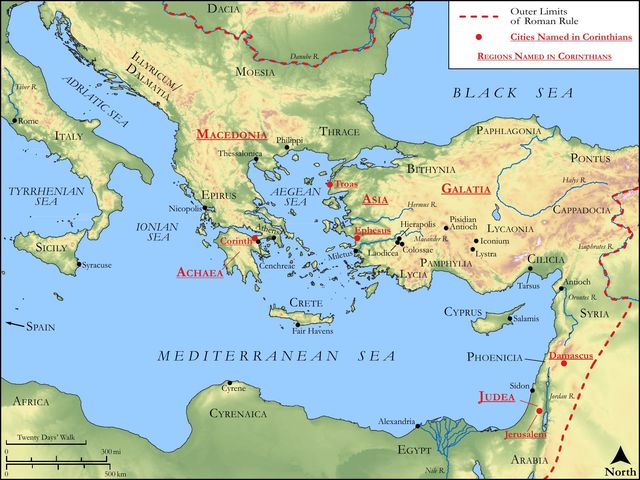
II.He fixes a better rule for his conduct, namely, not to boast of things without his measure, which was the measure God had distributed to him, Co2 10:13. His meaning is, either that he would not boast of more gifts or graces, or power and authority, than God had really bestowed on him; or, rather, that he would not act beyond his commission as to persons or things, nor go beyond the line prescribed to him, which he plainly intimates the false apostles did, while they boasted of other men's labors. The apostle's resolution was to keep within his own province, and that compass of ground which God had marked out for him. His commission as an apostle was to preach the gospel every where, especially among the Gentiles, and he was not confined to one place; yet he observed the directions of Providence, and the Holy Spirit, as to the particular places whither he went or where he did abide.
III.He acted according to this rule:
We stretch not ourselves beyond our measure, Co2 10:14. And, particularly, he acted according to this rule in preaching at Corinth, and in the exercise of his apostolical authority there; for he came thither by divine direction, and there he converted many to Christianity; and, therefore, in boasting of them as his charge, he acted not contrary to his rule, he boasted not of other men's labours, Co2 10:15.
IV.He declares his success in observing this rule.
His hope was that their faith was increased, and that others beyond them, even in the remoter parts of Achaia, would embrace the gospel also; and in all this he exceeded not his commission, nor acted in another man's line.
V.He seems to check himself in this matter, as if he had spoken too much in his own praise.
The unjust accusations and reflections of his enemies had made it needful he should justify himself; and the wrong methods they took gave him good occasion to mention the better rule he had observed: yet he is afraid of boasting, or taking any praise to himself, and therefore he mentions two things which ought to be regarded: - 1. He that glorieth should glory in the Lord, Co2 10:17. If we are able to fix good rules for our conduct, or act by them, or have any good success in so doing, the praise and glory of all are owing unto God. Ministers in particular must be careful not to glory in their performances, but must give God the glory of their work, and the success thereof. 2. Not he that commendeth himself is approved, but he whom the Lord commendeth, Co2 10:18. Of all flattery, self-flattery is the worst, and self-applause is seldom any better than self-flattery and self-deceit. At the best, self-commendation is no praise, and it is oftentimes as foolish and vain as it is proud; therefore, instead of praising or commending ourselves, we should strive to approve ourselves to God, and his approbation will be our best commendation.
Historical interpretation
Five Centuries of Reception
21 surviving comments on this passage. Each one is dated, so this reads as a timeline rather than a list.
Select a marker to jump to its quote. Markers stagger vertically where authors wrote within a few decades of each other.
Keep thyself pure as the habitation of God. Thou art the temple of Christ. Thou art the instrument of the Spirit. Thou knowest in what way I have brought thee up. Though I am the least of men, do thou seek to follow me, be thou an imitator of my conduct. I do not glory in the world, but in the Lord. I exhort Hero, my son; "but let him that glorieth, glory in the Lord." May I have joy of thee, my dear son, whose guardian may He be who is the only unbegotten God, and the Lord Jesus Christ! Do not believe all persons, do not place confidence in all; nor let any man get the better of thee by flattery. For many are the ministers of Satan; and "he that is hasty to believe is light of heart."
The primacy of knowledge the apostle shows to those capable of reflection, in writing to those Greeks of Corinth, in the following terms: "But having hope, when your faith is increased, that we shall be magnified in you according to our rule abundantly, to preach the Gospel beyond you." He does not mean the extension of his preaching locally: for he says also that in Achaia faith abounded; and it is related also in the Acts of the Apostles that he preached the word in Athens. But he teaches that knowledge (gnosis), which is the perfection of faith, goes beyond catechetical instruction, in accordance with the magnitude of the Lord's teaching and the rule of the Church.
The primacy of knowledge the apostle shows to those capable of reflection, in writing to those Greeks of Corinth, in the following terms: "But having hope, when your faith is increased, that we shall he magnified in you according to our rule abundantly, to preach the Gospel beyond you."
Touching such, however, as are betrothed, I can with constancy "above my small measure" pronounce and attest that they are to be veiled from that day forth on which they shuddered at the first bodily touch of a man by kiss and hand.
In the Epistle of Peter to them of Pontus: "Nor let any of you suffer as a thief, or a murderer, or as an evil-doer, or as a minder of other people's business,
By saying this Paul intimates that even his assurance and pride are to be given to the Lord, because it is by his favor that he has them. Someone who has confidence in the power of the gospel has confidence in the God who enables it. Thus God is glorified by all godly work. A person who has not received power from God cannot glory in the Lord, because he is seeking his own glory.