


Numbers 31:1
Bible text: King James Version (1769 Blayney text) · Public domain
Bible text: Berean Standard Bible · Public domain
Bible text: American Standard Version (1901) · Public domain
Bible text: World English Bible, Messianic edition · Public domain
Bible text: Geneva Bible (1599) · Public domain
Bible text: Young's Literal Translation · Public domain
- וַיְדַבֵּרvay·da·Berand he spokeH1696Conj-w ¦ V-Piel-ConsecImperf-3msVerb Piel Consecutive Imperfect 3rd Singular Masculineוַandיְדַבֵּרhe spoke
- יְהוָהYah·wehYahwehH3068N-properNoun Proper Title
- אֶל'eltoH413PrepPreposition
- מֹשֶׁהmo·ShehMosesH4872N-proper-mNoun Proper Masculine
- לֵּאמֹרle·Mor<to> sayingH559Prep-l ¦ V-Qal-InfVerb Qal Infinitive Constructלֵּ<to>אמֹרsaying
English is a literal word-by-word gloss of the Hebrew, not the KJV's wording. Why?
This is the original text the KJV's translators worked from — each Hebrew word with its own literal English meaning in this verse, prepared by scholars at Tyndale House, Cambridge. The KJV translates whole sentences, not word by word, so its wording differs: one Hebrew word can become several English words, and the KJV may choose “the LORD” where the gloss reads “Yahweh”. Both are faithful — they answer different questions. For the KJV's own rendering, switch to the KJV text.
Details
See on the biblical-era map
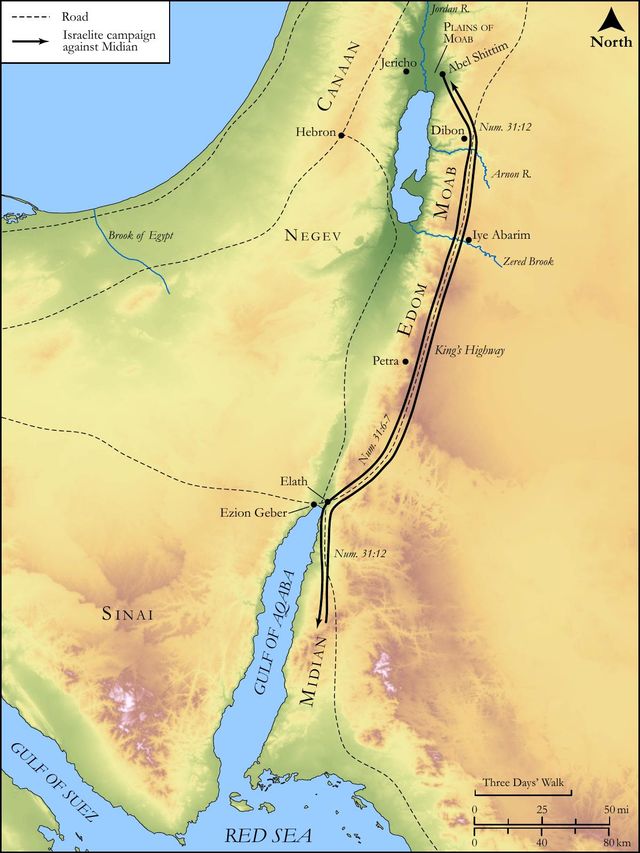
Study this verse
Historical interpretation
Historical reception
1 surviving comment on this verse from the historical church.
But a deeper vengeance is taken on fiercer foes and on those that are false as well as on those who have done greater wrongs, as was the case with the Midianites. For they had made many of the Jewish people to sin through their women. For this reason the anger of the Lord was poured out upon the people of our fathers. Thus it came about that Moses when victorious allowed none of them to live.
Continue studying Numbers 31:1 across the web’s major study libraries — every link below opens this exact verse, chapter, or book on the destination site.
Read & Compare
 BibleGatewayThis verse in more than 200 translations and 70 languages.
 Bible.comThe YouVersion reader — hundreds of translations, reading plans, and highlights.
 ESV.orgCrossway's official English Standard Version reader.
 NET BibleThe NET translation with 60,000+ translators' notes on every rendering decision.
 STEP BibleTyndale House's free study tool — original text, vocabulary, and scholarly resources.
 BibliaLogos Bible Software's free web reader.
 USCCBThe New American Bible (Revised Edition) with the U.S. bishops' study notes.
Commentaries
 BibleHub CommentariesDozens of classic commentaries on this verse, gathered on one page.
 StudyLightMore than 100 commentary sets — the largest collection on the web.
 BibleRefPlain-English commentary on what this verse means, verse by verse.
 Enduring WordDavid Guzik's free commentary on this chapter, widely used by Bible teachers.
 Bible Study ToolsVerse commentary alongside Greek and Hebrew study aids.
Original Language & Research
- BibleHub InterlinearThe verse word by word — original language, transliteration, and English.
- BibleHub LexiconEvery word's original-language definition and Strong's entry.
 Blue Letter BibleDeep-study tools — Strong's numbers, concordance, and word studies.
 SefariaThe Hebrew text with Rashi and centuries of Jewish commentary.
Sermons, Hymns & Audio


TrulyRandomVerse is not affiliated with these sites and doesn’t control their content. They’re linked because they’re genuinely useful.
Summary
Numbers 31:1 serves as a concise yet profoundly authoritative introduction to a divinely commanded military campaign against the Midianites. This brief verse underscores God's absolute sovereignty and direct initiative, marking the commencement of a righteous judgment. It sets the stage for the fulfillment of a previous directive to punish Midian for their instrumental role in leading Israel into grievous idolatry and immorality at Baal-peor, thereby transitioning the narrative from Israel's internal sin to God's external justice.
Context
ShowHideLiterary Context
Numbers 31:1 functions as a pivotal narrative transition within the book of Numbers. It immediately follows the detailed account of Israel's apostasy at Baal-peor, where 24,000 Israelites perished in a plague due to their involvement with Moabite and Midianite women in idolatrous practices and sexual immorality (as detailed in Numbers 25). Specifically, it directly initiates the fulfillment of the divine command given in Numbers 25:17-18 to "vex the Midianites, and smite them." This verse, therefore, is not an isolated command but the divine authorization for the execution of a previously declared judgment. It shifts the focus from Israel's internal purification and census (chapters 26-30) to God's external reckoning with those who enticed His people to sin, preparing the way for the subsequent details of the campaign, the division of spoils, and the final preparations for entering the Promised Land.
Historical & Cultural Context
The Midianites were a prominent, semi-nomadic people, descendants of Abraham through Keturah, whose territories stretched across the Arabian Desert, often interacting with Israel. While Moses' father-in-law, Jethro, was a Midianite priest, highlighting periods of peaceful coexistence, the incident at Baal-peor (Numbers 25) marked a significant hostile turn. This event involved a deliberate strategy by Balaam, at the behest of Balak and the Midianite elders, to corrupt Israel by enticing them into sexual immorality and the worship of Baal-peor. This was a direct assault on Israel's covenant relationship with Yahweh, a sin of the highest order that provoked divine wrath and a severe plague. The resulting war, initiated by the command in Numbers 31:1, was not merely a territorial conflict but a divinely mandated act of purification, justice, and holy war, aimed at eradicating a corrupting influence that had directly led God's people astray and violated the sanctity of their covenant with Him.
Key Themes
ShowHideNumbers 31:1, despite its brevity, introduces and reinforces several profound themes central to the Pentateuch and the book of Numbers. Firstly, it powerfully asserts Divine Sovereignty and Initiative, emphasizing that God is the ultimate orchestrator of events, initiating actions and communicating His will directly and decisively. Secondly, it reaffirms Moses' Prophetic Authority and Mediation, underscoring his unique and indispensable role as the direct recipient of God's revelation and the appointed leader through whom God communicates His commands to the entire nation of Israel. This highlights the importance of divinely appointed leadership. Thirdly, and most significantly, it sets the stage for the theme of Divine Justice and Consequences, demonstrating that God is holy and righteous, and He will not overlook sin, especially when it involves deliberate attempts to corrupt His chosen people and violate His covenant. This punitive action against Midian serves as a stark reminder that there are severe consequences for rebellion and enticement to idolatry, echoing the principle found in Deuteronomy 32:35 that "Vengeance is mine, and recompence." The verse thus underscores God's active involvement in history to uphold His holiness and execute His righteous judgment.
Exposition and Analysis
ShowHideKey Word Analysis
ShowHideThis is the sacred Tetragrammaton (YHWH, H3068), God's personal covenant name, often rendered "Yahweh" or "Jehovah." Its use here emphasizes that the speaker is not a generic deity but the self-Existent, eternal, covenant-keeping God of Israel. It highlights His unique identity, His relational commitment to His people, and the absolute authority derived from His divine nature, indicating that the command is from the ultimate source of power and truth.
The verb "spake" (H1696) denotes a direct, authoritative, and intentional communication. It implies a clear, articulate utterance, not a mere thought or impression. When God "speaks" through dâbar, it carries the full weight of divine command and absolute truth, demanding immediate attention and obedience. This word underscores the verbal and explicit nature of God's revelation to His chosen prophet, Moses.
The inclusion of "Moses" (H4872) is crucial. It reaffirms his unparalleled role as God's chosen mediator, prophet, and leader, the one through whom God communicates His will to the entire nation of Israel. This direct address highlights the divine authentication of Moses' leadership and the divine origin of the instructions that follow, ensuring that the subsequent actions are understood as God's will, not merely human initiative.
Verse Breakdown
ShowHide"¶ And the LORD spake"
This opening phrase immediately establishes the divine origin and supreme authority of the subsequent command. It signifies that the action about to be described is not a human initiative or a strategic decision by Moses, but a direct, sovereign directive from Yahweh Himself. The paragraph marker (¶) in the KJV often indicates a new section or thought, further emphasizing the significance and distinctness of this divine utterance as a pivotal moment in the narrative.
"unto Moses,"
This clause precisely specifies the recipient of the divine communication. It underscores Moses' unique and privileged position as the one chosen by God to receive His direct revelation. This direct address validates Moses' authority as God's spokesperson to the people and ensures that the message is transmitted faithfully through the divinely appointed channel, lending legitimacy to all subsequent actions.
"saying,"
This participle indicates that what follows is the direct content of God's communication. It signals that the subsequent verses will contain the explicit instructions or message that the LORD conveyed to Moses. This formulaic opening is common throughout the Pentateuch, lending ultimate weight and divine authority to the commands, laws, and narratives that proceed from it, preparing the reader for the specific divine mandate that is about to be revealed.
Literary Devices
ShowHideNumbers 31:1 employs several key literary devices to convey its profound significance. The most prominent is Formulaic Language, specifically the recurring phrase "And the LORD spake unto Moses, saying." This formula is a hallmark of the Pentateuch, serving as a powerful indicator of divine revelation and absolute authority. Its repetition throughout the Torah establishes a consistent pattern, reinforcing that the laws, commands, and historical events are not human constructs but originate directly from God Himself. The verse also functions as a crucial Narrative Transition, effectively shifting the focus from the internal consequences of Israel's sin and the subsequent census (Numbers 25-30) to the external execution of divine judgment against Midian. Furthermore, it acts as a foundational Divine Command, or the preface to one, establishing the ultimate source and legitimacy of the impending military action, framing it not as an act of human vengeance but as a righteous act of God's justice.
Theological and Thematic Connections
ShowHideNumbers 31:1, though brief, is pregnant with theological significance, primarily underscoring God's absolute sovereignty, His unwavering holiness, and the certainty of His justice. It reveals a God who is not distant or passive but actively involved in the affairs of humanity, meticulously overseeing the covenant He made with Israel. The command to wage war against Midian, initiated by this verse, is a stark demonstration that God takes sin, particularly that which corrupts His people and violates His covenant, with utmost seriousness. It reveals His character as a righteous judge who will not tolerate unrighteousness indefinitely, ensuring that justice is meted out against those who actively oppose His purposes and lead His people astray. This divine initiative also highlights the importance of obedience to God's revealed will, as Moses' subsequent actions are directly predicated on this divine word.
Reflection and Application
ShowHideNumbers 31:1, while a historical introduction to a specific act of divine judgment, offers timeless principles for reflection and application in our lives today. It powerfully reminds us that God is not a silent or absent deity but an actively engaged, sovereign LORD who speaks and acts in the world. His initiative in this verse calls us to consider the profound reality of His active involvement in our personal lives and in the broader sweep of history. Just as Moses was called to listen and obey, we too are called to cultivate a posture of attentiveness to God's voice, whether through His written Word, the Holy Spirit, or the guidance of His community. Furthermore, this verse sets the stage for a demonstration of God's perfect justice. While the context is one of severe judgment, it underscores God's holiness and His commitment to righteousness, reminding us that sin has real consequences and that God is ultimately just in all His dealings. This should inspire both reverence for His holiness and confidence in His ultimate triumph over all evil. It encourages us to align our lives with His righteous standards and to trust in His perfect timing and methods for justice.
Questions for Reflection
ShowHideFAQ
ShowHideWhy is this verse so short and seemingly insignificant?
ShowHideNumbers 31:1, though brief, is far from insignificant; its very brevity is a hallmark of its profound importance. It functions as a powerful, formulaic introduction that immediately establishes the divine authority and initiative behind the momentous events that follow. The phrase "And the LORD spake unto Moses, saying" is a recurring literary device throughout the Pentateuch (e.g., Exodus 6:1, Numbers 1:1), signaling that the subsequent narrative or command is not a human idea or a historical accident, but a direct, authoritative word from God Himself. Its conciseness underscores the weight, finality, and solemnity of God's utterance, setting a significant tone for the impending divine judgment and military campaign against Midian.
What is the significance of God speaking directly "unto Moses"?
ShowHideThe direct address "unto Moses" is highly significant because it reaffirms Moses' unique and unparalleled role as God's chosen mediator and prophet for the nation of Israel. In the Old Testament, God often communicated His will through prophets, but Moses held a special status as the one with whom God spoke "face to face, as a man speaks to his friend" (Exodus 33:11). This direct communication validates Moses' authority as the leader and ensures that the divine commands are transmitted faithfully and without distortion to the Israelites. It underscores that the subsequent actions are not Moses' personal vendetta or strategic decision, but the righteous execution of God's holy will, communicated through His appointed servant, thereby lending divine legitimacy to the entire campaign.
Christ-Centered Fulfillment
ShowHideWhile Numbers 31:1 initiates a physical war of retribution in the Old Testament, its underlying theological principles find profound Christ-centered fulfillment in the New Covenant. The very act of "the LORD spake" foreshadows the ultimate and final Word of God, Jesus Christ. Just as God spoke through Moses in the past, He has now "spoken to us by his Son" (Hebrews 1:1-2), who is the living embodiment of God's revelation and the very Word made flesh (John 1:1). The divine initiative and authority seen in Numbers 31:1 are perfectly realized in Christ, who came not to be served but to serve and to give his life as a ransom for many (Mark 10:45), initiating God's ultimate plan of salvation. The judgment against Midian, a consequence of their leading Israel into sin, points to Christ's ultimate victory over sin and death on the cross, where He bore the full weight of God's righteous wrath against sin, becoming sin for us so that in Him we might become the righteousness of God (2 Corinthians 5:21). Furthermore, while Old Testament "holy war" involved physical conflict, the New Testament call to battle is spiritual warfare against the forces of darkness (Ephesians 6:12), with Christ as the Captain of our salvation (Hebrews 2:10), who has already triumphed over principalities and powers through His cross (Colossians 2:15). Ultimately, the divine justice initiated in Numbers 31:1 will culminate in Christ's return as the righteous Judge, who will execute final judgment on all unrighteousness and establish His eternal kingdom in perfect justice and peace (Revelation 19:11-16).