


Numbers 15:41
Bible text: King James Version (1769 Blayney text) · Public domain
Bible text: Berean Standard Bible · Public domain
Bible text: American Standard Version (1901) · Public domain
Bible text: World English Bible, Messianic edition · Public domain
Bible text: Geneva Bible (1599) · Public domain
Bible text: Young's Literal Translation · Public domain
- אֲנִי'a·NiIH589Pro-1csPronoun Personal 1st Singular common gender
- יְהוָהYah·weh[am] YahwehH3068N-properNoun Proper Title
- אֱלֹהֵיכֶם'e·lo·hei·Khemyour GodH430N-mpc ¦ 2mpNoun Plural Masculine ConstructאֱלֹהֵיGodכֶםyour
- אֲשֶׁר'a·SherwhoH834RelParticle Relative
- הוֹצֵאתִיho·Tze·tiI brought outH3318V-Hiphil-Perf-1csVerb Hiphil Perfect 1st Singular common gender
- אֶתְכֶם'et·Khem<obj.> youH853DirObjM ¦ 2mpParticle Object Indicatorאֶתְ<obj.>כֶםyou
- מֵאֶרֶץme·'E·retzfrom [the] land ofH776Prep-m ¦ N-fscNoun Singular Feminine Constructמֵfromאֶרֶץ[the] land of
- מִצְרַיִםmitz·Ra·yimEgyptH4714N-properNoun Proper Location
- לִהְיוֹתlih·Yotto becomeH1961Prep-l ¦ V-Qal-InfVerb Qal Infinitive Constructלִtoהְיוֹתbecome
- לָכֶםla·Khemfor <the> youPrep-l ¦ 2mpSuffix Personal 2nd Plural Masculineלָfor <the>כֶםyou
- לֵאלֹהִיםle·lo·Him<into> GodH430Prep-l ¦ N-mpNoun Plural Masculine Absoluteלֵ<into>אלֹהִיםGod
- אֲנִי'a·NiIH589Pro-1csPronoun Personal 1st Singular common gender
- יְהוָהYah·weh[am] YahwehH3068N-properNoun Proper Title
- אֱלֹהֵיכֶם'e·lo·hei·Khemyour GodH430N-mpc ¦ 2mpNoun Plural Masculine ConstructאֱלֹהֵיGodכֶםyour
English is a literal word-by-word gloss of the Hebrew, not the KJV's wording. Why?
This is the original text the KJV's translators worked from — each Hebrew word with its own literal English meaning in this verse, prepared by scholars at Tyndale House, Cambridge. The KJV translates whole sentences, not word by word, so its wording differs: one Hebrew word can become several English words, and the KJV may choose “the LORD” where the gloss reads “Yahweh”. Both are faithful — they answer different questions. For the KJV's own rendering, switch to the KJV text.
Details
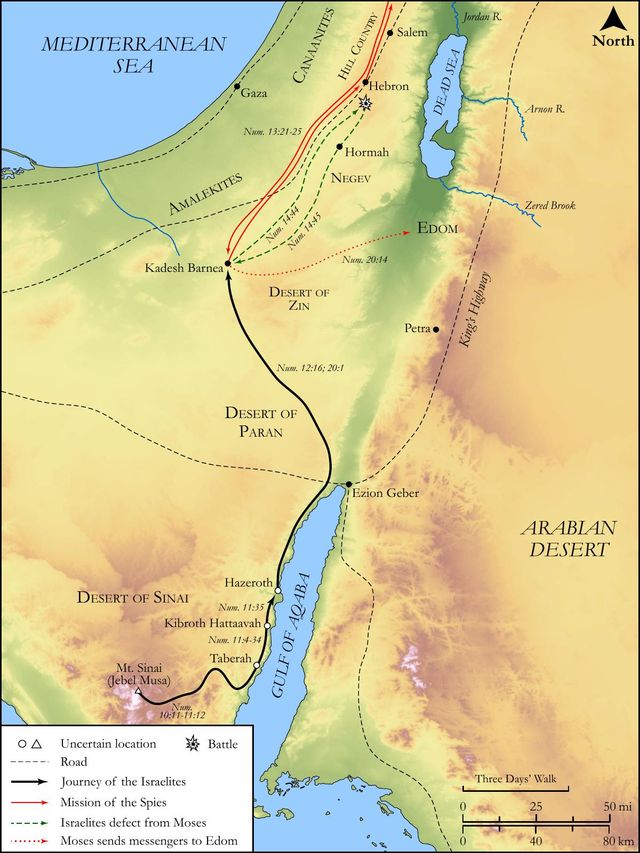
See on the biblical-era map
Study this verse
Public-domain commentary
Matthew Henry
From his Commentary on the Whole Bible. Henry comments on passages, not single verses — this entry covers Numbers 15:37–41.
Provision had been just now made by the law for the pardon of sins of ignorance and infirmity; now here is an expedient provided for the preventing of such sins. They are ordered to make fringes upon the borders of their garments, which were to be memorandums to them of their duty, that they might not sin through forgetfulness. 1. The sign appointed is a fringe of silk, or thread, or worsted, or the garment itself ravelled at the bottom, and a blue riband bound on the top of it to keep it tight, Num 15:38. The Jews being a peculiar people, they were thus distinguished from their neighbours in their dress, as well as in their diet, and taught by such little instances of singularity not to be conformed to the way of the heathen in greater things. Thus likewise they proclaimed themselves Jews wherever they were, as those that were not ashamed of God and his law. Our Saviour, being made under the law, wore these fringes; hence we read of the hem or border, of his garment, Mat 9:20. These borders the Pharisees enlarged, that they might be thought more holy and devout than other people. The phylacteries were different things; these were their own invention, the fringes were a divine institution. The Jews at this day wear them, saying, when they put them on, Blessed be he who has sanctified us unto himself, and commanded us to wear fringes. 2. The intention of it was to remind them that they were a peculiar people. They were not appointed for the trimming and adorning of their clothes, but to stir up their pure minds by way of remembrance (Pe2 3:1), that they might look upon the fringe and remember the commandments. Many look upon their ornaments to feed their pride, but they must look upon these ornaments to awaken their consciences to a sense of their duty, that their religion might constantly beset them, and that they might carry it about with them, as they did their clothes, wherever they went. If they were tempted to sin, the fringe would be a monitor to them not to break God's commandments: If a duty was forgotten to be done in its season, the fringe would remind them of it. This institution, though it is not an imposition upon us, is an instruction to us, always to remember the commandments of the Lord our God, that we may do them, to treasure them up in our memories, and to apply them to particular cases as there is occasion to use them. It was intended particularly to be a preservative from idolatry: that you seek not after your own heart, and your own eyes, in your religious worship. Yet it may extend also to the whole conversation, for nothing is more contrary to God's honour, and our own true interest, than to walk in the way of our heart and in the sight of our eyes; for the imagination of the heart is evil, and so is the lust of the eyes.
After the repetition of some ceremonial appointments, the chapter closes with that great and fundamental law of religion, Be holy unto your God, purged from sin, and sincerely devoted to his service; and that great reason for all the commandments is again and again inculcated, I am the Lord your God. Did we more firmly believe, and more frequently and seriously consider, that God is the Lord, and our God and Redeemer, we should see ourselves bound in duty, interest, and gratitude, to keep all his commandments.
Continue studying Numbers 15:41 across the web’s major study libraries — every link below opens this exact verse, chapter, or book on the destination site.
Read & Compare
 BibleGatewayThis verse in more than 200 translations and 70 languages.
 Bible.comThe YouVersion reader — hundreds of translations, reading plans, and highlights.
 ESV.orgCrossway's official English Standard Version reader.
 NET BibleThe NET translation with 60,000+ translators' notes on every rendering decision.
 STEP BibleTyndale House's free study tool — original text, vocabulary, and scholarly resources.
 BibliaLogos Bible Software's free web reader.
 USCCBThe New American Bible (Revised Edition) with the U.S. bishops' study notes.
Commentaries
 BibleHub CommentariesDozens of classic commentaries on this verse, gathered on one page.
 StudyLightMore than 100 commentary sets — the largest collection on the web.
 BibleRefPlain-English commentary on what this verse means, verse by verse.
 Enduring WordDavid Guzik's free commentary on this chapter, widely used by Bible teachers.
 Bible Study ToolsVerse commentary alongside Greek and Hebrew study aids.
Original Language & Research
- BibleHub InterlinearThe verse word by word — original language, transliteration, and English.
- BibleHub LexiconEvery word's original-language definition and Strong's entry.
 Blue Letter BibleDeep-study tools — Strong's numbers, concordance, and word studies.
 SefariaThe Hebrew text with Rashi and centuries of Jewish commentary.
Sermons, Hymns & Audio


TrulyRandomVerse is not affiliated with these sites and doesn’t control their content. They’re linked because they’re genuinely useful.
Summary
Numbers 15:41 serves as the profound and climactic declaration concluding the commandment regarding the wearing of tassels (tzitzit), powerfully reiterating God's foundational identity and His covenant claim over Israel. It is a comprehensive statement of divine ownership and purpose, asserting that the God who sovereignly delivered them from Egyptian bondage is indeed their exclusive God, thereby establishing the ultimate and non-negotiable basis for their faithful obedience to all His statutes and for living as His distinct people, set apart for His glory.
Context
ShowHideLiterary Context
Numbers 15:41 functions as the theological capstone to a section (Numbers 15:37-41) that introduces the specific commandment for the Israelites to wear tzitzit, or tassels, on the corners of their garments. This particular law is situated within a broader collection of statutes concerning various offerings, unintentional sins, and the severe consequences for defiant, high-handed transgressions against God's commands. The tzitzit were designed as a concrete, visual aid to help the Israelites "look at them and remember all the commandments of the LORD and do them" (Numbers 15:39), specifically to prevent them from "prostituting yourselves by going after your own heart and your own eyes" (Numbers 15:39). Verse 41 provides the ultimate divine authority and motivation for this command, and by extension, for all of God's commands throughout the Law, grounding obedience in God's redemptive act and His enduring covenant relationship. It prevents the tzitzit from becoming a mere ritualistic practice, instead tying it directly to the identity of their Deliverer and the very reason for their existence as a nation.
Historical & Cultural Context
The declaration "I am the LORD your God, which brought you out of the land of Egypt" directly invokes the foundational event of Israel's national identity: the Exodus. This was not merely a historical occurrence but the defining act of God's redemption, power, and faithfulness, serving as the basis for the covenant established at Mount Sinai, where Israel formally became God's treasured possession and a kingdom of priests (Exodus 19:5-6). Among the nations, a people's identity, prosperity, and very existence were often intrinsically linked to its patron god. For Israel, their unique identity was tied exclusively to YHWH, who had demonstrated His unparalleled power and sovereignty by delivering them from the greatest superpower of their day. This historical act of liberation established His exclusive right to be their God and underscored their absolute obligation to worship and obey Him alone, distinct from the polytheistic and idolatrous practices of surrounding nations, which often involved syncretism or the worship of multiple gods.
Key Themes
ShowHideThis verse powerfully encapsulates several core theological themes running through the Pentateuch and indeed the entire Old Testament. Firstly, it emphasizes Divine Identity and Authority, declaring God's unique and sovereign position through His personal covenant name, YHWH, combined with the possessive "your God" (Eloheykem). This highlights His self-existence and His active, relational engagement with His chosen people. Secondly, Redemption as Foundation is prominently featured, as the Exodus event is presented not just as a past act but as the enduring basis for Israel's relationship with God and their ongoing obligation to Him. This act of liberation signifies God's immense power, unwavering faithfulness, and His exclusive claim over them, echoing the very prologue to the Ten Commandments in Exodus 20:2. Thirdly, the phrase "to be your God" underscores the Covenant Relationship, where God chose Israel to be His special people, and they, in turn, were called to acknowledge and obey Him alone. Finally, the verse provides the ultimate Motivation for Obedience. Israel's adherence to God's laws, including the specific command of the tzitzit, was not arbitrary or legalistic but a grateful and necessary response to His prior act of salvation and His ongoing commitment to them as their God, reinforcing the principle that a deep, redemptive relationship precedes and compels faithful obligation.
Exposition and Analysis
ShowHideKey Word Analysis
ShowHideThis is the personal, covenantal name of God (H3068), derived from the root meaning "to be" or "to exist," signifying "the self-Existent or Eternal." Revealed to Moses at the burning bush (Exodus 3:14-15), it emphasizes God's unchanging, faithful, and relational nature, particularly in His covenant dealings with His chosen people. The use of YHWH here underscores His unwavering commitment to His promises and His active presence in Israel's history, providing the ultimate basis for His authority and the binding nature of His commands.
This phrase (H430), combining the plural form for God (Elohim) with the second-person plural possessive suffix, indicates a deeply personal and exclusive relationship between YHWH and the collective nation of Israel. While Elohim can refer to gods in a general sense, its use here with the possessive pronoun clearly refers to the supreme God of Israel. It speaks to the covenant bond where YHWH has chosen Israel as His own, and they are called to acknowledge Him as their sole deity. This possessive relationship is the bedrock of their identity, their belonging, and their obligation to Him.
Derived from the primitive root yatsa (H3318), meaning "to go out" or "to bring forth," this verb in the Hiphil stem indicates a causative action – God caused them to come out. It highlights God's active, powerful, and decisive intervention in history to liberate Israel from Egyptian bondage. This act of deliverance is presented as the foundational event that establishes His right to be their God and their corresponding obligation to obey Him. It is not merely a past event but a continuous, defining reality that shapes their present identity and future destiny.
Verse Breakdown
ShowHide"I [am] the LORD your God"
This opening clause is a direct, authoritative self-declaration by YHWH, the covenant God. It establishes His identity and His unique, exclusive relationship with Israel. It is a profound statement of sovereignty and ownership, asserting His absolute claim over them as their divine ruler, protector, and provider. The "I am" echoes God's self-revelation to Moses, emphasizing His eternal, self-existent nature and His active, unwavering presence among His people.
"which brought you out of the land of Egypt"
This clause grounds God's claim and Israel's obligation in a specific, historical, and miraculous act of redemption. The Exodus is presented as the definitive demonstration of God's power, faithfulness, and His sovereign choice of Israel. It is the foundational act that established their nationhood and their covenant relationship with Him, serving as the primary, undeniable reason for their allegiance and obedience. This act forever binds their identity to His redemptive power.
"to be your God"
This phrase articulates the ultimate purpose and goal of the Exodus. God did not merely deliver Israel for their freedom, but for the specific, profound purpose of entering into a covenant relationship where He would be their exclusive God, and they would be His unique, chosen people. It speaks to the ongoing, reciprocal nature of the covenant: He is irrevocably committed to them, and they are called to live in exclusive devotion and obedience to Him. This purpose defines their identity, their mission, and their future.
"I [am] the LORD your God"
The repetition of this full declaration provides a powerful emphasis and solemn finality to the verse. It underscores the certainty, unchangeableness, and absolute nature of God's identity and His unwavering claim over Israel. It acts as a theological bookend, reinforcing that all commands, including the specific instruction of the tzitzit, are rooted in the unchanging reality of who God is and what He has done for His people. This repetition serves to indelibly impress upon the Israelites the profound and non-negotiable basis for their entire existence and their faithful obedience.
Literary Devices
ShowHideNumbers 15:41 employs several potent literary devices to convey its profound and authoritative message. Repetition is the most prominent, with the phrase "I am the LORD your God" appearing at both the beginning and end of the verse. This serves to emphasize the divine speaker's identity, sovereignty, and absolute authority, creating a powerful rhetorical frame that underscores the certainty and solemnity of the declaration. It acts as a theological bookend, reinforcing that all commands and Israel's very existence are rooted in this unchanging reality of God's covenant relationship with them. The verse also functions as a Covenant Formula, echoing the foundational language used at the establishment of the covenant at Sinai (Exodus 20:2). This formula grounds the specific command of the tzitzit in the broader, overarching covenant relationship, elevating its significance beyond a mere ritual and embedding it within the very fabric of Israel's identity. Furthermore, the verse is a direct Divine Declaration, spoken in the first person by God Himself ("I am the LORD your God"), lending it absolute authority and making it an undeniable statement of His sovereign will and purpose for His people. This direct address creates a sense of immediacy and personal engagement.
Theological and Thematic Connections
ShowHideNumbers 15:41 is a profound theological statement that connects the specific command of the tzitzit to the very core of Israel's covenant relationship with God. It asserts that obedience is not arbitrary but flows directly from the foundational reality of who God is and what He has done for His people. The declaration "I am the LORD your God" is the bedrock of all divine law and instruction, reminding Israel that their distinct identity, their purpose, and their very existence are inextricably linked to their Deliverer. This verse encapsulates the timeless principle that God's gracious, redemptive acts precede and provide the ultimate motivation for human obedience, establishing a relationship of grace and deliverance before any demand for law-keeping. It is a timeless reminder that true faith is rooted in acknowledging God's sovereignty and His saving work, which then compels a life of grateful submission, holiness, and faithful adherence to His ways.
Reflection and Application
ShowHideNumbers 15:41 offers profound and enduring insights for believers today, transcending its original context to speak directly to the heart of our relationship with God. Just as Israel was to remember the Exodus as the defining basis of their identity and obedience, so too are we called to remember God's ultimate act of deliverance through Jesus Christ. Our salvation is not merely a past historical event but the ongoing, living foundation of our identity, our belonging, and our profound motivation for living according to God's will. This verse challenges us to deeply consider: Does our obedience truly flow from a grateful heart that acknowledges God as our Deliverer and sovereign Lord, or is it a mere performance of duty, a legalistic adherence to rules? Our identity as God's redeemed people is rooted in His unchanging character and His magnificent saving work, which then compels us to live lives that authentically reflect His holiness, His love, and His truth in a world that desperately needs to see Him. It reminds us that our faith is not just about intellectually believing in God, but about actively living for the God who has powerfully redeemed us and called us His own.
Questions for Reflection
ShowHideFAQ
ShowHideWhy is the phrase "I am the LORD your God" repeated in this verse?
ShowHideThe repetition of "I am the LORD your God" serves several crucial purposes, enhancing the impact and solemnity of the divine declaration. Firstly, it provides intense emphasis, underscoring the absolute authority and unchanging nature of the speaker, YHWH. It acts as a powerful theological bookend, framing the entire verse and reinforcing that the basis for Israel's obedience to the tzitzit command, and indeed all commands, is rooted in the unchanging reality of God's identity and His covenant relationship with them. Secondly, it echoes the foundational covenant formula found elsewhere in the Pentateuch, particularly at the beginning of the Ten Commandments in Exodus 20:2, reminding Israel of the foundational agreement that defines their existence and their obligations. This repetition ensures that the core message—God's unique claim over His people based on His redemptive act—is indelibly impressed upon their minds and hearts.
What is the significance of God identifying Himself as the one "who brought you out of the land of Egypt"?
ShowHideThis specific identification is profoundly significant because the Exodus was the defining, pivotal event in Israel's history, establishing their nationhood and their unique relationship with YHWH. By referencing this act, God grounds His authority and their obligation in a concrete, undeniable demonstration of His power, faithfulness, and love. It reminds Israel that their freedom, their very existence as a distinct people, and their future hope were a direct result of His sovereign intervention. Therefore, their obedience is not to an abstract deity or arbitrary rules, but to the very God who redeemed them from slavery and oppression, establishing His exclusive right to be their God and their corresponding duty to worship and obey Him alone. This historical act of salvation serves as the perpetual motivation for their covenant faithfulness, as powerfully articulated in passages like Deuteronomy 6:20-25.
Christ-Centered Fulfillment
ShowHideNumbers 15:41 finds its ultimate and most profound fulfillment in the person and work of Jesus Christ. Just as God declared Himself "the LORD your God, who brought you out of the land of Egypt" to establish His covenant with Israel and call them to obedience, so too in Christ, God has performed a greater, spiritual Exodus, delivering humanity from the far more pervasive and deadly bondage of sin and death. Jesus is the ultimate "Lamb of God, who takes away the sin of the world!" (John 1:29), whose substitutionary sacrifice on the cross constitutes the new and eternal deliverance for all who believe. Through His glorious resurrection, He has brought us out of the dominion of darkness and into His marvelous light, transferring us into the kingdom of His beloved Son (Colossians 1:13). This new exodus establishes a new covenant, where God declares Himself "our God" in an even more intimate and transformative way through the indwelling Holy Spirit, making us His people with His law written on our hearts (Jeremiah 31:33). Our obedience in the New Covenant is not based on external reminders like tassels, but on the internal transformation wrought by the Spirit, enabling us to walk in Christ's footsteps and fulfill the righteous requirements of the law by love, empowered by grace (Romans 8:4 and Galatians 5:13). Thus, Christ is the ultimate Deliverer, the perfect embodiment of God's covenant faithfulness, and the very reason we can truly live as "the LORD our God's" people, reflecting His glory.