


Numbers 15:26
Bible text: King James Version (1769 Blayney text) · Public domain
Bible text: King James Version with Strong's numbers · Public domain
Bible text: Berean Standard Bible · Public domain
Bible text: American Standard Version (1901) · Public domain
Bible text: World English Bible, Messianic edition · Public domain
Bible text: Geneva Bible (1599) · Public domain
Bible text: Young's Literal Translation · Public domain
- וְנִסְלַחve·nis·Lachand it will be forgivenH5545Conj-w ¦ V-Niphal-ConsecPerf-3msVerb Niphal Consecutive Perfect 3rd Singular Masculineוְandנִסְלַחit will be forgiven
- לְכָלle·kholto allH3605Prep-l ¦ N-mscNoun Singular Masculine Constructלְtoכָלall
- עֲדַת'a·Dat[the] congregation ofH5712N-fscNoun Singular Feminine Construct
- בְּנֵיbe·Nei[the] people ofH1121N-mpcNoun Plural Masculine Construct
- יִשְׂרָאֵלYis·ra·'ElIsraelH3478N-properNoun Proper Location
- וְלַגֵּרve·la·Gerand to the sojournerH1616Conj-w ¦ Prep-l ¦ N-msNoun Singular Masculine Absoluteוְandלַto theגֵּרsojourner
- הַגָּרha·Garwho sojournsH1481Art ¦ V-Qal-Prtcpl-msVerb Qal Participle Singular Masculine Absoluteהַwhoגָּרsojourns
- בְּתוֹכָםbe·to·Khamin midst of themH8432Prep-b ¦ N-msc ¦ 3mpNoun Singular Masculine Constructבְּinתוֹכָmidst ofםthem
- כִּיkiforH3588PrtParticle Conditional
- לְכָלle·kholto allH3605Prep-l ¦ N-mscNoun Singular Masculine Constructלְtoכָלall
- הָעָםha·'Amthe peopleH5971Art ¦ N-msNoun Singular Masculine Absoluteהָtheעָםpeople
- בִּשְׁגָגָהbish·ga·Gahby inadvertenceH7684Prep-b ¦ N-fsNoun Singular Feminine Absoluteבִּbyשְׁגָגָהinadvertence
English is a literal word-by-word gloss of the Hebrew, not the KJV's wording. Why?
This is the original text the KJV's translators worked from — each Hebrew word with its own literal English meaning in this verse, prepared by scholars at Tyndale House, Cambridge. The KJV translates whole sentences, not word by word, so its wording differs: one Hebrew word can become several English words, and the KJV may choose “the LORD” where the gloss reads “Yahweh”. Both are faithful — they answer different questions. For the KJV's own rendering, switch to the KJV text.
Details
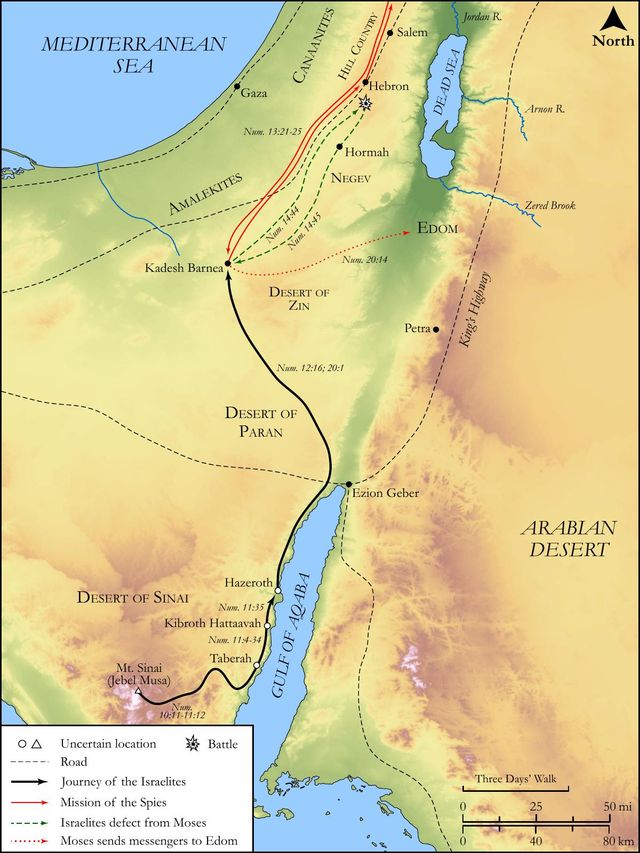
See on the biblical-era map
Study this verse
Public-domain commentary
Matthew Henry
From his Commentary on the Whole Bible. Henry comments on passages, not single verses — this entry covers Numbers 15:22–29.
We have here the laws concerning sacrifices for sins of ignorance; the Jews understand it of idolatry, or false worship, through the error of their teachers. The case here supposed is that they had not observed all these commandments, Num 15:22, Num 15:23. If they had failed in the offerings of their acknowledgment, and had not brought them according to the law, then they must bring an offering of atonement, yea, though the omission had been through forgetfulness or mistake. If they failed in one part of the ceremony, they must make it up by the observance of another part, which was in the nature of a remedial law. 1. The case is put of a national sin, committed through ignorance, and become customary through a vulgar error (Num 15:24) - the congregation, that is, the body of the people, for so it is explained (Num 15:25): All the congregation of the children of Israel. The ceremonial observances were so numerous, and so various, that, it might easily be supposed, some of them by degrees would be forgotten and disused, as particularly that immediately before concerning the heave-offering of their dough: now if, in process of time, upon consulting the law, there should appear to have been a general neglect of that or any other appointment, then a sacrifice must be offered for the whole congregation, and the oversight shall be forgiven (Num 15:25, Num 15:26) and not punished, as it deserved, with some national judgment. The offering of the sacrifice according to the manner, or ordinance, plainly refers to a former statute, of which this is the repetition; and the same bullock which is there called a sin-offering (Lev 4:13, Lev 4:21) is here called a burnt-offering (Num 15:24), because it was wholly burnt, though not upon the altar, yet without the camp. And here is the addition of a kid of the goats for a sin-offering. According to this law, we find that Hezekiah made atonement for the errors of his father's reign, by seven bullocks, seven rams, seven lambs, and seven he-goats, which he offered as a sin-offering for the kingdom, and for the sanctuary, and for Judah (Ch2 29:21), and for all Israel, Num 15:24. And we find the like done after the return out of captivity, Ezr 8:35. 2. It is likewise supposed to be the case of a particular person: If any soul sin through ignorance (Num 15:27), neglecting any part of his duty, he must bring his offering, as was appointed, Lev 4:27, etc. Thus atonement shall be made for the soul that sins, when he sins through ignorance, Num 15:28. Observe, (1.) Sins committed ignorantly need to have atonement made for them; for, though ignorance will in a degree excuse, it will not justify those that might have known their Lord's will and did it not. David prayed to be cleansed from his secret faults, that is, those sins which he himself was not aware of, the errors he did not understand, Psa 19:12. (2.) Sins committed ignorantly shall be forgiven, through Christ the great sacrifice, who, when he offered up himself once for all upon the cross, seemed to explain the intention of his offering in that prayer, Father, forgive them, for they know not what they do. And Paul seems to allude to this law concerning sins of ignorance (Ti1 1:13), I obtained mercy, because I did it ignorantly and in unbelief. And it looked favourable upon the Gentiles that this law of atoning for sins of ignorance is expressly made to extend to those who were strangers to the commonwealth of Israel (Num 15:29), but supposed to be proselytes of righteousness. Thus the blessing of Abraham comes upon the Gentiles.
Continue studying Numbers 15:26 across the web’s major study libraries — every link below opens this exact verse, chapter, or book on the destination site.
Read & Compare
 BibleGatewayThis verse in more than 200 translations and 70 languages.
 Bible.comThe YouVersion reader — hundreds of translations, reading plans, and highlights.
 ESV.orgCrossway's official English Standard Version reader.
 NET BibleThe NET translation with 60,000+ translators' notes on every rendering decision.
 STEP BibleTyndale House's free study tool — original text, vocabulary, and scholarly resources.
 BibliaLogos Bible Software's free web reader.
 USCCBThe New American Bible (Revised Edition) with the U.S. bishops' study notes.
Commentaries
 BibleHub CommentariesDozens of classic commentaries on this verse, gathered on one page.
 StudyLightMore than 100 commentary sets — the largest collection on the web.
 BibleRefPlain-English commentary on what this verse means, verse by verse.
 Enduring WordDavid Guzik's free commentary on this chapter, widely used by Bible teachers.
 Bible Study ToolsVerse commentary alongside Greek and Hebrew study aids.
Original Language & Research
- BibleHub InterlinearThe verse word by word — original language, transliteration, and English.
- BibleHub LexiconEvery word's original-language definition and Strong's entry.
 Blue Letter BibleDeep-study tools — Strong's numbers, concordance, and word studies.
 SefariaThe Hebrew text with Rashi and centuries of Jewish commentary.
Sermons, Hymns & Audio


TrulyRandomVerse is not affiliated with these sites and doesn’t control their content. They’re linked because they’re genuinely useful.
Summary
Numbers 15:26 reveals God's gracious provision for atonement and forgiveness for the entire congregation of Israel, including resident foreigners, when they inadvertently committed a sin or erred through ignorance. This divine decree underscores God's profound understanding of human fallibility and His commitment to maintaining a holy relationship with His people through a prescribed sacrificial procedure designed to cleanse the community from unintentional transgressions, sharply distinguishing them from defiant, high-handed sins for which no such atonement was offered.
Context
ShowHideLiterary Context
Numbers 15 immediately follows the Israelites' rebellion at Kadesh-Barnea, where their unbelief led to a divine decree of forty years of wilderness wandering. This chapter serves as a crucial interlude, providing laws for offerings and sacrifices that would apply once Israel entered the Promised Land, thereby re-establishing hope and a future for the covenant community despite their past failures. Numbers 15:22-29 specifically addresses corporate and individual sins committed "in ignorance" (unintentionally), outlining the required sacrifices for atonement. This section stands in stark contrast to the severe consequences for "presumptuous" or high-handed sins described in Numbers 15:30-31, for which no sacrifice was prescribed, leading to the offender being "cut off from among his people." The immediate verses preceding Numbers 15:26 (verses 22-25) detail the specific offering required when the entire congregation sins unintentionally—a young bull for a burnt offering and a male goat for a sin offering—and the subsequent forgiveness that follows the proper ritual. This structure highlights God's meticulous care for His covenant people and the sanctity of their relationship with Him.
Historical & Cultural Context
This passage is situated during the Israelites' wilderness wanderings, a pivotal period foundational for the establishment of their national and religious identity under the Mosaic Covenant. The intricate laws concerning purity, sacrifice, and atonement were central to Israelite worship and daily life, ensuring the maintenance of a holy relationship with a holy God in the midst of a nomadic existence. The concept of corporate responsibility was deeply ingrained in ancient Israelite society; the sin of one could affect the whole community, and conversely, the atonement for the community's sin was a collective act performed by the priests on behalf of all. The inclusion of the "stranger that sojourneth among them" (Hebrew: ger) is profoundly significant, referring to a resident alien who had chosen to live within the Israelite community and abide by its laws, rather than a mere transient visitor. This demonstrates God's expectation that even non-Israelites living among His people would be subject to and benefit from the same covenant principles and provisions for mercy and justice, reflecting a unique universal reach toward the stranger among the tribes of Israel.
Key Themes
ShowHideNumbers 15:26 contributes significantly to several overarching themes within the book of Numbers and the broader Pentateuch. Firstly, it powerfully illustrates God's Divine Mercy and Justice, demonstrating His provision for human frailty and unintentional error while simultaneously upholding the seriousness of sin, even when unwitting. This balance showcases a God who is both holy and compassionate. Secondly, it emphasizes the theme of Atonement, reinforcing the foundational principle that sin, regardless of intent, requires a covering or propitiation to restore fellowship with God. The sacrificial system, as meticulously detailed in passages like Leviticus 4, provides the divinely ordained means for this atonement. Thirdly, the verse highlights Corporate Responsibility and Atonement, showing that the entire community could incur guilt and receive forgiveness collectively, underscoring the communal nature of the covenant relationship and the interconnectedness of God's people. Finally, the explicit inclusion of the "stranger" points to God's Universal Reach, prefiguring the broader scope of God's redemptive plan to embrace those outside the immediate ethnic covenant community, a theme that finds its ultimate fulfillment in the New Testament, as seen in passages like Isaiah 56:6-7 and Ephesians 2:11-22.
Exposition and Analysis
ShowHideKey Word Analysis
ShowHideThis primitive root signifies "to forgive" or "to pardon." In the context of the Old Testament sacrificial system, it refers to the divine act of remitting the penalty or guilt of sin, often through the prescribed ritual of atonement. Here, it underscores God's active role in providing a path to reconciliation and cleansing for His people, particularly for unintentional transgressions.
This term denotes a "stated assemblage," "company," or "multitude," specifically referring to the entire organized community of Israel. Its use emphasizes the collective identity and corporate responsibility of God's people before Him. The phrase "all the congregation" highlights that the sin and subsequent forgiveness were communal, affecting and cleansing the entire body of God's chosen nation.
This word, derived from the root "to sojourn," properly means "a guest" and by implication, "a foreigner" or "resident alien." It refers to a non-Israelite who has chosen to live permanently among the Israelites and abide by their laws and customs, as opposed to a mere transient visitor. Their inclusion in the provision for forgiveness underscores the inclusive nature of God's covenant and His expectation that all who dwell within the community of Israel would live under and benefit from its divine statutes, reflecting a broader scope of divine mercy.
This crucial term signifies a "mistake" or "inadvertent transgression," a sin committed unwittingly, by error, or through inadvertence, rather than with deliberate defiance or malicious intent. The distinction between shᵉgâgâh and "high-handed" sin (Hebrew: yad ramah, lit. "with a high hand") in Numbers 15:30 is fundamental to the Old Testament sacrificial system, as specific offerings were prescribed only for unintentional transgressions, highlighting God's discernment of intent.
Verse Breakdown
ShowHide"And it shall be forgiven all the congregation of the children of Israel"
This initial clause declares the divine outcome of the prescribed atonement process: the entire community of God's people will receive forgiveness. It underscores the corporate nature of sin and the collective experience of divine mercy within the covenant, signifying a restoration of their standing before God.
"and the stranger that sojourneth among them"
This phrase explicitly extends the provision of forgiveness to non-Israelites who have integrated into the Israelite community. It demonstrates God's expansive grace and the universal principles of His law, applying to all who live under His divine authority within His people, blurring the lines between native-born and resident alien in terms of their accountability and access to atonement.
"seeing all the people [were] in ignorance"
This final clause provides the crucial condition for this specific type of forgiveness. The sin committed was not an act of deliberate rebellion or defiance but an error made without full knowledge or malicious intent, thereby qualifying for the atonement stipulated in the preceding verses. This distinction is vital, as it highlights God's justice in discerning the heart and intent behind actions.
Literary Devices
ShowHideNumbers 15:26 employs several significant literary devices that enhance its meaning and impact. Primarily, it functions as a Legal Formulation, characteristic of the Mosaic Law, clearly stating a divine statute and its application, complete with specific conditions and outcomes. The precise, declarative language is typical of covenant stipulations. There is also an implicit Contrast established within the broader chapter; while not explicitly stated in this verse, its context within Numbers 15 as a whole sets up a stark distinction between sins committed in ignorance (forgivable through sacrifice) and sins committed "with a high hand" or defiantly (for which no sacrifice was available, leading to being "cut off"). This contrast highlights the gravity of intentional rebellion versus unintentional error and underscores God's nuanced approach to sin. Furthermore, the Inclusion of the "stranger" is a powerful rhetorical device emphasizing the breadth of God's covenant and His justice, extending His provisions beyond ethnic boundaries to all who align themselves with His people and laws, foreshadowing a more universal scope of redemption.
Theological and Thematic Connections
ShowHideNumbers 15:26 profoundly reveals God's character as both just and merciful. It teaches us that even unintentional sin requires atonement, demonstrating the inherent holiness of God and the pervasive nature of sin's defilement, which impacts even those unaware of their transgression. The provision for forgiveness underscores God's understanding of human weakness and His desire to maintain fellowship with His people, providing a pathway for reconciliation rather than immediate condemnation. The corporate nature of the forgiveness highlights the communal aspect of Israel's covenant relationship with Yahweh, where the spiritual well-being of the whole was intertwined, emphasizing the solidarity of the community. Moreover, the inclusion of the "stranger" foreshadows the expansive nature of God's redemptive plan, indicating that His grace and covenant principles were not exclusively for ethnic Israel but extended to all who would align themselves with Him. This Old Testament principle of atonement for unintentional sin points forward to a greater, more complete atonement.
Reflection and Application
ShowHideNumbers 15:26 offers timeless truths for believers today, providing profound insights into the nature of God and our relationship with Him. It reminds us that God, in His infinite wisdom and mercy, understands the limitations of human knowledge and the reality of unintentional sin. While the Mosaic sacrificial system is no longer in effect, having been fulfilled in Christ, the underlying principle remains: all sin, whether conscious or unconscious, intentional or unintentional, separates us from a holy God and requires a means of reconciliation. This verse should cultivate in us a deep sense of humility, recognizing our constant need for God's grace and forgiveness, even for the errors we commit unknowingly. It also challenges us to consider our collective responsibility as the body of Christ, recognizing that the actions of individuals can impact the spiritual health and standing of the entire community before God. Furthermore, the inclusion of the "stranger" compels us to extend God's grace and welcoming spirit to those who are new to the faith or from different backgrounds, ensuring that the church is a place where all who seek God can find mercy, belonging, and a pathway to reconciliation.
Questions for Reflection
ShowHideFAQ
ShowHideWhat is the significance of the distinction between "ignorance" and "high-handed" sin in the Old Testament sacrificial system?
ShowHideThe distinction between sins committed in "ignorance" (Hebrew: shᵉgâgâh) and "high-handed" or "presumptuous" sins (Hebrew: yad ramah) is absolutely crucial for understanding the Mosaic Law and the sacrificial system. Sins of "ignorance" refer to transgressions committed unwittingly, by mistake, or without full knowledge or malicious intent. For these, God graciously provided a path to atonement through specific sacrifices, such as the sin offering, as detailed in Leviticus 4 and Numbers 15:22-29. In contrast, "high-handed" sin, described in Numbers 15:30-31, refers to deliberate, defiant rebellion against God's explicit commands, an act of open scorn toward the Lord. For such sins, no animal sacrifice was prescribed; the offender was to be "cut off from among his people," signifying severe divine judgment, often death or excommunication. This stark distinction highlights God's justice in dealing with deliberate rebellion while providing abundant mercy for human frailty and unintentional error, revealing His discernment of the heart's intent.
Why was the "stranger that sojourneth among them" included in the provision for forgiveness?
ShowHideThe inclusion of the "stranger" (Hebrew: ger), or resident alien, in the provisions for forgiveness in Numbers 15:26 is profoundly significant for several reasons. Firstly, it demonstrates the universality of God's moral law and His expectation that all who lived within the community of Israel, whether native-born or foreign resident, were subject to its statutes. The ger was not merely a transient visitor but someone who had chosen to live under the jurisdiction of Israel's laws and, by extension, God's covenant. Secondly, it showcases God's expansive mercy and grace, extending beyond ethnic boundaries. It prefigures the New Testament truth that God's redemptive plan is for all peoples, not just one nation. Just as the ger was brought into the community's legal and spiritual life and could access atonement, so too would Gentiles eventually be brought into God's family through faith in Christ, becoming "fellow citizens with the saints and members of the household of God," as Ephesians 2:19 beautifully describes. This inclusion underscores God's heart for all humanity and His desire for all to find reconciliation with Him.
Christ-Centered Fulfillment
ShowHideNumbers 15:26, with its provision for forgiveness for unintentional sins, finds its ultimate and perfect fulfillment in the person and work of Jesus Christ. The Old Testament sacrificial system, including the offerings for sins committed in ignorance, served as a temporary and imperfect shadow, pointing forward to the definitive sacrifice that would truly atone for all sin. The blood of bulls and goats could not ultimately take away sins (Hebrews 10:4), but they prepared God's people for the coming of the true Lamb of God. Jesus, through His perfect life, atoning death on the cross, and glorious resurrection, became the once-for-all sacrifice, not only for our conscious, deliberate transgressions but also for our "sins of ignorance"—the ways we fall short unknowingly or through inherited sinfulness (Hebrews 9:7 and Hebrews 9:12). His precious blood cleanses us from all sin, making us perfectly righteous before God and granting us full access to His presence (1 John 1:7). Furthermore, the inclusion of the "stranger" in Numbers 15:26 beautifully foreshadows the New Covenant reality where, in Christ, there is no longer Jew or Gentile, slave or free, male or female, but all who believe are united into one body (Galatians 3:28). The mercy extended to the ger under the Old Covenant finds its glorious expansion in the gospel, which welcomes all people, from every nation, tribe, and tongue, into God's family through faith in Jesus, the ultimate High Priest who offered Himself for the forgiveness of all our sins, known and unknown (Hebrews 7:27). He is our complete and eternal atonement.