


Numbers 10:13
- וַיִּסְעוּvai·yis·'Uand they set outH5265Conj-w ¦ V-Qal-ConsecImperf-3mpVerb Qal Consecutive Imperfect 3rd Plural Masculineוַandיִּסְעוּthey set out
- בָּרִאשֹׁנָהba·ri·sho·Nahat the first [time]H7223Prep-b ¦ Adj-fsAdjective Numerical Position Singular Feminine Absoluteבָּat theרִאשֹׁנָהfirst [time]
- עַל'alonH5921PrepPreposition
- פִּיpi[the] mouth ofH6310N-mscNoun Singular Masculine Construct
- יְהוָהYah·wehYahwehH3068N-properNoun Proper Title
- בְּיַדbe·yadby [the] hand ofH3027Prep-b ¦ N-cscNoun Singular common gender Constructבְּbyיַד[the] hand of
- מֹשֶׁהmo·ShehMosesH4872N-proper-mNoun Proper Masculine
English is a literal word-by-word gloss of the Hebrew, not the KJV's wording. Why?
This is the original text the KJV's translators worked from — each Hebrew word with its own literal English meaning in this verse, prepared by scholars at Tyndale House, Cambridge. The KJV translates whole sentences, not word by word, so its wording differs: one Hebrew word can become several English words, and the KJV may choose “the LORD” where the gloss reads “Yahweh”. Both are faithful — they answer different questions. For the KJV's own rendering, switch to the KJV text.
Details
See on the biblical-era map
Study this verse
Public-domain commentary
Matthew Henry
From his Commentary on the Whole Bible. Henry comments on passages, not single verses — this entry covers Numbers 10:11–28. His two-level outline is real structure in the source text, so it is rendered as structure.
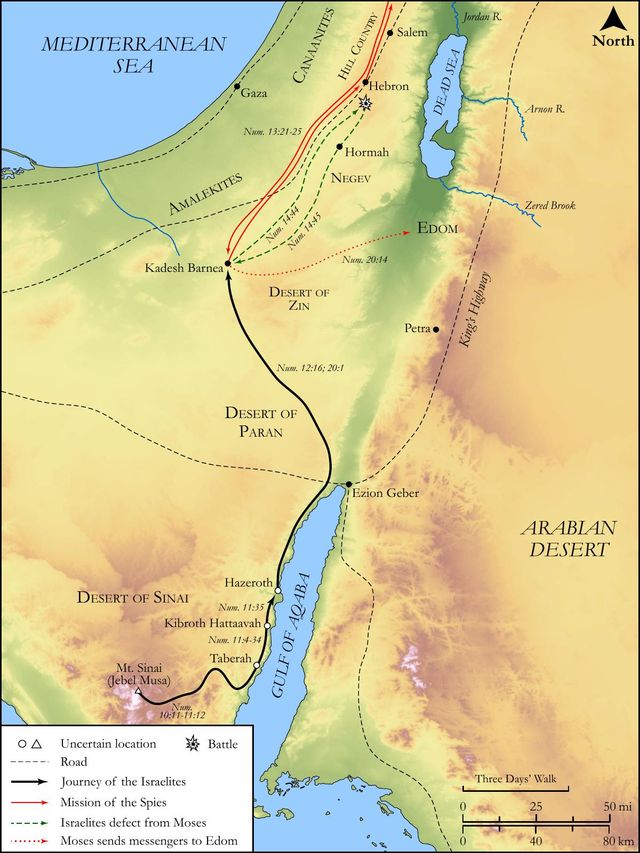
Here is, I. A general account of the removal of the camp of Israel from mount Sinai, before which mountain it had lain now about a year, in which time and place a great deal of memorable business was done. Of this removal, it should seem, God gave them notice some time before (Deu 1:6, Deu 1:7): You have dwelt long enough in this mountain, turn you and take your journey towards the land of promise. The apostle tells us that mount Sinai genders to bondage (Gal 4:24), and signifies the law there given, which is of use indeed as a schoolmaster to bring us to Christ, yet we must not rest in it, but advance towards the joys and liberties of the children of God, for our happiness is conferred not by the law, but by promise. Observe, 1. The signal given (Num 10:11): The cloud was taken up, and we may suppose it stood for some time, till they were ready to march; and a great deal of work it was to take down all those tents, and pack up all those goods that they had there; but every family being employed about its own, and all at the same time, many hands made quick work of it. 2. The march began: They took their journey according to the commandment of the Lord, and just as the cloud led them, Num 10:13. Some think that mention is thus frequently made in this and the foregoing chapter of the commandment of the Lord, guiding and governing them in all their travels, to obviate the calumny and reproach which were afterwards thrown upon Israel, that they tarried so long in the wilderness, because they had lost themselves there, and could not find the way out. No, the matter was not so; in every stage, in every step, they were under divine direction; and, if they knew not where they were, yet he that led them knew. Note, Those that have given up themselves to the direction of God's word and Spirit steer a steady course, even when they seem to be bewildered. While they are sure they cannot lose their God and guide, they need not fear losing their way. 3. The place they rested in, after three days' march: They went out of the wilderness of Sinai, and rested in the wilderness of Paran. Note, All our removals in this world are but from one wilderness to another. The changes which we think will be for the better do not always prove so; while we carry about with us, wherever we go, the common infirmities of human nature, we must expect, wherever we go, to meet with its common calamities; we shall never be at rest, never at home, till we come to heaven, and all will be well there.
II.A particular draught of the order of their march, according to the late model.
1.Judah's squadron marched first, Num 10:14-16. The leading standard, now lodged with that tribe, was an earnest of the sceptre which in David's time should be committed to it, and looked further to the captain of our salvation, of whom it was likewise foretold that unto him should the gathering of the people be.
2.Then came those two families of the Levites which were entrusted to carry the tabernacle. As soon as ever the cloud was taken up, the tabernacle was taken down, and packed up for removing, Num 10:17. And here the six wagons came laden with the more bulky part of the tabernacle. This frequent removing of the tabernacle in all their journeys signified the movableness of that ceremonial dispensation. That which was so often shifted would at length vanish away, Heb 8:13.
3.Reuben's squadron marched forward next, taking place after Judah, according to the commandment of the Lord, Num 10:18-20.
4.Then the Kohathites followed with their charge, the sacred furniture of the tabernacle, in the midst of the camp, the safest and most honourable place, Num 10:21. And they (that is, says the margin, the Gershonites and Merarites) did set up the tabernacle against they came; and perhaps it is expressed thus generally because, if there was occasion, not those Levites only, but the other Israelites that were in the first squadron, lent a hand to the tabernacle to hasten the rearing of it up, even before they set up their own tents.
5.Ephraim's squadron followed next after the ark (Num 10:22-24), to which some think the psalmist alludes when he prays (Psa 80:2), Before Ephraim, Benjamin, and Manasseh, the three tribes that composed this squadron, stir up thy strength (and the ark is called his strength, Psa 78:61), and come and save us.
6.Dan's squadron followed last, Num 10:25-27. It is called the rearward, or gathering host, of all the camps, because it gathered up all that were left behind; not the women and children (these we may suppose were taken care of by the heads of their families in their respective tribes), but all the unclean, the mixed multitude, and all that were weak and feeble, and cast behind in their march. Note, He that leadeth Joseph like a flock has a tender regard to the hindmost (Eze 34:16), that cannot keep pace with the rest, and of all that are given him he will lose none, Joh 17:11.
Continue studying Numbers 10:13 across the web’s major study libraries — every link below opens this exact verse, chapter, or book on the destination site.
Read & Compare
 BibleGatewayThis verse in more than 200 translations and 70 languages.
 Bible.comThe YouVersion reader — hundreds of translations, reading plans, and highlights.
 ESV.orgCrossway's official English Standard Version reader.
 NET BibleThe NET translation with 60,000+ translators' notes on every rendering decision.
 STEP BibleTyndale House's free study tool — original text, vocabulary, and scholarly resources.
 BibliaLogos Bible Software's free web reader.
 USCCBThe New American Bible (Revised Edition) with the U.S. bishops' study notes.
Commentaries
 BibleHub CommentariesDozens of classic commentaries on this verse, gathered on one page.
 StudyLightMore than 100 commentary sets — the largest collection on the web.
 BibleRefPlain-English commentary on what this verse means, verse by verse.
 Enduring WordDavid Guzik's free commentary on this chapter, widely used by Bible teachers.
 Bible Study ToolsVerse commentary alongside Greek and Hebrew study aids.
Original Language & Research
- BibleHub InterlinearThe verse word by word — original language, transliteration, and English.
- BibleHub LexiconEvery word's original-language definition and Strong's entry.
 Blue Letter BibleDeep-study tools — Strong's numbers, concordance, and word studies.
 SefariaThe Hebrew text with Rashi and centuries of Jewish commentary.
Sermons, Hymns & Audio


TrulyRandomVerse is not affiliated with these sites and doesn’t control their content. They’re linked because they’re genuinely useful.
Summary
Numbers 10:13 marks the long-anticipated and divinely orchestrated departure of the Israelites from Mount Sinai, initiating the next phase of their journey toward the Promised Land. After nearly a year encamped at the mountain, a period dedicated to receiving the Mosaic Law, establishing the Tabernacle, and meticulously organizing their community, this verse underscores the foundational principle governing their entire wilderness trek: absolute and immediate obedience to the explicit command of the LORD, communicated and facilitated through the faithful leadership of Moses. It signifies a pivotal transition from a season of intensive divine instruction and preparation to one of active progression and practical application of their covenant relationship with God.
Context
ShowHideLiterary Context
Numbers 10:13 is strategically positioned as the culmination of extensive preparations for Israel's departure from Mount Sinai. The preceding verses, specifically Numbers 10:11-12, establish the divine signal for their movement: the lifting of the cloud from over the Tabernacle on the twentieth day of the second month in the second year after their exodus from Egypt. This event triggered the meticulously planned order of march, beginning with the tribes of Judah, Issachar, and Zebulun. The verse thus serves as the direct fulfillment of the detailed instructions regarding the blowing of trumpets for assembly and movement, the dismantling of the Tabernacle, and the tribal encampment arrangements, all meticulously laid out in Numbers 10:1-10. It marks the definitive shift from a static, organizational phase at Sinai to a dynamic, migratory phase in the wilderness, fulfilling God's imperative to move forward.
Historical & Cultural Context
For approximately one year, the vast Israelite community had been encamped at the base of Mount Sinai (Exodus 19:1), a period of unparalleled national and theological formation. Here, they received the Ten Commandments, the comprehensive Mosaic Law, and detailed blueprints for the construction and operation of the Tabernacle, solidifying their identity as Yahweh's covenant people. The entire nation, comprising over 600,000 men, plus women, children, and a mixed multitude, was meticulously organized into tribal divisions, prepared for the arduous journey ahead. Their departure was not a human strategic decision but a direct, divinely initiated command, a continuation of God's miraculous leading since their exodus from Egypt, where He guided them by a pillar of cloud by day and fire by night. This moment represents the practical outworking of their covenant relationship, demonstrating their collective trust and obedience to Yahweh's sovereign plan as they ventured into the unknown wilderness toward the promised land of Canaan.
Key Themes
ShowHideNumbers 10:13 powerfully contributes to several overarching themes within the book of Numbers and the Pentateuch. Firstly, it highlights Divine Sovereignty and Guidance, emphasizing that Israel's movements were entirely dictated by God's explicit command, not human wisdom or convenience. Their journey was a direct response to God's initiative, underscoring His active role in leading His people. Secondly, it exemplifies Obedience and Faith, as the Israelites were called to move forward into the unknown wilderness solely on the basis of God's word, a testament to their faith in His provision and protection. This theme is foundational to the covenant relationship, as seen in the call for Israel to "walk in all the way that the LORD your God has commanded you" (Deuteronomy 5:33). Lastly, the verse underscores the importance of Mediated Leadership, specifically through Moses. He was God's chosen instrument to convey and implement divine directives, demonstrating the necessity of faithful human leadership in guiding God's people according to His will, a pattern evident from the very beginning of their journey out of Egypt (Exodus 3:10).
Exposition and Analysis
ShowHideKey Word Analysis
ShowHideThis primitive root verb signifies "to pull up" (especially tent-pins), "to set out," or "to journey." It conveys intentional, directed movement after a period of rest or encampment. In the context of Numbers, it is frequently used to describe the various stages of Israel's wilderness wanderings, emphasizing their nomadic existence and their progress towards the Promised Land. Here, it marks the decisive and collective act of moving forward as a direct response to God's signal, initiating the physical progression of the entire camp.
Derived from a word meaning "to blow," this noun primarily refers to "the mouth," but also figuratively to "speech," "commandment," or "accord." In the phrase "according to the commandment of the LORD" (עַל־פִּי יְהוָה, ‘al-pî YHWH), peh literally means "at the mouth of" or "by the mouth of." This idiom powerfully expresses direct divine imperative and revelation, underscoring that the instruction to move originated directly from God's own utterance or decree, not from human counsel or initiative. It highlights God's absolute sovereignty and the Israelites' role as recipients and executors of His explicit will.
This primitive word refers to "the hand" (the open one, indicating power, means, direction, etc.). As an idiom, "by the hand of" (בְּיַד, bĕyad) signifies agency, instrumentality, or mediation. In the phrase "by the hand of Moses," it emphasizes Moses' indispensable role as the instrument, agent, or mediator through whom God's command was communicated and often executed. Moses was not the source of the command but the faithful conduit through whom God's will was made known and implemented among the people. His "hand" represents his active involvement in leading, organizing, and ensuring the people followed God's directives.
Verse Breakdown
ShowHide"And they first took their journey"
This opening clause signifies the initial, decisive movement of the Israelites from their encampment at Mount Sinai. The adverb "first" (רִאשֹׁנָה, ri'shonah) indicates that this was the very beginning of their journey from this significant location, specifically referring to the first division of the camp, as detailed in the preceding verses. It marks a profound transition from a prolonged period of static encampment and intensive instruction to one of dynamic progression towards their divinely appointed destination, Canaan.
"according to the commandment of the LORD"
This crucial phrase establishes the ultimate authority and impetus behind Israel's movement. It unequivocally clarifies that their journey was not a spontaneous decision, a human strategic choice, or a response to environmental pressures, but a direct, divinely ordained imperative. This emphasizes God's active, sovereign involvement in guiding His people, ensuring that every step taken was in perfect alignment with His explicit will and precise instruction, revealed through the lifting of the cloud.
"by the hand of Moses"
This concluding phrase highlights the pivotal role of Moses as God's chosen mediator and leader. It indicates that the divine command was not only communicated through Moses but also that he was the instrumental agent responsible for organizing and directing the vast multitude in obedience to that command. Moses' leadership was essential for the orderly and faithful execution of God's will, underscoring his position as the divinely appointed agent for the nation of Israel, without whom such a massive movement would have been chaotic.
Literary Devices
ShowHideNumbers 10:13 employs several literary devices to convey its profound theological message and narrative significance. The most prominent is the Divine Command Formula, expressed through the phrase "according to the commandment of the LORD." This formula, pervasive throughout the Pentateuch, emphasizes God's absolute sovereignty and the direct, authoritative nature of His instructions. It removes any ambiguity about the source of Israel's actions, portraying them as entirely subservient to divine will. Furthermore, Metonymy is evident in the phrase "by the hand of Moses," where "hand" stands for Moses' agency, leadership, and mediation. It is not literally his physical hand, but his instrumental role in conveying and implementing God's commands. This highlights the delegated authority given to Moses and his indispensable function in the divine plan. The verse also functions as a Transitional Statement, marking a pivotal shift from the detailed preparations and prolonged encampment at Sinai to the active journeying in the wilderness, setting the stage for the subsequent narratives of Israel's wanderings, challenges, and continued reliance on divine guidance.
Theological and Thematic Connections
ShowHideNumbers 10:13 powerfully encapsulates the enduring themes of divine sovereignty, human obedience, and the indispensable role of divinely appointed leadership in the journey of faith. It teaches that God's people are called to move in lockstep with His explicit will, not according to their own timing, wisdom, or convenience. The meticulous preparation at Sinai was not an end in itself, but a foundational period for active, Spirit-led progression. This principle of waiting for and responding to God's clear direction, whether through His written Word or the leading of His Spirit, remains a timeless truth for believers, emphasizing that true spiritual progress is always a matter of humble submission to the divine imperative.
Reflection and Application
ShowHideNumbers 10:13 provides a profound blueprint for the spiritual journey of every believer. Just as Israel waited for the visible sign of God's cloud lifting before taking a single step, we are called to cultivate a posture of patient expectation and discerning attentiveness for God's leading in our lives. Our "journeys"—whether major life decisions, career changes, relational commitments, or even daily choices—should fundamentally be "according to the commandment of the LORD," rooted in His revealed Word and guided by His Holy Spirit, rather than by personal ambition, worldly wisdom, or fleeting emotions. This requires a deep, unwavering trust in His perfect timing and His infinite wisdom, especially when the path ahead appears uncertain, challenging, or counter-intuitive to our human understanding. Furthermore, the verse reminds us of the vital importance of faithful spiritual leadership that consistently points us to God's will, not their own, and the necessity of submitting to such leadership as it aligns with divine instruction. Our spiritual growth is not merely about passively receiving instruction but about actively applying it as we move forward in faith, trusting that God's guidance will always lead us to His intended destination and ultimate flourishing.
Questions for Reflection
ShowHideFAQ
ShowHideWhat does "according to the commandment of the LORD" mean for believers today?
ShowHideFor believers today, "according to the commandment of the LORD" means living a life of intentional and joyful obedience to God's revealed will, primarily found in the inspired Scriptures. Just as the Israelites received direct, explicit instructions for their journey, we have God's inerrant Word as our authoritative and sufficient guide for faith and life. This encompasses not only moral commands and theological truths but also principles for living righteously in every sphere of existence. It also implies cultivating a sensitivity to the Holy Spirit's guidance in specific situations, as He illuminates God's Word and directs our paths, leading us into all truth (John 16:13). Our spiritual journey is not random or self-directed but purposeful, aligning with God's sovereign design for our lives and His eternal kingdom.
Why was Moses' role "by the hand of Moses" so important for the Israelites?
ShowHideMoses' role was absolutely crucial because he was God's chosen, divinely appointed mediator and leader for the vast Israelite nation. The phrase "by the hand of Moses" signifies that he was the primary instrument through whom God communicated His precise commands to the people and the faithful agent who oversaw their meticulous implementation. Without Moses' unwavering faith, unparalleled access to God, and diligent leadership, the immense and diverse Israelite community would not have known God's specific instructions, nor would they have been able to execute them in such an orderly and unified fashion. He was the one who heard directly from God and then faithfully conveyed and enforced those divine directives, ensuring the people's obedience and their progressive movement toward the Promised Land, serving as a testament to his unique faithfulness "in all God's house" (Hebrews 3:5).
Christ-Centered Fulfillment
ShowHideNumbers 10:13, with its profound emphasis on divine guidance, obedient progression, and faithful mediation, finds its ultimate and glorious fulfillment in the person and work of Jesus Christ. While Israel journeyed "according to the commandment of the LORD by the hand of Moses" towards an earthly promised land, Christ embodies the perfect, unblemished obedience to the Father's will, leading His people to a heavenly inheritance and eternal rest. Jesus Himself declared, "My food is to do the will of him who sent me and to finish his work" and "I have come down from heaven not to do my will but to do the will of him who sent me". He is the ultimate "hand" of God, not merely a mediator, but God incarnate, who perfectly reveals the Father's will and leads His people into true spiritual freedom and the eternal promised land of His presence. Through His atoning sacrifice on the cross, He opens the way for us to follow God's commands, not out of legalistic duty or fear, but out of a transformed heart, empowered by His Spirit. Just as the cloud visibly guided Israel, the Holy Spirit, poured out by Christ, now indwells and guides believers into all truth (John 16:13) and empowers them to walk in obedience, making their entire lives a journey "according to the commandment of the LORD" through the perfect mediation, leadership, and indwelling presence of their Savior, "the pioneer and perfecter of faith" (Hebrews 12:2).