


Nehemiah 3:9
Bible text: King James Version (1769 Blayney text) · Public domain
Bible text: Berean Standard Bible · Public domain
Bible text: American Standard Version (1901) · Public domain
Bible text: World English Bible, Messianic edition · Public domain
Bible text: Geneva Bible (1599) · Public domain
Bible text: Young's Literal Translation · Public domain
- וְעַלve·'aland onH5921Conj-w ¦ PrepPrepositionוְandעַלon
- יָדָםya·Damtheir handH3027N-csc ¦ 3mpNoun Singular common gender Constructיָדָhandםtheir
- הֶחֱזִיקhe·che·Zikhe repairedH2388V-Hiphil-Perf-3msVerb Hiphil Perfect 3rd Singular Masculine
- רְפָיָהre·fa·YahRephaiahH7509N-proper-mNoun Proper Masculine
- בֶןven[the] son ofH1121N-mscNoun Singular Masculine Construct
- חוּרChurHurH2354N-proper-mNoun Proper Masculine
- שַׂרsar[the] official ofH8269N-mscNoun Singular Masculine Construct
- חֲצִיcha·Tzi<the> half ofH2677N-mscNoun Singular Masculine Construct
- פֶּלֶךְPe·lekh[the] district ofH6418N-mscNoun Singular Masculine Construct
- יְרוּשָׁלִָםye·ru·sha·LimJerusalemH3389N-properNoun Proper Location
English is a literal word-by-word gloss of the Hebrew, not the KJV's wording. Why?
This is the original text the KJV's translators worked from — each Hebrew word with its own literal English meaning in this verse, prepared by scholars at Tyndale House, Cambridge. The KJV translates whole sentences, not word by word, so its wording differs: one Hebrew word can become several English words, and the KJV may choose “the LORD” where the gloss reads “Yahweh”. Both are faithful — they answer different questions. For the KJV's own rendering, switch to the KJV text.
Details
See on the biblical-era map
Study this verse
Public-domain commentary
Matthew Henry
From his Commentary on the Whole Bible. Henry comments on passages, not single verses — this entry covers Nehemiah 3:1–32. His two-level outline is real structure in the source text, so it is rendered as structure.
The best way to know how to divide this chapter is to observe how the work was divided among the undertakers, that every one might know what he had to do, and mind it accordingly with a holy emulation, and desire to excel, yet without any contention, animosity, or separate interest. No strife appears among them but which should do most for the public good. Several things are observable in the account here given of the building of the wall about Jerusalem: -
I.That Eliashib the high priest, with his brethren the priests, led the van in this troop of builders, Neh 3:1.
Ministers should be foremost in every good work; for their office obliges them to teach and quicken by their example, as well as by their doctrine. If there be labour in it, who so fit as they to work? if danger, who so fit as they to venture? The dignity of the high priest was very great, and obliged him to signalize himself in this service. The priests repaired the sheep-gate, so called because through it were brought the sheep that were to be sacrificed in the temple; and therefore the priests undertook the repair of it because the offerings of the Lord made by fire were their inheritance. And of this gate only it is said that they sanctified it with the word and prayer, and perhaps with sacrifices perhaps,
1.Because it led to the temple; or,
2.Because with this the building of the wall began, and it is probable (though they were at work in all parts of the wall at the same time) that this was first finished, and therefore at this gate they solemnly committed their city and the walls of it to the divine protection; or,
3.Because the priests were the builders of it; and it becomes ministers above others, being themselves in a peculiar manner sanctified to God, to sanctify to him all their performances, and to do even their common actions after a godly sort.
II.That the undertakers were very many, who each took his share, some more and some less, in this work, according as their ability was.
Note, What is to be done for the public good every one should assist in, and further, to the utmost of his place and power. United force will conquer that which no individual dares venture on. Many hands will make light work.
III.That many were active in this work who were not themselves inhabitants of Jerusalem, and therefore consulted purely the public welfare and not any private interest or advantage of their own. Here are the men of Jericho with the first (Neh 3:2), the men of Gibeon and Mizpah (Neh 3:7), and Zanoah, Neh 3:13. Every Israelite should lend a hand towards the building up of Jerusalem.
IV.That several rulers, both of Jerusalem and of other cities, were active in this work, thinking themselves bound in honour to do the utmost that their wealth and power enabled them to do for the furtherance of this good work. But it is observable that they are called rulers of part, or the half part, of their respective cities. One was ruler of the half part of Jerusalem (Neh 3:12), another of part of Beth-haccerem (Neh 3:14), another of part of Mizpah (Neh 3:15), another of the half part of Beth-zur (Neh 3:16), one was ruler of one half part, and another of the other half part, of Keilah, Neh 3:17, Neh 3:18. Perhaps the Persian government would not entrust any one with a strong city, but appointed two to be a watch upon each other. Rome had two consuls.
V.Here is a just reproach fastened upon the nobles of Tekoa, that they put not their necks to the work of their Lord (Neh 3:5), that is, they would not come under the yoke of an obligation to this service; as if the dignity and liberty of their peerage were their discharge from serving God and doing good, which are indeed the highest honour and the truest freedom. Let not nobles think any thing below them by which they may advance the interests of their country; for what else is their nobility good for but that it puts them in a higher and larger sphere of usefulness than that in which inferior persons move?
VI.Two persons joined in repairing the old gate (Neh 3:6), and so were co-founders, and shared the honour of it between them.
The good work which we cannot compass ourselves we must be thankful to those that will go partners with us in. Some think that this is called the old gate because it belonged to the ancient Salem, which was said to be first built by Melchizedek.
VII.Several good honest tradesmen, as well as priests and rulers, were active in this work - goldsmiths, apothecaries, merchants, Neh 3:8, Neh 3:32. They did not think their callings excused them, nor plead that they could not leave their shops to attend the public business, knowing that what they lost would certainly be made up to them by the blessing of God upon their callings.
VIII.Some ladies are spoken of as helping forward this work - Shallum and his daughters (Neh 3:12), who, though not capable of personal service, yet having their portions in their own hands, or being rich widows, contributed money for buying materials and paying workmen. St. Paul speaks of some good women that laboured with him in the gospel, Phi 4:3.
IX.Of some it is said that they repaired over against their houses (Neh 3:10, Neh 3:23, Neh 3:28, Neh 3:29), and of one (who, it is likely, was only a lodger) that he repaired over against his chamber, Neh 3:30. When a general good work is to be done each should apply himself to that part of it that falls nearest to him and is within his reach. If every one will sweep before his own door, the street will be clean; if every one will mend one, we shall be all mended. If he that has but a chamber will repair before that, he does his part.
X.Of one it is said that he earnestly repaired that which fell to his share (Neh 3:20) - he did it with an inflamed zeal; not that others were cold or indifferent, but he was the most vigorous of any of them and consequently made himself remarkable. It is good to be thus zealously affected in a good thin; and it is probable that this good man's zeal provoked very many to take the more pains and make the more haste.
XI.Of one of these builders it is observed that he was the sixth son of his father, Neh 3:30.
His five elder brethren, it seems, laid not their hand to this work, but he did. In doing that which is good we need not stay to see our elders go before us; if they decline it, it does not therefore follow that we must. Thus the younger brother, if he be the better man, and does God and his generation better service, is indeed the better gentleman; those are most honourable that are most useful.
XII.Some of those that had first done helped their fellows, and undertook another share where they saw there was most need.
Meremoth repaired, Neh 3:4. and again, Neh 3:21. And the Tekoites, besides the piece they repaired (Neh 3:5), undertook another piece (Neh 3:27), which is the more remarkable because their nobles set them a bad example by withdrawing from the service, which, instead of serving them for an excuse to sit still, perhaps made them the more forward to do double work, that by their zeal they might either shame or atone for the covetousness and carelessness of their nobles.
Lastly, Here is no mention of any particular share that Nehemiah himself had in this work. A name-sake of his is mentioned, Neh 3:16. But did he do nothing? Yes, though he undertook not any particular piece of the wall, yet he did more than any of them, for he had the oversight of them all; half of his servants worked where there was most need, and the other half stood sentinel, as we find afterwards (Neh 4:16), while he himself in his own person walked the rounds, directed and encouraged the builders, set his hand to the work where he saw occasion, and kept a watchful eye upon the motions of the enemy, as we shall find in the next chapter. The pilot needs not haul at a rope: it is enough for him to steer.
Continue studying Nehemiah 3:9 across the web’s major study libraries — every link below opens this exact verse, chapter, or book on the destination site.
Read & Compare
 BibleGatewayThis verse in more than 200 translations and 70 languages.
 Bible.comThe YouVersion reader — hundreds of translations, reading plans, and highlights.
 ESV.orgCrossway's official English Standard Version reader.
 NET BibleThe NET translation with 60,000+ translators' notes on every rendering decision.
 STEP BibleTyndale House's free study tool — original text, vocabulary, and scholarly resources.
 BibliaLogos Bible Software's free web reader.
 USCCBThe New American Bible (Revised Edition) with the U.S. bishops' study notes.
Commentaries
 BibleHub CommentariesDozens of classic commentaries on this verse, gathered on one page.
 StudyLightMore than 100 commentary sets — the largest collection on the web.
 BibleRefPlain-English commentary on what this verse means, verse by verse.
 Enduring WordDavid Guzik's free commentary on this chapter, widely used by Bible teachers.
 Bible Study ToolsVerse commentary alongside Greek and Hebrew study aids.
Original Language & Research
- BibleHub InterlinearThe verse word by word — original language, transliteration, and English.
- BibleHub LexiconEvery word's original-language definition and Strong's entry.
 Blue Letter BibleDeep-study tools — Strong's numbers, concordance, and word studies.
 SefariaThe Hebrew text with Rashi and centuries of Jewish commentary.
Sermons, Hymns & Audio


TrulyRandomVerse is not affiliated with these sites and doesn’t control their content. They’re linked because they’re genuinely useful.
Summary
Nehemiah 3:9 is a concise yet profoundly significant verse embedded within the meticulous record of Jerusalem's wall reconstruction. It specifically highlights the contribution of Rephaiah, son of Hur, identified as "the ruler of the half part of Jerusalem," who actively participated in the repair efforts. This verse underscores the pervasive spirit of unity, shared responsibility, and leadership by example that characterized the monumental task of restoring the city's defenses after the Babylonian exile, showcasing that even those in positions of authority engaged in the physical labor.
Context
ShowHideLiterary Context
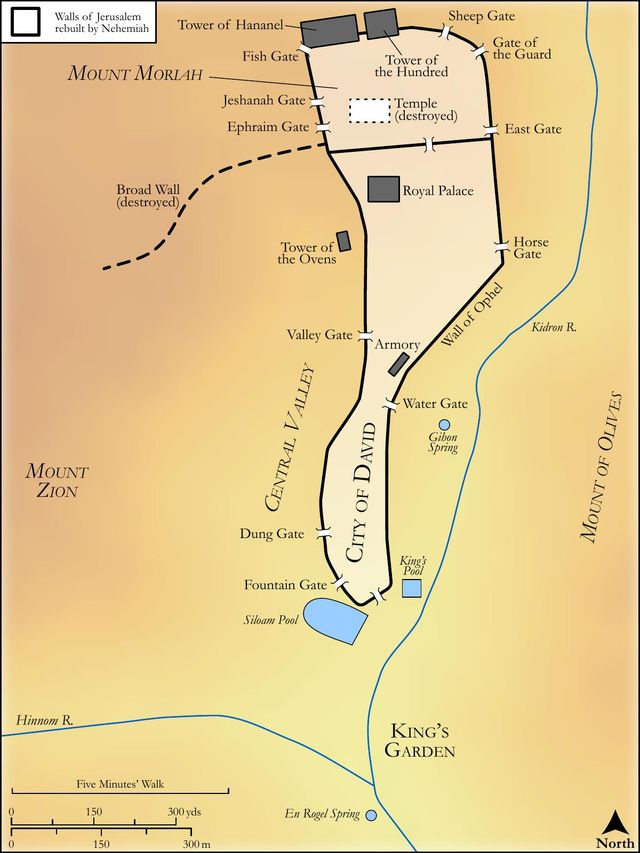
Nehemiah chapter 3 is a remarkable register, systematically detailing the rebuilding of Jerusalem's walls by various groups and individuals. It begins with the High Priest Eliashib and his fellow priests at the Sheep Gate and proceeds counter-clockwise around the city, meticulously listing who repaired which section. This chapter serves as a powerful testament to the organized and communal effort that followed Nehemiah's initial night survey of the broken walls, recorded in Nehemiah 2:11-16, and his inspiring call to action, "Let us rise up and build!" found in Nehemiah 2:18. Nehemiah 3:9 is situated within this detailed catalog, specifically mentioning Rephaiah's work "next unto them," indicating a seamless continuation of effort from the preceding group, emphasizing the collaborative and contiguous nature of the entire project. The verse's placement within this comprehensive list highlights the individual contributions that collectively formed a monumental achievement, reinforcing the idea that every hand was vital to the restoration.
Historical & Cultural Context
The events of Nehemiah unfold in the mid-5th century BC, during the Persian Empire's rule, following the return of Jewish exiles from Babylon. Jerusalem at this time was vulnerable, its walls in ruins, leaving its inhabitants exposed to external threats and undermining their sense of national and religious identity. Wall-building in that day was not merely a construction project; it was an act of re-establishing sovereignty, security, and communal dignity. The participation of a "ruler" like Rephaiah was culturally significant, as it demonstrated that the burden of reconstruction was shared across all social strata, from priests and merchants to civic leaders. This collective engagement was crucial for overcoming the immense logistical challenges and the persistent opposition from neighboring adversaries, as vividly described in Nehemiah 4. The very act of rebuilding was a profound statement of faith and resilience in the face of adversity.
Key Themes
ShowHideNehemiah 3 powerfully illustrates that the rebuilding of Jerusalem was a collective endeavor, requiring the contribution of every segment of society. From various guilds (goldsmiths, perfumers) to diverse professions (priests, merchants) and civic leaders, each played a vital role. Rephaiah's participation as a "ruler" underscores that no one, regardless of status or privilege, was exempt from the demanding work. This theme highlights the biblical principle that the flourishing of a community depends on the active and unified participation of all its members, each contributing their unique part. This communal effort, as seen in Nehemiah 3, stands as a testament to what can be achieved when God's people work together. Rephaiah, as a "ruler of the half part of Jerusalem," did not merely oversee or delegate but actively engaged in the physical labor of repairing the wall. This hands-on approach from someone in a position of authority set a powerful precedent, inspiring and motivating others to commit fully to the task. It exemplifies a form of servant leadership, where leaders are not detached figures but integral participants in the work, demonstrating humility and dedication. Such leadership fosters trust and solidarity, crucial for any large-scale communal undertaking, echoing principles found in the New Testament concerning spiritual leadership, as seen in passages like 1 Peter 5:2-3. The meticulous detail in Nehemiah 3, including the specific mention of "the half part of Jerusalem," highlights the systematic and organized approach to the massive reconstruction project. The work was divided into manageable sections, each assigned to specific families, groups, or leaders. This division of labor ensured accountability, efficiency, and steady progress. This meticulous record-keeping underscores the divine value placed on diligent planning, methodical execution, and the recognition of every individual contribution in achieving a God-ordained vision, a principle that can be applied to any significant endeavor, whether spiritual or practical, as encouraged in Proverbs 21:5.
Exposition and Analysis
ShowHideKey Word Analysis
ShowHideThis Hebrew name, derived from the root "to heal" and the divine name "Yah" (short for Yahweh), means "Jah has cured" or "Yahweh has healed." In the context of Jerusalem's restoration, which was a process of healing and rebuilding after devastation, Rephaiah's name carries a subtle but potent theological resonance. It implicitly connects the physical rebuilding of the city with God's overarching work of spiritual and national restoration for His people, affirming that the entire project was under divine care and ultimately a testament to God's restorative power.
The Hebrew verb chazaq is a primitive root meaning "to fasten upon; hence, to seize, be strong (figuratively, courageous, causatively strengthen, cure, help, repair, fortify), obstinate." It implies much more than simple mending; it denotes a vigorous, determined effort to reinforce, restore to strength, make firm, and secure. Its repeated use throughout Nehemiah 3 emphasizes the strenuous, resolute, and comprehensive nature of the work on the wall—not merely patching, but making the city's defenses robust and resilient once more. This word encapsulates the dedication and perseverance required for the task.
The Hebrew term sar is a broad designation for a "head person (of any rank or class); captain, chief, general, governor, keeper, lord, master, prince, ruler, steward." It indicates a person of significant authority, status, and leadership within a community or administrative division. Rephaiah's designation as a sar underscores that his participation was not that of a common laborer but of a high-ranking official who chose to engage directly in the manual work. This active involvement from a person of such standing set a powerful example for others, demonstrating a commitment that went beyond mere administrative oversight, fostering unity and shared purpose among all participants.
Verse Breakdown
ShowHide"And next unto them repaired"
This opening phrase immediately establishes the continuous and collaborative nature of the rebuilding effort. The wall was meticulously divided into sections, and as one group or individual completed their portion, the next group, literally "next to them," took up their tools and continued the work. This highlights the seamless coordination, unity, and shared momentum among the various participants, ensuring no gaps in the wall or in the collective effort. It speaks to a well-organized and highly motivated workforce, driven by a common purpose.
"Rephaiah the son of Hur"
This clause identifies the individual by name and lineage, a common practice in biblical historical and genealogical records. This personalization of the account shows that the work was not done by anonymous masses but by specific, accountable individuals, each contributing their unique part. Rephaiah's personal involvement, despite his status, reinforces the theme of shared responsibility and the importance of every person's contribution, regardless of their social standing, to the overall success of the project.
"the ruler of the half part of Jerusalem"
This phrase provides specific detail about Rephaiah's administrative position and jurisdiction. Ancient Jerusalem was sometimes divided into administrative sectors or districts, and Rephaiah was responsible for one such "half part." His participation in the physical labor, despite his high office, is a powerful demonstration of leadership by example. It shows that he was not above the demanding work and was personally invested in the city's restoration and security, a commitment that would have inspired and motivated those under his charge.
Literary Devices
ShowHideNehemiah 3:9, as an integral part of the larger chapter, primarily employs Lists/Catalogs as its dominant literary device. The entire chapter functions as a detailed register, meticulously listing individuals, families, and groups, along with the specific sections of the wall they repaired. This extensive catalog serves several crucial purposes: it demonstrates the comprehensive scope of the project, highlights the widespread participation and unity among the returning exiles, and emphasizes the individual accountability and contribution of each person. The repetitive structure of "next to them repaired [person/group] the section of..." creates a rhythmic, almost liturgical, recounting of the communal effort, reinforcing the idea of continuous, coordinated work. Furthermore, the inclusion of specific names and their administrative titles, like Rephaiah, adds a layer of Historical Verisimilitude, grounding the narrative in concrete reality and reinforcing the authenticity of the account. The very act of naming each participant can also be seen as a form of Commemoration, ensuring that their diligent work and sacrifice were not forgotten and that their legacy of service was preserved for future generations.
Theological and Thematic Connections
ShowHideNehemiah 3:9, within the broader context of the wall's rebuilding, powerfully illustrates the theological principle of God's people working together for His purposes, emphasizing unity in diversity. The unified effort, diverse contributions, and leadership by example seen in Jerusalem's restoration mirror the New Testament's teaching on the nature of the Church as the body of Christ. Just as each individual, from priests to rulers like Rephaiah, played a crucial role in reconstructing the physical walls, so too does every believer have a unique and indispensable function in building up the spiritual kingdom of God. This collective endeavor, empowered by divine grace, demonstrates that significant spiritual and communal achievements are rarely the work of a single individual but the fruit of many hands and hearts united in a common, God-given vision, with each member contributing their specific gifts and efforts for the common good and the glory of God.
Reflection and Application
ShowHideThe detailed account of Nehemiah 3, with Rephaiah's contribution in Nehemiah 3:9, offers timeless lessons for contemporary believers and communities. It calls us to recognize that significant undertakings, whether in our local churches, families, workplaces, or broader society, require a spirit of shared responsibility and collaborative effort. Just as the physical walls of Jerusalem provided security and identity, our spiritual "walls"—our faith, our community bonds, our moral integrity, our commitment to justice—require diligent and collective maintenance. Leaders are not merely to direct from a distance but are called to lead by example, humbly participating in the work alongside those they serve, inspiring and empowering others through their active involvement and personal sacrifice. This chapter reminds us that God often uses ordinary people, working together in an organized and diligent manner, to accomplish extraordinary things for His glory, and that every contribution, no matter how seemingly small, is valued and vital in His grand design.
Questions for Reflection
ShowHideFAQ
ShowHideWhy is Nehemiah 3 so detailed in listing individuals and their sections of the wall?
ShowHideThe meticulous detail in Nehemiah 3 serves several crucial purposes. First, it highlights the collective and unified effort required for such a monumental task, demonstrating that the rebuilding was not the work of a few but of the entire community, from priests to goldsmiths, and even "rulers" like Rephaiah. This comprehensive listing underscores the widespread commitment and cooperation. Second, it emphasizes individual accountability and contribution, ensuring that each person's specific role was recognized and recorded, underscoring the value of every single participant and their unique part in the grand design. Third, it provides a historical record of the immense undertaking, authenticating the narrative and showcasing the divine orchestration behind the restoration of Jerusalem. This level of detail also serves as a testament to the organizational genius of Nehemiah and the unwavering dedication of the people who responded to his impassioned call to "rise up and build" (Nehemiah 2:18).
What does "ruler of the half part of Jerusalem" signify about Rephaiah's role?
ShowHideThe phrase "ruler of the half part of Jerusalem" indicates that Rephaiah was a significant civic official, likely a district governor or administrator, responsible for a specific administrative division within Jerusalem. This detail is important because it highlights that even those in positions of authority and social standing were actively involved in the physical labor of rebuilding the wall. His participation underscores the theme of leadership by example and shared responsibility, demonstrating that no one was exempt from the demanding work, regardless of their status. It contrasts with leaders who might merely issue commands from afar, instead showing Rephaiah's personal investment and hands-on commitment to the city's restoration and security, which would have been a powerful motivator for others and fostered a deeper sense of unity and purpose among the workers. This kind of leadership is invaluable in any large-scale communal endeavor, as it builds trust and inspires greater dedication from all involved, as seen throughout Nehemiah 3.
Christ-Centered Fulfillment
ShowHideThe collective, unified, and diligent effort to rebuild Jerusalem's walls, exemplified by figures like Rephaiah in Nehemiah 3:9, finds its ultimate fulfillment and spiritual parallel in the person and work of Jesus Christ and the building of His Church. Just as the physical walls provided security and identity for God's people in the Old Testament, Christ is the foundational cornerstone of a new, spiritual temple—His body, the Church (Ephesians 2:19-22). Jesus Himself declared, "I will build my church, and the gates of hell shall not prevail against it" (Matthew 16:18). He is the ultimate leader who led by supreme example, not merely directing from afar but actively participating in the work of redemption, even to the point of washing His disciples' feet as a model of servant leadership (John 13:1-17) and offering His life as the supreme sacrifice for humanity (Philippians 2:5-8). The diverse contributions of the wall-builders in Nehemiah foreshadow the spiritual gifts given to every member of Christ's body, all working together for the common good and the edification of the Church, with Christ as the head providing direction and unity (1 Corinthians 12:4-7). Thus, the rebuilding of Jerusalem's walls points forward to Christ's ongoing work of building His people into a spiritual dwelling place for God, characterized by unity, shared purpose, and a leader who gave everything.