


Nehemiah 3:28
Bible text: King James Version (1769 Blayney text) · Public domain
Bible text: Berean Standard Bible · Public domain
Bible text: American Standard Version (1901) · Public domain
Bible text: World English Bible, Messianic edition · Public domain
Bible text: Geneva Bible (1599) · Public domain
Bible text: Young's Literal Translation · Public domain
- מֵעַלme·'Al<from> aboveH5921Prep-m ¦ PrepPrepositionמֵ<from>עַלabove
- שַׁעַרSha·'ar[the] gate ofH8179N-mscNoun Singular Masculine Construct
- הַסּוּסִיםha·su·Simthe horsesH5483Art ¦ N-mpNoun Plural Masculine Absoluteהַtheסּוּסִיםhorses
- הֶחֱזִיקוּhe·che·Zi·kuthey repairedH2388V-Hiphil-Perf-3cpVerb Hiphil Perfect 3rd Plural common gender
- הַכֹּהֲנִיםha·Ko·ha·Nimthe priestsH3548Art ¦ N-mpNoun Plural Masculine Absoluteהַtheכֹּהֲנִיםpriests
- אִישׁ'isheach oneH376N-msNoun Singular Masculine Absolute
- לְנֶגֶדle·Ne·gedto beforeH5048Prep-l ¦ Adj-mscAdjective Numerical Singular Masculine Constructלְtoנֶגֶדbefore
- בֵּיתוֹbei·Tohis own houseH1004N-msc ¦ 3msNoun Singular Masculine Constructבֵּיתown houseוֹhis
English is a literal word-by-word gloss of the Hebrew, not the KJV's wording. Why?
This is the original text the KJV's translators worked from — each Hebrew word with its own literal English meaning in this verse, prepared by scholars at Tyndale House, Cambridge. The KJV translates whole sentences, not word by word, so its wording differs: one Hebrew word can become several English words, and the KJV may choose “the LORD” where the gloss reads “Yahweh”. Both are faithful — they answer different questions. For the KJV's own rendering, switch to the KJV text.
Details
See on the biblical-era map
Study this verse
Public-domain commentary
Matthew Henry
From his Commentary on the Whole Bible. Henry comments on passages, not single verses — this entry covers Nehemiah 3:1–32. His two-level outline is real structure in the source text, so it is rendered as structure.
The best way to know how to divide this chapter is to observe how the work was divided among the undertakers, that every one might know what he had to do, and mind it accordingly with a holy emulation, and desire to excel, yet without any contention, animosity, or separate interest. No strife appears among them but which should do most for the public good. Several things are observable in the account here given of the building of the wall about Jerusalem: -
I.That Eliashib the high priest, with his brethren the priests, led the van in this troop of builders, Neh 3:1.
Ministers should be foremost in every good work; for their office obliges them to teach and quicken by their example, as well as by their doctrine. If there be labour in it, who so fit as they to work? if danger, who so fit as they to venture? The dignity of the high priest was very great, and obliged him to signalize himself in this service. The priests repaired the sheep-gate, so called because through it were brought the sheep that were to be sacrificed in the temple; and therefore the priests undertook the repair of it because the offerings of the Lord made by fire were their inheritance. And of this gate only it is said that they sanctified it with the word and prayer, and perhaps with sacrifices perhaps,
1.Because it led to the temple; or,
2.Because with this the building of the wall began, and it is probable (though they were at work in all parts of the wall at the same time) that this was first finished, and therefore at this gate they solemnly committed their city and the walls of it to the divine protection; or,
3.Because the priests were the builders of it; and it becomes ministers above others, being themselves in a peculiar manner sanctified to God, to sanctify to him all their performances, and to do even their common actions after a godly sort.
II.That the undertakers were very many, who each took his share, some more and some less, in this work, according as their ability was.
Note, What is to be done for the public good every one should assist in, and further, to the utmost of his place and power. United force will conquer that which no individual dares venture on. Many hands will make light work.
III.That many were active in this work who were not themselves inhabitants of Jerusalem, and therefore consulted purely the public welfare and not any private interest or advantage of their own. Here are the men of Jericho with the first (Neh 3:2), the men of Gibeon and Mizpah (Neh 3:7), and Zanoah, Neh 3:13. Every Israelite should lend a hand towards the building up of Jerusalem.
IV.That several rulers, both of Jerusalem and of other cities, were active in this work, thinking themselves bound in honour to do the utmost that their wealth and power enabled them to do for the furtherance of this good work. But it is observable that they are called rulers of part, or the half part, of their respective cities. One was ruler of the half part of Jerusalem (Neh 3:12), another of part of Beth-haccerem (Neh 3:14), another of part of Mizpah (Neh 3:15), another of the half part of Beth-zur (Neh 3:16), one was ruler of one half part, and another of the other half part, of Keilah, Neh 3:17, Neh 3:18. Perhaps the Persian government would not entrust any one with a strong city, but appointed two to be a watch upon each other. Rome had two consuls.
V.Here is a just reproach fastened upon the nobles of Tekoa, that they put not their necks to the work of their Lord (Neh 3:5), that is, they would not come under the yoke of an obligation to this service; as if the dignity and liberty of their peerage were their discharge from serving God and doing good, which are indeed the highest honour and the truest freedom. Let not nobles think any thing below them by which they may advance the interests of their country; for what else is their nobility good for but that it puts them in a higher and larger sphere of usefulness than that in which inferior persons move?
VI.Two persons joined in repairing the old gate (Neh 3:6), and so were co-founders, and shared the honour of it between them.
The good work which we cannot compass ourselves we must be thankful to those that will go partners with us in. Some think that this is called the old gate because it belonged to the ancient Salem, which was said to be first built by Melchizedek.
VII.Several good honest tradesmen, as well as priests and rulers, were active in this work - goldsmiths, apothecaries, merchants, Neh 3:8, Neh 3:32. They did not think their callings excused them, nor plead that they could not leave their shops to attend the public business, knowing that what they lost would certainly be made up to them by the blessing of God upon their callings.
VIII.Some ladies are spoken of as helping forward this work - Shallum and his daughters (Neh 3:12), who, though not capable of personal service, yet having their portions in their own hands, or being rich widows, contributed money for buying materials and paying workmen. St. Paul speaks of some good women that laboured with him in the gospel, Phi 4:3.
IX.Of some it is said that they repaired over against their houses (Neh 3:10, Neh 3:23, Neh 3:28, Neh 3:29), and of one (who, it is likely, was only a lodger) that he repaired over against his chamber, Neh 3:30. When a general good work is to be done each should apply himself to that part of it that falls nearest to him and is within his reach. If every one will sweep before his own door, the street will be clean; if every one will mend one, we shall be all mended. If he that has but a chamber will repair before that, he does his part.
X.Of one it is said that he earnestly repaired that which fell to his share (Neh 3:20) - he did it with an inflamed zeal; not that others were cold or indifferent, but he was the most vigorous of any of them and consequently made himself remarkable. It is good to be thus zealously affected in a good thin; and it is probable that this good man's zeal provoked very many to take the more pains and make the more haste.
XI.Of one of these builders it is observed that he was the sixth son of his father, Neh 3:30.
His five elder brethren, it seems, laid not their hand to this work, but he did. In doing that which is good we need not stay to see our elders go before us; if they decline it, it does not therefore follow that we must. Thus the younger brother, if he be the better man, and does God and his generation better service, is indeed the better gentleman; those are most honourable that are most useful.
XII.Some of those that had first done helped their fellows, and undertook another share where they saw there was most need.
Meremoth repaired, Neh 3:4. and again, Neh 3:21. And the Tekoites, besides the piece they repaired (Neh 3:5), undertook another piece (Neh 3:27), which is the more remarkable because their nobles set them a bad example by withdrawing from the service, which, instead of serving them for an excuse to sit still, perhaps made them the more forward to do double work, that by their zeal they might either shame or atone for the covetousness and carelessness of their nobles.
Lastly, Here is no mention of any particular share that Nehemiah himself had in this work. A name-sake of his is mentioned, Neh 3:16. But did he do nothing? Yes, though he undertook not any particular piece of the wall, yet he did more than any of them, for he had the oversight of them all; half of his servants worked where there was most need, and the other half stood sentinel, as we find afterwards (Neh 4:16), while he himself in his own person walked the rounds, directed and encouraged the builders, set his hand to the work where he saw occasion, and kept a watchful eye upon the motions of the enemy, as we shall find in the next chapter. The pilot needs not haul at a rope: it is enough for him to steer.
Historical interpretation
Historical reception
1 surviving comment on this verse from the historical church.
Upwards to the Horse Gate they built, etc. Jeremiah mentions this gate and designates it to be on the eastern side of the city, writing typically about the holy Church: And the city shall be built for the Lord from the tower of Hananeel (Jer. XXI). And a little later: Up to the brook Kidron, and unto the corner of the Horse Gate eastwards (Ibid.). Horses, when taken in a good sense, like donkeys, camels, and mules, sometimes signify the Gentile peoples converted to the Lord, and sometimes the cares of temporal matters rightly subjected to the Lord by the soul. The priests built the wall of God's city up to the Horse Gate, just as the holy teachers, after the calling of the Jewish people, continued spreading the word until they brought the Gentile peoples into the Holy Church. Equally, they build to the Horse Gate when they provide the example of a sufficient mode of living for those who enter the gates of the holy Church to restrain their carnal or mental desires; or certainly when they arrange their own thoughts, which they must have in dealing with their livelihood or habits, in such a way that they do not hinder the freedom of mind, with which they have always proposed to seek heavenly things. And it is aptly added about the laborers, "Everyone against his own house"; this phrase is often repeated in this construction of the holy city. There is no need to labor in explaining how in the holy Church each one should build a wall of virtues against his own house and fortify his mind against the devil's snares; so that he who roams about like a roaring lion, seeking someone to devour (1 Pet. V), cannot in any way break in, while each one fortifies his own body and mind with the strong faith in the Lord. But everyone also builds against his own house if he protects with diligent guard of regular discipline those who are committed to him, so that they cannot be deceived either by the incursion of vices or by heretical persuasion. It would take a long time to discuss in spiritual interpretation each of the buildings of the holy city or its builders; which, even without our speaking, the skilled reader can very easily recognize. This much, however, should be noted, that those who build the gates and towers, through which either citizens may enter or enemies be warded off, are the prophets, apostles, and evangelists; through whom the form and order of faith and right action have been provided to us, by which we ought to enter the unity of the holy Church; and by whose words we learn how to refute and repel the adversaries of truth. But those who build with other words are the pastors and teachers, whom the Apostle placed second, through whose diligence the Catholic faith, which was built by the great architects of the Church, is preserved throughout the world to this day. And just as Nehemiah, enumerating the builders of the city in order, renders them perpetually memorable; so the Lord, the comforter of our poverty, inscribes the names in heaven of all who build up His Church among the elect. But let us consider the remaining matters as well.
Continue studying Nehemiah 3:28 across the web’s major study libraries — every link below opens this exact verse, chapter, or book on the destination site.
Read & Compare
 BibleGatewayThis verse in more than 200 translations and 70 languages.
 Bible.comThe YouVersion reader — hundreds of translations, reading plans, and highlights.
 ESV.orgCrossway's official English Standard Version reader.
 NET BibleThe NET translation with 60,000+ translators' notes on every rendering decision.
 STEP BibleTyndale House's free study tool — original text, vocabulary, and scholarly resources.
 BibliaLogos Bible Software's free web reader.
 USCCBThe New American Bible (Revised Edition) with the U.S. bishops' study notes.
Commentaries
 BibleHub CommentariesDozens of classic commentaries on this verse, gathered on one page.
 StudyLightMore than 100 commentary sets — the largest collection on the web.
 BibleRefPlain-English commentary on what this verse means, verse by verse.
 Enduring WordDavid Guzik's free commentary on this chapter, widely used by Bible teachers.
 Bible Study ToolsVerse commentary alongside Greek and Hebrew study aids.
Original Language & Research
- BibleHub InterlinearThe verse word by word — original language, transliteration, and English.
- BibleHub LexiconEvery word's original-language definition and Strong's entry.
 Blue Letter BibleDeep-study tools — Strong's numbers, concordance, and word studies.
 SefariaThe Hebrew text with Rashi and centuries of Jewish commentary.
Sermons, Hymns & Audio


TrulyRandomVerse is not affiliated with these sites and doesn’t control their content. They’re linked because they’re genuinely useful.
Summary
Nehemiah 3:28 offers a precise and poignant detail within the meticulous record of Jerusalem's wall reconstruction, specifically highlighting the dedicated involvement of the priests in repairing the section immediately above the strategically vital Horse Gate. This verse powerfully illustrates the pervasive commitment across all societal strata, including the spiritual leadership, to the physical and spiritual restoration of the city, exemplifying the profound principle of shared responsibility, personal ownership, and unified action in a monumental collective endeavor.
Context
ShowHideLiterary Context
Nehemiah 3 stands as a unique and remarkably detailed register, systematically enumerating the diverse groups, families, and individuals who participated in the rapid and miraculous reconstruction of Jerusalem's dilapidated walls. Positioned directly after Nehemiah's initial, clandestine assessment of the city's devastation in Nehemiah 2 and preceding the intense external opposition faced by the builders in Nehemiah 4, this chapter serves as a testament to the comprehensive and organized nature of the rebuilding effort. It is structured as a continuous circuit around the city, commencing at the Sheep Gate and proceeding clockwise, meticulously detailing who repaired which specific section and often noting their proximity to their own homes or significant landmarks. Verse 28, with its specific mention of the priests and their work near the Horse Gate, is an integral part of this systematic enumeration, underscoring the widespread participation from all segments of the community, including the religious leadership, ensuring that no vital section of the city's defenses was overlooked. The meticulous listing emphasizes the unity and shared purpose that characterized this extraordinary period of restoration.
Historical & Cultural Context
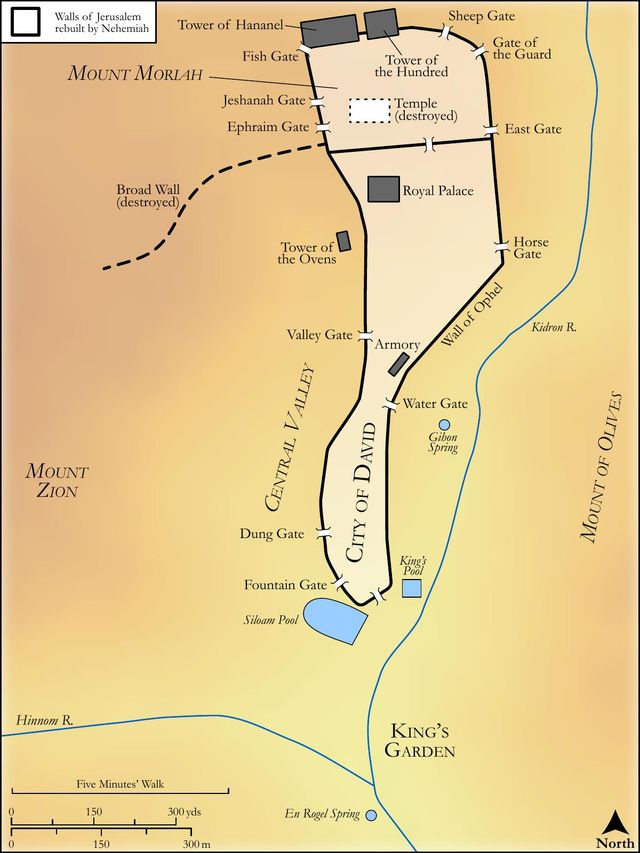
The monumental task of rebuilding Jerusalem's walls unfolded around 445-444 BC, during the Persian period, under the benevolent decree of King Artaxerxes I. Decades after the initial return of the exiles from Babylonian captivity, Jerusalem remained a vulnerable city, its walls in ruins, a stark symbol of the people's lingering desolation and lack of security. The Horse Gate, referenced in this verse and also in ancient texts like Jeremiah 31:40, was a significant entrance, likely situated on the eastern side of the city, potentially providing access to the Kidron Valley or a direct route to the Temple precincts. Its strategic importance meant its repair was absolutely crucial for both the city's defense and its practical accessibility. The involvement of priests, who were primarily spiritual leaders consecrated for Temple service, in strenuous manual labor highlights the extraordinary circumstances and the urgent, all-encompassing need for collective action. In that day, community projects of this magnitude often necessitated widespread voluntary participation, and the recurring motif of "every one over against his house" suggests a highly practical and incentivizing approach to labor allocation, fostering profound personal investment and ensuring efficient progress.
Key Themes
ShowHideNehemiah 3:28 contributes significantly to several overarching themes woven throughout the book of Nehemiah. Firstly, it powerfully exemplifies unity and collective action, showcasing how diverse groups—from goldsmiths and merchants to priests and rulers—collaborated seamlessly for a common, divinely appointed goal. This echoes the profound call for communal harmony found in Psalm 133:1, where the blessing of the Lord is commanded. Secondly, the phrase "every one over against his house" vividly illustrates the theme of personal responsibility and ownership, where individuals are motivated to contribute to the greater good by beginning with their immediate sphere of influence, a principle that resonates with the New Testament teaching in Galatians 6:4-5 about each person bearing their own load. Thirdly, the active participation of the priests underscores leadership by example and the inherently sacred nature of the work itself, demonstrating that spiritual devotion extends beyond ritual to practical, physical labor for the community's well-being. This aligns with the biblical injunction to serve God with all one's might, as encouraged in Deuteronomy 6:5, emphasizing a holistic commitment to God's purposes.
Exposition and Analysis
ShowHideKey Word Analysis
ShowHideThe Hebrew verb חָזַק (H2388, ḥāzaq) is a primitive root meaning "to fasten upon; hence, to seize, be strong (figuratively, courageous, causatively strengthen, cure, help, repair, fortify), obstinate." In the context of Nehemiah 3, this word denotes far more than a simple patch-up job; it signifies a robust process of actively restoring, reinforcing, and making the wall secure and durable. Its repeated use throughout the chapter emphasizes the diligent, strenuous, and high-quality work undertaken by the builders, ensuring the renewed defenses of Jerusalem would be resilient and long-lasting.
The Hebrew word כֹּהֵן (H3548, kôhēn), used here in its plural form kōhănîm, refers to "one officiating, a priest." These were the descendants of Aaron, consecrated to serve God in the Temple, whose primary duties involved sacrificial rituals, teaching the Law, and mediating between God and the people. Their direct involvement in the manual labor of rebuilding the city walls highlights the extraordinary nature of the task and their profound commitment beyond their typical religious duties. This participation underscores that the restoration of Jerusalem was a holistic endeavor encompassing both spiritual and physical dimensions, lending a significant sense of divine endorsement and spiritual urgency to the entire project.
The Hebrew word בַּיִת (H1004, bayith) primarily means "a house (in the greatest variation of applications, especially family, etc.)." In the phrase "every one over against his house," it signifies not just a physical dwelling but also the associated concepts of home, family, and personal property. This detail emphasizes the practical and deeply personal motivation behind the builders' efforts. By working on the section of the wall nearest their own homes, the priests, like other citizens, had a direct, vested interest in securing their families and properties, fostering a heightened sense of ownership, diligence, and commitment to the project's success and the overall security of the city.
Verse Breakdown
ShowHide"From above the horse gate"
This phrase precisely locates the section of the wall assigned to the priests. The Horse Gate was a significant entry point, likely situated on the eastern side of the city, possibly near the Temple Mount and leading towards the Kidron Valley. Its strategic importance meant its repair was crucial for the city's defense and access. The preposition "above" suggests that the priests were working on the section of the wall immediately adjacent to or directly over the gate structure itself, indicating a challenging and prominent segment that required substantial effort and skill.
"repaired the priests"
This identifies the specific group responsible for this particular section of the wall. The inclusion of the priests, traditionally associated with sacred duties within the Temple and not manual labor, is highly significant. Their participation underscores the broad societal commitment to the rebuilding project, demonstrating that no segment of the community, not even the spiritual elite, was exempt from contributing to this vital national undertaking. It also lends a sense of divine endorsement and spiritual significance to the physical work, showing that all labor undertaken for God's kingdom and the well-being of His people is honorable and sacred.
"every one over against his house"
This recurring motif throughout Nehemiah 3 emphasizes both personal responsibility and practical efficiency. It means that the priests, like many other builders, were assigned sections of the wall directly opposite or nearest to their own residences. This practical arrangement made the work more efficient, as individuals could easily access their assigned sections and had a direct, tangible vested interest in securing their own homes and properties. This fostered a deeper sense of ownership, commitment, and diligence, ultimately contributing to the rapid and successful completion of the entire city wall.
Literary Devices
ShowHideNehemiah 3:28, within the broader context of Nehemiah 3, skillfully employs several literary devices to convey its message. The chapter as a whole functions as a meticulous catalogue or list, systematically detailing the participants and their assigned sections of the wall. This creates a powerful sense of comprehensiveness, organization, and collective effort, emphasizing that every segment of the community was mobilized. The recurring phrase "every one over against his house" serves as a potent motif, a repeated element that underscores the theme of personal responsibility, proximity-based labor allocation, and vested interest. This motif lends a rhythmic and unifying quality to the otherwise detailed enumeration. The inclusion of the priests in manual labor, traditionally associated with spiritual and ceremonial duties, presents a form of irony or paradox, highlighting the extraordinary and urgent circumstances that necessitated such widespread and diverse participation. This unexpected involvement also functions as symbolism, where the physical rebuilding of Jerusalem's walls symbolizes the spiritual and communal restoration of the people of Israel and their renewed covenant relationship with God.
Theological and Thematic Connections
ShowHideNehemiah 3:28 profoundly illustrates the theological principle that all aspects of life, including strenuous physical labor, can be consecrated to God's purposes, especially when undertaken in unity for the common good of His people. The active participation of the priests, traditionally set apart for sacred duties within the Temple, in the manual rebuilding of the wall demonstrates that spiritual leadership is not divorced from practical service and that every member of the community has a vital and honorable role in God's redemptive plan. This verse underscores that true restoration, whether physical or spiritual, requires collective effort, personal responsibility, and a willingness to serve beyond one's conventional roles, all driven by a shared vision for God's glory and the well-being of His covenant people. It is a powerful testament to the holistic nature of faith, where devotion is expressed through diligent, collaborative service that builds up both individuals and the community.
Reflection and Application
ShowHideNehemiah 3:28 offers profound and enduring lessons for contemporary believers and communities. It challenges us to prayerfully consider our own "sections of the wall" that God might be calling us to repair, strengthen, or build—whether within our families, local churches, workplaces, or wider communities. Just as the priests worked diligently "over against his house," we are called to embrace ownership and responsibility for the areas within our immediate influence, recognizing that significant, God-honoring change often begins with faithful stewardship of what is closest to us. This verse powerfully reminds us that no task, however mundane, physically demanding, or seemingly outside our "job description," is beneath those who are truly committed to God's kingdom work. It encourages a spirit of unity, shared responsibility, and humble service, where every gift, every skill, and every willing hand contributes to the larger vision. When we observe spiritual leaders engaged in practical, hands-on service, it reinforces the holistic nature of faith—that our devotion to God is expressed not only in worship, prayer, and study but also in diligent, collaborative effort for the flourishing of His people and the advancement of His purposes in the world. This principle calls us to a practical, incarnational faith that actively builds up both individuals and communities for God's glory.
Questions for Reflection
ShowHideFAQ
ShowHideWhy were priests involved in building the wall, a seemingly non-religious task?
ShowHideThe involvement of the priests in rebuilding Jerusalem's physical walls, as highlighted in Nehemiah 3:28, underscores the extraordinary circumstances and the holistic, sacred nature of the restoration effort after the Babylonian exile. While their primary duties were spiritual—serving in the Temple, offering sacrifices, and teaching the Law—the security and sanctity of Jerusalem were absolutely paramount for the spiritual life and identity of the nation. A broken wall symbolized desolation, vulnerability, and a hindered capacity for true worship and communal life. Therefore, the rebuilding was not merely a secular construction project but a profoundly sacred endeavor, vital for the re-establishment of a functioning, secure, and godly society where the covenant could be lived out. The priests' active participation demonstrated their deep commitment to the entire community's well-being, showing that spiritual leadership extends to practical service and that all members, regardless of their specific calling, were united in this divinely ordained mission. It also set a powerful example for the rest of the population, emphasizing the urgency and ultimate spiritual importance of the work for God's glory and the people's flourishing.
Christ-Centered Fulfillment
ShowHideNehemiah 3:28, with its vivid depiction of diverse individuals, including the consecrated priests, working together to rebuild Jerusalem's physical walls, powerfully foreshadows the unified and Spirit-empowered work of the church in building God's spiritual kingdom through Christ. Just as the physical walls provided security, defined the sacred space, and enabled the flourishing of God's people in Nehemiah's day, Jesus Christ is the ultimate foundation and cornerstone upon whom the spiritual temple, His church, is being continuously built (Ephesians 2:20-22). The Old Testament priests, who served as mediators and guardians of God's presence under the Old Covenant, find their ultimate fulfillment in Jesus Christ, the Great High Priest who offered the perfect, once-for-all sacrifice for sin (Hebrews 4:14-16 and Hebrews 9:11-14). Moreover, the New Testament teaches that all believers in Christ are now a "royal priesthood" (1 Peter 2:9), called to participate actively in building up the body of Christ, each contributing their unique spiritual gifts and talents "over against his house"—that is, within their God-given spheres of influence—for the common good, the edification of the saints, and the glory of God (1 Corinthians 12:7). The collective, sacrificial effort seen in Nehemiah points forward to the unified mission of the church, empowered by the Holy Spirit, to extend God's kingdom and prepare a people for the New Jerusalem, where God's glorious presence will dwell perfectly with His redeemed people, needing no physical walls for protection or definition (Revelation 21:2-3).