


Matthew 26:8
Bible text: King James Version (1769 Blayney text) · Public domain
Bible text: Berean Standard Bible · Public domain
Bible text: American Standard Version (1901) · Public domain
Bible text: World English Bible, Messianic edition · Public domain
Bible text: Geneva Bible (1599) · Public domain
Bible text: Young's Literal Translation · Public domain
- ἰδόντεςidontesHaving seenG1492V-2AAP-NPMVerb 2nd Aorist Active Participle Nominative Plural Masculine
- δὲdethenG1161CONJConjunction
- οἱhoitheG3588T-NPMDefinite article Nominative Plural Masculine
- μαθηταὶmathētaidisciplesG3101N-NPMNoun Nominative Plural Masculine
- αὐτοῦautouof himG846P-GSMPersonal pronoun Genitive Singular Masculine
- ἠγανάκτησανēganaktēsanbecame indignantG23V-AAI-3PVerb Aorist Active Indicative 3rd Plural
- λέγοντες·legontessayingG3004V-PAP-NPMVerb Present Active Participle Nominative Plural Masculine
- εἰςeisFor whatG1519PREPPreposition
- τίtipurposeG5101I-ASNInterrogative pronoun Accusative Singular Neuter
- ἡhē[is] theG3588T-NSFDefinite article Nominative Singular Feminine
- ἀπώλειαapōleiawasteG684N-NSFNoun Nominative Singular Feminine
- αὕτη;hautēthis?G3778D-NSFDemonstrative pronoun Nominative Singular Feminine
English is a literal word-by-word gloss of the Greek, not the KJV's wording. Why?
This is the original text the KJV's translators worked from — each Greek word with its own literal English meaning in this verse, prepared by scholars at Tyndale House, Cambridge. The KJV translates whole sentences, not word by word, so its wording differs: one Greek word can become several English words, and the KJV may choose “charity” where the gloss reads “love”. Both are faithful — they answer different questions. For the KJV's own rendering, switch to the KJV text.
Details
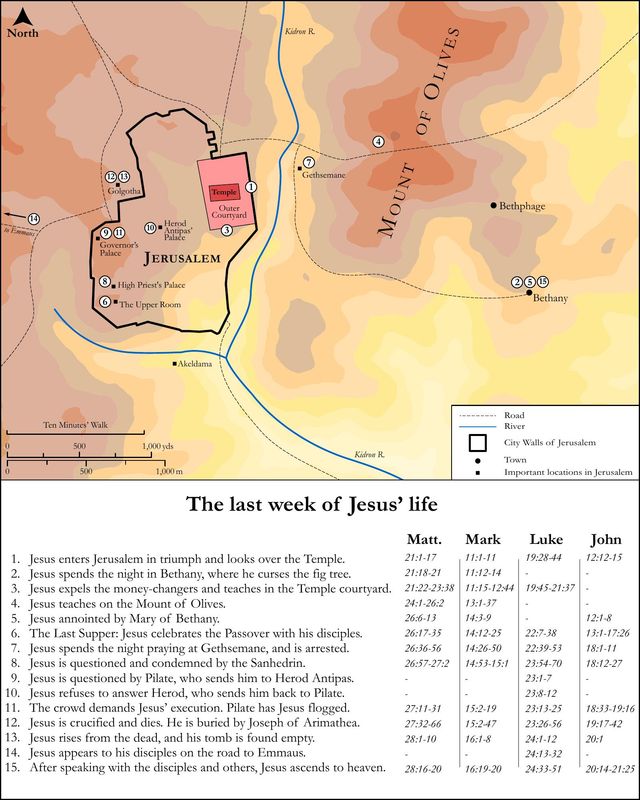
See on the biblical-era maps


Study this verse
Historical interpretation
Ten Centuries of Reception
15 surviving comments on this verse. Each one is dated, so this reads as a timeline rather than a list.
Select a marker to jump to its quote. Markers stagger vertically where authors wrote within a few decades of each other.
Some one may perhaps think that there are four different women of whom the Evangelists have written, but I rather agree with those who think that they are only three; one of whom Matthew and Mark wrote, one of whom Luke, another of whom John.
Matthew and Mark relate that this was done in the house of Simon the leper; but John says that Jesus came to a house where Lazarus was; and that not Simon, but Mary and Martha served. Further, according to John, six days before the Passover, He came to Bethany where Mary and Martha made Him a supper. But here it is in the house of Simon the leper, and two days before the Passover. And in Matthew and Mark, it is the disciples that have indignation with a good intent; in John, Judas alone with intent to steal; in Luke, no one finds fault.
Oil is throughout Scripture put for the work of mercy, with which the lamp of the word is fed; or for doctrine, the hearing of which sustains the word of faith when once kindled. All with which men anoint is comprehensively called oil; and one kind of oil is unguent, and one kind of unguent is precious. So all righteous acts are called good works; and of good works there is one kind which we do for, or to, men; another which we do for, or to, God. And this likewise that we do for God, in part only advances the good of men, in part, the glory of God. For example, one does a kindness to a man out of feelings of natural righteousness, not for God's sake, as the Gentiles sometime did; such a work is common oil of no fine savour, yet is it acceptable to God, forasmuch, as Peter says in Clement, the good works that the unbelievers do, profit them in this world, but avail not to gain them eternal life in another. They who do the same for God's sake, profit thereby not in this world only but in the next also, and that they do is ointment of good savour. Another sort is that done for the good of men, as alms, and the like. He who does this to Christians, anoints the Lord's feet, for they are the Lord's feet; and this penitents are most found to do for remission of their sins. He who devotes himself to chastity, and continues in fastings and prayers, and other things which conduce to God's glory only, this is the ointment which anoints the Lord's head, and with whose odour the whole Church is filled; this is the work meet not for penitents, but for the perfect, or the doctrine which is necessary for men; but the acknowledgment of the faith which belongs to God alone, is the ointment with which the head of Christ is anointed, with which we are buried together with Christ by baptism into death. (Rom. 6:4.)
In this woman is prefigured the people of the Gentiles, who gave glory to God in Christ's passion; for she anointed His head, but the head of Christ is God, and ointment is the fruit of good works. But the disciples, anxious for the salvation of Israel, say that this ought to have been sold for the use of the poor; designating by a prophetic instinct the Jews, who lacked faith, by the name of the poor. The Lord answers that there is abundant time in which they may show their care for the poor, but that salvation cannot be extended to the Gentiles but by obedience to His command, if, that is, by the pouring out of this woman's ointment they are buried together with Him, because regeneration can only be given to those who are dead in the profession of baptism. And this her work shall be told wherever this Gospel is preached, because when Israel draws back, the glory of the Gospel is preached by the belief of the Gentiles.
The Lord told them they would have much time to look after the poor. Further, it is only at his command that salvation can be given to the Gentiles buried with him in the outpouring of ointment by this woman, for rebirth is given only to those who have died with him in the profession of baptism.
(in Luc. 7, 37.) It is possible therefore that they were different persons, and so all appearance of contradiction between the Evangelists is removed. Or it is possible that it was the same woman at two different times and two different stages of desert; first while yet a sinner, afterwards more advanced.
(Hom. lxxx.) And in this way it may be the same in the three Evangelists, Matthew, Mark, and Luke. And not without good reason does the Evangelist mention Simon's leprosy, to show what gave this woman confidence to come to Christ. The leprosy was an unclean disease; when then she saw that Jesus had healed the man with whom He now lodged, she trusted that He could also cleanse the uncleanness of her soul; and so whereas other women came to Christ to be healed in their bodies, she came only for the honour and the healing of her soul, having nothing diseased in her body; and for this she is worthy our highest admiration. But she in John is a different woman, the wonderful sister of Lazarus.
The disciples had heard their Master say, I will have mercy, and not sacrifice, (Matt. 9:13.) wherefore they thought among themselves, If He accepts not burnt-offerings, much less will He the application of such ointment as this.
The disciples then thought thus, but Jesus, who saw the thoughts of the woman, suffered it. For her piety was great, and her ardour unspeakable, wherefore He condescended to suffer her to pour the ointment on His head. As the Father admitted the smoke and odour of the slain victim, so also Christ admitted this votive anointing of His head, though the disciples, who saw not her heart, murmured.
And He says not merely, She hath wrought a good work, but says first, Why trouble ye the woman? to teach us that every good act that is wrought by any, even though it lack somewhat of exact propriety, yet we ought to receive, cherish, and cultivate it, and not to require strict correctness in a beginner. If He had been asked before this was done by the woman, He would not have directed its doing; but when it was done, the rebuke of the disciples had no longer any place, and He Himself to guard the woman from importunate attacks speaks these things for her comfort.
That this mention of His death and burial might not cause her to despond, He comforts her by what follows, Verily I say unto you, Wheresoever &c.
Behold the accomplishment of this saying; to whatsoever part of the world you go, you will find this woman famous, and this has been wrought by the power of Him who spake this word. How many victories of kings and captains have passed into oblivion; how many who built cities and enslaved many nations are now known neither by report nor by name; but the deed of this woman pouring forth ointment in the house of a leper in the presence of twelve men, this resoimds throughout the world, and though so much time has elapsed, the memory of that which was done is not effaced. But why promised He no spiritual gift to this woman, but everlasting remembrance only? Because this He did promise made her confident of receiving the other also; whereas she wrought a good work, it is clear that she shall receive an adequate reward.
This woman seems indeed to be one and the same with all the evangelists, yet she is not so; but though with the three she doth seem to me to be one and the same, yet not so with John, but another person, one much to be admired, the sister of Lazarus.
But not without purpose did the evangelist mention the leprosy of Simon, but in order that He might show whence the woman took confidence, and came unto Him. For inasmuch as the leprosy seemed a most unclean disease, and to be abhorred, and yet she saw Jesus had both healed the man (for else He would not have chosen to have tarried with a leper), and had gone into his house; she grew confident, that He would also easily wipe off the uncleanness of her soul. And not for nought doth He name the city also, Bethany, but that thou mightest learn, that of His own will He cometh to His passion. For He who before this was fleeing through the midst of them; then, at the time when their envy was most kindled, comes near within about fifteen furlongs; so completely was His former withdrawing Himself a part of a dispensation.
The woman therefore having seen Him, and having taken confidence from thence came unto Him. For if she that had the issue of blood, although conscious to herself of nothing like this, yet because of that natural seeming uncleanness, approached Him trembling and in fear; much more was it likely this woman should be slow, and shrink back because of her evil conscience. Wherefore also it is after many women, the Samaritan, the Canaanite, her that had the issue of blood, and other besides, that she cometh unto Him, being conscious to herself of much impurity; and then not publicly but in a house. And whereas all the others were coming unto Him for the healing of the body alone, she came unto Him by way of honor only, and for the amendment of the soul. For neither was she at all afflicted in body, so that for this most especially one might marvel at her.
And not as to a mere man did she come unto Him; for then she would not have wiped His feet with her hair, but as to one greater than man can be. Therefore that which is the most honorable member of the whole body, this she laid at Christ's feet, even her own head.
And whence had they this thought? They used to hear their Master saying, "I will have mercy, and not sacrifice," and blaming the Jews, because they omitted the weightier matters, judgment, and mercy, and faith, and discoursing much on the mount concerning almsgiving, and from these things they inferred with themselves, and reasoned, that if He accepts not whole burnt offerings, neither the ancient worship, much more will He not accept the anointing of oil.
But though they thus thought, He knowing her intention suffers her. For indeed great was her reverence, and unspeakable her zeal; wherefore of this exceeding condescension, He permitted the oil to be poured even on His head.
For if He refused not to become man, and to be borne in the womb, and to be fed at the breast, why marvellest thou, if He doth not utterly reject this? For like as the Father suffered a savor of meat, and smoke, even so did He the harlot, accepting, as I have already said, her intention. For Jacob too anointed a pillar to God, and oil was offered in the sacrifices, and the priests were anointed with ointment.
But the disciples not knowing her purpose found fault unseasonably, and by the things they laid to her charge, they show the woman's munificence. For saying, that it might have been sold for three hundred pence, they showed how much this woman had spent on the ointment, and how great generosity she had manifested. Wherefore He also rebuked them, saying, "Why trouble ye the woman?" And He adds a reason, as it was His will again to put them in mind of His passion, "For she did it," He said, "for my burial." And another reason. "For ye have the poor always with you, but me ye have not always;" and, "Wheresoever the gospel shall be preached, that shall be told also which this woman hath done."
Seest thou how again He declares beforehand the going forth unto the Gentiles, in this way also consoling them for His death, if after the cross His power was so to shine forth, that the Gospel should be spread abroad in every part of the earth.
Who then is so wretched as to set his face against so much truth? For lo! what He said is come to pass, and to whatever part of the earth thou mayest go, thou wilt see her celebrated.
And yet neither was the person that did it distinguished, nor had what was done many witnesses, neither was it in a theatre, but in a house, that it took place, the disciples only being present.
Who then proclaimed it, and caused it to be spread abroad? It was the power of Him who is speaking these words. And while of countless kings and generals the noble exploits even of those whose memorials remain have sunk into silence; and having overthrown cities, and encompassed them with walls, and set up trophies, and enslaved many nations, they are not known so much as by hearsay, nor by name, though they have both set up statues, and established laws; yet that a woman who was a harlot poured out oil in the house of some leper, in the presence of ten men, this all men celebrate throughout the world; and so great a time has passed, and yet the memory of that which was done hath not faded away, but alike Persians and Indians, Scythians and Thracians, and Sarmatians, and the race of the Moors, and they that dwell in the British Islands, spread abroad that which was done secretly in a house by a woman that had been a harlot.
Great is the loving-kindness of the Lord. He endureth an harlot, an harlot kissing his feet, and moistening them with oil, and wiping them with her hair, and He receives her, and reproves them that blame her. For neither was it right that for so much zeal the woman should be driven to despair.
But mark thou this too, how far they were now raised up above the world, and forward in almsgiving. And why was it He did not merely say, "She hath wrought a good work," but before this, "Why trouble ye the woman?" That they might learn not at the beginning to require too high principles of the weaker sort. Therefore neither doth He examine the act merely itself by itself, but taking into account the person of the woman. And indeed if He had been making a law, He would not have brought in the woman, but that thou mightest learn that for her sake these things were said, that they might not mar her budding faith, but rather cherish it, therefore He saith it, teaching us whatever good thing may be done by any man, though it be not quite perfect, to receive it, and encourage it, and advance it, and not to seek all perfection at the beginning. For, that at least He Himself would rather have desired this, is manifest from the fact, that He required a bag to be borne, who had not where to lay His head. But then the time demanded not this, that He should correct the deed, but that He should accept it only. For even as, if any one asked Him, without the woman's having done it, He would not have approved this; so, after she had done it, He looks to one thing only, that she be not driven to perplexity by the reproof of the disciples, but that she should go from His care, having been made more cheerful and better. For indeed after the oil had been poured out, their rebuke had no seasonableness.
Do thou then likewise, if thou shouldest see any one provide sacred vessels and offer them, and loving to labor upon any other ornament of the church, about its walls or floor; do not command what has been made to be sold, or overthrown, lest thou spoil his zeal. But if, before he had provided them, he were to tell thee of it, command it to be given to the poor; forasmuch as He also did this not to spoil the spirit of the woman, and as many things as He says, He speaks for her comfort.
Then because He had said, "She hath done it for my burial;" that He might not seem to perplex the woman, by making mention of such a thing as this, His burial and death, I mean; see how by that which follows He recovers her, saying, "What she hath done shall be spoken of in the whole world."
And this was at once consolation to His disciples, and comfort and praise to her. For all men, He saith, shall celebrate her hereafter; and now too hath she announced beforehand my passion, by bringing unto me what was needed for a funeral, let not therefore any man reprove her. For I am so far from condemning her as having done amiss, or from blaming her as having not acted rightly, that I will not suffer what hath been done to lie hid, but the world shall know that which has been done in a house, and in secret. For in truth the deed came of a reverential mind, and fervent faith, and a contrite soul.
And wherefore did He promise the woman nothing spiritual; but the perpetual memory? From this He is causing her to feel a confidence about the other things also. For if she hath wrought a good work, it is quite evident she shall receive a due reward.
(Ver. 8, 9.) But when the disciples saw this, they were indignant and said, “Why this waste? This could have been sold at a high price and the money given to the poor.” I know that some criticize this passage, questioning why only one evangelist, Judas, is mentioned as being upset, when it is said that all the apostles were indignant. They do not understand the figure of speech known as synecdoche, by which one person can be used to represent all, or one can be used to represent many. For even Paul, in his Epistle to the Hebrews (although many Latin writers doubt it), when he described the sufferings and merits of the saints, introduced the following: They were stoned, they were tested, they were sawn in two, they were killed by the sword (Heb. 11:37), since the Jews only admit that Isaiah the Prophet was sawn. We can also say that the apostles were truly indignant because of the poor: but Judas because of his gains. And his muttering is also attributed to the crime that he did not have care for the poor, but wanted to provide for his own theft.
Not that he was a leper yet, but having been so, and having been healed by the Saviour, he retained the appellation to show forth the power of Him who healed him.
Another Evangelist (John 12:3.) instead of 'alabastrum' has 'nardum pisticam,' that is, genuine, unadulterated.
For let no one think that she who anointed His head and she who anointed His feet were one and the same; for the latter washed His feet with her tears, and wiped them with her hair, and is plainly said to have been a harlot. But of this woman nothing of this kind is recorded, and indeed a harlot could not have at once been made deserving of the Lord's head.
I know that some raise a cavil here, because John says that Judas alone was grieved because he had the bag, and was a thief from the beginning; but Matthew, that all the disciples were sorrowful. These know not the figure syllepsis, by which one name is put for many, and many for one; as Paul in the Epistle to the Hebrews says, They were sawn asunder, when it is thought that one only, Esaias namely, was so. (Heb. 11:37.)
Here a question arises how the Lord should have said elsewhere to His disciples, Lo, I am with you always, even to the end of the world; but here, Me ye shall not have always. (Matt. 28:20.) I suppose that in this place He speaks of His bodily presence, which shall not be with them after the resurrection in daily intercourse and friendship, as it is now.
Note His knowledge of things to come, how though about to suffer death within two days, He knows that His Gospel will be preached throughout the whole world.
Mystically; The Lord, about to suffer for the whole world, sojourns in Bethany, in the house of obedience, which once was that of Simon the leper. Simon also is interpreted 'obedient,' or, according to another interpretation, 'the world,' in whose house the Church is healed.
I know that some people criticize this passage because one Evangelist said only Judas became indignant since he kept the money purse and was a thief from the beginning, whereas Matthew wrote that all the apostles were indignant. Some may be unaware of the figure of speech called syllepsis, customarily termed “all for one and one for all.” The case is somewhat similar with Paul the apostle, who wrote in his epistle to the Hebrews (though many Latins have doubts about this), describing the sufferings and merits of the heroes of faith, inferring: “They were stoned, they were sawn in two, they were tempted, they were put to death by the sword.” [Hebrews 11:36-37] The Jews assert that only one person, Isaiah the prophet, was tortured. We may also point out that the apostles were indignant for the sake of the poor but Judas for the sake of his own gain. Hence his grumbling was also mixed with his misdeeds, because he had no concern for the poor but only wanted to be able to steal.
(de Cons. Ev. ii, 79.) Though the action described in Luke is the same as that described here, and the name of him with whom the Lord supped is the same, for Luke also names Simon; yet because it is not contrary to either nature or custom for two men to bear the same name, it is more probable that this was another Simon, not the leper, in whose house in Bethany these things were done. I would only suppose that the woman who on that occasion came near to Jesus' feet, and this woman, were not two different persons, but that the same Mary did this twice. The first time is that narrated by Luke; for John mentions it in praise of Mary before Christ's coming to Bethany, It was that Mary who anointed the Lord with ointment, and wiped his feet with her hair, whose brother Lazarus was sick. (John 11:2.) Mary therefore had done this before. That she did afterwards in Bethany is distinct from Luke's account, but is the same event that is recorded by all three, John, Matthew, and Mark. That Matthew and Mark say it was the Lord's head that she anointed, and John His feet, is reconciled by supposing that she anointed both. Against this one might raise a cavil from what Mark says, that she anointed His head by breaking the box over it, so that there could be none of the ointment left with which to anoint His feet also. Let such caviller understand, that His feet were first anointed before the box was broken, and there remained in it, yet whole, enough wherewith to anoint the head by breaking the box and shedding the contents.
(de Doctr. Christ. iii, 12.) But let not any suppose that the Lord's feet were by this woman bathed in ointment after the manner which the luxurious and debauched use. In all things of this nature, it is not the thing itself, but the mind of him who uses it, that is in fault. Whoso uses things after such sort as to pass the bounds observed by good men with whom he lives, either has some meaning in what he does, or is vicious. What then is vice in others, in a divine or prophetic person is a sign of some great thing. The good odour is the good report which one has gained by the works of a good life, and in following Christ's footsteps sheds a most precious odour on His feet.
(de Cons. Ev. ii. 78.) Still there may seem to be some discrepancy between the narrative of Matthew and Mark, who say, that after two days is the feast of the Passover, and then bring Jesus to Bethany; and that of John, who, relating this history of the ointment, says Six days before the Passover. They who urge this do not understand that the events in Bethany are in Matthew and Mark inserted out of their place, a little later than the time of their occurrence. Neither of them, it is to be observed, introduce their account with 'afterwards.'
(de Cons. Ev. ii. 79.) We may however understand that the other disciples thought or said the same, or that they assented to what Judas said, and thus Matthew and Mark have described their common consent. But Judas said it because he was a thief, the others out of their care for the poor; and John desired to mention it only in the case of him whose thievish propensity he thought ought to be recorded.
(Serm. 58, 1.) We recognise here a providential arrangement whereby the chief men of the Jews, who had often sought occasion of effecting their cruel purposes against Christ, could never yet succeed till the days of the paschal celebration. For it behoved that the things which had long been promised in symbol and mystery should be accomplished in manifest reality, that the typical lamb should be displaced by the true, and one sacrifice embrace the whole catalogue of the varied victims. That shadows should give way to substance, and copies to the presence of the original; victim is commuted for victim, blood is abolished by blood, and the festival of the Law is at once fulfilled and changed.
He clearly shows that the Apostles had uttered something harsh against her, when He says, Why trouble ye the woman? And beautifully He adds, She hath wrought a good work in me; as much as to say, It is not a waste of ointment, as ye say, but a good work, that is, a service of piety and devotion.
For the poor ye have ever with you. The Lord shows in these words as of set purpose, that they were not to be blamed who ministered of their substance to Him while He dwelt in a mortal body; forasmuch as the poor were ever in the Church, to whom the believers might do good whensoever they would, but He would abide in the body with them but a very short time; whence it follows, But me ye shall not have always.
Or, it is to be explained by supposing this spoken to Judas only; and He said not, Ye have not, but Ye shall not have, because this was spoken in the person of Judas to all his followers. And He says, Not always, though they have it at no time, because the wicked seem to have Christ in this present world, while they mix among His members and approach His table, but they shall not always so have Him when He shall say to His elect, Come, ye blessed of my Father. (Matt. 25:34.) It was the custom among this people to embalm the bodies of (Matt. 25:34.) the dead with divers spices, to the end that they might be kept from corruption as long as possible. And as this woman was desirous of embalming the Lord's dead Body, and would not be able because she would be anticipated by His resurrection, it was therefore arranged by Divine Providence that she should anoint the Lord's living Body. This then is what He says, In that she hath poured, that is, By anointing My living Body she shows forth My death and burial.
(Hom. in Ev. xxxiii. 1.) Or, we may think that this is the same woman whom Luke calls a sinner, and John names Mary.
Alabaster is a kind of marble, white but marked with veins of different colours, which was in use for vessels to hold ointment, because it was said to preserve it from corruption.
From the Greek πίστις, faith, whence 'pisticus,' faithful. For this ointment was pure, unadulterated.
That is, To whatsoever place throughout the whole world the Church shall be propagated, there this also that she hath done shall be told. That also that is added signifies, that as Judas by his reproof of her has earned evil character of treachery, so has she also earned the glory of pious devotedness.
(non occ.) Having set before us the counsels of the chief of the Jews concerning the death of Christ, the Evangelist would proceed to follow out their execution, and to relate the bargain of Judas with the Jews to deliver Him up, but he first shows the cause of this betrayal. He was grieved that the ointment which the woman poured upon Christ's head had not been sold that he might have carried off something out of the price it brought, and to make up this loss he was willing to betray his Master. And therefore he proceeds, Now when Jesus was in Bethany, in the house of Simon the leper.
Continue studying Matthew 26:8 across the web’s major study libraries — every link below opens this exact verse, chapter, or book on the destination site.
Read & Compare
 BibleGatewayThis verse in more than 200 translations and 70 languages.
 Bible.comThe YouVersion reader — hundreds of translations, reading plans, and highlights.
 ESV.orgCrossway's official English Standard Version reader.
 NET BibleThe NET translation with 60,000+ translators' notes on every rendering decision.
 STEP BibleTyndale House's free study tool — original text, vocabulary, and scholarly resources.
 BibliaLogos Bible Software's free web reader.
 USCCBThe New American Bible (Revised Edition) with the U.S. bishops' study notes.
Commentaries
 BibleHub CommentariesDozens of classic commentaries on this verse, gathered on one page.
 StudyLightMore than 100 commentary sets — the largest collection on the web.
 BibleRefPlain-English commentary on what this verse means, verse by verse.
 Enduring WordDavid Guzik's free commentary on this chapter, widely used by Bible teachers.
 Bible Study ToolsVerse commentary alongside Greek and Hebrew study aids.
Original Language & Research
- BibleHub InterlinearThe verse word by word — original language, transliteration, and English.
- BibleHub LexiconEvery word's original-language definition and Strong's entry.
 Blue Letter BibleDeep-study tools — Strong's numbers, concordance, and word studies.
 CNTR CollationThe earliest Greek manuscripts of this verse, collated letter by letter.
Sermons, Hymns & Audio


TrulyRandomVerse is not affiliated with these sites and doesn’t control their content. They’re linked because they’re genuinely useful.
Summary
Matthew 26:8 captures the disciples' immediate and strong negative reaction to a woman's lavish anointing of Jesus with expensive perfumed oil. Their indignation stems from a perception of "waste," believing the costly ointment could have been sold and the proceeds given to the poor. This verse highlights a critical moment of misunderstanding regarding the nature of true worship, sacrificial devotion, and the prophetic significance of Jesus' impending death and burial, setting the stage for Jesus' subsequent defense of the woman's act.
Context
ShowHideLiterary Context
This verse is situated within the Passion narrative, specifically following the account of Jesus' anointing at Bethany in the house of Simon the leper. Matthew 26:6-7 describes the woman's act of pouring very costly ointment on Jesus' head. The disciples' indignation in Matthew 26:8 serves as a direct response to this act, immediately preceding Jesus' defense of the woman and His profound statement about the lasting memorial of her deed in Matthew 26:10-13. This incident is strategically placed by Matthew just before Judas's betrayal, creating a stark contrast between selfless devotion and self-serving greed.
Historical & Cultural Context
The anointing with costly perfumed oil was a significant act among the Jews of that day, often associated with hospitality, honor, or preparation for burial. Nard, a common and highly prized perfume, was imported from India, making it extremely expensive. The disciples' concern about the "waste" of such a valuable substance reflects a pragmatic economic mindset common in a society where poverty was widespread and resources were scarce. Their suggestion to sell the oil and give to the poor, while seemingly benevolent, also reveals a common human tendency to evaluate spiritual acts through a material lens. The setting in Bethany, a village near Jerusalem, places this event in the immediate lead-up to the Passover, a time of heightened religious and political tension.
Key Themes
ShowHideMatthew 26 introduces several crucial themes. The disciples' reaction in Matthew 26:8 underscores the theme of misunderstanding and spiritual blindness, as they fail to grasp the deeper, prophetic significance of the woman's act, focusing instead on its monetary value. This contrasts sharply with the theme of true worship and lavish devotion, exemplified by the woman's selfless offering, which Jesus Himself affirms as beautiful and eternally memorable in Matthew 26:10-13. Furthermore, the broader narrative of Matthew 26 highlights the imminence of Jesus' suffering and death, a reality that the anointing prophetically foreshadows, yet one that the disciples are still struggling to fully comprehend or accept.
Exposition and Analysis
ShowHideKey Word Analysis
ShowHide(aganaktéō), meaning "to be greatly afflicted, i.e. (figuratively) indignant." This word conveys a strong sense of displeasure, annoyance, or even moral outrage. The disciples were not merely surprised or puzzled; they were deeply upset, feeling that a significant wrong had been committed, an act that they perceived as offensive or improper. Their reaction suggests a genuine, albeit misguided, conviction that the oil was being misused.
(eídō), meaning "to see (literally or figuratively); by implication, (in the perfect tense only) to know." While the disciples physically "saw" the anointing, this word also implies a level of perception or understanding. However, their subsequent indignation reveals that while they saw the physical act, they failed to grasp its deeper spiritual or prophetic meaning, demonstrating a superficial rather than insightful perception.
(apṓleia), meaning "ruin or loss (physical, spiritual or eternal)." In this context, it specifically refers to the squandering or senseless destruction of something valuable. The disciples viewed the pouring out of the costly oil as an irretrievable loss, a "throwing away" of resources that could have been put to a more "practical" use, such as charity. This word highlights their utilitarian perspective, which stood in stark contrast to the woman's act of devotion.
Verse Breakdown
ShowHide"But when his disciples saw [it]"
This clause introduces the disciples' reaction, emphasizing that their indignation was a direct, immediate response to witnessing the woman's act of anointing Jesus. The conjunction "But" (G1161, dé) signals a contrast between the woman's action and the disciples' perception of it.
"they had indignation"
This phrase describes the emotional state of the disciples. Their "indignation" (G23, aganaktéō) indicates a strong feeling of displeasure, annoyance, or even moral outrage. They were genuinely upset and felt that the woman's action was inappropriate or wrong, demonstrating a profound misunderstanding of the spiritual significance of the event.
"saying, To what purpose [is] this waste?"
This final clause reveals the specific nature of their indignation. Their question, "To what purpose?" (G5101, tís + G1519, eis), challenges the utility and value of the woman's act. They explicitly label the anointing as "waste" (G684, apṓleia), viewing the lavish expenditure of costly oil as a senseless squandering of resources rather than an act of worship or prophetic significance. This question encapsulates their pragmatic, materialistic assessment of the situation.
Literary Devices
ShowHideMatthew employs Contrast as a primary literary device in this passage. The lavish, selfless devotion of the woman is set in sharp opposition to the pragmatic, critical, and ultimately self-serving (as John's Gospel clarifies regarding Judas) reaction of the disciples. This contrast highlights the differing values and spiritual perceptions between those who truly understand and embrace Jesus' mission and those who are still bound by worldly concerns. Furthermore, the disciples' question, "To what purpose is this waste?", functions as a rhetorical Irony. While they intend to highlight the perceived futility of the act, Jesus' subsequent explanation reveals that the anointing serves a profound and divinely purposed "purpose"—His burial—making their accusation of "waste" deeply ironic in light of its true significance.
Theological and Thematic Connections
ShowHideMatthew 26:8 serves as a poignant illustration of the clash between human utilitarianism and divine value. The disciples, focused on the monetary worth of the oil and its potential for charitable use, completely miss the spiritual depth of the woman's act. This incident underscores that true worship and devotion to Christ often involve costly, seemingly "wasteful" acts of sacrifice that defy worldly logic but are profoundly pleasing to God. It challenges believers to consider whether their own evaluations of spiritual acts are rooted in pragmatic calculations or in a heart of unreserved love and surrender to the Lord. The passage also subtly foreshadows the disciples' broader failure to grasp the necessity and significance of Jesus' impending death and burial, a truth the woman's anointing prophetically embraces.
Reflection and Application
ShowHideMatthew 26:8 challenges us to critically examine our own perspectives on generosity, worship, and service to God. Do we, like the disciples, sometimes view acts of deep devotion, costly giving, or spiritual commitment as "wasteful" if they don't yield immediate, tangible, or financially quantifiable results? This verse reminds us that true worship often involves radical sacrifice, not measured by worldly standards of efficiency or practicality, but by the heart's unreserved devotion. It calls us to cultivate a spirit that values lavish love for Christ above all else, understanding that what may seem like a "waste" to a pragmatic mind is, in God's economy, a beautiful, fragrant, and eternally significant offering. Our call is to give our best, even our "alabaster boxes," without counting the cost, trusting that God sees the heart and purpose behind our devotion.
Questions for Reflection
ShowHideFAQ
ShowHideWhy did the disciples have "indignation" at the woman's act?
ShowHideThe disciples' indignation stemmed from their perception that the woman's act was a "waste" of a very valuable resource. They estimated the perfumed oil to be worth a great deal (Mark and John specify 300 denarii, a year's wages for a laborer), and they believed it should have been sold to provide for the poor. Their reaction highlights a pragmatic, economic mindset that failed to grasp the spiritual and prophetic significance of the woman's act. While their stated concern was for the poor, John 12:4-6 clarifies that Judas Iscariot, the primary instigator of this complaint, was motivated by greed, as he was a thief who kept the money bag.
Christ-Centered Fulfillment
ShowHideMatthew 26:8, with the disciples' indignant cry of "waste," paradoxically points to the ultimate "waste" (from a worldly perspective) that Christ Himself would embody for humanity's salvation. The woman's act of pouring out precious ointment foreshadows Jesus pouring out His infinitely more precious life on the cross. What the disciples deemed a squandering of earthly resources, Jesus would demonstrate as the most profound and necessary act of divine love—His self-sacrifice. His death, a "waste" to those who sought a political Messiah or saw only defeat, was in fact the ultimate act of worship and obedience to the Father, securing eternal life for all who believe. Just as the fragrance of the ointment filled the house, the "fragrance" of Christ's perfect sacrifice fills the heavens, a sweet aroma to God (Ephesians 5:2). The disciples' inability to see the purpose in the woman's "waste" mirrors humanity's blindness to the divine purpose in Christ's suffering, which ultimately led to His glorious resurrection and the triumph over sin and death (Philippians 2:8-11). His "waste" of self was our gain, echoing the principle that unless a grain of wheat falls into the earth and dies, it remains alone; but if it dies, it bears much fruit (John 12:24).