


Matthew 2:17
Bible text: King James Version (1769 Blayney text) · Public domain
Bible text: Berean Standard Bible · Public domain
Bible text: American Standard Version (1901) · Public domain
Bible text: World English Bible, Messianic edition · Public domain
Bible text: Geneva Bible (1599) · Public domain
Bible text: Young's Literal Translation · Public domain
- ΤότεToteThenG5119ADVAdverb
- ἐπληρώθηeplērōthēwas fulfilledG4137V-API-3SVerb Aorist Passive Indicative 3rd Singular
- τὸtothatG3588T-NSNDefinite article Nominative Singular Neuter
- ῥηθὲνrhēthenhaving been spokenG2046V-APP-NSNVerb Aorist Passive Participle Nominative Singular Neuter
- διὰdiathroughG1223PREPPreposition
- ἸερεμίουIeremiouJeremiahG2408N-GSM-PNoun Genitive Singular Masculine Individual
- τοῦtoutheG3588T-GSMDefinite article Genitive Singular Masculine
- προφήτουprophētouprophetG4396N-GSMNoun Genitive Singular Masculine
- λέγοντος·legontossayingG3004V-PAP-GSMVerb Present Active Participle Genitive Singular Masculine
English is a literal word-by-word gloss of the Greek, not the KJV's wording. Why?
This is the original text the KJV's translators worked from — each Greek word with its own literal English meaning in this verse, prepared by scholars at Tyndale House, Cambridge. The KJV translates whole sentences, not word by word, so its wording differs: one Greek word can become several English words, and the KJV may choose “charity” where the gloss reads “love”. Both are faithful — they answer different questions. For the KJV's own rendering, switch to the KJV text.
Details
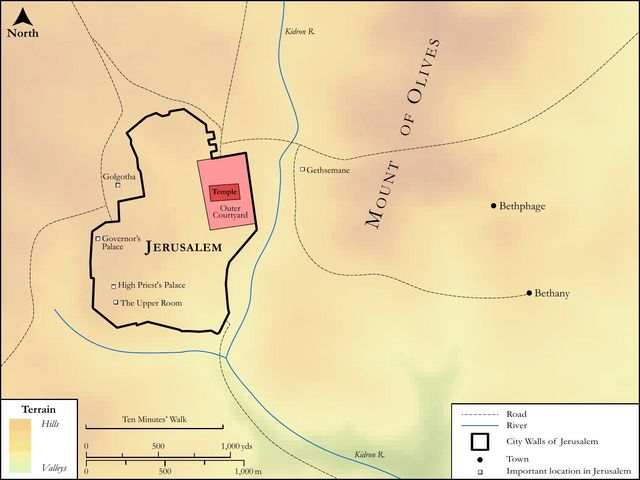
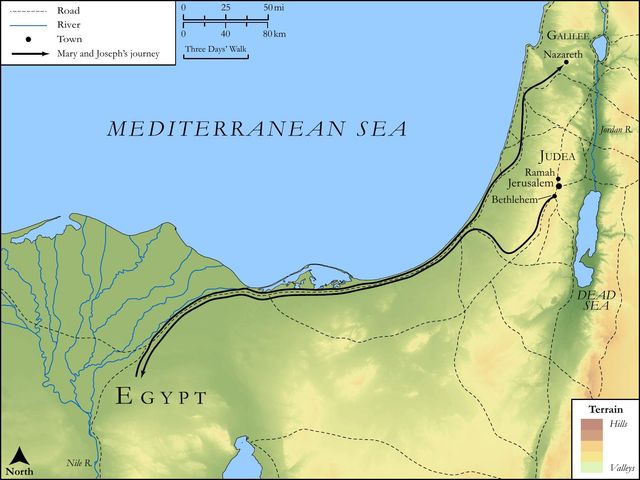
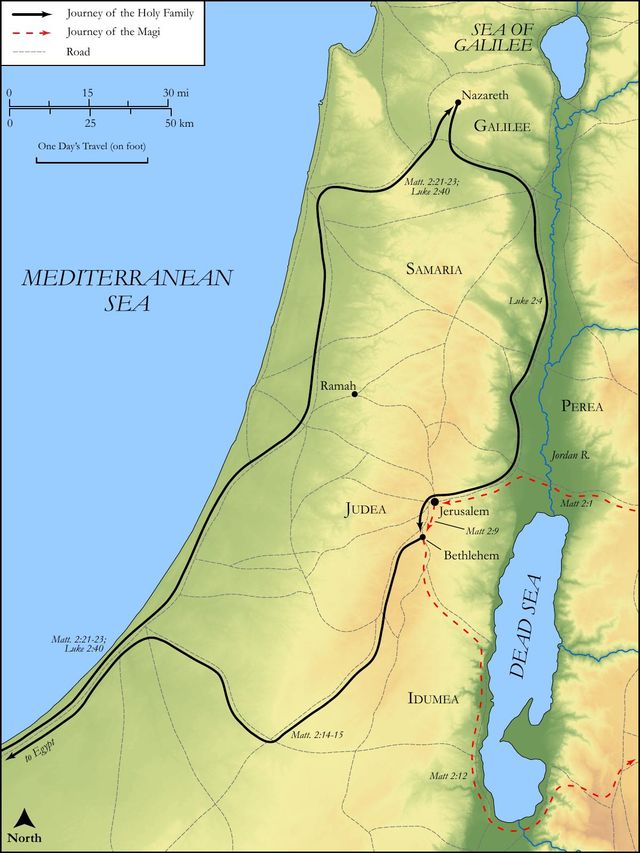
See on the biblical-era maps
Study this verse
Public-domain commentary
Matthew Henry
From his Commentary on the Whole Bible. Henry comments on passages, not single verses — this entry covers Matthew 2:16–18. His two-level outline is real structure in the source text, so it is rendered as structure.
Here is, I. Herod's resentment of the departure of the wise men. He waited long for their return; he hopes, though they be slow, they will be sure, and he shall crush this rival at his first appearing; but he hears, upon enquiry, that they are gone off another way, which increases his jealousy, and makes him suspect they are in the interest of this new King, which made him exceedingly wroth; and he is the more desperate and outrageous for his being disappointed. Note, Inveterate corruption swells the higher for the obstructions it meets with in a sinful pursuit.
II.His political contrivance, notwithstanding this, to take off him that is born King of the Jews.
If he could not reach him by a particular execution, he doubted not but to involve him in a general stroke, which, like the sword of war, should devour one as well as another. This would be sure work; and thus those that would destroy their own iniquity must be sure to destroy all their iniquities. Herod was an Edomite, enmity to Israel was bred in the bone with him. Doeg was an Edomite, who, for David's sake, slew all the priests of the Lord. It was strange that Herod could find any so inhuman as to be employed in such a bloody and barbarous piece of work; but wicked hands never want wicked tools to work with. Little children have always been taken under the special protection, not only of human laws, but of human nature; yet these are sacrificed to the rage of this tyrant, under whom, as under Nero, innocence is the least security. Herod was, throughout his reign, a bloody man; it was not long before, that he destroyed the whole Sanhedrim, or bench of judges; but blood to the blood-thirsty is like drink to those in a dropsy; Quo plus sunt potae, plus sitiuntur aquae - The more they drink, the more thirsty they become. Herod was now about seventy years old, so that an infant, at this time under two years old, was not likely ever to give him any disturbance. Nor was he a man over fond of his own children, or of their preferment, having formerly slain two of his own sons, Alexander and Aristobulus, and his son Antipater after this, but five days before he himself died; so that it was purely to gratify his own brutish lusts of pride and cruelty that he did this. All is fish that comes to his net.
Observe, What large measures he took, 1. As to time; He slew all from two years old and under. It is probable that the blessed Jesus was at this time not a year old; yet Herod took in all the infants under two years old, that he might be sure not to miss of his prey. He cares not how many heads fall, which he allows to be innocent, provided that escape not which he supposes to be guilty. 2. As to place; He kills all the male children, not only in Bethlehem, but in all the coasts thereof, in all the villages of that city. This was being overmuch wicked, Ecc 7:17. Hate, an unbridled wrath, armed with an unlawful power, often transports men to the most absurd and unreasonable instances of cruelty. It was no unrighteous thing for God to permit this; every life is forfeited to his justice as soon as it commences; that sin which entered by one man's disobedience, introduced death with it; and we are not to suppose any thing more than that common guilt, we are not to suppose that these children were sinners above all that were in Israel, because they suffered such things. God's judgments are a great deep. The diseases and deaths of little children are proofs of original sin. But we must look upon this murder of the infants under another character: it was their martyrdom. How early did persecution commence against Christ and his kingdom! Think ye that he came to send peace on the earth? No, but a sword, such a sword as this, Mat 10:34, Mat 10:35. A passive testimony was hereby given to the Lord Jesus. As when he was in the womb, he was witnessed to by a child's leaping in the womb for joy at his approach, so now, at two years old, he had contemporary witnesses to him of the same age. They shed their blood for him, who afterwards shed his for them. These were the infantry of the noble army of martyrs. If these infants were thus baptized with blood, though it were their own, into the church triumphant, it could not be said but that, with what they got in heaven, they were abundantly recompensed for what they lost on earth. Out of the mouths of these babes and sucklings God did perfect his praise; otherwise, it is not good to the Almighty that he should thus afflict.
The tradition of the Greek church (and we have it in the Aethiopic missal) is, that the number of the children slain was 14,000; but that is very absurd. I believe, if the births of the male children in the weekly bills were computed, there would not be found so many under two years old, in one of the most populous cities in the world, that was not near a fortieth part of it. But it is an instance of the vanity of tradition. It is strange that Josephus does not relate this story; but he wrote long after St. Matthew, and it is probable that he therefore would not relate it, because he would not so far countenance the Christian history; for he was a zealous Jew; but, to be sure, if it had not been true and well attested, he would have contested it. Macrobius, a heathen writer, tells us, that when Augustus Caesar heard that Herod, among the children he order to be slain under two years old, slew his own son, he passed this jest upon him, That it was better to be Herod's swine than his son. The usage of the country forbade him to kill a swine, but nothing could restrain him from killing his son. Some think that he had a young child at nurse in Bethlehem; others think that, through mistake, two events are confounded - the murder of the infants, and the murder of his son Antipater. But for the church of Rome to put the Holy Innocents, as they call them, into their calendar, and observe a day in memory of them, while they have so often, by their barbarous massacres, justified, and even out - one Herod, is but to do as their predecessors did, who built the tombs of the prophets, while they themselves filled up the same measure.
Some observe another design of Providence in the murder of the infants. By all the prophecies of the Old Testament it appears that Bethlehem was the place, and this the time, of the Messiah's nativity; now all the children of Bethlehem, born at this time, being murdered, and Jesus only escaping, none but Jesus could pretend to be the Messiah. Herod now thought he had baffled all the Old Testament prophecies, had defeated the indications of the star, and the devotions of the wise men, by ridding the country of this new King; having burnt the hive, he concludes he had killed the master bee; but God in heaven laughs at him, and has him in derision. Whatever crafty cruel devices are in men's hearts, the counsel of the Lord shall stand.
III.The fulfilling of scripture in this (Mat 2:17, Mat 2:18); Then was fulfilled that prophecy (Jer 31:15), A voice was heard in Ramah.
See and adore the fulness of the scripture! That prediction was accomplished in Jeremiah's time, when Nebuzaradan, after he had destroyed Jerusalem, brought all his prisoners to Ramah (Jer 40:1), and there disposed of them as he pleased, for the sword, or for captivity. Then was the cry in Ramah heard to Bethlehem (for those two cities, the one in Judah's lot, and the other in Benjamin's, were not far asunder); but now the prophecy is again fulfilled in the great sorrow that was for the death of these infants. The scripture was fulfilled,
1.In the place of this mourning. The noise of it was heard from Bethlehem to Ramah; for Herod's cruelty extended itself to all the coasts of Bethlehem, even into the lot of Benjamin, among the children of Rachel. Some think the country about Bethlehem was called Rachel, because there she died, and was buried. Rachel's sepulchre was hard by Bethlehem, Gen 35:16, Gen 35:19. Compare Sa1 10:2. Rachel had her heart much set upon children: the son she died in travail of she called Benoni - the son of her sorrow. These mothers were like Rachel, lived near Rachel's grave, and many of them descended from Rachel; and therefore their lamentations are elegantly represented by Rachel's weeping.
2.In the degree of this mourning. It was lamentation and mourning, and great mourning; all little enough to express the sense they had of this aggravated calamity. There was a great cry in Egypt when the first-born were slain, and so there was here when the youngest was slain; for whom we naturally have a particular tenderness. Here was a representation of this world we live in. We hear in it lamentation, and weeping, and mourning, and see the tears of the oppressed, some upon one account, and some upon another. Our ways lie through a vale of tears. This sorrow was so great, that they would not be comforted. They hardened themselves in it, and took a pleasure in their grief. Blessed be God, there is no occasion of grief in this world, no, not that which is supplied by sin itself, that will justify us in refusing to be comforted! They would not be comforted, because they are not, that is, they are not in the land of the living, are not as they were, in their mothers' embraces. If, indeed, they were not, there might be some excuse for sorrowing as though we had no hope; but we know they are not lost, but gone before; if we forget that they are, we lose the best ground of our comfort, Th1 4:13. Some make this grief of the Bethlehemites to be a judgment upon them for their contempt of Christ. They that would not rejoice for the birth of the Son of God, are justly made to weep for the death of their own sons; for they only wondered at the tidings the shepherds brought them, but did not welcome them.
The quoting of this prophecy might serve to obviate an objection which some would make against Christ, upon this sad providence. "Can the Messiah, who is to be the Consolation of Israel, be introduced with all this lamentation?" Yes, for so it was foretold, and the scripture must be accomplished. And besides, if we look further into this prophecy, we shall find that the bitter weeping in Ramah was but a prologue to the greatest joy, for it follows, Thy work shall be rewarded, and there is hope in thy end. The worse things are, the sooner they will mend. Unto them a child was born, sufficient to repair their losses.
Historical interpretation
Nine Centuries of Reception
12 surviving comments on this verse. Each one is dated, so this reads as a timeline rather than a list.
Select a marker to jump to its quote. Markers stagger vertically where authors wrote within a few decades of each other.
(Hil. Quæst. N. and V. Test. 9. 62.) Or, The sons of Benjamin, who were akin to Rachel, were formerly cut off by the other tribes, and so extinct both then and ever after. (see Judg. 20.) Then therefore Rachel began to mourn her sons, when she saw those of her sister cut off in such a cause, that they should be heirs of eternal life; for he who has experienced any misfortune, is made more sensible of his losses by the good fortune of a neighbour.
It could not be that they were not who seemed now dead, but by glorious martyrdom they were advanced to eternal life; and consolation is for those who have suffered loss, not for those who have reaped a gain. Rachel affords a type of the Church long barren now at length fruitful. She is heard weeping for her children, not because she mourned them dead, but because they were slaughtered by those whom she would have retained as her first-born sons.
(Hom. ix.) The Evangelist by this history of so bloody a massacre, having filled the reader with horror, now again sooths his feelings, showing that these things were not done because God could not hinder, or knew not of them; but as the Prophet had foretold.
"Then was fulfilled that which was spoken by Jeremy the prophet, saying, In Rama was there a voice heard, Rachel weeping for her children, and would not be comforted, because they are not."
Thus having filled the hearer with horror by relating these things: the slaughter so violent and unjust, so extremely cruel and lawless; he comforts him again, by saying, Not from God's wanting power to prevent it did all this take place, nor from any ignorance of His, but when He both knew it, and foretold it, and that loudly by His prophet. Be not troubled then, neither despond, looking unto His unspeakable providence, which one may most clearly see, alike by what He works, and by what He permits.
But what, it may be said, hath Rachel to do with Bethlehem? For it saith, "Rachel weeping for her children." And what hath Rama to do with Rachel? Rachel was the mother of Benjamin, and on his death, they buried her in the horse-course that was near this place. The tomb then being near, and the portion pertaining unto Benjamin her infant (for Rama was of the tribe of Benjamin), from the head of the tribe first, and next from the place of her sepulture, He naturally denominates her young children who were massacred. Then to show that the wound that befell her was incurable and cruel, He saith, "she would not be comforted because they are not."
Hence again we are taught this, which I mentioned before, never to be confounded when what is happening is contrary to the promise of God. Behold, for instance, when He was come for the salvation of the people, or rather for the salvation of the world, of what kind were His beginnings. His mother, first, in flight; His birth-place is involved in irremediable calamities, and a murder is perpetrated of all murders the bitterest, and there is lamentation and great mourning, and wailings everywhere. But be not troubled for He is wont ever to accomplish His own dispensations by their contraries, affording us from thence a very great demonstration of His power.
(Vers. 17 seqq.) Then was fulfilled what was spoken by the prophet Jeremiah, saying: A voice was heard in Ramah, sobbing and loud lamentation; Rachel weeping for her children, and she would not be consoled, since they are no more (Jerem. XXXI, 15). But when Herod died, behold, an angel of the Lord appeared in a dream to Joseph in Egypt, saying: Rise, take the child and his mother, and go to the land of Israel. From Rachel was born Benjamin, in whose tribe Bethlehem is not (Genes. XXXV). Therefore, it is asked how Rachel mourns the sons of Judah, that is, Bethlehem, as if they were her own. We will answer briefly, because she is buried near Bethlehem in Ephrath, and from the maternal womb, she received the name of the mother's lodging. Whether because Judah and Benjamin were two joined tribes, and Herod had ordered not only the killing of children in Bethlehem, but also in all its borders. By the slaughter of Bethlehem, we understand that many from Benjamin were also killed. But she wept for her children, and she did not receive consolation, according to a twofold interpretation. Either because she considered them dead for eternity, or because she did not want to console herself about those whom she knew would survive. But what is said in Rama, let us not think that this is the name of a place, near Gabaa, but 'rama' is interpreted as 'an elevated place', so the meaning is: A voice was heard in an elevated place, that is, far and wide dispersed.
(In Hierem. 31:15.) This passage of Jeremiah has been quoted by Matthew neither according to the Hebrew nor the LXX version. This shows that the Evangelists and Apostles did not follow any one's translation, but according to the Hebrew manner expressed in their own words what they had read in Hebrew.
By Ramah we need not suppose that the town of that name near Gibeah is meant; but take it as signifying 'high.' A voice was heard 'aloft,' that is, spread far and wide.'
Rachel's son was Benjamin, in which tribe Bethlehem is not situated. How then does Rachel weep for the children of Judah as if they were her own? We answer briefly. She was buried near Bethlehem in Ephrata, and was regarded as the mother, because her body was there entertained. Or, as the two tribes of Judah and Benjamin were contiguous, and Herod's command extended to the coasts of Bethlehem as well as to the town itself, we may suppose that many were slain in Benjamin.
This may be understood in two ways; either she thought them dead for all eternity, so that no consolation could comfort her; or, she desired not to receive any comfort for those who she knew had gone into life eternal.
Or, it was heard on high, because uttered for the death of the innocent, according to that, The voice of the poor entereth into the heavens. (Ecclus. 35:21.) The 'weeping' means the cries of the children; 'lamentation,' refers to the mothers. In the infants themselves their death ends their cries, in the mothers it is continually renewed by the remembrance of their loss.
The sacred Evangelist adds, to show the greatness of the mourning, that even the dead Rachel was roused to mourn her sons, and would not be comforted because they were not.
Or, The Church weeps the removal of the saints from this earth, but wishes not to be comforted as though they should return again to the struggles of life, for they are not to be recalled into life.
Rachel is well set for a type of the Church, as the word signifies 'a sheep' or 'seeing;' (vid. note i, p. 19.) her whole thought being to fix her eye in contemplation of God; and she is the hundredth sheep that the shepherd layeth on his shoulder.
Lest anyone think that the slaying of the children took place against the will of God, the evangelist shows that God both knew of it beforehand and foretold it.
(ord.) She will not be comforted in this present life, for that they are not, but transfers all her hope and comfort to the life to come.
Continue studying Matthew 2:17 across the web’s major study libraries — every link below opens this exact verse, chapter, or book on the destination site.
Read & Compare
 BibleGatewayThis verse in more than 200 translations and 70 languages.
 Bible.comThe YouVersion reader — hundreds of translations, reading plans, and highlights.
 ESV.orgCrossway's official English Standard Version reader.
 NET BibleThe NET translation with 60,000+ translators' notes on every rendering decision.
 STEP BibleTyndale House's free study tool — original text, vocabulary, and scholarly resources.
 BibliaLogos Bible Software's free web reader.
 USCCBThe New American Bible (Revised Edition) with the U.S. bishops' study notes.
Commentaries
 BibleHub CommentariesDozens of classic commentaries on this verse, gathered on one page.
 StudyLightMore than 100 commentary sets — the largest collection on the web.
 BibleRefPlain-English commentary on what this verse means, verse by verse.
 Enduring WordDavid Guzik's free commentary on this chapter, widely used by Bible teachers.
 Bible Study ToolsVerse commentary alongside Greek and Hebrew study aids.
Original Language & Research
- BibleHub InterlinearThe verse word by word — original language, transliteration, and English.
- BibleHub LexiconEvery word's original-language definition and Strong's entry.
 Blue Letter BibleDeep-study tools — Strong's numbers, concordance, and word studies.
 CNTR CollationThe earliest Greek manuscripts of this verse, collated letter by letter.
Sermons, Hymns & Audio


TrulyRandomVerse is not affiliated with these sites and doesn’t control their content. They’re linked because they’re genuinely useful.
Summary
Matthew 2:17 serves as a pivotal interpretive declaration by the evangelist, signaling that the horrific massacre of Bethlehem's male children by King Herod was not a random tragedy but a direct fulfillment of ancient prophecy. This verse acts as a theological bridge, connecting the unfolding events of Jesus's early life to God's sovereign plan, foretold centuries earlier through His prophets, thereby underscoring the divine purpose even amidst profound human suffering.
Context
ShowHideLiterary Context
This verse immediately follows the chilling account of King Herod's brutal decree to slaughter all male children two years old and under in Bethlehem and its vicinity, as recorded in Matthew 2:16. This act of unspeakable cruelty was Herod's desperate attempt to eliminate the newborn "King of the Jews," whose birth had been announced by the Wise Men. Providentially, Joseph, having been warned by an angel, had already taken Mary and the infant Jesus to flee to Egypt, thus preserving the Messiah. Matthew frequently employs "fulfillment formulas" throughout his Gospel, such as in Matthew 1:22 concerning Jesus's birth and Matthew 2:15 regarding the return from Egypt, to demonstrate that Jesus's life meticulously aligns with Old Testament predictions, a crucial argument for his Jewish audience.
Historical & Cultural Context
The historical backdrop is the reign of Herod the Great, a paranoid and ruthless king appointed by Rome, known for his extreme cruelty, even executing members of his own family whom he perceived as threats to his throne. His fear of a rival king, especially one prophesied by Jewish scriptures, was entirely consistent with his character. Bethlehem, the birthplace of Jesus, held immense significance as the city of David and the prophesied birthplace of the Messiah. The cultural expectation among Jews for a Messiah was high, and Matthew's Gospel, written primarily for a Jewish audience, consistently seeks to demonstrate Jesus's messianic credentials by linking His life events to their sacred texts. The lamentation described in Jeremiah 31:15, which Matthew quotes, originally referred to the sorrow of the Israelite exiles being led away from Ramah (near Bethlehem) into Babylonian captivity, a profound historical trauma for the Jewish people.
Key Themes
ShowHideMatthew 2:17 contributes significantly to several overarching themes in Matthew's Gospel. Firstly, the Fulfillment of Prophecy is paramount; Matthew consistently highlights how events in Jesus's life, even tragic ones, are part of God's pre-ordained plan revealed in the Old Testament. This emphasis reinforces Jesus's identity as the long-awaited Messiah, whose life is the culmination of divine promises. Secondly, the verse underscores God's Sovereignty Amidst Suffering; even in the face of immense human cruelty and the innocent suffering of the children of Bethlehem, Matthew asserts that God's plan is unfolding according to His divine foreknowledge and purpose. This provides a theological framework for understanding suffering within God's redemptive narrative. Lastly, it powerfully affirms Messianic Identity by linking Jesus's early life experiences, including the painful and traumatic, to ancient prophecies, building a compelling and undeniable case for Jesus's unique role as the Christ, the anointed one of God.
Exposition and Analysis
ShowHideKey Word Analysis
ShowHideThis word (G4137) means "to make replete, i.e. (literally) to cram (a net), level up (a hollow), or (figuratively) to furnish (or imbue, diffuse, influence), satisfy, execute (an office), finish (a period or task), verify (or coincide with a prediction), etc." In this context, it specifically denotes the verification or coincidence of an event with a prior prediction, indicating that the tragic events in Bethlehem brought to completion or brought into reality what had been foretold. It implies divine intentionality and precision.
This verb (G4483) means "to utter, i.e. speak or say." It refers to the act of articulating words, emphasizing that the prophecy from Jeremiah was a direct verbal utterance, a divine declaration conveyed through a human agent. It highlights the authoritative and deliberate nature of the prophetic word.
This noun (G4396) refers to "a foreteller ("prophet"); by analogy, an inspired speaker." Jeremiah is identified here not merely as a historical figure, but as one who spoke under divine inspiration, conveying God's message, which included foretelling future events and interpreting God's will for His people. This term lends authority and divine origin to the words about to be quoted.
Verse Breakdown
ShowHide"Then was fulfilled"
This phrase, a characteristic "fulfillment formula" in Matthew's Gospel, acts as a theological commentary. "Then" (G5119, tóte') points to the specific time of the massacre, indicating that this event, though tragic, was the precise moment for the prophecy's realization. "Was fulfilled" (G4137, plēróō') signifies that the prophecy reached its completion or came to pass, not by chance, but by divine design.
"that which was spoken"
This refers to the content of the prophecy itself, emphasizing its verbal and authoritative nature. It highlights that the events were not random but were in direct alignment with words previously uttered by God's messenger.
"by Jeremy the prophet, saying,"
This clearly identifies the source of the prophecy as Jeremiah (G2408, Hieremías'), an authoritative figure in the Old Testament prophetic tradition. By naming him, Matthew grounds the current events in the continuous narrative of God's interaction with His people, affirming the enduring relevance and truthfulness of the Old Testament Scriptures. The word "saying" (G3004, légō') introduces the direct quotation that follows in the next verse.
Literary Devices
ShowHideMatthew 2:17 primarily employs the Fulfillment Formula, a recurring literary device throughout his Gospel (e.g., Matthew 1:22, Matthew 2:15). This formula, "Then was fulfilled that which was spoken by..." serves as a theological commentary, explicitly linking the events of Jesus's life to Old Testament prophecies and demonstrating their divine necessity. It functions as an Allusion to the Old Testament, specifically to Jeremiah, inviting the reader to recall the original context of the prophecy and understand its reapplication. Furthermore, the verse acts as a form of Theological Commentary by the evangelist himself, providing an interpretive lens through which the reader is to understand the preceding tragic events, transforming them from random acts of violence into purposeful elements within God's unfolding redemptive plan.
Theological and Thematic Connections
ShowHideMatthew 2:17 profoundly asserts God's unwavering sovereignty, even in the face of profound human evil and innocent suffering. It posits that the horrific massacre of the Bethlehem children, while a testament to human depravity, was not outside the scope of God's foreknowledge or His ultimate redemptive plan. This verse demonstrates the intricate connection between Old Testament prophecy and New Testament events, revealing a divine blueprint for history that culminates in Christ. It reassures believers that even when circumstances appear chaotic and senseless, God's purposes are being meticulously accomplished, offering a framework for faith amidst tragedy. The lament of Rachel, originally for the exiles, is re-echoed in Bethlehem, showing that the suffering of God's people, though grievous, is never without divine attention or ultimate meaning within His larger narrative of salvation.
Reflection and Application
ShowHideMatthew 2:17, though describing a deeply sorrowful event, offers a profound theological comfort: God is sovereign, and His purposes are fulfilled even amidst the most painful human experiences. In a world often marked by suffering, injustice, and seemingly senseless tragedies, this verse calls us to look beyond immediate circumstances and recognize the overarching hand of God. It encourages us to trust that even when we cannot comprehend the "why" of suffering, God's plan is unfolding, and His ultimate redemptive purposes will prevail. For believers, this means finding hope not in the absence of pain, but in the presence of a God who works all things for good for those who love Him. It challenges us to cultivate a faith that sees God's hand not only in blessings but also in the midst of trials, knowing that His word is true and His promises are sure.
Questions for Reflection
ShowHideFAQ
ShowHideWhy does Matthew emphasize "fulfillment" so frequently in his Gospel?
ShowHideMatthew's Gospel, written primarily for a Jewish audience, frequently emphasizes "fulfillment" (using phrases like "then was fulfilled") to demonstrate that Jesus is the long-awaited Messiah, the Christ, whose life, death, and resurrection perfectly align with the prophecies of the Old Testament. This was crucial for convincing Jewish readers that Jesus was indeed the one foretold by their sacred scriptures. By showing that events in Jesus's life, from His birth to His flight to Egypt and even the tragic massacre of the innocents, were all part of God's pre-ordained plan, Matthew strengthens his argument for Jesus's messianic identity and divine authority. He wants his readers to see Jesus not as a random historical figure, but as the culmination of God's redemptive history, the one for whom all of Israel's story had been preparing.
Was Jeremiah 31:15 really about Herod's massacre of the innocents, or was Matthew reinterpreting it?
ShowHideThe original context of Jeremiah 31:15 describes Rachel weeping for her children (the tribes of Ephraim and Manasseh, her descendants) as they were led into Babylonian exile from Ramah, a place near Bethlehem. Matthew's use of this prophecy for Herod's massacre is an example of what scholars call "typological fulfillment" or "prophetic reapplication." Matthew is not suggesting that Jeremiah's original prophecy only referred to Herod's time, but rather that the sorrow and lamentation of Rachel, a mother figure for Israel, found a profound and tragic echo in the new suffering inflicted upon the children of Bethlehem. The earlier event (exile) serves as a type or foreshadowing of the later event (Herod's massacre), both being instances of profound national sorrow and the loss of Israel's children. Matthew sees a deeper, spiritual continuity in these events, where the suffering of Israel's past is recapitulated in the context of the Messiah's arrival, underscoring the depth of the redemptive drama. This method of interpreting Old Testament texts was common in Jewish thought and early Christian writings.
Christ-Centered Fulfillment
ShowHideMatthew 2:17, while highlighting the tragic suffering of the innocent children, ultimately points to the Christ-centered fulfillment of God's redemptive plan. The lamentation of Rachel, re-echoed in Bethlehem, foreshadows the deeper, ultimate suffering that the Messiah Himself would endure. Jesus, the true Israel, uniquely experienced exile, rejection, and profound sorrow, culminating in His sacrificial death. His journey from Bethlehem, through the flight to Egypt, and ultimately to the cross, is a narrative of suffering that ultimately brings comfort and salvation. The tears shed in Bethlehem anticipate the tears that Jesus would shed over Jerusalem (Luke 19:41) and the ultimate sorrow He would bear for the sins of the world (Isaiah 53:4-6). Through His suffering, Jesus fully identifies with humanity's pain, becoming our sympathetic High Priest (Hebrews 2:17-18). Thus, the fulfillment in Matthew 2:17, while initially somber, ultimately points to the one who would conquer suffering and death, promising a future where God Himself will wipe away every tear from our eyes (Revelation 21:4). The prophetic word, fulfilled in Christ, assures us that even the darkest moments are woven into God's glorious tapestry of salvation.