


Matthew 12:46
Bible text: King James Version (1769 Blayney text) · Public domain
Bible text: Berean Standard Bible · Public domain
Bible text: American Standard Version (1901) · Public domain
Bible text: World English Bible, Messianic edition · Public domain
Bible text: Geneva Bible (1599) · Public domain
Bible text: Young's Literal Translation · Public domain
- ἜτιEtiWhileG2089ADVAdverb
- δὲdenowG1161CONJConjunction
- αὐτοῦautouwhen HeG846P-GSMPersonal pronoun Genitive Singular Masculine
- λαλοῦντοςlalountosis speakingG2980V-PAP-GSMVerb Present Active Participle Genitive Singular Masculine
- τοῖςtoisto theG3588T-DPMDefinite article Dative Plural Masculine
- ὄχλοιςochloiscrowdsG3793N-DPMNoun Dative Plural Masculine
- ἰδοὺidoubeholdG2400INJInterjection
- ἡhētheG3588T-NSFDefinite article Nominative Singular Feminine
- μήτηρmētērmotherG3384N-NSFNoun Nominative Singular Feminine
- καὶkaiandG2532CONJConjunction
- οἱhoitheG3588T-NPMDefinite article Nominative Plural Masculine
- ἀδελφοὶadelphoibrothersG80N-NPMNoun Nominative Plural Masculine
- αὐτοῦautouof HimG846P-GSMPersonal pronoun Genitive Singular Masculine
- εἱστήκεισανheistēkeisanhad been standingG2476V-LAI-3PVerb Pluperfect Active Indicative 3rd Plural
- ἔξωexōoutsideG1854PREPPreposition
- ζητοῦντεςzētountesseekingG2212V-PAP-NPMVerb Present Active Participle Nominative Plural Masculine
- αὐτῷautōto HimG846P-DSMPersonal pronoun Dative Singular Masculine
- λαλῆσαιlalēsaito speakG2980V-AANVerb Aorist Active Infinitive
English is a literal word-by-word gloss of the Greek, not the KJV's wording. Why?
This is the original text the KJV's translators worked from — each Greek word with its own literal English meaning in this verse, prepared by scholars at Tyndale House, Cambridge. The KJV translates whole sentences, not word by word, so its wording differs: one Greek word can become several English words, and the KJV may choose “charity” where the gloss reads “love”. Both are faithful — they answer different questions. For the KJV's own rendering, switch to the KJV text.
Details
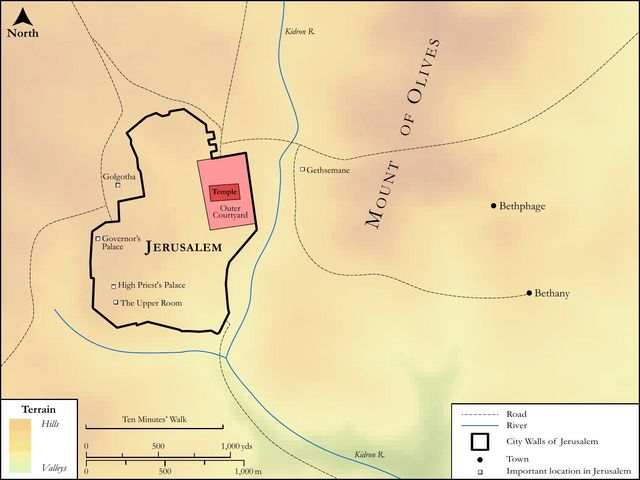
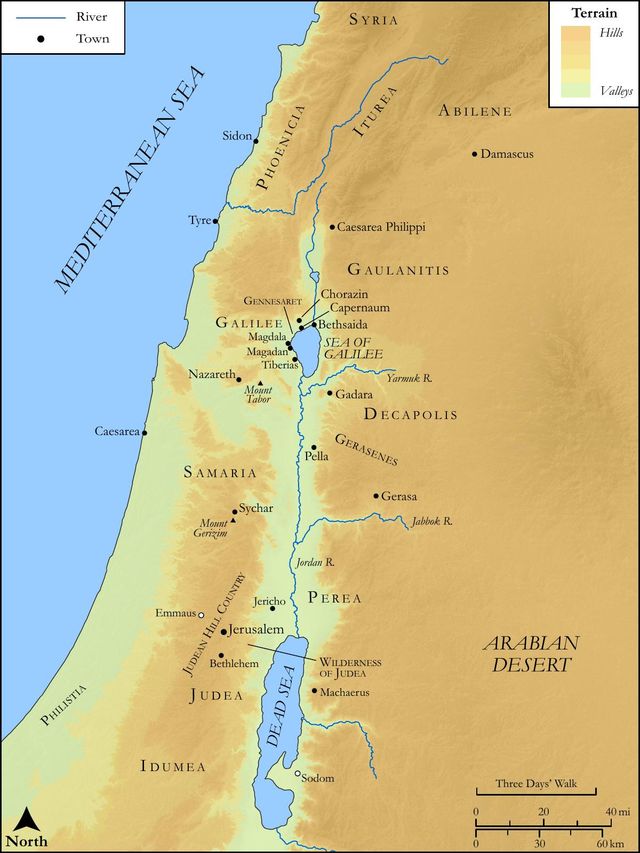
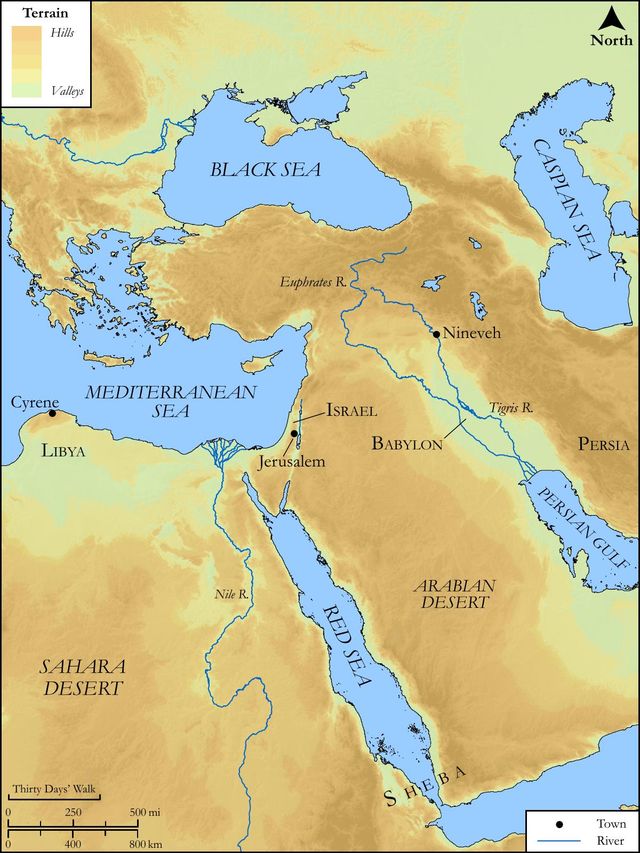
See on the biblical-era maps
Study this verse
Public-domain commentary
Matthew Henry
From his Commentary on the Whole Bible. Henry comments on passages, not single verses — this entry covers Matthew 12:46–50. His three-level outline is real structure in the source text, so it is rendered as structure.
Many excellent, useful sayings came from the mouth of our Lord Jesus upon particular occasions; even his digressions were instructive, as well as his set discourses: as here,
Observe, I. How Christ was interrupted in his preaching by his mother and his brethren, that stood without, desiring to speak with him (Mat 12:40, Mat 12:47); which desire of theirs was conveyed to him through the crowd. It is needless to enquire which of his brethren they were that came along with his mother (perhaps they were those who did not believe in him, Joh 7:5); or what their business was; perhaps it was only designed to oblige him to break off, for fear he should fatigue himself, or to caution him to take heed of giving offence by his discourse to the Pharisees, and or involving himself in a difficulty; as if they could teach him wisdom.
1.He was as yet talking to the people. Note, Christ's preaching was talking; it was plain, easy, and familiar, and suited to their capacity and case. What Christ had delivered had been cavilled at, and yet he went on. Note, The opposition we meet with in our work, must not drive us from it. He left off talking with the Pharisees, for he saw he could do no good with them; but continued to talk to the common people, who, not having such a conceit of their knowledge as the Pharisees had, were willing to learn.
2.His mother and brethren stood without, desiring to speak with him, when they should have been standing within, desiring to hear him. They had the advantage of his daily converse in private, and therefore were less mindful to attend upon his public preaching. Note, Frequently those who are nearest to the means of knowledge and grace, are most negligent. Familiarity and easiness of access breed some degree of contempt. We are apt to neglect that this day, which we think we may have any day, forgetting that it is only the present time we can be sure of; tomorrow is none of ours. There is too much truth in that common proverb, "The nearer the church, the further from God;" it is pity it should be so.
3.They not only would not hear him themselves, but they interrupted others that heard him gladly. The devil was a sworn enemy to our Saviour's preaching. He had sought to baffle his discourse by the unreasonable cavils of the scribes and Pharisees, and when he could not gain his point that way, he endeavoured to break it off by the unseasonable visits of relations. Note, We often meet with hindrances and obstructions in our work, by our friends that are about us, and are taken off by civil respects from our spiritual concerns. Those who really wish well to us and to our work, may sometimes, by their indiscretion, prove our back-friends, and impediments to us in our duty; as Peter was offensive to Christ, with his, "Master, spare thyself," when he thought himself very officious. The mother of our Lord desired to speak with him; it seemed she had not then learned to command her Son, as the iniquity and idolatry of the church of Rome has since pretended to teach her: nor was she so free from fault and folly as they would make her. It was Christ's prerogative, and not his mother's, to do every thing wisely, and well, and in its season. Christ once said to his mother, How is it that ye sought me? Wist he not, that I must be about my Father's business? And it was then said, she laid up that saying in her heart (Luk 2:49); but if she had remembered it now, she would not have given him this interruption when he was about his Father's business. Note, There is many a good truth that we thought was well laid up when we heard it, which yet is out of the way when we have occasion to use it.
II.How he resented this interruption, Mat 12:48-50.
1.He would not hearken to it; he was so intent upon his work, that no natural or civil respects should take him off from it. Who is my mother and who are my brethren? Not that natural affection is to be put off, or that, under pretence of religion, we may be disrespectful to parents, or unkind to other relations; but every thing is beautiful in its season, and the less duty must stand by, while the greater is done. When our regard to our relations comes in competition with the service of God, and the improving of an opportunity to do good, in such a case, we must say to our Father, I have not seen him, as Levi did, Deu 33:9. The nearest relations must be comparatively hated, that is, we must love them less than Christ (Luk 14:26), and our duty to God must have the preference. This Christ has here given us an example of; the zeal of God's house did so far eat him up, that it made him not only forget himself, but forget his dearest relations. And we must not take it ill of our friends, nor put it upon the score of their wickedness, if they prefer the pleasing of God before the pleasing of us; but we must readily forgive those neglects which may be easily imputed to a pious zeal for God's glory and others' good. Nay, we must deny ourselves and our own satisfaction, rather than do that which may any way divert our friends fRom. or distract them in, their duty to God.
2.He took that occasion to prefer his disciples, who were his spiritual kindred, before his natural relations as such: which was a good reason why he would not leave preaching to speak with his brethren. He would rather be profiting his disciples, than pleasing his relations. Observe,
(1.)The description of Christ's disciples. They are such as do the will of his Father; not only hear it, and know it, and talk of it, but do it; for doing the will of God is the best preparative for discipleship (Joh 7:17), and the best proof of it (Mat 7:21); that denominates us his disciples indeed. Christ does not say, "Whosoever shall do my will," for he came not to seek or do his own will distinct from his Father's: his will and his Father's are the same; but he refers us to his Father's will, because now in his present state and work he referred himself to it, Joh 6:38.
(2.)The dignity of Christ's disciples: The same is my brother, and sister, and mother. His disciples, that had left all to follow him, and embraced his doctrine, were dearer to him than any that were akin to him according to the flesh. They had preferred Christ before their relations; they left their father (Mat 4:22; Mat 10:37); and now to make them amends, and to show that there was no love lost, he preferred them before his relations. Did not they hereby receive, in point of honour, a hundred fold? Mat 19:29. It was very endearing and very encouraging for Christ to say, Behold my mother and my brethren; yet it was not their privilege alone, this honour have all the saints. Note, All obedient believers are near akin to Jesus Christ. They wear his name, bear his image, have his nature, are of his family. He loves them, converses freely with them as his relations. He bids them welcome to his table, takes care of them, provides for them, sees that they want nothing that is fit for them: when he died he left them rich legacies, now he is in heaven he keeps up a correspondence with them, and will have them all with him at last, and will in nothing fail to do the kinsman's part (Rut 3:13), nor will ever be ashamed of his poor relations, but will confess them before men, before the angels, and before his Father.
Historical interpretation
Seven Centuries of Reception
11 surviving comments on this verse. Each one is dated, so this reads as a timeline rather than a list.
Select a marker to jump to its quote. Markers stagger vertically where authors wrote within a few decades of each other.
Because He had spoken all the aforesaid things in the power of His Father's majesty, therefore the Evangelist proceeds to tell what answer He made to one that told Him that His mother and His brethren waited for Him without; While he yet spake unto the people, his mother and his brethren stood without desiring to see him.
And He cannot be held to have thought meanly of His mother, seeing that in His passion He evinced the most extreme carefulness for her.
Although they had like the rest power to come in, yet they abstain from all approach to Him, for he came unto his own, and his own received him not. (John 1:11.)
That “his brothers” did not yet believe in him we learn from John, while from Mark we have also heard something else: for his own family tried to lay hands on him, as though he were beside himself. On account of their frame of mind, the Lord does not often mention them as his own family. He points instead to those who are obedient. To believers he applies all the terms of family relationship, those, namely, who had been joined to him in the kindred fellowship of obedience. Even if temporarily he had a quarrel with Mary, as Simeon had foretold when he had said “a sword shall pierce through your own soul,” she overcame these things, as was fitting, and the Lord graciously made mention of her at his passion and entrusted her to the beloved disciple.
(in Luc. 8:21.) Nor does He overthrow the duty of filial submission, which is conveyed in the command, Honour thy father and thy mother, (Ex. 20:12.) but shows that He owes more to the mysteries and relationship of His Father, than of His mother; as it follows, And stretching out his hand to his disciples, he said, Behold my mother and my brethren.
(Hom. xliv.) But mart the loftiness of His brethrena; when they should have come in and heartened with the crowd, or if they would not this, to have waited the end of His speech, and then to have approached Him—they on the contrary call Him out to them, and do this before the multitude, therein showing their superabundant love of honour, and also, that with all authority they lay their commands upon Christ. This the Evangelist covertly hints when he says, While he yet spake; as much as to say, Was there no other time? But what did they seek to say? Was it aught of the dogmas of truth? then should they have brought it forth before all, that all might profit thereby. But if of other things that concerned themselves alone, they should not have called Him in such haste, whence it is plain that they did this out of vain glory.
For He said not, Go and say unto her, She is not My mother, but continues His discourse to him that had brought Him word; as it follows; But he answered and said unto him that told him, Who is my mother? and who are my brethren?
But had He desired to disown His mother, He would have done it at the time when the Jews cast His birth in His teeth.
And besides what has been said, He taught also somewhat more, namely, that we should not neglect virtue relying on any kindred. For if it profited His mother nothing that she was such, if she had not had virtue, who is there that shall be saved by his kindred? For there is one only nobility, to do the will of God, and therefore it follows, Whoso shall do the will of my Father which is in heaven, the same is my brother, and sister, and mother. Many women have blessed that holy Virgin and her womb, and have desired to be made such mothers. What is it then that hinders? Behold, He hath set before you a broad way, and not women only, but men likewise, may become the mother of God.
That which I was lately saying, that when virtue is wanting all things are vain, this is now also pointed out very abundantly. For I indeed was saying, that age and nature, and to dwell in the wilderness, and all such things, are alike unprofitable, where there is not a good mind; but to-day we learn in addition another thing, that even to have borne Christ in the womb, and to have brought forth that marvellous birth, hath no profit, if there be not virtue.
And this is hence especially manifest. "For while He yet talked to the people," it is said, "one told Him, Thy mother and Thy brethren seek Thee. But He saith, who is my mother, and who are my brethren?" And this He said, not as being ashamed of His mother, nor denying her that bare Him; for if He had been ashamed of her, He would not have passed through that womb; but as declaring that she hath no advantage from this, unless she do all that is required to be done. For in fact that which she had essayed to do, was of superfluous vanity; in that she wanted to show the people that she hath power and authority over her Son, imagining not as yet anything great concerning Him; whence also her unseasonable approach. See at all events both her self-confidence and theirs. Since when they ought to have gone in, and listened with the multitude; or if they were not so minded, to have waited for His bringing His discourse to an end, and then to have come near; they call Him out, and do this before all, evincing a superfluous vanity, and wishing to make it appear, that with much authority they enjoin Him. And this too the evangelist shows that he is blaming, for with this very allusion did he thus express himself, "While He yet talked to the people;" as if he should say, What? was there no other opportunity? Why, was it not possible to speak with Him in private?
And what was it they wished to say? For if it were touching the doctrines of the truth, they ought to have propounded these things publicly, and stated them before all, that the rest also might have the benefit: but if about other matters that concerned themselves, they ought not to have been so urgent. For if He suffered not the burial of a father, lest the attendance on Him should be interrupted, much less ought they to have stopped His discourse to the people, for things that were of no importance. Whence it is clear, that nothing but vainglory led them to do this; which John too declares, by saying, "Neither did His brethren believe on Him;" and some sayings too of theirs he reports, full of great folly; telling us that they were for dragging Him to Jerusalem, for no other purpose, but that they themselves might reap glory from His miracles. "For if thou do these things," it is said, "show Thyself to the world. For there is no man that doeth anything in secret, and seeketh himself to be manifest;" when also He Himself rebuked them, attributing it to their carnal mind. That is, because the Jews were reproaching Him, and saying, "Is not this the carpenter's son, whose father and mother we know? and His brethren, are not they with us?" they, willing to throw off the disparagement caused by His birth, were calling Him to the display of His miracles.
For this cause He quite repels them, being minded to heal their infirmity; since surely, had it been His will to deny His mother, He would have denied her then, when the Jews were reproaching Him. But as it is, we see that He takes so great care of her, as even at the very cross to commit her to the disciple whom He loved most of all, and to give him a great charge concerning her.
But now He doth not so, out of care for her, and for His brethren. I mean, because their regard for Him was as towards a mere man, and they were vainglorious, He casts out the disease, not insulting, but correcting them.
But do thou, I pray, examine not the words only, which contain a moderate reproof, but also the unbecoming conduct of His brethren, and the boldness wherewith they had been bold and who was the person reproving it, no mere man, but the only-begotten Son of God; and with what purpose He reproved; that it was not with intent to drive them to perplexity, but to deliver them from the most tyrannical passion and to lead them on by little and little to the right idea concerning Himself, and to convince her that He was not her Son only, but also her Lord: so wilt thou perceive that the reproof is in the highest degree both becoming Him and profitable to her, and withal having in it much gentleness. For He said not, "Go thy way, tell my mother, thou art not my mother," but He addresses Himself to the person that told Him; saying, "Who is my mother?" together with the things that have been mentioned providing for another object also. What then is that? That neither they nor others confiding in their kindred, should neglect virtue. For if she is nothing profited by being His mother, were it not for that quality in her, hardly will any one else be saved by his kindred. For there is one only nobleness, to do the will of God. This kind of noble birth is better than the other, and more real.
(cont. Helvid. 14, et seq.) From this is taken one of Helvidius's propositions, on the ground that mention is made in the Gospel of the brethren of the Lord. How, says he, are they called brethren of the Lord, if they were not his brethren? But now it should be known that in divine Scripture men are said to be brethren in four different ways, by nature, by nation, by kindred, and by affection. By nature, as Esau and Jacob. By nation, as all Jews are called brethren, as in Deuteronomy, Thou shalt not set over thee a foreigner who is not thy brother. (Deut. 17:15) They are called brethren by kindred who are of one family, as in Genesis, Abraham said unto Lot, Let there not be strife between thee and me, for we are brethren. (Gen. 13:8) Also men are called brethren by affection, which is of two kinds, special and general. Special, as all Christians are called brethren, as the Saviour says, Go tell my brethren. General, inasmuch as all men are born of one father, we are bound together by a tie of consanguinity, as in that, Say unto them that hate you, Ye are our brethren. (Is. 66:5 sec. LXX.) I ask then, after which manner these are called the Lord's brethren in the Gospel? According to nature? But Scripture saith not, neither calling them sons of Mary nor of Joseph. By nation? But it is absurd that some few out of all the Jews should be called brethren, seeing that all the Jews who were there might have thus been called brethren. By affection, either of a human sort, or of the Spirit? If that be true, yet how were they more His brethren than the Apostles, whom He instructed in the inmost mysteries. Or if because they were men, and all men are brethren, it was foolish to say of them in particular, Behold, thy brethren seek thee. It only remains then that they should be His brethren by kindred, not by affection, not by privilege of nation, not by nature.
(in loc.) But some suspect the brethren of the Lord to be sons of Joseph by another wife, following the idle fancies of apocryphal writers, who have coined a certain woman called E sea. But we understand by the brethren of the Lord, not the sons of Joseph, but cousins of the Saviour, sons of a sister of Mary, an aunt of Our Lord, who is said to be the mother of James the Less, and Joseph, and Jude, whom in another place of the Gospel we find called the brethren of the Lord. (Mark 6:3) And that cousins are called brethren, appears from every part of Scripture.
He that delivers this message, seems to me not to do it casually and without meaning, but as setting a snare for Him, whether He would prefer flesh and blood to the spiritual work; and thus the Lord refused to go out, not because He disowned His mother and His brethren, but that He might confound him that had laid this snare for Him.
He did not then, as Marcion and Manichæus say, disown His mother, so as to be thought to be born of a phantasm, but He preferred His Apostles to His kindred, that we also in a comparison of our affections should set the spirit before the flesh.
Let us also expound in another way. The Saviour is speaking to the multitude—that is, He teaches the Gentiles the inward mysteries; His mother and His brethren, that is the synagogue and the Jewish people, stand without.
And when they shall have asked and enquired, and sent a messenger, they shall receive for answer, that their will is free, and that they can enter in, if they will believe.
(Verse 46 and following) While he was still speaking to the crowds, behold his mother and brothers stood outside seeking to speak to him. But someone said to him: Look, your mother and brothers stand outside seeking you. But he answered the one who told him, saying: Who is my mother, and who are my brothers? And stretching out his hand towards his disciples, he said. The Lord was occupied with the work of speaking, teaching the people, and fulfilling the duty of preaching, while his mother and brothers came and stood outside, desiring to speak to him. Then someone announces to the Savior that his mother and brothers are standing outside, seeking him. It seems to me that this person who announces it is not doing so by chance and simply: but is setting a trap for the Savior, whether he prefers spiritual work over flesh and blood. Therefore, the Lord, not because he denied his mother and brothers, ignored their request to go out; but because he responded to the one laying a trap, extending his hand towards his disciples, he said:
(De Cons. Ev. ii. 40.) We are to understand without doubt that this happened close upon the foregoing; for he begins to tell it with the words, And while he yet spake. What can that yet mean but that it was at the very time He spake the foregoing things? Mark also follows up that which He had said concerning blasphemy against the Holy Ghost, by saying, And there came his mother and his brethren. (Mark 3:31) Luke has not observed the order of action here, but has placed this earlier as he happened to recollect it.
(Mor. vii. 17.) For it often happens that the soul in the commencement of its progress is lifted up, and prides itself on its virtues, that it opens an entrance to the adversary who is raging against it, and who shows himself the more violent in breaking into it, by how much he was grieved at being cast out, though but for a short space.
(Hom. in Ev. iii. 2.) The Lord deigned to call faithful disciples His brethren, saying, Go, tell my brethren. Since then a man may be made a brother of the Lord by coming to the faith, it should be enquired how one may become also His mother. Be it known by us then, that he that by believing is made brother or sister of Christ, becomes His mother by preaching; for in pouring Him into the heart of the hearer, he may be said to beget the Lord; and he is made the Lord's mother, when by his word love of the Lord is begotten in the mind of his neighbour.
(ubi sup.) Thus also His mother is declared to stand without, as though she was not acknowledged, because the synagogue is therefore not acknowledged by its Author, because it held to the observance of the Law, and having lost the spiritual discernment thereof, kept itself without to guard the letter.
Hence also His mother, when she is seemingly not acknowledged, is said to be standing outside, because clearly the Synagogue is not recognized by its Author, since, while holding to the observance of the Law, it lost spiritual understanding, and fixed itself outside in guarding the letter.
Subject to a certain human foible, His mother wanted to show that she had authority over her child, for she did not yet comprehend His greatness. This is why, while He was still speaking, she wished to summon Him to herself, seeking to draw attention to her son’s obedience to her. What does Christ do? He knew her intentions; hear what He says:
Continue studying Matthew 12:46 across the web’s major study libraries — every link below opens this exact verse, chapter, or book on the destination site.
Read & Compare
 BibleGatewayThis verse in more than 200 translations and 70 languages.
 Bible.comThe YouVersion reader — hundreds of translations, reading plans, and highlights.
 ESV.orgCrossway's official English Standard Version reader.
 NET BibleThe NET translation with 60,000+ translators' notes on every rendering decision.
 STEP BibleTyndale House's free study tool — original text, vocabulary, and scholarly resources.
 BibliaLogos Bible Software's free web reader.
 USCCBThe New American Bible (Revised Edition) with the U.S. bishops' study notes.
Commentaries
 BibleHub CommentariesDozens of classic commentaries on this verse, gathered on one page.
 StudyLightMore than 100 commentary sets — the largest collection on the web.
 BibleRefPlain-English commentary on what this verse means, verse by verse.
 Enduring WordDavid Guzik's free commentary on this chapter, widely used by Bible teachers.
 Bible Study ToolsVerse commentary alongside Greek and Hebrew study aids.
Original Language & Research
- BibleHub InterlinearThe verse word by word — original language, transliteration, and English.
- BibleHub LexiconEvery word's original-language definition and Strong's entry.
 Blue Letter BibleDeep-study tools — Strong's numbers, concordance, and word studies.
 CNTR CollationThe earliest Greek manuscripts of this verse, collated letter by letter.
Sermons, Hymns & Audio


TrulyRandomVerse is not affiliated with these sites and doesn’t control their content. They’re linked because they’re genuinely useful.
Summary
While Jesus was deeply immersed in teaching the multitudes, a significant interruption occurred: His mother and His brothers arrived and stood outside the gathering, seeking to speak with Him. This seemingly minor domestic interlude serves as a crucial narrative pivot, setting the stage for Jesus's profound redefinition of true family, shifting the emphasis from biological ties to spiritual kinship rooted in obedience to God's will.
Context
ShowHideLiterary Context
Matthew 12:46 is strategically placed within a section of Matthew's Gospel (chapters 11-12) that highlights escalating conflict between Jesus and the religious authorities, particularly the Pharisees. Immediately preceding this verse, Jesus has delivered powerful teachings on the blasphemy against the Holy Spirit, the sign of Jonah, and the return of an unclean spirit, emphasizing the critical importance of spiritual allegiance and the dangers of spiritual apathy. The arrival of His family, therefore, is not merely a personal anecdote but a dramatic setup for Jesus's subsequent declaration in Matthew 12:49-50, where He identifies His true family as those who do the will of His Father in heaven. This interruption serves to underscore the radical nature of Jesus's Kingdom priorities over conventional societal expectations.
Historical & Cultural Context
In first-century Jewish society, family bonds were paramount. Kinship provided identity, security, and social standing. The concept of "family" (Hebrew: mishpacha) extended beyond the nuclear unit to include wider clans and tribes, emphasizing collective identity and loyalty. For Jesus's mother and brothers to arrive publicly, seeking Him out, suggests a matter of some urgency or concern, possibly even a desire to intervene in His ministry, as hinted in parallel accounts (Mark 3:21). Their "standing without" (outside) the house or gathering place also implies a degree of separation or exclusion from the immediate circle of His disciples and listeners, highlighting a physical and perhaps spiritual distance that Jesus is about to address.
Key Themes
ShowHideThis verse, and the passage it introduces, contributes significantly to several key themes in Matthew's Gospel. Firstly, it develops the theme of Kingdom Priorities, demonstrating that Jesus's divine mission and the will of God supersede even the most sacred earthly relationships. Secondly, it introduces and elaborates on the theme of Spiritual vs. Biological Family, radically redefining what it means to be part of Jesus's true family, shifting the focus from bloodlines to spiritual obedience and discipleship, a concept echoed in Mark 3:35 and Luke 8:21. Thirdly, it subtly reinforces Jesus's Authority as the one who reinterprets and reorders societal norms and expectations based on divine truth. Finally, it touches upon the theme of Discipleship, illustrating that true discipleship involves a radical commitment to God's will, even when it challenges conventional loyalties.
Exposition and Analysis
ShowHideKey Word Analysis
ShowHideThis interjection serves as a dramatic marker, drawing immediate attention to the sudden and unexpected arrival of Jesus's family. It signals a significant turn in the narrative, prompting the reader to recognize the importance of the ensuing interaction.
The verb "stood" (hístēmi) implies a fixed, deliberate posture, while the adverb "without" (éxō) explicitly indicates their position outside the immediate vicinity where Jesus was teaching. This physical separation is not merely logistical but carries symbolic weight, hinting at their current spiritual distance or lack of understanding regarding Jesus's true mission compared to those "within" His circle of listeners.
This word signifies a strong intention or seeking. Their desire to speak with Jesus was not casual but purposeful, though the precise nature of their intent is left ambiguous in Matthew, allowing Jesus's subsequent teaching to provide the definitive answer to what truly matters.
Verse Breakdown
ShowHide"While he yet talked to the people"
This opening clause establishes the setting and Jesus's ongoing activity. He is actively engaged in His public ministry, delivering important teachings to a crowd, underscoring His commitment to His divine mission. The word "yet" (G2089, éti) emphasizes the continuity and intensity of His discourse.
"behold, his mother and his brethren stood without"
This marks the sudden, attention-grabbing interruption. The arrival of His immediate family—Mary and His biological brothers—is presented as an external presence, physically separated from the teaching environment. Their "standing without" suggests a boundary, a division between Jesus's public, spiritual work and His private, familial ties.
"desiring to speak with him"
This final clause reveals the purpose of their arrival. They had a specific intent to communicate with Jesus, though the content of their desired conversation is withheld, making Jesus's subsequent response (in Matthew 12:48-50) all the more impactful as a redefinition of true kinship.
Literary Devices
ShowHideMatthew 12:46 employs several literary devices to enhance its meaning and impact. Dramatic Irony is present, as the reader is aware of Jesus's divine identity and mission, while His family's actions suggest a more conventional, earthly understanding of His role. Their desire to speak with Him, perhaps to intervene or take Him home, contrasts sharply with the eternal significance of His ongoing teaching. The verse also utilizes Foreshadowing, as the arrival of Jesus's family sets the stage for His radical redefinition of kinship in the subsequent verses, hinting at a new spiritual order that transcends biological ties. Furthermore, there is a clear Contrast between the physical proximity of the crowd listening to Jesus's words and the physical separation of His family "standing without," symbolizing the spiritual distinction between those who are "in" the Kingdom through obedience and those who are "outside" in their understanding.
Theological and Thematic Connections
ShowHideThis verse is pivotal for understanding Jesus's radical redefinition of family and the nature of discipleship in the Kingdom of God. It highlights that while earthly family is important, it is secondary to the spiritual family formed by those who hear and obey God's will. Jesus's response to His family's arrival is not a rejection of His mother or brothers, but a profound theological statement that spiritual kinship, forged through faith and obedience, transcends biological ties. This emphasis on prioritizing God's will above all else is a cornerstone of Christian discipleship, challenging believers to align their deepest loyalties with the Kingdom of God.
Reflection and Application
ShowHideMatthew 12:46, as the prelude to Jesus's teaching on spiritual family, challenges us to critically examine our own priorities and loyalties. In a world that often places ultimate value on blood relations and traditional family structures, Jesus calls us to a higher allegiance: to God's will. This doesn't diminish the importance of our earthly families, which are gifts from God, but it reorders our ultimate devotion. It prompts us to consider whether our deepest identity and commitment are found in our biological ties or in our spiritual relationship with Christ and our shared obedience to the Father. True kinship in the Kingdom of God is defined not by birth, but by spiritual rebirth and active participation in God's purposes. This verse encourages us to cultivate a heart that prioritizes hearing and doing the Word of God, recognizing that such obedience unites us with Jesus and with all who share this spiritual commitment, forming a family that transcends earthly boundaries and endures for eternity.
Questions for Reflection
ShowHideFAQ
ShowHideWho were Jesus's "brethren" mentioned in this verse?
ShowHideThe term "brethren" (Greek: adelphoi) in this context most commonly refers to Jesus's biological brothers, the sons of Mary and Joseph who were born after Jesus. While the term can sometimes refer to wider relatives or even spiritual brothers, the consistent pairing with "his mother" in the Gospels (e.g., Matthew 13:55-56 lists James, Joseph, Simon, and Judas as His brothers, and sisters are also mentioned) strongly indicates a biological relationship.
Why did Jesus's mother and brothers desire to speak with Him, and what does "stood without" imply?
ShowHideThe Gospels do not explicitly state their exact reason in Matthew, but parallel accounts, particularly Mark 3:21, suggest they may have been concerned about Him, perhaps even thinking He was "out of his mind" due to the intensity of His ministry and the accusations He faced. Their "standing without" implies a physical separation from the crowd Jesus was teaching, which also carries symbolic weight. It suggests they were not yet fully "inside" His spiritual circle of understanding and commitment, setting up Jesus's teaching about who truly belongs to His family.
Does this verse suggest Jesus was disrespectful to His family?
ShowHideNo, this verse does not suggest disrespect. Instead, it highlights Jesus's divine priority. Jesus was not rejecting His earthly family but elevating the concept of family to a spiritual plane. His response in the subsequent verses (e.g., Matthew 12:50) clarifies that true kinship with Him is defined by obedience to God's will, a principle that applies to all, including His biological family. He was teaching a profound truth about the nature of the Kingdom of God, where spiritual allegiance takes precedence.
Christ-Centered Fulfillment
ShowHideMatthew 12:46, with its depiction of Jesus's earthly family seeking Him, serves as a powerful Christ-centered moment, illustrating the profound shift from an old covenant understanding of lineage and physical proximity to a new covenant reality of spiritual kinship. Jesus, the Son of God incarnate, came not merely to establish an earthly dynasty but to inaugurate a spiritual family, a new humanity united by faith and obedience to God. His subsequent declaration that His true mother and brothers are those who "do the will of my Father who is in heaven" (Matthew 12:50) reveals His ultimate mission: to gather a people for Himself from every tribe and tongue, transcending all biological and national boundaries. This spiritual family, the Church, is born not of blood or human decision, but of God (John 1:12-13). Jesus, through His obedient life, atoning death, and glorious resurrection, became the "firstborn among many brethren" (Romans 8:29), establishing a new covenant where all who believe are adopted as children of God and co-heirs with Christ (Galatians 4:4-7). Thus, this narrative moment foreshadows the universal reach of the Gospel, inviting all to enter into the ultimate family of God through Christ.