


Mark 3:35
Bible text: King James Version (1769 Blayney text) · Public domain
Bible text: Berean Standard Bible · Public domain
Bible text: American Standard Version (1901) · Public domain
Bible text: World English Bible, Messianic edition · Public domain
Bible text: Geneva Bible (1599) · Public domain
Bible text: Young's Literal Translation · Public domain
- ὃςhosWho[ever]G3739R-NSMRelative pronoun Nominative Singular Masculine
- γὰρgarforG1063CONJConjunction
- ἂνanmaybeG302PRTParticle or Disjunctive
- ποιήσῃpoiēsēmay doG4160V-AAS-3SVerb Aorist Active Subjunctive 3rd Singular
- τὸtotheG3588T-ASNDefinite article Accusative Singular Neuter
- θέλημαthelēmawillG2307N-ASNNoun Accusative Singular Neuter
- τοῦtou<the>G3588T-GSMDefinite article Genitive Singular Masculine
- θεοῦtheouof GodG2316N-GSM-TNoun Genitive Singular Masculine Title
- οὗτοςhoutosheG3778D-NSMDemonstrative pronoun Nominative Singular Masculine
- ἀδελφόςadelphosbrotherG80N-NSMNoun Nominative Singular Masculine
- μουmouof MineG3165P-1GSPersonal pronoun Genitive 1st Singular
- καὶkaiandG2532CONJConjunction
- ἀδελφὴadelphēsisterG79N-NSFNoun Nominative Singular Feminine
- μουmouof MineG3165P-1GSPersonal pronoun Genitive 1st Singular
- καὶkaiandG2532CONJConjunction
- μήτηρmētērmotherG3384N-NSFNoun Nominative Singular Feminine
- ἐστίνestinisG1510V-PAI-3SVerb Present Active Indicative 3rd Singular
English is a literal word-by-word gloss of the Greek, not the KJV's wording. Why?
This is the original text the KJV's translators worked from — each Greek word with its own literal English meaning in this verse, prepared by scholars at Tyndale House, Cambridge. The KJV translates whole sentences, not word by word, so its wording differs: one Greek word can become several English words, and the KJV may choose “charity” where the gloss reads “love”. Both are faithful — they answer different questions. For the KJV's own rendering, switch to the KJV text.
Details
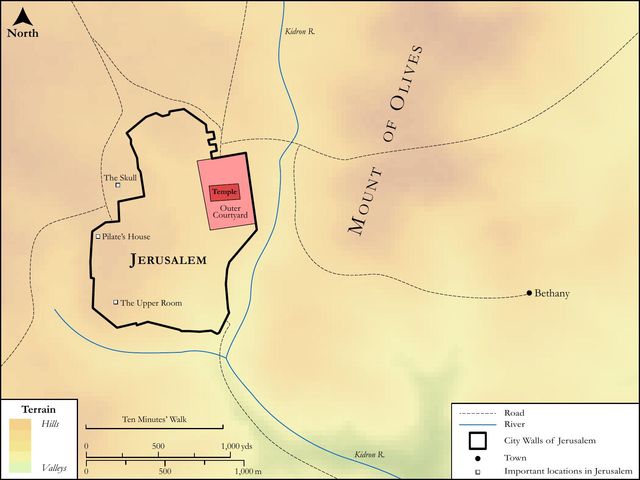
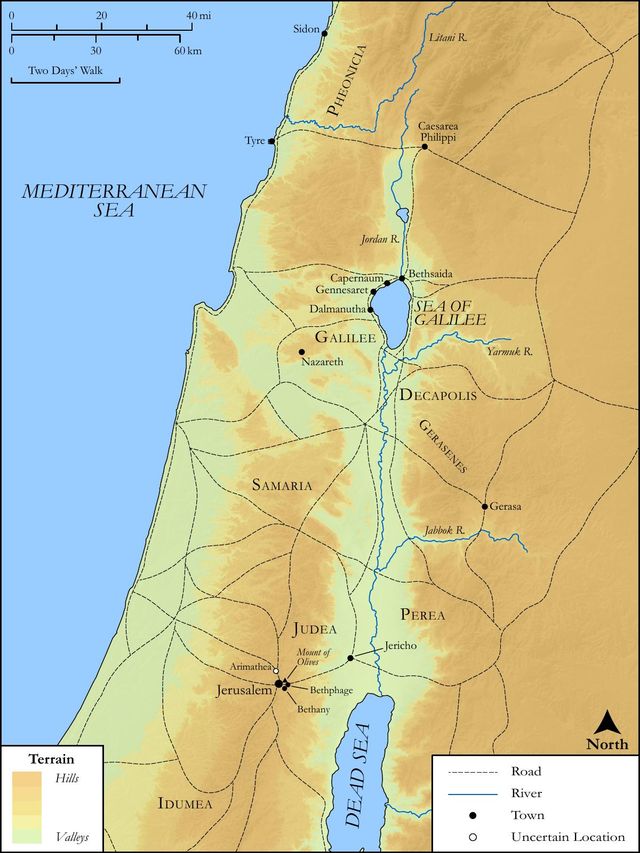
See on the biblical-era maps
Study this verse
Public-domain commentary
Matthew Henry
From his Commentary on the Whole Bible. Henry comments on passages, not single verses — this entry covers Mark 3:31–35. His two-level outline is real structure in the source text, so it is rendered as structure.
Here is, 1. The disrespect which Christ's kindred, according to the flesh, showed to him, when he was preaching (and they knew very well that he was then in his element); they not only stood without, having no desire to come in, and hear him, but they sent in a message to call him out to them (Mar 3:31, Mar 3:32), as if he must leave his work, to hearken to their impertinences; it is probable that they had no business with him, only sent for him on purpose to oblige him to break off, lest he should kill himself. He knew how far his strength would go, and preferred the salvation of souls before his own life, and soon after made it to appear with a witness; it was therefore an idle thing for them, under pretence of his sparing himself, to interrupt him; and it was worse, if really they had business with him, when they knew he preferred his business, as a Saviour, so much before any other business.
2.The respect which Christ showed to his spiritual kindred upon this occasion. Now, as at other times, he put a comparative neglect upon his mother, which seemed purposely designed to obviate the prevent the extravagant respect which men in aftertimes would be apt to pay her. Our respect ought to be guided and governed by Christ's; now the virgin Mary, or Christ's mother, is not equalled with, but postponed to, ordinary believers, on whom Christ here puts a superlative honour. He looked upon those that at about him, and pronounced those of them that not only heard, but did, the will of God, to be to him as his brother, and sister, and mother; as much esteemed, loved, and cared for, as his nearest relations, Mar 3:33-35. This is a good reason why we should honour those that fear the Lord, and choose them for our people; why we should be not hearers of the word only, but doers of the work, that we may share with the saints in this honour, Surely it is good to be akin to those who are thus nearly allied to Christ, and to have fellowship with those that have fellowship with Christ; and woe to those that hate and persecute Christ's kindred, that are his bone and his flesh, every one resembling the children of a king (see Jdg 8:18, Jdg 8:19); for he will with jealously plead their cause, and avenge their blood.
Historical interpretation
Seven Centuries of Reception
8 surviving comments on this verse. Each one is dated, so this reads as a timeline rather than a list.
Select a marker to jump to its quote. Markers stagger vertically where authors wrote within a few decades of each other.
But let us be assured that we are His brethren and His sisters, if we do the will of the Father; that we may be joint-heirs with Him, for He discerns us not by sex but by our deeds. Wherefore it goes on: Whosoever shall do the will of God, &c.
(non occ.) From this it is manifest that His brethren and His mother were not always with Him; but because He was beloved by them, they come from reverence and affection, waiting without. Wherefore it goes on, And the multitude sat about him, &c.
(non occ.) By this, the Lord shows that we should honour those who are relations by faith rather than those who are relations by blood. A man indeed is made the mother of Jesus by preaching Himq; for He, as it were, brings forth the Lord, when he pours Him into the heart of his hearers.
She did the Father’s will. It was this in her that the Lord magnified, not merely that her flesh gave birth to flesh.… When he said, “Blessed are they who hear the Word of God and keep it,” he was in effect saying: “My mother whom you have called blessed is blessed for the reason that she keeps the Word of God, not that the Word was made flesh in her and dwelt among us, but that she keeps the very Word of God through which she was made and which was made flesh in her.”
What else does he here teach us, than to prefer to kinship “after the flesh” our descent “after the Spirit.” He teaches that persons are united by nearness of spirit to those who are just and holy, and that by obeying and following they cleave to their teaching and conduct. Therefore Mary is more blessed in receiving the faith of Christ than in conceiving the flesh of Christ. For to the one who said, “Blessed is the womb, which bore you!” he himself answered: “Blessed are they who hear the Word of God and keep it.” Concerning his own brothers, his own relatives after the flesh, who at first did not believe in him, he found dubious advantage in being their kin. As for Mary, her nearness as a mother would have been little help for her salvation if she had not borne Christ in her heart in a more blessed manner than in the flesh.
(Vict. Ant. e Cat. in Marc.) But another Evangelist says, that His brethren did not believe on Him. With which this agrees, which says, that they sought Him, waiting without, and with this meaning the Lord does not mention them as relations. Wherefore it follows, And he answered them, saying, Who is my mother or my brethren? (John 7:5) But He does not here mention His mother and His brethren altogether with reproof, but to show that a man must honour his own soul above all earthly kindred; wherefore this is fitly said to those who called Him to speak with His mother and relations, as if it were a more useful task than the teaching of salvation.
But since he who does the will of the Father is called sister and brother of the Lord, on account of both sexes who are gathered to the faith, this is not surprising; yet it is greatly to be wondered how one is also called mother. For he deigned to call his faithful disciples brothers, saying: Go, announce to my brothers. Therefore, he who could become a brother of the Lord by coming to faith—it must be asked how he can also be a mother? But we should know that one who is a brother and sister of Christ by believing becomes a mother by preaching. For one gives birth to the Lord, as it were, when one has poured him into the heart of the hearer. And one becomes his mother if through one's voice the love of the Lord is begotten in the mind of one's neighbor.
To confirm this matter fittingly for us, blessed Felicity is present, whose birthday we celebrate today, who by believing became a handmaid of Christ, and by preaching was made a mother of Christ. For she feared to leave her seven sons, as is read in the more accurate accounts of her deeds, alive in the flesh after her, just as carnal parents usually fear to send their dead children before them. For when she was seized in the labor of persecution, she strengthened the hearts of her sons by preaching the love of the heavenly fatherland, and she brought forth in spirit those whom she had borne in the flesh, so that by preaching she might bear to God those whom she had borne in the flesh to the world.
(ubi sup.) The brothers of the Lord must not be thought to be the sons of the ever-virgin Mary, as Helvidius sayp, nor the sons of Joseph by a former marriage, as some think, but rather they must be understood to be His relations.
(Ambr in Luc. 6, 36. Bede ubi sup.) Being asked therefore by a message to go out, He declines, not as though He refused the dutiful service of His mother, but to show that He owes more to His Father's mysteries than to His mother's feelings. Nor does He rudely despise His brothers, but, preferring His spiritual work to fleshly relationship, He teaches us that religion is the bond of the heart rather than that of the body. Wherefore it goes on, And looking round about on them which sat about him, he said, Behold my mother and my brethren.
(ubi sup.) But mystically, the mother and brother of Jesus means the synagogue, (from which according to the flesh He sprung,) and the Jewish people who, while the Saviour is teaching within, come to Him, and are not able to enter, because they cannot understand spiritual things. But the crowd eagerly enter, because when the Jews delayed, the Gentiles flocked to Christ; but His kindred, who stand without wishing to see the Lord, are the Jews who obstinately remained without, guarding the letter, and would rather compel the Lord to go forth to them to teach carnal things, than consent to enter in to learn spiritual things of Him. (Ambr in Luc. 6, 37.). If therefore not even His parents when standing without are acknowledged, how shall we be acknowledged, if we stand without? For the word is within and the light within.
Because the relations of the Lord had come to seize upon Him, as if beside Himself, His mother, urged by the sympathy of her love, came to Him; wherefore it is said, And there came unto him his mother, and, standing without, sent unto him, calling him.
He does not therefore say this, as denying His mother, but as showing that He is worthy of honour, not only because she bore Christ, but on account of her possessing every other virtue.
Continue studying Mark 3:35 across the web’s major study libraries — every link below opens this exact verse, chapter, or book on the destination site.
Read & Compare
 BibleGatewayThis verse in more than 200 translations and 70 languages.
 Bible.comThe YouVersion reader — hundreds of translations, reading plans, and highlights.
 ESV.orgCrossway's official English Standard Version reader.
 NET BibleThe NET translation with 60,000+ translators' notes on every rendering decision.
 STEP BibleTyndale House's free study tool — original text, vocabulary, and scholarly resources.
 BibliaLogos Bible Software's free web reader.
 USCCBThe New American Bible (Revised Edition) with the U.S. bishops' study notes.
Commentaries
 BibleHub CommentariesDozens of classic commentaries on this verse, gathered on one page.
 StudyLightMore than 100 commentary sets — the largest collection on the web.
 BibleRefPlain-English commentary on what this verse means, verse by verse.
 Enduring WordDavid Guzik's free commentary on this chapter, widely used by Bible teachers.
 Bible Study ToolsVerse commentary alongside Greek and Hebrew study aids.
Original Language & Research
- BibleHub InterlinearThe verse word by word — original language, transliteration, and English.
- BibleHub LexiconEvery word's original-language definition and Strong's entry.
 Blue Letter BibleDeep-study tools — Strong's numbers, concordance, and word studies.
 CNTR CollationThe earliest Greek manuscripts of this verse, collated letter by letter.
Sermons, Hymns & Audio


TrulyRandomVerse is not affiliated with these sites and doesn’t control their content. They’re linked because they’re genuinely useful.
Summary
Mark 3:35 is a profound declaration by Jesus that radically redefines the nature of true kinship, asserting that genuine relationship with Him and belonging to God's family is not determined by biological lineage but by active, obedient alignment with the divine will. This statement elevates spiritual devotion and practical obedience above all natural ties, establishing a new paradigm for community in the kingdom of God.
Context
ShowHideLiterary Context
This verse concludes a significant pericope in Mark's Gospel (Mark 3:20-35) that begins with Jesus' own family expressing concern, believing Him to be "out of his mind" (Mark 3:21). This concern is juxtaposed with the scribes from Jerusalem accusing Jesus of casting out demons by the power of Beelzebub, the prince of devils, a charge Jesus refutes with a powerful parable about a house divided against itself (Mark 3:22-30). Immediately preceding Mark 3:35, Jesus' mother and brothers arrive, standing outside and sending for Him. When informed, Jesus points to the crowd seated around Him, who are listening to His teaching, and declares them to be His true family (Mark 3:31-34). Mark 3:35 then serves as the climactic explanation for this redefinition of family, providing the criterion for inclusion.
Historical & Cultural Context
In first-century Jewish society, family (the mishpachah) was the foundational unit of identity, security, and social structure. Lineage, blood ties, and tribal affiliation were paramount, deeply rooted in the Old Testament's emphasis on Abrahamic descent and covenant promises. To prioritize anything over one's biological family, especially one's mother and brothers, was counter-cultural and potentially scandalous. Jesus' statement would have been shocking to His audience, challenging deeply ingrained societal norms and expectations. It underscored His revolutionary message that the kingdom of God transcended traditional human structures, demanding a new kind of allegiance.
Key Themes
ShowHideThis verse powerfully contributes to several key themes within Mark's Gospel and broader New Testament theology. Firstly, it highlights the theme of Spiritual Kinship over Biological Ties, asserting that belonging to God's family is based on a spiritual covenant, not physical descent. This radical redefinition of family is central to understanding the new community Jesus is forming. Secondly, the verse emphasizes The Centrality of Obedience to God's Will. "Doing the will of God" is presented as the singular, defining characteristic of true discipleship and the pathway to intimate relationship with Jesus. This theme resonates with Jesus' teaching throughout the Gospels, such as His words in Matthew 7:21 where He states that not everyone who calls Him "Lord" will enter the kingdom, but only "he that doeth the will of my Father which is in heaven." Finally, it underscores the theme of Radical Discipleship, where following Jesus requires a reordering of priorities, even to the extent of re-evaluating the most fundamental human relationships in light of one's commitment to God.
Exposition and Analysis
ShowHideKey Word Analysis
ShowHideThis relative pronoun, often combined with other particles like G302 (án), indicates a general, indefinite reference, meaning "anyone who," "whoever," or "whatever." In this context, it emphasizes the universal accessibility of this spiritual kinship – it is open to anyone who meets the stated condition, regardless of background or prior status.
This verb signifies active, practical performance or accomplishment, not merely intellectual assent or passive reception. It implies an ongoing, intentional commitment to carry out an action. Here, it stresses that true belonging is contingent upon a life of active obedience and engagement with God's commands, distinguishing genuine discipleship from mere hearing or knowing.
Derived from a verb meaning "to wish" or "to desire," thélēma refers to a determination, purpose, or decree. It denotes God's active volition and intention. In this verse, "the will of God" is not an abstract concept but God's specific desires and commands for humanity, particularly as revealed through Jesus' teaching and life. It implies a moral and spiritual alignment with God's character and purposes.
Verse Breakdown
ShowHide"For whosoever shall do the will of God,"
This opening clause establishes the singular, non-negotiable criterion for inclusion in Jesus' spiritual family. The conjunction "For" (G1063, gár) introduces the reason or explanation for Jesus' preceding statement in Mark 3:34, where He identified those around Him as His mother and brothers. The phrase "whosoever shall do" (G3739 hós + G302 án + G4160 poiéō) emphasizes that this is an open invitation to anyone who actively and consistently performs God's will. "The will of God" (G2307 thélēma G2316 theós) refers to God's revealed purpose, His moral commands, and His redemptive plan, which Jesus Himself embodies and proclaims. It is not about perfect execution, but a committed orientation of one's life towards God's desires.
"the same is my brother, and my sister, and mother."
This powerful declaration reveals the profound consequence of "doing the will of God." "The same" (G3778 hoûtos) refers back to the "whosoever" of the first clause, identifying them as the true kin of Jesus. By listing "brother, and my sister, and mother" (G80 adelphós, G79 adelphḗ, G3384 mḗtēr), Jesus uses the most intimate and foundational familial terms in Jewish society to describe this spiritual bond. This is a radical redefinition, asserting that spiritual affinity through obedience creates a bond even stronger and more significant than biological ties, establishing a new family based on shared devotion to God.
Literary Devices
ShowHideMark 3:35 employs several significant literary devices. Metaphor is central, as Jesus uses the familiar terms of "brother," "sister," and "mother" to describe a spiritual relationship, thereby extending the concept of family beyond biological lineage to encompass a community united by obedience to God. This creates a powerful image of intimacy and belonging. The verse also utilizes Contrast, setting up a clear distinction between physical family (His mother and brothers waiting outside) and spiritual family (those doing the will of God). This highlights the radical nature of Jesus' teaching and the new priorities of the kingdom. Furthermore, there is an element of Reversal of Expectations, as the audience would have anticipated Jesus to prioritize His biological family. Instead, He subverts this expectation, demonstrating that true honor and connection in His kingdom are earned through spiritual alignment, not birthright.
Theological and Thematic Connections
ShowHideMark 3:35 is a foundational text for understanding the nature of the Christian community and the true meaning of discipleship. It reveals that the family of God is not an exclusive club based on ethnicity, social status, or even biological relationship to Jesus, but an inclusive fellowship open to all who commit to God's will. This radical redefinition of family underscores the spiritual revolution Jesus inaugurated, where allegiance to God takes precedence over all earthly ties. It implies that the Church, as the community of those who do God's will, is the true extension of Jesus' family on earth, bound together by a shared spiritual purpose and obedience. This passage challenges believers to examine their own priorities, ensuring that their ultimate allegiance and deepest bonds are rooted in their commitment to God's kingdom.
Reflection and Application
ShowHideMark 3:35 serves as a profound call to introspection and action for every believer. It challenges us to consider where our deepest loyalties lie and what truly defines our identity and belonging. Are we merely hearers of the Word, or are we active doers of God's will? This verse encourages us to prioritize our spiritual kinship with fellow believers, recognizing that the bonds forged through shared commitment to Christ are eternal and transcend earthly distinctions. It reminds us that our place in God's family is secured not by birthright or human merit, but by a responsive heart that seeks to obey God's desires. This means actively pursuing righteousness, loving our neighbor, participating in the mission of the Church, and aligning our daily choices with the values of the Kingdom. Our obedience is not a means to earn salvation, but a joyful response to the grace that has already made us children of God, confirming our place in His intimate family.
Questions for Reflection
ShowHideFAQ
ShowHideDid Jesus disrespect His biological family by saying this?
ShowHideNo, Jesus did not disrespect His biological family. Instead, He used their arrival as a teaching moment to elevate the spiritual reality of God's kingdom. In a culture where family ties were paramount, Jesus' statement was revolutionary, not dismissive. He was not devaluing earthly family but demonstrating that there is a higher, more profound family based on spiritual obedience to God. His words highlight that even the most intimate human relationships must be understood in light of one's ultimate allegiance to God. Elsewhere, Jesus honored His mother (e.g., John 19:26-27). This passage in Mark simply clarifies that spiritual bonds, forged through shared commitment to God's will, are the true foundation of His eternal community.
Christ-Centered Fulfillment
ShowHideMark 3:35 finds its ultimate fulfillment in the person and work of Jesus Christ, who perfectly embodied "doing the will of God." Jesus Himself declared, "My meat is to do the will of him that sent me, and to finish his work" (John 4:34). His entire life, from His incarnation to His crucifixion, was an act of perfect obedience to the Father's will (Philippians 2:8). By His sacrificial death and resurrection, Jesus established the new covenant, making it possible for all who believe in Him to be adopted into God's family, no longer by natural birth but by spiritual rebirth (John 1:12-13). Through faith in Christ, believers are united with Him, becoming "fellow citizens with the saints, and of the household of God" (Ephesians 2:19). Thus, those who "do the will of God" are those who, empowered by the Holy Spirit, live in conformity to the example and teachings of Christ, thereby demonstrating their true kinship with the Son and their rightful place in the Father's eternal family, purchased by the blood of the Lamb.