


Mark 15:45
Bible text: King James Version (1769 Blayney text) · Public domain
Bible text: Berean Standard Bible · Public domain
Bible text: American Standard Version (1901) · Public domain
Bible text: World English Bible, Messianic edition · Public domain
Bible text: Geneva Bible (1599) · Public domain
Bible text: Young's Literal Translation · Public domain
- καὶkaiAndG2532CONJConjunction
- γνοὺςgnoushaving known [it]G1097V-2AAP-NSMVerb 2nd Aorist Active Participle Nominative Singular Masculine
- ἀπὸapofromG575PREPPreposition
- τοῦtoutheG3588T-GSMDefinite article Genitive Singular Masculine
- κεντυρίωνοςkenturiōnoscenturionG2760N-GSMNoun Genitive Singular Masculine
- ἐδωρήσατοedōrēsatoHe grantedG1433V-ADI-3SVerb Aorist Middle Deponent Indicative 3rd Singular
- τὸtotheG3588T-ASNDefinite article Accusative Singular Neuter
- πτῶμαptōmabodyG4430N-ASNNoun Accusative Singular Neuter
- τῷtō<the>G3588T-DSMDefinite article Dative Singular Masculine
- ἸωσήφIōsēphto JosephG2501N-DSM-PNoun Dative Singular Masculine Individual
English is a literal word-by-word gloss of the Greek, not the KJV's wording. Why?
This is the original text the KJV's translators worked from — each Greek word with its own literal English meaning in this verse, prepared by scholars at Tyndale House, Cambridge. The KJV translates whole sentences, not word by word, so its wording differs: one Greek word can become several English words, and the KJV may choose “charity” where the gloss reads “love”. Both are faithful — they answer different questions. For the KJV's own rendering, switch to the KJV text.
Details
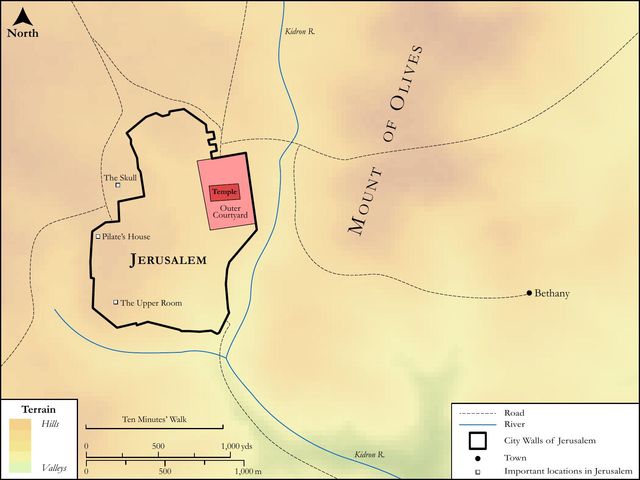
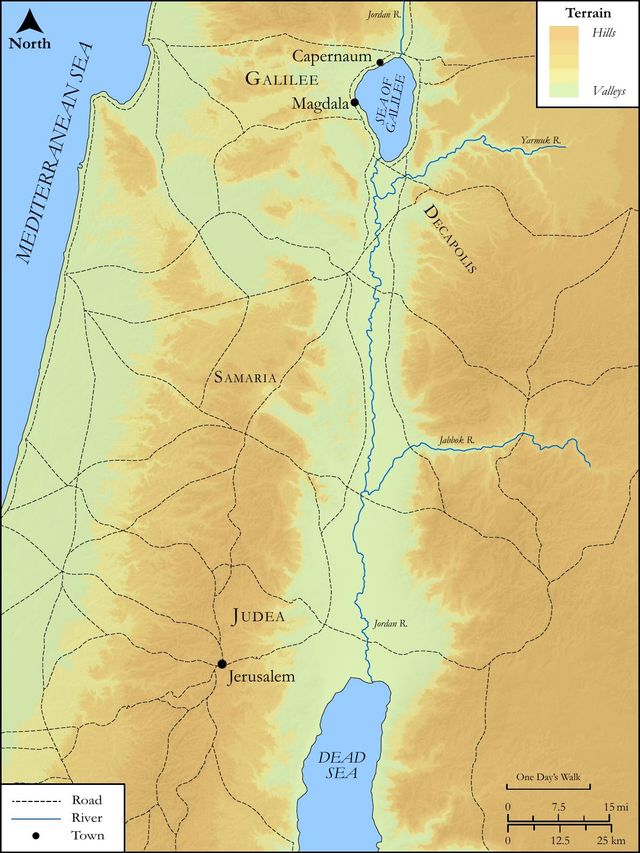
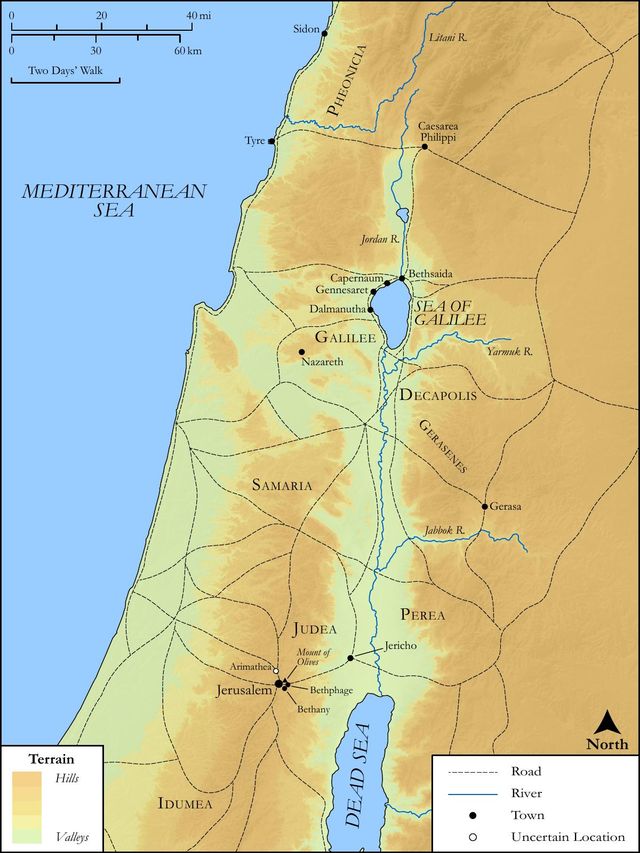
See on the biblical-era maps
Study this verse
Public-domain commentary
Matthew Henry
From his Commentary on the Whole Bible. Henry comments on passages, not single verses — this entry covers Mark 15:42–47. His two-level outline is real structure in the source text, so it is rendered as structure.
We are here attending the funeral of our Lord Jesus, a solemn, mournful funeral. O that we may by grace be planted in the likeness of it! Observe,
I.How the body of Christ was begged.
It was, as the dead bodies of malefactors are, at the disposal of the government. Those that hurried him to the cross, designed that he should make his grave with the wicked; but God designed he should make it with the rich (Isa 53:9), and so he did. We are here told,
1.When the body of Christ was begged, in order to its being buried, and why such haste was made with the funeral; The even was come, and it was the preparation, that is, the day before the sabbath, Mar 15:42. The Jews were more strict in the observation of the sabbath than of any other feast; and therefore, though this day was itself a feast-day, yet they observed it more religiously as the eve of the sabbath; when they prepared their houses and tables for the splendid and joyful solemnizing of the sabbath day. Note, The day before the sabbath should be a day of preparation for the sabbath, not of our houses and tables, but of our hearts, which, as much as possible, should be freed from the cares and business of the world, and fixed, and put in frame for the service and enjoyment of God. Such work is to be done, and such advantages are to be gained on the sabbath day, that it is requisite we should get ready for it a day before; nay, the whole week should be divided between the improvement of the foregoing sabbath and the preparation for the following sabbath.
2.Who was it that begged the body, and took care for the decent interment of it; it was Joseph of Arimathea, who is here called an honourable counsellor (Mar 15:43), a person of character and distinction, and in an office of public trust; some think in the state, and that he was one of Pilate's privy council; his post rather seems to have been in the church, he was one of the great Sanhedrim of the Jews, or one of the high priest's council. He was euschēmōn bouleutēs - a counsellor that conducted himself in his place as did become him. Those are truly honourable, and those only, in place of power and trust, who make conscience of their duty, and whose deportment is agreeable to their preferment. But here is a more shining character put upon him; he was one that waited for the kingdom of God, the kingdom of grace on earth, and of glory in heaven, the kingdom of the Messiah. Note, Those who wait for the kingdom of God, and hope for an interest in the privileges of it, must show it by their forwardness to own Christ's cause and interest, even then when it seems to be crushed and run down. Observe, Even among the honourable counsellors there were some, there was one at least, that waited for the kingdom of God, whose faith will condemn the unbelief of all the rest. This man God raised up for this necessary service, when none of Christ's disciples could, or durst, undertake it, having neither purse, nor interest, nor courage, for it. Joseph went in boldly to Pilate; though he knew how much it would affront the chief priests, who had loaded him with so much reproach, to see any honour done him, yet he put on courage; perhaps at first he was a little afraid, but tolmēsas - taking heart on it, he determined to show this respect to the remains of the Lord Jesus, let the worst come to the worst.
3.What a surprise it was to Pilate, to hear that he was dead (Pilate, perhaps, expecting that he would have saved himself, and come down from the cross), especially that he was already dead, that one who seemed to have more than ordinary vigour, should so soon yield to death. Every circumstance of Christ's dying was marvellous; for from first to last his name was called Wonderful. Pilate doubted (so some understand it) whether he was yet dead or no, fearing lest he should be imposed upon, and the body should be taken down alive, and recovered, whereas the sentence was, as with us, to hang till the body be dead. He therefore called the centurion, his own officer, and asked him whether he had been any while dead (Mar 15:44), whether it was so long since they perceived any sign of life in him, any breath or motion, that they might conclude he was dead past recall. The centurion could assure him of this, for he had particularly observed how he gave up the ghost, Mar 15:39. There was a special providence in it, that Pilate should be so strict in examining this, that there might be no pretence to say that he was buried alive, and so to take away the truth of his resurrection; and so fully was this determined, that the objection was never started. Thus the truth of Christ gains confirmation, sometimes, even from its enemies.
II.How the body of Christ was buried.
Pilate gave Joseph leave to take down the body, and do what he pleased with it. It was a wonder the chief priests were not too quick for him, and had not first begged the body of Pilate, to expose it and drag it about the streets, but that remainder of their wrath did God restrain, and gave that invaluable prize to Joseph, who knew how to value it; and the hearts of the priests were so influenced, that they did not oppose it. Sit divus, modo non sit vivus - We care not for his being adored, provided he be not revived.
1.Joseph bought fine linen to wrap the body in, though in such a case old linen that had been worn might have been thought sufficient. In paying respects to Christ it becomes us to be generous, and to serve him with the best that can be got, not with that which can be got at the best hand.
2.He took down the body, mangled and macerated as it was, and wrapt it in the linen as a treasure of great worth. Our Lord Jesus hath commanded himself to be delivered to us sacramentally in the ordinance of the Lord's supper, which we should receive in such a manner as may best express our love to him who loved us and died for us.
3.He laid it in a sepulchre of his own, in a private place. We sometimes find it spoken of in the story of the kings of Judah, as a slur upon the memory of the wicked kings, that they were not buried in the sepulchres of the kings; our Lord Jesus, though he did no evil but much good, and to him was given the throne of his father David, yet was buried in the graves of the common people, for it was not in this world, but in the other, that his rest was glorious. The sepulchre belonged to Joseph. Abraham when he had no other possession in the land of Canaan, yet had a burying-place, but Christ had not so much as that. This sepulchre was hewn out of a rock, for Christ died to make the grave a refuge and shelter to the saints, and being hewn out of a rock, it is a strong refuge. O that thou wouldest hide me in the grave! Christ himself is a hiding place to his people, that is, as the shadow of a great rock.
4.He rolled a stone to the door of the sepulchre, for so the manner of the Jews was to bury. When Daniel was put into the lion's den, a stone was laid to the mouth of it to keep him in, as here to the door of Christ's sepulchre, but neither of them could keep off the angels' visits to the prisoners.
5.Some of the good women attended the funeral, and beheld where he was laid, that they might come after the sabbath to anoint the dead body, because they had not time to do it now. When Moses, the mediator and lawgiver of the Jewish church, was buried, care was taken that no man should know of his sepulchre (Deu 34:6), because the respect of the people towards his person were to die with him; but when our great Mediator and Lawgiver was buried, special notice was taken of his sepulchre, because he was to rise again: and the care taken of his body, bespeaks the care which he himself will take concerning his body the church. Even when it seems to be a dead body, and as a valley full of dry bones, it shall be preserved in order to a resurrection; as shall also the dead bodies of the saints, with whose dust there is a covenant in force which shall not be forgotten. Our mediations on Christ's burial should lead us to think of our own, and should help to make the grave familiar to us, and so to render that bed easy which we must shortly make in the darkness. Frequent thoughts of it would not only take off the dread and terror of it, but quicken us, since the graves are always ready for us, to get ready for the graves, Job 17:1.
Historical interpretation
Five Centuries of Reception
4 surviving comments on this verse. Each one is dated, so this reads as a timeline rather than a list.
Select a marker to jump to its quote. Markers stagger vertically where authors wrote within a few decades of each other.
As the female sex through the Virgin Mary is not shut out from salvation, so it is not thrust away from the knowledge of the mystery of the cross, and of the resurrection, through the widow Mary Magdalene, and the others, who were mothers.
It is interpreted, taking down, of which was Joseph, who came to take down the body of Christ from the cross. There follows: Came and went in boldly unto Pilate, and craved the body of Jesus.
By the burial of Christ we rise again, by His going down into hell we mount up into heaven; here is found the honey in the mouth of the dead lion.
These things also fit the Jewish people, which finally is believing, which is ennobled by faith to become the child of Abraham. It lays aside its despair, it waits for the kingdom of God, it goes in to the Christians, that it may be baptized; which is implied by the name of Pilate, which is interpreted, 'One who works with a hammer,' that is, he who subdues the iron nations, that he may rule them with a rod of iron. It seeks for the sacrifice, that is, the viaticum, which is given to penitents at their last end, and wraps it up in a heart clean and dead to sin; it makes it firm in the safeguard of faith, and shuts it up with the covering of hope, through works of charity; (for the end of the commandment is charity;) (1 Tim. 1:5) whilst the elect, who are the stars of the sea, are looking on from afar, for, if it be possible, the very elect shall be offended.
(ubi sup.) What is called parasceue in Greek, is in Latin præparatio; by which name those Jews, who lived amongst Greeks, used to call the sixth day of the week, because on that day they used to prepare what was necessary for the rest of the sabbath day. Because then man was made on the sixth day, but on the seventh the Creator rested from all His work, fitly was our Saviour crucified on the sixth day, and thus fulfilled the mystery of man's restoration. But on the sabbath, resting in the tomb, He was waiting for the event of the resurrection, which was to come on the eighth day. So we must also in this age of time be crucified to the world; but in the seventh day, that is, when a man has paid the debt to death, our bodies indeed must rest in the grave, but our souls after good works in hidden peace with God; till in the eighth period, even our bodies themselves, glorified in the resurrection, receive incorruption together with our souls. But the man who buried the body of the Lord must needs by his righteous merits have been worthy, and by the nobility of worldly power able to perform this service. Therefore it is said, An honourable counsellor, which also waited for the kingdom of God. He is called in Latin, decurio, because he is of the order of the curia, and served the office of a provincial magistracy; this officer was also called curialis, from his care of civic duties. Arimathæa is the same as Ramathain, the city of Elkanah and Samuel.
(ubi sup.) But it was not an obscure person, nor a man of mean rank, who could come to the governor and obtain the body. There follows: And he bought fine linen, and took him down, and wrapped him in the linen.
(ubi sup.) By this however, according to a spiritual meaning, we may understand that the body of the Lord should not be wrapped in gold or gems, or silk, but in a clean linen cloth. Hence it became a custom in the Church that the sacrifice of the altar should not be celebrated in silk, or in a dyed cloth, but in linen produced from the earth, just as the body of the Lord was wrapped in clean linen; as, we read in the Pontifical acts, it was ordered by the blessed Sylvesterf. Though it has also another meaning, that he who receives Jesus in a pure mind wraps Him in clean linen. There follows: And laid him in a sepulchre which was hewn out of a rock, and rolled a stone unto the door of the sepulchre. It is said that the sepulchre of the Lord is a round cell, hewn out of the rock which was around it, so high, that a man standing upright could scarcely touch the roof with his outstretched hand; and it has an entrance to the east, to which the great stone was rolled, and placed upon it. In the northern part of it is the tomb itself, that is, the place where our Lord's body lay, made of the same rock, seven feet in length, raised three palms higher than the floor. It is not open from above, but on the south side, the whole of which is open, and through which the body was brought in. The colour of the sepulchre and of the recess is said to be a mixed white and red.
We read in Luke, that His acquaintances and the women who had followed Him stood afar off. When these then who were known to Jesus returned home after the burial of His body, the women alone, who were bound to Him with a closer love, after following the funeral, took care to see how He was laid, that they might be able at a fitting season to offer Him the sacrifice of their devotion. But on the day of the parasceue, that is, of the preparation, the holy women, that is, humble souls, do the same, when they burn with love for the Saviour, and diligently follow the steps of His Passion in this life, where their future rest is to be prepared; and they weigh with a pious minuteness the order in which His passion was accomplished, if perchance they be able to imitate it.
He was bold with a praiseworthy boldness; for he did not consider within himself, I shall fall from my rich estate, and I shall be expelled by the Jews, if I beg for the body of Him, who was condemned as a blasphemer. It goes on: And Pilate marvelled if he were already dead. For he thought that He should continue long alive upon the cross, as also the thieves used to live long, upon the instrument of their execution. It goes on: And calling unto him the centurion, he asked him if he had been any while dead; that is, before the time when other executed persons usually died. There follows: And when he knew it of the centurion, (that is, that He was dead,) he gave the body to Joseph.
Burying the precious body preciously; for being a disciple of our Lord, he knew how greatly the Lord's body ought to be honoured.
Let us too imitate Joseph, taking to ourselves the body of Christ by Unity, and let us place it in a sepulchre, hewn out of the rock, that is, in a soul recollected, never forgetful of God; for this is a soul hewn out of the rock, that is, out of Christ, for He is our rock, who holds together our strength. We ought also to wrap Him in linen, that is, to receive Him in a pure body; for the linen is the body which is the clothing of the soul. We must, however, not throw open, but wrap Him up; for He is secret, closed and hidden. There follows: And Mary Magdalene and Mary the mother of Joses beheld where he was laid.
(non occ.) After the passion and death of Christ, the Evangelist relates His burial, saying, And now when the even was come, because it was the preparation, that is, the day before the sabbath, Joseph of Arimathæa.
Continue studying Mark 15:45 across the web’s major study libraries — every link below opens this exact verse, chapter, or book on the destination site.
Read & Compare
 BibleGatewayThis verse in more than 200 translations and 70 languages.
 Bible.comThe YouVersion reader — hundreds of translations, reading plans, and highlights.
 ESV.orgCrossway's official English Standard Version reader.
 NET BibleThe NET translation with 60,000+ translators' notes on every rendering decision.
 STEP BibleTyndale House's free study tool — original text, vocabulary, and scholarly resources.
 BibliaLogos Bible Software's free web reader.
 USCCBThe New American Bible (Revised Edition) with the U.S. bishops' study notes.
Commentaries
 BibleHub CommentariesDozens of classic commentaries on this verse, gathered on one page.
 StudyLightMore than 100 commentary sets — the largest collection on the web.
 BibleRefPlain-English commentary on what this verse means, verse by verse.
 Enduring WordDavid Guzik's free commentary on this chapter, widely used by Bible teachers.
 Bible Study ToolsVerse commentary alongside Greek and Hebrew study aids.
Original Language & Research
- BibleHub InterlinearThe verse word by word — original language, transliteration, and English.
- BibleHub LexiconEvery word's original-language definition and Strong's entry.
 Blue Letter BibleDeep-study tools — Strong's numbers, concordance, and word studies.
 CNTR CollationThe earliest Greek manuscripts of this verse, collated letter by letter.
Sermons, Hymns & Audio


TrulyRandomVerse is not affiliated with these sites and doesn’t control their content. They’re linked because they’re genuinely useful.
Summary
Mark 15:45 details Pontius Pilate's confirmation of Jesus' death through the centurion overseeing the crucifixion, leading to the release of Jesus' body to Joseph of Arimathea for burial. This pivotal moment ensures the proper handling of Jesus' remains, underscoring the authenticity of His death and setting the stage for His resurrection, all while highlighting the courageous faith of Joseph in a hostile environment.
Context
ShowHideLiterary Context
This verse immediately follows the dramatic account of Jesus' crucifixion and death in Mark 15:21-41. Specifically, Mark 15:37 records Jesus' final breath, and Mark 15:39 captures the centurion's profound confession, "Truly this man was the Son of God!" Joseph of Arimathea's courageous request for Jesus' body is detailed in Mark 15:43, and Pilate's surprise at Jesus' swift death is noted in Mark 15:44. Thus, Mark 15:45 serves as the crucial administrative step that allows for the burial, bridging the narrative from Jesus' death to His entombment.
Historical & Cultural Context
Roman crucifixion was a brutal, slow form of execution, often taking days for the victim to die. It was customary for the bodies of crucified criminals to be left on the cross as a public deterrent or thrown into a common grave. Jewish law, however, mandated that bodies not remain unburied overnight, especially before a Sabbath or high holy day (Deuteronomy 21:22-23). Given that the next day was the Sabbath (and Passover), a quick burial was imperative. Pontius Pilate, as the Roman governor, held absolute authority over capital punishment and the disposition of bodies. A centurion, a seasoned Roman officer commanding approximately 100 soldiers, was a highly reliable witness, and his official confirmation of death was standard procedure for Pilate before releasing a body, especially one as politically charged as Jesus'.
Key Themes
ShowHideThis verse contributes significantly to several key themes in Mark's Gospel. First, it reinforces the authenticity and certainty of Jesus' death, a foundational truth for the subsequent resurrection. The centurion's official confirmation leaves no room for doubt about Jesus' physical demise. Second, it highlights the courage and piety of Joseph of Arimathea, a secret disciple who, despite his prominent position on the Jewish council, risked everything to honor Jesus (Mark 15:43). His actions fulfill the prophetic word that the Messiah would be "with the rich in his death" (Isaiah 53:9). Third, it subtly points to divine providence, demonstrating how God's plan unfolded even in the darkest hours of the crucifixion, ensuring a proper burial for His Son, despite the ignominy of the cross.
Exposition and Analysis
ShowHideKey Word Analysis
ShowHideThis verb signifies a deep, experiential knowledge, not merely intellectual assent. Here, it implies Pilate's thorough understanding and verification of the centurion's report regarding Jesus' death. It's an authoritative recognition, crucial for the legal release of the body.
Derived from the word for "gift," this verb means "to bestow gratuitously" or "to give as a gift." Pilate's action is presented as a granting or bestowing of the body, emphasizing his authority in the matter and the fact that Joseph's request was granted as an act of permission.
This term refers to the physical body, a sound whole. In this context, it unequivocally denotes the deceased physical form of Jesus, emphasizing the reality of His death and the tangible object that would be laid in the tomb, a crucial element for the truth of the resurrection.
Verse Breakdown
ShowHide"And when he knew it of the centurion"
This clause describes Pilate's authoritative verification. Pilate, having been surprised by the swiftness of Jesus' death (Mark 15:44), sought official confirmation from the most reliable source available—the centurion who had overseen the entire crucifixion. The centurion's testimony was not merely an opinion but an official report from a professional military officer, whose word carried significant weight and ensured the legal and medical certainty of Jesus' death.
"he gave the body to Joseph."
Upon receiving the centurion's conclusive report, Pilate granted Joseph of Arimathea's request. This act of "giving" signifies Pilate's legal release of the body into Joseph's custody. It underscores Joseph's successful petition and his responsibility for the proper burial, which was a significant act of devotion and courage given the circumstances.
Literary Devices
ShowHideMark employs several literary devices in this brief verse. The most prominent is Confirmation, where the centurion's report serves to definitively establish the reality of Jesus' death. This is crucial for the theological narrative, precluding any later claims that Jesus merely swooned or survived the crucifixion. There is also an element of Irony, as Pilate, who condemned Jesus to death, is now the one who officially facilitates His burial, albeit at the request of a secret disciple. Furthermore, the quick succession of events—Jesus' death, Pilate's surprise, the centurion's confirmation, and the body's release—creates a sense of Expediency and urgency, reflecting the impending Sabbath and the need for a swift burial.
Theological and Thematic Connections
ShowHideMark 15:45, though seemingly a simple administrative detail, holds profound theological significance. It meticulously establishes the certainty of Jesus' death, a non-negotiable prerequisite for the truth of His resurrection. Without a verified death, the resurrection would lose its power and meaning. The centurion's independent, professional confirmation, coming from a Roman officer who had just witnessed Jesus' final moments and declared Him "the Son of God," adds an undeniable layer of credibility. This verse thus safeguards the integrity of the Gospel message, ensuring that the subsequent accounts of the empty tomb and appearances are grounded in the historical reality of Jesus' physical demise. It also highlights the divine orchestration of events, as even in death, God's plan unfolds, ensuring a proper burial for His Son through the courageous act of Joseph of Arimathea.
Reflection and Application
ShowHideThis verse, often overlooked in the grand narrative of the crucifixion, offers powerful lessons for contemporary believers. Joseph of Arimathea's bold request, made at great personal risk, reminds us that genuine faith often demands courageous action, even when it means standing against the prevailing tide or risking social standing. His willingness to identify with a condemned criminal, even in death, exemplifies true discipleship that extends beyond public acclamation to quiet, sacrificial service. For us, this means being willing to act on our convictions, to care for those overlooked or despised by society, and to honor God's purposes even when circumstances seem bleak or dangerous. Furthermore, the meticulous confirmation of Jesus' death underscores the historical reliability of the Gospel. In a world often skeptical of truth claims, this detail strengthens our confidence in the foundational facts of our faith: that Jesus truly died, was buried, and rose again, offering us hope and eternal life.
Questions for Reflection
ShowHideFAQ
ShowHideWhy was the centurion's confirmation of Jesus' death so important?
ShowHideThe centurion's confirmation was crucial for several reasons. First, it provided official, military-grade verification of Jesus' death, leaving no room for doubt or later claims that Jesus merely swooned or survived the crucifixion. Roman crucifixions were notoriously slow, and Pilate was surprised by Jesus' swift demise (Mark 15:44). The centurion, as the officer in charge, was the most credible witness. Second, this confirmation was necessary for Pilate to legally release Jesus' body for burial. Without it, the body would likely have been disposed of in a common grave or left on the cross, violating Jewish burial customs before the Sabbath (Deuteronomy 21:22-23). The certainty of Jesus' death is a foundational truth for the Christian faith, as it underscores the reality of His sacrifice and the power of His subsequent resurrection (1 Corinthians 15:3-4).
Who was Joseph of Arimathea, and why was his role significant?
ShowHideJoseph of Arimathea was a wealthy and respected member of the Sanhedrin, the Jewish ruling council (Mark 15:43). He was a secret disciple of Jesus, "waiting for the kingdom of God." His role was profoundly significant for several reasons. First, he displayed immense courage by boldly approaching Pontius Pilate to request Jesus' body. This act was dangerous, as it publicly associated him with a condemned criminal and could have jeopardized his reputation, standing, and even his life. Second, his wealth and influence allowed for a proper burial in his own new tomb (Matthew 27:57-60), fulfilling the prophecy in Isaiah 53:9 that the Messiah would be "with the rich in his death." His actions ensured that Jesus' body was treated with dignity and respect, rather than being discarded, and provided the necessary context for the resurrection narrative.
Christ-Centered Fulfillment
ShowHideMark 15:45, though a detail of Jesus' burial, is profoundly Christ-centered in its implications. The meticulous confirmation of Jesus' death by the centurion, followed by Pilate's release of the body, underscores the absolute reality of the Incarnate Son's physical demise. This is not merely a historical footnote but a theological bedrock. The very purpose of Christ's coming was to offer Himself as a sacrifice for sin, and a real death was essential for a real atonement (Hebrews 9:22). His burial, facilitated by Joseph of Arimathea, signifies the completion of His earthly ministry and the full extent of His descent into human experience, including death itself (Philippians 2:8). This verified death and burial are the necessary precursors to the glorious truth of the resurrection. The tomb, though sealed, would not hold Him, for Christ's power over death and the grave was soon to be revealed (Acts 2:24). Thus, this verse, by confirming the end of His earthly life, powerfully anticipates the beginning of His resurrected life, which is the cornerstone of Christian hope and the ultimate victory over sin and death (Romans 6:4 and 1 Corinthians 15:20-22).