


Mark 15:40
Bible text: King James Version (1769 Blayney text) · Public domain
Bible text: King James Version with Strong's numbers · Public domain
Bible text: Berean Standard Bible · Public domain
Bible text: American Standard Version (1901) · Public domain
Bible text: World English Bible, Messianic edition · Public domain
Bible text: Geneva Bible (1599) · Public domain
Bible text: Young's Literal Translation · Public domain
- ἦσανēsanThere wereG1510V-IAI-3PVerb Imperfect Active Indicative 3rd Plural
- δὲdethenG1161CONJConjunction
- καὶkaialsoG2532CONJConjunction
- γυναῖκεςgunaikeswomenG1135N-NPFNoun Nominative Plural Feminine
- ἀπὸapofromG575PREPPreposition
- μακρόθενmakrothenafar offG3113ADVAdverb
- θεωροῦσαιtheōrousailooking onG2334V-PAP-NPFVerb Present Active Participle Nominative Plural Feminine
- ἐνenamongG1722PREPPreposition
- αἷςhaiswhomG3739R-DPFRelative pronoun Dative Plural Feminine
- ἦνēnwasG1510V-IAI-3SVerb Imperfect Active Indicative 3rd Singular
- καὶkaialsoG2532CONJConjunction
- ΜαρίαMariaMaryG3137N-NSF-PNoun Nominative Singular Feminine Individual
- ἡhē<the>G3588T-NSFDefinite article Nominative Singular Feminine
- ΜαγδαληνὴMagdalēnēMagdaleneG3094N-NSF-LGNoun Nominative Singular Feminine Location Gentilic
- καὶkaiandG2532CONJConjunction
- ΜαρίαMariaMaryG3137N-NSF-PNoun Nominative Singular Feminine Individual
- ἡhētheG3588T-NSFDefinite article Nominative Singular Feminine
- τοῦtou<the>G3588T-GSMDefinite article Genitive Singular Masculine
- ἸακώβουIakōbouof JamesG2385N-GSM-PNoun Genitive Singular Masculine Individual
- τοῦtoutheG3588T-GSMDefinite article Genitive Singular Masculine
- μικροῦmikrouleastG3398A-GSMAdjective Genitive Singular Masculine
- καὶkaiandG2532CONJConjunction
- ἸωσῆτοςIōsētosof JosesG2500N-GSM-PNoun Genitive Singular Masculine Individual
- μήτηρmētērmotherG3384N-NSFNoun Nominative Singular Feminine
- καὶkaiandG2532CONJConjunction
- ΣαλώμηSalōmēSalomeG4539N-NSF-PNoun Nominative Singular Feminine Individual
English is a literal word-by-word gloss of the Greek, not the KJV's wording. Why?
This is the original text the KJV's translators worked from — each Greek word with its own literal English meaning in this verse, prepared by scholars at Tyndale House, Cambridge. The KJV translates whole sentences, not word by word, so its wording differs: one Greek word can become several English words, and the KJV may choose “charity” where the gloss reads “love”. Both are faithful — they answer different questions. For the KJV's own rendering, switch to the KJV text.
Details
See on the biblical-era maps
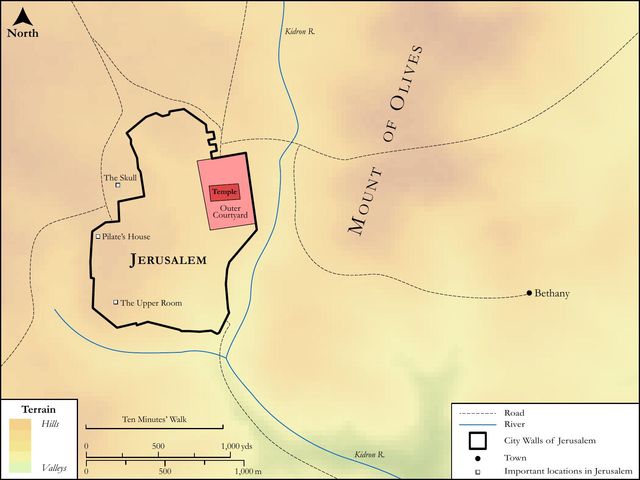
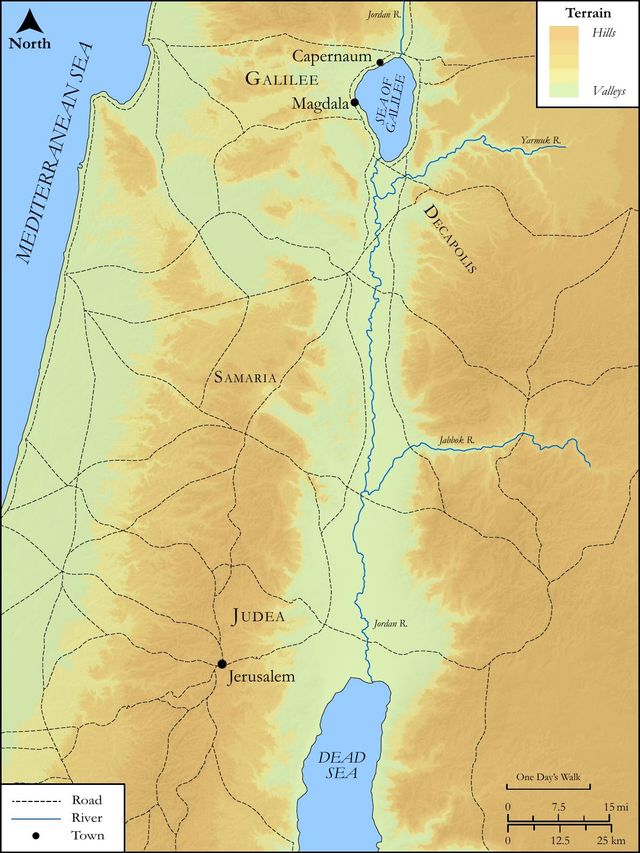
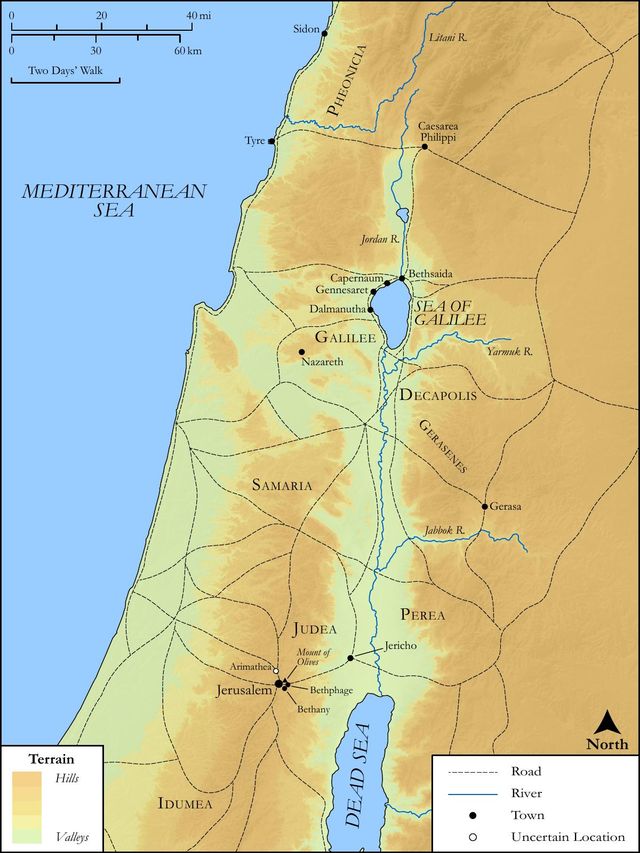
Study this verse
Public-domain commentary
Matthew Henry
From his Commentary on the Whole Bible. Henry comments on passages, not single verses — this entry covers Mark 15:33–41. His two-level outline is real structure in the source text, so it is rendered as structure.
Here we have an account of Christ's dying, how his enemies abused him, and God honoured him at his death.
I.There was a thick darkness over the whole land (some think over the whole earth), for three hours, from noon till three of the clock.
Now the scripture was fulfilled (Amo 8:9), I will cause the sun to go down at noon, and I will darken the earth in the clear day; and Jer 15:9, Her sun is gone down while it is yet day. The Jews have often demanded of Christ a sign from heaven; and now they had one, but such a one as signified the blinding of their eyes. It was a sign of the darkness that was come, and coming, upon the Jewish church and nation. They were doing their utmost to extinguish the Sun of righteousness, which was now setting, and the rising again of which they would never own; and what then might be expected among them but a worse than Egyptian darkness? This intimated to them, that the things which belonged to their peace, were now hid from their eyes, and that the day of the Lord was at hand, which should be to them a day of darkness and gloominess, Joe 2:1, Joe 2:2. It was the power of darkness that they were now under, the works of darkness that they were now doing; and such as this should their doom justly be, who loved darkness rather than light.
II.Toward the close of this darkness, our Lord Jesus, in the agony of his soul, cried out, My God, my God, why hast thou forsaken me? Mar 15:34. The darkness signified the present cloud which the human soul of Christ was under, when he was making it an offering for sin. Mr. Fox, in his Acts and Monuments (vol. 3, p. 160), tells of one Dr. Hunter, a martyr in queen Mary's time, who, being fastened to the stake, to be burnt, put up this short prayer, Son of God, shine upon me; and immediately the sun in the firmament shone out of the dark cloud, so full in his face, that he was forced to look another way, which was very comfortable to him. But our Lord Jesus, on the contrary, was denied the light of the sun, when he was in his sufferings, to signifying the withdrawing of the light of God's countenance. And this he complained of more than any thing; he did not complain of his disciples' forsaking him, but of his Father's,
1.Because this wounded his spirit; and that is a thing hard to bear (Pro 18:14); brought the waters into his soul, Psa 69:1-3.
2.Because in this especially he was made sin for us; our iniquities had deserved indignation and wrath upon the soul (Rom 2:8), and therefore, Christ, being made a sacrifice, underwent as much of it as he was capable of; and it could not but bear hard indeed upon him who had lain in the bosom of the Father from eternity, and was always his light. These symptoms of divine wrath, which Christ was under in his sufferings, were like that fire from heaven which had been sent sometimes, in extraordinary cases, to consume the sacrifices (as Lev 9:24; Ch2 7:1; Kg1 18:38); and it was always a token of God's acceptance. The fire that should have fallen upon the sinner, if God had not been pacified, fell upon the sacrifice, as a token that he was so; therefore it now fell upon Christ, and extorted him from this loud and bitter cry. When Paul was to be offered as a sacrifice for the service of saints, he could joy and rejoice (Phi 2:17); but it is another thing to be offered as a sacrifice for the sin of sinners. Now, at the sixth hour, and so to the ninth, the sun was darkened by an extraordinary eclipse; and if it be true, as some astronomers compute, that in the evening of this day on which Christ died there was an eclipse of the moon, that was natural and expected, in which seven digits of the moon were darkened, and it continued from five o'clock till seven, it is remarkable, and yet further significant of the darkness of the time that then was. When the sun shall be darkened, the moon also shall not give her light.
III.Christ's prayer was bantered by them that stood by (Mar 15:35, Mar 15:36); because he cried, Eli, Eli, or (as Mark has it, according to the Syriac dialect) Eloi, Eloi, they said, He calls for Elias, though they knew very well what he said, and what it signified, My God, My God. Thus did they represent him as praying to saints, either because he had abandoned God, or God had abandoned him; and hereby they would make him more and more odious to the people. One of them filled a sponge with vinegar, and reached it up to him upon a reed; "Let him cool his mouth with that, it is a drink good enough for him," Mar 15:36. This was intended for a further affront and abuse to him; and whoever it was that checked him who did it, did but add to the reproach; "Let him alone; he has called for Elias: let us see whether Elias will come take him down; and if not, we may conclude that he also hath abandoned him."
IV.Christ did again cry with a loud voice, and so gave up the ghost, Mar 15:37.
He was now commending his soul into his Father's hand; and though God is not moved with any bodily exercise, yet this loud voice signified the great strength and ardency of affection wherewith he did it; to teach us, in every thing wherein we have to do with God, to put forth our utmost vigour, and to perform all the duties of religion, particularly that of self-resignation, with our whole heart and whole soul; and then, though speech fails, that we cannot cry with a loud voice, as Christ did, yet if God be the strength of the heart, that will not fail. Christ was really and truly dead, for he gave up the ghost; his human soul departed to the world of spirits, and left his body a breathless clod of clay.
V.Just at that instant that Christ died upon mount Calvary, the veil of the temple was rent in twain from the top to the bottom, Mar 15:38. This bespoke a great deal,
1.Of the terror of the unbelieving Jews; for it was a presage of the utter destruction of their church and nation, which followed not long after; it was like the cutting asunder of the staff of beauty (for this veil was exceedingly splendid and glorious, Exo 26:31), and that was done at the same time when they gave for his price thirty pieces of silver (Zac 11:10, Zac 11:12), to break the covenant which he had made with that people. Now it was time to cry, Ichabod, The glory is departed from Israel. Some think that the story which Josephus relates, of the temple door opening of its own accord, with that voice, Let us depart hence, some years before the destruction of Jerusalem, is the same with this; but that is not probable: however, this had the same signification, according to that (Hos 5:14), I will tear, and go away.
2.It bespeaks a great deal of comfort to all believing Christians, for it signifies the consecrating and laying open to us of a new and living way into the holiest by the blood of Jesus.
VI.The centurion who commanded the detachment which had the oversight of the execution was convinced, and confessed that this Jesus was the Son of God, Mar 15:39. One thing that satisfied him, was, that he so cried out, and gave up the ghost: that one who was ready to give up the ghost, should be able to cry out so, was very surprising. Of all the sad spectacles of this kind he never observed the like; and that one who had strength to cry so loud, should yet immediately give up the ghost, this also made him wonder; and he said, to the honour of Christ, and the shame of those that abused him, Truly this man was the Son of God. But what reason had he to say so? I answer,
1.He had reason to say that he suffered unjustly, and had a great deal of wrong done him. Note, He suffered for saying that he was the Son of God; and it was true, he did say so, so that if he suffered unjustly, as it was plain by all the circumstances of his suffering that he did, then what he said was true, and he was indeed the Son of God.
2.He had reason to say that he was a favourite of heaven, and one for whom the almighty power was particularly engaged, seeing how Heaven did him honour at his death, and frowned upon his persecutors. "Surely," thinks he, "this must be some divine person, highly beloved of God." This he expresses by such words as denote his eternal generation as God, and his special designation to the office of Mediator, though he meant not so. Our Lord Jesus, even in the depth of his sufferings and humiliation, was the Son of God, and was declared to be so with power.
VII.There were some of his friends, the good women especially, that attended him (Mar 15:40, Mar 15:41); There were women looking on afar off:
the men durst not be seen at all, the mob was so very outrageous; Currenti cede furori - Give way to the raging torrent, they thought, was good counsel now. The women durst not come near, but stood at a distance, overwhelmed with grief. Some of these women are here named. Mary Magdalene was one; she had been his patient, and owed all her comfort to his power and goodness, which rescued her out of the possession of seven devils, in gratitude for which she thought she could never do enough for him. Mary also was there, the mother of James the little, Jacobus parvus, so the word is; probably, he was so called because he was, like Zaccheus, little of stature. This Mary was the wife of Cleophas or Alpheus, sister to the virgin Mary. These women had followed Christ from Galilee, though they were not required to attend the feast, as the males were; but it is probably that they came, in expectation that his temporal kingdom would now shortly be set up, and big with hopes of preferment for themselves, and their relations under him. It is plain that the mother of Zebedee's children was so (Mat 20:21); and now to see him upon a cross, whom they thought to have seen upon a throne, could not but be a great disappointment to them. Note, Those that follow Christ, in expectation of great things in this world by him, and by the profession of his religion, may probably live to see themselves sadly disappointed.
Historical interpretation
Ten Centuries of Reception
9 surviving comments on this verse. Each one is dated, so this reads as a timeline rather than a list.
Select a marker to jump to its quote. Markers stagger vertically where authors wrote within a few decades of each other.
The veil of the temple is rent, that is, the heaven is opened.
But the last are now made the first. The Gentile people confesses. The blinded Jew denies, so that their error is worse than the first.
As the female sex through the Virgin Mary is not shut out from salvation, so it is not thrust away from the knowledge of the mystery of the cross, and of the resurrection, through the widow Mary Magdalene, and the others, who were mothers.
(in Matt. Tract. 35) But it seems to me, that here three women are chiefly named, by Matthew and Mark. Two indeed are set down by each Evangelist, Mary Magdalene, and Mary the mother of James; the third is called by Matthew, the mother of the sons of Zebedee, but by Mark she is called Salome.
As they were “looking on,” so we too gaze on his wounds as he hangs. We see his blood as he dies. We see the price offered by the redeemer, touch the scars of his resurrection. He bows his head, as if to kiss you. His heart is made bare open, as it were, in love to you. His arms are extended that he may embrace you. His whole body is displayed for your redemption. Ponder how great these things are. Let all this be rightly weighed in your mind: as he was once fixed to the cross in every part of his body for you, so he may now be fixed in every part of your soul.
How can we understand the same Mary Magdalene both to have stood afar off along with other women as the accounts of Matthew and Mark bear, and to have been by the cross, as John tells us? It could have been the case that these women were at such a distance as made it quite natural to say at once that they were near because they were at hand there in the sight of him, and yet afar off in comparison with the crowd of people who were standing round about in closer vicinity along with the centurion and the soldiers. It is open for us, then, to suppose that those women who were present at the scene along with the Lord’s mother, after he commended her to the disciple, began then to retire with the view of extricating themselves from the dense mass of people, and from a greater distance looking on at what remained to be done.
There were also women looking on from a distance, among whom were Mary Magdalene, and Mary the mother of James the Less and Joses, and Salome. And when he was in Galilee, they followed him and ministered to him. James the Less is said to be James the son of Alphaeus, who was also called the brother of the Lord, because he was the son of Mary, the Lord’s aunt, of whom John makes mention in his Gospel, saying: Now there stood by the cross of Jesus his mother, and his mother’s sister, Mary the wife of Cleophas (John 19). He seems to call her Mary of Cleophas, either from her father or from her kinship. James was called the Less to distinguish him from James the Greater, the son of Zebedee, who was called among the first apostles and chosen by the Lord. It was the Jewish custom, and not considered blameworthy by the ancient custom of the people, that women provided food and clothing for teachers from their substance; Paul recalls having renounced this in case it could cause scandal among the Gentiles: Do we not have the right to be accompanied by a wife, as the other apostles do (1 Cor. 9)? They ministered to the Lord from their substance, so that he reaped their carnal things, of which they reaped spiritual things. Not that the Lord of creatures needed food, but to show a pattern for teachers, that they should be content with food and clothing from their disciples. But let us see what companions he had. Namely, Mary Magdalene, from whom he had cast out seven devils, and Mary the mother of James and Joses, his aunt, and others, which we read of in the other Gospels.
(ubi sup.) Now the cause of the centurion's wonder is clear, that seeing that the Lord died in that way, that is, sent forth His spirit, he said, Truly this man was the Son of God. For no one can send forth his own spirit, but He who is the Creator of souls.
(ubi sup.) He means by James the Less, the son of Alphæus, who was also called the brother of our Lord, because he was the son of Mary, our Lord's mother's sister, whom John mentions, saying, Now there stood by the cross of Jesus his mother and his mother's sister, Mary of Cleophas, and Mary Magdalene. (John 19:25) And he seems to call her Mary of Cleophas, from her father or some relation. But he was called James the Less, to distinguish him from James the Great, that is, the son of Zebedee, who was called amongst the first of the Apostles by our Lord. Further, it was a Jewish custom, nor was it thought blamable after the manners of an ancient people, that women should furnish to teachers food and clothing out of their substance. Wherefore there follows: Who also when he was in Galilee followed him, and ministered unto him. They ministered unto the Lord of their substance, that He might reap their carnal things whose spiritual things they reaped, and that He might show forth a type for all masters, who ought to be content with food and clothing from their disciples. But let us see what companions He had with Him, for it goes on: And many other women which came up with him into Jerusalem.
How could it be said that the brother of the Lord was not the apostle, but a third James, since Paul also gives him the name of an apostle, saying, “I saw none of the other apostles except James, the brother of the Lord”; and the evangelist Mark names the same man, not a third, but one of the two Jameses, saying, “There were women also watching from a distance, among whom were Mary Magdalene and Mary the mother of the James the younger and of Joseph and Salome?” Now “greater and lesser” are customarily used to establish a difference not among three, but between two. Hence the lesser James is named “of Alphaeus,” in distinction from the greater, who was the son of Zebedee.
Again, God by the rending of the veil implied that the grace of the Holy Spirit goes away and is rent from the temple, so that the Holy of holies might be seen by all;e also that the temple will mourn amongst the Jews, when they shall deplore their calamities, and rend their clothes. This also is a figure of the living temple, that is, the body of Christ, in whose Passion His garment is torn, that is, His flesh. Again, it means another thing; for the flesh is the veil of our temple, that is, of our mind. But the power of the flesh is torn in the Passion of Christ, from the top to the bottom, that is, from Adam even down to the latest man; for also Adam was made whole by the Passion of Christ, and his flesh does not remain under the curse, nor does it deserve corruption, but we all are gifted with incorruption. And when the centurion who stood over against him saw. He who commands a hundred soldiers is called a centurion. But seeing that He died with such power as the Lord, he wondered and confessed.
And so the order is inverted, for the Jew kills, and the Gentile confesses; the disciples fly, and the women remain. For there follows: There were also women looking on afar off, amongst whom was Mary Magdalene, and Mary the mother of James the less and of Joses, and Salome.
After the Evangelist has related the Passion and the death of Christ, he now goes on to mention those things which followed after the death of our Lord. Wherefore it is said: And the veil of the temple was rent in twain from the top to the bottom.
Continue studying Mark 15:40 across the web’s major study libraries — every link below opens this exact verse, chapter, or book on the destination site.
Read & Compare
 BibleGatewayThis verse in more than 200 translations and 70 languages.
 Bible.comThe YouVersion reader — hundreds of translations, reading plans, and highlights.
 ESV.orgCrossway's official English Standard Version reader.
 NET BibleThe NET translation with 60,000+ translators' notes on every rendering decision.
 STEP BibleTyndale House's free study tool — original text, vocabulary, and scholarly resources.
 BibliaLogos Bible Software's free web reader.
 USCCBThe New American Bible (Revised Edition) with the U.S. bishops' study notes.
Commentaries
 BibleHub CommentariesDozens of classic commentaries on this verse, gathered on one page.
 StudyLightMore than 100 commentary sets — the largest collection on the web.
 BibleRefPlain-English commentary on what this verse means, verse by verse.
 Enduring WordDavid Guzik's free commentary on this chapter, widely used by Bible teachers.
 Bible Study ToolsVerse commentary alongside Greek and Hebrew study aids.
Original Language & Research
- BibleHub InterlinearThe verse word by word — original language, transliteration, and English.
- BibleHub LexiconEvery word's original-language definition and Strong's entry.
 Blue Letter BibleDeep-study tools — Strong's numbers, concordance, and word studies.
 CNTR CollationThe earliest Greek manuscripts of this verse, collated letter by letter.
Sermons, Hymns & Audio


TrulyRandomVerse is not affiliated with these sites and doesn’t control their content. They’re linked because they’re genuinely useful.
Summary
Mark 15:40 offers a poignant glimpse into the unwavering devotion of a group of women who, unlike most of Jesus' male disciples, remained present at the cross, observing the horrific scene of His crucifixion from a distance. This verse identifies Mary Magdalene, Mary the mother of James the less and of Joses, and Salome, highlighting their faithful witness to Jesus' suffering and death, a testament to their profound commitment even in the face of despair and danger.
Context
ShowHideLiterary Context
This verse immediately follows the climactic moment of Jesus' death on the cross and the Roman centurion's profound confession, "Truly this man was the Son of God" (Mark 15:39). The preceding verses detail the mockery, the darkness over the land, and Jesus' final cry, emphasizing the profound spiritual and physical agony of the crucifixion (Mark 15:33-37). Mark's narrative consistently portrays the male disciples as failing or fleeing, culminating in Peter's denial (Mark 14:66-72), making the steadfast presence of these women a powerful contrast. Their presence here sets the stage for their crucial role as the first witnesses to the empty tomb and the resurrection in the subsequent chapter (Mark 16:1-8).
Historical & Cultural Context
Crucifixion was a public, brutal, and humiliating form of execution designed to deter rebellion and assert Roman power. It was a spectacle of state-sanctioned violence, and those associated with the condemned were often viewed with suspicion or contempt. In first-century Jewish and Roman societies, women generally held a subordinate status, and their public presence, especially at such a gruesome event, was noteworthy. Their "looking on afar off" may have been a practical necessity due to the crowd, the Roman guard, or simply the horrific nature of the scene, but it also underscores their courage in remaining close enough to bear witness despite the social stigma and personal danger of being identified with a crucified "criminal." Their act was one of profound loyalty, transcending societal expectations and personal fear.
Key Themes
ShowHideMark 15:40 powerfully reinforces several key themes woven throughout the Gospel. First, it highlights the unwavering faithfulness of these women disciples, contrasting sharply with the abandonment by most of the male disciples (Mark 14:50). Their steadfast presence at the cross exemplifies true discipleship, enduring even in the face of apparent defeat and profound suffering. Second, the verse underscores the prominence and vital role of women in Jesus' ministry, a theme consistently present in Mark's Gospel, where women are often depicted as models of faith and devotion, serving Jesus and supporting His mission (Mark 1:31, Mark 14:3-9). Finally, their act of "looking on" emphasizes their role as witnesses to suffering, bearing silent, sorrowful testimony to the ultimate sacrifice of Jesus, a witness that would culminate in their being the first to witness the resurrection (Mark 16:1-8).
Exposition and Analysis
ShowHideKey Word Analysis
ShowHideThis term refers to adult females. In this context, it emphasizes the presence of a specific group of female followers of Jesus, distinguishing them from the general crowd or the male disciples. Their identity as "women" highlights their unique courage and devotion in a patriarchal society, especially given the public and dangerous nature of the crucifixion.
This verb signifies to be a spectator of, to discern, or to perceive. It implies more than just a casual glance; it suggests an intentional, focused observation, indicating that these women were actively witnessing and processing the horrific events unfolding before them. Their "looking on" implies a deep engagement with Jesus' suffering.
This adverb denotes "from a distance" or "from far." While it could imply a physical separation due to crowds or guards, it also conveys a sense of emotional or relational distance from the immediate brutality, allowing them to observe without being directly implicated or overwhelmed by the chaos at the foot of the cross. Yet, it also underscores their proximity compared to those who had fled entirely.
Verse Breakdown
ShowHide"There were also women looking on afar off"
This opening clause immediately draws attention to the presence of a distinct group—women—who were actively observing the crucifixion. The phrase "afar off" suggests a physical distance, perhaps for safety, due to the crowd, or the nature of the execution, yet their intentional "looking on" signifies their unwavering commitment to witness Jesus' final moments, a stark contrast to the male disciples who had largely abandoned Him.
"among whom was Mary Magdalene,"
Mary Magdalene is consistently listed first among the women present at the cross and later at the tomb in all four Gospels, indicating her prominent role among Jesus' followers. She is known as one from whom Jesus had cast out seven demons (Luke 8:2), and her unwavering devotion is a testament to the transformative power of Christ.
"and Mary the mother of James the less and of Joses,"
This Mary is distinct from Jesus' mother. She is often identified as Mary, the wife of Clopas (John 19:25), and is likely the mother of two figures known in early Christian tradition. "James the less" (Greek: Iakobou tou mikrou) distinguishes him from other prominent Jameses (e.g., James, son of Zebedee), likely referring to James the Less, one of the apostles or a close relative of Jesus. Joses is also mentioned as a brother of Jesus in Mark (Mark 6:3).
"and Salome;"
Salome is another significant figure among Jesus' female followers. She is often identified as the mother of James and John, the sons of Zebedee, who had previously sought positions of honor in Jesus' kingdom (Mark 10:37). Her presence here, witnessing the suffering of the one she had followed, demonstrates a profound shift from ambition to humble, faithful devotion.
Literary Devices
ShowHideMark 15:40 employs several powerful literary devices. Contrast is prominent, as the steadfast presence of these women stands in stark opposition to the flight and denial of Jesus' male disciples, highlighting their exceptional loyalty. This creates a sense of Irony, as those often overlooked in society become the most faithful witnesses in Jesus' darkest hour. The phrase "looking on afar off" serves as Symbolism, representing not only their physical distance but also their sorrowful, yet courageous, role as silent observers of a divine tragedy. Their names, specifically listed, provide Specificity and Verisimilitude, grounding the narrative in historical reality and emphasizing the individual commitment of these particular women. This specificity also serves as a form of Foreshadowing, as these same women will be the first to discover the empty tomb and receive the resurrection message (Mark 16:1-8), making their witness at the cross all the more significant.
Theological and Thematic Connections
ShowHideMark 15:40 profoundly illustrates the nature of true discipleship, characterized by unwavering loyalty and courageous presence even in the face of despair and apparent defeat. The women's steadfastness at the cross, where Jesus' earthly mission appeared to end in ignominy, serves as a powerful theological statement: genuine faith endures beyond triumph, through suffering, and into the depths of sorrow. Their witness underscores the inclusive nature of God's kingdom, where those often overlooked or despised play pivotal roles in bearing witness to divine truth. This scene also foreshadows their crucial role as the first evangelists of the resurrection, demonstrating that faithfulness in suffering prepares one for the reception of glorious truth.
Reflection and Application
ShowHideThe scene at the cross in Mark 15:40 calls us to a deeper reflection on the nature of our own discipleship. Are we fair-weather followers, present only when the path is clear and the triumphs are evident? Or do we, like these courageous women, remain steadfast even when the cost is high, the circumstances are bleak, and the outcome seems uncertain? Their example challenges us to cultivate a faith that is not contingent on comfort or success, but rooted in an enduring commitment to Christ Himself, regardless of the external circumstances. It reminds us that faithfulness often manifests not in grand gestures, but in quiet, persistent presence and unwavering devotion, especially in moments of adversity. Their witness encourages us to stand with Christ, even when it means standing against the tide, embracing the suffering that often precedes glory, and trusting in God's ultimate plan even when it is veiled in darkness.
Questions for Reflection
ShowHideFAQ
ShowHideWho were these specific women mentioned in Mark 15:40, and why are they significant?
ShowHideMark 15:40 names three women: Mary Magdalene, Mary the mother of James the less and of Joses, and Salome. They are significant because, unlike most of Jesus' male disciples who had fled, these women remained at the cross, bearing witness to Jesus' suffering and death. Mary Magdalene was a prominent follower from whom Jesus had cast out seven demons (Luke 8:2); she is consistently listed first and is a key figure in the resurrection accounts. Mary, the mother of James the less and of Joses, is distinct from Jesus' mother and is likely related to James the Less, an apostle, and Joses, possibly one of Jesus' brothers (Mark 6:3). Salome is often identified as the mother of James and John, the sons of Zebedee (Mark 10:35-40). Their presence highlights their deep devotion, courage, and their crucial role as faithful witnesses, foreshadowing their later role as the first to discover the empty tomb (Mark 16:1-8).
Christ-Centered Fulfillment
ShowHideMark 15:40, by detailing the faithful presence of these women at the cross, points powerfully to the Christ-centered fulfillment of God's redemptive plan. Their unwavering witness to Jesus' suffering underscores the reality and depth of His atoning sacrifice, the very act by which humanity is reconciled to God. The Lamb of God, who takes away the sin of the world (John 1:29), was not abandoned by all, but was faithfully observed by those whose lives He had transformed. This scene, therefore, emphasizes the profound truth that Christ's suffering was a real, historical event, witnessed by loyal adherents. Furthermore, the women's steadfastness in the face of apparent defeat foreshadows the ultimate triumph of Christ over death, for these same women would be the first to proclaim the resurrection, revealing that the cross was not the end but the necessary prelude to glory (Mark 16:1-8). Their presence at the cross, then, is a testament to the enduring power of Christ's love to inspire such devotion, even unto death, and serves as a vital link between His crucifixion and His glorious resurrection, which secures eternal life for all who believe (Romans 6:4).