


Luke 7:31
Bible text: King James Version (1769 Blayney text) · Public domain
Bible text: Berean Standard Bible · Public domain
Bible text: American Standard Version (1901) · Public domain
Bible text: World English Bible, Messianic edition · Public domain
Bible text: Geneva Bible (1599) · Public domain
Bible text: Young's Literal Translation · Public domain
- ΕἶπενEipensaidG2036V-2AAI-3SVerb 2nd Aorist Active Indicative 3rd Singular
- δὲdenowG1161CONJConjunction
- ὁho<the>G3588T-NSMDefinite article Nominative Singular Masculine
- κύριοςkuriosLordG2962N-NSM-TNoun Nominative Singular Masculine Title
- τίνιtiniTo whatG5101I-DSNInterrogative pronoun Dative Singular Neuter
- οὖνounthereforeG3767CONJConjunction
- ὁμοιώσωhomoiōsōwill I likenG3666V-FAI-1SVerb Future Active Indicative 1st Singular
- τοὺςtoustheG3588T-APMDefinite article Accusative Plural Masculine
- ἀνθρώπουςanthrōpousmenG444N-APMNoun Accusative Plural Masculine
- τῆςtēsof theG3588T-GSFDefinite article Genitive Singular Feminine
- γενεᾶςgeneasgenerationG1074N-GSFNoun Genitive Singular Feminine
- ταύτηςtautēsthisG3778D-GSFDemonstrative pronoun Genitive Singular Feminine
- καὶkaiAndG2532CONJConjunction
- τίνιtinito whatG5101I-DSNInterrogative pronoun Dative Singular Neuter
- εἰσὶνeisinare theyG1510V-PAI-3PVerb Present Active Indicative 3rd Plural
- ὅμοιοι;homoioilike?G3664A-NPMAdjective Nominative Plural Masculine
English is a literal word-by-word gloss of the Greek, not the KJV's wording. Why?
This is the original text the KJV's translators worked from — each Greek word with its own literal English meaning in this verse, prepared by scholars at Tyndale House, Cambridge. The KJV translates whole sentences, not word by word, so its wording differs: one Greek word can become several English words, and the KJV may choose “charity” where the gloss reads “love”. Both are faithful — they answer different questions. For the KJV's own rendering, switch to the KJV text.
Details
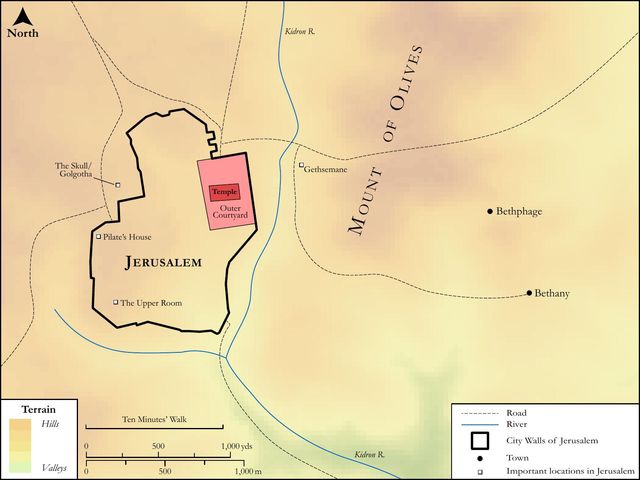
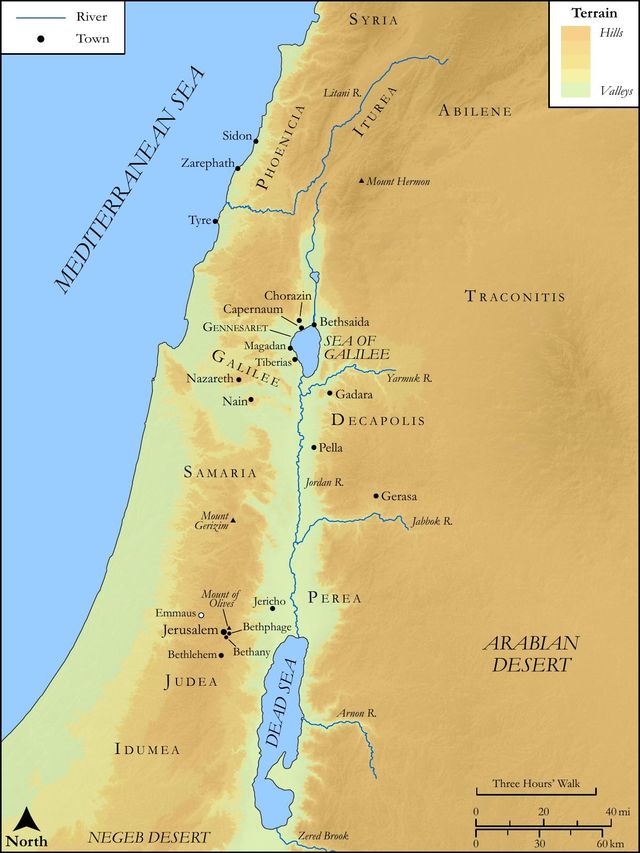
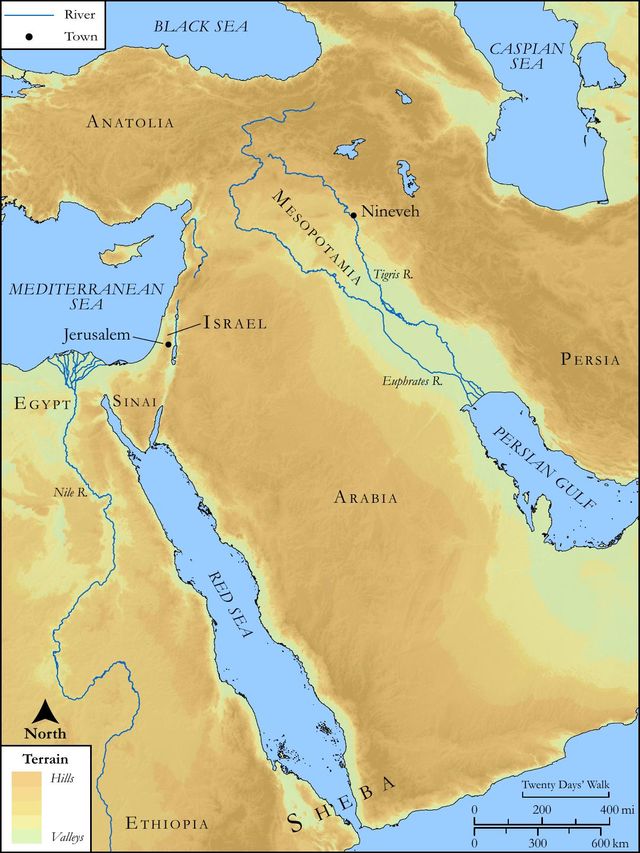
See on the biblical-era maps
Study this verse
Public-domain commentary
Matthew Henry
From his Commentary on the Whole Bible. Henry comments on passages, not single verses — this entry covers Luke 7:19–35. His three-level outline is real structure in the source text, so it is rendered as structure.
All this discourse concerning John Baptist, occasioned by his sending to ask whether he was the Messiah or no, we had, much as it is here related, Mt. 11:2-19.
I.We have here the message John Baptist sent to Christ, and the return he made to it. Observe,
1.The great thing we are to enquire concerning Christ is whether he be he that should come to redeem and save sinners, or whether we are to look for another, Luk 7:19, Luk 7:20. We are sure that God has promised that a Saviour shall come, an anointed Saviour; we are as sure that what he has promised he will perform in its season. If this Jesus be that promised Messiah, we will receive him, and will look for no other; but, if not, we will continue our expectations, and, though he tarry, will wait for him.
2.The faith of John Baptist himself, or at least of his disciples, wanted to be confirmed in this matter; for Christ had not yet publicly declared himself to be indeed the Christ, nay, he would not have his disciples, who knew him to be so, to speak of it, till the proofs of his being so were completed in his resurrection. The great men of the Jewish church had not owned him, nor had he gained any interest that was likely to set him upon the throne of his father David. Nothing of that power and grandeur was to be seen about him in which it was expected that the Messiah would appear; and therefore it is not strange that they should ask, Art thou the Messiah? not doubting but that, if he was not, he would direct them what other to look for.
3.Christ left it to his own works to praise him in the gates, to tell what he was and to prove it. While John's messengers were with him, he wrought many miraculous cures, in that same hour, which perhaps intimates that they staid but an hour with him; and what a deal of work did Christ do in a little time! Luk 7:21. He cured many of their infirmities and plagues in body, and of evil spirits that affected the mind either with frenzy or melancholy, and unto many that were blind he gave sight. He multiplied the cures, that there might be no ground left to suspect a fraud; and then (Luk 7:22) he bade them go and tell John what they had seen. And he and they might easily argue, as even the common people did (Joh 7:31), When Christ cometh, will he do more miracles than these which this man hath done? These cures, which they saw him work, were not only confirmations of his commission, but explications of it. The Messiah must come to cure a diseased world, to give light and sight to them that sit in darkness, and to restrain and conquer evil spirits. You see that Jesus does this to the bodies of people, and therefore must conclude this is he that should come to do it to the souls of people, and you are to look for no other. To his miracles in the kingdom of nature he adds this in the kingdom of grace (Luk 7:22), To the poor the gospel is preached, which they knew was to be done by the Messiah; for he was anointed to preach the gospel to the meek (Isa 61:1), and to save the souls of the poor and needy, Psa 72:13. Judge, therefore, whether you can look for any other that will more fully answer the characters of the Messiah and the great intentions of his coming.
4.He gave them an intimation of the danger people were in of being prejudiced against him, notwithstanding these evident proofs of his being the Messiah (Luk 7:23): Blessed is he whosoever shall not be offended in me, or scandalized at me. We are here in a state of trial and probation; and it is agreeable to such a state that, as there are sufficient arguments to confirm the truth to those that are honest and impartial in searching after it, and have their minds prepared to receive it, so there should be also objections, to cloud the truth to those that are careless, worldly, and sensual. Christ's education at Nazareth, his residence at Galilee, the meanness of his family and relations, his poverty, and the despicableness of his followers - these and the like were stumbling-blocks to many, which all the miracles he wrought could not help them over. He is blessed, for he is wise, humble, and well disposed, that is not overcome by these prejudices. It is a sign that God has blessed him, for it is by his grace that he is helped over these stumbling-stones; and he shall be blessed indeed, blessed in Christ.
II.We have here the high encomium which Christ gave of John Baptist; not while his messengers were present (lest he should seem to flatter him), but when they were departed (Luk 7:24), to make the people sensible of the advantages they had enjoyed in John's ministry, and were deprived of by his imprisonment. Let them now consider what they went out into the wilderness to see, who that was about whom there had been so much talk and such a great and general amazement. "Come," saith Christ, "I will tell you."
1.He was a man of unshaken self-consistence, a man of steadiness and constancy. He was not a reed shaken with the wind, first in one direction and then in another, shifting with every wind; he was firm as a rock, not fickle as a reed. If he could have bowed like a reed to Herod, and have complied with the court, he might have been a favourite there; but none of these things moved him.
2.He was a man of unparalleled self-denial, a great example of mortification and contempt of the world. He was not a man clothed in soft raiment, nor did he live delicately (Luk 7:25); but, on the contrary, he lived in a wilderness and was clad and fed accordingly. Instead of adorning and pampering the body, he brought it under, and kept it in subjection.
3.He was a prophet, had his commission and instructions immediately from God, and not of man or by man. He was by birth a priest, but that is never taken notice of; for his glory, as a prophet, eclipsed the honour of his priesthood. Nay, he was more, he was much more than a prophet (Luk 7:26), than any of the prophets of the Old Testament; for they spoke of Christ as at a distance, he spoke of him as at the door.
4.He was the harbinger and forerunner of the Messiah, and was himself prophesied of in the Old Testament (Luk 7:27): This is he of whom it is written (Mal 3:1), Behold, I send my messenger before thy face. Before he sent the Master himself, he sent a messenger, to give notice of his coming, and prepare people to receive him. Had the Messiah been to appear as a temporal prince, under which character the carnal Jews expected him, his messenger would have appeared either in the pomp of a general or the gaiety of a herald at arms; but it was a previous indication, plain enough, of the spiritual nature of Christ's kingdom, that the messenger he sent before him to prepare his way did it by preaching repentance and reformation of men's hearts and lives. Certainly that kingdom was not of this world which was thus ushered in.
5.He was, upon this account, so great, that really there was not a greater prophet than he. Prophets were the greatest that were born of women, more honourable than kings and princes, and John was the greatest of all the prophets. The country was not sensible what a valuable, what an invaluable, man it had in it, when John Baptist went about preaching and baptizing. And yet he that is least in the kingdom of God is greater than he. The least gospel minister, that has obtained mercy of the Lord to be skilful and faithful in his work, or the meanest of the apostles and first preachers of the gospel, being employed under a more excellent dispensation, are in a more honourable office than John Baptist. The meanest of those that follow the Lamb far excel the greatest of those that went before him. Those therefore who live under the gospel dispensation have so much the more to answer for.
III.We have here the just censure of the men of that generation, who were not wrought upon by the ministry either of John Baptist or of Jesus Christ himself.
1.Christ here shows what contempt was put upon John Baptist, while he was preaching and baptizing.
(1.)Those who did show him any respect were but the common ordinary sort of people, who, in the eye of the gay part of mankind, were rather a disgrace to him than a credit, Luk 7:29. The people indeed, the vulgar herd, of whom it was said, This people, who know not the law, are cursed (Joh 7:49), and the publicans, men of ill fame, as being generally men of bad morals, or taken to be so, these were baptized with his baptism, and became his disciples; and these, though glorious monuments of divine grace, yet did not magnify John in the eye of the world; but by their repentance and reformation they justified God, justified his conduct and the wisdom of it in appointing such a one as John Baptist to be the forerunner of the Messiah: they hereby made it to appear that it was the best method that could be taken, for it was not in vain to them whatever it was to others.
(2.)The great men of their church and nation, the polite and the politicians, that would have done him some credit in the eye of the world, did him all the dishonour they could; they heard him indeed, but they were not baptized of him, Luk 7:30. The Pharisees, who were most in reputation for religion and devotion, and the lawyers, who were celebrated for their learning, especially their knowledge of the scriptures, rejected the counsel of God against themselves; they frustrated it, they received the grace of God, by the baptism of John, in vain. God in sending that messenger among them had a kind purpose of good to them, designed their salvation by it, and, if they had closed with the counsel of God, it had been for themselves, they had been made for ever; but they rejected it, would not comply with it, and it was against themselves, it was to their own ruin; they came short of the benefit intended them, and not only so, but forfeited the grace of God, put a bar in their own door, and, by refusing that discipline which was to fit them for the kingdom of the Messiah, shut themselves out of it, and they not only excluded themselves, but hindered others, and stood in their way.
2.He here shows the strange perverseness of the men of that generation, in their cavils both against John and Christ, and the prejudices they conceived against them.
(1.)They made but a jesting matter of the methods God took to do them good (Luk 7:31): "Whereunto shall I liken the men of this generation? What can I think of absurd enough to represent them by? They are, then, like children sitting in the market-place, that mind nothing that is serious, but are as full of play as they can hold. As if God were but in jest with them, in all the methods he takes to do them good, as children are with one another in the market-place (Luk 7:32), they turn it all off with a banter, and are not more affected with it than with a piece of pageantry." This is the ruin of multitudes, they can never persuade themselves to be serious in the concerns of their souls. Old men, sitting in the sanhedrim, were but as children sitting in the market-place, and no more affected with the things that belonged to their everlasting peace than people are with children's play. O the amazing stupidity and vanity of the blind and ungodly world! The Lord awaken them out of their security.
(2.)They still found something or other to carp at. [1.] John Baptist was a reserved austere man, lived much in solitude, and ought to have been admired for being such a humble, sober, self-denying man, and hearkened to as a man of thought and contemplation; but this, which was his praise, was turned to his reproach. Because he came neither eating nor drinking, so freely, plentifully, and cheerfully, as others did, you say, "He has a devil; he is a melancholy man, he is possessed, as the demoniac whose dwelling was among the tombs, though he be not quite so wild." [2.] Our Lord Jesus was of a more free and open conversation; he came eating and drinking, Luk 7:34. He would go and dine with Pharisees, though he knew they did not care for him; and with publicans, though he knew they were no credit to him; yet, in hopes of doing good both to the one and the other, he conversed familiarly with them. By this it appears that the ministers of Christ may be of very different tempers and dispositions, very different ways of preaching and living, and yet all good and useful; diversity of gifts, but each given to profit withal. Therefore none must make themselves a standard to all others, nor judge hardly of those that do not do just as they do. John Baptist bore witness to Christ, and Christ applauded John Baptist, though they were the reverse of each other in their way of living. But the common enemies of them both reproached them both. The very same men that had represented John as crazed in his intellects, because he came neither eating nor drinking, represented our Lord Jesus as corrupt in his morals, because he came eating and drinking; he is a gluttonous man, and a wine-bibber. Ill-will never speaks well. See the malice of wicked people, and how they put the worst construction upon every thing they meet with in the gospel, and in the preachers and professors of it; and hereby they think to depreciate them, but really destroy themselves.
3.He shows that, notwithstanding this, God will be glorified in the salvation of a chosen remnant (Luk 7:35): Wisdom is justified of all her children. There are those who are given to wisdom as her children, and they shall be brought by the grace of God to submit to wisdom's conduct and government, and thereby to justify wisdom in the ways she takes for bringing them to that submission; for to them they are effectual, and thereby appear well chosen. Wisdom's children are herein unanimous, one and all, they have all a complacency in the methods of grace which divine wisdom takes, and think never the worse of them for their being ridiculed by some.
Historical interpretation
Four Centuries of Reception
12 surviving comments on this verse. Each one is dated, so this reads as a timeline rather than a list.
Select a marker to jump to its quote. Markers stagger vertically where authors wrote within a few decades of each other.
Because also they believed, they justified God, for He appeared just to them in all that He did. But the disobedient conduct of the Pharisees in not receiving John, accorded not with the words of the prophet, That thou mightest be justified when thou speakest. (Ps. 51:4.) Hence it follows, But the Pharisees and lawyers rejected the counsel of God, &c.
For Christ would not abstain from this food, lest He should give a handle to heretics, who say that the creatures of God are bad, and blame flesh and wine.
(Hom. 6. in Eccl.) But singing and lamentation are nothing else but the breaking forth, the one indeed of joy, the other of sorrow. Now at the sound of a tune played upon a musical instrument, man by the concordant beating of his feet, and motion of his body, pourtrays his inward feelings. Hence he says, We have sung, and ye have not danced; we have mourned to you, and ye have not wept.
(Verse 35.) Therefore Wisdom is justified by all her children. Well by all, because justice is preserved around all, so that the reception of the faithful may be, and the rejection of the unfaithful. From which the majority of Greeks have it thus: Wisdom is justified by all her works; that is, the work of justice is to preserve the measure around the merit of each individual.
Therefore he says well: We have sung to you, and you have not danced (Exodus 15:1). Moses sang indeed when he made the waves subside in the Red Sea for the crossing of the Jews, the water stood up, and it submerged the horses of the Egyptians and their riders. Isaiah sang the song of his beloved vineyard, indicating that the people, who had previously been fruitful with abundant virtues, would become rough with wickedness (Isaiah 5:1). The Hebrews sang when their feet were moistened by the touch of the roasting flame, both inside and outside, while everything else was burning; however, the fire alone licked them harmlessly and did not burn them (Daniel 3:24). Habakkuk also, with a learned song, comforted the public sorrow, and prophesied that the passion of the Lord would be sweet to the faithful (Habakkuk 3:2). Therefore, the prophets sang with spiritual melodies, resulting in public words of salvation. The prophets wept with mournful dirges, soothing the hard hearts of the Jews.
God is justified by baptism, wherein men justify themselves confessing their sins. For he that sins and confesses his sin unto God, justifies God, submitting himself to Him who overcometh, and hoping for grace from Him; God therefore is justified by baptism, in which there is confession and pardon of sin.
Let us not then despise (as the Pharisees did) the counsel of God, which is in the baptism of John, that is, the counsel which the Angel of great counsel searches out. (Is. 9:6. LXX.) No one despises the counsel of man. Who then shall reject the counsel of God?
But the prophets sung, repeating in spiritual strains their oracles of the common salvation; they wept, soothing with mournful dirges the hard hearts of the Jews. The songs were not sung in the market-place, nor in the streets, but in Jerusalem. For that is the Lord's forum, in which the laws of His heavenly precepts are framed.
The Son of God is wisdom, by nature, not by growth, which is justified by baptism, when it is not rejected through obstinacy, but through righteousness is acknowledged the gift of God. Herein then is the justification of God, if he seems to transfer His gifts not to the unworthy and guilty, but to those who are through baptism holy and just.
He well says, of all, for justice is reserved for all, that the faithful may be taken up, the unbelievers cast out.
(Hom. 37. in Matt.) Having declared the praises of John, he next exposes the great fault of the Pharisees and lawyers, who would not after the publicans receive the baptism of John. Hence it is said, And all the people that heard him, and the Publicans, justified God.
(Hom. in Ps. 108.) But by the children of wisdom, He means the wise. For Scripture is accustomed to indicate the bad rather by their sin than their name, but to call the good the children of the virtue which characterizes them.
There may have been perchance a sort of game among the Jewish children, something of this kind. A group of youths was divided into two parts. One made fun of the confusion in the world, the uneven course of its affairs, and the painful and rapid change from one extreme to the other, by playing some of them on instruments of music. The other group wailed. Neither did the mourners share the merriment of those who were playing music and rejoicing, nor did those with the instruments of music join in the sorrow of those who were weeping. Finally, they rebuked one another with their lack of sympathy, so to speak, and absence of affection. The one party would say, "We have played unto you, and you have not danced." The others would respond, "We have wailed to you, and you have not wept."
There was a certain play among the Jewish children of this kind. A company of boys were collected together, who, mocking the sudden changes in the affairs of this life, some of them sang, some mourned, but the mourners did not rejoice with those that rejoiced, nor did those who rejoiced fall in with those that wept. They then rebuked each other in turn with the charge of want of sympathy. That such were the feelings of the Jewish people and their rulers, Christ implied in the following words, spoken in the person of Christ; Whereunto then shall I liken the men of this generation, and to what are they like? They are like to children sitting in the market-place.
They take upon themselves to slander a man worthy of all admiration. They say that he who mortifies the law of sin which is in his members hath a devil.
But where could they point out the Lord as gluttonous? For Christ is found every where repressing excess, and leading men to temperance. But He associated with publicans and sinners. Hence they said against Him, He is a friend of Publicans and sinners, though He could in no wise fall into sin, but on the contrary was to them the cause of salvation. For the sun is not polluted though sending its rays over all the earth, and frequently falling upon unclean bodies. Neither will the Sun of righteousness be hurt by associating with the bad. But let no one attempt to place his own condition on a level with Christ's greatness, but let each considering his own infirmity avoid having dealing with such men, for "evil communications corrupt good manners." It follows, And wisdom is justified of all her children.
The prophet’s words will apply to us, “Woe to them that call evil good, and good evil. Who call bitter sweet and sweet bitter. Who put light for darkness, and darkness for light.” This was the character of the Israelites and especially of those who were their chiefs, the scribes, namely, and Pharisees. Christ said about them, “To what shall I liken the men of this generation?”
People are in the habit of dancing or singing as the custom is with vows, particularly at marriages, and so we have marriages to which a vow is attached and at which we are expected to dance or sing. Our vows are celebrated when the church is united to Christ. John says, “The one who has the bride is the bridegroom.” It is good for us to dance because of this marriage, for David, both king and prophet, danced before the ark of the covenant “with much singing.” He broke into dancing in high rejoicing, for in the Spirit he foresaw Mary, born of his own line, brought into Christ’s chamber. He says, “And he, like a bridegroom, will come forth from his chamber.” He sang more than the other prophetic authors did because he was gladder than the rest of them. By these joys, he united those coming after him in marriage. By inviting us to his own vows in a more charming way than usual, having danced with such joy in front of the ark before his marriage, he taught us what we ought to do at those other vows. The prophet David danced.
These words were spoken either in the person of the Evangelist, or, as some think, of the Saviour; but when he says, against themselves, he means that he who rejects the grace of God, does it against himself. Or, they are blamed as foolish and ungrateful for being unwilling to receive the counsel of God, sent to themselves. The counsel then is of God, because He ordained salvation by the passion and death of Christ, which the Pharisees and lawyers despised.
The Jewish generation is compared to children, because formerly they had prophets for their teachers, of whom it is said, Out of the mouths of babes and sucklings hast thou perfected praise.
To what, then, shall I compare the men of this generation, and what are they like? They are like children sitting in the marketplace, calling to one another and saying: We played the flute for you, and you did not dance. We wailed, and you did not weep. The generation of the Jews is compared to children sitting in the marketplace because they used to receive the prophets as teachers. Of whom it is said: Out of the mouth of infants and nursing babies, you have perfected praise (Psalm VIII). And elsewhere, The unfolding of your words gives light; it imparts understanding to the simple (Psalm CXVIII), that is, to the humble in spirit. The Lord's marketplace or the synagogue, or even Jerusalem itself is where the laws of heavenly precepts were established. Where these children, according to Matthew, spoke to their equals, because they used to reproach their people daily with their own voices, they would not listen to the Psalms, first of David, nor after being corrected by the reproaches of the prophets. Whenever victory over the enemy was foretold or commemorated, they did not rise to the works of virtue. For by the word of dance is not meant the bodily gyrations of actors with swaying movements but the devotion of a zealous heart and the piety of agile members. Whenever the prophecies of calamities caused by future or present enemies resounded, and yet the listeners did not care to take refuge in remedies for penitence. The Psalmist sings: Shout with joy to God our helper, rejoice to the God of Jacob, take up a psalm, and bring the tambourine (Psalm LXXX), and so forth. But what follows? My people did not listen to my voice, and Israel did not attend to me (Ibid.). The prophet cries out: Thus says the Lord: Turn to me with all your heart, in fasting, in weeping, and in mourning, and rend your hearts and not your garments (Joel II). And again: My belly, my belly! I writhe in pain. The heart of my thoughts troubles me. I will not remain silent, for my soul has heard the sound of the trumpet, the alarm of war (Jeremiah IV). And a little later: For my people are foolish, they have not known me; they are senseless children, without understanding (Ibid.).
Continue studying Luke 7:31 across the web’s major study libraries — every link below opens this exact verse, chapter, or book on the destination site.
Read & Compare
 BibleGatewayThis verse in more than 200 translations and 70 languages.
 Bible.comThe YouVersion reader — hundreds of translations, reading plans, and highlights.
 ESV.orgCrossway's official English Standard Version reader.
 NET BibleThe NET translation with 60,000+ translators' notes on every rendering decision.
 STEP BibleTyndale House's free study tool — original text, vocabulary, and scholarly resources.
 BibliaLogos Bible Software's free web reader.
 USCCBThe New American Bible (Revised Edition) with the U.S. bishops' study notes.
Commentaries
 BibleHub CommentariesDozens of classic commentaries on this verse, gathered on one page.
 StudyLightMore than 100 commentary sets — the largest collection on the web.
 BibleRefPlain-English commentary on what this verse means, verse by verse.
 Enduring WordDavid Guzik's free commentary on this chapter, widely used by Bible teachers.
 Bible Study ToolsVerse commentary alongside Greek and Hebrew study aids.
Original Language & Research
- BibleHub InterlinearThe verse word by word — original language, transliteration, and English.
- BibleHub LexiconEvery word's original-language definition and Strong's entry.
 Blue Letter BibleDeep-study tools — Strong's numbers, concordance, and word studies.
 CNTR CollationThe earliest Greek manuscripts of this verse, collated letter by letter.
Sermons, Hymns & Audio


TrulyRandomVerse is not affiliated with these sites and doesn’t control their content. They’re linked because they’re genuinely useful.
Summary
In Luke 7:31, Jesus poses a profound rhetorical question, lamenting the spiritual inconsistency and stubborn resistance of "this generation" to God's divine messengers. This pivotal inquiry sets the stage for His subsequent parable, which illustrates the unreasonableness of those who found fault with both the austere message of John the Baptist and Jesus's more accessible approach to proclaiming the kingdom of God, highlighting their unwillingness to respond to God's call regardless of its presentation.
Context
ShowHideLiterary Context
Luke 7:31 serves as a critical transition within Luke's Gospel, immediately following Jesus's discourse on the identity and significance of John the Baptist. Jesus has just affirmed John as "more than a prophet" and the one who prepared the way for the Messiah. The preceding verses (Luke 7:29-30) highlight a stark contrast in responses to John's ministry: tax collectors and ordinary people "justified God" by accepting John's baptism, while the Pharisees and lawyers "rejected God's purpose for themselves" by refusing it. Jesus's rhetorical question in verse 31 directly addresses this paradoxical and resistant attitude, setting up the parable of the children in the marketplace (Luke 7:32-35), which further illustrates the spiritual immaturity and obstinacy of those who would neither mourn with John nor rejoice with Jesus.
Historical & Cultural Context
First-century Judea was a complex religious and political landscape, marked by diverse Jewish sects (Pharisees, Sadducees, Essenes) and Roman occupation. The Jewish people held varied expectations for the Messiah, often anticipating a political deliverer rather than a suffering servant. John the Baptist emerged as a prophetic figure, preaching repentance and baptism in the wilderness, embodying the ascetic prophet archetype reminiscent of Elijah. Jesus, in contrast, engaged more directly with society, eating with "sinners" and tax collectors, and proclaiming the kingdom through teaching and miracles. The "men of this generation" refers to the contemporary Jewish populace, particularly the religious leaders, who witnessed both John's rigorous call to repentance and Jesus's compassionate invitation to the kingdom. Their resistance stemmed from a combination of pride, misinterpretation of prophecy, and a desire to maintain their established religious authority and traditions, leading them to reject both divine messengers who did not conform to their preconceived notions.
Key Themes
ShowHideLuke 7:31 encapsulates several profound themes central to Luke's narrative and broader biblical theology. Foremost is the theme of Spiritual Indifference and Inconsistency, where people exhibit a stubborn refusal to respond positively to God's call, regardless of the messenger or method. They are portrayed as having a critical spirit, quick to find fault with both John's asceticism ("He hath a devil") and Jesus's eating and drinking ("a gluttonous man, and a winebibber"). This highlights a pervasive Lack of Discernment, an inability to recognize and embrace divine truth when it is presented, even when accompanied by powerful signs and teachings. Instead of seeking understanding or repentance, they resort to criticism and justification of their unbelief. Although not explicitly stated in this verse, it foreshadows the theme of Divine Wisdom's Justification, which is explicitly stated in Luke 7:35. This implies that despite widespread rejection, God's wisdom, embodied in both John and Jesus, will ultimately be affirmed and vindicated by those who truly accept and live by it, revealing the true "children of wisdom."
Exposition and Analysis
ShowHideKey Word Analysis
ShowHideMeaning "supreme in authority, i.e. (as noun) controller; by implication, Master (as a respectful title)." In this context, "the Lord" refers to Jesus, emphasizing His divine authority and sovereign perspective as He observes and critiques the spiritual state of His contemporaries. It underscores that His question is not one of genuine perplexity, but a divinely authoritative observation and lament.
Meaning "to assimilate, i.e. compare; passively, to become similar." This verb highlights Jesus's teaching method of using parables and comparisons to reveal spiritual truths and human conditions. It signifies His intent to draw an analogy that will expose the illogical and resistant behavior of "this generation," forcing them to confront their own spiritual stubbornness.
Meaning "a generation; by implication, an age (the period or the persons)." Here, "this generation" refers specifically to the contemporary Jewish people who were eyewitnesses to the ministries of John the Baptist and Jesus. It denotes a particular group characterized by their shared experience of divine revelation and their collective, largely negative, response to it, embodying a pattern of spiritual resistance.
Verse Breakdown
ShowHide"And the Lord said"
This opening phrase establishes Jesus as the speaker, emphasizing His divine authority and insight. The use of "Lord" (κύριος, kýrios) here, rather than simply "Jesus," elevates the statement to one of profound theological weight, coming from the Master who fully comprehends the human heart and its resistance to God.
"Whereunto then shall I liken the men of this generation?"
This is a rhetorical question, not seeking information but expressing exasperation and setting the stage for a critical comparison. Jesus is lamenting the spiritual inconsistency and stubbornness of His contemporaries. The phrase "the men of this generation" refers to the people of that specific era who witnessed both John's and Jesus's ministries, yet remained largely unresponsive or critical.
"and to what are they like?"
This second part of the rhetorical question intensifies the first, reiterating the challenge to find an appropriate comparison for their behavior. It underscores the perplexing and illogical nature of their rejection, highlighting their spiritual immaturity and unwillingness to be pleased or persuaded by divine truth, regardless of its form.
Literary Devices
ShowHideLuke 7:31 is rich in literary devices that enhance its impact. The most prominent is the Rhetorical Question, where Jesus asks a question not to elicit an answer, but to make a point and provoke thought. This technique draws the listeners into self-reflection, forcing them to consider the absurd inconsistency of their own attitudes. The verse also serves as a direct setup for an Analogy or Parable, immediately preceding the parable of the children in the marketplace. Jesus's question explicitly asks "Whereunto shall I liken," signaling His intention to use a comparison to illuminate their spiritual state. There is also an element of Irony present; the very people who claim to be spiritually discerning and righteous are revealed as childishly petulant and resistant to God's messengers, regardless of their approach. This highlights the ironic contrast between their self-perception and their actual spiritual condition.
Theological and Thematic Connections
ShowHideLuke 7:31 serves as a poignant theological statement about humanity's persistent resistance to God's overtures. It reveals a pattern of spiritual stubbornness where individuals, particularly those entrenched in religious self-righteousness, refuse to acknowledge divine truth when it challenges their preconceived notions or comfortable traditions. Jesus's lament underscores that God's wisdom, manifested through diverse messengers and methods—from John's austere call to repentance to Jesus's gracious invitation to the kingdom—is consistently met with skepticism, criticism, and rejection by those unwilling to humble themselves. This verse, therefore, highlights the critical importance of spiritual receptivity and discernment, warning against the dangers of a fault-finding spirit that ultimately rejects God's saving purpose.
Reflection and Application
ShowHideLuke 7:31 challenges us to critically examine our own spiritual posture and receptivity to God's truth. Just as "this generation" found reasons to reject both John the Baptist and Jesus, we too can fall into the trap of spiritual inconsistency, resisting God's voice when it comes in unexpected forms or through messengers we don't prefer. This verse calls us to guard against a critical, fault-finding spirit that prioritizes our own comfort or preconceived notions over humble submission to God's will. True spiritual maturity involves cultivating a heart that is open and discerning, willing to hear and respond to God's truth, whether it comes through a challenging prophetic word or a gentle invitation to grace. It reminds us that God's wisdom will always be vindicated by those who, like "her children" (Luke 7:35), genuinely embrace and live by it, rather than seeking excuses for unbelief.
Questions for Reflection
ShowHideFAQ
ShowHideWho are "the men of this generation" that Jesus refers to?
ShowHide"The men of this generation" refers primarily to the contemporary Jewish people of Jesus's time, particularly those who witnessed the ministries of both John the Baptist and Jesus. While it can encompass the general populace, Jesus's critique is often directed at the religious leaders—the Pharisees and lawyers—who, despite their religious devotion, consistently rejected God's purpose for them as revealed through John's baptism and Jesus's teachings. They represent a specific group characterized by their spiritual stubbornness and inability to discern God's work, regardless of how it was presented, as illustrated in the preceding verses Luke 7:29-30.
Why does Jesus use a rhetorical question in Luke 7:31?
ShowHideJesus uses a rhetorical question not because He is genuinely seeking an answer, but to express His profound frustration and disappointment with the spiritual inconsistency of "this generation." It serves as a powerful teaching device to highlight the absurdity and unreasonableness of their behavior. By asking "Whereunto then shall I liken them?" Jesus forces His audience to confront their own contradictory responses to divine truth. This question sets the stage for the subsequent parable (Luke 7:32-35), which provides the answer to His rhetorical query, likening them to petulant children who refuse to be pleased, regardless of whether a flute is played or a dirge is sung.
Christ-Centered Fulfillment
ShowHideLuke 7:31 powerfully foreshadows the ultimate rejection of Christ himself, revealing a consistent pattern of humanity's resistance to divine wisdom. The "men of this generation" who found fault with both John the Baptist's asceticism and Jesus's more social approach embody the world's deep-seated antagonism towards God's truth, regardless of its manifestation. This rejection culminates in the crucifixion of Jesus, the very wisdom of God incarnate (1 Corinthians 1:24). Just as they refused to dance to the joyful tune of the Messiah or mourn with the prophet of repentance, so too did they ultimately reject the One who came to bring both sorrow for sin and the joy of salvation. Yet, in this very rejection, Christ's mission is fulfilled. His lament in Luke 7:31 highlights the profound spiritual blindness that led to His suffering, but it also underscores the vindication of divine wisdom through His resurrection and the establishment of His kingdom, which, though rejected by many, is embraced by the "children of wisdom" (Luke 7:35) who recognize Him as Lord and Savior (Philippians 2:9-11).