


Luke 6:39
Bible text: King James Version (1769 Blayney text) · Public domain
Bible text: Berean Standard Bible · Public domain
Bible text: American Standard Version (1901) · Public domain
Bible text: World English Bible, Messianic edition · Public domain
Bible text: Geneva Bible (1599) · Public domain
Bible text: Young's Literal Translation · Public domain
- εἶπενeipenHe spokeG2036V-2AAI-3SVerb 2nd Aorist Active Indicative 3rd Singular
- δὲdethenG1161CONJConjunction
- παραβολὴνparabolēna parableG3850N-ASFNoun Accusative Singular Feminine
- αὐτοῖς·autoisto themG846P-DPMPersonal pronoun Dative Plural Masculine
- μήτιmētisurely not everG3385PRT-NNegative Particle Negative
- δύναταιdunataiis ableG1410V-PNI-3SVerb Present Middle Or Passive Deponent Indicative 3rd Singular
- τυφλὸςtuphlosa blind [man]G5185A-NSMAdjective Nominative Singular Masculine
- τυφλὸνtuphlona blind [man]G5185A-ASMAdjective Accusative Singular Masculine
- ὁδηγεῖν;hodēgeinto lead?G3594V-PANVerb Present Active Infinitive
- οὐχὶouchiSurelyG3780PRT-NNegative Particle Negative
- ἀμφότεροιamphoteroibothG297A-NPMAdjective Nominative Plural Masculine
- εἰςeisintoG1519PREPPreposition
- βόθυνονbothunona pitG999N-ASMNoun Accusative Singular Masculine
- ἐμπεσοῦνται;empesountaiwill fall in?G1706V-FNI-3PVerb Future Middle Or Passive Deponent Indicative 3rd Plural
English is a literal word-by-word gloss of the Greek, not the KJV's wording. Why?
This is the original text the KJV's translators worked from — each Greek word with its own literal English meaning in this verse, prepared by scholars at Tyndale House, Cambridge. The KJV translates whole sentences, not word by word, so its wording differs: one Greek word can become several English words, and the KJV may choose “charity” where the gloss reads “love”. Both are faithful — they answer different questions. For the KJV's own rendering, switch to the KJV text.
Details
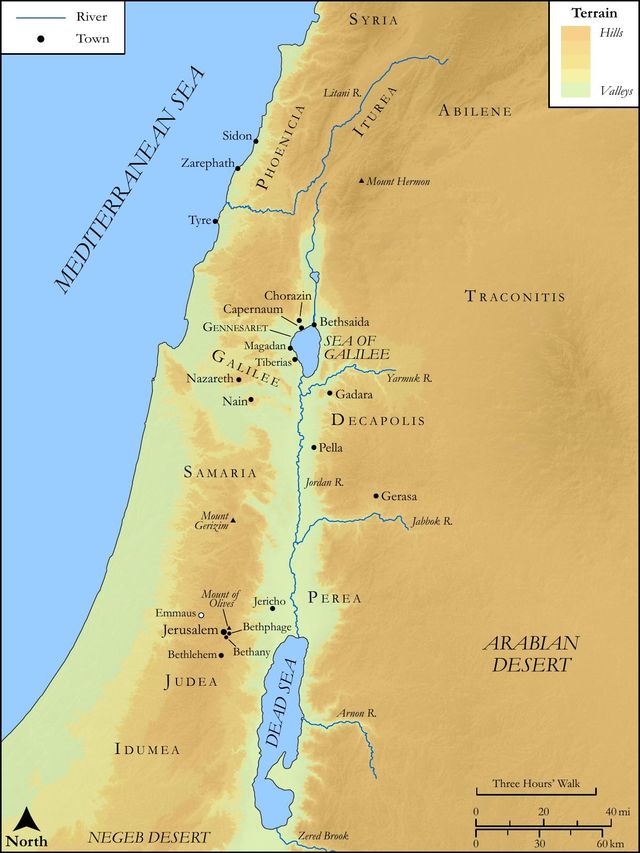
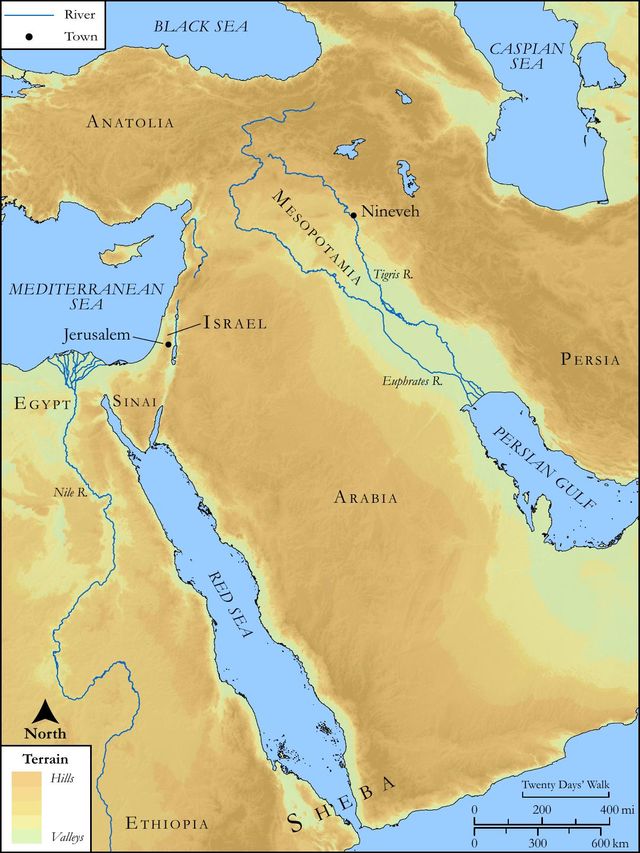
See on the biblical-era maps

Study this verse
Public-domain commentary
Matthew Henry
From his Commentary on the Whole Bible. Henry comments on passages, not single verses — this entry covers Luke 6:37–49. His four-level outline is real structure in the source text, so it is rendered as structure.
All these sayings of Christ we had before in Matthew; some of them in ch. 7, others in other places. They were sayings that Christ often used; they needed only to be mentioned, it was easy to apply them. Grotius thinks that we need not be critical here in seeking for the coherence: they are golden sentences, like Solomon's proverbs or parables. Let us observe here,
I.We ought to be very candid in our censures of others, because we need grains of allowance ourselves:
"Therefore judge not others, because then you yourselves shall not be judged; therefore condemn not others, because then you yourselves shall not be condemned, Luk 6:37. Exercise towards others that charity which thinks no evil, which bears all things, believes and hopes all things; and then others will exercise that charity towards you. God will not judge and condemn you, men will not." They that are merciful to other people's names shall find others merciful to theirs.
II.If we are of a giving and a forgiving spirit, we shall ourselves reap the benefit of it:
Forgive and you shall be forgiven. If we forgive the injuries done to us by others, others will forgive our inadvertencies. If we forgive others' trespasses against us, God will forgive our trespasses against him. And he will be no less mindful of the liberal that devise liberal things (Luk 6:38): Give, and it shall be given to you. God, in his providence, will recompense it to you; it is lent to him, and he is not unrighteous to forget it (Heb 6:10), but he will pay it again. Men shall return it into your bosom; for God often makes use of men as instruments, not only of his avenging, but of his rewarding justice. If we in a right manner give to others when they need, God will incline the hearts of others to give to us when we need, and to give liberally, good measure pressed down and shaken together. They that sow plentifully shall reap plentifully. Whom God recompenses he recompenses abundantly.
III.We must expect to be dealt with ourselves as we deal with others:
With the same measure that ye mete it shall be measured to you again. Those that deal hardly with others must acknowledge, as Adoni-bezek did (Jdg 1:7), that God is righteous, if others deal hardly with them, and they may expect to be paid in their own coin; but they that deal kindly with others have reason to hope that, when they have occasion, God will raise them up friends who will deal kindly with them. Though Providence does not always go by this rule, because the full and exact retributions are reserved for another world, yet, ordinarily, it observes a proportion sufficient to deter us from all acts of rigour and to encourage us in all acts of beneficence.
IV.Those who put themselves under the guidance of the ignorant and erroneous are likely to perish with them (Luk 6:39):
Can the blind lead the blind? Can the Pharisees, who are blinded with pride, prejudice, and bigotry, lead the blind people into the right way? Shall not both fall together into the ditch? How can they expect any other? Those that are led by the common opinion, course, and custom, of this world, are themselves blind, and are led by the blind, and will perish with the world that sits in darkness. Those that ignorantly, and at a venture, follow the multitude to do evil, follow the blind in the broad way that leads the many to destruction.
V.Christ's followers cannot expect better treatment in the world than their Master had, Luk 6:40.
Let them not promise themselves more honour or pleasure in the world than Christ had, nor aim at the worldly pomp and grandeur which he was never ambitious of, but always declined, nor affect that power in secular things which he would not assume; but every one that would show himself perfect, an established disciple, let him be as his Master - dead to the world, and every thing in it, as his Master is; let him live a life of labour and self-denial as his Master doth, and make himself a servant of all; let him stoop, and let him toil, and do all the good he can, and then he will be a complete disciple.
VI.Those who take upon them to rebuke and reform others are concerned to look to it that they be themselves blameless, and harmless, and without rebuke, Luk 6:41, Luk 6:42.
1.Those with a very ill grace censure the faults of others who are not aware of their own faults. It is very absurd for any to pretend to be so quick-sighted as to spy small faults in others, like a mote in the eye, when they are themselves so perfectly past feeling as not to perceive a beam in their own eye.
2.Those are altogether unfit to help to reform others whose reforming charity does not begin at home. How canst thou offer thy service to thy brother, to pull out the mote from his eye, which requires a good eye as well as a good hand, when thou thyself hast a beam in thine own eye, and makest no complaint of it?
3.Those therefore who would be serviceable to the souls of others must first make it appear that they are solicitous about their own souls. To help to pull the mote out of our brother's eye is a good work, but then we must qualify ourselves for it by beginning with ourselves; and our reforming our own lives may, by the influence of example, contribute to others reforming theirs.
VII.We may expect that men's words and actions will be according as they are, according as their hearts are, and according as their principles are.
1.The heart is the tree, and the words and actions are fruit according to the nature of the tree, Luk 6:43, Luk 6:44. If a man be really a good man, if he have a principle of grace in his heart, and the prevailing bent and bias of the soul be towards God and heaven, though perhaps he may not abound in fruit, though some of his fruits be blasted, and though he may be sometimes like a tree in winter, yet he does not bring forth corrupt fruit; though he may not do you all the good he should, yet he will not in any material instance do you hurt. If he cannot reform ill manners, he will not corrupt good manners. If the fruit that a man brings forth be corrupt, if a man's devotion tend to debauch the mind and conversation, if a man's conversation be vicious, if he be a drunkard or fornicator, if he be a swearer or liar, if he be in any instance unjust or unnatural, his fruit is corrupt, and you may be sure that he is not a good tree. On the other hand, a corrupt tree doth not bring forth good fruit, though it may bring forth green leaves; for of thorns men do not gather figs, nor of a bramble do they gather grapes. You may, if you please, stick figs upon thorns, and hang a bunch of grapes upon a bramble, but they neither are, nor can be, the natural product of the trees; so neither can you expect any good conduct from those who have justly a bad character. If the fruit be good, you may conclude that the tree is so; if the conversation be holy, heavenly, and regular, though you cannot infallibly know the heart, yet you may charitably hope that it is upright with God; for every tree is known by its fruit. But the vile person will speak villany (Isa 32:6), and the experience of the moderns herein agrees with the proverb of the ancients, that wickedness proceedeth from the wicked, Sa1 24:13.
2.The heart is the treasure, and the words and actions are the expenses or produce from that treasure, Luk 6:45. This we had, Mat 12:34, Mat 12:35. The reigning love of God and Christ in the heart denominates a man a good man; and it is a good treasure a man may bring forth that which is good. But where the love of the world and the flesh reign there is an evil treasure in the heart, out of which an evil man is continually bringing forth that which is evil; and by what is brought forth you may know what is in the heart, as you may know what is in the vessel, water or wine, by what is drawn out from it, Joh 2:8. Of the abundance of the heart the mouth speaks; what the mouth ordinarily speaks, speaks with relish and delight, generally agrees with what is innermost and uppermost in the heart: He that speaks of the earth is earthly, Joh 3:31. Not but that a good man may possibly drop a bad word, and a wicked man make use of a good word to serve a bad turn; but, for the most part, the heart is as the words are, vain or serious; it therefore concerns us to get our hearts filled, not only with good, but with abundance of it.
VIII.It is not enough to hear the sayings of Christ, but we must do them; not enough to profess relation to him, as his servants, but we must make conscience of obeying him.
1.It is putting an affront upon him to call him Lord, Lord, as if we were wholly at his command, and had devoted ourselves to his service, if we do not make conscience of conforming to his will and serving the interests of his kingdom. We do but mock Christ, as they that in scorn said, Hail, King of the Jews, if we call him ever so often Lord, Lord, and yet walk in the way of our own hearts and in the sight of our own eyes. Why do we call him Lord, Lord, in prayer (compare Mat 7:21, Mat 7:22), if we do not obey his commands? He that turns away his ear from hearing the law, his prayer shall be an abomination.
2.It is putting a cheat upon ourselves if we think that a bare profession of religion will save us, that hearing the sayings of Christ will bring us to heaven, without doing them. This he illustrates by a similitude (Luk 6:47-49), which shows,
(1.)That those only make sure work for their souls and eternity, and take the course that will stand them in stead in a trying time, who do not only come to Christ as his scholars, and hear his sayings but do them, who think, and speak, and act, in every thing according to the established rules of his holy religion. They are like a house built on a rock. These are they that take pains in religion, as they do, - that dig deep, that found their hope upon Christ, who is the Rock of ages (and other foundation can no man lay); these are they who provide for hereafter, who get ready for the worst, who lay up in store a good foundation for the time to come, for the eternity to come, Ti1 6:19. They who do thus do well for themselves; for,
[1.]They shall keep their integrity, in times of temptation and persecution; when others fall from their own stedfastness, as the seed on the stony ground, they shall stand fast in the Lord.
[2.]They shall keep their comfort, and peace, and hope, and joy, in the midst of the greatest distresses. The storms and streams of affliction shall not shock them, for their feet are set upon a rock, a rock higher than they.
[3.]Their everlasting welfare is secured. In death and judgment they are safe. Obedient believers are kept by the power of Christ, through faith, unto salvation, and shall never perish.
(2.)That those who rest in a bare hearing of the sayings of Christ, and do not live up to them, are but preparing for a fatal disappointment: He that heareth and doeth not (that knows his duty, but lives in the neglect of it), he is like a man that built a house without a foundation. He pleases himself with hopes that he has no ground for, and his hopes will fail him when he most needs the comfort of them, and when he expects the crowning of them; when the stream beats vehemently upon his house, it is gone, the sand it is built upon is washed away, and immediately it falls, Such is the hope of the hypocrite, though he has gained, when God takes away his soul; it is as the spider's web, and the giving up of the ghost.
Historical interpretation
Nine Centuries of Reception
9 surviving comments on this verse. Each one is dated, so this reads as a timeline rather than a list.
Select a marker to jump to its quote. Markers stagger vertically where authors wrote within a few decades of each other.
Let the Marcionites therefore make their choice: Will it not be just the same inconsistency to desert the prescription of their master, as to have Christ teaching in the interest of men or of the Creator? But "a blind man will lead a blind man into the ditch." Some persons believe Marcion.
(Hom. 9, in Hexameron.) In truth, self knowledge seems the most important of all. For not only the eye, looking at outward things, fails to exercise its sight upon itself, but our understanding also, though very quick in apprehending the sin of another, is slow to perceive its own defects.
(de Qu. Ev. l. ii. q. 9.) Or, He has added the words, Can the blind, lead the blind, in order that they might not expect to receive from the Levites that measure of which He says, They shall give into thy bosom, because they gave tithes to them. And these He calls blind, because they received not the Gospel, that the people might the rather now begin to hope for that reward through the disciples of the Lord, whom wishing to point out as His imitators, He added, The disciple is not above his master.
But the Apostle explains this when he says, He who sows sparingly, (that is, scantily, and with a niggardly hand,) shall also reap sparingly, (2 Cor. 6:9.) (that is, not abundantly,) and he who sows blessings, shall reap also blessings, that is, bountifully. But if a man has not, and performs not, he is not guilty. For a man is accepted in that which he has, not in that which he has not.
The Lord added to what had gone before a very necessary parable, as it is said, And he spake a parable to them, for His disciples were the future teachers of the world, and it therefore became them to know the way of a virtuous life, having their minds illuminated as it were by a divine brightness, that they should not be blind leaders of the blind. And then he adds, Can the blind lead the blind? But if any should chance to attain unto an equal degree of virtue with their teachers, let them stand in the measure of their teachers, and follow their footsteps. Hence it follows, The disciple is not above his master. Hence also Paul says, Be ye also followers of me, as I am of Christ (1 Cor. 1:11.). Since Christ therefore judged not, why judgest thou? for He came not to judge the world, but to show mercy.
As if He said, How can he who is guilty of grievous sins, (which He calls the beam,) condemn him who has sinned only slightly, or even in some cases not at all? For this the mote signifies.
That is to say, first show thyself clean from great sins, and then afterwards shalt thou give counsel to thy neighbour, who is guilty only of slight sins.
This parable he added as a most necessary attachment to what had been said. The blessed disciples were about to be the initiators and teachers of the world. It was necessary for them therefore to prove themselves possessed of everything piety requires. They must know the pathway of the evangelic mode of life and be workmen ready for every good work. They must be able to bestow upon well-instructed hearers such correct and saving teaching as exactly represents the truth. This they must do, as having already first received their sight and a mind illuminated with the divine light, lest they should be blind leaders of the blind. It is not possible for those enveloped in the darkness of ignorance to guide those who are afflicted in the same way into the knowledge of the truth. Should they attempt it, they will both roll into the ditch of carelessness.He overthrew the bragging passion of boastfulness, which most give way, that they may not enviously strive to surpass their teachers in honor. He added, "The disciple is not above his teacher." Even if some make such progress, as to attain to a virtue that rivals that of their teachers, they will range themselves no higher than their level and be their imitators. Paul shall again support us. He says, "Imitate me, as I also imitate Christ."
[Syncletica] also said, ‘It is dangerous for a man to try teaching before he is trained in the good life. A man whose house is about to fall down may invite travellers inside to refresh them, but instead they will be hurt in the collapse of the house. It is the same with teachers who have not carefully trained themselves in the good life; they destroy their hearers as well as themselves. Their mouth invites to salvation, their way of life leads to ruin.’
He also gave them this parable: Can a blind man lead a blind man? Will they not both fall into a pit? The sense of this saying depends on the preceding, where he instructs about giving alms and forgiving injury. If (he says) anger against the violent and greed against the petitioner has blinded you, can you cure his fault with your corrupted mind? Or will not only he who committed the injury but also you, who could not endure it, be considered guilty? But if his wickedness finds you gentle and with a tranquil heart, both he will be moved to repentance, and you will be given the reward of patience, because you are endeavoring to lead the blind with a seeing eye—that is, a serene heart—towards the light.
Or the sense of this sentence depends upon the former, in which we are enjoined to give alms, and forgive injuries. If, says He, anger has blinded thee against the violent, and avarice against the grasping, how canst thou with thy corrupt heart cure his corruption? If even thy Master Christ, who as God might revenge His injuries, chose rather by patience to render His persecutors more merciful, it is surely binding on His disciples, who are but men, to follow the same rule of perfection.
Now this has reference to the previous parable, in which He forewarned them that the blind cannot be led by the blind, that is, the sinner corrected by the sinner. Hence it is said, Or, how canst thou say to thy brother, Brother let me cast out the mote that is in thine eye, if thou seest not the beam that is in thine own eye?
Or else, If thou judgest another, and in the very same way sinnest thyself, art not thou like to the blind leading the blind? For how canst thou lead him to good when thou also thyself committest sin? For the disciple is not above his master. If therefore thou sinnest, who thinkest thyself a master and guide, where will he be who is taught and led by thee? For he will be the perfect disciple who is as his master.
But the Lord introduces another parable taken from the same figure, as follows, But why seest thou the mote (that is, the slight fault) which is in thy brother's eye, but the beam which is in thine own eye (that is, thy great sin) thou regardest not?
But these words are applicable to all, and especially to teachers, who while they punish the least sins of those who are put under them, leave their own unpunished. Wherefore the Lord calls them hypocrites, because to this end judge they the sins of others, that they themselves might seem just. Hence it follows, Thou hypocrite, first cast the beam out of thine own eye, &c.
Continue studying Luke 6:39 across the web’s major study libraries — every link below opens this exact verse, chapter, or book on the destination site.
Read & Compare
 BibleGatewayThis verse in more than 200 translations and 70 languages.
 Bible.comThe YouVersion reader — hundreds of translations, reading plans, and highlights.
 ESV.orgCrossway's official English Standard Version reader.
 NET BibleThe NET translation with 60,000+ translators' notes on every rendering decision.
 STEP BibleTyndale House's free study tool — original text, vocabulary, and scholarly resources.
 BibliaLogos Bible Software's free web reader.
 USCCBThe New American Bible (Revised Edition) with the U.S. bishops' study notes.
Commentaries
 BibleHub CommentariesDozens of classic commentaries on this verse, gathered on one page.
 StudyLightMore than 100 commentary sets — the largest collection on the web.
 BibleRefPlain-English commentary on what this verse means, verse by verse.
 Enduring WordDavid Guzik's free commentary on this chapter, widely used by Bible teachers.
 Bible Study ToolsVerse commentary alongside Greek and Hebrew study aids.
Original Language & Research
- BibleHub InterlinearThe verse word by word — original language, transliteration, and English.
- BibleHub LexiconEvery word's original-language definition and Strong's entry.
 Blue Letter BibleDeep-study tools — Strong's numbers, concordance, and word studies.
 CNTR CollationThe earliest Greek manuscripts of this verse, collated letter by letter.
Sermons, Hymns & Audio


TrulyRandomVerse is not affiliated with these sites and doesn’t control their content. They’re linked because they’re genuinely useful.
Summary
In Luke 6:39, Jesus employs a concise yet profound parable to caution against the perils of unqualified spiritual leadership, asking rhetorically whether a blind person can effectively guide another blind person without both falling into a ditch. This vivid imagery underscores the critical necessity of spiritual discernment and clear vision for anyone who presumes to lead or teach, highlighting the inevitable and shared disaster that awaits both the misguided leader and their unsuspecting followers. The parable serves as a foundational warning against spiritual ignorance in positions of influence and a call for diligent self-examination.
Context
ShowHideLiterary Context
This parable is strategically placed within Jesus' extensive teachings often referred to as the Sermon on the Plain. Following His radical commands to love enemies, bless those who curse, and refrain from judging others (Luke 6:27-38), Jesus pivots to emphasize the indispensable quality of spiritual insight for those who would guide others. The immediate verses following this parable reinforce its message: the sayings about the disciple not being above the teacher (Luke 6:40), the urgent need to remove the "log" from one's own eye before attempting to remove the "speck" from another's (Luke 6:41-42), and the principle that a good tree produces good fruit (Luke 6:43-45). Together, these teachings form a cohesive unit stressing internal transformation, integrity, and the critical importance of a leader's character and spiritual condition.
Historical & Cultural Context
In ancient Israel, spiritual guidance was primarily provided by scribes, Pharisees, and various religious teachers. Jesus' audience would have been familiar with the concept of spiritual authorities and the expectation of their wisdom. Travel in Galilee and Judaea, especially off main roads, was fraught with hazards like unseen pits, ravines, or "ditches" (bóthynos), making the imagery of falling into one a readily understood danger. Furthermore, "blindness" (typhlós) was a common biblical metaphor for spiritual ignorance or moral insensitivity, particularly among those who claimed to have spiritual insight but lacked true understanding of God's ways, as Jesus often accused the religious leaders of His day (e.g., Matthew 23:16-26).
Key Themes
ShowHideThe parable in Luke 6:39 contributes significantly to several key themes within Luke's Gospel and Jesus' broader ministry. Firstly, it highlights the theme of spiritual discernment, emphasizing that true insight is paramount for effective leadership. Secondly, it underscores the accountability of leaders, warning that those who presume to guide others without proper spiritual vision will lead both themselves and their followers to ruin. This ties into the broader theme of true discipleship, which requires a clear understanding of Jesus' teachings and a commitment to following Him. Thirdly, the parable implicitly calls for self-examination before attempting to correct or lead others, a theme explicitly developed in the subsequent verses about the speck and the log. Finally, it reinforces the danger of false teaching and the critical need for followers to exercise their own spiritual judgment, rather than blindly accepting guidance.
Exposition and Analysis
ShowHideKey Word Analysis
ShowHideThis word literally refers to physical blindness but, in this context, functions as a powerful metaphor for spiritual or intellectual ignorance, a lack of understanding, or moral insensitivity. It signifies an inability to perceive spiritual truth or discern the right path.
Derived from the word for "way" (hodos) and "to lead" (agéō), this verb means "to show the way," "to guide," or "to teach." It implies a position of authority and responsibility in guiding others along a path, whether literally or figuratively (spiritually).
This term refers to a pit, a hole in the ground, or a cistern. In the parable, it serves as a vivid image of disaster, ruin, or a perilous trap, symbolizing the inevitable negative consequences of misguided leadership.
Verse Breakdown
ShowHide"And he spake a parable unto them,"
This introductory phrase sets the stage, indicating that Jesus is about to deliver a concise, illustrative story or saying designed to convey a profound spiritual truth. The "them" refers to His disciples and the broader crowd gathered to hear His teachings on the Plain.
"Can the blind lead the blind?"
This is a rhetorical question, designed to elicit an obvious negative answer. It immediately presents the core absurdity of the situation: a person lacking sight (spiritual vision) attempting to guide another person who also lacks sight. The implication is that such a scenario is inherently illogical and dangerous.
"shall they not both fall into the ditch?"
This second rhetorical question provides the inevitable and disastrous consequence of the first. It vividly portrays the shared fate of both the unqualified leader and their unsuspecting follower. The "ditch" symbolizes ruin, destruction, or a complete failure to reach a safe destination, emphasizing the severe peril of spiritual misguidance.
Literary Devices
ShowHideLuke 6:39 is rich in literary devices that amplify its message. The primary device is Parable, a short, illustrative story or saying used by Jesus to convey a moral or spiritual lesson. Specifically, this is an Adage or Aphorism, a concise statement of a general truth. The central image of the "blind leading the blind" functions as a powerful Metaphor for spiritual ignorance and incompetence in leadership. The phrase "Can the blind lead the blind? shall they not both fall into the ditch?" is a Rhetorical Question, posed not to elicit information but to make a point more forcefully, implying an obvious negative answer. Finally, the vivid Imagery of "falling into the ditch" creates a strong mental picture of shared disaster, making the consequences of misguided leadership tangible and memorable.
Theological and Thematic Connections
ShowHideThis parable profoundly addresses the critical need for spiritual discernment and the grave responsibility of those in leadership. It warns against the dangers of following or being led by individuals who lack true spiritual insight, emphasizing that such a path inevitably leads to shared ruin. The core theological implication is that genuine spiritual guidance must originate from a place of clear vision, rooted in divine truth and understanding. Without this, any attempt to lead others will be futile and destructive, highlighting God's standard for integrity and competence in those who teach or guide His people.
Reflection and Application
ShowHideLuke 6:39 serves as a timeless warning and a profound call to both leaders and followers within the Christian community. For those in positions of spiritual authority—pastors, teachers, mentors, parents—it is a stark reminder of the absolute necessity of cultivating genuine spiritual insight, rooted in God's Word and empowered by the Holy Spirit. Leading others without a clear, Spirit-led vision is not merely ineffective; it is actively dangerous, jeopardizing the spiritual well-being of those entrusted to one's care. This parable compels leaders to constantly examine their own hearts, motives, and understanding, ensuring that their "sight" is clear before attempting to guide others. For followers, the parable is an equally vital call to discernment. It teaches that one must not blindly follow any leader or teaching without critically evaluating it against the unchanging truth of Scripture. Believers are responsible for their own spiritual journey and must cultivate their own spiritual vision through prayer, diligent study of the Bible, and reliance on the Holy Spirit, ensuring they are not led astray by those who lack true insight.
Questions for Reflection
ShowHideFAQ
ShowHideWhat does "blind" mean in this parable?
ShowHideIn Luke 6:39, "blind" (Greek: typhlós) is used metaphorically. While it literally refers to physical sightlessness, Jesus uses it to describe a lack of spiritual understanding, moral insight, or divine wisdom. It signifies a person who is spiritually ignorant, unable to discern truth from error, or incapable of seeing the path of righteousness clearly. Therefore, a "blind leader" is one who lacks the necessary spiritual vision to guide others safely, and "blind followers" are those who do not exercise their own discernment and are thus susceptible to being led astray. This concept is further elaborated in passages like John 9:39-41, where Jesus speaks of spiritual blindness among those who claim to see.
Who are the "blind" leaders Jesus is referring to?
ShowHideWhile Jesus' parables often have universal application, in the immediate context of His ministry, He frequently directed such warnings toward the religious leaders of His day—the Pharisees and scribes. These individuals often prided themselves on their knowledge of the Law and their role as guides for the people, yet Jesus consistently critiqued them for their hypocrisy, legalism, and lack of true spiritual insight, effectively calling them "blind guides" (e.g., Matthew 23:16). However, the parable's principle extends beyond specific historical figures to anyone in a position of spiritual influence—whether a pastor, teacher, parent, or mentor—who attempts to lead others without first possessing genuine spiritual vision and alignment with God's truth.
Christ-Centered Fulfillment
ShowHideLuke 6:39, with its stark warning about blind guides, finds its ultimate fulfillment and resolution in the person and ministry of Jesus Christ. He is not merely a guide with clear vision; He is the very embodiment of spiritual sight, the Light of the World who perfectly illuminates the path to God. Unlike the "blind leaders" who lead others into a "ditch" of spiritual ruin, Jesus declares, "I am the light of the world: he that followeth me shall not walk in darkness, but shall have the light of life". He is the only one who can truly "lead" (hodēgéō) humanity out of the darkness of sin and ignorance and into the glorious light of God's truth. As the Good Shepherd, He knows His sheep and "leads them out" into abundant life, never into a ditch of destruction. Furthermore, Jesus is not only the perfect guide but also the one who gives sight to the spiritually blind, opening eyes that were once closed to divine realities (e.g., John 9:1-7). He embodies the truth He teaches, living a life of perfect obedience and offering Himself as the "way, the truth, and the life", ensuring that all who follow Him will never fall into the ditch of eternal separation from God.