


Luke 5:3
Bible text: King James Version (1769 Blayney text) · Public domain
Bible text: King James Version with Strong's numbers · Public domain
Bible text: Berean Standard Bible · Public domain
Bible text: American Standard Version (1901) · Public domain
Bible text: World English Bible, Messianic edition · Public domain
Bible text: Geneva Bible (1599) · Public domain
Bible text: Young's Literal Translation · Public domain
- ἐμβὰςembasHaving climbedG1684V-2AAP-NSMVerb 2nd Aorist Active Participle Nominative Singular Masculine
- δὲdethenG1161CONJConjunction
- εἰςeisintoG1519PREPPreposition
- ἓνhenoneG1520A-ASNAdjective Accusative Singular Neuter
- τῶνtōnof theG3588T-GPNDefinite article Genitive Plural Neuter
- πλοίωνploiōnboatsG4143N-GPNNoun Genitive Plural Neuter
- ὃhowhichG3739R-NSNRelative pronoun Nominative Singular Neuter
- ἦνēnwasG1510V-IAI-3SVerb Imperfect Active Indicative 3rd Singular
- τοῦtouof theG3588T-GSNDefinite article Genitive Singular Neuter
- ΣίμωνοςSimōnosSimon’sG4613N-GSM-PNoun Genitive Singular Masculine Individual
- ἠρώτησενērōtēsenHe askedG2065V-AAI-3SVerb Aorist Active Indicative 3rd Singular
- αὐτὸνautonhimG846P-ASMPersonal pronoun Accusative Singular Masculine
- ἀπὸapofromG575PREPPreposition
- τῆςtēstheG3588T-GSFDefinite article Genitive Singular Feminine
- γῆςgēslandG1093N-GSFNoun Genitive Singular Feminine
- ἐπαναγαγεῖνepanagageinto put offG1877V-2AANVerb 2nd Aorist Active Infinitive
- ὀλίγονoligona littleG3641A-ASNAdjective Accusative Singular Neuter
- καὶkaiandG2532CONJConjunction
- καθίσαςkathisasHaving sat downG2523V-AAP-NSMVerb Aorist Active Participle Nominative Singular Masculine
- ἐκekfromG1537PREPPreposition
- τοῦtoutheG3588T-GSNDefinite article Genitive Singular Neuter
- πλοίουploiouboatG4143N-GSNNoun Genitive Singular Neuter
- ἐδίδασκενedidaskenHe was teachingG1321V-IAI-3SVerb Imperfect Active Indicative 3rd Singular
- τοὺςtoustheG3588T-APMDefinite article Accusative Plural Masculine
- ὄχλουςochlouscrowdsG3793N-APMNoun Accusative Plural Masculine
English is a literal word-by-word gloss of the Greek, not the KJV's wording. Why?
This is the original text the KJV's translators worked from — each Greek word with its own literal English meaning in this verse, prepared by scholars at Tyndale House, Cambridge. The KJV translates whole sentences, not word by word, so its wording differs: one Greek word can become several English words, and the KJV may choose “charity” where the gloss reads “love”. Both are faithful — they answer different questions. For the KJV's own rendering, switch to the KJV text.
Details
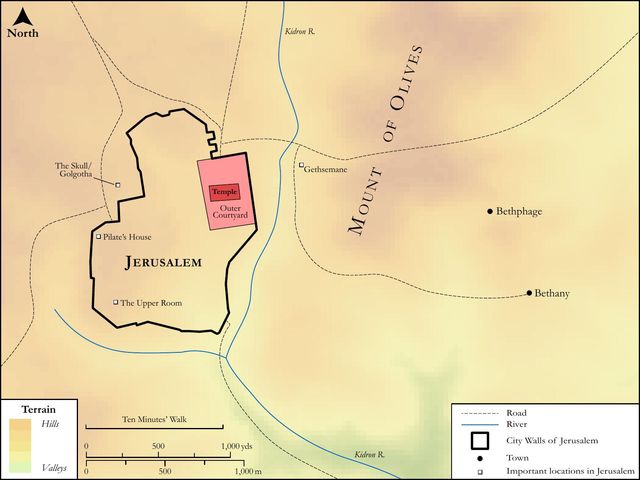
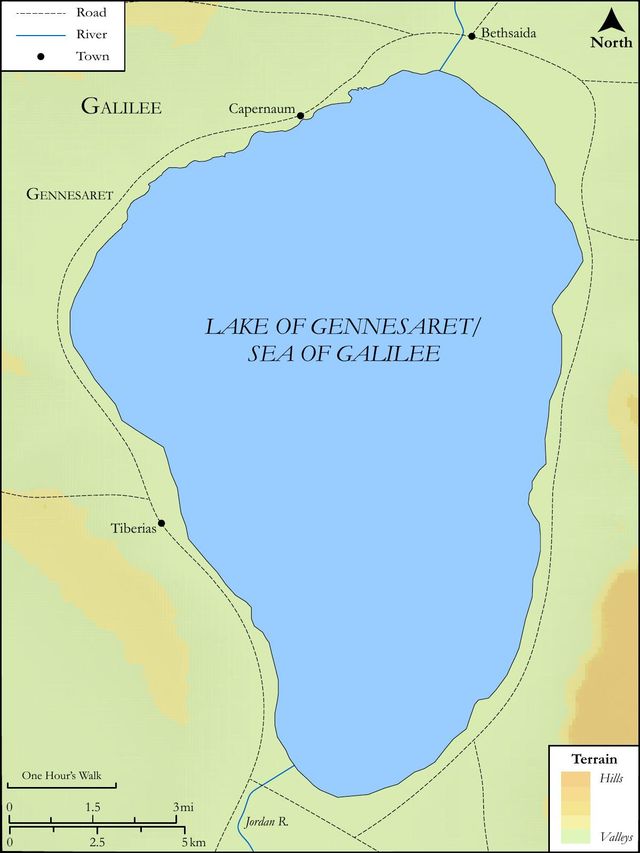
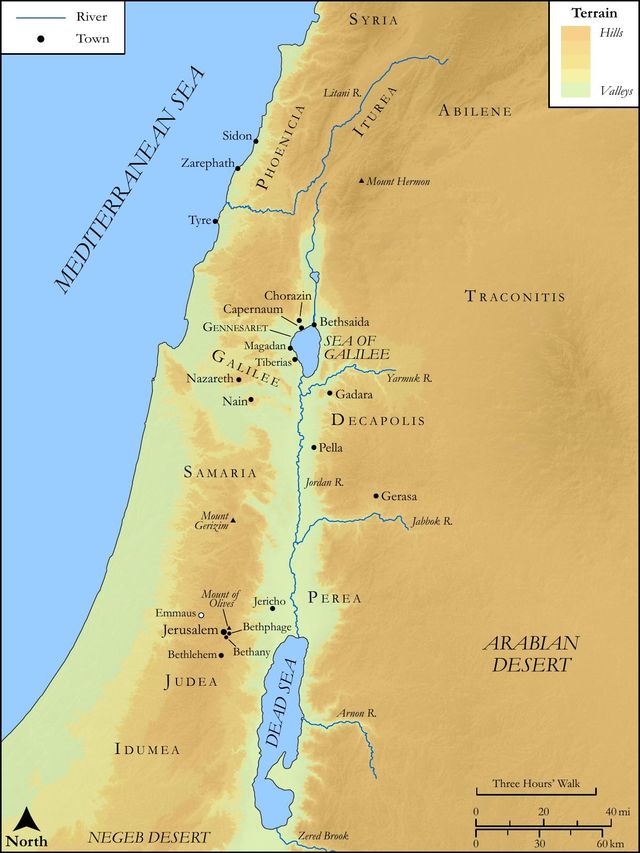
See on the biblical-era maps
Study this verse
Public-domain commentary
Matthew Henry
From his Commentary on the Whole Bible. Henry comments on passages, not single verses — this entry covers Luke 5:1–11. His four-level outline is real structure in the source text, so it is rendered as structure.
This passage of story fell, in order of time, before the two miracles we had in the close of the foregoing chapter, and is the same with that which was more briefly related by Matthew and Mark, of Christ's calling Peter and Andrew to be fishers of men, Mat 4:18, and Mar 1:16. They had not related this miraculous draught of fishes at that time, having only in view the calling of his disciples; but Luke gives us that story as one of the many signs which Jesus did in the presence of his disciples, which had not been written in the foregoing books, Joh 20:30, Joh 20:31. Observe here,
I.What vast crowds attended Christ's preaching:
The people pressed upon him to hear the word of God (Luk 5:1), insomuch that no house would contain them, but he was forced to draw them out to the strand, that they might be reminded of the promise made to Abraham, that his seed should be as the sand upon the sea shore (Gen 22:17), and yet of them but a remnant shall be saved, Rom 9:27. The people flocked about him (so the word signifies); they showed respect to his preaching, though not without some rudeness to his person, which was very excusable, for they pressed upon him. Some would reckon this a discredit to him, to be thus cried up by the vulgar, when none of the rulers or of the Pharisees believed in him; but he reckoned it an honour to him, for their souls were as precious as the souls of the grandees, and it is his aim to bring not so much the mighty as the many sons to God. It was foretold concerning him that to him shall the gathering of the people be. Christ was a popular preacher; and though he was able, at twelve, to dispute with the doctors, yet he chose, at thirty, to preach to the capacity of the vulgar. See how the people relished good preaching, though under all external disadvantages: they pressed to hear the word of God; they could perceive it to be the word of God, by the divine power and evidence that went along with it, and therefore they coveted to hear it.
II.What poor conveniences Christ had for preaching:
He stood by the lake of Gennesareth (Luk 5:1), upon a level with the crowd, so that they could neither see him nor hear him; he was lost among them, and, every one striving to get near him, he was crowded, and in danger of being crowded into the water: what must he do? It does not appear that his hearers had any contrivance to give him advantage, but there were two ships, or fishing boats, brought ashore, one belonging to Simon and Andrew, the other to Zebedee and his sons, Luk 5:2. At first, Christ saw Peter and Andrew fishing at some distance (so Matthew tells us, Mat 4:18); but he waited till they came to land, and till the fishermen, that is, the servants, were gone out of them having washed their nets, and thrown them by for that time: so Christ entered into that ship that belonged to Simon, and begged of him that he would lend it him for a pulpit; and, though he might have commanded him, yet, for love's sake, he rather prayed him that he would thrust out a little from the land, which would be the worse for his being heard, but Christ would have it so, that he might the better be seen; and it is his being lifted up that draws men to him. Wisdom cries in the top of high places, Pro 8:2. It intimates that Christ had a strong voice (strong indeed, for he made the dead to hear it), and that he did not desire to favour himself. There he sat down, and taught the people the good knowledge of the Lord.
III.What a particular acquaintance Christ, hereupon, fell into with these fishermen.
They had had some conversation with him before, which began at John's baptism (Joh 1:40, Joh 1:41); they were with him at Cana of Galilee (Joh 2:2), and in Judea (Joh 4:3); but as yet they were not called to attend him constantly, and therefore here we have them at their calling, and now it was that they were called into a more intimate fellowship with Christ.
1.When Christ had done preaching, he ordered Peter to apply himself to the business of his calling again: Launch out into the deep, and let down your nets, Luk 5:4. It was not the sabbath day, and therefore, as soon as the lecture was over, he set them to work. Time spent on week-days in the public exercises of religion may be but little hindrance to us in time, and a great furtherance to us in temper of mind, in our worldly business. With what cheerfulness may we go about the duties of our calling when we have been in the mount with God, and from thence fetch a double blessing into our worldly employments, and thus have them sanctified to us by the word and prayer! It is our wisdom and duty so to manage our religious exercises as that they may befriend our worldly business, and so to manage our worldly business as that it may be no enemy to our religious exercises.
2.Peter having attended upon Christ in his preaching, Christ will accompany him in his fishing. He staid with Christ at the shore, and now Christ will launch out with him into the deep. Note, Those that will be constant followers of Christ shall have him a constant guide to them.
3.Christ ordered Peter and his ship's crew to cast their nets into the sea, which they did, in obedience to him, though they had been hard at it all night, and had caught nothing, Luk 5:4, Luk 5:5. We may observe here,
(1.)How melancholy their business had now been: "Master, we have toiled all the night, when we should have been asleep in our beds, and have taken nothing, but have had our labour for our pains." One would have thought that this should have excused them from hearing the sermon; but such a love had they to the word of God that it was more refreshing and reviving to them, after a wearisome night, than the softest slumbers. But they mention it to Christ, when he bids them go a fishing again. Note,
[1.]Some callings are much more toilsome than others are, and more perilous; yet Providence has so ordered it for the common good that there is no useful calling so discouraging but some or other have a genius for it. Those who follow their business, and get abundance by it with a great deal of ease, should think with compassion of those who cannot follow theirs but with a great fatigue, and hardly get a bare livelihood by it. When we have rested all night, let us not forget those who have toiled all night, as Jacob, when he kept Laban's sheep.
[2.]Be the calling ever so laborious, it is good to see people diligent in it, and make the best of it; these fishermen, that were thus industrious, Christ singled out for his favourites. They were fit to be preferred as good soldiers of Jesus Christ who had thus learned to endure hardness.
[3.]Even those who are most diligent in their business often meet with disappointments; they who toiled all night yet caught nothing; for the race is not always to the swift. God will have us to be diligent, purely in duty to his command and dependence upon his goodness, rather than with an assurance of worldly success. We must do our duty, and then leave the event to God.
[4.]When we are tired with our worldly business, and crossed in our worldly affairs, we are welcome to come to Christ, and spread our case before him, who will take cognizance of it.
(2.)How ready their obedience was to the command of Christ: Nevertheless, at thy word, I will let down the net.
[1.]Though they had toiled all night, yet, if Christ bid them, they will renew their toil, for they know that they who wait on him shall renew their strength, as work is renewed upon their hands; for every fresh service they shall have a fresh supply of grace sufficient.
[2.]Though they have taken nothing, yet, if Christ bid them let down for a draught, they will hope to take something. Note, We must not abruptly quit the callings wherein we are called because we have not the success in them we promised ourselves. The ministers of the gospel must continue to let down that net, though they have perhaps toiled long and caught nothing; and this is thank-worthy, to continue unwearied in our labours, though we see not the success of them.
[3.]In this they have an eye to the word of Christ, and a dependence upon that: "At thy word, I will let down the net, because thou dost enjoin it, and thou dost encourage it." We are then likely to speed well when we follow the guidance of Christ's word.
4.The draught of fish they caught was so much beyond what was ever known that it amounted to a miracle (Luk 5:6): They enclosed a great multitude of fishes, so that their net broke, and yet, which is strange, they did not lose their draught. It was so great a draught that they had not hands sufficient to draw it up; but they were obliged to beckon to their partners, who were at a distance, out of call, to come and help them, Luk 5:7. But the greatest evidence of the vastness of the draught was that they filled both the ships with fish, to such a degree that they overloaded them, and they began to sink, so that the fish had like to have been lost again with their own weight. Thus many an overgrown estate, raised out of the water, returns to the place whence it came. Suppose these ships were but five or six tons a piece, what a vast quantity of fish must there be to load, nay to over-load, them both!
Now by this vast draught of fishes, (1.) Christ intended to show his dominion in the seas as well as on the dry land, over its wealth as over its waves. Thus he would show that he was that Son of man under whose feet all things were put, and particularly the fish of the sea and whatsoever passeth through the paths of the sea, Psa 8:8. (2.) He intended hereby to confirm the doctrine he had just now preached out of Peter's ship. We may suppose that the people on shore, who heard the sermon, having a notion that the preacher was a prophet sent of God, carefully attended his motions afterward, and staid halting about there, to see what he would do next; and this miracle immediately following would be a confirmation to their faith, of his being at least a teacher come from God. (3.) He intended hereby to repay Peter for the loan of his boat; for Christ's gospel now, as his ark formerly in the house of Obed-edom, will be sure to make amends, rich amends, for its kind entertainment. None shall shut a door or kindle a fire in God's house for nought, Mal 1:10. Christ's recompences for services done to his name are abundant, they are superabundant. (4.) He intended hereby to give a specimen, to those who were to be his ambassadors to the world, of the success of their embassy, that though they might for a time, and in one particular place, toil and catch nothing, yet they should be instrumental to bring in many to Christ, and enclose many in the gospel net.
5.The impression which this miraculous draught of fishes made upon Peter was very remarkable.
(1.)All concerned were astonished, and the more astonished for their being concerned. All the boat's crew were astonished at the draught of fishes which they had taken (Luk 5:9); they were all surprised; and the more they considered it, and all the circumstances of it, the more they were wonder-struck, I had almost said thunder-struck, at the thought of it, and so were also James and John, who were partners with Simon (Luk 5:10), and who, for aught that appears, were not so well acquainted with Christ, before this, as Peter and Andrew were. Now they were the more affected with it,
[1.]Because they understood it better than others did. They that were well acquainted with this sea, and it is probable had plied upon it many years, had never seen such a draught of fishes fetched out of it, nor any thing like it, any thing near it; and therefore they could not be tempted to diminish it, as others might, by suggesting that it was accidental at this time, and what might as well have happened at any time. It greatly corroborates the evidence of Christ's miracles that those who were best acquainted with them most admired them.
[2.]Because they were most interested in it, and benefited by it. Peter and his part-owners were gainers by this great draught of fishes; it was a rich booty for them and therefore it transported them, and their joy was a helper to their faith. Note, When Christ's works of wonder are to us, in particular, works of grace, then especially they command our faith in his doctrine.
(2.)Peter, above all the rest, was astonished to such a degree that he fell down at Jesus's knees, as he sat in the stern of his boat, and said, as one in an ecstasy or transport, that knew not where he was or what he said, Depart from me, for I am a sinful man, O Lord, Luk 5:8. Not that he feared the weight of the fish would sink him because he was a sinful man, but that he thought himself unworthy of the favour of Christ's presence in his boat, and worthy that it should be to him a matter rather of terror than of comfort. This word of Peter's came from the same principle with theirs who, under the Old Testament, so often said that they did exceedingly fear and quake at the extraordinary display of the divine glory and majesty. It was the language of Peter's humility and self-denial, and had not the least tincture of the devils' dialect, What have we to do with thee, Jesus, thou Son of God?
[1.]His acknowledgment was very just, and what it becomes us all to make: I am a sinful man, O Lord. Note, Even the best men are sinful men, and should be ready upon all occasions to own it, and especially to own it to Jesus Christ; for to whom else, but to him who came into the world to save sinners, should sinful men apply themselves?
[2.]His inference from it was what might have been just, though really it was not so. If I be a sinful man, as indeed I am, I ought to say, "Come to me, O Lord, or let me come to thee, or I am undone, for ever undone." But, considering what reason sinful men have to tremble before the holy Lord God and to dread his wrath, Peter may well be excused, if, in a sense of his own sinfulness and vileness, he cried out on a sudden, Depart from me. Note, Those whom Christ designs to admit to the most intimate acquaintance with him he first makes sensible that they deserve to be set at the greatest distance from him. We must all own ourselves sinful men, and that therefore Jesus Christ might justly depart from us; but we must therefore fall down at his knees, to pray him that he would not depart; for woe unto us if he leave us, if the Saviour depart from the sinful man.
6.The occasion which Christ took from this to intimate to Peter (Luk 5:10), and soon after to James and John (Mat 4:21), his purpose to make them his apostles, and instruments of planting his religion in the world. He said unto Simon, who was in the greatest surprise of any of them at this prodigious draught of fishes, "Thou shalt both see and do greater things than these; fear not; let not this astonish thee; be not afraid that, after having done thee this honour, it is so great that I shall never do thee more; no, henceforth thou shalt catch men, by enclosing them in the gospel net, and that shall be a greater instance of the Redeemer's power, and his favour to thee, than this is; that shall be a more astonishing miracle, and infinitely more advantageous than this." When by Peter's preaching three thousand souls were, in one day, added to the church, then the type of this great draught of fishes was abundantly answered.
Lastly, The fishermen's farewell to their calling, in order to their constant attendance on Christ (Luk 5:11): When they had brought their ships to land, instead of going to seek for a market for their fish, that they might make the best hand they could of this miracle, they forsook all and followed him, being more solicitous to serve the interests of Christ than to advance any secular interests of their own. It is observable that they left all to follow Christ, when their calling prospered in their hands more than ever it had done and they had had uncommon success in it. When riches increase, and we are therefore most in temptation to set our hearts upon them, then to quit them for the service of Christ, this is thank-worthy.
Historical interpretation
Seven Centuries of Reception
7 surviving comments on this verse. Each one is dated, so this reads as a timeline rather than a list.
Select a marker to jump to its quote. Markers stagger vertically where authors wrote within a few decades of each other.
(Orat. 37.) Condescending to all, in order that He might draw forth a fish from the deep, i. e. man swimming in the everchanging scenes and bitter storms of this life.
When the Lord had performed many and various kinds of cures, the multitude began to heed neither time nor place in their desire to be healed. The evening came, they followed; a lake is before them, they still press on; as it is said, And it came to pass, as the people pressed upon him.
(Hom. 25. in Matt.) For they clung to Him with love and admiration, and longed to keep Him with them. For who would depart while He performed such miracles? who would not be content to see only His face, and the mouth that uttered such things? Nor as performing miracles only was He an object of admiration, but His whole appearance was overflowing with grace. Therefore when He speaks, they listen to Him in silence, interrupting not the chain of His discourse; for it is said, that they might hear the word of God, &c. It follows, And he stood near the lake of Gennesaret.
This was a sign of leisure, but according to Matthew He finds them mending their nets. For so great was their poverty, that they patched up their old nets, not being able to buy new ones. But our Lord was very desirous to collect the multitudes, that none might remain behind, but they might all behold Him face to face; He therefore enters into a ship, as it is said, And he entered into a ship, which was Simon's, and prayed him.
After having performed many miracles, He again commences His teaching, and being on the sea, He fishes for those who were on the shore. Hence it follows, And he sat down and taught the people out of the ship.
(de Quæst. Ev. 1. 2. c. 2.) From which ship He taught the multitude, for by the authority of the Church He teaches the Gentiles. But the Lord entering the ship, and asking Peter to put off a little from the land, signifies that we must be moderate in our words to the multitude, that they may be neither taught earthly things, nor from earthly things rush into the depths of the sacraments. Or, the Gospel must first be preached to the neighbouring countries of the Gentiles, that (as He afterwards says, Launch out into the deep,) He might command it to be preached afterwards to the more distant nations.
But ascending into one of the boats, which was Simon’s, he asked him to put out a little from the land. And sitting down, he taught the crowds from the boat. Simon’s boat is the early Church, about which Paul says: "For he who worked through Peter for the apostleship of the circumcised worked also through me for the Gentiles" (Galatians II). It is aptly called one, because the heart and soul of the multitude of believers were one (Acts IV). From which he taught the crowds, because he teaches the nations today through the authority of the Church.
The lake of Gennesaret is said to be the same as the sea of Galilee or the sea of Tiberias; but it is called the sea of Galilee from the adjacent province, the sea of Tiberias from a neighbouring city. Gennesaret however, is the name given it from the nature of the lake itself, (which is thought from its crossing waves to raise a breeze upon itself,) being the Greek expression for "making a breeze to itself." (quasi a γιννάω et ἀὴρ.) For the water is not steady like that of a lake, but constantly agitated by the breezes blowing over it. It is sweet to the taste, and wholesome to drink. In the Hebrew tongue, any extent of water, whether it be sweet or salt, is called a sea.
Now mystically, the two ships represent circumcision and uncircumcision. The Lord sees these, because in each people He knows who are His, and by seeing, i. e. by a merciful visitation, He brings them nearer the tranquillity of the life to come. The fishermen are the doctors of the Church, because by the net of faith they catch us, and bring us as it were ashore to the land of the living. But these nets are at one time spread out for catching fish, at another washed and folded up. For every time is not fitted for teaching, but at one time the teacher must speak with the tongue, and at another time we must discipline ourselves. The ship of Simon is the primitive Church, of which St. Paul says, He that wrought effectually in Peter to the Apostleship of circumcision. (Gal. 2:8.) The ship is well called one, for in the multitude of believers there was one heart and one soul. (Acts 4:32.)
But the Lord seeks to avoid glory the more it followed Him, and therefore separating Himself from the multitude, He entered into a ship, as it is said, And he saw two ships standing near the lake: but the fishermen were gone out of them, and were washing their nets.
Behold the gentleness of Christ; He asks Peter; and the willingness of Peter, who was obedient in all things.
Continue studying Luke 5:3 across the web’s major study libraries — every link below opens this exact verse, chapter, or book on the destination site.
Read & Compare
 BibleGatewayThis verse in more than 200 translations and 70 languages.
 Bible.comThe YouVersion reader — hundreds of translations, reading plans, and highlights.
 ESV.orgCrossway's official English Standard Version reader.
 NET BibleThe NET translation with 60,000+ translators' notes on every rendering decision.
 STEP BibleTyndale House's free study tool — original text, vocabulary, and scholarly resources.
 BibliaLogos Bible Software's free web reader.
 USCCBThe New American Bible (Revised Edition) with the U.S. bishops' study notes.
Commentaries
 BibleHub CommentariesDozens of classic commentaries on this verse, gathered on one page.
 StudyLightMore than 100 commentary sets — the largest collection on the web.
 BibleRefPlain-English commentary on what this verse means, verse by verse.
 Enduring WordDavid Guzik's free commentary on this chapter, widely used by Bible teachers.
 Bible Study ToolsVerse commentary alongside Greek and Hebrew study aids.
Original Language & Research
- BibleHub InterlinearThe verse word by word — original language, transliteration, and English.
- BibleHub LexiconEvery word's original-language definition and Strong's entry.
 Blue Letter BibleDeep-study tools — Strong's numbers, concordance, and word studies.
 CNTR CollationThe earliest Greek manuscripts of this verse, collated letter by letter.
Sermons, Hymns & Audio


TrulyRandomVerse is not affiliated with these sites and doesn’t control their content. They’re linked because they’re genuinely useful.
Summary
Luke 5:3 vividly portrays Jesus' ingenious adaptation to the overwhelming crowds pressing upon Him on the shore of the Sea of Galilee. By entering Simon Peter's fishing boat and requesting it be pushed a short distance from the land, Jesus transformed the vessel into a natural pulpit. From this unique vantage point, He effectively taught the eager multitude, demonstrating His resourcefulness, the accessibility of His message, and the divine authority of His instruction, setting the stage for the miraculous catch and the subsequent call of His first disciples.
Context
ShowHideLiterary Context
This verse is a pivotal moment following the initial surge of public interest in Jesus' ministry. Luke 5:1 describes the immense crowds pressing in to hear the Word of God, making it difficult for Jesus to teach effectively. The two ships mentioned in Luke 5:2 belong to fishermen who have just returned from a fruitless night of toil. Jesus' choice of Simon's boat is not arbitrary; it immediately precedes the miraculous catch of fish in Luke 5:4-7 and the profound call of Peter, James, and John to become "fishers of men" in Luke 5:10-11. Thus, this seemingly simple act of teaching from a boat serves as a practical solution to a logistical problem and a crucial prelude to a foundational event in the formation of Jesus' inner circle.
Historical & Cultural Context
The Sea of Galilee, also known as Lake Gennesaret or Tiberias, was a bustling hub of fishing and commerce in first-century Galilee. Fishing was a primary industry, supporting many families, including that of Simon Peter. Public teaching in ancient Israel often occurred in synagogues, but also frequently in open-air settings, especially when large crowds gathered. Natural topography, like hillsides or shorelines, could be utilized to create an amphitheater effect, allowing a speaker's voice to carry. By having the boat "thrust out a little from the land," Jesus leveraged the acoustic properties of water, which acts as a sound reflector, to amplify His voice and ensure His message reached the entire multitude gathered on the shore. This demonstrates Jesus' practical wisdom and His willingness to adapt traditional teaching methods to reach the common people where they were.
Key Themes
ShowHideThis verse contributes significantly to several key themes within Luke's Gospel and the broader biblical narrative. Firstly, it highlights Jesus' Resourcefulness and Adaptability in ministry; He doesn't let logistical challenges hinder His mission but creatively utilizes available resources, even a humble fishing boat, to proclaim the Kingdom of God. Secondly, it underscores the Authority of Jesus' Teaching; even from an unconventional pulpit, His words carry divine weight and draw immense crowds, fulfilling prophecies about a great teacher (e.g., Deuteronomy 18:15). Thirdly, the interaction with Simon's boat serves as a Preparation for Discipleship, initiating a personal engagement with Peter that culminates in his call to follow Jesus and become a "fisher of men" (Luke 5:10). Finally, it exemplifies the Accessibility of the Gospel; Jesus teaches the "people" (Greek: ochlos), indicating His message is for everyone, not just an elite few, and He meets them in their everyday environment, making the divine accessible to all who would listen.
Exposition and Analysis
ShowHideKey Word Analysis
ShowHideThis verb means "to walk on, i.e., embark (aboard a vessel), reach (a pool)." In this context, it signifies Jesus' deliberate action of stepping into the boat. It's not a casual entry but a purposeful movement to secure a platform for His teaching. This act of "embarking" sets Him apart and elevates Him, literally and figuratively, above the pressing crowd, enabling a more effective delivery of His message.
Derived from a primary verb meaning "to learn," didáskō means "to teach (in the same broad application)." This word emphasizes Jesus' primary role as an authoritative instructor. He was not merely conversing or sharing opinions, but systematically imparting divine truth, doctrine, and principles of the Kingdom of God. The continuous tense implied by the imperfect verb suggests an ongoing act of teaching, not just a single utterance.
This term refers to "a throng (as borne along); by implication, the rabble; by extension, a class of people; figuratively, a riot." In this context, óchlos denotes the large, undifferentiated crowd or multitude. It highlights the vast number of ordinary individuals drawn to Jesus, emphasizing the broad appeal and accessibility of His message to the common folk, rather than just a select group of disciples or religious leaders.
Verse Breakdown
ShowHide"And he entered into one of the ships, which was Simon's"
Jesus, seeking a solution to the pressing crowd, purposefully steps into one of the available fishing boats. The detail that it "was Simon's" is significant, as it immediately identifies the owner, Simon Peter, who will play a crucial role in the events that follow and become a foundational apostle. This personal connection foreshadows the deeper relationship Jesus will forge with Simon.
"and prayed him that he would thrust out a little from the land"
Jesus does not command Simon but "prayed him," or rather, "requested him." This polite yet firm request highlights Jesus' respect for Simon's property and autonomy, even as He exercises His divine authority. The instruction to "thrust out a little from the land" (Greek: epanágō oligō) is a practical maneuver, creating a small distance between the boat and the shore. This distance served both to manage the crowd and to create an optimal acoustic environment for His voice to carry over the water to the multitude.
"And he sat down, and taught the people out of the ship"
Having secured His teaching platform, Jesus "sat down," a posture traditionally associated with authoritative teaching for rabbis and scribes. From this elevated position within the boat, He "taught the people." This phrase underscores the primary purpose of the entire setup: the clear and effective proclamation of God's Word to the eager multitude. The boat, an ordinary instrument of labor, was transformed into an extraordinary pulpit for divine instruction.
Literary Devices
ShowHideLuke's narrative in this verse employs several effective Literary Devices. The scene itself functions as a powerful Symbolism, where the boat, an instrument of earthly labor and sustenance, is transformed into a vessel for divine revelation and spiritual nourishment. This foreshadows how ordinary people and their everyday lives would be used by Jesus for extraordinary spiritual purposes. The act of Jesus "sitting down" is a subtle yet significant use of Cultural Allusion, as it was the customary posture for a rabbi when delivering authoritative teaching, immediately signaling His role and authority to His audience. Furthermore, the entire episode serves as Foreshadowing for Simon Peter's subsequent call to discipleship and his future role as a "fisher of men" (Luke 5:10), where his very livelihood becomes a metaphor for his spiritual mission. The natural setting of the Sea of Galilee, with its acoustic properties, is utilized as a Setting as Character, actively facilitating the effective delivery of Jesus' message.
Theological and Thematic Connections
ShowHideLuke 5:3 powerfully illustrates the divine authority and practical wisdom of Jesus, who, faced with a pressing crowd, creatively adapts His method to ensure the Word of God is clearly proclaimed. This act underscores God's commitment to making His truth accessible to all people, regardless of their social standing or the logistical challenges. It reveals a God who is not limited by circumstances but ingeniously uses ordinary means—a fisherman's boat—to accomplish extraordinary spiritual ends. The scene also highlights the importance of human cooperation in God's redemptive plan, as Simon's willingness to lend his boat becomes a precursor to his deeper commitment and call to ministry. This readiness to yield one's resources, however humble, for the Lord's purposes is a recurring theme throughout Scripture.
Reflection and Application
ShowHideLuke 5:3 offers profound insights for contemporary believers, challenging us to emulate Jesus' resourcefulness and adaptability in sharing the Gospel. Just as Jesus transformed a simple fishing boat into a pulpit, we are called to creatively utilize whatever "boats" or resources God has placed in our lives—our talents, our homes, our professions, our digital platforms—to make His truth known. This verse reminds us that the effectiveness of our witness is often less about grand platforms and more about our willingness to be available and adaptable for God's purposes. Furthermore, the scene emphasizes the paramount importance of hearing and receiving God's Word. The crowd pressed in, eager to hear; similarly, we are invited to cultivate a deep hunger for Scripture, recognizing that it is through His Word that Jesus continues to teach, transform, and call us to deeper discipleship. Our posture should be one of attentive listening, ready to obey whatever the Lord reveals, just as Simon's initial cooperation led to a life-altering encounter.
Questions for Reflection
ShowHideFAQ
ShowHideWhy did Jesus choose to teach from a boat instead of on land?
ShowHideJesus chose to teach from a boat primarily for practical and acoustic reasons. As Luke 5:1 indicates, the crowds were so large and pressing that it was difficult for Him to teach effectively from the shore. By entering Simon's boat and having it pushed a short distance from the land, Jesus created a natural barrier between Himself and the multitude, preventing them from crushing Him. More importantly, the water acted as a natural soundboard, allowing His voice to carry clearly and resonate across the surface to the entire crowd gathered on the bank, effectively turning the shoreline into an open-air amphitheater. This demonstrates Jesus' practical wisdom and His ability to adapt His methods to ensure His message was heard by as many people as possible.
Christ-Centered Fulfillment
ShowHideLuke 5:3, though a simple narrative of Jesus' teaching method, deeply resonates with His ultimate identity and mission as the Christ. Here, the Son of God, the very Word made flesh, demonstrates His divine authority not through earthly pomp, but through humble adaptability and profound teaching. His act of entering Simon's boat foreshadows His willingness to enter into the ordinary lives of humanity, sanctifying common spaces and transforming mundane tools for sacred purposes. As the ultimate Teacher, Jesus' instruction from the boat anticipates His entire ministry of proclaiming the good news of the Kingdom—a message that would spread from the shores of Galilee to the ends of the earth. Moreover, His request to Simon, which leads to the miraculous catch of fish and the call to become "fishers of men" (Luke 5:10), beautifully illustrates Christ's transformative power: He calls ordinary people from their ordinary vocations to participate in His extraordinary mission. The boat, a symbol of Peter's livelihood, becomes a symbol of the Church, a vessel from which the Gospel is proclaimed, carrying the life-giving message of Christ to all who will listen, fulfilling His Great Commission to make disciples of all nations.