


Luke 18:38
Bible text: King James Version (1769 Blayney text) · Public domain
Bible text: Berean Standard Bible · Public domain
Bible text: American Standard Version (1901) · Public domain
Bible text: World English Bible, Messianic edition · Public domain
Bible text: Geneva Bible (1599) · Public domain
Bible text: Young's Literal Translation · Public domain
- καὶkaiAndG2532CONJConjunction
- ἐβόησενeboēsenhe called outG994V-AAI-3SVerb Aorist Active Indicative 3rd Singular
- λέγων·legōnsayingG3004V-PAP-NSMVerb Present Active Participle Nominative Singular Masculine
- ἸησοῦIēsouJesusG2424N-VSM-PNoun Vocative Singular Masculine Person Gentilic
- υἱὲhuieSonG5207N-VSMNoun Vocative Singular Masculine
- ΔαυίδDauidof DavidG1138N-GSM-PNoun Genitive Singular Masculine Individual
- ἐλέησόνeleēsondo have mercy onG1653V-AAM-2SVerb Aorist Active Imperative 2nd Singular
- μεmemeG3165P-1ASPersonal pronoun Accusative 1st Singular
English is a literal word-by-word gloss of the Greek, not the KJV's wording. Why?
This is the original text the KJV's translators worked from — each Greek word with its own literal English meaning in this verse, prepared by scholars at Tyndale House, Cambridge. The KJV translates whole sentences, not word by word, so its wording differs: one Greek word can become several English words, and the KJV may choose “charity” where the gloss reads “love”. Both are faithful — they answer different questions. For the KJV's own rendering, switch to the KJV text.
Details
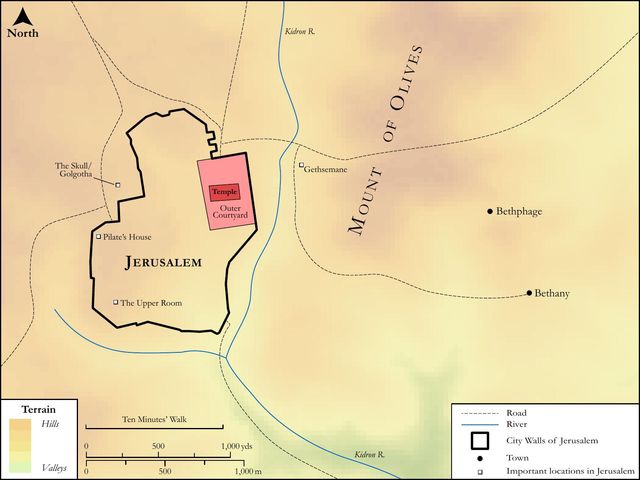
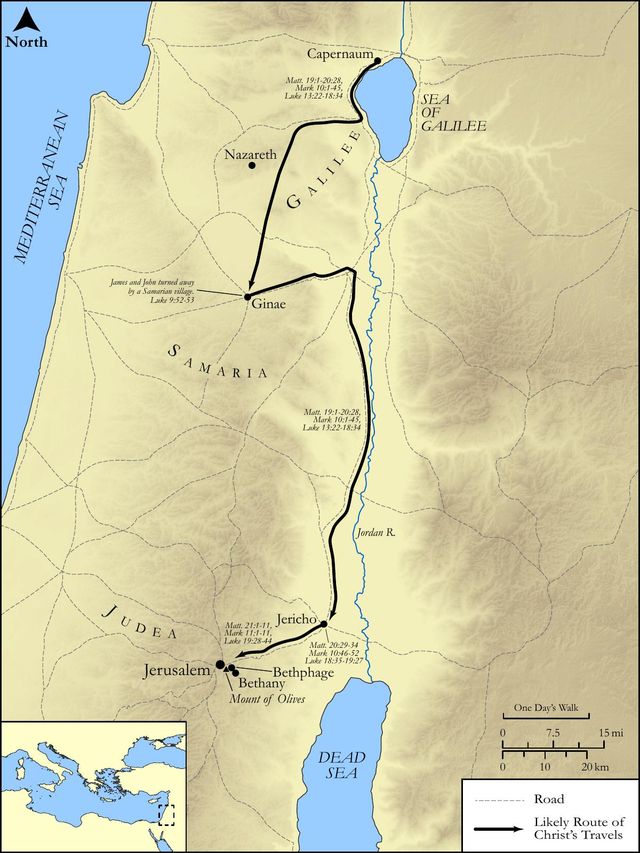
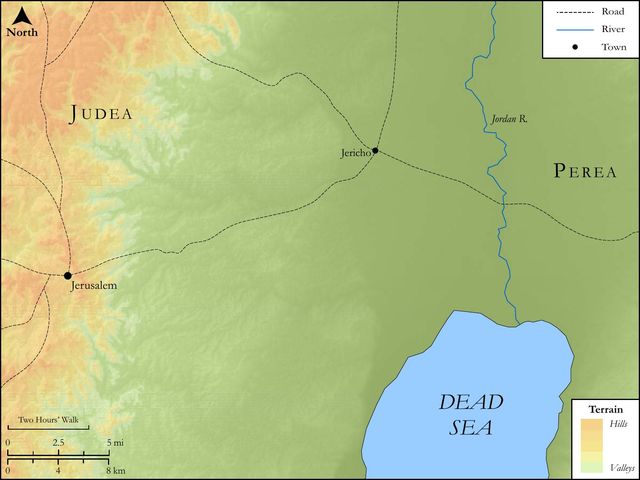
See on the biblical-era maps
Study this verse
Public-domain commentary
Matthew Henry
From his Commentary on the Whole Bible. Henry comments on passages, not single verses — this entry covers Luke 18:35–43. His two-level outline is real structure in the source text, so it is rendered as structure.
Christ came not only to bring light to a dark world, and so to set before us the objects we are to have in view, but also to give sight to blind souls, and by healing the organ to enable them to view those objects. As a token of this, he cured many of their bodily blindness: we have now an account of one to whom he gave sight near Jericho. Mark gives us an account of one, and names him, whom he cured as he went out of Jericho, Mar 10:46. Matthew speaks of two whom he cured as they departed from Jericho, Mat 20:30. Luke says it was en tō engizein auton - when he was near to Jericho, which might be when he was going out of it as well as when he was coming into it. Observe,
I.This poor blind man sat by the wayside, begging, Luk 18:35.
It seems, he was not only blind, but poor, had nothing to subsist on, nor any relations to maintain him; the fitter emblem of the world of mankind which Christ came to heal and save; they are therefore wretched and miserable, for they are both poor and blind, Rev 3:17. He sat begging, for he was blind, and could not work for his living. Note, Those ought to be relieved by charity whom the providence of God has any way disabled to get their own bread. Such objects of charity by the way-side ought not to be overlooked by us. Christ here cast a favourable eye upon a common beggar, and, though there are cheats among such, yet they must not therefore be all thought such.
II.Hearing the noise of a multitude passing by, he asked what it meant, Luk 18:36.
This we had not before. It teaches us that it is good to be inquisitive, and that those who are so some time or other find the benefit of it. Those who want their sight should make so much the better use of their hearing, and, when they cannot see with their own eyes, should, by asking questions, make use of other people's eyes. So this blind man did, and by that means came to understand that Jesus of Nazareth passed by, Luk 18:37. It is good being in Christ's way; and, when we have an opportunity of applying ourselves to him, not to let it slip.
III.His prayer has in it a great deal both of faith and fervency:
Jesus, thou Son of David, have mercy on me, Luk 18:38. He owns Christ to be the Son of David, the Messiah promised; he believes him to be Jesus, a Saviour; he believes he is able to help and succour him, and earnestly begs his favour: "Have mercy on me, pardon my sin, pity my misery." Christ is a merciful king; those that apply themselves to him as the Son of David shall find him so, and ask enough for themselves when they pray, Have mercy on us; for Christ's mercy includes all.
IV.Those who are in good earnest for Christ's favours and blessings will not be put by from the pursuit of them, though they meet with opposition and rebuke. They who went along chid him as troublesome to the Master, noisy and impertinent, and bade him hold his peace; but he went on with his petition, nay, the check given him was but as a dam to a full stream, which makes it swell so much the more; he cried the louder, Thou Son of David, have mercy on me. Those who would speed in prayer must be importunate in prayer. This history, in the close of the chapter, intimates the same thing with the parable in the beginning of the chapter, that men ought always to pray, and not to faint.
V.Christ encourages poor beggars, whom men frown upon, and invites them to come to him, and is ready to entertain them, and bid them welcome:
He commanded him to be brought to him. Note, Christ has more tenderness and compassion for distressed supplicants than any of his followers have. Though Christ was upon his journey, yet he stopped and stood, and commanded him to be brought to him. Those who had checked him must now lend him their hands to lead him to Christ.
VI.Though Christ knows all our wants, he will know them from us (Luk 18:41):
What wilt thou that I shall do unto thee? By spreading our case before God, with a particular representation of our wants and burdens, we teach ourselves to value the mercy we are in pursuit of; and it is necessary that we should, else we are not fit to receive it. This man poured out his soul before Christ, when he said, Lord, that I may receive my sight. Thus particular should we be in prayer, upon particular occasions.
VII.The prayer of faith, guided by Christ's encouraging promises, and grounded on them, shall not be in vain; nay, it shall not only receive an answer of peace, but of honour (Luk 18:42); Christ said, Receive thy sight, thy faith hath saved thee. True faith will produce fervency in prayer, and both together will fetch in abundance of the fruits of Christ's favour; and they are then doubly comfortable when they come in that way, when we are saved by faith.
VIII.The grace of Christ ought to be thankfully acknowledged, to the glory of God, Luk 18:43.
1.The poor beggar himself, that had his sight restored, followed Christ, glorifying God. Christ made it his business to glorify his Father; and those whom he healed pleased him best when they praised God, as those shall please God best who praise Christ and do him honour; for, in confessing that he is Lord, we give glory to God the Father. It is for the glory of God if we follow Christ, as those will do whose eyes are opened.
2.The people that saw it could not forbear giving praise to God, who had given such power to the Son of Man, and by him had conferred such favours on the sons of men. Note, We must give praise to God for his mercies to others as well as for mercies to ourselves.
Historical interpretation
Nine Centuries of Reception
12 surviving comments on this verse. Each one is dated, so this reads as a timeline rather than a list.
Select a marker to jump to its quote. Markers stagger vertically where authors wrote within a few decades of each other.
Why then did the blind man, on hearing that He was passing by, exclaim, "Jesus, Thou Son of David, have mercy on me? " unless he was considered, in no uncertain manner, to be the Son of David (in other words, to belong to David's family) through his mother and his brethren, who at some time or other had been made known to him by public notoriety? "Those, however, who went before rebuked the blind man, that he should hold his peace.
But how consistent is the interpretation on our side of the question! For He, who had been a little while ago invoked by the blind man as "the Son of David," then made no remark on the subject, not having the Scribes in His presence; whereas He now purposely moots the point before them, and that of His own accord, in order that He might show Himself whom the Mind man, following the doctrine of the Scribes, had simply declared to be the Son of David, to be also his Lord.
While he was asking who it was, they said to him, “Jesus, the Nazarene.” He knew that they were not saying that to him with love. He left what pertained to enemies and grasped hold of what pertained to friends. “Son of David, have mercy on me.” They were trying to prevent him, fearing that his eyes may be opened, and the Pharisees might recognize him and be irritated.
In the blind man we have a type of the Gentile people, who have received by the Sacrament of our Lord the brightness of the light which they had lost. And it matters not whether the cure is conveyed in the case of one or two blind men, inasmuch as deriving their origin from Ham and Japhet, the sons of Noah, in the two blind men they put forward two authors of their race.
Or, He asked the blind man to the end that we might believe, that without confession no man can be saved.
Having been brought up a Jew, he was not ignorant that of the seed of David should God be born according to the flesh, and therefore he addresses Him as God, saying, Have mercy upon me. Would that those might imitate him who divide Christ into two. For he speaks of Christ as God, yet calls Him Son of David. But they marvel at the justice of his confession, and some even wished to prevent him from confessing his faith. But by checks of this kind his ardour was not damped. For faith is able to resist all, and to triumph over all. It is a good thing to lay aside shame in behalf of divine worship. For if for money's sake some are bold, is it not fitting when the soul is at stake, to put on a righteous boldness? As it follows, But he cried out the more, Son of David, & c. The voice of one invoking in faith stops Christ, for He looks back upon them who call upon Him in faith. And accordingly He calls the blind man to Him, and bids him draw nigh, that he in truth who had first laid hold on Him in faith, might approach Him also in the body. The Lord asks this blind man as he drew near, What will thou that I shall do? He asks the question purposely, not as ignorant, but that those who stood by might know that he sought not money, but divine power from God. And thus it follows, But he said, Lord, that I may receive my sight.
From which it is clear, that he was released from a double blindness, both bodily and intellectual. For he would not have glorified Him as God, had he not truly seen Him as He is. But he also gave occasion to others to glorify God; as it follows, And all the people, when they saw it, gave praise unto God.
The blind man must have understood that the sight of the blind cannot be restored by human means but requires, on the contrary, a divine power and an authority such as God only possesses. With God nothing whatsoever is impossible. The blind man came near to him as to the omnipotent God. How then does he call him the Son of David? What can one answer to this? The following is perhaps the explanation. Since he was born and raised in Judaism, of course, the predictions contained in the law and the holy prophets concerning Christ had not escaped his knowledge. He heard them chant that passage in the book of the Psalms, “The Lord has sworn in truth to David, and will not annul it, saying: ‘of the fruit of your loins I will set a king upon your throne.’ ” The blind man also knew that the blessed prophet Isaiah said, “There will spring up a shoot from the root of Jesse, and from his root a flower will grow up.” Isaiah also said, “Behold, a virgin will conceive and bring forth a son, and they will call his name Emmanuel, which being interpreted is, God with us.” He already believed that the Word, being God, of his own will had submitted to be born in the flesh of the holy Virgin. He now comes near to him as to God and says, “Have mercy on me, Son of David.” Christ testifies that this was his state of mind in offering his petition. He said to him, “Your faith has saved you.”
(Hom. de cæco et Zacchæo) There was a great multitude gathered round Christ, and the blind man indeed knew Him not, but felt a drawing towards Him, and grasped with his heart what his sight embraced not. As it follows, And when he heard the multitude passing by, he asked what it was. And those that saw spoke indeed according to their own opinion. And they told him that Jesus of Nazareth passeth by. But the blind man cried out. He is told one thing, he proclaims another; for it follows, And he cried out, saying, Jesus, thou Son of David, have mercy on me. Who taught thee this, O man? Hast thou that art deprived of sight read books? Whence then knowest thou the Light of the world? Verily the Lord giveth sight to the blind. (Ps. 146:8.)
(Chrys. ut sup.) Or because the Jews perverting the truth might say, as in the case of him who was born blind, This is not he, but one like unto to him, (John 9:8.) He wished the blind first to make manifest the infirmity of his nature, that then he might fully acknowledge the greatness of the grace bestowed upon him. And as soon as the blind man explained the nature of his request, with words of the highest authority He commanded him to see. As it follows, And Jesus said to him, Receive thy sight. This served only still more to increase the guilt of unbelief in the Jews. For what prophet ever spoke in this way? Observe moreover what the physician claims from him whom he has restored to health. Thy faith hath saved thee. For faith then mercies are sold. Where faith is willing to accept, there grace abounds. And as from the same fountain some in small vessels draw little water, while others in large draw much, the fountain knowing no difference in measure; and as according to the windows which are opened, the sun sheds more or less of its brightness within; so according to the measure of a man's motives does he draw down supplies of grace. The voice of Christ is changed into the light of the afflicted. For He was the Word of true light. And thus it follows, And immediately he said. But the blind man as before his restoration he showed an earnest faith, so afterwards did he give plain tokens of his gratitude; And he followed him, glorifying God.
(Chrys. ubi sup.) We may here well inquire, why Christ forbids the healed demoniac who wished to follow Him, but permits the blind man who had received his sight. There seems to be a good reason for both the one case and the other. He sends away the former as a kind of herald, to proclaim aloud by the evidence of his own state his benefactor, for it was indeed a notable miracle to see a raving madman brought to a sound mind. But the blind man He allows to follow Him, since He was going up to Jerusalem about to accomplish the high mystery of the Cross, that men having a recent report of a miracle might not suppose that He suffered so much from helplessness as from compassion.
Therefore whoever recognizes the darkness of his own blindness, whoever understands that the light of eternity is what he lacks, let him cry out from the depths of his heart, let him cry out with the voices of his mind, saying: "Jesus, Son of David, have mercy on me."
(Hom. 2. in Ev.) Because the disciples being yet carnal were unable to receive the words of mystery, they are brought to a miracle. Before their eyes a blind man receives his sight, that by a divine work their faith might be strengthened.
(Hom. 2. in Ev.) Or, blindness is a symbol of the human race, which in our first parent knowing not the brightness of heavenly light, now suffers the darkness of his condemnation. Jericho is interpreted 'the moon,' whose monthly wanings represent the feebleness of our mortality. While then our Creator is drawing nigh to Jericho, the blind is restored to sight, because when God took upon Him the weakness of our flesh, the human race received back the light which it had lost. He then who is ignorant of this brightness of the everlasting light, is blind. But if he does no more than believe in the Redeemer who said, I am the way, the truth, and the life; (John 13:6.) he sits by the way side. If he both believes and prays that he may receive the everlasting light, he sits by the way side and begs. Those that went before Jesus, as He was coming, represent the multitude of carnal desires, and the busy crowd of vices which before that Jesus comes to our heart, scatter our thoughts, and disturb us even in our prayers. But the blind man cried out the more; for the more violently we are assailed by our restless thoughts, the more fervently ought we to give ourselves to prayer. As long as we still suffer our manifold fancies to trouble us in our prayers, we feel in some measure Jesus passing by. But when we are very stedfast in prayer, God is fixed in our heart, and the lost light is restored. Or to pass by is of man, to stand is of God. The Lord then passing by heard the blind man crying, standing still restored him to sight, for by His humanity in compassion to our blindness He has pity upon our cries, by the power of His divinity He pours upon us the light of His grace.
Now for this reason He asks what the blind man wished, that He might stir up his heart to prayer, for He wishes that to be sought in prayer, which He knows beforehand both that we seek and He grants.
(ubi sup.) The blind man seeks from the Lord not gold, but light. Let us then seek not for false riches, but for that light which together with the Angels alone we may see, the way whereunto is faith. Well then was it said to the blind, Receive thy sight; thy faith hath saved thee. He who sees, also follows, because the good which he understands he practises.
Not only for the gift of light obtained, but for the merit of the faith which obtained it.
And he cried out, saying: Jesus, Son of David, have mercy on me. And those who were going before rebuked him, so that he might be silent. But he cried out much more, Son of David, have mercy on me. What do those signify who precede Jesus as he comes, if not the crowds of carnal desires and the tumults of vices, which, before Jesus comes to our hearts, scatter our thoughts with their temptations and disturb the voices of the heart in prayer? For often, when we wish to turn to God after having committed sins, while we strive to pray against these same vices that we have committed, the phantasms of the sins we committed come to our heart, reverberate the focus of our mind, confound, and press down the mind and voice of our supplication. But he who is rebuked by the crowd to be silent cries out all the more, because the more heavily we are pressed by the tumult of carnal thoughts, the more ardently we should persist in prayer.
And to show that our Lord did not even walk without doing good, He performed a miracle on the way, giving His disciples this example, that we should be profitable in all things, and that nothing in us should be in vain.
Continue studying Luke 18:38 across the web’s major study libraries — every link below opens this exact verse, chapter, or book on the destination site.
Read & Compare
 BibleGatewayThis verse in more than 200 translations and 70 languages.
 Bible.comThe YouVersion reader — hundreds of translations, reading plans, and highlights.
 ESV.orgCrossway's official English Standard Version reader.
 NET BibleThe NET translation with 60,000+ translators' notes on every rendering decision.
 STEP BibleTyndale House's free study tool — original text, vocabulary, and scholarly resources.
 BibliaLogos Bible Software's free web reader.
 USCCBThe New American Bible (Revised Edition) with the U.S. bishops' study notes.
Commentaries
 BibleHub CommentariesDozens of classic commentaries on this verse, gathered on one page.
 StudyLightMore than 100 commentary sets — the largest collection on the web.
 BibleRefPlain-English commentary on what this verse means, verse by verse.
 Enduring WordDavid Guzik's free commentary on this chapter, widely used by Bible teachers.
 Bible Study ToolsVerse commentary alongside Greek and Hebrew study aids.
Original Language & Research
- BibleHub InterlinearThe verse word by word — original language, transliteration, and English.
- BibleHub LexiconEvery word's original-language definition and Strong's entry.
 Blue Letter BibleDeep-study tools — Strong's numbers, concordance, and word studies.
 CNTR CollationThe earliest Greek manuscripts of this verse, collated letter by letter.
Sermons, Hymns & Audio


TrulyRandomVerse is not affiliated with these sites and doesn’t control their content. They’re linked because they’re genuinely useful.
Summary
Luke 18:38 captures the fervent, desperate cry of a blind man near Jericho, who, upon discerning Jesus' presence, boldly addresses Him as "Jesus, Son of David," and pleads for mercy. This pivotal moment underscores the man's profound spiritual insight and unwavering faith, setting the stage for Jesus' compassionate response and miraculous healing, illustrating the power of persistent, humble supplication to the Messiah.
Context
ShowHideLiterary Context
This powerful encounter occurs as Jesus is on His final, determined journey towards Jerusalem, a path He has repeatedly foretold will lead to His suffering and death (Luke 18:31-34). The narrative immediately precedes the account of Zacchaeus in Jericho (Luke 19:1-10). Importantly, the blind man's persistent faith and clear recognition of Jesus' messianic identity stand in stark contrast to the disciples' ongoing confusion and lack of understanding regarding Jesus' mission and impending passion. The man's cry also echoes the themes of persistence in prayer and humble faith highlighted in the preceding parables of the persistent widow (Luke 18:1-8) and the Pharisee and the tax collector (Luke 18:9-14), positioning him as an exemplar of the very faith Jesus seeks.
Historical & Cultural Context
Jericho was a significant city, strategically located on the main route from Galilee to Jerusalem, making it a common stop for pilgrims. In ancient Israel, blindness was a common affliction, often leading to neglect and dependence on begging for survival, as there were no provisions for the needy. The physically disabled were frequently viewed with suspicion, sometimes even believed to be suffering due to sin (John 9:1-2). The title "Son of David" was a deeply significant messianic appellation among the Jewish people, rooted in God's covenant with King David (2 Samuel 7:12-16). It referred to the promised descendant of David who would be the Messiah, the rightful King of Israel, who would restore the kingdom. For a blind beggar to publicly declare Jesus as the "Son of David" was a bold and profound theological statement, risking rebuke from the crowd or religious authorities.
Key Themes
ShowHideThis verse powerfully contributes to several key themes within Luke's Gospel and the broader biblical narrative. Firstly, it highlights the theme of Recognition of Jesus' Identity. Despite his physical blindness, the man possesses remarkable spiritual insight, recognizing Jesus as the long-awaited Messiah, the "Son of David," a title the disciples themselves struggled to fully grasp. Secondly, the man's unwavering Faith and Persistence are central. His refusal to be silenced by the crowd and his continued, louder cry demonstrate a tenacious faith that Jesus often commended as a prerequisite for divine intervention (Luke 17:19). Finally, the scene underscores Jesus' Divine Compassion and Mercy for the lowly. Jesus, despite His urgent journey to Jerusalem, stops for an outcast, demonstrating His kingdom values of prioritizing the humble and needy, a recurring motif throughout His ministry.
Exposition and Analysis
ShowHideKey Word Analysis
ShowHideThis verb signifies a loud, urgent shout, a "halloo" or a cry for help. It conveys the man's desperation and his determination to be heard above the noise of the crowd. It is not a polite request but a forceful, public declaration of need.
While literally meaning "child" or "son," in this context, when combined with "David," it denotes a direct descendant and, more significantly, the rightful heir. It carries the weight of lineage and the fulfillment of prophecy, establishing a claim to royal authority and messianic identity.
Refers to King David, the revered monarch of Israel, from whose lineage the Messiah was prophesied to come. By invoking David's name, the blind man explicitly identifies Jesus as the promised Messiah, the true King of Israel, who would bring salvation and restoration.
This word signifies active compassion that leads to practical help or deliverance, often implying divine grace. It is more than mere pity; it is a plea for God's compassionate intervention to alleviate suffering, heal, or save. The man is not demanding, but humbly appealing to Jesus' benevolent power.
Verse Breakdown
ShowHide"And he cried, saying,"
This opening phrase immediately establishes the urgency and public nature of the blind man's plea. He doesn't whisper or wait to be noticed; he actively and loudly calls out, demonstrating his desperation and conviction that Jesus is his only hope. His voice cuts through the commotion of the crowd, demanding attention.
"Jesus, thou Son of David,"
This is the core of the man's address, revealing profound spiritual insight. By calling Jesus "Jesus," he acknowledges His person and presence. By adding "Son of David," he publicly declares his belief in Jesus' messianic identity, recognizing Him as the promised King from David's royal line. This title is a theological statement, signifying Jesus' unique authority and power to fulfill Old Testament prophecies.
"have mercy on me."
This is a direct, humble, and specific request. It is not a demand for healing, but a plea for active compassion and grace. The man understands that his healing, or any help, would be an act of Jesus' unmerited favor and divine power, acknowledging his own helplessness and dependence on Jesus' benevolence.
Literary Devices
ShowHideLuke's account of the blind man employs several powerful literary devices. There is striking Irony present, as the physically blind man "sees" Jesus' true identity as the "Son of David" more clearly than the crowd or even the disciples, who possess physical sight but often lack spiritual understanding. This spiritual insight in the face of physical limitation is a recurring motif in the Gospels. The man's persistent cry and the subsequent miracle serve as Foreshadowing for Jesus' triumphal entry into Jerusalem, where He will be hailed as King, and for the spiritual sight He offers to all who believe. Furthermore, the narrative uses Contrast effectively, pitting the blind man's humble, persistent faith against the crowd's attempts to silence him and the rich young ruler's inability to sacrifice for the kingdom. Finally, Symbolism is deeply embedded, with physical blindness often representing spiritual blindness throughout the Gospels, and the restoration of sight symbolizing spiritual enlightenment, salvation, and the dawning of God's kingdom.
Theological and Thematic Connections
ShowHideLuke 18:38 powerfully illustrates the theological truth that genuine faith, even from the lowly, is recognized and rewarded by God. The blind man's cry is a model of humble, persistent prayer, rooted in a correct understanding of Jesus' identity as the Messiah. His appeal for "mercy" encapsulates the human condition of need and dependence on divine grace, while Jesus' willingness to stop and respond demonstrates God's active compassion for the suffering and outcast. This encounter affirms Jesus' authority not only as a healer but as the promised King who brings salvation and restoration, highlighting that true spiritual sight comes from recognizing Him as Lord.
Reflection and Application
ShowHideThe blind man's unwavering cry in Luke 18:38 offers profound lessons for our own spiritual journey. His example challenges us to examine the depth of our faith and the persistence of our prayers. Are we willing to cry out to Jesus despite the distractions and discouragements of the world, or even the rebukes of those around us? Do we truly believe in His authority and identity as the "Son of David," the one who has the power to meet our deepest needs? This passage encourages us to be bold in approaching Jesus with our vulnerabilities, our "blind spots," and our desperate pleas for mercy, trusting that He is always ready to stop, listen, and respond with compassion. Just as the blind man's physical sight was restored, our spiritual sight can be sharpened as we fix our gaze on Christ, allowing Him to illuminate areas of darkness in our lives and grant us the wisdom to see His will clearly.
Questions for Reflection
ShowHideFAQ
ShowHideWhy did the blind man call Jesus "Son of David"?
ShowHideThe blind man called Jesus "Son of David" because it was a widely recognized messianic title among the Jewish people. It signified that Jesus was the long-awaited King, the promised descendant of King David, who would fulfill Old Testament prophecies and restore Israel. By using this title, the blind man demonstrated profound spiritual insight, recognizing Jesus' true identity and authority as the Messiah, even though he was physically blind. This public declaration was a bold act of faith, acknowledging Jesus' unique claim to divine kingship and His power to bring about salvation and healing. It was a direct appeal to Jesus' royal and redemptive authority.
What does "have mercy on me" mean in this context, and why is it significant?
ShowHideIn this context, "have mercy on me" (Greek: eleéson) is far more than a simple request for pity. It is a humble yet urgent plea for active, compassionate intervention from a position of power and grace. The blind man is not demanding, but rather appealing to Jesus' divine benevolence and ability to alleviate his suffering and restore his sight. It signifies a recognition of his own helplessness and a complete reliance on Jesus' power and willingness to act. This plea is significant because it acknowledges Jesus' authority to bring about a miraculous change, trusting that His mercy will lead to tangible healing and deliverance, aligning with the broader biblical theme of God's compassion for the afflicted and His readiness to respond to those who cry out to Him in faith (Psalm 103:8).
Christ-Centered Fulfillment
ShowHideThe blind man's fervent cry to "Jesus, Son of David, have mercy on me" finds its ultimate fulfillment in the person and work of Christ. Jesus, as the true "Son of David," is the promised King who comes not merely to restore physical sight, but to open the eyes of the spiritually blind and bring salvation to all who call upon His name. The blind man's recognition of Jesus' messianic identity foreshadows the universal confession that Jesus is Lord, a truth revealed fully in the New Testament (Romans 10:9). His plea for "mercy" is answered supremely in Christ's atoning sacrifice on the cross, where He bore the sins of humanity, offering ultimate compassion and deliverance from spiritual blindness and eternal death (2 Corinthians 5:21). Through faith in Him, we receive not just physical healing, but the spiritual sight that enables us to see God's truth, walk in His light, and inherit eternal life, fulfilling the very essence of the mercy sought by the blind man near Jericho (John 8:12).