


Judges 20:7
Bible text: King James Version (1769 Blayney text) · Public domain
Bible text: Berean Standard Bible · Public domain
Bible text: American Standard Version (1901) · Public domain
Bible text: World English Bible, Messianic edition · Public domain
Bible text: Geneva Bible (1599) · Public domain
Bible text: Young's Literal Translation · Public domain
- הִנֵּהhi·Nehhere!H2009PrtParticle Interjection
- כֻלְּכֶםkhu·le·Khemall of youH3605N-msc ¦ 2mpNoun Singular Masculine Constructכֻלְּall ofכֶםyou
- בְּנֵיbe·NeiO people ofH1121N-mpcNoun Plural Masculine Construct
- יִשְׂרָאֵלYis·ra·'ElIsraelH3478N-properNoun Proper Location
- הָבוּha·VugiveH3051V-Qal-Imp-2mpVerb Qal Imperative 2nd Plural Masculine
- לָכֶםla·Khemfor <the> yourselvesPrep-l ¦ 2mpSuffix Personal 2nd Plural Masculineלָfor <the>כֶםyourselves
- דָּבָרda·Vara wordH1697N-msNoun Singular Masculine Absolute
- וְעֵצָהve·'e·Tzahand counselH6098Conj-w ¦ N-fsNoun Singular Feminine Absoluteוְandעֵצָהcounsel
- הֲלֹםha·LomhereH1988AdvAdverb
English is a literal word-by-word gloss of the Hebrew, not the KJV's wording. Why?
This is the original text the KJV's translators worked from — each Hebrew word with its own literal English meaning in this verse, prepared by scholars at Tyndale House, Cambridge. The KJV translates whole sentences, not word by word, so its wording differs: one Hebrew word can become several English words, and the KJV may choose “the LORD” where the gloss reads “Yahweh”. Both are faithful — they answer different questions. For the KJV's own rendering, switch to the KJV text.
Details
See on the biblical-era maps

Study this verse
Public-domain commentary
Matthew Henry
From his Commentary on the Whole Bible. Henry comments on passages, not single verses — this entry covers Judges 20:1–11. His two-level outline is real structure in the source text, so it is rendered as structure.
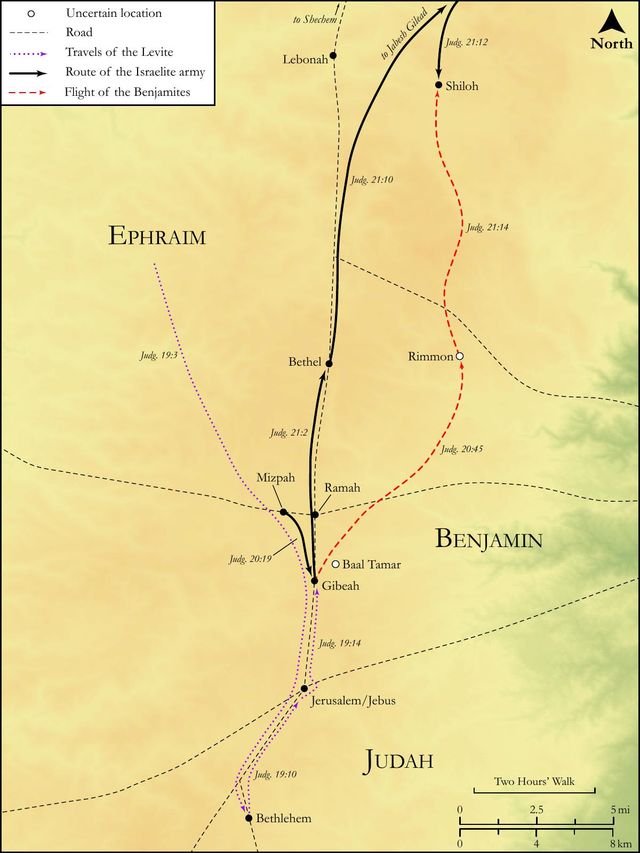
Here is, I. A general meeting of all the congregation of Israel to examine the matter concerning the Levite's concubine, and to consider what was to be done upon it, Jdg 20:1, Jdg 20:2. It does not appear that they were summoned by the authority of any one common head, but they came together by the consent and agreement, as it were, of one common heart, fired with a holy zeal for the honour of God and Israel. 1. The place of their meeting was Mizpeh; they gathered together unto the Lord there, for Mizpeh was so very near to Shiloh that their encampment might very well be supposed to reach from Mizpeh to Shiloh. Shiloh was a small town, and therefore, when there was a general meeting of the people to represent themselves before God, they chose Mizpeh for their head-quarters, which was the next adjoining city of note, perhaps because they were not willing to give that trouble to Shiloh which so great an assembly would occasion, it being the resident of the priests that attended the tabernacle. 2. The persons that met were all Israel, from Dan (the city very lately so called, Jdg 18:29) in the north to Beersheba in the south, with the land of Gilead (that is, the tribes on the other side Jordan), all as one man, so unanimous were they in their concern for the public good. Here was an assembly of the people of God, not a convocation of the Levites and priests, though a Levite was the person principally concerned in the cause, but an assembly of the people, to whom the Levite referred himself with an Appello populum - I appeal to the people. The people of God were 400,000 footmen that drew the sword, that is, were armed and disciplined, and fit for service, and some of them perhaps such as had known the wars of Canaan, Jdg 3:1. In this assembly of all Israel, the chief (or corners) of the people (for rulers are the corner-stones of the people, that keep all together) presented themselves as the representatives of the rest. They rendered themselves at their respective posts, at the head of the thousands and hundreds, the fifties and tens, over which they presided; for so much order and government, we may suppose, at least, they had among them, though they had no general or commander-in-chief. So that here was, (1.) A general congress of the states for counsel. The chief of the people presented themselves, to lead and direct in this affair. (2.) A general rendezvous of the militia for action, all that drew sword and were men of war (Jdg 20:17), not hirelings nor pressed men, but the best freeholders, that went at their own charge. Israel were above 600,000 when they came into Canaan, and we have reason to think they were at this time much increased, rather than diminished; but then all between twenty and sixty were military men, now we may suppose more than the one half exempted from bearing arms to cultivate the land; so that these were as the trained bands. The militia of the two tribes and a half were 40,000 (Jos 4:13), but the tribes were many more.
II.Notice given to the tribe of Benjamin of this meeting (Jdg 20:3):
They heard that the children of Israel had gone up to Mizpeh. Probably they had a legal summons sent them to appear with their brethren, that the cause might be fairly debated, before any resolutions were taken up upon it, and so the mischiefs that followed would have been happily prevented; but the notice they had of this meeting rather hardened and exasperated them than awakened them to think of the things that belonged to their peace and honour.
III.A solemn examination of the crime charged upon the men of Gibeah.
A very horrid representation of it had been made by the report of the messengers that were sent to call them together, but it was fit it should be more closely enquired into, because such things are often made worse than really they were; a committee therefore was appointed to examine the witnesses (upon oath, no doubt) and to report the matter. It is only the testimony of the Levite himself that is here recorded, but it is probable his servant, and the old man, were examined, and gave in their testimony, for that more than one were examined appears by the original (Jdg 20:3), which is, Tell you us; and the law was that none should be put to death, much less so many, upon the testimony of one witness only. The Levite gives a particular account of the matter: that he came into Gibeah only as a traveller to lodge there, not giving the least shadow of suspicion that he designed them any ill turn (Jdg 20:4), and that the men of Gibeah, even those that were of substance among them, that should have been a protection to the stranger within their gates, riotously set upon the house where he lodged, and thought to slay him; he could not, for shame relate the demand which they, without shame, made, Jdg 19:22. They declared their sin as Sodom, even the sin of Sodom, but his modesty would not suffer him to repeat it; it was sufficient to say they would have slain him, for he would rather have been slain than have submitted to their villany; and, if they had got him into their hands, they would have abused him to death, witness what they had done to his concubine: They have forced her that she is dead, Jdg 20:5. And, to excite in his countrymen an indignation at this wickedness, he had sent pieces of the mangled body to all the tribes, which had fetched them together to bear their testimony against the lewdness and folly committed in Israel, Jdg 20:6. All lewdness is folly, but especially lewdness in Israel. For those to defile their own bodies who have the honourable seal of the covenant in their flesh, for those to defy the divine vengeance to whom it is so clearly revealed from heaven - Nabal is their name, and folly is with them. He concludes his declaration with an appeal to the judgment of the court (Jdg 20:7): You are all children of Israel, and therefore you know law and judgment, Est 1:13. "You are a holy people to God, and have a dread of every thing which will dishonour God and defile the land; you are of the same community, members of the same body, and therefore likely to feel from the distempers of it; you are children of Israel, that ought to take particular care of the Levites, God's tribe, among you, and therefore give your advice and counsel what is to be done."
IV.The resolution they came to hereupon, which was that, being now together, they would not disperse till they had seen vengeance taken upon this wicked city, which was the reproach and scandal of their nation. Observe,
1.Their zeal against the lewdness that was committed. They would not return to their houses, how much soever their families and their affairs at home wanted them, till they had vindicated the honour of God and Israel, and recovered with their swords, if it could not be had otherwise, that satisfaction for the crime which the justice of the nation called for, Jdg 20:8. By this they showed themselves children of Israel indeed, that they preferred the public interest before their private concerns.
2.Their prudence in sending out a considerable body of their forces to fetch provisions for the rest, Jdg 20:9, Jdg 20:10. One of ten, and he chosen by lot, 40,000 in all, must go to their respective countries, whence they came, to fetch bread and other necessaries for the subsistence of this great army; for when they came from home they took with them provisions only for a journey to Mizpeh, not for an encampment (which might prove long) before Gibeah. This was to prevent their scattering to forage for themselves, for, if they had done this, it would have been hard to get them all together again, especially all in so good a mind. Note, When there appears in people a pious zeal for any good work it is best to strike while the iron is hot, for such zeal is apt to cool quickly if the prosecution of the work be delayed. Let it never be said that we left that good work to be done tomorrow which we could as well have done today.
3.Their unanimity in these counsels, and the execution of them. The resolution was voted, Nemine contradicente - Without a dissenting voice (Jdg 20:8); it was one and all; and, when it was put in execution, they were knit together as one man, Jdg 20:11. This was their glory and strength, that the several tribes had no separate interests when the common good was concerned.
Continue studying Judges 20:7 across the web’s major study libraries — every link below opens this exact verse, chapter, or book on the destination site.
Read & Compare
 BibleGatewayThis verse in more than 200 translations and 70 languages.
 Bible.comThe YouVersion reader — hundreds of translations, reading plans, and highlights.
 ESV.orgCrossway's official English Standard Version reader.
 NET BibleThe NET translation with 60,000+ translators' notes on every rendering decision.
 STEP BibleTyndale House's free study tool — original text, vocabulary, and scholarly resources.
 BibliaLogos Bible Software's free web reader.
 USCCBThe New American Bible (Revised Edition) with the U.S. bishops' study notes.
Commentaries
 BibleHub CommentariesDozens of classic commentaries on this verse, gathered on one page.
 StudyLightMore than 100 commentary sets — the largest collection on the web.
 BibleRefPlain-English commentary on what this verse means, verse by verse.
 Enduring WordDavid Guzik's free commentary on this chapter, widely used by Bible teachers.
 Bible Study ToolsVerse commentary alongside Greek and Hebrew study aids.
Original Language & Research
- BibleHub InterlinearThe verse word by word — original language, transliteration, and English.
- BibleHub LexiconEvery word's original-language definition and Strong's entry.
 Blue Letter BibleDeep-study tools — Strong's numbers, concordance, and word studies.
 SefariaThe Hebrew text with Rashi and centuries of Jewish commentary.
Sermons, Hymns & Audio


TrulyRandomVerse is not affiliated with these sites and doesn’t control their content. They’re linked because they’re genuinely useful.
Summary
Judges 20:7 encapsulates a critical juncture in Israel's history, as the Levite, whose concubine suffered a horrific death in Gibeah, addresses the assembled tribes. Following his poignant recounting of the crime and the shocking display of his concubine's dismembered body, he invokes their shared identity as "children of Israel" and earnestly calls for their collective "advice and counsel." This verse represents a desperate plea for national solidarity and a unified, deliberate response to the profound moral depravity and egregious injustice that had defiled the covenant community, thereby setting the stage for the tragic civil war that would ensue.
Context
ShowHideLiterary Context
Judges 20:7 immediately follows the Levite's harrowing testimony to the assembled tribes of Israel at Mizpah, a narrative detailed in Judges 19. Chapter 19 graphically describes the unspeakable crime committed by the men of Gibeah against his concubine, culminating in her death and the Levite's shocking act of dismembering her body into twelve pieces. These pieces were then sent throughout Israel as a desperate and visceral call for justice and intervention. This verse serves as the Levite's direct appeal to the entire nation after presenting his case, urging them to deliberate and decide on a unified course of action against the perpetrators. It acts as the pivotal catalyst for the national assembly's decision to confront the tribe of Benjamin, leading directly into the tragic civil war described in the remainder of Judges 20.
Historical & Cultural Context
The events of Judges 20:7 unfold during a period of profound moral and spiritual decline in Israel, famously characterized by the recurring refrain, "In those days there was no king in Israel: every man did that which was right in his own eyes" (as explicitly stated in Judges 21:25). This era was marked by pervasive tribal autonomy, a severely weakened central authority, and a widespread disregard for covenant law and God's statutes. The gathering at Mizpah was significant, as it was a traditional place for national assemblies, covenant renewal, and spiritual discernment. The crime against the concubine, a severe violation of the hospitality owed to the stranger and of human dignity, was considered an affront not merely to the Levite but to the entire covenant community. Such an atrocity demanded a corporate response to purge evil from their midst, reflecting the principles found in passages like Deuteronomy 13:5, which commanded the removal of evil from Israel.
Key Themes
ShowHideThis verse powerfully highlights several critical themes pertinent to the book of Judges and the broader biblical narrative. First, it underscores National Unity and Collective Responsibility, as the Levite reminds them they are "all children of Israel," emphasizing their shared identity and covenantal obligation to uphold justice within their borders. The crime against one individual is presented as an affront to the entire nation, demanding a unified response from all tribes. Second, it points to the desperate need for Seeking Justice and Accountability in a society spiraling into moral decay. The call for "advice and counsel" signifies a desire for deliberate, communal judgment rather than impulsive vengeance, underscoring the serious nature of the situation and the urgent need to hold perpetrators accountable. Finally, it emphasizes the importance of Deliberation and Wise Counsel in times of profound crisis, reflecting the ancient Israelite practice of communal decision-making in matters affecting the whole community, a principle also advised in Proverbs 11:14, which states, "Where no counsel is, the people fall: but in the multitude of counsellors there is safety."
Exposition and Analysis
ShowHideKey Word Analysis
ShowHideThis word broadly signifies a son or descendant, but in its widest sense, it encompasses literal and figurative relationships, including a nation or people. In the phrase "children of Israel," it emphasizes the collective identity of the Israelites as descendants of Jacob (Israel) and, more profoundly, as God's chosen covenant people. The Levite's use of "all children of Israel" is a powerful rhetorical appeal, reminding the assembled tribes of their shared heritage, their common obligations under the Mosaic Law, and their collective responsibility to uphold justice and righteousness within the community, implying that an offense against one was an offense against all.
This term denotes a deliberate plan, a strategic course of action, or a well-considered counsel. It implies a thoughtful and reasoned approach to a complex problem, seeking a unified strategy rather than individual opinions or impulsive reactions. The Levite is not merely asking for suggestions but for a collective, binding decision on how to proceed, highlighting the gravity and necessity of a well-formed national response.
While dâbâr can mean "word" or "thing," in this context, paired with ʻêtsâh, it refers to a weighty matter, a decision, or a pronouncement. It signifies the substance of the advice, the concrete resolution or judgment that the assembly is expected to render. Together, "advice and counsel" call for a comprehensive, unified, and authoritative national policy to address the crisis, moving beyond mere deliberation to decisive action.
Verse Breakdown
ShowHide"Behold, ye [are] all children of Israel;"
This opening clause serves as a powerful reminder and invocation of their shared identity and covenantal relationship with God. The Levite appeals to their common heritage and corporate responsibility, implying that the heinous crime committed in Gibeah is not merely a local issue but a national affront that demands a unified response from all who bear the name "Israel." It highlights the concept of corporate solidarity within the covenant community, emphasizing that the defilement of one part affects the whole.
"give here your advice and counsel."
This is a direct, urgent plea for a collective, deliberate, and strategic decision. The Levite is not seeking casual opinions but a formal, well-considered judgment and a unified plan of action from the assembled leaders and representatives of the tribes. It underscores the gravity of the situation and the need for the entire nation to participate in discerning and executing justice, reflecting the communal nature of law and order in ancient Israel, and the necessity of a unified front against evil.
Literary Devices
ShowHideJudges 20:7 employs several potent literary devices to convey the urgency and gravity of the Levite's appeal. The most prominent is Direct Address, as the Levite speaks directly and forcefully to the assembled tribes, creating an immediate and urgent tone that compels attention and action. His opening phrase, "Behold, ye are all children of Israel," functions as a powerful Appeal to Identity and Shared Values, invoking their covenantal relationship and collective responsibility to God and one another. This appeal also carries a strong element of Pathos, as the preceding narrative (Judges 19) has already stirred deep outrage and sorrow, making his plea for justice emotionally resonant and morally imperative. The doubling of terms, "advice and counsel," is a form of Emphasis or Hendiadys, intensifying the request for a comprehensive, well-thought-out, and unified national resolution rather than a mere suggestion. Ultimately, the verse serves as a direct Call to Action, demanding not just passive listening but active participation in a critical decision that will determine the moral trajectory of the nation.
Theological and Thematic Connections
ShowHideJudges 20:7 stands as a stark testament to the theological principle of corporate responsibility within God's covenant people. The Levite's appeal to "all children of Israel" underscores that sin, especially grievous sin and moral depravity, committed within the community affects the entire body. This passage highlights the divine expectation for God's people to actively pursue justice, purge evil from their midst, and collectively discern God's will in times of crisis. The failure to address such depravity not only corrupts the individual but defiles the entire nation, jeopardizing their covenant relationship with God and inviting divine judgment. It also speaks to the importance of seeking wise, communal counsel when facing moral dilemmas, recognizing that collective wisdom, when guided by divine principles and a commitment to righteousness, can lead to righteous judgment and the preservation of communal integrity.
Reflection and Application
ShowHideJudges 20:7 serves as a powerful, albeit tragic, reminder of the enduring importance of communal responsibility and the pursuit of justice within any group claiming to follow God. In our contemporary context, this verse challenges us to consider how we, as individuals and as the church, respond to injustice and moral decay within our own communities and the broader society. It compels us to move beyond passive observation to active engagement, seeking wise counsel and unified action when confronted with egregious sin or pervasive brokenness. The Levite's appeal for "advice and counsel" underscores the value of collective discernment, reminding us that wisdom often resides in the multitude of counselors, and that difficult decisions are best made through prayerful, collaborative deliberation rather than individual impulse or apathy. It also serves as a cautionary tale, demonstrating the devastating consequences when a society, even one with a covenant relationship with God, drifts so far from divine standards that it requires such drastic intervention, potentially leading to internal strife and devastating loss. Our call is to be agents of righteousness and reconciliation, actively participating in the restoration of justice and moral order.
Questions for Reflection
ShowHideFAQ
ShowHideWhy does the Levite emphasize "all children of Israel" in his appeal?
ShowHideThe Levite's emphasis on "all children of Israel" is a crucial rhetorical strategy designed to evoke a sense of shared covenant identity and corporate responsibility. An egregious crime like the one committed in Gibeah was not merely a private offense but a direct affront to the entire nation and its covenant with God. By highlighting their collective identity, the Levite implies that the sin of Gibeah had defiled the whole community, and therefore, the entire nation bore the responsibility to address it and purge the evil from their midst, in line with principles found in Deuteronomy 13:5. It was a powerful call for national solidarity and unified action in the face of profound moral decay and spiritual compromise.
What was the significance of the Levite's request for "advice and counsel" in this context?
ShowHideThe request for "advice and counsel" was highly significant. It was not a casual query but a formal plea for a collective, deliberate, and unified national strategy and judgment. In ancient Israel, especially in matters of such gravity, communal decision-making was vital for maintaining justice and order. The Levite was calling for the assembled leaders and representatives of the tribes to engage in serious deliberation, to weigh the matter according to God's law, and to arrive at a unified course of action to uphold justice and restore order. It underscored the gravity of the situation and the need for a comprehensive, national response, reflecting the wisdom found in Proverbs 11:14 that "in the multitude of counsellors there is safety," and that collective discernment was essential for righteous judgment.
Christ-Centered Fulfillment
ShowHideJudges 20:7, with its desperate plea for counsel and justice amidst Israel's moral chaos, powerfully foreshadows the ultimate need for a perfect King and Counselor. The Levite's appeal for "advice and counsel" from a fractured and morally compromised nation highlights humanity's inherent inability to perfectly govern itself or administer true justice without divine guidance. This chaotic period of "every man doing what was right in his own eyes" (as seen in Judges 21:25) ultimately points to Jesus Christ, who is prophesied as the "Wonderful Counselor" in Isaiah 9:6. Unlike the flawed counsel of fallen humanity, Christ's wisdom is perfect, and His judgment is eternally righteous. He is the one who perfectly embodies and establishes justice, not merely by punishing sin, but by atoning for it, taking away the sin of the world as the Lamb of God. The unity that Israel struggled to achieve, and the justice they failed to consistently uphold, are fully realized in Christ's body, the Church, where believers are called to live in harmony under His headship, empowered by His Spirit to pursue righteousness and justice in a way that Israel could not on its own (as seen in Ephesians 4:1-3). He is the true King who brings order, counsel, and ultimate salvation to His people, establishing a kingdom of righteousness that will never end.