


Judges 20:38
Bible text: King James Version (1769 Blayney text) · Public domain
Bible text: Berean Standard Bible · Public domain
Bible text: American Standard Version (1901) · Public domain
Bible text: World English Bible, Messianic edition · Public domain
Bible text: Geneva Bible (1599) · Public domain
Bible text: Young's Literal Translation · Public domain
- וְהַמּוֹעֵדve·ha·mo·'Edand the appointed signalH4150Conj-w ¦ Art ¦ N-msNoun Singular Masculine Absoluteוְandהַtheמּוֹעֵדappointed signal
- הָיָהha·Yahit belongedH1961V-Qal-Perf-3msVerb Qal Perfect 3rd Singular Masculine
- לְאִישׁle·'Ishto [the] man ofH376Prep-l ¦ N-mscNoun Singular Masculine Constructלְtoאִישׁ[the] man of
- יִשְׂרָאֵלYis·ra·'ElIsraelH3478N-properNoun Proper Location
- עִם'imwithH5973PrepPreposition
- הָאֹרֵבha·'o·Revthe ambusherH693Art ¦ V-Qal-Prtcpl-msVerb Qal Participle Singular Masculine Absoluteהָtheאֹרֵבambusher
- הֶרֶבHe·revmake greatH7235V-Hiphil-Imp-2msVerb Hiphil Imperative 2nd Singular Masculine
- לְהַעֲלוֹתָםle·ha·'a·lo·Tamto they cause to go upH5927Prep-l ¦ V-Hiphil-Inf ¦ 3mpVerb Hiphil Infinitive Constructלְtoהַעֲלוֹתָcause to go upםthey
- מַשְׂאַתmas·'At[the] rising ofH4864N-fscNoun Singular Feminine Construct
- הֶעָשָׁןhe·'a·Shanthe smokeH6227Art ¦ N-msNoun Singular Masculine Absoluteהֶtheעָשָׁןsmoke
- מִןminfromH4480PrepPreposition
- הָעִירha·'Irthe cityH5892Art ¦ N-fsNoun Singular Feminine Absoluteהָtheעִירcity
English is a literal word-by-word gloss of the Hebrew, not the KJV's wording. Why?
This is the original text the KJV's translators worked from — each Hebrew word with its own literal English meaning in this verse, prepared by scholars at Tyndale House, Cambridge. The KJV translates whole sentences, not word by word, so its wording differs: one Hebrew word can become several English words, and the KJV may choose “the LORD” where the gloss reads “Yahweh”. Both are faithful — they answer different questions. For the KJV's own rendering, switch to the KJV text.
Details
See on the biblical-era maps

Study this verse
Public-domain commentary
Matthew Henry
From his Commentary on the Whole Bible. Henry comments on passages, not single verses — this entry covers Judges 20:26–48. His four-level outline is real structure in the source text, so it is rendered as structure.
We have here a full account of the complete victory which the Israelites obtained over the Benjamites in the third engagement: the righteous cause was victorious at last, when the managers of it amended what had been amiss; for, when a good cause suffers, it is for want of good management. Observe then how the victory was obtained, and how it was pursued.
I.How the victory was obtained.
Two things they had trusted too much to in the former engagements - the goodness of their cause and the superiority of their numbers. It was true that they had both right and strength on their side, which were great advantages; but they depended too much upon them, to the neglect of those duties to which now, this third time, when they see their error, they apply themselves.
1.They were previously so confident of the goodness of their cause that they thought it needless to address themselves to God for his presence and blessing. They took it for granted that God would bless them, nay, perhaps they concluded that he owed them his favour, and could not in justice withhold it, since it was in defence of virtue that they appeared and took up arms. But God having shown them that he was under no obligation to prosper their enterprise, that he neither needed them nor was tied to them, that they were more indebted to him for the honour of being ministers of his justice than he to them for the service, now they became humble petitioners for success. Before they only consulted God's oracle, Who shall go up first? And, Shall we go up? But now they implored his favour, fasted and prayed, and offered burnt-offerings and peace-offerings (Jdg 20:26), to make an atonement for sin and an acknowledgment of their dependence upon God, and as an expression of their desire towards him. We cannot expect the presence of God with us, unless we thus seek it in the way he has appointed. And when they were in this frame, and thus sought the Lord, then he not only ordered them to go up against the Benjamites the third time, but gave them a promise of victory: Tomorrow I will deliver them into thy hand, Jdg 20:28.
2.They were previously so confident of the greatness of their strength that they thought it needless to use any art, to lay any ambush, or form a stratagem, not doubting but to conquer purely by a strong hand; but now they saw it was requisite to use some policy, as if they had an enemy to deal with them that had been superior in number; accordingly, they set liers in wait (Jdg 20:29), and gained their point, as their fathers did before Ai (Jos. 8), stratagems of that kind being most likely to take effect after a previous defeat, which has flushed the enemy, and made the pretended flight the less suspected. The management of this artifice is here very largely described. The assurance God had given them of success in this day's action, instead of making them remiss and presumptuous, set all heads and hands on work for the effecting of what God had promised.
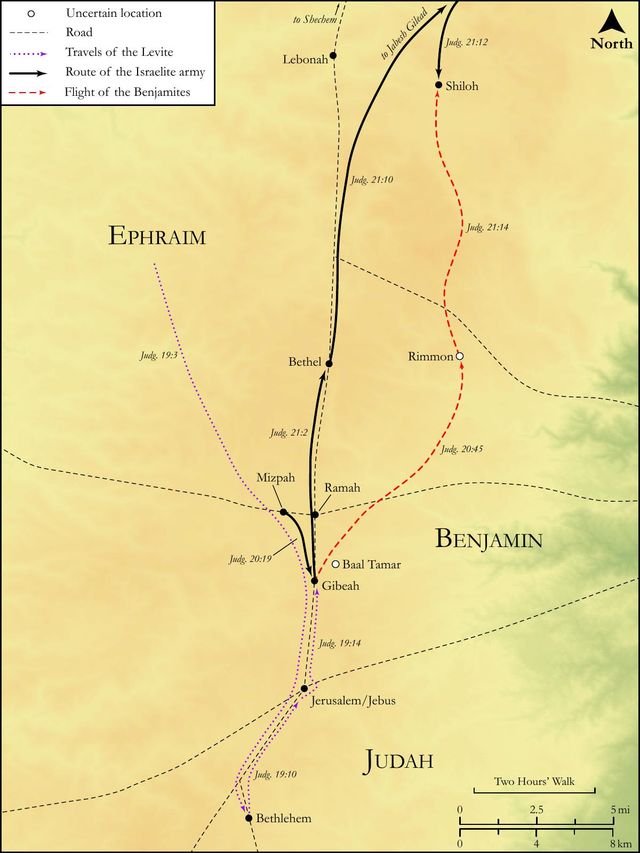
(1.)Observe the method they took. The body of the army faced the city of Gibeah, as they had done before, advancing towards the gates, Jdg 20:30. The Benjamites, the body of whose army was now quartered at Gibeah, sallied out upon them, and charged them with great bravery. The besiegers gave back. retired with precipitation, as if their hearts failed them upon the sight of the Benjamites, which they were willing to believe, proudly imagining that by their former success they had made themselves very formidable. Some loss the Israelites sustained in this counterfeit flight, about thirty men being cut off in their rear, Jdg 20:31, Jdg 20:39. But, when the Benjamites were all drawn out of the city, the ambush seized the city (Jdg 20:37), gave a signal to the body of the army (Jdg 20:38, Jdg 20:40), which immediately turned upon them (Jdg 20:41), and, it should seem, another considerable party that was posted at Baal-tamar came upon them at the same time (Jdg 20:33); so that the Benjamites were quite surrounded, which put them into the greatest consternation that could be. A sense of guilt now disheartened them, and the higher their hopes had been raised the more grievous was this confusion. At first the battle was sore (Jdg 20:34), the Benjamites fought with fury; but, when they saw what a snare they were drawn into, they thought one pair of heels (as we say) was worth two pair of hands, and they made the best of their way towards the wilderness (Jdg 20:42); but in vain: the battle overtook them, and, to complete their distress, those who came out of the cities of Israel, that waited to see the event of the battle, joined with their pursuers, and helped to cut them off. Every man's hand was against them.
(2.)Observe in this story,
[1.]That the Benjamites, in the beginning of the battle, were confident that the day was their own: They are smitten down before us, Jdg 20:32, Jdg 20:39. Sometimes God suffers wicked men to be lifted up in successes and hopes, that their fall may be the sorer. See how short their joy is, and their triumphing but for a moment. Let not him that girdeth on the harness boast, except he has reason to boast in God.
[2.]Evil was near them and they did not know it, Jdg 20:34. But (Jdg 20:41) they saw, when it was too late to prevent it, that evil had come upon them. What evils may at any time be near us we cannot tell, but the less they are feared the heavier they fall. Sinners will not be persuaded to see evil near them, but how dreadful will it be when it comes and there is no escaping! Th1 5:3.
[3.]Though the men of Israel played their parts so well in this engagement, yet the victory is ascribed to God (Jdg 20:35): The Lord smote Benjamin before Israel. The battle was his, and so was the success.
[4.]They trode down the men of Benjamin with ease when God fought against them, Jdg 20:43. It is an easy thing to trample upon those who have made God their enemy. See Mal 4:3.
II.How the victory was prosecuted and improved in a military execution done upon these sinners against their own souls.
1.Gibeah itself, that nest of lewdness, was destroyed in the first place. The ambush that entered the city by surprise drew themselves along, that is, dispersed themselves into the several parts of it, which they might easily do, now that all the men of war had sallied out and very presumptuously left it defenceless; and they smote all they found, even women and children, with the sword (Jdg 20:37), and set fire to the city, Jdg 20:40. Sin brings ruin upon cities.
2.The army in the field was quite routed and cut off: 18,000 men of valour lay dead upon the spot, Jdg 20:44.
3.Those that escaped from the field were pursued, and cut off in their flight, to the number of 7000, Jdg 20:45. It is to no purpose to think of out-running divine vengeance. Evil pursues sinners, and it will overtake them.
4.Even those that tarried at home were involved in the ruin. They let their sword devour for ever, not considering that it would be bitterness in the latter end, as Abner pleads long after, when he was at the head of an army of Benjamites, probably with an eye to this very story, Sa2 2:25, Sa2 2:26. They put to the sword all that breathed, and set fire to all the cities, Jdg 20:48. So that of all the tribe of Benjamin, for aught that appears, there remained none alive but 600 men that took shelter in the rock Rimmon, and lay close there four months, Jdg 20:47. Now,
(1.)It is difficult to justify this severity as it was Israel's act. The whole tribe of Benjamin was culpable; but must they therefore be treated as devoted Canaanites? That it was done in the heat of war, that this was the way of prosecuting victories which the sword of Israel had been accustomed to, that the Israelites were extremely exasperated against the Benjamites for the slaughter they had made among them in the two former engagements, will go but a little way to excuse the cruelty of this execution. It is true they had sworn that whosoever did not come up to Mizpeh should be put to death, Jdg 21:5. But that, if it was a justifiable oath, yet extended only to the men of war; the rest were not expected to come. Yet,
(2.)It is easy to justify the hand of God in it. Benjamin had sinner against him, and God had threatened that, if they forgot him, they should perish as the nations that were before them perished (Deu 8:20), who were all in this manner cut off.
(3.)It is easy likewise to improve it for warning against the beginnings of sin: they are like the letting forth of water, therefore leave it off before it be meddled with, for we know not what will be in the end thereof. The eternal ruin of souls will be worse, and more fearful, than all these desolations of a tribe. This affair of Gibeah is twice spoken of by the prophet Hosea as the beginning of the corruption of Israel and a pattern to all that followed (Hos 9:9): They have deeply corrupted themselves as in the days of Gibeah; and (Hos 10:9), Thou hast sinned from the days of Gibeah; and it is added that the battle in Gibeah against the children of iniquity did not (that is, did not at first) overtake them.
Continue studying Judges 20:38 across the web’s major study libraries — every link below opens this exact verse, chapter, or book on the destination site.
Read & Compare
 BibleGatewayThis verse in more than 200 translations and 70 languages.
 Bible.comThe YouVersion reader — hundreds of translations, reading plans, and highlights.
 ESV.orgCrossway's official English Standard Version reader.
 NET BibleThe NET translation with 60,000+ translators' notes on every rendering decision.
 STEP BibleTyndale House's free study tool — original text, vocabulary, and scholarly resources.
 BibliaLogos Bible Software's free web reader.
 USCCBThe New American Bible (Revised Edition) with the U.S. bishops' study notes.
Commentaries
 BibleHub CommentariesDozens of classic commentaries on this verse, gathered on one page.
 StudyLightMore than 100 commentary sets — the largest collection on the web.
 BibleRefPlain-English commentary on what this verse means, verse by verse.
 Enduring WordDavid Guzik's free commentary on this chapter, widely used by Bible teachers.
 Bible Study ToolsVerse commentary alongside Greek and Hebrew study aids.
Original Language & Research
- BibleHub InterlinearThe verse word by word — original language, transliteration, and English.
- BibleHub LexiconEvery word's original-language definition and Strong's entry.
 Blue Letter BibleDeep-study tools — Strong's numbers, concordance, and word studies.
 SefariaThe Hebrew text with Rashi and centuries of Jewish commentary.
Sermons, Hymns & Audio


TrulyRandomVerse is not affiliated with these sites and doesn’t control their content. They’re linked because they’re genuinely useful.
Summary
Judges 20:38 unveils a pivotal tactical detail in the third and ultimately decisive battle between the tribes of Israel and Benjamin: a pre-arranged signal involving a large, unmistakable flame with smoke. This signal, critical for the coordinated assault, was to be made by the Israelite ambushers concealed within the city of Gibeah, indicating that their strategic position was secured and the Benjamites had been successfully drawn out. This verse underscores the meticulous planning and divine guidance that characterized Israel's final, successful engagement after two devastating defeats, highlighting the profound importance of precise coordination and God's sovereign hand in bringing about justice amidst civil strife.
Context
ShowHideLiterary Context
Judges 20:38 is intricately woven into one of the most harrowing and morally complex narratives in the book of Judges, detailing a devastating civil war (Judges 19-21) that pushed the tribe of Benjamin to the brink of annihilation. The preceding chapters meticulously recount the horrific crime committed by Benjamites in Gibeah against a Levite's concubine, an act of depravity that served as the catalyst for this internecine conflict. Despite the righteous indignation of the other Israelite tribes and their initial attempts to exact justice, they suffered two crushing defeats, losing tens of thousands of men (as vividly described in Judges 20:21-25). Humbled by these catastrophic losses, the Israelites finally prostrated themselves before the Lord, weeping and seeking specific divine guidance for the third engagement (a turning point elaborated in Judges 20:26-28). This verse, therefore, details a crucial, divinely sanctioned element of the sophisticated strategy for this third battle, a cunning ambush designed to overcome the Benjamites' initial military superiority and bring about God's long-delayed justice.
Historical & Cultural Context
The era of the Judges, as depicted in the biblical narrative, was a tumultuous period characterized by a recurring cycle of apostasy, divine judgment through oppression, repentance, and subsequent deliverance, often punctuated by severe internal strife and pervasive moral decay. This particular narrative starkly illustrates the profound moral decline within Israel, where, as the book's concluding verse laments, "everyone did what was right in his own eyes" (Judges 21:25). Militarily, ambushes were a widely recognized and highly effective tactic in ancient warfare, frequently employed against numerically superior forces or those entrenched in fortified positions. The use of smoke and fire as signals was also a common and practical method of long-distance communication, offering clear visibility both by day (smoke) and by night (flame). The tribal confederation of Israel meant that inter-tribal conflict, while devastating in its consequences, was still considered an internal matter, albeit one with profound theological and national implications, particularly when issues of justice, covenant fidelity, and the very identity of Israel as God's people were at stake.
Key Themes
ShowHideThough a detail of military strategy, Judges 20:38 significantly contributes to several overarching themes prominent in Judges 20 and the broader book. Firstly, it powerfully highlights the theme of Divine Guidance and Strategy. After two devastating failures rooted in self-reliance, Israel's ultimate success came only when they humbled themselves, sought, and meticulously followed God's specific instructions. This demonstrates that even human military tactics, or any human endeavor, require divine sanction and wisdom for true and lasting victory, emphasizing that God's ways are higher than human ways (as echoed in Isaiah 55:8-9). Secondly, the entire war, culminating in this battle, underscores the Consequences of Unrighteousness and Moral Decay. The "appointed sign" leads to the destruction of Gibeah, a tragic testament to the devastating impact of unaddressed sin within the community, leading to the near-annihilation of a tribe and immense suffering for all of Israel. Thirdly, the "appointed sign" emphasizes Coordination and Communication as vital elements of any successful endeavor, whether military, spiritual, or communal, illustrating the necessity of precise execution of a divine plan. Finally, it subtly points to God's Sovereignty and Justice, as He orchestrates events, even through the flawed and violent actions of His people, ultimately ensuring that justice is served, albeit at a terrible cost, revealing His unwavering commitment to righteousness, as seen throughout the narrative of Judges.
Exposition and Analysis
ShowHideKey Word Analysis
ShowHideThe Hebrew word מוֹעֵד (môwʻêd', H4150) is rich in meaning, typically referring to an "appointed time," "appointed place," or "appointed meeting," often used in the context of God's set times for festivals or sacred assemblies (e.g., Leviticus 23:2). Here, its usage as an "appointed sign" (or signal) emphasizes that this communication was not spontaneous but a pre-arranged, agreed-upon, and crucial element of the strategic plan. It signifies a precise, pre-determined moment for coordinated action, indicating the meticulous planning and divine precision involved in the ambush, ensuring that all parties understood their roles and timing.
The Hebrew word מַשְׂאֵת (masʼêth', H4864) literally means "a raising" or "a lifting up," and specifically refers to a "rising of flame" or a "beacon." In this context, it denotes a highly visible signal, a column of fire designed to be seen from a distance. The choice of "flame" as part of the signal underscores its prominence, especially for visibility during the night, ensuring that the main Israelite force could clearly discern the moment to launch their decisive assault, thereby preventing any misinterpretation or delay in their coordinated attack.
The Hebrew root אָרַב (ʼârab', H693), from which "liers in wait" is derived, means "to lurk" or "to lie in ambush." This term refers to the specific contingent of Israelite soldiers who were strategically hidden in ambush around Gibeah. Their role was critical: to infiltrate the city, set it ablaze once the Benjamites were drawn out, and provide the signal. This highlights the sophisticated nature of the military strategy, relying on deception and precise timing, and the specific, covert role of this detachment in the overall divine plan.
Verse Breakdown
ShowHide"Now there was an appointed sign between the men of Israel and the liers in wait"
This clause establishes the pre-arranged and mutually understood nature of the communication. It signifies a clear, pre-determined signal agreed upon by both the main Israelite army and the hidden ambush force. This coordination was absolutely essential for the success of the complex military maneuver, ensuring that the two units acted in perfect synchronicity. It speaks to the discipline and meticulous planning that went into this divinely-guided strategy, a stark contrast to the initial, less coordinated and prideful attacks that had led to devastating defeats.
"that they should make a great flame with smoke rise up out of the city"
This specifies the exact nature and origin of the signal. The "great flame with smoke" was to originate from within Gibeah, the city where the ambushers were concealed. This highly visible visual cue would serve as undeniable confirmation that the ambush had been successfully initiated, the city was taken, and the Benjamite defenders had been drawn away from their stronghold. This signal would then trigger the main Israelite army to launch their decisive assault, completing the strategic encirclement. The dual nature of flame and smoke was ingeniously designed to ensure maximum visibility regardless of the time of day or night, preventing any ambiguity.
Literary Devices
ShowHideThe verse employs several literary devices that enhance its impact and meaning within the broader narrative of Judges. Foreshadowing is powerfully present, as the "great flame with smoke" not only functions as a tactical signal but also grimly foreshadows the fiery destruction that will imminently befall Gibeah and, by extension, the judgment upon the Benjamite tribe. This visual of rising smoke and flame is a potent biblical motif, frequently associated with divine judgment, purification, and destruction. There is also a strong element of Symbolism, where the fire and smoke symbolize not merely a military signal, but the consuming nature of unaddressed sin and the purifying, albeit devastating, judgment of God upon it. The meticulous planning described, particularly after Israel's previous, chaotic failures, highlights a significant narrative shift, indicating a return to Divine Providence actively guiding Israel's actions, contrasting sharply with their earlier self-reliance. The Narrative Pacing here is deliberate and suspenseful, building tension towards the climactic third battle, with this precise tactical detail emphasizing the exactitude and divine orchestration required for victory after earlier, more haphazard attempts.
Theological and Thematic Connections
ShowHideJudges 20:38, though a detail of military strategy, profoundly illustrates God's active involvement in human affairs and the indispensable consequences of seeking His guidance. After two humiliating defeats, Israel finally humbled themselves, wept before the Lord, and sought His specific instruction, leading to this intricate and divinely-revealed battle plan. This demonstrates that even in seemingly secular or violent contexts, God's sovereignty prevails, and His wisdom is paramount for success, especially when human efforts have failed. The "appointed sign" underscores the divine orchestration of events, where even small, precise details are part of God's larger purpose to bring about justice for the heinous sin committed in Gibeah. It serves as a powerful reminder that true victory, even in the pursuit of righteousness, is not achieved by human strength or cunning alone, but by humble reliance on God's strategic wisdom and His timing. This pattern of human failure followed by divine intervention and meticulous instruction is a recurring theme throughout biblical history, emphasizing God's patience, His unwavering commitment to justice, and His desire for His people's humble obedience.
Reflection and Application
ShowHideThe detailed strategy in Judges 20:38, born out of Israel's humbling defeats and subsequent earnest seeking of God's wisdom, offers profound and timeless lessons for contemporary life. It serves as a potent reminder that even when we are pursuing a just or righteous cause, our own strength, initial strategies, or self-reliant approaches may prove utterly insufficient. True and lasting success, whether personal or communal, often emerges from a posture of humility, a sincere seeking of divine counsel, and patiently waiting for God's specific, strategic guidance. Just as the "appointed sign" was absolutely crucial for coordinated action in this military context, clear communication, precise execution, and divine timing are vital in our personal and communal endeavors, be it in family life, professional settings, or church ministry. Furthermore, this narrative serves as a somber warning about the devastating, far-reaching consequences of unaddressed sin and pervasive moral decay, not just for individuals but for entire communities. It compels us to reflect on areas where we, or our communities, might be acting independently of God's wisdom, leading to repeated failures, internal strife, or unresolved issues, and encourages a return to seeking His specific, strategic direction for true and lasting resolution, reconciliation, and restoration.
Questions for Reflection
ShowHideFAQ
ShowHideWhy was an "appointed sign" so crucial for Israel's victory in this battle?
ShowHideThe "appointed sign" was crucial because it was the linchpin of a complex, divinely-revealed ambush strategy, given after Israel's previous, self-reliant failures. The main Israelite army needed a clear, unmistakable signal from the "liers in wait" (the ambushers) hidden within Gibeah. This signal, a great flame and smoke, would precisely indicate that the ambushers had successfully infiltrated the city, set it ablaze, and drawn the Benjamite forces out of their stronghold, leaving them vulnerable. Without such a precise, pre-arranged signal, the timing of the main army's assault would have been uncoordinated, potentially leading to another disastrous defeat. It highlights the absolute importance of precise execution when following God's strategic instructions, as seen in other biblical ambushes like the one at Ai in Joshua 8.
What is the significance of the signal being a "great flame with smoke"?
ShowHideThe combination of a "great flame" and "smoke" was chosen for its maximum visibility and clarity, ensuring the signal could be seen regardless of the time of day. A flame would be highly visible at night, while a large column of smoke would be clearly seen during daylight hours. The "great" aspect further emphasized its intended prominence, ensuring it couldn't be mistaken for a small, accidental fire. This dual-purpose, highly prominent signal was essential for communicating across a distance to the main Israelite army, ensuring that the critical moment for their charge was precisely understood and acted upon, preventing any confusion or delay that could jeopardize the entire operation. It underscores the meticulous detail in God's battle plan, leaving no room for ambiguity.
How does this verse, focused on military tactics, relate to God's character or broader theological truths?
ShowHideWhile seemingly a tactical detail, Judges 20:38 profoundly reveals several theological truths about God's character and His interaction with humanity. Firstly, it showcases God's sovereignty and active involvement in human affairs, even in the context of war and judgment. After Israel's repeated failures and their subsequent humbling themselves, God provided a specific, detailed strategy, demonstrating His willingness to guide His people when they seek Him in humility. Secondly, it highlights God's justice; the meticulous plan was orchestrated to bring about righteous judgment upon the Benjamites for their grievous sin, specifically the atrocity committed in Gibeah. Thirdly, it illustrates the principle that true success comes not from human strength, initial presumption, or self-reliance, but from humble obedience to God's specific instructions, even in the smallest details. It underscores that God works through human means, but always according to His divine plan and timing, ultimately bringing His purposes to fruition as demonstrated throughout the narrative of Judges.
Christ-Centered Fulfillment
ShowHideJudges 20:38, with its focus on a divinely appointed sign leading to judgment, the defeat of a rebellious element, and the eventual re-establishment of order within Israel, finds profound Christ-centered fulfillment. The "great flame with smoke" rising from Gibeah symbolizes a judgment that, while devastating, ultimately purifies and sets the stage for restoration within the covenant community. This grim yet necessary act of justice foreshadows the ultimate judgment on sin, which was not executed upon humanity, but upon the Lamb of God, Jesus Christ, who bore the full wrath of God for our transgressions, becoming the "appointed sign" of God's redemptive plan. Just as Israel needed a pre-arranged, clear signal for decisive action, humanity needed a clear, unmistakable sign of God's redemptive plan to overcome the dominion of sin and death. That sign is Christ Himself, whose coming was foretold by prophets (e.g., Isaiah 7:14) and whose life, sacrificial death, and glorious resurrection serve as the ultimate "appointed sign" from God to humanity, signaling the decisive victory over sin, death, and the powers of darkness (Colossians 2:15). The meticulous planning and divine guidance evident in Judges 20 point to the perfect, eternal plan of God for salvation, conceived before the foundation of the world (Ephesians 1:4-5). In Christ, the full consequences of sin are borne, and a new covenant is established, offering not just a temporary restoration of a tribe, but the eternal reconciliation of all who believe to God, fulfilling the deepest longings for peace, justice, and true community that the tragic narrative of Judges so poignantly reveals (Romans 5:10-11).