


Joshua 7:14
- וְנִקְרַבְתֶּםve·nik·rav·Temand you will bring yourselves nearH7126Conj-w ¦ V-Niphal-ConsecPerf-2mpVerb Niphal Consecutive Perfect 2nd Plural Masculineוְandנִקְרַבְתֶּםyou will bring yourselves near
- בַּבֹּקֶרba·Bo·kerin the morningH1242Prep-b ¦ N-msNoun Singular Masculine Absoluteבַּin theבֹּקֶרmorning
- לְשִׁבְטֵיכֶםle·shiv·tei·Khemto your tribesH7626Prep-l ¦ N-mpc ¦ 2mpNoun Plural Masculine Constructלְtoשִׁבְטֵיtribesכֶםyour
- וְהָיָהve·ha·Yahand it will beH1961Conj-w ¦ V-Qal-ConsecPerf-3msVerb Qal Consecutive Perfect 3rd Singular Masculineוְandהָיָהit will be
- הַשֵּׁבֶטha·she·Vetthe tribeH7626Art ¦ N-msNoun Singular Masculine Absoluteהַtheשֵּׁבֶטtribe
- אֲשֶׁר'a·SherwhichH834RelParticle Relative
- יִלְכְּדֶנּוּyil·ke·De·nuhe will take itH3920V-Qal-Imperf-3ms ¦ 3msVerb Qal Imperfect 3rd Singular Masculineיִלְכְּדֶhe will takeנּוּit
- יְהוָהYah·wehYahwehH3068N-properNoun Proper Title
- יִקְרַבyik·Ravit will draw nearH7126V-Qal-Imperf-3msVerb Qal Imperfect 3rd Singular Masculine
- לַמִּשְׁפָּחוֹתla·mish·pa·Chotto the familiesH4940Prep-l ¦ N-fpNoun Plural Feminine Absoluteלַto theמִּשְׁפָּחוֹתfamilies
- וְהַמִּשְׁפָּחָהve·ha·mish·pa·Chahand the familyH4940Conj-w ¦ Art ¦ N-fsNoun Singular Feminine Absoluteוְandהַtheמִּשְׁפָּחָהfamily
- אֲשֶׁר'a·SherwhichH834RelParticle Relative
- יִלְכְּדֶנָּהyil·ke·De·nahhe will take itH3920V-Qal-Imperf-3ms ¦ 3fsVerb Qal Imperfect 3rd Singular Masculineיִלְכְּדֶhe will takeנָּהit
- יְהוָהYah·wehYahwehH3068N-properNoun Proper Title
- תִּקְרַבtik·Ravit will draw nearH7126V-Qal-Imperf-3fsVerb Qal Imperfect 3rd Singular Feminine
- לַבָּתִּיםla·ba·Timto the householdsH1004Prep-l ¦ N-mpNoun Plural Masculine Absoluteלַto theבָּתִּיםhouseholds
- וְהַבַּיִתve·ha·Ba·yitand the householdH1004Conj-w ¦ Art ¦ N-msNoun Singular Masculine Absoluteוְandהַtheבַּיִתhousehold
- אֲשֶׁר'a·SherwhichH834RelParticle Relative
- יִלְכְּדֶנּוּyil·ke·De·nuhe will take itH3920V-Qal-Imperf-3ms ¦ 3msVerb Qal Imperfect 3rd Singular Masculineיִלְכְּדֶhe will takeנּוּit
- יְהוָהYah·wehYahwehH3068N-properNoun Proper Title
- יִקְרַבyik·Ravit will draw nearH7126V-Qal-Imperf-3msVerb Qal Imperfect 3rd Singular Masculine
- לַגְּבָרִיםla·ge·va·Rimto the menH1397Prep-l ¦ N-mpNoun Plural Masculine Absoluteלַto theגְּבָרִיםmen
English is a literal word-by-word gloss of the Hebrew, not the KJV's wording. Why?
This is the original text the KJV's translators worked from — each Hebrew word with its own literal English meaning in this verse, prepared by scholars at Tyndale House, Cambridge. The KJV translates whole sentences, not word by word, so its wording differs: one Hebrew word can become several English words, and the KJV may choose “the LORD” where the gloss reads “Yahweh”. Both are faithful — they answer different questions. For the KJV's own rendering, switch to the KJV text.
Details
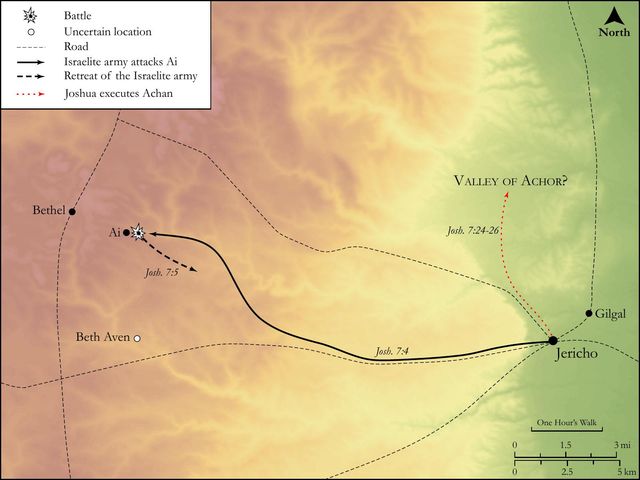
See on the biblical-era map
Study this verse
Public-domain commentary
Matthew Henry
From his Commentary on the Whole Bible. Henry comments on passages, not single verses — this entry covers Joshua 7:10–15. His three-level outline is real structure in the source text, so it is rendered as structure.
We have here God's answer to Joshua's address, which, we may suppose, came from the oracle over the ark, before which Joshua had prostrated himself, v. 6. Those that desire to know the will of God must attend with their desires upon the lively oracles, and wait at wisdom's gates for wisdom's dictates, Pro 8:34. And let those that find themselves under the tokens of God's displeasure never complain of him, but complain to him, and they shall receive an answer of peace. The answer came immediately, while he was yet speaking (Isa 65:24), as that to Daniel, Dan 9:20, etc.
I.God encourages Joshua against his present despondencies, and the black and melancholy apprehensions he had of the present posture of Israel's affairs (Jos 7:10): "Get thee up, suffer not thy spirits to droop and sink thus; wherefore liest thou thus upon thy face?" No doubt Joshua did well to humble himself before God, and mourn as he did, under the tokens of his displeasure; but now God told him it was enough, he would not have him continue any longer in that melancholy posture, for God delights not in the grief of penitents when they afflict their souls further than as it qualifies them for pardon and peace; the days even of that mourning must be ended. Arise, shake thyself from the dust, Isa 53:2. Joshua continued his mourning till eventide (Jos 7:6), so late that they could do nothing that night towards the discovery of the criminal, but were forced to put it off till next morning. Daniel (Dan 9:21), and Ezra (Ezr 9:5, Ezr 9:6), continued their mourning only till the time of the evening sacrifice; that revived them both: but Joshua went past that time, and therefore is thus roused: "Get thee up, do not lie all night there." Yet we find that Moses fell down before the Lord forty days and forty nights, to make intercession for Israel, Deu 9:18. Joshua must get up because he has other work to do than to lie there; the accursed thing must be discovered and cast out, and the sooner the better; Joshua is the man that must do it, and therefore it is time for him to lay aside his mourning weeds, and put on his judge's robes, and clothe himself with zeal as a cloak. Weeping must not hinder sowing, nor one duty of religion jostle out another. Every thing is beautiful in its season. Shechaniah perhaps had an eye to this in what he said to Ezra upon a like occasion. See Ezr 10:2-4.
II.He informs him of the true and only cause of this disaster, and shows him wherefore he contended with them (Jos 7:11):
Israel hath sinned. "Think not that God's mind is changed, his arm shortened, or his promise about to fail; no, it is sin, it is sin, that great mischief-maker, that has stopped the current of divine favours and has made this breach upon you." The sinner is not named, though the sin is described, but it is spoken of as the act of Israel in general, till they have fastened it upon the particular person, and their godly sorrow have so wrought a clearing of themselves, as theirs did, Co2 7:11. Observe how the sin is here made to appear exceedingly sinful.
1.They have transgressed my covenant, an express precept with a penalty annexed to it. It was agreed that God should have all the spoil of Jericho, and they should have the spoil of the rest of the cities of Canaan; but, in robbing God of his part, they transgressed this covenant.
2.They have even taken of the devoted thing, in contempt of the curse which was so solemnly denounced against him that should dare to break in upon God's property, as if that curse had nothing in it formidable.
3.They have also stolen; they did it clandestinely, as if they could conceal it from the divine omniscience, and they were ready to say, The Lord shall not see, or will not miss so small a matter out of so great a spoil. Thus thou thoughtest I was altogether such a one as thyself.
4.They have dissembled also. Probably, when the action was over, Joshua called all the tribes, and asked them whether they had faithfully disposed of the spoil according to the divine command, and charged them, if they knew of any transgression, that they should discover it, but Achan joined with the rest in a general protestation of innocency, and kept his countenance, like the adulterous woman that eats and wipes her mouth, and says, I have done no wickedness. Nay,
5.They have put the accursed thing among their own goods, as if they had as good a title to that as to any thing they have, never expecting to be called to an account, nor designing to make restitution. All this Joshua, though a wise and vigilant ruler, knew nothing of, till God told him, who knows all the secret wickedness that is in the world, which men know nothing of God could at this time have told him who the person was that had done this thing, but he does not,
(1.)To exercise the zeal of Joshua and Israel, in searching out the criminal.
(2.)To give the sinner himself space to repent and make confession. Joshua no doubt proclaimed it immediately throughout the camp that there was such a transgression committed, upon which, if Achan had surrendered himself, and penitently owned his guilt, and prevented the scrutiny, who knows but he might have had the benefit of that law which accepted of a trespass-offering, with restitution, from those that had sinned through ignorance in the holy things of the law? Lev 5:15, Lev 5:16. But Achan never discovering himself till the lot discovered him evidenced the hardness of his heart, and therefore he found no mercy.
III.He awakens him to enquire further into it, by telling him,
1.That this was the only ground for the controversy God had with them, this, and nothing else; so that when this accursed thing was put away he needed not fear, all would be well, the stream of their successes, when this one obstruction was removed, would run as strong as ever.
2.That if this accursed thing were not destroyed they could not expect the return of God's gracious presence; in plain terms, neither will I be with you any more as I have been, except you destroy the accursed, that is, the accursed person, who is made so by the accursed thing. That which is accursed will be destroyed; and those whom God has entrusted to bear the sword bear it in vain if they make it not a terror to that wickedness which brings these judgments of God on a land. By personal repentance and reformation, we destroy the accursed thing in our own hearts, and, unless we do this, we must never expect the favour of the blessed God. Let all men know that it is nothing but sin that separates between them and God, and, if it be not sincerely repented of and forsaken, it will separate eternally.
IV.He directs him in what method to make this enquiry and prosecution.
1.He must sanctify the people, now over-night, that is, as it is explained, he must command them to sanctify themselves, Jos 7:13. And what can either magistrates or ministers do more towards sanctification? They must put themselves into a suitable frame to appear before God and submit to the divine scrutiny, must examine themselves, now that God was coming to examine them, must prepare to meet their God. They were called to sanctify themselves when they were to receive the divine law (Ex. 19), and now also when they were to come under the divine judgment; for in both God is to be attended with the utmost reverence. "There is an accursed thing in the midst of you, and therefore sanctify yourselves," that is, Let all that are innocent be able to clear themselves, and be the more careful to cleanse themselves. The sin of others may be improved by us as furtherances of our sanctification, as the scandal of the incestuous Corinthian occasioned a blessed reformation in that church, Co2 7:11.
2.He must bring them all under the scrutiny of the lot (Jos 7:14); the tribe which the guilty person was of should first be discovered by lot, then the family, then the household, and last of all the person. The conviction came upon him thus gradually that he might have some space given him to come in and surrender himself; for God is not willing that any should perish, but that all should come to repentance. Observe, The Lord is said to take the tribe, and family, and household, on which the lot fell, because the disposal of the lot is of the Lord, and, however casual it seems, is under the direction of infinite wisdom and justice; and to show that when the sin of sinners finds them out God is to be acknowledged in it; it is he that seizes them, and the arrests are in his name. God hath found out the iniquity of thy servants, Gen 44:16. It is also intimated with what a certain and unerring judgment the righteous God does and will distinguish between the innocent and the guilty, so that though for a time they seem involved in the same condemnation, as the whole tribe did when it was first taken by the lot, yet he who has his fan in his hand will effectually provide for the taking out of the precious from the vile; so that though the righteous be of the same tribe, and family, and household, with the wicked, yet they shall never be treated as the wicked, Gen 18:25.
3.When the criminal was found out he must be put to death without mercy (Heb 10:28), and with all the expressions of a holy detestation, Jos 7:15. He and all that he has must be burnt with fire, that there might be no remainders of the accursed thing among them; and the reason given for this severe sentence is because the criminal has,
(1.)Given a great affront to God: He has transgressed the covenant of the Lord, who is jealous particularly for the honour of the holy covenant.
(2.)He has done a great injury to the church of God: He has wrought folly in Israel, has shamed that nation which is looked upon by all its neighbours to be a wise and understanding people, has infected that nation which is sanctified to God, and troubled that nation of which he is the protector. These being crimes so heinous in their nature, and of such pernicious consequence and example, the execution, which otherwise would have come under the imputation of cruelty, is to be applauded as a piece of necessary justice. It was sacrilege; it was invading God's rights, alienating his property, and converting to a private use that which was devoted to his glory and appropriated to the service of his sanctuary - this was the crime to be thus severely punished, for warning to all people in all ages to take heed how they rob God.
Continue studying Joshua 7:14 across the web’s major study libraries — every link below opens this exact verse, chapter, or book on the destination site.
Read & Compare
 BibleGatewayThis verse in more than 200 translations and 70 languages.
 Bible.comThe YouVersion reader — hundreds of translations, reading plans, and highlights.
 ESV.orgCrossway's official English Standard Version reader.
 NET BibleThe NET translation with 60,000+ translators' notes on every rendering decision.
 STEP BibleTyndale House's free study tool — original text, vocabulary, and scholarly resources.
 BibliaLogos Bible Software's free web reader.
 USCCBThe New American Bible (Revised Edition) with the U.S. bishops' study notes.
Commentaries
 BibleHub CommentariesDozens of classic commentaries on this verse, gathered on one page.
 StudyLightMore than 100 commentary sets — the largest collection on the web.
 BibleRefPlain-English commentary on what this verse means, verse by verse.
 Enduring WordDavid Guzik's free commentary on this chapter, widely used by Bible teachers.
 Bible Study ToolsVerse commentary alongside Greek and Hebrew study aids.
Original Language & Research
- BibleHub InterlinearThe verse word by word — original language, transliteration, and English.
- BibleHub LexiconEvery word's original-language definition and Strong's entry.
 Blue Letter BibleDeep-study tools — Strong's numbers, concordance, and word studies.
 SefariaThe Hebrew text with Rashi and centuries of Jewish commentary.
Sermons, Hymns & Audio


TrulyRandomVerse is not affiliated with these sites and doesn’t control their content. They’re linked because they’re genuinely useful.
Summary
Joshua 7:14 meticulously outlines the divine protocol given to Joshua for identifying the individual responsible for Israel's devastating defeat at Ai. Following the miraculous capture of Jericho, a single act of disobedience by one Israelite brought divine judgment upon the entire community, leading to a humiliating loss against a smaller foe. This verse details the systematic, God-ordained process of elimination, moving from the broadest communal unit—the tribes—down to the specific individual, thereby revealing the hidden sin that had provoked God's wrath and hindered His presence among His people.
Context
ShowHideLiterary Context
The immediate literary context of Joshua 7:14 is the aftermath of Israel's humiliating defeat at Ai, a stark contrast to their miraculous victory at Jericho. Following the initial report of the defeat in Joshua 7:2-5, Joshua and the elders express profound grief and confusion, questioning God's presence and purpose (Joshua 7:6-9). In response, the Lord reveals that Israel's defeat was not due to a lack of divine power but to a breach of covenant—specifically, the taking of "the accursed thing" (herem) from Jericho, which had been explicitly forbidden (Joshua 7:10-13). Joshua 7:14, therefore, serves as God's direct instruction to Joshua on the precise, step-by-step method for uncovering the hidden sin and identifying the guilty party, setting the stage for Achan's exposure and the subsequent restoration of God's favor. The meticulous nature of the process underscores the gravity of the transgression and the necessity of its complete eradication for the nation's spiritual and military success.
Historical & Cultural Context
Historically and culturally, the narrative of Joshua 7:14 is set within the context of ancient Israel's conquest of Canaan, a period governed by specific covenant laws and a strong emphasis on corporate solidarity. In the Ancient Near East, the concept of a community bearing the consequences of an individual's transgression was not uncommon, but within Israel, this was amplified by their unique covenant relationship with Yahweh. The "accursed thing" (herem) from Jericho was not merely spoils of war but items devoted to God for destruction or His treasury, and to take them was an act of sacrilege, a direct affront to God's holiness and authority. The method described—a systematic selection process from tribe to individual—echoes ancient judicial practices and possibly the use of lots or divine revelation (like the Urim and Thummim, though not explicitly stated here) to uncover hidden truths. However, the repeated phrase "the LORD taketh" emphasizes divine intervention and infallible discernment. The purity of the camp was paramount for God's presence and blessing, making the identification and removal of sin a critical necessity for the entire nation's well-being and success in the conquest.
Key Themes
ShowHideSeveral key themes converge in Joshua 7 and are powerfully underscored in Joshua 7:14. Firstly, it highlights Divine Omniscience and Justice, demonstrating that no sin, however hidden, escapes God's notice and that His justice demands its exposure and reckoning. Secondly, the passage powerfully illustrates the profound concept of Corporate Responsibility or Covenant Solidarity, where the sin of one individual (Achan) directly impacts the entire community, bringing judgment upon the nation (Joshua 7:1 and Joshua 7:11). This principle is foundational to Israel's identity as God's covenant people. Thirdly, it vividly illustrates the Consequences of Disobedience, showing how a single act of transgression can hinder God's blessing and presence, leading to defeat and distress. Finally, the meticulous, step-by-step process of identification—from tribe to individual—reveals God's Thoroughness and Sovereign Control in uncovering hidden matters, ensuring that His will and justice are perfectly executed.
Exposition and Analysis
ShowHideKey Word Analysis
ShowHideThis verb (לָכַד) carries the primary meaning of "to seize," "to capture," or "to apprehend." In this context, it signifies a divine act of selection and identification, emphasizing that the process is not random or based on human guesswork, but rather God's active and infallible hand guiding the revelation of the guilty party. It underscores the certainty of the outcome because the Lord Himself is doing the "taking," a sovereign act of discernment.
The verb (קָרַב) means "to draw near," "to approach," or "to present." Here, it describes the formal, structured presentation of each group (tribes, families, households, individuals) before Joshua, and implicitly before God, for the divine selection process. It denotes an orderly, solemn procedure, highlighting the gravity of the inquiry and the need for the community to submit to God's method of revelation for the purpose of purification.
Verse Breakdown
ShowHide"In the morning therefore ye shall be brought according to your tribes"
This opening clause establishes the setting and the initial scope of the divine inquiry. The phrase "in the morning" often denotes a time for official or judicial proceedings in ancient Israel, emphasizing the solemnity and urgency of the task. The command for "all Israel" (implied from the preceding verses) to be "brought" or presented by their tribal divisions indicates the comprehensive and systematic nature of the search, starting with the broadest communal unit, ensuring no one is overlooked.
"and it shall be, [that] the tribe which the LORD taketh shall come according to the families [thereof]"
This clause describes the first stage of the divine narrowing process. Through a method divinely orchestrated (likely involving lots or direct revelation, as the Lord "taketh" or selects), one specific tribe will be identified as containing the offender. Once identified, that tribe is then commanded to present itself further, broken down by its constituent families, demonstrating the progressive refinement of the search.
"and the family which the LORD shall take shall come by households"
The process continues with increasing precision. Within the already identified tribe, the Lord will again "take" or select a particular family. This selected family is then required to present its members, further subdivided by their individual households. This step highlights the relentless and meticulous nature of God's pursuit of truth, leaving no stone unturned in the uncovering of hidden sin.
"and the household which the LORD shall take shall come man by man"
This final clause brings the divine search to its ultimate conclusion: the identification of the single individual responsible for the transgression. Within the chosen household, the Lord will "take" or pinpoint the specific man, leaving no doubt as to the guilty party. This step-by-step method underscores God's perfect knowledge and His commitment to exposing hidden sin with absolute accuracy, ensuring justice is served and the community is cleansed.
Literary Devices
ShowHideJoshua 7:14 employs several potent Literary Devices to convey its message. The most prominent is Repetition, specifically of the phrase "the LORD taketh" (or "shall take"). This repeated emphasis serves to underscore the divine agency and sovereign control over the entire identification process, ensuring that the revelation of the guilty party is not a matter of chance or human ingenuity but a direct, infallible act of God. Furthermore, the verse utilizes Climax or Gradation, moving systematically from the broadest social unit ("tribes") to progressively narrower ones ("families," "households") until it culminates in the identification of the single "man by man." This dramatic narrowing builds suspense and highlights the meticulousness and infallibility of God's justice. The passage also implicitly uses Corporate Solidarity as a thematic device, where the collective "Israel" bears the consequences of an individual's sin, illustrating the profound interconnectedness within the covenant community and the need for communal holiness.
Theological and Thematic Connections
ShowHideThe theological weight of Joshua 7:14 is immense, revealing core truths about God's character and His relationship with His covenant people. It powerfully demonstrates God's absolute holiness and His demand for purity within His community. Sin, even when committed by one individual and hidden from human sight, defiles the entire corporate body and provokes divine wrath, hindering God's blessing and presence. This passage underscores the principle of corporate responsibility, where the well-being of the whole is intricately linked to the obedience of its parts. God's meticulous process of revelation signifies His unwavering commitment to justice and His omniscience, ensuring that hidden sin will ultimately be brought to light. This divine exposure is not merely punitive but redemptive, aiming to restore the community to a right relationship with Him by removing the impediment of sin and re-establishing the conditions for His blessing.
Reflection and Application
ShowHideJoshua 7:14 offers profound and enduring lessons for believers today, reminding us of the pervasive nature and far-reaching consequences of sin. It calls us to a deep sense of personal accountability, recognizing that our actions, whether public or private, can impact not only ourselves but also the spiritual health and effectiveness of our families, churches, and communities. The meticulousness of God in uncovering Achan's sin should instill in us a healthy reverence for His omniscience; there are no hidden sins from Him, and a life of integrity and transparency is essential for maintaining a vibrant relationship with God. Furthermore, this passage challenges us to consider our corporate responsibility within the body of Christ. Just as Israel needed to purge the sin from their midst to restore God's favor, so too must the church collectively strive for purity, addressing sin through confession, repentance, and restorative discipline where necessary. This pursuit of holiness is not for condemnation but for the flourishing of God's presence and blessing among His people, enabling the church to fulfill its mission unhindered.
Questions for Reflection
ShowHideFAQ
ShowHideWhy did God punish the entire community for the sin of one individual, Achan?
ShowHideThe punishment of the entire community for Achan's sin highlights the profound concept of corporate solidarity within ancient Israel, particularly in their covenant relationship with God. Israel was understood as a single, unified entity in covenant with Yahweh, where the actions of one member could affect the spiritual standing and blessing of the whole. Achan's transgression, by taking "the accursed thing" (Joshua 7:1), was not merely a personal offense but a breach of the national covenant, defiling the entire camp and disrupting God's presence and favor among His people. God's holiness demands that sin be dealt with, and in this context, the entire community bore the consequences until the sin was identified and purged, emphasizing the gravity of covenant faithfulness and the communal nature of their relationship with God.
How exactly did the LORD "take" or identify the guilty tribe, family, household, and individual?
ShowHideWhile the precise method is not explicitly detailed in Joshua 7:14, the phrase "the LORD taketh" strongly implies a divine, supernatural process rather than a human investigation. In ancient Israel, methods for discerning God's will often included the casting of lots (as seen in 1 Samuel 14:41-42) or the use of the Urim and Thummim by the high priest. It's most probable that Joshua employed one of these divinely sanctioned means, guided by God, to systematically narrow down the search. The emphasis is not on the mechanics of the process but on the certainty that God Himself was orchestrating the revelation, ensuring the infallible identification of the transgressor and the restoration of His people's purity.
Christ-Centered Fulfillment
ShowHideJoshua 7:14, while a stark portrayal of sin's consequences and God's justice in the Old Covenant, finds its ultimate fulfillment and profound reorientation in the person and work of Jesus Christ. Achan's individual sin brought corporate condemnation and death upon Israel, highlighting humanity's inherent inability to perfectly uphold God's law and the devastating impact of transgression. However, in Christ, we see the ultimate reversal of this pattern. The Lamb of God willingly "took" upon Himself the sin of the world, bearing the corporate judgment that humanity deserved, so that those who believe might be freed from condemnation (Romans 8:1). Unlike Achan, whose exposure led to death for himself and his family, Jesus's "being taken" (arrested, crucified) leads to life for all who are united with Him. Through His perfect obedience and atoning sacrifice on the cross, Christ has dealt definitively with the "accursed thing" of sin, cleansing His people and restoring fellowship with a holy God. He is the one righteous man whose singular act of obedience brings righteousness to many (Romans 5:19), transforming the principle of corporate solidarity from one of shared condemnation in Adam to one of shared righteousness and life in Him (1 Corinthians 15:22).