


Joshua 4:16
Bible text: King James Version (1769 Blayney text) · Public domain
Bible text: Berean Standard Bible · Public domain
Bible text: American Standard Version (1901) · Public domain
Bible text: World English Bible, Messianic edition · Public domain
Bible text: Geneva Bible (1599) · Public domain
Bible text: Young's Literal Translation · Public domain
- צַוֵּהtza·VehcommandH6680V-Piel-Imp-2msVerb Piel Imperative 2nd Singular Masculine
- אֶת'et<obj.>H853DirObjMParticle Object Indicator
- הַכֹּהֲנִיםha·Ko·ha·Nimthe priestsH3548Art ¦ N-mpNoun Plural Masculine Absoluteהַtheכֹּהֲנִיםpriests
- נֹשְׂאֵיno·se·'Ei[the] bearers ofH5375V-Qal-Prtcpl-mpVerb Qal Participle Plural Masculine Construct
- אֲרוֹן'a·Ron[the] ark ofH727N-mscNoun Singular Masculine Construct
- הָעֵדוּתha·'e·Dutthe testimonyH5715Art ¦ N-fsNoun Singular Feminine Absoluteהָtheעֵדוּתtestimony
- וְיַעֲלוּve·ya·'a·Luso they may come upH5927Conj-w ¦ V-Qal-ConjImperf-3mpVerb Qal Conjunction+Imperfect 3rd Plural Masculineוְsoיַעֲלוּthey may come up
- מִןminfromH4480PrepPreposition
- הַיַּרְדֵּןhai·yar·Denthe JordanH3383Art ¦ N-properNoun Proper LocationהַtheיַּרְדֵּןJordan
English is a literal word-by-word gloss of the Hebrew, not the KJV's wording. Why?
This is the original text the KJV's translators worked from — each Hebrew word with its own literal English meaning in this verse, prepared by scholars at Tyndale House, Cambridge. The KJV translates whole sentences, not word by word, so its wording differs: one Hebrew word can become several English words, and the KJV may choose “the LORD” where the gloss reads “Yahweh”. Both are faithful — they answer different questions. For the KJV's own rendering, switch to the KJV text.
Details
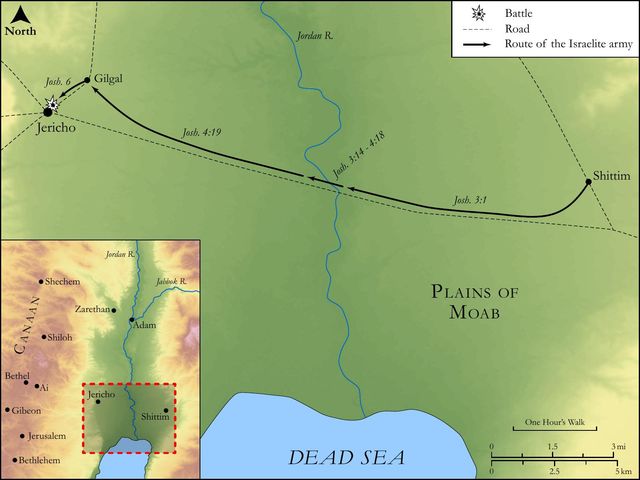
See on the biblical-era map
Study this verse
Public-domain commentary
Matthew Henry
From his Commentary on the Whole Bible. Henry comments on passages, not single verses — this entry covers Joshua 4:10–19.
The inspired historian seems to be so well pleased with his subject here that he is loth to quit it, and is therefore very particular in his narrative, especially in observing how closely Joshua pursued the orders God gave him, and that he did nothing without divine direction, finishing all that the Lord had commanded him (v. 10), which is also said to be what Moses commanded. We read not of any particular commands that Moses gave to Joshua about this matter: the thing was altogether new to him. It must therefore be understood of the general instructions Moses had given him to follow the divine direction, to deliver that to the people which he received of the Lord, and to take all occasions to remind them of their duty to God, as the best return for his favours to them. This which Moses, who was now dead and gone, had said to him, he had in mind at this time, and did accordingly. It is well for us to have the good instructions that have been given us ready to us when we have occasion for them.
I.The people hasted and passed over, v.
10. Some understand this of the twelve men that carried the stones, but it seems rather to be meant of the body of the people; for, though an account was given of their passing over (v. 1), yet here it is repeated for the sake of this circumstance, which was to be added, that they passed over in haste, either because Joshua by their officers ordered them to make haste, for it was to be but one day's work and they must not leave a hoof behind, or perhaps it was their own inclination that hastened them. 1. Some hasted because they were not able to trust God. They were afraid the waters should return upon them, being conscious of guilt, and diffident of the divine power and goodness. 2. Others because they were not willing to tempt God to continue the miracle longer than needs must, nor would they put the patience of the priests that bor the ark too much to the stretch by unnecessary delay. 3. Others because they were eager to be in Canaan, and would thus show how much they longed after that pleasant land. 4. Those that considered least, yet hasted because others did. He that believeth doth not make haste to anticipate God's counsels, but he makes haste to attend them, Isa 28:16.
II.The two tribes and a half led the van, Jos 4:12, Jos 4:13.
So they had promised when they had their lot given them on that side Jordan, Num 32:27. And Joshua had lately reminded them of their promise, Jos 1:12-15. It was fit that those who had the first settlement should be the first in the encounter of difficulties, the rather because they had not the incumbrance of families with them as the other tribes had, and they were all chose men, and fit for service, ready armed. It was a good providence that they had so strong a body to lead them on, and would be an encouragement to the rest. And the two tribes had no reason to complain: the post of danger is the post of honour.
III.When all the people had got clear to the other side, the priests with the ark came up out of Jordan.
This, one would think, should have been done of course; their own reason would tell them that now there was no more occasion for them, and yet they did not stir a step till Joshua ordered them to move, and Joshua did not order them out of Jordan till God directed him to do so, Jos 4:15-17. so observant were they of Joshua, and he of God, which was their praise, as it was their happiness to be under such good direction. How low a condition soever God may at any time bring his priests or people to, let them patiently wait, till by his providence he shall call them up out of it, as the priests here were called to come up out of Jordan, and let them not be weary of waiting, while they have the tokens of God's presence with them, even the ark of the covenant, in the depth of their adversity.
IV.As soon as ever the priests and the ark had come up out of Jordan, the waters of the river, which had stood on a heap, gradually flowed down according to their nature and usual course, and soon filled the channel again, v. 18. This makes it yet more evident that the stop which had now been given to the river was not from any secret natural cause, but purely from the power of God's presence, and for the sake of his Israel; for when Israel's turn was served, and the token of God's presence was removed, immediately the water went forward again; so that if it be asked, What ailed thee, O Jordan! that thou wast driven back? It must be answered, It was purely in obedience to the God of Israel, and in kindness to the Israel of God. There is therefore none like unto the God of Jeshurun; happy also art thou, O Israel! who is like unto thee, O people? Some observe here, by way of allusion, that when the ark, and the priests that bor it, are removed from any place, the flood-gates are drawn up, the defence has departed, and an inundation of judgments is to be expected shortly. Those that are unchurched will soon be undone. The glory has departed if the ark is taken.
V.Notice is taken of the honour put upon Joshua by all this (v.
14): On that day the Lord magnified Joshua, both by the fellowship he admitted him to with himself, speaking to him upon all occasions and being ready to be consulted by him, and by the authority he confirmed him in over both priests and people. Those that honour God he will honour, and when he will magnify a man, as he had said he would magnify Joshua (Jos 3:7), he will do it effectually. Yet it was not for Joshua's sake only that he was thus magnified, but to put him in a capacity of doing so much the more service to Israel, for hereupon they feared him as they feared Moses. Se here what is the best and surest way to command the respect of inferiors, and to gain their reverence and observance, not by blustering and threatening, and carrying it with a high hand, but by holiness and love, and all possible indications of a constant regard to their welfare, and to God's will and honour. Those are feared in the best manner, and to the best purpose, who make it to appear that God is with them, and that they set him before them. Those that are sanctified are truly magnified, and are worthy of double honour. Favourites of heaven should be looked on with awe.
VI.An account is kept of the time of this great event (v.
19): it was on the tenth day of the first month, just forty years since they came out of Egypt, wanting five days. God had said in his wrath that they should wander forty years in the wilderness, but, to make up that forty, we must take in the first year, which was then past, and had been a year of triumph in their deliverance out of Egypt, and this last, which had been a year of triumph likewise on the other side Jordan, so that all the forty were not years of sorrow; and at last he brought them into Canaan five days before the forty years were ended, to show how little pleasure God takes in punishing, how swift he is to show mercy, and that for the elects' sake the days of trouble are shortened, Mat 24:22. God ordered it so that they should enter Canaan four days before the annual solemnity of the passover, and on the very day when the preparation for it was to begin (Exo 12:3), because he would have their entrance into Canaan Graced and sanctified with that religious feast, and would have them then to be reminded of their deliverance out of Egypt, that, comparing them together, God might be glorified as the Alpha and Omega of their bliss.
Continue studying Joshua 4:16 across the web’s major study libraries — every link below opens this exact verse, chapter, or book on the destination site.
Read & Compare
 BibleGatewayThis verse in more than 200 translations and 70 languages.
 Bible.comThe YouVersion reader — hundreds of translations, reading plans, and highlights.
 ESV.orgCrossway's official English Standard Version reader.
 NET BibleThe NET translation with 60,000+ translators' notes on every rendering decision.
 STEP BibleTyndale House's free study tool — original text, vocabulary, and scholarly resources.
 BibliaLogos Bible Software's free web reader.
 USCCBThe New American Bible (Revised Edition) with the U.S. bishops' study notes.
Commentaries
 BibleHub CommentariesDozens of classic commentaries on this verse, gathered on one page.
 StudyLightMore than 100 commentary sets — the largest collection on the web.
 BibleRefPlain-English commentary on what this verse means, verse by verse.
 Enduring WordDavid Guzik's free commentary on this chapter, widely used by Bible teachers.
 Bible Study ToolsVerse commentary alongside Greek and Hebrew study aids.
Original Language & Research
- BibleHub InterlinearThe verse word by word — original language, transliteration, and English.
- BibleHub LexiconEvery word's original-language definition and Strong's entry.
 Blue Letter BibleDeep-study tools — Strong's numbers, concordance, and word studies.
 SefariaThe Hebrew text with Rashi and centuries of Jewish commentary.
Sermons, Hymns & Audio


TrulyRandomVerse is not affiliated with these sites and doesn’t control their content. They’re linked because they’re genuinely useful.
Summary
Joshua 4:16 marks the climactic moment of Israel's miraculous crossing of the Jordan River into the Promised Land. Following the complete passage of the entire nation on miraculously dry ground, this verse records God's final, authoritative command to Joshua, instructing the priests who bore the sacred Ark of the Testimony to ascend from the riverbed. This pivotal act signaled the divinely appointed conclusion of the miracle, immediately preceding the return of the Jordan's waters to their normal course and thereby solidifying the nation's entry into their inheritance, confirming God's unwavering faithfulness and Joshua's divinely appointed leadership.
Context
ShowHideLiterary Context
Joshua 4:16 is strategically positioned within the narrative of Israel's momentous entry into the Promised Land, serving as the capstone to the miraculous Jordan River crossing detailed in chapters 3 and 4. Chapter 3 meticulously describes the preparations, including the consecration of the people and God's command for the priests to step into the Jordan with the Ark of the Covenant, which immediately causes the waters to pile up, allowing the entire nation to cross on dry ground. Chapter 4 then elaborates on the establishment of twelve memorial stones from the riverbed, intended as a perpetual reminder of God's mighty intervention for future generations. Verse 16, therefore, represents the final divine directive for the priests to exit the riverbed, an act that directly precipitates the dramatic return of the waters in Joshua 4:18, thus concluding the miraculous phase of the crossing and setting the stage for Israel's encampment at Gilgal.
Historical & Cultural Context
The crossing of the Jordan River was an event of immense historical and theological significance, marking the definitive end of Israel's forty years of wilderness wandering and the commencement of their conquest of Canaan. Historically, the Jordan River, particularly during the spring harvest season, was known to be at flood stage, presenting a formidable natural barrier. For Israel, crossing such an obstacle on dry ground was an unparalleled demonstration of YHWH's sovereign power, powerfully echoing the miraculous parting of the Red Sea under Moses' leadership. Culturally, the Ark of the Testimony was the preeminent sacred object in Israelite worship, embodying God's tangible presence, His covenant, and His divine law. The priests, consecrated individuals from the tribe of Levi, were the sole authorized bearers of the Ark, underscoring the profound sanctity and divine authority associated with the entire event. This public display of God's power and the Ark's central role would have instilled both profound awe within Israel and paralyzing fear among the inhabitants of Canaan, as explicitly noted in Joshua 5:1.
Key Themes
ShowHideThis verse contributes profoundly to several major theological and narrative themes woven throughout the book of Joshua and the broader Old Testament. It powerfully illustrates Divine Authority and Obedience, as the entirety of the crossing, from the initial step into the river to the final ascent from it, was meticulously orchestrated by God's precise commands delivered through Joshua, thereby emphasizing the paramount importance of immediate and complete obedience to divine instruction. The miraculous piling up and immediate return of the Jordan's waters upon the priests' exit dramatically demonstrates God's Sovereignty Over Creation, affirming Him as the absolute Lord of all nature, capable of manipulating its elements to fulfill His redemptive purposes, much like the earlier parting of the Red Sea. Furthermore, this miracle served as an undeniable Confirmation of Joshua's Leadership, just as God had previously exalted Moses, this event unequivocally confirmed Joshua's divine appointment and authority in the eyes of all Israel (Joshua 3:7). Finally, the central and indispensable role of the Significance of the Ark underscores the profound truth that God Himself, through His tangible presence symbolized by the Ark, was actively leading His people into their promised inheritance.
Exposition and Analysis
ShowHideKey Word Analysis
ShowHideThis verb (H6680) denotes a strong, authoritative directive, typically issued from a superior to an inferior, or, as here, from God to humans via His appointed leader. Its use emphasizes that Joshua is not acting on his own initiative but is relaying a direct, binding divine imperative. The term "command" highlights the absolute necessity of obedience and underscores the divine origin of the instructions given to the priests, signifying an order that must be meticulously followed.
These individuals (H3548) were consecrated members of the tribe of Levi, specifically descendants of Aaron, set apart for sacred service within the tabernacle and later the temple. Their unique role in bearing the Ark of the Testimony underscored their privileged proximity to God's presence and their mediatorial function between God and Israel. Their obedience in this dangerous and unprecedented act was a profound testament to their faith and their unwavering commitment to their sacred duty, demonstrating their trust in God's power.
This term (H727) refers to the Ark of the Covenant, often called the "Ark of the Testimony" because it contained the two tablets of the Law, which were God's "testimony" or "witness" (H5715, ʻêdûwth) to His covenant with Israel. It was the paramount symbol of God's holy presence among His people, His covenant faithfulness, and His divine law. Its central position, leading the way into the Jordan and then being commanded to exit, powerfully signified God's active leadership and the divinely orchestrated conclusion of this miraculous event.
Verse Breakdown
ShowHide"Command the priests"
This initial phrase establishes the clear chain of command: God communicates His will to Joshua, and Joshua, as God's divinely appointed leader, authoritatively relays this divine instruction to the priests. This highlights Joshua's affirmed authority, which was being progressively established and validated through these miraculous events, and simultaneously emphasizes the priests' submission to both God's direct will and His chosen human instrument.
"that bear the ark of the testimony"
This clause precisely identifies the specific group of priests involved and underscores the immense sacred responsibility entrusted to them. The Ark was not merely an object; it was the tangible focal point of God's holy presence and covenant. The fact that those bearing this most sacred item were commanded to move signifies that God Himself was meticulously orchestrating the final, crucial steps of the crossing, ensuring that His presence remained central and paramount throughout the entire miraculous intervention.
"that they come up out of Jordan"
This is the precise, decisive action commanded, marking the definitive completion of the crossing. Their ascent from the riverbed was the pre-arranged signal for the piled-up waters to return to their normal course, as explicitly stated in Joshua 4:18. This final act of obedience was as critically important as their initial step into the river, bringing the miraculous intervention to its divinely appointed conclusion and allowing the natural order to resume, thereby confirming the miracle's divine origin.
Literary Devices
ShowHideThe narrative of Joshua 4:16 is rich with significant literary devices that amplify its theological impact. Divine Command is the overarching device, as the entire miraculous event, from its inception to its conclusion, is driven by God's explicit instructions, emphasizing His absolute sovereignty and Israel's required, immediate obedience. The Symbolism of the Jordan River is profound; it represents a formidable natural barrier between the wilderness and the Promised Land, and its miraculous parting signifies God's omnipotent power to overcome any obstacle for His people. The Ark itself functions as a powerful Symbol of God's tangible presence, His covenant faithfulness, and His active leadership, its leading role underscoring that God Himself is the one bringing Israel into their promised inheritance. The immediate return of the waters upon the priests' exit creates a dramatic and undeniable Cause and Effect relationship, leaving no ambiguity that the miracle was entirely God's doing, directly tied to the obedient actions of His consecrated servants. This entire episode also serves as Typology, foreshadowing greater spiritual realities and divine interventions to come.
Theological and Thematic Connections
ShowHideJoshua 4:16 stands as a powerful testament to God's active, personal involvement in the lives of His covenant people, demonstrating His unwavering faithfulness and sovereign power. The precise command for the priests to exit the Jordan, which immediately results in the dramatic return of the waters, irrefutably solidifies the divine nature of the entire crossing. This momentous event serves as a foundational narrative for Israel, profoundly teaching them about God's absolute ability to overcome seemingly impossible obstacles and His expectation of their complete and immediate obedience. It underscores the vital truth that divine breakthrough often requires not merely an initial, bold step of faith, but also sustained, precise obedience to God's subsequent commands, even after the miraculous has occurred. The Ark's central and indispensable role throughout the crossing reinforces the profound theological truth that God's presence is the ultimate guarantee of success and the sole source of all power and victory for His people.
Reflection and Application
ShowHideJoshua 4:16 offers profound and enduring lessons for the contemporary believer navigating their own journey of faith. Just as the priests were commanded to "come up out of Jordan" after the spectacular miraculous crossing, we are powerfully reminded that our spiritual journey involves not only dramatic breakthroughs and divine interventions but also sustained, humble, and diligent obedience to God's ongoing directives. It is a common human tendency to celebrate a significant spiritual victory or a clear answer to prayer and then, perhaps unconsciously, lapse into complacency. This verse challenges us to prayerfully consider what God's "next command" might be after a season of profound divine intervention. It teaches us that God's purposes for our lives unfold in progressive stages, each requiring our unwavering trust and precise compliance, whether it involves stepping boldly into the unknown or stepping out of a miraculous moment back into what might appear to be the ordinary rhythm of life. Our spiritual focus must remain steadfastly on God's active presence and His continuous leading, fully trusting that His timing and direction are always perfect, guiding us faithfully through every phase of our spiritual pilgrimage.
Questions for Reflection
ShowHideFAQ
ShowHideWhy were the priests specifically commanded to bear the Ark and then to come up out of the Jordan?
ShowHideThe priests were specifically chosen for this sacred duty because they were consecrated to God and uniquely permitted to handle the Ark of the Testimony, which profoundly symbolized God's holy presence among His people. Their central role underscored the entirely divine nature of the event; it was not a natural phenomenon but a miracle meticulously orchestrated by God Himself. Their initial step into the flooded Jordan demonstrated absolute faith and courageous obedience, while their subsequent command to "come up out of Jordan" marked the divinely appointed conclusion of the miracle, signifying God's precise control over every minute aspect of the crossing. Their actions, intrinsically tied to the Ark, made it unequivocally clear that God was personally leading Israel into the Promised Land, confirming His covenant faithfulness.
What is the significance of the phrase "ark of the testimony" in this context?
ShowHideThe "ark of the testimony" (also known as the Ark of the Covenant) was the most sacred object in Israel, containing the two tablets of the Law, which were God's "testimony" or "witness" to His covenant with Israel (Exodus 25:16). In the context of the Jordan crossing, its presence at the forefront symbolized God's active, personal leadership and His covenant faithfulness. It was God Himself, through the Ark, who was supernaturally parting the waters and leading His people into their promised inheritance. The term "testimony" emphasizes that the Ark served as a constant, tangible reminder of God's covenant promises and His unwavering faithfulness to His divine word, which was being powerfully and visibly demonstrated through this unprecedented miracle.
Christ-Centered Fulfillment
ShowHideJoshua 4:16, with its profound emphasis on divine command, the sacred Ark of the Testimony, and the entry into the Promised Land, finds its ultimate and rich Christ-centered fulfillment. The Ark, serving as the preeminent symbol of God's presence and covenant faithfulness, powerfully points to Jesus Christ as the ultimate embodiment of God's presence among humanity, the very Word made flesh who tabernacled among us (John 1:14). Just as the Ark led Israel through the impossible barrier of the Jordan River into their promised inheritance, so Jesus, through His sacrificial death and glorious resurrection, has decisively conquered the ultimate barriers of sin and death, thereby leading His redeemed people into the true "promised land" of eternal life and perfect fellowship with God (Hebrews 2:14-15). His victorious "coming up" from the grave, much like the priests ascending from the Jordan, signals the triumphant completion of His redemptive work and the opening of the way for all who believe to enter into God's spiritual inheritance and newness of life (Romans 6:4). Our continued obedience to Christ's commands, empowered by His indwelling Spirit, is our pathway to experiencing the fullness of God's promises, as He is the true and faithful leader who goes before us into every challenge, every transition, and every spiritual victory (Matthew 28:18-20).