


Job 42:13
Bible text: King James Version (1769 Blayney text) · Public domain
Bible text: Berean Standard Bible · Public domain
Bible text: American Standard Version (1901) · Public domain
Bible text: World English Bible, Messianic edition · Public domain
Bible text: Geneva Bible (1599) · Public domain
Bible text: Young's Literal Translation · Public domain
- וַיְהִיvay·hiand it belongedH1961Conj-w ¦ V-Qal-ConsecImperf-3msVerb Qal Consecutive Imperfect 3rd Singular Masculineוַandיְהִיit belonged
- לוֹloto himPrep-l ¦ 3msSuffix Personal 3rd Singular Masculineלtoוֹhim
- שִׁבְעָנָהshiv·'A·nahsevenH7658N-fsNoun Singular Feminine Absolute
- בָנִיםva·NimsonsH1121N-mpNoun Plural Masculine Absolute
- וְשָׁלוֹשׁve·sha·Lo·oshand threeH7969Conj-w ¦ Adj-csAdjective Numerical Singular common gender Absoluteוְandשָׁלוֹשׁthree
- בָּנוֹתba·NotdaughtersH1323N-fpNoun Plural Feminine Absolute
English is a literal word-by-word gloss of the Hebrew, not the KJV's wording. Why?
This is the original text the KJV's translators worked from — each Hebrew word with its own literal English meaning in this verse, prepared by scholars at Tyndale House, Cambridge. The KJV translates whole sentences, not word by word, so its wording differs: one Hebrew word can become several English words, and the KJV may choose “the LORD” where the gloss reads “Yahweh”. Both are faithful — they answer different questions. For the KJV's own rendering, switch to the KJV text.
Details
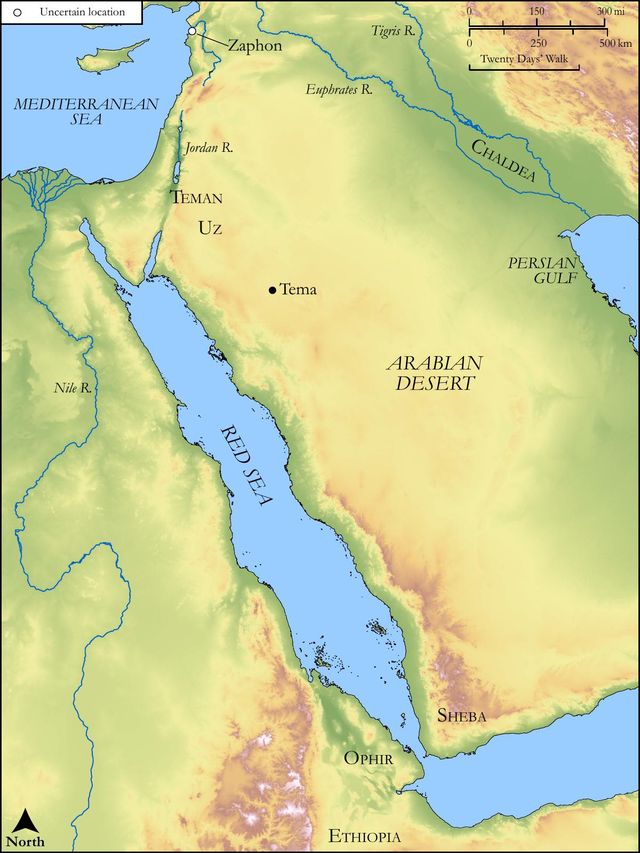
See on the biblical-era map
Study this verse
Public-domain commentary
Matthew Henry
From his Commentary on the Whole Bible. Henry comments on passages, not single verses — this entry covers Job 42:10–17. His three-level outline is real structure in the source text, so it is rendered as structure.
You have heard of the patience of Job (says the apostle, Jam 5:11) and have seen the end of the Lord, that is, what end the Lord, at length, put to his troubles. In the beginning of this book we had Job's patience under his troubles, for an example; here, in the close, for our encouragement to follow that example, we have the happy issue of his troubles and the prosperous condition to which he was restored after them, which confirms us in counting those happy which endure. Perhaps, too, the extraordinary prosperity which Job was crowned with after his afflictions was intended to be to us Christians a type and figure of the glory and happiness of heaven, which the afflictions of this present time are working for us, and in which they will issue at last; this will be more than double to all the delights and satisfactions we now enjoy, as Job's after-prosperity was to his former, though then he was the greatest of all the men of the east. He that rightly endures temptation, when he is tried, shall receive a crown of life (Jam 1:12), as Job, when he was tried, received all the wealth, and honour, and comfort, which here we have an account of.
I.God returned in ways of mercy to him; and his thoughts concerning him were thoughts of good and not of evil, to give the expected (nay, the unexpected) end, Jer 29:11. His troubles began in Satan's malice, which God restrained; his restoration began in God's mercy, which Satan could not oppose. Job's sorest complaint, and indeed the sorrowful accent of all his complaints, on which he laid the greatest emphasis, was that God appeared against him. But now God plainly appeared for him, and watched over him to build and to plant, like as he had (at least in his apprehension) watched over him to pluck up and to throw down, Jer 31:28. This put a new face upon his affairs immediately, and every thing now looked as pleasing and promising as before it had looked gloomy and frightful.
1.God turned his captivity, that is, he redressed his grievances and took away all the causes of his complaints; he loosed him from the bond with which Satan had now, for a great while, bound him, and delivered him out of those cruel hands into which he had delivered him. We may suppose that now all his bodily pains and distempers were healed so suddenly and so thoroughly that the cure was next to miraculous: His flesh became fresher than a child's, and he returned to the days of his youth; and, what was more, he felt a very great alteration in his mind; it was calm and easy, and the tumult was all over, his disquieting thoughts had all vanished, his fears were silenced, and the consolations of God were now as much the delight of his soul as his terrors had been its burden. The tide thus turned, his troubles began to ebb as fast as they had flowed, just then when he was praying for his friends, praying over his sacrifice which he offered for them. Mercy did not return when he was disputing with his friends, no, not though he had right on his side, but when he was praying for them; for God is better served and pleased with our warm devotions than with our warm disputations. When Job completed his repentance by this instance of his forgiving men their trespasses, then God completed his remission by turning his captivity. Note, We are really doing our business when we are praying for our friends, if we pray in a right manner, for in those prayers there is not only faith, but love. Christ has taught us to pray with and for others in teaching us to say, Our Father; and, in seeking mercy for others, we may find mercy ourselves. Our Lord Jesus has his exaltation and dominion there, where he ever lives making intercession. Some, by the turning of Job's captivity, understand the restitution which the Sabeans and Chaldeans made of the cattle which they had taken from him, God wonderfully inclining them to do it; and with these he began the world again. Probably it was so; those spoilers had swallowed down his riches, but they were forced to vomit them up again, Job 20:15. But I rather understand this more generally of the turn now given.
2.God doubled his possessions: Also the Lord gave Job twice as much as he had before. It is probable that he did at first, in some way or other, intimate to him that it was his gracious purpose, by degrees, in due time to bring him to such a height of prosperity that he should have twice as much as ever he had, for the encouraging of his hope and the quickening of his industry, and that it might appear that this wonderful increase was a special token of God's favour. And it may be considered as intended,
(1.)To balance his losses. He suffered for the glory of God, and therefore God made it up to him with advantage, and allowed him more than interest upon interest. God will take care that none shall lose by him.
(2.)To recompense his patience and his confidence in God, which (notwithstanding the workings of corruption) he did not cast away, but still held fast, and that is it which has a great recompence of reward, Heb 10:35. Job's friends had often put their severe censure of Job upon this issue, If thou wert pure and upright, surely now he would awake for thee, Job 8:6. But he does not awake for thee; therefore thou art not upright. "Well," says God, "though your argument be not conclusive, I will even by that demonstrate the integrity of my servant Job; his latter end shall greatly increase, and by that it shall appear, since you will have it so, that it was not for any injustice in his hands that he suffered the loss of all things." Now it appeared that Job had reason to bless God for taking away (as he did, Job 1:21), since it made so good a return.
II.His old acquaintance, neighbours, and relations, were very kind to him, Job 42:11.
They had been estranged from him, and this was not the least of the grievances of his afflicted state; he bitterly complained of their unkindness, Job 19:13, etc. But now they visited him with all possible expressions of affection and respect.
1.They put honour upon him, in coming to dine with him as formerly, but (we may suppose) privately bringing their entertainment along with them, so that he had the reputation of feasting them without the expense.
2.They sympathized with him, and showed a tender concern for him, such as becomes brethren. They bemoaned him when they talked over all the calamities of his afflicted state, and comforted him when they took notice of God's gracious returns to him. They wept for his griefs, and rejoiced in his joys, and proved not such miserable comforters as his three friends, that, at first, were so forward and officious to attend him. These were not such great men nor such learned and eloquent men as those, but they proved much more skilful and kind in comforting Job. God sometimes chooses the foolish and weak things of the world, as for conviction, so for comfort.
3.They made a collection among them for the repair of his losses and the setting of him up again. They did not think it enough to say, Be warmed, Be filled, but gave him such things as would be of use to him, Jam 2:16. Every one gave him a piece of money (some more, it is likely, and some less, according to their ability) and every one an ear-ring of gold (an ornament much used by the children of the east), which would be as good as money to him: this was a superfluity which they could well spare, and the rule is, That our abundance must be a supply to our brethren's necessity. But why did Job's relations now, at length, show this kindness to him?
(1.)God put it in their hearts to do so; and every creature is that to us which he makes it to be. Job had acknowledged God in their estrangement from him, for which he now rewarded him in turning them to him again.
(2.)Perhaps some of them withdrew from him because they thought him a hypocrite, but, now that his integrity was made manifest, they returned to him and to communion with him again. When God was friendly to him they were all willing to be friendly too, Psa 119:74, Psa 119:79. Others of them, it may be, withdrew because he was poor, and sore, and a rueful spectacle, but now that he began to recover they were willing to renew their acquaintance with him. Swallow-friends, that are gone in winter, will return in the spring, though their friendship is of little value.
(3.)Perhaps the rebuke which God had given to Eliphaz and the other two for their unkindness to Job awakened the rest of his friends to return to their duty. Reproofs to others we should thus take as admonitions and instructions to us.
4.Job prayed for his friends, and then they flocked about him, overcome by his kindness, and every one desiring an interest in his prayers. The more we pray for our friends and relations the more comfort we may expect in them.
III.His estate strangely increased, by the blessing of God upon the little that his friends gave him.
He thankfully received their courtesy, and did not think it below him to have his estate repaired by contributions. He did not, on the one hand, urge his friends to raise money for him; he acquits himself from that (Job 6:22), Did I say, Bring unto me or give me a reward of your substance? Yet what they brought he thankfully accepted, and did not upbraid them with their former unkindnesses, nor ask them why they did not do this sooner. He was neither so covetous and griping as to ask their charity, nor so proud and ill-natured as to refuse it when they offered it; and, being in so good a temper, God gave him that which was far better than their money and ear-rings, and that was his blessing, Job 42:12. The Lord comforted him now according to the days wherein he had afflicted him, and blessed his latter end more than his beginning. Observe,
1.The blessing of the Lord makes rich; it is he that gives us power to get wealth and gives success in honest endeavours. Those therefore that would thrive must have an eye to God's blessing, and never to out of it, no, not into the warm sun; and those that have thriven must not sacrifice to their own net, but acknowledge their obligations to God for his blessing.
2.That blessing can make very rich and sometimes makes good people so. Those that become rich by getting think they can easily make themselves very rich by saving; but, as those that have little must depend upon God to make it much, so those that have much must depend upon God to make it more and to double it; else you have sown much and bring in little, Hag 1:6.
3.The last days of a good man sometimes prove his best days, his last works his best works, his last comforts his best comforts; for his path, like that of the morning-light, shines more and more to the perfect day. Of a wicked man it is said, His last state is worse than his first (Luk 11:26), but of the upright man, His end is peace; and sometimes the nearer it is the clearer are the views of it. In respect of outward prosperity God is pleased sometimes to make the latter end of a good man's life more comfortable than the former part of it has been, and strangely to outdo the expectations of his afflicted people, who thought they should never live to see better days, that we may not despair even in the depths of adversity. We know not what good times we may yet be reserved for in our latter end. Non, si male nunc, et olim sic erit - It may yet be well with us, though now it is otherwise. Job, in his affliction, had wished to be as in months past, as rich as he had been before, and quite despaired of that; but God is often better to us than our own fears, nay, than our own wishes, for Job's possessions were doubled to him; the number of his cattle, his sheep and camels, his oxen and she-asses, is just double here to what it was, Job 1:3. This is a remarkable instance of the extent of the divine providence to things that seem minute, as this of the exact number of a man's cattle, as also of the harmony of providence, and the reference of one event to another; for known unto God are all his works, from the beginning to the end. Job's other possessions, no doubt, were increased in proportion to his cattle, lands, money, servants, etc. So that if, before, he was the greatest of all the men of the east, what was he now?
IV.His family was built up again, and he had great comfort in his children, Job 42:13-15.
The last of his afflictions that are recorded (ch. 1), and the most grievous, was the death of all his children at once. His friends upbraided him with it (Job 8:4), but God repaired even that breach in process of time, either by the same wife, or, she being dead, by another.
1.The number of his children was the same as before, seven sons and three daughters. Some give this reason why they were not doubled as his cattle were, because his children that were dead were not lost, but gone before to a better world; and therefore, if he have but the same number of them, they may be reckoned doubled, for he has two fleeces of children (as I may say) mahanaim - two hosts, one in heaven, the other on earth, and in both he is rich.
2.The names of his daughters are here registered (Job 42:14), because, in the significations of them, they seemed designed to perpetuate the remembrance of God's great goodness to him in the surprising change of his condition. He called the first Jemima - The day (whence perhaps Diana had her name), because of the shining forth of his prosperity after a dark night of affliction. The next Kezia, a spice of a very fragrant smell, because (says bishop Patrick) God had healed his ulcers, the smell of which was offensive. The third Keren-happuch (that is Plenty restored, or A horn of paint), because (says he) God had wiped away the tears which fouled his face, Job 16:16. Concerning these daughters we are here told,
(1.)That God adorned them with great beauty, no women so fair as the daughters of Job, Job 42:15. In the Old Testament we often find women praised for their beauty, as Sarah, Rebekah, and many others; but we never find any women in the New Testament whose beauty is in the least taken notice of, no, not the virgin Mary herself, because the beauty of holiness is that which is brought to a much clearer light by the gospel.
(2.)That their father (God enabling him to do it) supplied them with great fortunes: He gave them inheritance among their brethren, and did not turn them off with small portions, as most did. It is probable that they had some extraordinary personal merit, which Job had an eye to in the extraordinary favour he showed them. Perhaps they excelled their brethren in wisdom and piety; and therefore, that they might continue in his family, to be a stay and blessing to it, he made them co-heirs with their brethren.
V.His life was long.
What age he was when his troubles came we are nowhere told, but here we are told he lived 140 years, whence some conjecture that he was 70 when he was in his troubles, and that so his age was doubled, as his other possessions.
1.He lived to have much of the comfort of this life, for he saw his posterity to the fourth generation, Job 42:16. Though his children were not doubled to him, yet in his children's children (and those are the crown of old men) they were more than doubled. As God appointed to Adam another seed instead of that which was slain (Gen 4:25), so he did to Job with advantage. God has ways to repair the losses and balance the griefs of those who are written childless, as Job was when he had buried all his children.
2.He lived till he was satisfied, for he died full of days, satisfied with living in this world, and willing to leave it; not peevishly so, as in the days of his affliction, but piously so, and thus, as Eliphaz had encouraged him to hope, he came to his grave like a shock of corn in his season.
Historical interpretation
Two Centuries of Reception
3 surviving comments on this verse. Each one is dated, so this reads as a timeline rather than a list.
Select a marker to jump to its quote. Markers stagger vertically where authors wrote within a few decades of each other.
“He also had,” the text says, “seven sons and three daughters.” Later he gives them names that seem to be inspired by the circumstances. He calls them “Day, Cinnamon and Amalthea’s horn.”
For the souls of the elect surpass, by the comeliness of their beauty, all the human race that lives after the fashion of men on the earth. The more they humble themselves by outward affliction, the more truly do they array themselves within. Hence this is said by the psalmist to the holy church, which is adorned with the beauty of the elect, “The King has greatly desired your beauty.” And of him it is added a little after, “All the glory of this daughter of kings is from within,” for if [the church] sought glory outside, it would have no beauty within for the king greatly to desire. And although many shine therein with the beauty of virtues and surpass the merits of others by the very perfection of their conduct, yet some, because they are not able to attain to higher things being conscious of their own weakness, are embraced in the bosom of its gentleness. These, as far as they possess strength, avoid sins, although they do not fulfill higher excellencies as far as thy desire. Yet God graciously receives them and admits them to himself in proportion to the recompense they deserve.
36. That he had had seven thousand sheep, and three thousand camels, five hundred yoke of oxen, and five hundred she asses, before the trial of his scourging, the preface of this same history points out to us. Those things which were lost through his scourging, were now restored twofold. But as many children were restored as he had lost. For he had seven sons and three daughters. But he is now described as having received seven sons and three daughters, in order that those who had been destroyed may be shown to be alive. For when it is said; The Lord added all that had been to Job twofold, and yet He restored him as many children as he had lost, He also added to him a double number of children, to whom He afterwards restored ten in the flesh, but reserved the ten that had been lost, in the hidden abode [‘vita’] of souls. But if any one wishes, as an intellectual being, to put aside the chaff of the history, and to feed on the grain of mysteries, it is necessary for him to learn what is our opinion. For it is possible for us to understand that by these animals is designated the universal body of the faithful. For hence is that which is said by the Psalmist to the Father concerning the Son; Thou hast put all things under His feet, sheep and all kine, and, moreover, the herds of the plain. [Ps. 6, 7] Hence is it that the same Prophet, beholding the simple ones inhabiting Holy Church, says; Thine animals shall dwell therein. [Ps. 68, 10]
37. What then do we understand by ‘sheep,’ but the innocent, what by ‘camels,’ but those who surpass the evil doings of others by the involved mass of their exuberant vices; what by ‘yoked oxen,’ but the Israelites subject to the Law; what by ‘asses,’ but the simple minds of the Gentiles? For that the innocent are designated by the name of ‘sheep’ the Psalmist witnesses, who says, But we are His people, and the sheep of His pasture. [Ps. 95, 7] For those who neglect to preserve their innocence, are not fed with that refreshment of the spiritual pasture.
38. But by the name of ‘camel’ is expressed in Holy Scripture sometimes the Lord, sometimes the pride of the Gentiles, tortuous, as it were, with a swelling excrescence from above. For since a camel bends itself of its own accord to take up its burdens, it designates not improperly the grace of our Redeemer, Who, in deigning to hear the burden of our infirmity, descended of His own accord from the height of His power. Whence He says also in the Gospel; I have power to lay down My life, and I have power to take it up again, and no man taketh it from Me. [John 10, 38] Whence He also says again; It is easier for a camel to go through the eye of a needle, than for a rich man to enter into the kingdom of heaven. [Matt. 19, 24] For what does He mean by the name ‘rich,’ but any haughty person, what by the expression ‘camel,’ but His own condescension? For a camel passed through the eye of a needle, when the same our Redeemer entered through the narrow straits of His passion to the suffering of death. And this passion was like a needle, because it wounded His body with pain. But a camel goes more easily through the eye of a needle, than a rich man enters the kingdom of heaven, because, unless He took on Him first the burdens of our infirmity, and showed us the opening [‘foramen’] of humility by His passion, our haughty stubbornness would never bend itself down to His humility. Again, by the name ‘camel’ is designated the Gentile world, tortuous and full of sins; as it is said by Moses, that when the day had already declined, Rebecca sitting on a camel beheld Isaac who had gone forth in the field, and that she immediately descended from the camel, and being ashamed at the sight of him, covered herself with a veil. [Gen. 24, 64. 65.] For whom did Isaac designate, in having gone forth in the field when the day had already declined, but Him, Who, coming in this last age of the world, as if in the close of the day, went forth as it were into the field? Because though He is invisible, yet He showed Himself to be visible in this world. And Rebecca when sitting on a camel beheld him, because the Church, coming forth from the Gentiles, when it was still resting on its sins, and cleaving not to spiritual, but animal emotions, listened to Him. But she immediately descended from the camel, because it abandoned the sins, with which it had before been proudly elated, and was careful to cover itself with a veil, because, on beholding the Lord, it blushed at the infirmity of its own conduct; and she, who was before carried by the camel unconstrained, is afterwards on descending modestly covered. Whence it is said by the voice of the Apostle to this same Church, when converted from her former pride, as if to Rebecca descending from the camel, and throwing over her a veil; For what fruit had ye then in those things whereof ye are now ashamed? [Rom. 6, 21]
39. But in ‘oxen’ is expressed sometimes the madness of the lustful, sometimes the laborious strength of preachers, sometimes the humility of the Israelites. For that by the name of ox is designated by comparison the madness of the lustful, Solomon points out. For when he had first mentioned the wantonness of the seducing woman, he added; Immediately he followeth her, as an ox led for a victim. [Prov. 7, 22] Again, that the labour of preachers is expressed by the name of ox, the words of the Law witness, which says; Thou shall not muzzle the mouth of the ox when treading out the corn. [Deut. 25, 4] As if it plainly said; Thou shalt not keep the preachers of the word from obtaining their stipends. [1 Cor. 9, 9; 1 Tim. 5, 18] Again, that the people of Israel is typified by the name of ox, the Prophet asserts, who says, when announcing the coming of the Redeemer, The ox knoweth his owner, and the ass his master’s crib. [Is. 1, 3] Signifying in truth by the ‘ox’ the people of Israel, brought into subjection to the yoke of the Law, but indicating by the ‘ass’ the people of the Gentiles, given up to pleasures, and more overwhelmingly brutish.
40. Under the name also of he asses and she asses is designated sometimes the wantonness of the lustful, sometimes the gentleness of the simple, but sometimes, as we have before said, the foolishness of the Gentiles. For that the wantonness of the lustful is expressed, by way of comparison, by the term he asses, is plainly declared, when it is said by the Prophet; Whose flesh is as the flesh of asses. [Ez. 23, 20] Again, because the life of the simple is typified by the name of she asses, when our Redeemer was going to Jerusalem, He is said to have sat on a she ass. For Jerusalem means the vision of peace. [Matt. 21, 5] What then does it signify, that our Lord sits on a she ass, and guides it to Jerusalem, except that when He possesses simple minds by ruling over them, He leads them by His own sacred indwelling [‘sessione’] to the vision of peace? Again, that by the name of he asses the foolishness of the Gentiles is designated, the Prophet witnesses, saying; Blessed are ye that sow upon all waters, sending in thither the foot of the ox and the ass. [Is. 32, 20] For to sow upon all waters is to preach to all people the fruitful words of life. But to send in the foot of the ox and the ass, is to bind the ways of the Israelitish and the Gentile people by the bands of heavenly precepts.
41. While preserving then the truth of the letter, we rightly believe that under the name of blessed Job, the people of Holy Church are designated by all these animals; in order that those things that are written, by the dispensation of the Holy Spirit Which wonderfully orders all things, may both relate to us what has happened, and announce what is to come. Let us recognise then in the ‘sheep’ the faithful and innocent people from Judaea, which had been before fed with the pastures of the Law. Let us recognise in the ‘camels’ the simple-minded from the Gentiles coming to the faith, who before, when under sacrilegious rites, through a kind of deformity of limbs, from the foulness, that is, of their vices, appeared very hideous. And because, as we have before said, the Holy Scriptures take good care to repeat their assertions, the Israelites, who were crushed, as it were, by the yoke of the Law, can again he understood by the ‘oxen.’ But, as has been said, by asses, can be understood the Gentile people, who, when they used to bow down to worship stones, foolishly, as it were, bent down their back, and, with no reluctant mind, served any idols whatever with brutish sense. Holy Church therefore which, when oppressed at her first beginnings with innumerable temptations, lost either the people of Israel, or many of the Gentiles, (those, namely, whom she was unable to gain,) receives double at the end; because there springs up in her, out of each people, a multiplied number of believers. By yoked oxen preachers can also be understood. Whence, when the Lord sent them forth to preach, He is described as having sent them two and two; [Luke 10, 1] in order that either because there are two precepts of charity, or that society cannot exist between a less number than two, the holy preachers might learn from the very mode of their sending forth, how much they should love the agreement of fellowship. By she asses, as we have before said, the minds of the simple can be designated. But Holy Church receives oxen and she asses in double number; because holy preachers, who from being oppressed with fear in the time of her temptation had hitherto remained silent, and the minds of the simple, which from being overpowered by terrors were afraid to confess her truth, now exert their voices with greater powers in confession of the truth, the more weakly they were before afraid.
42. We have briefly stated these points as typical of Holy Church. But how they serve to set forth the Head of this same Holy Church, we remind you that we have stated at greater length in the beginning of this work. Whoever therefore is anxious to be more fully satisfied on these points, should deign to read the second book of this work. But if we are now asked to discuss the number of the animals, why a thousand yoke of oxen, or a thousand she asses, and six thousand camels, and fourteen thousand sheep, are mentioned; we can state briefly, that in secular knowledge the number thousand is considered perfect, because it is the solid square of the number ten. For ten times ten are a hundred, which though a square, is a plane figure. But in order that it may rise in height and become solid, the hundred is again multiplied by ten, and becomes a thousand. But the number six is perfect, because it is the first number which is made up of its several parts, that is, its sixth, its third, and its half, which are one, and two, and three, and these added together become six. Nor is any other number found before six, which, when it is divided into its several parts, has its whole amount made up. But because we transcend all this knowledge, by advancing through the loftiness of Holy Scripture, we there find the reason why the numbers six, seven, ten, and a thousand, are perfect. For the number six is perfect in Holy Scripture, because in the beginning of the world God completed on the sixth day those works which He began on the first. The number seven is perfect therein, because every good work is performed with seven virtues through the Spirit, in order that both faith and works may be perfected at the same time. The number ten is perfect therein, because the Law is included in ten precepts, and no fault is forbidden further than by the ten words, and as the Truth relates, the labourers in the vineyard are rewarded with a denarius. [Mat. 20, 2] For in a denary three are joined to seven. But man, who consists of soul and body, consists of seven qualities. For he flourishes in three spiritually and in four bodily. For in the love of God he is excited in three qualities spiritually, when it is said to him by the Law; Thou shalt love the Lord thy God with all thy mind, and with all thy soul, and with all thy strength. [Matt. 22, 37] But he consists of four qualities bodily; because, namely, he is composed of hot and cold, of moist and dry matter. Man therefore who consists of seven qualities is said to be rewarded with a denarius, because in that attainment of the heavenly country our seven are joined to the eternal Three, in order that man may enjoy the contemplation of the Trinity, and, by the reward of his work, live as though made perfect by a denarius. Or certainly, because there are seven virtues in which we toil in this life, and when the contemplation of the Trinity is granted them as a reward, the life of those that toil is rewarded with a denarius. But every one who is perfect receives a denarius even in this life, when he unites to these same seven virtues, faith, hope, and charity. The number thousand is also considered as perfect in Holy Scripture, because universality is designated by its appellation. Whence it is written; The word which He commanded to a thousand generations. [Ps. 105, 8] For since it cannot be believed that the world can be extended to a hundred generations, what else is set forth by a thousand generations but the whole number of generations? Blessed Job therefore received fourteen thousand sheep. For since in Holy Church the perfection of virtues extends to both sexes, the number seven is doubled therein. And six thousand camels; because they receive therein the plenitude of their work, who were before cut off from her by the filthiness of their sins. He received also a thousand yoke of oxen, and a thousand she asses, because she exalts Israelites and Gentiles, learned and simple, after the falls of temptations, to the height of perfection. He received also seven sons and three daughters, because to the minds of those whom she had begotten with seven virtues, she adds faith, hope, charity, to complete their perfection, in order that she may the more truly rejoice in her offspring, the more she considers that there is no virtue wanting to her faithful ones. But because we have run over these points briefly, let us now turn to examine also the names themselves of his daughters.
Continue studying Job 42:13 across the web’s major study libraries — every link below opens this exact verse, chapter, or book on the destination site.
Read & Compare
 BibleGatewayThis verse in more than 200 translations and 70 languages.
 Bible.comThe YouVersion reader — hundreds of translations, reading plans, and highlights.
 ESV.orgCrossway's official English Standard Version reader.
 NET BibleThe NET translation with 60,000+ translators' notes on every rendering decision.
 STEP BibleTyndale House's free study tool — original text, vocabulary, and scholarly resources.
 BibliaLogos Bible Software's free web reader.
 USCCBThe New American Bible (Revised Edition) with the U.S. bishops' study notes.
Commentaries
 BibleHub CommentariesDozens of classic commentaries on this verse, gathered on one page.
 StudyLightMore than 100 commentary sets — the largest collection on the web.
 BibleRefPlain-English commentary on what this verse means, verse by verse.
 Enduring WordDavid Guzik's free commentary on this chapter, widely used by Bible teachers.
 Bible Study ToolsVerse commentary alongside Greek and Hebrew study aids.
Original Language & Research
- BibleHub InterlinearThe verse word by word — original language, transliteration, and English.
- BibleHub LexiconEvery word's original-language definition and Strong's entry.
 Blue Letter BibleDeep-study tools — Strong's numbers, concordance, and word studies.
 SefariaThe Hebrew text with Rashi and centuries of Jewish commentary.
Sermons, Hymns & Audio


TrulyRandomVerse is not affiliated with these sites and doesn’t control their content. They’re linked because they’re genuinely useful.
Summary
Job 42:13 marks a pivotal moment in the epilogue of the Book of Job, detailing the comprehensive restoration of Job's family life after his profound and undeserved suffering. Following his humble repentance and intercession for his friends, the Lord blesses Job with a new family, specifically "seven sons and three daughters," mirroring the exact number of children he possessed before his trials. This verse serves as a powerful testament to divine restoration, emphasizing God's faithfulness and His sovereign capacity to bring about new beginnings and wholeness even after devastating loss, signifying the culmination of Job's vindication and renewed prosperity.
Context
ShowHideLiterary Context
This verse is strategically placed within the triumphant epilogue of the Book of Job, specifically Job 42:7-17. It immediately follows the Lord's direct address to Job, Job's humble and contrite response, and his obedient intercession on behalf of his three friends, Eliphaz, Bildad, and Zophar, whose theological framework the Lord had rebuked. The narrative pivot to restoration occurs in Job 42:10, where "the LORD turned the captivity of Job, and also the LORD gave Job twice as much as he had before." While his material wealth and livestock are explicitly doubled, the restoration of his family is presented differently. This verse, Job 42:13, specifically enumerates his new children, explicitly stating the return to his original family count. This distinction highlights the unique and irreplaceable value of human life compared to material possessions, providing a concrete detail of the Lord's comprehensive blessing and bringing the narrative of Job's personal restoration to a satisfying and complete close.
Historical & Cultural Context
In the days of the patriarchs, a large family, particularly one with many sons, was considered a paramount sign of divine blessing, prosperity, and a secure future. Sons ensured the continuation of the family line, provided for inheritance, and solidified social standing, while daughters, though often married off, contributed to family alliances and were valued for their beauty and domestic skills, as evidenced by the special mention of Job's daughters' beauty and inheritance in Job 42:15. The catastrophic loss of children, as Job experienced in Job 1:18-19, was one of the most devastating calamities imaginable, akin to the complete annihilation of one's legacy and future. Therefore, the restoration of Job's children to the exact original number (seven sons and three daughters, as in Job 1:2) would have been understood by the original audience as the ultimate symbol of God's complete and perfect restoration, a profound reversal of his former desolation, and an undeniable sign of divine favor and vindication.
Key Themes
ShowHideThis verse powerfully encapsulates several overarching themes of the Book of Job. Firstly, it underscores Divine Restoration and Blessing, demonstrating God's capacity not only to restore what was lost but to grant new life and abundant blessing after profound suffering and loss. It is a tangible manifestation of the Lord's faithfulness to those who endure trials with integrity. Secondly, it speaks to Completeness and Wholeness, as the number of children precisely matches his original family, signifying that God's restoration is thorough, perfect, and leaves nothing essential lacking. This aspect of the narrative provides a deep sense of Narrative Resolution and Vindication, affirming that Job's righteousness was ultimately acknowledged and rewarded by God, challenging the simplistic retribution theology espoused by his friends. Finally, the birth of new children symbolizes New Beginnings and Hope, offering Job and his wife a fresh start and a future filled with the promise of joy and continuity, starkly contrasting with the despair of their earlier losses and reinforcing the theme of God's ultimate sovereignty over life and destiny.
Exposition and Analysis
ShowHideKey Word Analysis
ShowHideThis term refers to a male offspring, specifically understood as a "builder of the family name." In ancient Israelite culture, sons were paramount for the continuation of the family line, inheritance, and social standing, embodying the future of the clan. The restoration of sons to Job signifies the rebuilding and securing of his lineage and legacy, a complete reversal of the devastation he experienced.
This numerical term denotes the quantity of sons Job received. In biblical numerology, the number seven frequently symbolizes completeness, perfection, and divine fullness or blessing. The precise restoration of seven sons to Job is not merely a quantitative replacement but a qualitative statement of God's perfect and divinely ordained restoration of Job's patriarchal line, ensuring his legacy and future are fully established.
This term refers to a female offspring, understood as the feminine counterpart to "bên." While not carrying the same weight for lineage continuation as sons, daughters were deeply valued for their beauty, their role in family life, and their potential to form alliances through marriage. The inclusion of daughters in the restoration underscores the holistic nature of God's blessing, completing the family unit and contributing to the overall sense of Job's renewed prosperity and joy.
Verse Breakdown
ShowHide"He had also"
This phrase immediately connects the verse to the preceding narrative of Job's comprehensive restoration, particularly the doubling of his material wealth and the renewal of his relationships with family and friends. The "also" indicates that the blessing of new children is an additional, crucial, and distinct component of the Lord's holistic restoration, signifying a recovery that extends beyond mere possessions to the very core of his family life and legacy.
"seven sons"
This specifies the number of male children Job received. The number seven is highly symbolic in biblical literature, frequently denoting completeness, perfection, or divine fullness. By restoring exactly seven sons, God not only replaces those Job lost but signifies a perfect, divinely ordained restoration of his patriarchal line, ensuring his legacy and future. This precisely mirrors the number of sons Job had at the beginning of the book (Job 1:2), emphasizing a return to a state of ideal blessing and divine favor.
"and three daughters"
This specifies the number of female children Job received. The number three is also symbolically significant in the Bible, often representing divine wholeness, completion, or manifestation. Together with the seven sons, the three daughters complete the original count of ten children, demonstrating God's meticulous and perfect restoration. The subsequent mention of their exceptional beauty and inheritance rights in Job 42:15 further highlights their unique value and the completeness of Job's blessing, underscoring that God's restorative work is comprehensive and leaves nothing essential lacking.
Literary Devices
ShowHideJob 42:13 employs several key literary devices to convey its profound message of restoration and divine favor. Symbolism is prominently featured through the numbers "seven" and "three." "Seven" often represents completeness, perfection, and divine blessing in biblical numerology, while "three" can signify divine wholeness, manifestation, or completion. Their combination here underscores a perfectly restored and divinely blessed family, mirroring the ideal household of the patriarchs. There is also a powerful implicit Parallelism with Job 1:2, where Job's original family of seven sons and three daughters is introduced. This direct numerical correspondence provides a profound sense of Narrative Closure and Resolution, indicating that Job's life has come full circle, and God has fully vindicated and blessed him. The new children themselves serve as a potent Symbol of new life, hope, and God's grace, contrasting sharply with the despair and desolation of Job's earlier losses and marking a definitive new beginning for him and his wife.
Theological and Thematic Connections
ShowHideJob 42:13 stands as a profound theological statement on God's sovereignty, His boundless capacity for restoration, and the nuanced nature of divine blessing. It powerfully challenges the simplistic cause-and-effect theology espoused by Job's friends, demonstrating that suffering is not always a direct consequence of sin, and that God's justice ultimately prevails through vindication and abundant grace. The restoration of Job's family, specifically to the exact original number, underscores that while material possessions can be quantitatively increased, human life is uniquely precious and irreplaceable, signifying a complete and perfect return to wholeness rather than mere multiplication. This divine act of renewal points to God's ultimate control over life and death, blessing and barrenness, and His unwavering faithfulness to those who persevere in faith, even amidst unimaginable trials. It teaches that God's redemptive plan often culminates in restoration that transcends human expectation, offering profound hope that even the most devastating losses can be met with new life and renewed purpose by a sovereign and benevolent God.
Reflection and Application
ShowHideJob 42:13 offers a profound message of hope and encouragement for all who navigate seasons of loss, grief, or seemingly insurmountable challenges. It reminds us that God is ultimately a God of restoration, capable of bringing new life and wholeness even from the ashes of devastation. Job's story teaches us that our present suffering does not define our ultimate destiny, and that faithful endurance, coupled with humble repentance and intercession, can lead to divine vindication and blessing that exceeds our initial state. This verse invites us to trust in God's sovereign plan, even when it is incomprehensible, and to hold onto the promise that He works all things for the good of those who love Him. It encourages us to look beyond immediate circumstances to the unwavering faithfulness of God, who can provide new beginnings, new relationships, and new joys, confirming that His grace is sufficient and His restorative power is limitless, ultimately bringing beauty from ashes.
Questions for Reflection
ShowHideFAQ
ShowHideWhy did God restore Job's children to the original number rather than doubling them, as He did with his livestock and wealth?
ShowHideThe restoration of Job's children to the original number (seven sons and three daughters) rather than doubling them, as was done with his material possessions, carries profound theological and symbolic significance. It underscores the unique and irreplaceable value of human life. While material wealth can be quantitatively increased, children are a qualitative blessing, each life unique and precious, not mere commodities to be multiplied. Instead, God perfectly restores the completeness of Job's family, signifying that his lineage and legacy are fully re-established. This emphasizes that God's restoration is not merely about more, but about wholeness, perfection, and the sacredness of human life. It also highlights the idea of a "new beginning" for Job and his wife, with a new generation of children, rather than the miraculous resurrection of the previous ones. This perfect restoration of his family, matching the original count from Job 1:2, signifies a divine vindication and a return to a state of ideal blessing, demonstrating God's meticulous care for Job's deepest losses.
Christ-Centered Fulfillment
ShowHideJob 42:13, with its narrative of profound suffering followed by complete and perfect restoration, finds its ultimate and most glorious fulfillment in the person and redemptive work of Jesus Christ. Job's experience of losing everything, enduring immense pain, and then being divinely vindicated and blessed, serves as a powerful Old Testament foreshadowing of Christ's journey. Jesus, the ultimate righteous sufferer, endured unimaginable agony, rejection, and death on the cross, becoming the Lamb of God who takes away the sin of the world. Yet, through His resurrection, God the Father vindicated Him, raising Him to glory and bestowing upon Him all authority in heaven and on earth. The restoration of Job's family to "seven sons and three daughters" beautifully prefigures the spiritual family that Christ establishes through His redemptive work. Through faith in Him, believers are born again, becoming children of God and adopted into His eternal family, the Church. This new spiritual lineage is not merely a restoration but an eternal, unbreakable bond, far surpassing any earthly family. Just as Job received new life and a new legacy, so too do believers receive new life in Christ, a spiritual inheritance, and the promise of an eternal home with God, the ultimate and perfect fulfillment of all restoration and blessing.