


Jeremiah 28:8
Bible text: King James Version (1769 Blayney text) · Public domain
Bible text: King James Version with Strong's numbers · Public domain
Bible text: Berean Standard Bible · Public domain
Bible text: American Standard Version (1901) · Public domain
Bible text: World English Bible, Messianic edition · Public domain
Bible text: Geneva Bible (1599) · Public domain
Bible text: Young's Literal Translation · Public domain
- הַנְּבִיאִיםha·ne·vi·'Imthe prophetsH5030Art ¦ N-mpNoun Plural Masculine Absoluteהַtheנְּבִיאִיםprophets
- אֲשֶׁר'a·SherwhoH834RelParticle Relative
- הָיוּha·Yuthey wereH1961V-Qal-Perf-3cpVerb Qal Perfect 3rd Plural common gender
- לְפָנַיle·fa·Nai<to> before meH6440Prep-l ¦ N-mpc ¦ 1csNoun Plural Masculine Constructלְ<to>פָנַbeforeיme
- וּלְפָנֶיךָu·le·fa·Nei·khaand <to> before youH6440Conj-w ¦ Prep-l ¦ N-mpc ¦ 2msNoun Plural Masculine Constructוּandלְ<to>פָנֶיbeforeךָyou
- מִןminfromH4480PrepPreposition
- הָעוֹלָםha·'o·Lam<the> antiquityH5769Art ¦ N-msNoun Singular Masculine Absoluteהָ<the>עוֹלָםantiquity
- וַיִּנָּבְאוּvai·yi·Na·ve·'Uand they prophesiedH5012Conj-w ¦ V-Niphal-ConsecImperf-3mpVerb Niphal Consecutive Imperfect 3rd Plural Masculineוַandיִּנָּבְאוּthey prophesied
- אֶל'elagainstH413PrepPreposition
- אֲרָצוֹת'a·ra·TzotlandsH776N-fpNoun Plural Feminine Absolute
- רַבּוֹתra·bOtmanyH7227Adj-fpAdjective Plural Feminine Absolute
- וְעַלve·'aland onH5921Conj-w ¦ PrepPrepositionוְandעַלon
- מַמְלָכוֹתmam·la·KhotkingdomsH4467N-fpNoun Plural Feminine Absolute
- גְּדֹלוֹתge·do·LotgreatH1419Adj-fpAdjective Plural Feminine Absolute
- לְמִלְחָמָהle·mil·cha·Mahof warH4421Prep-l ¦ N-fsNoun Singular Feminine Absoluteלְofמִלְחָמָהwar
- וּלְרָעָהu·le·ra·'Ahand of calamityH7451Conj-w ¦ Prep-l ¦ N-fsNoun Singular Feminine Absoluteוּandלְofרָעָהcalamity
- וּלְדָבֶרu·le·Da·verand of pestilenceH1698Conj-w ¦ Prep-l ¦ N-msNoun Singular Masculine Absoluteוּandלְofדָבֶרpestilence
English is a literal word-by-word gloss of the Hebrew, not the KJV's wording. Why?
This is the original text the KJV's translators worked from — each Hebrew word with its own literal English meaning in this verse, prepared by scholars at Tyndale House, Cambridge. The KJV translates whole sentences, not word by word, so its wording differs: one Hebrew word can become several English words, and the KJV may choose “the LORD” where the gloss reads “Yahweh”. Both are faithful — they answer different questions. For the KJV's own rendering, switch to the KJV text.
Details
See on the biblical-era map
Study this verse
Public-domain commentary
Matthew Henry
From his Commentary on the Whole Bible. Henry comments on passages, not single verses — this entry covers Jeremiah 28:1–9. His two-level outline is real structure in the source text, so it is rendered as structure.
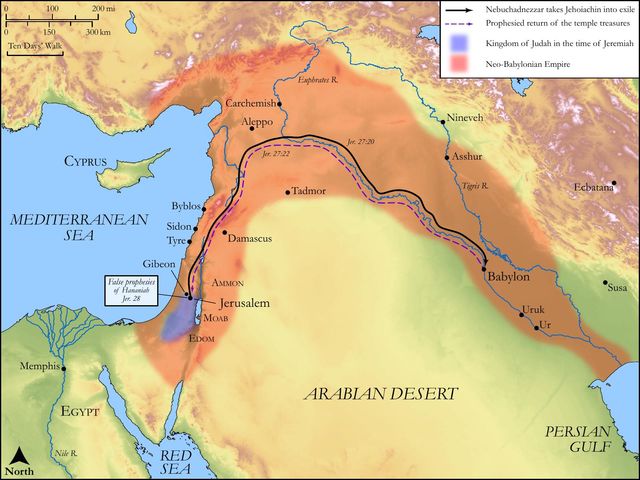
This struggle between a true prophet and a false one is said here to have happened in the beginning of the reign of Zedekiah, and yet in the fourth year, for the first four years of his reign might well be called the beginning, or former part, of it, because during those years he reigned under the dominion of the king of Babylon and as a tributary to him; whereas the rest of his reign, which might well be called the latter part of it, in distinction from that former part, he reigned in rebellion against the king of Babylon. In this fourth year of his reign he went in person to Babylon (as we find, Jer 51:59), and it is probable that this gave the people some hope that his negotiation in person would put a good end to the war, in which hope the false prophets encouraged them, this Hananiah particularly, who was of Gibeon, a priests' city, and therefore probably himself a priest, as well as Jeremiah. Now here we have,
I.The prediction which Hananiah delivered publicly, solemnly, in the house of the Lord, and in the name of the Lord, in an august assembly, in the presence of the priests and of all the people, who probably were expecting to have some message from heaven. In delivering this prophecy, he faced Jeremiah, he spoke it to him (Jer 28:1), designing to confront and contradict him, as much as to say, "Jeremiah, thou liest." Now this prediction is that the king of Babylon's power, at least his power over Judah and Jerusalem, should be speedily broken, that within two full years the vessels of the temple should be brought back, and Jeremiah, and all the captives that were carried away with him, should return; whereas Jeremiah had foretold that the yoke of the king of Babylon should be bound on yet faster, and that the vessels and captives should not return for 70 years, Jer 28:2-4. Now, upon the reading of this sham prophecy, and comparing it with the messages that God sent by the true prophets, we may observe what a vast difference there is between them. Here is nothing of the spirit and life, the majesty of style and sublimity of expression, that appear in the discourses of God's prophets, nothing of that divine flame and flatus. But that which is especially wanting here is an air of piety; he speaks with a great deal of confidence of the return of their prosperity, but here is not a word of good counsel given them to repent, and reform, and return to God, to pray, and seek his face, that they may be prepared for the favours God had in reserve for them. He promises them temporal mercies, in God's name, but makes no mention of those spiritual mercies which God always promised should go along with them, as Jer 24:7, I will give them a heart to know me. By all this it appears that, whatever he pretended, he had only the spirit of the world, not the Spirit of God (Co1 2:12), that he aimed to please, not to profit.
II.Jeremiah's reply to this pretended prophecy.
1.He heartily wishes it might prove true. Such an affection has he for his country, and so truly desirous is he of the welfare of it, that he would be content to lie under the imputation of a false prophet, so that their ruin might be prevented. He said, Amen; the Lord do so; the Lord perform thy words, Jer 28:5, Jer 28:6. This was not the first time that Jeremiah had prayed for his people, though he had prophesied against them, and deprecated the judgments which yet he certainly knew would come; as Christ prayed, Father, if it be possible, let this cup pass from me, when yet he knew it must not pass from him. Though, as a faithful prophet, he foresaw and foretold the destruction of Jerusalem, yet, as a faithful Israelite, he prayed earnestly for the preservation of it, in obedience to that command, Pray for the peace of Jerusalem. Though the will of God's purpose is the rule of prophecy and patience, the will of his precept is the rule of prayer and practice. God himself, though he has determined, does not desire, the death of sinners, but would have all men to be saved. Jeremiah often interceded for his people, Jer 18:20. The false prophets thought to ingratiate themselves with the people by promising them peace; now the prophet shows that he bore them as great a good-will as their prophets did, whom they were so fond of; and, though he had no warrant from God to promise them peace, yet he earnestly desired it and prayed for it. How strangely were those besotted who caressed those who did them the greatest wrong imaginable by flattering them and persecuted him who did them the greatest service imaginable by interceding for them! See Jer 27:18.
2.He appeals to the event, to prove it false, Jer 28:7-9. The false prophets reflected upon Jeremiah, as Ahab upon Micaiah, because he never prophesied good concerning them, but evil. Now he pleads that this had been the purport of the prophecies that other prophets had delivered, so that it ought not to be looked upon as a strange thing, or as rendering his mission doubtful; for prophets of old prophesied against many countries and great kingdoms, so bold were they in delivering the messages which God sent by them, and so far from fearing men, or seeking to please them, as Hananiah did. They made no difficulty, any more than Jeremiah did, of threatening war, famine, and pestilence, and what they said was regarded as coming from God; why then should Jeremiah be run down as a pestilent fellow, and a sower of sedition, when he preached no otherwise than God's prophets had always done before him? Other prophets had foretold destruction did not come, which yet did not disprove their divine mission, as in the case of Jonah; for God is gracious, and ready to turn away his wrath from those that turn away from their sins. But the prophet that prophesied of peace and prosperity, especially as Hananiah did, absolutely and unconditionally, without adding that necessary proviso, that they do not by wilful sin put a bar in their own door and stop the current of God's favours, will be proved a true prophet only by the accomplishment of his prediction; if it come to pass, then it shall be known that the Lord has sent him, but, if not, he will appear to be a cheat and an impostor.
Historical interpretation
Historical reception
2 surviving comments on this verse. Each one is dated, so this reads as a timeline rather than a list.
(Verse 5 onwards) And Jeremiah the prophet said to the prophet Hananiah: Listen, Hananiah: The Lord did not send you, and yet you have made this people trust in a lie. Therefore, thus says the Lord: Behold, I will send (or cast) you away from the face of the earth, you will die this year. And what follows: Because you have spoken against the Lord. And Hananiah the prophet died in that year, in the seventh month, which is not mentioned in the Septuagint. For as much as they have set him forth above: He died in the seventh month. And this Ananias is not spoken of in the Septuagint as a prophet, though the Holy Scripture of the Hebrews calls him a prophet, even though Jeremiah accuses him, saying: Hear, Ananias, the Lord has not sent you, yet thou have prophesied. For how could he call him a prophet, whom he denied to be sent by the Lord? But the truth and order of the history is preserved, as we have said, not according to what it was, but according to what it was thought to be at that time. You deceived, he says, the people with a lie, so that they would not submit to the judgments of God. Therefore, you know that you will die this year. When we die, we are released from the prisons of the body, according to that testimony, which heretics interpret wrongly: Bring my soul out of prison (Ps. 141:8): so how is death now imposed as a punishment on false prophets? But in this place it should be noted that Jeremiah, after suffering injury from a false prophet, and before receiving a direct message from the Lord, remains silent; later, however, sent by the Lord, he boldly accuses the liar and announces his impending death. And that he who usually translates the seventh month is said to rest under this number, perhaps they falsely claim that he died in the seventh month so that he may be freed from the evils of the body, according to what they quote from the writing. Death is rest for a man. But we know that the bodies of believers are temples of God, if indeed the Holy Spirit dwells in them (Sirach 22:11).
(Vers. 7 seqq.) Nevertheless, listen to this word that I speak in your ears and in the ears of all the people: The prophets who were before me and you from the beginning, prophesied about many lands and great kingdoms, about battles, affliction, and famine. The prophet who prophesied peace, when his word comes, the prophet whom the Lord has sent in truth will be known. Jeremiah could have said to Ananiah: You speak falsely, you deceive the people, you are not a prophet but a false prophet. But if he had said so, the false prophet could also have retorted the same against Jeremiah, so he does no wrong. And he is speaking as if to a prophet. Not only, he says, am I a prophet and you, but there were many others before you and me, among whom were Isaiah, Hosea, Joel, and Amos, and the rest. They prophesied, he says, against many lands and not insignificant kingdoms, but great ones, announcing war and adversity to them, and announcing a scarcity of all things. And on the other hand, there were others who promised peace and prosperity. Both opinions, not through flattery or lies, but proven by the outcome of events. Therefore, following the example of others, Ananias speaks of himself, so that when the end of things comes, the truth of the prophets may be revealed. The Lord himself also spoke through Moses (Deut. 23), that the end of prophecy may be shown. And it should be noted that he does not threaten or intimidate, but confidently rebukes the liar with the truth, and postpones it for the future, so that those who hear may await the outcome of events.
Continue studying Jeremiah 28:8 across the web’s major study libraries — every link below opens this exact verse, chapter, or book on the destination site.
Read & Compare
 BibleGatewayThis verse in more than 200 translations and 70 languages.
 Bible.comThe YouVersion reader — hundreds of translations, reading plans, and highlights.
 ESV.orgCrossway's official English Standard Version reader.
 NET BibleThe NET translation with 60,000+ translators' notes on every rendering decision.
 STEP BibleTyndale House's free study tool — original text, vocabulary, and scholarly resources.
 BibliaLogos Bible Software's free web reader.
 USCCBThe New American Bible (Revised Edition) with the U.S. bishops' study notes.
Commentaries
 BibleHub CommentariesDozens of classic commentaries on this verse, gathered on one page.
 StudyLightMore than 100 commentary sets — the largest collection on the web.
 BibleRefPlain-English commentary on what this verse means, verse by verse.
 Enduring WordDavid Guzik's free commentary on this chapter, widely used by Bible teachers.
 Bible Study ToolsVerse commentary alongside Greek and Hebrew study aids.
Original Language & Research
- BibleHub InterlinearThe verse word by word — original language, transliteration, and English.
- BibleHub LexiconEvery word's original-language definition and Strong's entry.
 Blue Letter BibleDeep-study tools — Strong's numbers, concordance, and word studies.
 SefariaThe Hebrew text with Rashi and centuries of Jewish commentary.
Sermons, Hymns & Audio


TrulyRandomVerse is not affiliated with these sites and doesn’t control their content. They’re linked because they’re genuinely useful.
Summary
Jeremiah 28:8 stands as a pivotal declaration in the prophetic confrontation between Jeremiah and Hananiah, where Jeremiah establishes the historical benchmark of authentic prophecy. He asserts that genuine prophets, both those who preceded him and Hananiah throughout antiquity, consistently delivered messages of divine judgment. These pronouncements foretold "war, and of evil (calamity), and of pestilence" against numerous nations and formidable kingdoms. This enduring pattern of prophetic witness, rooted in God's righteous character and sovereign dealings with humanity, starkly contrasts with Hananiah's popular but ultimately deceptive prophecy of immediate peace and restoration, thereby providing a crucial criterion for discerning true divine revelation from false assurances.
Context
ShowHideLiterary Context
Jeremiah 28:8 is strategically placed within a dramatic prophetic confrontation that unfolds in the fourth year of King Zedekiah's reign, around 593 BC. Hananiah, a false prophet, had just delivered a popular message claiming divine authority, prophesying the imminent breaking of Babylon's yoke, the return of the temple vessels, and the release of all exiles within two years, as detailed in Jeremiah 28:2-4. Jeremiah's initial response in Jeremiah 28:5-7 is a cautious "Amen," expressing a desire for peace while simultaneously urging discernment. Verse 8 then becomes Jeremiah's foundational argument, appealing to the consistent and often somber historical pattern of true prophecy. This appeal sets the stage for the definitive test of Hananiah's prophecy in Jeremiah 28:9 and ultimately leads to the divine judgment pronounced upon Hananiah for his deception in Jeremiah 28:15-17.
Historical & Cultural Context
The historical backdrop for Jeremiah 28:8 is Jerusalem during the tumultuous period of the Babylonian exile, specifically following the first major deportation in 597 BC. This event saw King Jehoiachin, along with many of Judah's elite and skilled craftsmen, forcibly removed to Babylon. King Zedekiah, installed as a puppet ruler by Nebuchadnezzar, found himself under immense internal pressure from pro-Egyptian factions and surrounding nations to rebel against Babylonian hegemony. In this highly charged political and religious environment, prophets played a crucial role, often influencing royal policy and public sentiment. There was a pervasive cultural yearning for messages of hope, immediate deliverance from foreign oppression, and national restoration, making Hananiah's optimistic prophecy particularly appealing. Conversely, Jeremiah had consistently preached an unpopular message of submission to Babylon, interpreting it as God's disciplinary judgment. The "war, evil, and pestilence" mentioned in the verse were not abstract concepts but tangible, devastating realities of Judah's day, frequently employed by God as instruments of judgment against rebellious nations, a pattern well-documented throughout Israel's history and the broader biblical narrative.
Key Themes
ShowHideThis verse powerfully articulates several foundational theological and narrative themes. Firstly, it establishes the authenticity and criteria of prophecy, positing that true prophets, throughout history, have predominantly delivered messages of judgment, calling nations to account for their sin and warning of consequences, rather than solely offering uncritical assurances of peace and prosperity. This stands in stark contrast to the deceptive messages of false prophets, exemplified by Hananiah's pronouncements of peace and restoration in Jeremiah 28:2-4. Secondly, the verse underscores divine judgment and sovereignty. God is consistently portrayed as utterly sovereign over all nations and kingdoms, utilizing instruments such as "war, evil (calamity), and pestilence" as means of discipline and judgment for widespread sin and disobedience. This pattern of divine judgment is a recurrent motif throughout the Old Testament, clearly articulated in passages like Ezekiel 14:21, where God speaks of sending "famine, and the evil beast, and the pestilence, and the sword." Finally, the verse highlights the historical precedent of true prophecy, serving as a powerful reminder to both Jeremiah and Hananiah, as well as to the broader audience, that God's consistent character and His established methods of dealing with rebellious nations are revealed through the enduring prophetic tradition.
Exposition and Analysis
ShowHideKey Word Analysis
ShowHideDerived from the root verb H5012 (nâbâʼ), this term (H5030) refers to an individual divinely inspired to speak on behalf of God. A nâbîyʼ is not merely a prognosticator but an authoritative messenger, conveying God's will and truth to humanity, often encompassing both predictive elements and declarative discourse concerning present realities. Jeremiah uses this term to refer to the long line of God's authentic spokespersons who preceded him and Hananiah, whose messages established a consistent pattern.
This is the verbal form (H5012) of "prophet," signifying the act of delivering a divinely inspired message. It means "to speak by inspiration," whether it involves foretelling future events, declaring God's truth, or conveying His commands. Jeremiah emphasizes that the content of the true prophets' inspired speech was consistently focused on warnings of judgment and calamity, reflecting God's righteous dealings with nations.
While this versatile word (H7451) can denote moral wickedness, in the context of divine judgment against nations, it primarily refers to calamity, disaster, misfortune, distress, or adversity. It encompasses the wide-ranging suffering and desolation that befall a people as a consequence of their sin and rebellion, often orchestrated by God as a means of discipline or punishment. Here, it forms part of a formidable triad of severe judgments, indicating widespread suffering and destruction beyond the specific categories of war and disease.
Verse Breakdown
ShowHide"The prophets that have been before me and before thee of old"
This opening clause establishes the profound historical continuity and authoritative precedent upon which Jeremiah bases his argument. He appeals to a long-standing and well-recognized tradition of true prophecy, one that predates both his own ministry and Hananiah's. The phrase "of old" (Hebrew, ʻôwlâm), implying a deep, enduring past, underscores that this pattern of divine communication is not novel or isolated but foundational to God's consistent dealings with nations throughout history.
"prophesied both against many countries, and against great kingdoms,"
This segment precisely delineates the expansive scope and specific targets of these historical prophecies. True prophets were not confined to delivering messages solely to Israel but extended their pronouncements to "many countries" and "great kingdoms," thereby demonstrating God's universal sovereignty and His righteous governance over all human empires. The inclusion of "great kingdoms" emphasizes that even the most powerful and seemingly invincible human entities are ultimately subject to divine scrutiny, accountability, and judgment.
"of war, and of evil, and of pestilence."
This concluding part specifies the consistent and often severe content of these historical prophecies. The triad of "war, and of evil (calamity), and of pestilence" represents the most devastating forms of divine judgment, bringing widespread destruction, suffering, and death. This was the standard, albeit frequently unpopular, message delivered by God's true messengers when nations persisted in rebellion and disobedience, standing in stark contrast to Hananiah's message of unadulterated peace and prosperity.
Literary Devices
ShowHideJeremiah 28:8 employs several potent literary devices to bolster Jeremiah's argument and underscore the gravity of his message. It prominently features Historical Allusion, referencing the long and established line of prophets who preceded both Jeremiah and Hananiah. This appeals to a recognized and authoritative tradition within Israel's collective memory, validating Jeremiah's message by situating it within an undeniable pattern of divine communication. Furthermore, the verse utilizes a powerful Triad or List of Woes ("war, and of evil, and of pestilence"), a common rhetorical device in prophetic literature. This specific grouping of calamities is frequently found elsewhere in the Old Testament (e.g., Ezekiel 14:21), serving to emphasize the comprehensive, devastating, and divinely ordained nature of God's judgments, creating a sense of inevitability and divine consistency. Finally, the verse establishes a clear, implicit Contrast with Hananiah's message of peace, thereby highlighting the fundamental difference between true prophecy (which often includes uncomfortable truths about impending judgment for sin) and false prophecy (which typically caters to popular desires for comfort and immediate restoration without requiring repentance).
Theological and Thematic Connections
ShowHideJeremiah 28:8 profoundly illustrates God's unwavering character as a righteous and just judge who holds all nations accountable for their actions. It reveals that God's consistent method of dealing with pervasive sin and rebellion, even among the most powerful kingdoms, involves a necessary outpouring of judgment, often manifested through geopolitical conflicts and natural calamities. This verse serves as a crucial theological corrective, countering the dangerous notion that God is solely a God of comfort and prosperity. Instead, it reminds us that His infinite love is inextricably intertwined with His perfect justice, and that true, lasting peace can only be realized through repentance and humble alignment with His sovereign will. The historical pattern of prophets speaking of "war, evil, and pestilence" serves as a solemn warning against spiritual presumption and a compelling call to profound spiritual discernment, urging believers to rigorously test all messages against the consistent revelation of God's Word and His historical dealings with humanity.
Reflection and Application
ShowHideIn a contemporary world saturated with an overwhelming deluge of information and conflicting voices, Jeremiah 28:8 stands as a timeless and urgent call to cultivate profound spiritual discernment. It challenges us to critically evaluate all messages—whether emanating from religious leaders, various media platforms, or prevailing popular culture—against the unchanging truth of God's character and the consistent revelation of His inspired Word. Just as the prophets of old courageously delivered uncomfortable truths about sin and its inevitable consequences, true spiritual leadership today often necessitates the delivery of challenging messages that call for repentance, humility, and unwavering submission to God's will, rather than merely offering comforting platitudes or echoing popular sentiments. This verse powerfully reminds us that God remains sovereign over all nations and the unfolding tapestry of history, and His justice is a consistent, enduring theme throughout all time, bringing consequences for sin just as surely as He extends grace and redemption to those who genuinely turn to Him. We are therefore invited to cultivate a deep and discerning understanding of biblical patterns and God's consistent ways, preparing ourselves not only for seasons of blessing and prosperity but also for inevitable periods of difficulty and judgment, recognizing God's sovereign hand even amidst adversity.
Questions for Reflection
ShowHideFAQ
ShowHideWhat is the primary difference between Jeremiah's prophecy and Hananiah's, as highlighted in this verse?
ShowHideJeremiah 28:8 highlights a fundamental difference in the content and historical precedent of their prophecies. Jeremiah argues that true prophets, throughout history, consistently delivered messages of judgment—foretelling "war, and of evil, and of pestilence" against nations and kingdoms. This was often an unpopular message, but it faithfully reflected God's righteous judgment against sin and rebellion. Hananiah, by contrast, prophesied only "peace" and immediate restoration, as seen in Jeremiah 28:2-4. This message was popular and appealing but ultimately false, contradicting the consistent pattern of God's dealings with His people when they were in rebellion.
Why did true prophets often prophesy "evil" (calamity) rather than only good things?
ShowHideTrue prophets, as described in Jeremiah 28:8, often prophesied "evil" (referring to calamity, disaster, or misfortune, not moral evil) because their primary role was to call God's people and other nations back to obedience and covenant faithfulness. When people or nations persisted in sin and rebellion, God, in His perfect justice and holiness, would send warnings of impending judgment. These judgments—such as "war, and of evil, and of pestilence"—were not arbitrary acts but were the just consequences of disobedience, intended to bring about repentance, restoration, or to demonstrate God's righteous rule. The prophets faithfully delivered God's full message, which included both warnings of judgment for disobedience and promises of blessing for obedience, as clearly outlined in the covenant blessings and curses found in Deuteronomy 28. Their messages were a direct reflection of God's holy character and His unwavering commitment to justice.
Christ-Centered Fulfillment
ShowHideWhile Jeremiah 28:8 vividly portrays the Old Testament pattern of prophets foretelling judgment, it ultimately directs our gaze to Christ as the ultimate and true Prophet, whose message encompasses both the dire consequences of sin and the definitive promise of true peace. Jesus, like the faithful prophets of old, did not shy away from declaring uncomfortable truths about human sin and divine judgment, warning of a coming day of reckoning for those who reject Him and His kingdom (Matthew 25:31-46). Yet, His prophetic ministry also brought the definitive solution to the "war, evil, and pestilence" that plague humanity. Through His atoning sacrifice on the cross, Christ took upon Himself the full weight of God's judgment for sin, thereby offering a profound peace that surpasses all human understanding—a peace rooted not in the mere absence of conflict, but in complete reconciliation with God (Romans 5:1). He is the one who ultimately overcomes the world's "tribulation" and brokenness (John 16:33), and in Him, the prophetic warnings of old find their ultimate resolution, and the promises of true, eternal peace are eternally secured. Indeed, He is the very Word made flesh, through whom God has spoken His final and most complete revelation to humanity (John 1:14; Hebrews 1:1-2).