


Isaiah 36:14
Bible text: King James Version (1769 Blayney text) · Public domain
Bible text: Berean Standard Bible · Public domain
Bible text: American Standard Version (1901) · Public domain
Bible text: World English Bible, Messianic edition · Public domain
Bible text: Geneva Bible (1599) · Public domain
Bible text: Young's Literal Translation · Public domain
- כֹּהkohthusH3541AdvAdverb
- אָמַר'a·Marhe saysH559V-Qal-Perf-3msVerb Qal Perfect 3rd Singular Masculine
- הַמֶּלֶךְha·Me·lekhthe kingH4428Art ¦ N-msNoun Singular Masculine Absoluteהַtheמֶּלֶךְking
- אַל'almay notH408NegParticle Negative
- יַשִּׁאya·Shi'he deceiveH5377V-Hiphil-Imperf-3msVerb Hiphil Imperfect 3rd Singular Masculine
- לָכֶםla·Khem<to> youPrep-l ¦ 2mpSuffix Personal 2nd Plural Masculineלָ<to>כֶםyou
- חִזְקִיָּהוּchiz·ki·Ya·huHezekiahH2396N-proper-mNoun Proper Masculine
- כִּיkiforH3588PrtParticle Conditional
- לֹאlo'notH3808NegParticle Negative
- יוּכַלyu·Khalhe will be ableH3201V-Qal-Imperf-3msVerb Qal Imperfect 3rd Singular Masculine
- לְהַצִּילle·ha·Tzilto deliverH5337Prep-l ¦ V-Hiphil-InfVerb Hiphil Infinitive Constructלְtoהַצִּילdeliver
- אֶתְכֶם'et·Khem<obj.> youH853DirObjM ¦ 2mpParticle Object Indicatorאֶתְ<obj.>כֶםyou
English is a literal word-by-word gloss of the Hebrew, not the KJV's wording. Why?
This is the original text the KJV's translators worked from — each Hebrew word with its own literal English meaning in this verse, prepared by scholars at Tyndale House, Cambridge. The KJV translates whole sentences, not word by word, so its wording differs: one Hebrew word can become several English words, and the KJV may choose “the LORD” where the gloss reads “Yahweh”. Both are faithful — they answer different questions. For the KJV's own rendering, switch to the KJV text.
Details
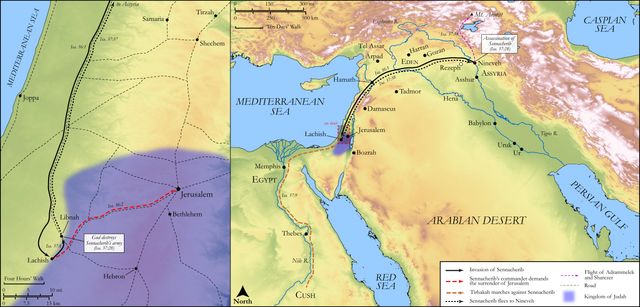
See on the biblical-era map
Study this verse
Public-domain commentary
Matthew Henry
From his Commentary on the Whole Bible. Henry comments on passages, not single verses — this entry covers Isaiah 36:11–22.
We may hence learn these lessons: - 1. That, while princes and counsellors have public matters under debate, it is not fair to appeal to the people. It was a reasonable motion which Hezekiah's plenipotentiaries made, that this parley should be held in a language which the people did not understand (Isa 36:11), because reasons of state are secret things and ought to be kept secret, the vulgar being incompetent judges of them. It is therefore an unfair practice, and not doing as men would be done by, to incense subjects against their rulers by base insinuations. 2. Proud and haughty scorners, the fairer they are spoken to, commonly speak the fouler. Nothing could be said more mildly and respectfully than that which Hezekiah's agents said to Rabshakeh. Besides that the thing itself was just which they desired, they called themselves his servants, they petitioned for it: Speak, we pray thee; but this made him the more spiteful and imperious. To give rough answers to those who give us soft answers is one way of rendering evil for good; and those are wicked indeed, and it is to be feared incurable, with whom that which usually turns away wrath does but make bad worse. 3. When Satan would tempt men from trusting in God, and cleaving to him, he does so by insinuating that in yielding to him they may better their condition; but it is a false suggestion, and grossly absurd, and therefore to be rejected with the utmost abhorrence. When the world and the flesh say to us, "Make an agreement with us and come out to us, submit to our dominion and come into our interests, and you shall eat every one of his own vine," they do but deceive us, promising liberty when they would lead us into the basest captivity and slavery. One might as well take Rabshakeh's word as theirs for kind usage and fair quarter; therefore, when they speak fair, believe them not. Let them say what they will, there is no land like the land of promise, the holy land. 4. Nothing can be more absurd in itself, nor a greater affront to the true and living God, than to compare him with the gods of the heathen; as if he could do no more for the protection of his worshippers than they can for the protection of theirs, and as if the God of Israel could as easily be mastered as the gods of Hamath and Arphad, whereas they are vanity and a lie. They are nothing; he is the great I AM: they are the creatures of men's fancy and the works of men's hands; he is the Creator of all things. 5. Presumptuous sinners are ready to think that, because they have been too hard for their fellow-creatures, they are therefore a match for their Creator. This and the other nation they have subdued, and therefore the Lord himself shall not deliver Jerusalem out of their hand. But, though the potsherds may strive with the potsherds of the earth, let them not strive with the potter. 6. It is sometimes prudent not to answer a fool according to his folly. Hezekiah's command was, "Answer him not; it will but provoke him to rail and blaspheme yet more and more; leave it to God to stop his mouth, for you cannot." They had reason enough on their side, but it would be hard to speak it to such an unreasonable adversary without a mixture of passion; and, if they should fall a railing like him, Rabshakeh would be much too hard for them at that weapon. 7. It becomes the people of God to lay to heart the dishonour done to God by the blasphemies of wicked men, though they do not think it prudent to reply to those blasphemies. Though they answered him not a word, yet they rent their clothes, in a holy zeal for the glory of God's name and a holy indignation at the contempt put upon it. They tore their garments when they heard blasphemy, as taking no pleasure in their own ornaments when God's honour suffered.
Historical interpretation
Historical reception
2 surviving comments on this verse. Each one is dated, so this reads as a timeline rather than a list.
Immediately then, he supplemented this threat with an enticement in order to deceive with counterpromises and temptations those whom he had not conquered with terror, saying on behalf of the king of the Assyrians: “Make peace with me and come to me,” or as we read in the book of Kings: “Do with me what is useful and come to me.” Both have the same meaning. Do, he said, what is to your own advantage and it will accrue to your blessing. In other words: Bless the king of Assyria and praise him, and confess him to be your lord that you might receive a reward. Also, live in your cities and enjoy your crops until I return from Egypt or until I restore captured Libnah. After I come, I will take you to a land much like your own, with grain and wine and oil. But he did not give a name for this land because he could not find an equal to the Promised Land. Yet he promised it nevertheless, for everyone desires to be in the land of his birth. Some think the land that he promised was Media, which has terrain similar in both location and foliage to that of Judea. Then he added: “Where is the god of Hamath and of Arpad and of Sepharvaim? Have they delivered Samaria from my hand?” This shows that Samaria will be subject to them for all of its days and therefore that it should be taken. If, he said, we were easily victorious over the ten tribes who had the protection of so many gods, how much more easily will we conquer you, even lonely Jerusalem, which has the protection of only one God?
(Verse 11 and following) And Eliakim, Sobna, and Joah said to Rabshakeh, 'Speak to your servants in the Aramaic language, for we understand it. Do not speak to us in Judahite in the hearing of the people who are on the wall.' But Rabshakeh said to them, 'Has my master sent me to your master and to you to speak these words? Has he not sent me to the men who sit on the wall, who will eat their own dung and drink their own urine with you?' And Rabsaces stood and cried with a loud voice in the language of Judah and said, Hear the words of the great king, the king of Assyria. Thus says the king: Let not Hezekiah deceive you, for he will not be able to deliver you out of his hand. Neither let Hezekiah make you trust in the Lord, saying, The Lord will surely deliver us, and this city shall not be given into the hand of the king of Assyria. Do not listen to Hezekiah. For the king of Assyria says: The testimony of Rabshakeh is that he relies on the Lord, who has captured all the cities of Judah and said to the people: Do not be afraid and do not be dismayed before the king of Assyria and all the multitude that is with him, for there are more with us than with him. With him is an arm of flesh; with us is the Lord our God, our helper, who fights for us. And the people were strengthened by the words of Hezekiah, king of Judah. But Sennacherib wants to destroy what Hezekiah has built; and he speaks to the people, 'Do not let Hezekiah deceive you, and do not put your trust in the Lord our God.' And as Eliakim, Shebna, and Joah humbly implore, 'Speak to your servants in the Syrian language, for we understand; and do not speak to us in the language of Judah in the hearing of the people who are on the wall,' it means: 'Why is it necessary to stir up the people with false terrors and boast of empty power?' Speak the language that the people do not understand. For if we have knowledge of your language: and we know the Syrian language, which is common to both. To which Rabshakeh replied arrogantly: Did my master send me to your lord and to you, and not rather to the men who sit on the wall? And he increased the threat, saying that they should eat their own feces and drink the urine of their own feet with them? By these means he showed that they were to be taken by hunger, scarcity, and thirst. At the same time he joins enticement with fear, so that he may deceive those whom he did not conquer with terror, with promises and persuasion, saying from the speech of the king Assyrians.
Continue studying Isaiah 36:14 across the web’s major study libraries — every link below opens this exact verse, chapter, or book on the destination site.
Read & Compare
 BibleGatewayThis verse in more than 200 translations and 70 languages.
 Bible.comThe YouVersion reader — hundreds of translations, reading plans, and highlights.
 ESV.orgCrossway's official English Standard Version reader.
 NET BibleThe NET translation with 60,000+ translators' notes on every rendering decision.
 STEP BibleTyndale House's free study tool — original text, vocabulary, and scholarly resources.
 BibliaLogos Bible Software's free web reader.
 USCCBThe New American Bible (Revised Edition) with the U.S. bishops' study notes.
Commentaries
 BibleHub CommentariesDozens of classic commentaries on this verse, gathered on one page.
 StudyLightMore than 100 commentary sets — the largest collection on the web.
 BibleRefPlain-English commentary on what this verse means, verse by verse.
 Enduring WordDavid Guzik's free commentary on this chapter, widely used by Bible teachers.
 Bible Study ToolsVerse commentary alongside Greek and Hebrew study aids.
Original Language & Research
- BibleHub InterlinearThe verse word by word — original language, transliteration, and English.
- BibleHub LexiconEvery word's original-language definition and Strong's entry.
 Blue Letter BibleDeep-study tools — Strong's numbers, concordance, and word studies.
 SefariaThe Hebrew text with Rashi and centuries of Jewish commentary.
Sermons, Hymns & Audio


TrulyRandomVerse is not affiliated with these sites and doesn’t control their content. They’re linked because they’re genuinely useful.
Summary
Isaiah 36:14 captures a critical moment during the Assyrian siege of Jerusalem, as Sennacherib's field commander, the Rabshakeh, delivers a chilling message designed to shatter the morale of King Hezekiah and the people of Judah. This verse, presented as a direct quote from the formidable Assyrian king, emphatically warns the besieged inhabitants not to be swayed by Hezekiah's assurances of divine protection or human resistance, unequivocally stating that their king utterly lacks the power to deliver them from the overwhelming might of the Assyrian Empire. It functions as a potent weapon of psychological warfare, meticulously crafted to sow deep seeds of doubt, fear, and despair, thereby compelling Judah to surrender without a costly fight.
Context
ShowHideLiterary Context
Isaiah 36:14 is strategically placed within a pivotal historical narrative section of the book of Isaiah (chapters 36-39), which closely parallels accounts found in 2 Kings 18-20. These historical chapters serve as a crucial interlude within Isaiah's broader prophetic oracles, providing a concrete historical backdrop against which his messages of judgment, trust, and ultimate salvation are vividly demonstrated. Specifically, this verse is part of the Rabshakeh's second and more aggressive public address to the people of Jerusalem, following an initial, less confrontational exchange with Hezekiah's high-ranking officials. The narrative skillfully builds dramatic tension, setting the stage for King Hezekiah's desperate, humble prayer and the Lord's subsequent miraculous intervention, which powerfully vindicates Isaiah's earlier prophecies concerning God's unwavering protection for His holy city.
Historical & Cultural Context
The events detailed in Isaiah 36-39 transpired around 701 BC, during the reign of King Hezekiah in the Southern Kingdom of Judah, amidst the relentless and brutal expansion of the Neo-Assyrian Empire under the formidable King Sennacherib. Assyria was, without question, the dominant superpower of that day, notorious for its highly organized and formidable military, its ruthless conquest tactics—including mass deportations and psychological warfare—and its policy of instilling terror. The Rabshakeh, a high-ranking Assyrian official and master of rhetoric, delivered his message in Hebrew, ensuring it was perfectly understood by the common people gathered on the city walls. This public address was a meticulously calculated move to bypass Hezekiah's leadership, directly appealing to the fears and vulnerabilities of the populace under siege. This was a common and effective Assyrian strategy designed to induce surrender through demoralization before resorting to a costly direct military assault.
Key Themes
ShowHideThis verse powerfully contributes to several overarching themes woven throughout the book of Isaiah and the broader biblical narrative. Firstly, it vividly illustrates the theme of Propaganda and Psychological Warfare, demonstrating with chilling clarity how words can be wielded as potent weapons to demoralize an enemy and manipulate their will to resist. The Rabshakeh's speech, including this verse, is a masterclass in such tactics, meticulously designed to erode trust in both human leadership and divine protection. Secondly, it profoundly underscores the Futility of Trust in Human Power alone, starkly contrasting Hezekiah's perceived inability with the true, ultimate source of deliverance. The Assyrian boast directly challenges the people to consider whether their hope should reside in a fallible human king or in the omnipotent God, echoing timeless biblical warnings found in passages like Jeremiah 17:5 against placing ultimate reliance on human strength. Finally, and most significantly, the verse dramatically sets the stage for the profound theme of Divine Sovereignty and Deliverance, as God's subsequent miraculous intervention (Isaiah 37:36) resoundingly refutes the Rabshakeh's arrogant claims, proving beyond doubt that true salvation comes not from human might or strategic genius, but solely from the Lord's unfailing and limitless power.
Exposition and Analysis
ShowHideKey Word Analysis
ShowHideThis noun refers to a monarch or ruler. In this context, it specifically identifies Sennacherib, the Assyrian emperor, as the source of the message. The Rabshakeh's declaration carries the full weight and authority of the most powerful earthly ruler of the time, emphasizing the overwhelming might and absolute decree of the Assyrian Empire.
This primitive root means "to lead astray," "to delude," or "to seduce." The Rabshakeh employs this strong term to imply that Hezekiah's promises of rescue are not merely mistaken or naive, but are intentionally misleading or fundamentally false. It suggests a deliberate act of beguiling the people into a false sense of security, thereby making their eventual downfall, in the Rabshakeh's view, more devastating and inevitable.
This primitive root signifies "to be able," encompassing both literal capacity and moral possibility. In this context, the Rabshakeh's declaration, "he shall not be able," is an absolute and categorical denial of Hezekiah's capability or power. It asserts the Judean king's utter impotence in the face of Assyrian might, aiming to strip away any lingering hope of human resistance or divine intervention through Hezekiah's leadership.
This primitive root means "to snatch away," "to rescue," "to save," or "to rid." It often implies a powerful and decisive act of intervention to free someone from imminent danger, oppression, or captivity. The Rabshakeh's claim is that Hezekiah is utterly incapable of performing such a powerful act of salvation for his people, emphasizing the perceived hopelessness and inescapable doom of their situation without Assyrian capitulation.
Verse Breakdown
ShowHide"Thus saith the king,"
This opening phrase serves as a powerful authoritative declaration, identifying the source of the message as King Sennacherib of Assyria, even though it is delivered through his high-ranking field commander, the Rabshakeh. It imbues the message with an air of absolute authority, finality, and unchallengeable power, coming directly from the supreme ruler of the invading empire.
"Let not Hezekiah deceive you:"
This is a direct, imperative warning issued to the people of Jerusalem gathered on the city walls. The Rabshakeh directly accuses King Hezekiah of misleading his subjects, implying that any assurances of divine protection or human resistance are mere illusions or deliberate falsehoods. This clause is designed to directly challenge and undermine the people's trust in their own king and his counsel, creating internal division and doubt.
"for he shall not be able to deliver you."
This clause provides the devastating justification for the preceding warning. It is a definitive, categorical declaration of Hezekiah's utter powerlessness and incapacity to save his people from the overwhelming Assyrian army. This statement aims to strip the people of any remaining hope in their human leadership, leaving them feeling completely exposed, vulnerable, and ultimately, more inclined to surrender.
Literary Devices
ShowHideThe Rabshakeh's speech, particularly this verse, is a masterful display of Psychological Warfare and Propaganda. The message is a direct Ad Hominem attack on King Hezekiah's credibility and capability, meticulously crafted to erode the people's trust in their leader and the God he represents. The Rabshakeh employs forceful Assertion and Categorical Statement ("he shall not be able") to project an image of absolute certainty and overwhelming, irresistible power, leaving no room for doubt about the inevitable outcome if Judah resists. There is also a profound element of Dramatic Irony at play, though entirely unbeknownst to the arrogant Rabshakeh, as his confident boast of Hezekiah's inability to deliver will be dramatically and miraculously overturned by God's intervention. This sets up a stark Contrast between human arrogance and divine omnipotence, powerfully highlighting the ultimate futility of trusting in earthly might over the power of the living God.
Theological and Thematic Connections
ShowHideIsaiah 36:14, though spoken by an enemy of God's people, inadvertently sets the stage for a profound theological truth: the ultimate inability of finite human power to deliver in the face of overwhelming spiritual or physical threats, and conversely, the exclusive and limitless capacity of God to bring true salvation. The Rabshakeh's declaration, intended to instill fear and despair, paradoxically highlights the very point where human strength ends and divine power must begin. It forces a crucial choice upon the besieged people: will they trust in the limited arm of flesh, which is demonstrably weak, or in the limitless, unfailing power of the living God? This moment becomes a pivotal test of faith, revealing that genuine deliverance stems not from human ingenuity, military might, or political maneuvering, but solely from the sovereign and miraculous intervention of the Lord.
Reflection and Application
ShowHideIn our contemporary lives, we frequently encounter "Rabshakeh moments"—situations, voices, or internal narratives that seek to undermine our faith, sow doubt, and declare our ultimate inability to overcome challenges. These voices might manifest as overwhelming financial burdens, daunting health diagnoses, complex relational conflicts, pervasive societal pressures, or even insidious internal fears and anxieties that whisper messages of inadequacy and hopelessness. Just as the Rabshakeh sought to isolate Judah from their king and, more importantly, from their God, these modern "voices" attempt to sever our trust in divine provision, power, and faithfulness. This verse challenges us to discern truth from falsehood, to recognize precisely where true power and deliverance lie, and to steadfastly resist the temptation to succumb to despair when human efforts or resources seem utterly insufficient. Like King Hezekiah, our faithful response to such overwhelming odds should be to turn to the Lord in humble, earnest prayer, placing our hope not in the strength or wisdom of man, which is fleeting, but in the unfailing, omnipotent power of God, who alone can deliver us from seemingly impossible situations and bring about His perfect will.
Questions for Reflection
ShowHideFAQ
ShowHideWho is "the king" in this verse, and why is his message significant?
ShowHide"The king" refers to Sennacherib, the powerful and ruthless king of Assyria, who was actively besieging Jerusalem. His message, delivered through his high-ranking field commander, the Rabshakeh, was profoundly significant because it represented a direct and public challenge to King Hezekiah's authority and, by extension, to God's ability to protect Judah. It was a calculated and strategic act of psychological warfare, meticulously designed to demoralize the people of Jerusalem and persuade them to surrender without a fight, leveraging the Assyrian Empire's fearsome reputation for overwhelming military might and brutality.
What was the Rabshakeh's main objective in delivering this message?
ShowHideThe Rabshakeh's main objective was to break the will and resolve of the besieged people of Jerusalem and force their surrender without the need for a costly and potentially difficult full-scale military assault. By publicly denouncing Hezekiah as a deceiver and emphatically declaring his inability to deliver them, the Rabshakeh aimed to sow deep disunity, fear, and despair among the populace, convincing them that continued resistance was futile and that their only hope lay in capitulating to Assyrian demands. This tactic was a core component of a broader Assyrian strategy to conquer cities through psychological pressure as much as through raw military force.
How did King Hezekiah respond to this intimidating message?
ShowHideKing Hezekiah's response to this intimidating message was a model of faithful leadership in crisis, demonstrating profound humility and trust in God. Instead of panicking, engaging in political maneuvering, or immediately surrendering, he tore his clothes, covered himself with sackcloth, and immediately went into the house of the Lord. He then sent his trusted officials to the prophet Isaiah to seek the Lord's word and counsel regarding the Assyrian threats. His primary response was one of profound humility, earnest prayer, and seeking divine guidance, as powerfully recorded in Isaiah 37:1-7. This decisive act of turning to God, rather than relying on human strength or political strategy, proved to be the pivotal moment for Jerusalem's miraculous deliverance.
Was Hezekiah truly unable to deliver his people, as the Rabshakeh claimed?
ShowHideFrom a purely human and military perspective, Hezekiah and the people of Judah were indeed vastly outmatched by the formidable and overwhelming Assyrian army. Humanly speaking, Hezekiah would not have been able to deliver them. However, the Rabshakeh's confident claim proved ultimately and spectacularly false because he fundamentally underestimated the power of the living God. While Hezekiah himself could not deliver his people by his own strength, the Lord God could and did. In a dramatic and awe-inspiring display of divine power, the angel of the Lord struck down 185,000 Assyrian soldiers in a single night, as vividly detailed in Isaiah 37:36. This miraculous intervention unequivocally demonstrated that true deliverance comes from God alone, not from human might, political strategy, or military prowess.
Christ-Centered Fulfillment
ShowHideThe Rabshakeh's arrogant boast that King Hezekiah was utterly unable to deliver his people, though intended to instill despair and secure surrender, ultimately foreshadows a profound and timeless truth about human incapacity and the absolute necessity of divine deliverance—a truth perfectly and gloriously fulfilled in Jesus Christ. Just as Hezekiah, a good and righteous king, was ultimately powerless to save Judah from the overwhelming Assyrian threat by his own strength, so too is fallen humanity utterly unable to deliver itself from the far greater spiritual enemies of sin, death, and the devil. The world, much like besieged Jerusalem, faces a spiritual enemy it cannot overcome through its own strength, wisdom, moral effort, or religious rituals. Yet, into this seemingly hopeless situation steps the ultimate and eternal King, Jesus, who is truly, uniquely, and perfectly "able to deliver." He is the Lamb of God who takes away the sin of the world, accomplishing what no human king, priest, or sacrifice could ever achieve. Through His perfect life of obedience, His atoning death on the cross, and His glorious resurrection from the dead, Christ has decisively conquered these spiritual foes, disarming the powers and authorities and triumphing over them by the cross. He is the one who, through His own death, destroyed him who has the power of death, that is, the devil, and delivered all those who were held in slavery by their fear of death. Thus, the Rabshakeh's empty boast against Hezekiah becomes a powerful historical backdrop against which the absolute, unparalleled, and eternal ability of Christ to deliver us, not merely from physical enemies but from eternal condemnation and spiritual bondage, shines forth as the ultimate and everlasting fulfillment. In Christ, we are more than conquerors through Him who loved us.