


Isaiah 28:4
Bible text: King James Version (1769 Blayney text) · Public domain
Bible text: King James Version with Strong's numbers · Public domain
Bible text: Berean Standard Bible · Public domain
Bible text: American Standard Version (1901) · Public domain
Bible text: World English Bible, Messianic edition · Public domain
Bible text: Geneva Bible (1599) · Public domain
Bible text: Young's Literal Translation · Public domain
- וְהָיְתָהve·Ha·ye·Tahand it will beH1961Conj-w ¦ V-Qal-ConsecPerf-3fsVerb Qal Consecutive Perfect 3rd Singular Feminineוְandהָיְתָהit will be
- צִיצַתtzi·Tzata flowerH6733N-fscNoun Singular Feminine Construct
- נֹבֵלno·Vel<of> witheringH5034V-Qal-Prtcpl-msVerb Qal Participle Singular Masculine Absolute
- צְבִיtze·Vi[the] beauty ofH6643N-mscNoun Singular Masculine Construct
- תִפְאַרְתּוֹtif·'ar·Toits splendorH8597N-fsc ¦ 3msNoun Singular Feminine Constructתִפְאַרְתּsplendorוֹits
- אֲשֶׁר'a·SherwhichH834RelParticle Relative
- עַל'al[is] onH5921PrepPreposition
- רֹאשׁrosh[the] head ofH7218N-mscNoun Singular Masculine Construct
- גֵּיאgei'a valley ofH1516N-cscNoun Singular common gender Construct
- שְׁמָנִיםshe·ma·Nimfatness<es>H8081Adj-mpAdjective Plural Masculine Absolute
- כְּבִכּוּרָהּke·vi·ku·Rahlike an early figH1063Prep-k ¦ N-fsNoun Singular Feminine Absoluteכְּlikeבִכּוּרָהּan early fig
- בְּטֶרֶםbe·Te·rem<in> beforeH2962Prep-b ¦ Adj-cscAdjective Numerical Singular common gender Constructבְּ<in>טֶרֶםbefore
- קַיִץKa·yitzsummerH7019N-msNoun Singular Masculine Absolute
- אֲשֶׁר'a·SherwhichH834RelParticle Relative
- יִרְאֶהyir·'Ehhe will seeH7200V-Qal-Imperf-3msVerb Qal Imperfect 3rd Singular Masculine
- הָרֹאֶהha·ro·'Ehthe [one who] seesH7200Art ¦ V-Qal-Prtcpl-msVerb Qal Participle Singular Masculine Absoluteהָtheרֹאֶה[one who] sees
- אוֹתָהּ'o·Tah<obj.> itH853DirObjM ¦ 3fsParticle Object Indicatorאוֹתָ<obj.>הּit
- בְּעוֹדָהּbe·'o·Dahwhile still itH5750Prep-b ¦ Adj-msc ¦ 3fsAdjective Numerical Singular Masculine Constructבְּwhileעוֹדָstillהּit
- בְּכַפּוֹbe·kha·Po[is] in his handH3709Prep-b ¦ N-fsc ¦ 3msNoun Singular Feminine Constructבְּ[is] inכַפּhandוֹhis
- יִבְלָעֶנָּהyiv·la·'E·nahhe will swallow itH1104V-Qal-Imperf-3ms ¦ 3fsVerb Qal Imperfect 3rd Singular Masculineיִבְלָעֶhe will swallowנָּהit
English is a literal word-by-word gloss of the Hebrew, not the KJV's wording. Why?
This is the original text the KJV's translators worked from — each Hebrew word with its own literal English meaning in this verse, prepared by scholars at Tyndale House, Cambridge. The KJV translates whole sentences, not word by word, so its wording differs: one Hebrew word can become several English words, and the KJV may choose “the LORD” where the gloss reads “Yahweh”. Both are faithful — they answer different questions. For the KJV's own rendering, switch to the KJV text.
Details
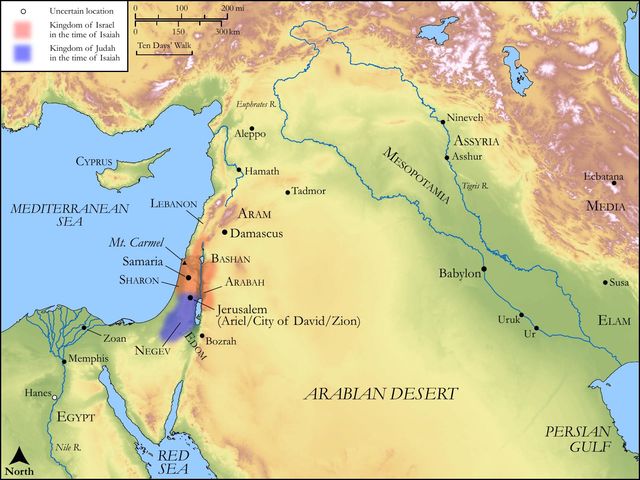
See on the biblical-era map
Study this verse
Public-domain commentary
Matthew Henry
From his Commentary on the Whole Bible. Henry comments on passages, not single verses — this entry covers Isaiah 28:1–8. His four-level outline is real structure in the source text, so it is rendered as structure.
Here, I. The prophet warns the kingdom of the ten tribes of the judgments that were coming upon them for their sins, which were soon after executed by the king of Assyria, who laid their country waste, and carried the people into captivity. Ephraim had his name from fruitfulness, their soil being very fertile and the products of it abundant and the best of the kind; they had a great many fat valleys (Isa 28:1, Isa 28:4), and Samaria, which was situated on a hill, was, as it were, on the head of the fat valleys. Their country was rich and pleasant, and as the garden of the Lord: it was the glory of Canaan, as that was the glory of all lands; their harvest and vintage were the glorious beauty on the head of their valleys, which were covered over with corn and vines. Now observe,
1.What an ill use they made of their plenty. What God gave them to serve him with they perverted, and abused, by making it the food and fuel of their lusts.
(1.)They were puffed up with pride by it. The goodness with which God crowned their years, which should have been to him a crown of praise, was to them a crown of pride. Those that are rich in the world are apt to be high-minded, Ti1 6:17. Their king, who wore the crown, was proud that he ruled over so rich a country; Samaria, their royal city, was notorious for pride. Perhaps it was usual at their festivals, or revels, to wear garlands made up of flowers and ears of corn, which they wore in honour of their fruitful country. Pride was a sin that generally prevailed among them, and therefore the prophet, in his name who resists the proud, boldly proclaims a woe to the crown of pride. If those who wear crowns be proud of them, let them not think to escape this woe. What men are proud of, be it ever so mean, is to them as a crown; he that is proud thinks himself as great as a king. But woe to those who thus exalt themselves, for they shall be abased; their pride is the preface to their destruction.
(2.)They indulged themselves in sensuality. Ephraim was notorious for drunkenness, and excess of riot; Samaria, the head of the fat valleys, was full of those that were overcome with wine, were broken with it, so the margin. See how foolishly drunkards act, and no marvel when, in the very commission of the sin, they make fools and brutes of themselves; they yield,
[1.]To be conquered by the sin; it overcomes them, and brings them into bondage (Pe2 2:19); they are led captive by it, and the captivity is the more shameful and inglorious because it is voluntary. Some of these wretched slaves have themselves owned that there is not a greater drudgery in the world than hard drinking. They are overcome not with the wine, but with the love of it.
[2.]To be ruined by it. They are broken by wine. Their constitution is broken by it, and their health ruined. They are broken in the callings and estates, and their souls are in danger of being eternally undone, and all this for the gratification of a base lust. Woe to these drunkards of Ephraim! Ministers must bring the general woes of the word home to particular places and persons. We must say, Woe to this or that person, if he be a drunkard. There is a particular woe to the drunkards of Ephraim, for they are of God's professing people, and it becomes them worse than any other; they know better, and therefore should give a better example. Some make the crown of pride to belong to the drunkards, and to mean the garlands with which those were crowned that got the victory in their wicked drinking matches and drank down the rest of the company. They were proud of their being mighty to drink wine; but woe to those who thus glory in their shame.
2.The justice of God in taking away their plenty from them, which they thus abused. Their glorious beauty, the plenty they were proud of, is but a fading flower; it is meat that perishes. The most substantial fruits, if God blast them and blow upon them, are but fading flowers, Isa 28:1. God can easily take away their corn in the season thereof (Hos 2:9), and recover locum vastatum - ground that has been alienated and has run to waste, those goods of his which they prepared for Baal. God has an officer ready to make a seizure for him, has one at his beck, a mighty and strong one, who is able to do the business, even the king of Assyria, who shall cast down to the earth with the hand, shall easily and effectually, and with the turn of a hand, destroy all that which they are proud of and pleased with, Isa 28:2. He shall throw it down to the ground, to be broken to pieces with a strong hand, with a hand that they cannot oppose. Then the crown of pride, and the drunkards of Ephraim, shall be trodden under foot (Isa 28:3); they shall lie exposed to contempt, and shall not be able to recover themselves. Drunkards, in their folly, are apt to talk proudly, and vaunt themselves most when they most shame themselves; but they thereby render themselves the more ridiculous. The beauty of their valleys, which they gloried in, will be,
(1.)Like a fading flower (as before, Isa 28:1); it will wither of itself, and has in itself the principles of its own corruption; it will perish in time by its own moth and rust.
(2.)Like the hasty fruit, which, as soon as it is discovered, is plucked and eaten up; so the wealth of this world, besides that it is apt to decay of itself, is subject to be devoured by others as greedily as the first-ripe fruit, which is earnestly desired, Mic 7:1. Thieves break through and steal. The harvest which the worldling is proud of the hungry eat up (Job 5:5); no sooner do they see the prey but they catch at it, and swallow up all they can lay their hands on. It is likewise easily devoured, as that fruit which, being ripe before it has grown, is very small, and is soon eaten up; and there being little of it, and that of little worth, it is not reserved, but used immediately.
II.He next turns to the kingdom of Judah, whom he calls the residue of his people (Isa 28:5), for they were but two tribes to the other ten.
1.He promises them God's favours, and that they shall be taken under his guidance and protection when the beauty of Ephraim shall be left exposed to be trodden down and eaten up, Isa 28:5, Isa 28:6. In that day, when the Assyrian army is laying Israel waste, and Judah might think that their neighbour's house being on fire their own was in danger, in that day of treading down and perplexity, then God will be to the residue of his people all they need and can desire; not only to the kingdom of Judah, but to those of Israel who had kept their integrity, and, as was probably the case with some, betook themselves to the land of Judah, to be sheltered by good king Hezekiah. When the Assyrian, that mighty one, was in Israel as a tempest of hail, noisy and battering, as a destroying storm bearing down all before it, especially at sea, and as a flood of mighty waters overflowing the country (Isa 28:2), then in that day will the Lord of hosts, of all hosts, distinguish by peculiar favours his people who have distinguished themselves by a steady and singular adherence to him, and that which they most need he will himself be to them. This very much enhances the worth of the promises that God, covenanting to be to his people a God all-sufficient, undertakes to be himself all that to them which they can desire.
(1.)He will put all the credit and honour upon them which are requisite, not only to rescue them from contempt, but to gain them esteem and reputation. He will be to them for a crown of glory and for a diadem of beauty. Those that wore the crown of pride looked upon God's people with disdain, and trampled upon them, for they were the song of the drunkards of Ephraim; but God will so appear for them by his providence as to make it evident that they have his favour towards them, and that shall be to them a crown of glory; for what greater glory can any people have than for God to acknowledge them as his own? And he will so appear in them, by his grace, as to make it evident that they have his image renewed on them, and that shall be to them a diadem of beauty; for what greater beauty can any person have than the beauty of holiness? Note, Those that have God for their God have him for a crown of glory and a diadem of beauty; for they are made to him kings and priests.
(2.)He will give them all the wisdom and grace necessary to the due discharge of the duty of their place. He will himself be a spirit of judgment to those that sit in judgment; the privy counsellors shall be guided by wisdom and discretion and the judges shall govern by justice and equity. It is a great mercy to any people when those that are called to places of power and public trust are qualified for their places, when those that sit in judgment have a spirit of judgment, a spirit of government.
(3.)He will give them all the courage and boldness requisite to carry them resolutely through the difficulties and oppositions they are likely to meet with. He will be for strength to those that turn the battle to the gate, to the gates of the enemy whose cities they besiege, or to their own gates, when they sally out upon the enemies that besiege them. The strength of the soldiery depends as much upon God as the wisdom of the magistracy; and where God gives both these he is to that people a crown of glory. This may well be supposed to refer to Christ, and so the Chaldee paraphrast understands it: In that day shall the Messiah be a crown of glory. Simeon calls him the glory of his people Israel; and he is made of God to us wisdom, righteousness, and strength.
2.He complains of the corruptions that were found among them, and the many corrupt ones (Isa 28:7): But they also, many of those of Judah, have erred through wine. There are drunkards of Jerusalem, as well as drunkards of Ephraim; and therefore the mercy of God is to be so much the more admired that he has not blasted the glory of Judah as he has done that of Ephraim. Sparing mercy lays us under peculiar obligations when it is thus distinguishing. Ephraim's sins are found in Judah, and yet not Ephraim's ruins. They have erred through wine. Their drinking to excess is itself a practical error; they think to raise their fancy by it, but they ruin their judgment, and so put a cheat upon themselves; they think to preserve their health by it and help digestion, but they spoil their constitution and hasten diseases and deaths. It is also the occasion of a great many errors in principle; their understanding is clouded and their conscience debauched by it; and therefore, to support themselves in it, they espouse corrupt notions, and form their minds in favour of their lusts. Probably some were drawn in to worship idols by their love of the wine and strong drink which there was plenty of at their idolatrous festivals; and so they erred through wine, as Israel, for love of the daughters of Moab, joined themselves to Baal-peor. Three things are here observed as aggravations of this sin: - (1.) That those were guilty of it whose business it was to warn others against it and to teach them better, and therefore who ought to have set a better example: The priest and the prophet are swallowed up of wine; their office is quite drowned and lost in it. The priests, as sacrificers, were obliged by a particular law to be temperate (Lev 10:9), and, as rulers and magistrates, it was not for them to drink wine, Pro 31:4. The prophets were a kind of Nazarites (as appears by Amo 2:11), and, as reprovers by office, were concerned to keep at the utmost distance from the sins they reproved in others; yet there were many of them ensnared in this sin. What! a priest, a prophet, a minister, and yet drunk! Tell it not in Gath. Such a scandal are they to their coat. (2.) That the consequences of it were very pernicious, not only by the ill influence of their example, but the prophet, when he was drunk, erred in vision; the false prophets plainly discovered themselves to be so when they were in drink. The priest stumbled in judgment and forgot the law (Pro 31:5); he reeled and staggered as much in the operations of his mind as in the motions of his body. What wisdom or justice can be expected from those that sacrifice reason, and virtue, and conscience, and all that is valuable to such a base lust as the love of strong drink is? Happy art thou, O land! when thy princes eat and drink for strength, and not for drunkenness, Ecc 10:17. (3.) That the disease was epidemic, and the generality of those that kept any thing of a table were infected with it: All tables are full of vomit, Isa 28:8. See what an odious thing the sin of drunkenness is, what an affront it is to human society; it is rude and ill-mannered enough to sicken the beholders, for the tables where they eat their meat are filthily stained with the marks of this sin, which the sinners declare as Sodom. Their tables are full of vomit, so that the victor, instead of being proud of his crown, ought rather to be ashamed of it. It bodes ill to any people when so sottish a sin as drunkenness has become national.
Continue studying Isaiah 28:4 across the web’s major study libraries — every link below opens this exact verse, chapter, or book on the destination site.
Read & Compare
 BibleGatewayThis verse in more than 200 translations and 70 languages.
 Bible.comThe YouVersion reader — hundreds of translations, reading plans, and highlights.
 ESV.orgCrossway's official English Standard Version reader.
 NET BibleThe NET translation with 60,000+ translators' notes on every rendering decision.
 STEP BibleTyndale House's free study tool — original text, vocabulary, and scholarly resources.
 BibliaLogos Bible Software's free web reader.
 USCCBThe New American Bible (Revised Edition) with the U.S. bishops' study notes.
Commentaries
 BibleHub CommentariesDozens of classic commentaries on this verse, gathered on one page.
 StudyLightMore than 100 commentary sets — the largest collection on the web.
 BibleRefPlain-English commentary on what this verse means, verse by verse.
 Enduring WordDavid Guzik's free commentary on this chapter, widely used by Bible teachers.
 Bible Study ToolsVerse commentary alongside Greek and Hebrew study aids.
Original Language & Research
- BibleHub InterlinearThe verse word by word — original language, transliteration, and English.
- BibleHub LexiconEvery word's original-language definition and Strong's entry.
 Blue Letter BibleDeep-study tools — Strong's numbers, concordance, and word studies.
 SefariaThe Hebrew text with Rashi and centuries of Jewish commentary.
Sermons, Hymns & Audio


TrulyRandomVerse is not affiliated with these sites and doesn’t control their content. They’re linked because they’re genuinely useful.
Summary
Isaiah 28:4 delivers a powerful prophetic indictment against the Northern Kingdom of Israel, specifically targeting Samaria, its proud capital. The verse employs vivid, agricultural imagery to declare the city's apparent splendor and prosperity as utterly ephemeral and destined for swift annihilation. Likening Samaria's "glorious beauty" to a rapidly wilting flower and a highly desirable early fig that is instantly consumed, the prophecy underscores the transient nature of worldly pride and the certainty of divine judgment, which will swiftly and completely devour its perceived strength.
Context
ShowHideLiterary Context
This verse is deeply embedded within a series of "woe oracles" pronounced by the prophet Isaiah, primarily against the Northern Kingdom of Israel (often referred to as Ephraim) in Isaiah 28, before shifting focus to Judah and Jerusalem. The immediate context, Isaiah 28:1-6, specifically condemns the "drunkards of Ephraim" and their "crown of pride," which is Samaria. Isaiah 28:4 directly elaborates on the "glorious beauty" introduced in Isaiah 28:1, intensifying the imagery of decay and swift destruction. The prophet contrasts Samaria's fleeting glory with the enduring "crown of glory" and "diadem of beauty" that the Lord Himself will be to His remnant (Isaiah 28:5), setting up a profound theological contrast between human pride and divine steadfastness.
Historical & Cultural Context
Isaiah prophesied during the 8th century BCE, a period marked by the aggressive expansion of the Assyrian Empire. The Northern Kingdom of Israel, though experiencing a period of relative prosperity and political stability under kings like Jeroboam II, was simultaneously in deep moral and spiritual decline, characterized by idolatry, injustice, and drunkenness among its leaders. Samaria, strategically built on a fertile hill, symbolized this wealth and prominence. The phrase "fat valley" (Hebrew: gei shmanim) refers to the rich, fertile plains surrounding Samaria, indicative of its agricultural abundance and the luxurious lifestyle of its elite. The metaphors of a "fading flower" and "hasty fruit" would have been immediately understood by an agrarian society, where the seasonal nature of crops and the rapid perishability of certain early fruits (like the early fig) were common knowledge. This imagery powerfully conveyed the imminent and total destruction that the Assyrian invasion would bring upon Samaria, swiftly consuming its perceived strength and beauty.
Key Themes
ShowHideIsaiah 28:4 profoundly contributes to several overarching themes within Isaiah's prophecy and the broader biblical narrative. The primary theme is Divine Judgment against human pride and spiritual apostasy. Samaria's downfall is not presented as a random geopolitical event but as a direct consequence of its rebellion against God's covenant, demonstrating His righteous wrath and sovereign control over nations. Another significant theme is the Transience of Worldly Glory and Security. The vivid imagery of the "fading flower" and "hasty fruit" underscores that material wealth, human power, and outward splendor, when not grounded in obedience to God, are inherently temporary and ultimately unsustainable. This resonates deeply with the biblical emphasis on the impermanence of earthly existence and achievements, as echoed in passages like Psalm 90:5-6 and 1 John 2:17. Finally, the verse highlights the Swiftness and Completeness of Destruction. The immediate consumption of the "hasty fruit" signifies that what appears desirable and strong will be quickly and utterly devoured, leaving nothing behind, a stark warning of God's decisive and thorough judgment.
Exposition and Analysis
ShowHideKey Word Analysis
ShowHideThis word signifies splendor, prominence, or beauty, often associated with a gazelle (known for its beauty). In this context, it ironically describes the outward magnificence, prestige, and perceived strength of Samaria, which, despite its impressive appearance and strategic importance, was morally corrupt. The term highlights the contrast between its outward show and its inner decay, setting the stage for its impending disgrace.
This primitive root means "to wilt," "to fall away," or "to fail." It can also carry the figurative sense of being foolish or wicked, and causatively, to despise or disgrace. Here, it vividly portrays the rapid decay, loss of vitality, and ultimate collapse of Samaria's beauty and power, emphasizing its impermanence and inevitable decline.
A primitive root meaning "to make away with (specifically by swallowing)" or, more generally, "to destroy." This powerful verb conveys a sense of swift, complete, and irreversible consumption or annihilation. It underscores the sudden and total nature of the judgment that will befall Samaria, implying that its former glory will be utterly devoured, leaving no trace.
Verse Breakdown
ShowHide"And the glorious beauty, which is on the head of the fat valley, shall be a fading flower"
This initial clause introduces the subject of divine judgment: Samaria, personified by its "glorious beauty" and its strategic location. The phrase "on the head" (Hebrew: rôʼsh) refers to its prominent, elevated position, symbolizing its leadership, pride, and perceived invincibility. The "fat valley" (Hebrew: shemen for "fat," gayʼ for "valley") denotes its exceptionally fertile and prosperous surroundings, which were the source of its wealth and false sense of security. This outward splendor, however, is immediately contrasted with its inevitable destiny: to become a "fading flower," an image of rapid decay, loss of vitality, and ultimate impermanence.
"and as the hasty fruit before the summer"
This second simile further intensifies the depiction of Samaria's transient and vulnerable nature. "Hasty fruit" (Hebrew: bikkûwr) specifically refers to the early fig, which ripens quickly, often before the main summer harvest. While highly prized for its early appearance and sweetness, it is also known for its rapid perishability and often less substantial nature compared to later fruits. This imagery reinforces the idea of something desirable but inherently short-lived and susceptible to swift disappearance.
"which when he that looketh upon it seeth, while it is yet in his hand he eateth it up."
This final clause vividly illustrates the extreme swiftness and totality of the destruction. The "hasty fruit" is so eagerly desired and so quickly consumed that it is devoured almost immediately upon being seen and taken into hand, leaving no opportunity for delay or preservation. This portrays the invading Assyrian army as the "he that looketh upon it," who will seize Samaria and utterly consume its wealth, power, and inhabitants with overwhelming speed and ease, leaving nothing behind.
Literary Devices
ShowHideIsaiah 28:4 is exceptionally rich in Imagery and Simile, creating a profoundly impactful and memorable prophecy of judgment. The prophet employs vivid sensory details to paint a stark picture of Samaria's initial desirability and its subsequent, swift demise. The city, with its "glorious beauty" and prominent position "on the head of the fat valley," is initially presented as a highly desirable entity, evoking a sense of prosperity and pride. This beauty is then directly compared to a "fading flower," a Simile that immediately introduces the theme of transience, decay, and loss of vitality. The flower, once vibrant and full of life, quickly loses its splendor and withers. A second, equally potent Simile compares Samaria's glory to "the hasty fruit before the summer," specifically an early fig. This fruit, while eagerly anticipated and quickly consumed, is also inherently ephemeral, underscoring the fleeting nature of Samaria's perceived strength. The final phrase, "while it is yet in his hand he eateth it up," uses Hyperbole to emphasize the extreme swiftness and totality of the consumption, suggesting an almost instantaneous and complete destruction. The entire verse functions as an extended Metaphor where Samaria's outward prosperity, pride, and false security are represented by these beautiful but ultimately perishable natural elements, highlighting the profound fragility of human achievement and security when separated from God.
Theological and Thematic Connections
ShowHideIsaiah 28:4 stands as a profound theological declaration concerning the nature of divine judgment and the inherent impermanence of all earthly glory not rooted in God. It powerfully underscores the biblical principle that pride, self-reliance, and moral corruption, even amidst outward prosperity, inevitably lead to downfall. Samaria's "glorious beauty" was a deceptive facade, a temporary display that concealed deep spiritual apostasy and a blatant rejection of God's covenant. The swiftness and completeness of its destruction highlight God's absolute sovereignty and His unwavering justice, demonstrating that no human power, wealth, or strategic advantage can ultimately withstand His determined will when sin persists. This passage serves as a timeless reminder that true and lasting security, beauty, and prosperity are not found in material possessions or worldly status, but in a humble and steadfast relationship with the Lord, who alone is eternal and unchanging.
Reflection and Application
ShowHideIsaiah 28:4 offers a timeless and sobering warning against placing our ultimate confidence in fleeting worldly possessions, transient status, or ephemeral power. It compels us to critically examine the foundations of our own security and to recognize that spiritual pride and moral compromise, whether in individuals, communities, or nations, inevitably lead to decline and judgment. The stark imagery of the fading flower and the swiftly consumed hasty fruit urges us to confront the ephemeral nature of all that is earthly and to reorient our priorities towards what is eternal and truly enduring. Instead of striving for outward appearances or accumulating material prosperity that can be "eaten up" in an instant by unforeseen circumstances or divine decree, believers are called to build their lives on the unchanging truth of God's Word and to seek lasting spiritual riches that are not subject to decay, moth, rust, or swift consumption. This verse powerfully underscores God's unfailing justice and His ultimate sovereignty, reminding us that true wisdom involves profound humility before God and an unwavering reliance on His enduring grace and provision.
Questions for Reflection
ShowHideFAQ
ShowHideWhat is the significance of the "fat valley" in Isaiah 28:4?
ShowHideThe "fat valley" (Hebrew: gei shmanim, literally "valley of fatness") refers to the exceptionally fertile and prosperous surroundings of Samaria, the capital city of the Northern Kingdom of Israel. It serves as a powerful symbol of the city's immense wealth, agricultural abundance, and the luxurious, indulgent lifestyle of its inhabitants and leaders. Ironically, this very prosperity, which fostered pride and a false sense of security, had led to deep spiritual pride and moral decay, making it a prime target for God's righteous judgment. The phrase underscores the contrast between Samaria's outward opulence and its inward corruption, highlighting that what was a source of pride and perceived strength would become the very object of swift and complete destruction, much like the "glorious beauty" mentioned in Isaiah 28:1.
Why is Samaria compared to a "fading flower" and "hasty fruit"?
ShowHideThese two vivid similes are employed to emphasize the profound transience, fragility, and vulnerability of Samaria's glory, power, and perceived security. A "fading flower" (Hebrew: tsiytsâh nâbêl) powerfully portrays rapid decay, loss of vitality, and ultimate impermanence, indicating that Samaria's beauty and strength were not enduring but destined to wither quickly. The "hasty fruit" (Hebrew: bikkûwr), typically referring to an early fig, was highly prized for its early ripeness but also known for its rapid perishability and swift consumption once picked. This imagery conveys that Samaria's perceived desirability and strength would be quickly and completely devoured by its enemies, specifically the invading Assyrian forces, leaving no opportunity for it to last or be saved, as further elaborated in Isaiah 28:2. Both metaphors combine to underscore the sudden, irreversible, and total nature of the impending judgment.
Christ-Centered Fulfillment
ShowHideIsaiah 28:4, with its stark portrayal of fading worldly glory and swift, decisive judgment, finds its ultimate fulfillment and profound counterpoint in the person and work of Jesus Christ. The "glorious beauty" of Samaria was a fleeting, human-made construct, destined for inevitable decay and consumption, much like all earthly kingdoms, treasures, and human achievements apart from God. In stark contrast, Christ embodies an eternal and unfading glory, a beauty and majesty not subject to the ravages of time, the corruption of sin, or the judgment of God. He is the true and lasting "beauty" that never fades, the unshakable foundation upon which an eternal kingdom is built, as described in Hebrews 12:28. While the "hasty fruit" of Samaria was quickly "eaten up" by an earthly conqueror, symbolizing destruction, Christ's sacrificial death on the cross was a once-for-all act that utterly conquered sin and death, offering eternal life that cannot be consumed, destroyed, or taken away. He invites His followers to lay up treasures in heaven, where neither moth nor rust destroys, and where thieves do not break in and steal, contrasting sharply with the perishable nature of earthly wealth and glory (Matthew 6:19-21). The judgment pronounced on Samaria foreshadows the final, universal judgment, but for those who are "in Christ," the swift consumption of earthly glory gives way to an eternal inheritance in the New Heavens and New Earth, where God Himself dwells with His people, and there will be no more sorrow, pain, or death (Revelation 21:1-4). Thus, Christ is the enduring reality, the eternal King whose glory never fades, offering a security, hope, and beauty that transcend all transient earthly power and splendor.