


Isaiah 19:15
Bible text: King James Version (1769 Blayney text) · Public domain
Bible text: Berean Standard Bible · Public domain
Bible text: American Standard Version (1901) · Public domain
Bible text: World English Bible, Messianic edition · Public domain
Bible text: Geneva Bible (1599) · Public domain
Bible text: Young's Literal Translation · Public domain
- וְלֹאve·lo'and notH3808Conj-w ¦ NegParticle Negativeוְandלֹאnot
- יִהְיֶהyih·Yehit will beH1961V-Qal-Imperf-3msVerb Qal Imperfect 3rd Singular Masculine
- לְמִצְרַיִםle·mitz·Ra·yimfor EgyptH4714Prep-l ¦ N-properNoun Proper LocationלְforמִצְרַיִםEgypt
- מַעֲשֶׂהma·'a·Seha deedH4639N-msNoun Singular Masculine Absolute
- אֲשֶׁר'a·SherwhichH834RelParticle Relative
- יַעֲשֶׂהya·'a·Sehit will doH6213V-Qal-Imperf-3msVerb Qal Imperfect 3rd Singular Masculine
- רֹאשׁroshheadH7218N-msNoun Singular Masculine Absolute
- וְזָנָבve·za·Navand tailH2180Conj-w ¦ N-msNoun Singular Masculine Absoluteוְandזָנָבtail
- כִּפָּהki·Pahpalm branchH3712N-fsNoun Singular Feminine Absolute
- וְאַגְמוֹןve·'ag·Monand bulrushH100Conj-w ¦ N-msNoun Singular Masculine Absoluteוְandאַגְמוֹןbulrush
English is a literal word-by-word gloss of the Hebrew, not the KJV's wording. Why?
This is the original text the KJV's translators worked from — each Hebrew word with its own literal English meaning in this verse, prepared by scholars at Tyndale House, Cambridge. The KJV translates whole sentences, not word by word, so its wording differs: one Hebrew word can become several English words, and the KJV may choose “the LORD” where the gloss reads “Yahweh”. Both are faithful — they answer different questions. For the KJV's own rendering, switch to the KJV text.
Details
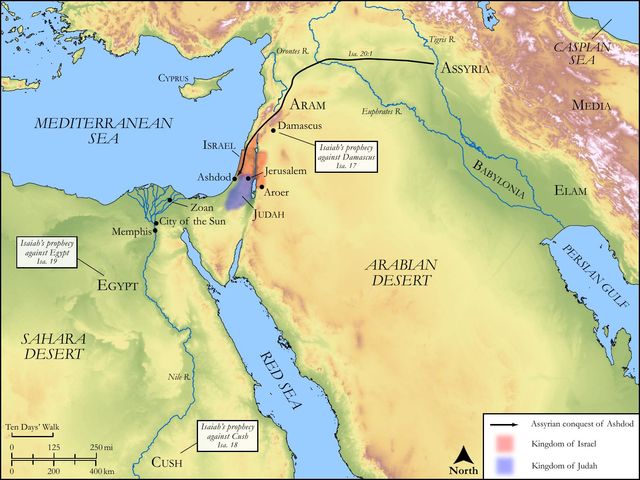
See on the biblical-era map
Study this verse
Public-domain commentary
Matthew Henry
From his Commentary on the Whole Bible. Henry comments on passages, not single verses — this entry covers Isaiah 19:1–17. His four-level outline is real structure in the source text, so it is rendered as structure.
Though the land of Egypt had of old been a house of bondage to the people of God, where they had been ruled with rigour, yet among the unbelieving Jews there still remained much of the humour of their fathers, who said, Let us make us a captain and return into Egypt. Upon all occasions they trusted to Egypt for help (Isa 30:2), and thither they fled, in disobedience to God's express command, when things were brought to the last extremity in their own country, Jer 43:7. Rabshakeh upbraided Hezekiah with this, Isa 36:6. While they kept up an alliance with Egypt, and it was a powerful ally, they stood not in awe of the judgments of God; for against them they depended upon Egypt to protect them. Nor did they depend upon the power of God when at any time they were in distress; but Egypt was their confidence. To prevent all this mischief, Egypt must be mortified, and many ways God here tells them he will take to mortify them.
I.The gods of Egypt shall appear to them to be what they always really were, utterly unable to help them, Isa 19:1.
"The Lord rides upon a cloud, a swift cloud, and shall come into Egypt. As a judge goes in state to the bench to try and condemn the malefactors, or as a general takes the field with his troops to crush the rebels, so shall God come into Egypt with his judgments; and when he comes he will certainly overcome." In all this burden of Egypt here is no mention of any foreign enemy invading them; but God himself will come against them, and raise up the causes of their destruction from among themselves. He comes upon a cloud, above the reach of the opposition or resistance. He comes apace upon a swift cloud; for their judgment lingers not when the time has come. He rides upon the wings of the wind, with a majesty far excelling the greatest pomp and splendour of earthly princes. He makes the clouds his chariots, Psa 18:9; Psa 104:3. When he comes the idols of Egypt shall be moved, shall be removed at his presence, and perhaps be made to fall as Dagon did before the ark. Isis, Osiris, and Apis, those celebrated idols of Egypt, being found unable to relieve their worshippers, shall be disowned and rejected by them. Idolatry had got deeper rooting in Egypt than in any land besides, even the most absurd idolatries; and yet now the idols shall be moved and they shall be ashamed of them. When the Lord brought Israel out of Egypt he executed judgments upon the gods of the Egyptians (Num 33:4); no marvel then if, when he comes, they begin to tremble. The Egyptians shall seek to the idols, when they are at their wits' end, and consult the charmers and wizards (Isa 19:3); but all in vain; they see their ruin hastening on them notwithstanding.
II.The militia of Egypt, that had been famed for their valour, shall be quite dispirited and disheartened.
No kingdom in the world was ever in a better method of keeping up a standing army than the Egyptians were; but now their heroes, that used to be celebrated for courage, shall be posted for cowards: The heart of Egypt shall melt in the midst of it, like wax before the fire (Isa 19:1); the spirit of Egypt shall fail, Isa 19:3. They shall have no inclination, no resolution, to stand up in defence of their country, their liberty, and property; but shall tamely and ingloriously yield all to the invader and oppressor. The Egyptians shall be like women (Isa 19:16); they shall be frightened and put into confusion by the least alarm; even those that dwell in the heart of the country, in the midst of it, and therefore furthest from danger, will be as full of frights as those that are situate on the frontiers. Let not the bold and brave be proud or secure, for God can easily cut off the spirit of princes (Psa 76:12) and take away their hearts, Job 12:24.
III.The Egyptians shall be embroiled in endless dissensions and quarrels among themselves.
There shall be no occasion to bring a foreign force upon them to destroy them; they shall destroy one another (Isa 19:2): I will set the Egyptians against the Egyptians. As these divisions and animosities are their sin, God is not the author of them, they come from men's lusts; but God, as a Judge, permits them for their punishment, and by their destroying differences corrects them for their sinful agreements. Instead of helping one another, and acting each in his place for the common good, they shall fight every one against his brother and neighbour, whom he ought to love as himself - city against city, and kingdom against kingdom. Egypt was then divided into twelve provinces, or dynasties; but Psammetichus, the governor of one of them, by setting them at variance with one another, at length made himself master of them all. A kingdom thus divided against itself would soon be brought to desolation. En quo discordi cives perduxit miseros! - Oh the wretchedness brought upon a people by their disagreements among themselves! It is brought to this by a perverse spirit, a spirit of contradiction, which the Lord would mingle, as an intoxicating draught made up of several ingredients, for the Egyptians, Isa 19:14. One party shall be for a thing for no other reason than because the other is against it; that is a perverse spirit, which, if it mingle with the public counsels, tends directly to the ruin of the public interests.
IV.Their politics shall be all blasted, and turned into foolishness.
When God will destroy the nation he will destroy the counsel thereof (Isa 19:3), by taking away wisdom from the statesmen (Job 12:20), or setting them one against another (as Hushai and Ahithophel), or by his providence breaking their measures even when they seemed well laid; so that the princes of Zoan are fools: they make fools of one another, every one betrays his own folly, and divine Providence makes fools of them all, Isa 19:11. Pharaoh had his wise counsellors. Egypt was famous for such. But their counsel has all become brutish; they have lost all their forecast; one would think they had become idiots, and were bereaved of common sense. Let no man glory then in his own wisdom, nor depend upon that, nor upon the wisdom of those about him; for he that gives understanding can when he please take it away. And from those it is most likely to be taken away that boast of their policy, as Pharaoh's counsellors here did, and, to recommend themselves to places of public trust, boast of their great understanding ("I am the son of the wise, of the God of wisdom, of wisdom itself," says one; "my father was an eminent privy-counsellor of note in his day for wisdom"), or of the antiquity and dignity of their families: "I am," says another, "the son of ancient kings." The nobles of Egypt boasted much of their antiquity, producing fabulous records of their succession for above 10,000 years. This humour prevailed much among them about this time, as appears by Herodotus, their common boast being that Egypt was some thousands of years more ancient than any other nation. "But where are thy wise men? Isa 19:12. Let them now show their wisdom by foreseeing what ruin is coming upon their nation, and preventing it, if they can. Let them with all their skill know what the Lord of hosts has purposed upon Egypt, and arm themselves accordingly. Nay, so far are they from doing this that they themselves are, in effect, contriving the ruin of Egypt, and hastening it on, Isa 19:13. The princes of Noph are not only deceived themselves, but they have seduced Egypt, by putting their kings upon arbitrary proceedings" (by which both themselves and their people were soon undone); "the governors of Egypt, that are the stay and cornerstones of the tribes thereof, are themselves undermining it." It is sad with a people when those that undertake for their safety are helping forward their destruction, and the physicians of the state are her worst disease, when the things that belong to the public peace are so far hidden from the eyes of those that are entrusted with the public counsels that in every thing they blunder and take wrong measures; so here (Isa 19:14): They have caused Egypt to err in every work thereof. Every step they took was a false step. They always mistook either the end or the means, and their counsels were all unsteady and uncertain, like the staggerings and stammerings of a drunken man in his vomit, who knows not what he says nor where he goes. See what reason we have to pray for our privy-counsellors and ministers of state, who are the great supports and blessings of the state if God give them a spirit of wisdom, but quite the contrary if he hide their heart from understanding.
V.The rod of government shall be turned into the serpent of tyranny and oppression (Isa 19:4):
"The Egyptians will I give over into the hand of a cruel lord, not a foreigner, but one of their own, one that shall rule over them by an hereditary right, but shall be a fierce king and rule them with rigour," either the twelve tyrants that succeeded Sethon, or rather Psammetichus that recovered the monarchy again; for he speaks of one cruel lord. Now the barbarous usage which the Egyptian task masters gave to God's Israel long ago was remembered against them and they were paid in their own coin by another Pharaoh. It is sad with a people when the powers that should be for edification are for destruction, and they are ruined by those by whom they should be ruled, when such as this is the manner of the king, as it is described (in terrorem - in order to impress alarm), Sa1 8:11.
VI.Egypt was famous for its river Nile, which was its wealth, and strength, and beauty, and was idolized by them.
Now it is here threatened that the waters shall fail from the sea and the river shall be wasted and dried up, Isa 19:5. Nature shall not herein favour them as she has done. Egypt was never watered with the rain of heaven (Zac 14:18), and therefore the fruitfulness of their country depended wholly upon the overflowing of their river; if that therefore be dried up, their fruitful land will soon be turned into barrenness and their harvests cease: Every thing sown by the brooks will wither of course, will be driven away, and be no more, Isa 19:7. If the paper-reeds by the brooks, at the very mouth of them, wither, much more the corn, which lies at a greater distance, but derives its moisture from them. Yet this is not all; the drying up of their rivers is the destruction,
1.Of their fortifications, for they are brooks of defence (Isa 19:6), making the country difficult of access to an enemy. Deep rivers are the strongest lines, and most hardly forced. Pharaoh is said to be a great dragon lying in the midst of his rivers, and guarded by them, bidding defiance to all about him, Eze 29:3. But these shall be emptied and dried up, not by an enemy, as Sennacherib with the sole of his foot dried up mighty rivers (Isa 37:25), and as Cyrus, who took Babylon by drawing Euphrates into many streams, but by the providence of God, which sometimes turns water-springs into dry ground, Psa 107:33.
2.It is the destruction of their fish, which in Egypt was much of their food, witness that base reflection which the children of Israel made (Num 11:5): We remember the fish which we did eat in Egypt freely. The drying up of the rivers will kill the fish (Psa 105:29), and will thereby ruin those who make it their business,
(1.)To catch fish, whether by angling or nets (Isa 19:8); they shall lament and languish, for their trade is at an end. There is nothing which the children of this world do more heartily lament than the loss of that which they used to get money by. Ploratur lachrymis amissa pecunia veris - Those are genuine tears which are shed over lost money.
(2.)To keep fish, that it may be ready when it is called for. There were those that made sluices and ponds for fish (Isa 19:10), but they shall be broken in the purposes thereof; their business will fail, either for want of water to fill their ponds or for want of fish to replenish their waters. God can find ways to deprive a country even of that which is its staple commodity. The Egyptians may themselves remember the fish they have formerly eaten freely, but now cannot have for money. And that which aggravates the loss of these advantages by the river is that it is their own doing (Isa 19:6): They shall turn the rivers far away. Their kings and great men, to gratify their own fancy, will drain water from the main river to their own houses and grounds at a distance, preferring their private convenience before the public good, and so by degrees the force of the river is sensibly weakened. Thus many do themselves a greater prejudice at last than they think of,
[1.]Who pretend to be wiser than nature, and to do better for themselves than nature has done.
[2.]Who consult their own particular interest more than the common good. Such may gratify themselves, but surely they can never satisfy themselves, who to serve a turn contribute to a public calamity, which they themselves, in the long run, cannot avoid sharing in. Herodotus tells us that Pharaoh-Necho (who reigned not long after this), projecting to cut a free passage by water from Nilus into the Red Sea, employed a vast number of men to make a ditch or channel for that purpose, in which attempt he impaired the river, lost 120,000 of his people, and yet left the work unaccomplished.
VII.Egypt was famous for the linen manufacture; but that trade shall be ruined.
Solomon's merchants traded with Egypt for linen-yarn, Kg1 10:28. Their country produced the best flax and the best hands to work it; but those that work in fine flax shall be confounded (Isa 19:9), either for want of flax to work on or for want of a demand for that which they have worked or opportunity to export it. The decay of trade weakens and wastes a nation and by degrees brings it to ruin. The trade of Egypt must needs sink, for (Isa 19:15) there shall not be any work for Egypt to be employed in; and where there is nothing to be done there is nothing to be got. There shall be a universal stop put to business, no work which either head or tail, branch or rush, may do; nothing for high or low, weak or strong, to do; no hire, Zac 8:10. Note, The flourishing of a kingdom depends much upon the industry of the people; and then things are likely to do well when all hands are at work, when the head and top-branch do not disdain to labour, and the labour of the tail and rush is not disdained. But when the learned professions are unemployed, the principal merchants have no stocks, and the handicraft tradesmen nothing to do, poverty comes upon a people as one that travaileth and as an armed man.
VIII.A general consternation shall seize the Egyptians; they shall be afraid and fear (Isa 19:16), which will be both an evidence of a universal decay and a means and presage of utter ruin. Two things will put them into this fright: - 1. What they hear from the land of Judah; that shall be a terror to Egypt, Isa 19:17. When they hear of the desolations made in Judah by the army of Sennacherib, considering both the near neighbourhood and the strict alliance that was between them and Judah, they will conclude it must be their turn next to become a prey to that victorious army. When their neighbour's house was on fire they could not but see their own in danger; and therefore every one of the Egyptians that makes mention of Judah shall be afraid of himself, expecting the bitter cup shortly to be put into his hands. 2. What they see in their own land. They shall fear (Isa 19:16) because of the shaking of the hand of the Lord of hosts, and (Isa 19:17) because of the counsel of the Lord of hosts, which from the shaking of his hand they shall conclude he has determined against Egypt as well as Judah. For, if judgment begin at the house of God, where will it end? If this be done in the green tree, what shall be done in the dry? See here, (1.) How easily God can make those a terror to themselves that have been, not only secure, but a terror to all about them. It is but shaking his hand over them, or laying it upon some of their neighbours, and the stoutest hearts tremble immediately. (2.) How well it becomes us to fear before God when he does but shake his hand over us, and to humble ourselves under his mighty hand when it does but threaten us, especially when we see his counsel determined against us; for who can change his counsel?
Historical interpretation
Historical reception
2 surviving comments on this verse. Each one is dated, so this reads as a timeline rather than a list.
(Verse 12 and following) How can you say to Pharaoh: I am the son of the wise, the son of ancient kings? Where are your wise men now? Let them tell you and make known what the Lord of hosts has planned against Egypt. The princes of Tanis have become foolish, the princes of Memphis are deluded; the leaders of Egypt have led it astray. The Lord has poured into them a spirit of confusion; they have made Egypt stagger in all its undertakings, as a drunkard staggers and vomits. And Egypt will have no need for one who makes the head and tail bend and restrain. Heretics often say to their king or Pharaoh: We are the sons of the wise ones who from the beginning delivered to us the Apostolic teaching: We are the sons of the ancient kings who are called the kings of the philosophers, and we have knowledge of the Scriptures joined with secular wisdom. He now asks them, whether it be the king of the heretics himself, where are his wise men who despised Ecclesiastical simplicity: and he compels them to answer what the Lord of Sabaoth has thought concerning Egypt of this world, and what he will do in its consummation. The foolish princes of Taneos are approved, who held the lowly command of the heretics. All the princes of Memphis, who boast of polluting eloquence and speech, are confounded. For 'Memphis' signifies 'mouth' or 'from the mouth' and metaphorically means 'speech'. And what follows: They deceived the corner of Egypt, or according to the Septuagint: they will deceive Egypt through tribes, signifies that the kingdom of secular wisdom is shown to be foolish, and the leaders of individual doctrines, who are interpreted as tribes, are shown to have had foolish teachers. For the Lord has mixed for them the spirit of confusion, or errors, according to what is written: And as they did not think it worthwhile to retain the knowledge of God, God gave them over to a depraved mind (Rom. I, 24). And just as the holy one, Isaiah, can say: We will make the spirit of your salvation come upon the earth, so the sinner will make the spirit of error, that is, the spirit of malice. This is in accordance with what we read in Jeremiah: Your own wickedness will punish you, and your turning from me will rebuke you (Jerem. II, 19). But if a heretic is scandalized who does not accept the old Testament, which is said to be mixed with the spirit of error or confusion, let him hear the writing in the Apostle, that is, in the new Testament: God gave them up to the desires of their hearts in uncleanness (Rom. I, 24). And again: Therefore, God gave them up to shameful passions. And again: God gave them up to a reprobate sense, to do what is not fitting. But they are delivered up in the desires of their hearts, because they changed the glory of the incorruptible God into the likeness of the image of a corruptible man, and of birds, and of four-footed beasts, and of creeping things. Which indeed is not only read in the Epistle to the Romans, but also in the Epistle to the Thessalonians concerning the Antichrist: Because they receive not the love of the truth, that they might be saved. Therefore God shall send them the operation of error, to believe lying: That all may be judged who have not believed the truth but have consented to iniquity (2 Thess. 2:10). I think the Apostle Paul took this from the present reading of Isaiah, in which he says: The Lord hath mingled for them the spirit of error, and they have erred in all their works, as an intoxicated man staggereth and vomiteth, so also shall Egypt stagger and vomit because of her excess. Joel speaks of those who are drunk: Woe to those who are drunk without wine. And not only drunk, but also vomiting the madness of dragons, and the incurable madness of asps, so that after they vomit up this kind of wine, they understand their drunkenness and recognize that as long as they are drunk, they have neither beginning nor end, that is, neither head nor tail, but a trunk on both sides of the animal. For beginning and end, which both Symmachus and the Septuagint translated, Theodotion added the Hebrew words Chaphphe () and Agmon (), which Aquila interpreted as bent and perverse. In incurvo, senes intelligi volens; in perverso, lascivientes pueros, qui omniaperversa faciant; ac per hoc esse sensum, quod in Aegypto non solum caput desit et cauda, sed et senes et pueri, id est, et principium et finis.
(Verse. 14, 15.) The Lord mixed in its midst the spirit of dizziness: and he caused Egypt to wander in all its work, like a drunkard and a vomiter: and Egypt will have no work that it does, bending and restraining head and tail. First let us speak about the interpretation, and afterwards we will discuss what is written. The spirit of dizziness can also be interpreted as the spirit of error. In addition, in what we have translated as bending and restraining, we can say bending and lascivious, so that we understand old man and child. However, when we swiftly translated the Hebrew word Agmon (), we were deceived by ambiguity, and we said restraining, which Aquila translated more significantly as στρεβλοῦντα, that is, one who does nothing rightly, but everything crooked, in order to signify a child. Therefore, the sense is: The princes of Taneos have become foolish, and the wise counselors have given foolish advice to Pharaoh, and the princes of Mempheos have become bewildered, and they have deceived Egypt, the corner of nations, because the Lord has mixed into them a spirit of error and confusion, causing them to not know what they are speaking and to make Egypt go astray. And just as a drunkard, when he vomits what he has eaten and does not know where it is, but lies in a state of alien mind, so Egypt will have no work or counsel that has a head, or an end, or is suitable for the elders or the children, some of whom are foolish and delirious due to extreme age, while others are ignorant of their own insolence and infancy. But whether you want to receive this in relation to the devastation in Babylon, or in relation to the coming of Christ, and both literally and spiritually, it will have significance.
Continue studying Isaiah 19:15 across the web’s major study libraries — every link below opens this exact verse, chapter, or book on the destination site.
Read & Compare
 BibleGatewayThis verse in more than 200 translations and 70 languages.
 Bible.comThe YouVersion reader — hundreds of translations, reading plans, and highlights.
 ESV.orgCrossway's official English Standard Version reader.
 NET BibleThe NET translation with 60,000+ translators' notes on every rendering decision.
 STEP BibleTyndale House's free study tool — original text, vocabulary, and scholarly resources.
 BibliaLogos Bible Software's free web reader.
 USCCBThe New American Bible (Revised Edition) with the U.S. bishops' study notes.
Commentaries
 BibleHub CommentariesDozens of classic commentaries on this verse, gathered on one page.
 StudyLightMore than 100 commentary sets — the largest collection on the web.
 BibleRefPlain-English commentary on what this verse means, verse by verse.
 Enduring WordDavid Guzik's free commentary on this chapter, widely used by Bible teachers.
 Bible Study ToolsVerse commentary alongside Greek and Hebrew study aids.
Original Language & Research
- BibleHub InterlinearThe verse word by word — original language, transliteration, and English.
- BibleHub LexiconEvery word's original-language definition and Strong's entry.
 Blue Letter BibleDeep-study tools — Strong's numbers, concordance, and word studies.
 SefariaThe Hebrew text with Rashi and centuries of Jewish commentary.
Sermons, Hymns & Audio


TrulyRandomVerse is not affiliated with these sites and doesn’t control their content. They’re linked because they’re genuinely useful.
Summary
Isaiah 19:15 delivers a profound prophetic declaration concerning God's comprehensive judgment upon ancient Egypt, foretelling a state of absolute national paralysis and utter helplessness. This verse serves as a climactic summation of the preceding divine woes, indicating that no segment of Egyptian society—from its most exalted leadership to its most common laborers, and from its strongest national assets to its weakest—would possess the capacity to perform any meaningful work, devise any effective solution, or offer any substantial contribution. It vividly portrays a complete societal, economic, and political breakdown, a direct and devastating consequence of divine decree against a proud nation that had placed its trust in its own formidable wisdom and power rather than in the Lord Almighty.
Context
ShowHideLiterary Context
Isaiah 19:15 concludes the initial, judgment-focused section of a significant prophetic oracle against Egypt, which spans Isaiah 19:1-15. The verses immediately preceding this one meticulously detail a series of escalating divine judgments: internal strife and civil war leading to societal chaos (Isaiah 19:2-3), the catastrophic drying up of the life-giving Nile River, which precipitates economic collapse, famine, and widespread despair (Isaiah 19:5-10), and the utter failure and foolishness of Egypt's renowned wise men and counselors, exposing the futility of human wisdom against divine decree (Isaiah 19:11-14). Verse 15 functions as a powerful, climactic summation, emphasizing that the cumulative and pervasive effect of these judgments would render the entire nation utterly impotent and incapable of any productive action. This decisive pronouncement of judgment then dramatically sets the stage for a surprising and hopeful shift in the latter part of the chapter, where a future redemption, spiritual transformation, and even conversion of Egypt are remarkably foretold (Isaiah 19:18-25).
Historical & Cultural Context
Ancient Egypt stood as a preeminent world power during Isaiah's time, widely celebrated for its advanced civilization, formidable military might, unparalleled agricultural prosperity (owing to the annual flooding of the Nile River), and deep-rooted traditions of profound wisdom and magical arts. It frequently served as a crucial strategic ally or a formidable rival for the kingdoms of Judah and Israel, and its pantheon of gods was considered mighty and influential. The prophecy in Isaiah 19 directly challenges Egypt's deeply ingrained self-sufficiency, its reliance on its own strength, and its pervasive idolatry. Specifically, it targets Egypt's dependence on the Nile (which symbolized its very lifeblood, economic stability, and national identity) and its "wise men" (who embodied its intellectual prowess and spiritual authority). The drying of the Nile and the subsequent paralysis of its entire populace would have constituted the ultimate humiliation for a nation whose identity, power, and prosperity were so intricately linked to these foundational elements. This oracle would have resonated profoundly with the people of Judah, who often looked to Egypt for military or political assistance against the looming threat of the Assyrian Empire, serving as a stark reminder that all human alliances and self-reliance are ultimately futile without the sovereign favor and intervention of God.
Key Themes
ShowHideThis verse powerfully contributes to several overarching theological and narrative themes found throughout the book of Isaiah and the broader prophetic literature. Firstly, it underscores the theme of Divine Sovereignty and Judgment, demonstrating God's absolute and unchallenged control over all nations, their destinies, and their rise and fall. Even a mighty and seemingly invincible empire like Egypt is shown to be utterly subject to His will, highlighting the profound truth that all human power, wisdom, and resources are ultimately subservient to the Creator's decree. Secondly, it emphasizes the theme of Universal Paralysis and Comprehensive Breakdown, employing vivid and inclusive imagery to convey that no part of Egyptian society, from the very top to the very bottom, would be exempt from the incapacitation. The "head or tail" idiom, a common biblical expression also found in Deuteronomy 28:13, signifies the entire social and political hierarchy, while "branch or rush" further expands this comprehensive scope to include both the strong and the weak, the prominent and the insignificant, the valuable and the common. This pervasive imagery powerfully reinforces the idea that Egypt's internal strength, external capabilities, and very capacity for action would be completely nullified. Thirdly, the prophecy implicitly but powerfully addresses the Consequences of Pride, Idolatry, and Self-Reliance, as Egypt's catastrophic downfall and paralysis are presented as a direct result of its reliance on its own wisdom, abundant resources, and false gods rather than on the true and living God of Israel.
Exposition and Analysis
ShowHideKey Word Analysis
ShowHideFrom the root עָשָׂה (ʻâsâh), this noun denotes an action, deed, labor, or product. In the context of Isaiah 19:15, it signifies any productive activity, accomplishment, or output, encompassing all forms of human endeavor—economic, political, social, and even military. The declaration "neither shall there be any work" implies a complete cessation of all meaningful, effective, and beneficial activity, leading to profound national stagnation, an inability to achieve anything constructive, and a pervasive sense of futility.
This term literally translates to "head" but is extensively used figuratively to denote leadership, chief, beginning, or highest rank. It represents the most prominent, influential, and authoritative members of society—the rulers, counselors, priests, and elite. Its inclusion emphasizes that even those in positions of supreme power, wisdom, and strategic direction would be utterly incapable of providing guidance, executing plans, or offering effective solutions to the nation's plight.
This word refers to a bulrush or reed, a weak, common plant typically found growing in marshy areas. It stands in stark contrast to the "branch" (which implies strength or prominence) and serves as a powerful symbol for the lowest, weakest, or most insignificant members of society, or perhaps even the most common, easily overlooked, and fragile elements of the nation's fabric. Its explicit inclusion ensures that the prophecy of paralysis is exhaustive and all-encompassing, extending to every single component and individual within Egypt, leaving no one untouched by the divine judgment.
Verse Breakdown
ShowHide"Neither shall there be [any] work for Egypt"
This initial, declarative clause establishes the core message and the dire reality of the verse: a complete, absolute, and pervasive cessation of all productive activity and effective functioning within the nation of Egypt. It signifies a state of profound national paralysis, where no one can accomplish anything meaningful, contribute to the nation's well-being, or execute any plan. This "work" (maʻăseh) encompasses all forms of labor, planning, administration, and execution—economic, political, social, and even military—indicating a total breakdown of national capability and purpose.
"which the head or tail"
This powerful idiomatic expression is a classic example of a merism, representing the entirety of society from its highest echelons to its lowest ranks. The "head" (rôʼsh) symbolizes the leaders, the elite, the wise, and those in positions of authority and power. The "tail" (zânâb) represents the common people, the subservient, the insignificant, or those at the lowest rung of the social ladder. The phrase emphasizes that everyone, without exception, regardless of their status, influence, or position, would be rendered utterly impotent and unable to act effectively or initiate any meaningful change.
"branch or rush, may do."
This second pair of contrasting terms further reinforces the comprehensive and exhaustive nature of Egypt's impending paralysis. A "branch" (Hebrew: kippâh) typically refers to a strong, prominent part of a tree, symbolizing strength, significance, or perhaps the nation's most robust and valuable assets. A "rush" (Hebrew: ʼagmôwn) is a weak, common reed, symbolizing weakness, insignificance, or the most vulnerable and fragile aspects of the nation. Together, these terms convey that neither the strong nor the weak, neither the significant nor the insignificant, nor any part of the national fabric, would be able to "do" (ʻâsâh) or accomplish anything. This reiterates the total loss of national capability and the pervasive, inescapable nature of the divine judgment, leaving Egypt utterly helpless.
Literary Devices
ShowHideIsaiah 19:15 masterfully employs several potent literary devices to convey its message of comprehensive and inescapable judgment. The most prominent and effective device is Merism, powerfully demonstrated through the use of two contrasting pairs: "head or tail" and "branch or rush." Merism is a rhetorical figure where two contrasting parts are used to represent a complete whole (e.g., "heaven and earth" to signify all that God has made). Here, "head or tail" comprehensively encompasses all social strata within Egypt, from the highest leadership and most influential figures to the lowest commoners and most subservient members. Similarly, "branch or rush" signifies everything from the strongest, most prominent, and valuable elements of the nation to the weakest, most insignificant, and fragile components. This dual application of merism creates a profound sense of Totality and Universality, emphatically stressing that absolutely no part of Egyptian society—no individual, no institution, no resource, no capability—would be exempt from the divine judgment and the resulting paralysis. Furthermore, the verse effectively utilizes Symbolism and Metaphor: the term "work" symbolizes all productive activity, national capability, and the very essence of a functioning society, while the "head, tail, branch, and rush" serve as vivid metaphors for the diverse components, strengths, and weaknesses of the nation. The stark and inclusive imagery paints a compelling picture of complete national incapacitation, helplessness, and the utter futility of human effort when divinely opposed.
Theological and Thematic Connections
ShowHideIsaiah 19:15 stands as a potent theological declaration of God's absolute and unchallengeable sovereignty over all nations and every human endeavor. It powerfully illustrates that even the mightiest empires, with their advanced civilizations, vast resources, and renowned wisdom, are utterly dependent on the divine will for their very existence and functionality. When a nation, like ancient Egypt, succumbs to the perils of pride, widespread idolatry, and self-reliance, turning away from the Lord, its formidable strength can be swiftly, comprehensively, and completely nullified. This verse underscores the foundational biblical principle that all human plans, power, and ingenuity are ultimately futile and destined to fail without God's favor and blessing. True security, lasting prosperity, and genuine capability come only from Him. It serves as a profound testament to God's unwavering justice in judging nations for their rebellion and idolatry, while simultaneously setting the theological stage for His eventual redemptive purposes, even for those who were once His adversaries, as seen in the latter part of Isaiah 19.
Reflection and Application
ShowHideThe ancient prophecy against Egypt, culminating in the complete cessation of all "work" for the nation, offers timeless and profound lessons for individuals, communities, and societies in every age. It serves as a powerful challenge to the pervasive human tendency to place our ultimate reliance on our own strength, our accumulated wisdom, our abundant resources, or our technological advancements, rather than on the sovereign and all-sufficient God. In a world that frequently measures success by productivity, innovation, self-sufficiency, and economic growth, this verse serves as a stark reminder that true capability, lasting fruitfulness, and genuine peace are ultimately derived from divine favor and alignment with God's purposes. When we, as individuals or as communities, turn away from God, pursuing pride, various forms of idolatry (whether of wealth, power, status, or self), or humanistic philosophies that exclude the divine, we risk experiencing a profound spiritual, moral, or even practical paralysis. In such a state, our efforts may become fruitless, our direction lost, and our endeavors ultimately meaningless. This passage calls us to cultivate a posture of profound humility, genuine repentance, and a radical dependence on God, acknowledging that His wisdom, power, and sovereign will far surpass any human endeavor or ingenuity. Our "work" in life, whether professional, relational, or spiritual, only truly flourishes and yields eternal fruit when it is consecrated to Him and aligned with His divine will.
Questions for Reflection
ShowHideFAQ
ShowHideWhat does "head or tail, branch or rush" mean in this verse?
ShowHideThis phrase is a powerful and inclusive example of merism, a literary device where two contrasting parts are used to represent a complete and exhaustive whole. "Head or tail" refers to the entire social and political hierarchy of ancient Egypt, encompassing everyone from its highest, most influential leaders and decision-makers ("head") to its lowest commoners, most subservient members, and those with minimal influence ("tail"). This idiom is also found in Deuteronomy 28:13, where being "the head and not the tail" signifies a position of leadership and prominence. Similarly, "branch or rush" encompasses all aspects of the nation's strength and weakness. A "branch" (Hebrew: kippâh) symbolizes strength, prominence, or the most significant and valuable parts of the nation, while a "rush" (Hebrew: ʼagmôwn) represents weakness, insignificance, or common elements like a fragile reed found in marshlands. Together, these two pairs emphatically convey that absolutely no part of Egyptian society—no person, no institution, no resource, no capability, whether strong or weak, prominent or obscure—would be able to perform any meaningful "work" or achieve anything constructive. It signifies a total, pervasive, and inescapable paralysis across the entire nation.
Is this prophecy only about ancient Egypt, or does it have broader relevance?
ShowHideWhile Isaiah 19:15 is indeed specifically addressed to ancient Egypt and foretells a historical judgment that came to pass, its underlying theological principles and spiritual implications possess profound and timeless relevance for all generations. The prophecy serves as a powerful illustration of God's sovereignty over all nations, empires, and human endeavors, and His unwavering justice in judging those who are proud, idolatrous, and self-reliant, turning away from Him. It reminds us that human power, wisdom, and resources are ultimately finite, fragile, and can be rendered completely ineffective without divine favor and blessing. Any nation, community, or even individual that turns away from God and relies solely on its own strength and ingenuity risks experiencing a profound "paralysis" of purpose, productivity, and true peace. However, it is also crucial to remember that the broader prophecy in Isaiah 19 does not conclude solely with judgment. It remarkably transitions to a future hope, where Egypt, alongside Assyria, will eventually turn to the Lord, be blessed, and become a part of God's people alongside Israel (Isaiah 19:18-25). This remarkable shift highlights God's ultimate redemptive plan for all peoples, extending His grace and salvation even amidst His righteous judgment.
Christ-Centered Fulfillment
ShowHideIsaiah 19:15, with its vivid depiction of a once-mighty nation utterly paralyzed and incapable of any "work" or effective action, serves as a profound Old Testament foreshadowing of humanity's spiritual condition apart from Christ. Under the pervasive dominion of sin, humanity is born into a state of spiritual impotence, utterly unable to perform any "work" that genuinely pleases God, earns salvation, or secures eternal life. As Ephesians 2:1 starkly declares, we were "dead in the trespasses and sins," completely unable to move, respond, or act righteously in God's sight. This spiritual paralysis affects every facet of our being, from the "head" of our intellect and will, which cannot fully comprehend divine truth without spiritual illumination (1 Corinthians 2:14), to the "tail" of our actions, which are inherently flawed and tainted by sin. We cannot earn salvation, achieve true spiritual vitality, or bridge the chasm between ourselves and a holy God through our own efforts, no matter how strong or weak our "branch or rush" (our human capabilities or perceived virtues) may be. However, in Christ, this pervasive spiritual paralysis is gloriously overcome. He is the divine enabler, the one who empowers us to "do" what we could never accomplish on our own. Through His perfect life, atoning sacrifice on the cross, and the triumphant power of His resurrection, He makes us spiritually alive (Ephesians 2:4-5), imparting new life and empowering us to bear abundant spiritual fruit (John 15:5). We are now able to "do all things through Him who strengthens" us (Philippians 4:13). The "new creation" in Christ (2 Corinthians 5:17) is no longer paralyzed by the bondage of sin but is enabled by the indwelling Holy Spirit to walk in good works, which God Himself prepared beforehand for us to do (Ephesians 2:10). Thus, the judgment on Egypt serves as a vivid, historical illustration of the spiritual helplessness from which only the transformative power of Christ can deliver us, transforming our inherent inability into divine capability and purpose.