


Genesis 38:4
Bible text: King James Version (1769 Blayney text) · Public domain
Bible text: Berean Standard Bible · Public domain
Bible text: American Standard Version (1901) · Public domain
Bible text: World English Bible, Messianic edition · Public domain
Bible text: Geneva Bible (1599) · Public domain
Bible text: Young's Literal Translation · Public domain
- וַתַּהַרva·Ta·harand she conceivedH2029Conj-w ¦ V-Qal-ConsecImperf-3fsVerb Qal Consecutive Imperfect 3rd Singular Feminineוַandתַּהַרshe conceived
- עוֹדodagainH5750Adj-msAdjective Numerical Singular Masculine Absolute
- וַתֵּלֶדva·Te·ledand she boreH3205Conj-w ¦ V-Qal-ConsecImperf-3fsVerb Qal Consecutive Imperfect 3rd Singular Feminineוַandתֵּלֶדshe bore
- בֵּןBena sonH1121N-msNoun Singular Masculine Absolute
- וַתִּקְרָאva·tik·Ra'and she calledH7121Conj-w ¦ V-Qal-ConsecImperf-3fsVerb Qal Consecutive Imperfect 3rd Singular Feminineוַandתִּקְרָאshe called
- אֶת'et<obj.>H853DirObjMParticle Object Indicator
- שְׁמוֹshe·Mohis nameH8034N-msc ¦ 3msNoun Singular Masculine Constructשְׁמnameוֹhis
- אוֹנָן'o·NanOnanH209N-proper-mNoun Proper Masculine
English is a literal word-by-word gloss of the Hebrew, not the KJV's wording. Why?
This is the original text the KJV's translators worked from — each Hebrew word with its own literal English meaning in this verse, prepared by scholars at Tyndale House, Cambridge. The KJV translates whole sentences, not word by word, so its wording differs: one Hebrew word can become several English words, and the KJV may choose “the LORD” where the gloss reads “Yahweh”. Both are faithful — they answer different questions. For the KJV's own rendering, switch to the KJV text.
Details
See on the biblical-era maps


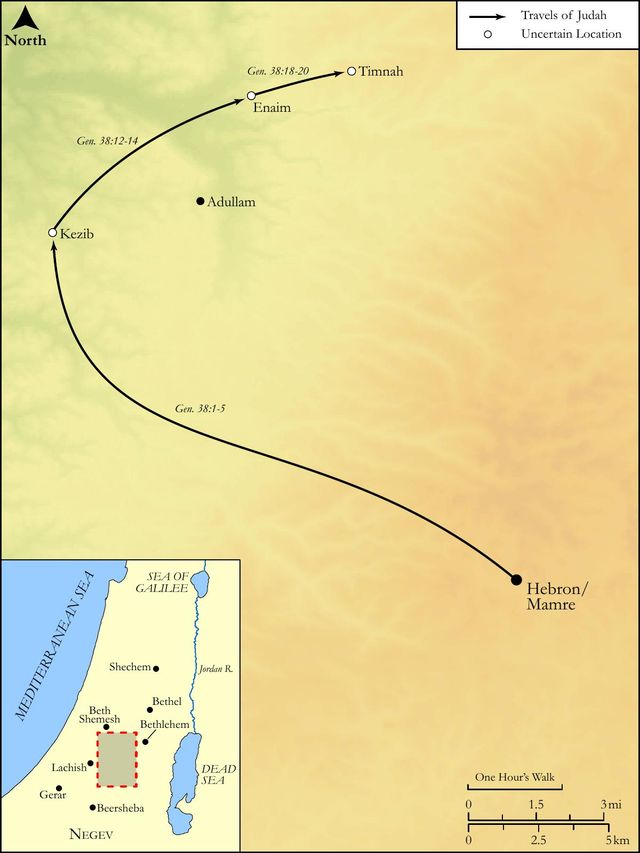
Study this verse
Public-domain commentary
Matthew Henry
From his Commentary on the Whole Bible. Henry comments on passages, not single verses — this entry covers Genesis 38:1–11.
Here is, 1. Judah's foolish friendship with a Canaanite-man. He went down from his brethren, and withdrew for a time from their society and his father's family, and got to be intimately acquainted with one Hirah, an Adullamite, Gen 38:1. It is computed that he was now not much above fifteen or sixteen years of age, an easy prey to the tempter. Note, When young people that have been well educated begin to change their company, they will soon change their manners, and lose their good education. Those that go down from their brethren, that despise and forsake the society of the seed of Israel, and pick up Canaanites for their companions, are going down the hill apace. It is of great consequence to young people to choose proper associates; for these they will imitate, study to recommend themselves to, and, by their opinion of them, value themselves: an error in this choice is often fatal. 2. His foolish marriage with a Canaanite-woman, a match made, not by his father, who, it should seem, was not consulted, but by his new friend Hirah, Gen 38:2. Many have been drawn into marriages scandalous and pernicious to themselves and their families by keeping bad company, and growing familiar with bad people: one wicked league entangles men in another. Let young people be admonished by this to take their good parents for their best friends, and to be advised by them, and not by flatterers, who wheedle them, to make a prey of them. 3. His children by this Canaanite, and his disposal of them. Three sons he had by her, Er, Onan, and Shelah. It is probable that she embraced the worship of the God of Israel, at least in profession, but, for aught that appears, there was little of the fear of God in the family. Judah married too young, and very rashly; he also married his sons too young, when they had neither wit nor grace to govern themselves, and the consequences were very bad. (1.) His first-born, Er, was notoriously wicked; he was so in the sight of the Lord, that is, in defiance of God and his law; or, if perhaps he was not wicked in the sight of God, to whom all men's wickedness is open; and what came of it? Why, God cut him off presently (Gen 38:7): The Lord slew him. Note, Sometimes God makes quick work with sinners, and takes them away in his wrath, when they are but just setting out in a wicked course of life. (2.) The next son, Onan, was, according to the ancient usage, married to the widow, to preserve the name of his deceased brother that died childless. Though God had taken away his life for his wickedness, yet they were solicitous to preserve his memory; and their disappointment therein, through Onan's sin, was a further punishment of his wickedness. The custom of marrying the brother's widow was afterwards made one of the laws of Moses, Deu 25:5. Onan, though he consented to marry the widow, yet, to the great abuse of his own body, of the wife that he had married, and of the memory of his brother that was gone, he refused to raise up seed unto his brother, as he was in duty bound. This was so much the worse because the Messiah was to descend from Judah, and, had he not been guilty of this wickedness, he might have had the honour of being one of his ancestors. Note, Those sins that dishonour the body and defile it are very displeasing to God and evidences of vile affections. (3.) Shelah, the third son, was reserved for the widow (Gen 38:11), yet with a design that he should not marry so young as his brothers had done, lest he die also. Some think that Judah never intended to marry Shelah to Tamar, but unjustly suspected her to have been the death of her two former husbands (whereas it was their own wickedness that slew them), and then sent her to her father's house, with a charge to remain a widow. If so, it was an inexcusable piece of prevarication that he was guilty of. However, Tamar acquiesced for the present, and waited the issue.
Continue studying Genesis 38:4 across the web’s major study libraries — every link below opens this exact verse, chapter, or book on the destination site.
Read & Compare
 BibleGatewayThis verse in more than 200 translations and 70 languages.
 Bible.comThe YouVersion reader — hundreds of translations, reading plans, and highlights.
 ESV.orgCrossway's official English Standard Version reader.
 NET BibleThe NET translation with 60,000+ translators' notes on every rendering decision.
 STEP BibleTyndale House's free study tool — original text, vocabulary, and scholarly resources.
 BibliaLogos Bible Software's free web reader.
 USCCBThe New American Bible (Revised Edition) with the U.S. bishops' study notes.
Commentaries
 BibleHub CommentariesDozens of classic commentaries on this verse, gathered on one page.
 StudyLightMore than 100 commentary sets — the largest collection on the web.
 BibleRefPlain-English commentary on what this verse means, verse by verse.
 Enduring WordDavid Guzik's free commentary on this chapter, widely used by Bible teachers.
 Bible Study ToolsVerse commentary alongside Greek and Hebrew study aids.
Original Language & Research
- BibleHub InterlinearThe verse word by word — original language, transliteration, and English.
- BibleHub LexiconEvery word's original-language definition and Strong's entry.
 Blue Letter BibleDeep-study tools — Strong's numbers, concordance, and word studies.
 SefariaThe Hebrew text with Rashi and centuries of Jewish commentary.
Sermons, Hymns & Audio


TrulyRandomVerse is not affiliated with these sites and doesn’t control their content. They’re linked because they’re genuinely useful.
Summary
Genesis 38:4 records the birth of Onan, Judah's second son, to his Canaanite wife. This concise genealogical entry is far from trivial; it serves as a crucial link in the patriarchal lineage, setting the stage for the complex and morally charged events that define the remainder of chapter 38, particularly concerning the levirate marriage custom and its profound implications for familial duty and divine judgment within the unfolding narrative of God's redemptive plan.
Context
ShowHideLiterary Context
Genesis chapter 38 functions as a significant narrative interlude, strategically placed between the account of Joseph's sale into slavery (Genesis 37) and his rise in Egypt (Genesis 39). This abrupt shift in focus from Joseph to Judah, one of his brothers, highlights Judah's personal journey and family development. Verse 4 specifically follows the birth of Judah's firstborn son, Er, as detailed in Genesis 38:3, and precedes the marriage of Er to Tamar. The immediate narrative flow establishes the burgeoning family of Judah, emphasizing the importance of male heirs in ancient Israelite society and preparing the reader for the subsequent dramatic events involving Er, Onan, and Tamar, which critically test the boundaries of familial obligation and divine justice.
Historical & Cultural Context
The events of Genesis 38 unfold in the patriarchal household of Judah, where lineage, inheritance, and the continuation of the family name were paramount. Marriage customs, particularly the levirate marriage (Deuteronomy 25:5-10), were designed to ensure the perpetuation of a deceased brother's line, preserving his name and inheritance. Judah's marriage to a Canaanite woman, the daughter of Shuah, reflects the intermingling of Abraham's descendants with local populations, a practice that would later be explicitly forbidden under the Mosaic Law. The naming of children, often by the mother, frequently carried symbolic or prophetic significance, reflecting circumstances of birth or hopes for the child's future.
Key Themes
ShowHideGenesis 38, despite its challenging content, contributes significantly to several overarching themes within the book of Genesis and the broader biblical narrative. It underscores the theme of God's sovereignty working through imperfect human agents and flawed circumstances to achieve His purposes, particularly in preserving the promised lineage leading to the Messiah. The chapter also explores themes of familial duty and responsibility, particularly through the custom of levirate marriage and the consequences of its neglect, as seen in Onan's actions (Genesis 38:8-10). Furthermore, it highlights the importance of lineage and covenant faithfulness, demonstrating how God meticulously tracks the descendants of Abraham, Isaac, and Jacob, especially the line of Judah, from whom the scepter would not depart (Genesis 49:10).
Exposition and Analysis
ShowHideGenesis 38:4 concisely states, "And she conceived again, and bare a son; and she called his name Onan." This verse, while brief, is packed with significance, marking the continuation of Judah's lineage and introducing a pivotal character in the unfolding drama of the chapter.
Key Word Analysis
ShowHideFrom a primitive root meaning "to be (or become) pregnant." This word emphasizes the biological reality of the new life forming within Judah's wife, highlighting the natural process of procreation that is foundational to the continuation of the family line and, by extension, God's covenant promises.
Derived from a root meaning "to build," this term signifies a male offspring who is seen as a "builder of the family name." In ancient patriarchal societies, the birth of a son was crucial for inheritance, perpetuating the lineage, and maintaining tribal identity. Onan's birth thus represents the strengthening and continuation of Judah's emerging family.
A variation of a word meaning "strength" or "vigor." The naming of the child by the mother, a common practice, here introduces a figure whose name ironically contrasts with his later actions. His name suggests potency and capability, yet his failure to fulfill his familial duties and his deliberate misuse of his physical capabilities will lead to divine judgment, making the etymology poignant.
Verse Breakdown
ShowHide"And she conceived again"
This clause indicates a second pregnancy for Judah's Canaanite wife, following the birth of their first son, Er, as recorded in the preceding verse. The repetition of "conceived" underscores the ongoing process of procreation and the establishment of Judah's family.
"and bare a son"
This phrase directly states the outcome of the pregnancy: the birth of a male child. In a culture where male heirs were essential for the family's survival, inheritance, and social standing, this was a momentous event, signifying the continuation and strengthening of Judah's lineage.
"and she called his name Onan"
This final clause identifies the newborn son by name. The act of naming, often performed by the mother, was significant, frequently reflecting circumstances of birth, hopes for the child, or even prophetic insights. The name "Onan" itself, meaning "strong" or "vigorous," sets up a subtle tension with the character's future actions, foreshadowing the tragic irony of his story.
Literary Devices
ShowHideThe brevity of Genesis 38:4 belies its literary function. The verse employs Foreshadowing by introducing Onan, whose name, meaning "strong" or "vigorous," subtly hints at the physical capacity he would later misuse in his refusal to fulfill the levirate duty. This creates an Irony between his name and his ultimate failure to act responsibly, leading to divine judgment. The verse also serves as a crucial point of Progression in the narrative, moving Judah's family story forward and setting the stage for the dramatic and morally complex events that will unfold in the subsequent verses of chapter 38.
Theological and Thematic Connections
ShowHideGenesis 38:4, while a simple genealogical record, is deeply embedded in the grand narrative of God's redemptive plan. It demonstrates God's unwavering faithfulness to His covenant promises, even when working through the flawed and often scandalous lives of His chosen people. The meticulous recording of Judah's lineage, despite the moral complexities that arise within it, underscores the divine commitment to preserving the line through which the Messiah would ultimately come. This verse, therefore, is not merely a historical note but a testament to God's sovereign hand guiding history toward His ultimate redemptive purposes, even amidst human sin and imperfection.
Reflection and Application
ShowHideGenesis 38:4, though a seemingly minor detail within a challenging chapter, offers profound insights for contemporary believers. It reminds us that God's overarching plan for humanity's redemption is not contingent upon human perfection but unfolds through the messy, imperfect realities of human lives and relationships. The inclusion of such a detail in Scripture underscores the Bible's unflinching honesty about human nature and God's persistent grace. For us, this means recognizing that our own lives, with all their complexities and imperfections, are woven into God's larger tapestry of redemption. It calls us to consider our own roles within our families and communities, recognizing that every action, every decision, contributes to a larger narrative. We are called to embody faithfulness, responsibility, and obedience, understanding that even our seemingly small choices have implications for the unfolding of God's purposes in the world.
Questions for Reflection
ShowHideFAQ
ShowHideWhy is Genesis 38 an interlude in the Joseph narrative?
ShowHideGenesis 38 provides a crucial pause in the story of Joseph to focus on Judah's personal life and lineage. This interlude is vital for several reasons: it explains Judah's later prominence among his brothers, foreshadows the moral decline that necessitated the Law, and most importantly, meticulously traces the lineage of the tribe of Judah, from which the Messiah would ultimately descend. It highlights God's sovereign hand in preserving the covenant line despite human failings, ensuring that the narrative of redemption continues even when human characters stray, as seen in the events that unfold after Genesis 38:4.
What is the significance of Onan's birth in the broader biblical narrative?
ShowHideOnan's birth, recorded in Genesis 38:4, is significant not only for continuing Judah's immediate family line but also for setting the stage for the dramatic and morally instructive events of Genesis 38:8-10. His subsequent refusal to fulfill the levirate marriage duty, and the divine judgment that follows, serve as a stark lesson on obedience, familial responsibility, and the consequences of self-serving actions within God's covenant framework. It also underscores the importance of preserving the family line for the Messianic promise, demonstrating that even through human failure, God's ultimate plan for redemption remains on track.
Christ-Centered Fulfillment
ShowHideGenesis 38:4, by recording the birth of Onan within Judah's lineage, contributes to the unfolding of God's redemptive plan that culminates in Jesus Christ. Although Onan himself is a figure of disobedience and judgment, his birth is a necessary link in the genealogical chain of Judah, the tribe prophesied to hold the scepter until Shiloh (the Messiah) comes (Genesis 49:10). This verse, therefore, subtly points to Christ by affirming the continuation of the very family line from which the Savior would eventually emerge, demonstrating God's unwavering faithfulness to His covenant promises even amidst human sin and imperfection. The New Testament genealogies of Jesus explicitly include Judah (Matthew 1:2-3 and Luke 3:33), underscoring the divine commitment to this specific lineage, ultimately leading to the one who would be born King of the Jews (Matthew 2:2) and the true Lamb of God who takes away the sin of the world (John 1:29).