


Genesis 29:7
Bible text: King James Version (1769 Blayney text) · Public domain
Bible text: Berean Standard Bible · Public domain
Bible text: American Standard Version (1901) · Public domain
Bible text: World English Bible, Messianic edition · Public domain
Bible text: Geneva Bible (1599) · Public domain
Bible text: Young's Literal Translation · Public domain
- וַיֹּאמֶרvai·Yo·merand he saidH559Conj-w ¦ V-Qal-ConsecImperf-3msVerb Qal Consecutive Imperfect 3rd Singular Masculineוַandיֹּאמֶרhe said
- הֵןhenhere!H2005PrtParticle Interjection
- עוֹד'OdstillH5750Adj-msAdjective Numerical Singular Masculine Absolute
- הַיּוֹםhai·Yomthe dayH3117Art ¦ N-msNoun Singular Masculine Absoluteהַtheיּוֹםday
- גָּדוֹלga·Dol[is] greatH1419Adj-msAdjective Singular Masculine Absolute
- לֹאlo'notH3808NegParticle Negative
- עֵת'et[the] time ofH6256N-cscNoun Singular common gender Construct
- הֵאָסֵףhe·'a·Sef[the] being gathered ofH622V-Niphal-InfVerb Niphal Infinitive Construct
- הַמִּקְנֶהha·mik·Nehthe livestockH4735Art ¦ N-msNoun Singular Masculine Absoluteהַtheמִּקְנֶהlivestock
- הַשְׁקוּhash·KuwaterH8248V-Hiphil-Imp-2mpVerb Hiphil Imperative 2nd Plural Masculine
- הַצֹּאןha·Tzonthe sheepH6629Art ¦ N-csNoun Singular common gender Absoluteהַtheצֹּאןsheep
- וּלְכוּu·le·Khuand goH1980Conj-w ¦ V-Qal-Imp-2mpVerb Qal Imperative 2nd Plural Masculineוּandלְכוּgo
- רְעוּre·'Upasture [them]H7462V-Qal-Imp-2mpVerb Qal Imperative 2nd Plural Masculine
English is a literal word-by-word gloss of the Hebrew, not the KJV's wording. Why?
This is the original text the KJV's translators worked from — each Hebrew word with its own literal English meaning in this verse, prepared by scholars at Tyndale House, Cambridge. The KJV translates whole sentences, not word by word, so its wording differs: one Hebrew word can become several English words, and the KJV may choose “the LORD” where the gloss reads “Yahweh”. Both are faithful — they answer different questions. For the KJV's own rendering, switch to the KJV text.
Details
See on the biblical-era maps


Study this verse
Public-domain commentary
Matthew Henry
From his Commentary on the Whole Bible. Henry comments on passages, not single verses — this entry covers Genesis 29:1–8.
All the stages Israel's march to Canaan are distinctly noticed, but no particular journal is kept of Jacob's expedition further than Beth-el; no, he had no more such happy nights as he had at Beth-el, no more such visions of the Almighty. That was intended for a feast; he must not expect it to be his daily bread. But, 1. We are here told how cheerfully he proceeded in his journey after the sweet communion he had with God at Beth-el: Then Jacob lifted up his feet; so the margin reads it, Gen 29:1. Then he went on with cheerfulness and alacrity, not burdened with his cares, nor cramped with his fears, being assured of God's gracious presence with him. Note, After the visions we have had of God, and the vows we have made to him in solemn ordinances, we should run the way of his commandments with enlarged hearts, Heb 12:1. 2. How happily he arrived at his journey's end. Providence brought him to the very field where his uncle's flocks were to be watered, and there he met with Rachel, who was to be his wife. Observe, (1.) The divine Providence is to be acknowledged in all the little circumstances which concur to make a journey, or other undertaking, comfortable and successful. If, when we are at a loss, we meet seasonably with those that can direct us - if we meet with a disaster, and those are at hand that will help us - we must not say that it was by chance, nor that fortune therein favoured us, but that it was by Providence, and that God therein favoured us. Our ways are ways of pleasantness, if we continually acknowledge God in them. (2.) Those that have flocks must look well to them, and be diligent to know their state, Pro 27:23. What is here said of the constant care of the shepherds concerning their sheep (Gen 29:2, Gen 29:3, Gen 29:7, Gen 29:8) may serve to illustrate the tender concern which our Lord Jesus, the great Shepherd of the sheep, has for his flock, the church; for he is the good Shepherd, that knows his sheep, and is known of them, Joh 10:14. The stone at the well's mouth, which is so often mentioned here, was either to secure their property in it (for water was scarce, it was not there usus communis aquarum - for every one's use), or it was to save the well from receiving damage from the heat of the sun, or from any spiteful hand, or to prevent the lambs of the flock from being drowned in it. (3.) Separate interests should not take us from joint and mutual help; when all the shepherds came together with their flocks, then, like loving neighbours, at watering-time, they watered their flocks together. (4.) It becomes us to speak civilly and respectfully to strangers. Though Jacob was no courtier, but a plain man, dwelling in tents, and a stranger to compliment, yet he addresses himself very obligingly to the people he met with, and calls them his brethren, Gen 29:4. The law of kindness in the tongue has a commanding power, Pro 31:26. Some think he calls them brethren because they were of the same trade, shepherds like him. Though he was now upon his preferment, he was not ashamed of his occupation. (5.) Those that show respect have usually respect shown to them. As Jacob was civil to these strangers, so he found them civil to him. When he undertook to teach them how to despatch their business (Gen 29:7), they did not bid him meddle with his own concerns and let them alone; but, though he was a stranger, they gave him the reason of their delay, Gen 29:8. Those that are neighbourly and friendly shall have neighbourly and friendly usage.
Continue studying Genesis 29:7 across the web’s major study libraries — every link below opens this exact verse, chapter, or book on the destination site.
Read & Compare
 BibleGatewayThis verse in more than 200 translations and 70 languages.
 Bible.comThe YouVersion reader — hundreds of translations, reading plans, and highlights.
 ESV.orgCrossway's official English Standard Version reader.
 NET BibleThe NET translation with 60,000+ translators' notes on every rendering decision.
 STEP BibleTyndale House's free study tool — original text, vocabulary, and scholarly resources.
 BibliaLogos Bible Software's free web reader.
 USCCBThe New American Bible (Revised Edition) with the U.S. bishops' study notes.
Commentaries
 BibleHub CommentariesDozens of classic commentaries on this verse, gathered on one page.
 StudyLightMore than 100 commentary sets — the largest collection on the web.
 BibleRefPlain-English commentary on what this verse means, verse by verse.
 Enduring WordDavid Guzik's free commentary on this chapter, widely used by Bible teachers.
 Bible Study ToolsVerse commentary alongside Greek and Hebrew study aids.
Original Language & Research
- BibleHub InterlinearThe verse word by word — original language, transliteration, and English.
- BibleHub LexiconEvery word's original-language definition and Strong's entry.
 Blue Letter BibleDeep-study tools — Strong's numbers, concordance, and word studies.
 SefariaThe Hebrew text with Rashi and centuries of Jewish commentary.
Sermons, Hymns & Audio


TrulyRandomVerse is not affiliated with these sites and doesn’t control their content. They’re linked because they’re genuinely useful.
Summary
Jacob, newly arrived in Haran, encounters local shepherds gathered by a well with their flocks and immediately perceives their idleness, noting that it is still "high day" and therefore premature to gather their livestock for the night. With practical wisdom, he urges them to water their sheep and then lead them back to pasture, emphasizing the diligent and efficient utilization of the remaining daylight for their essential pastoral responsibilities.
Context
ShowHideLiterary Context
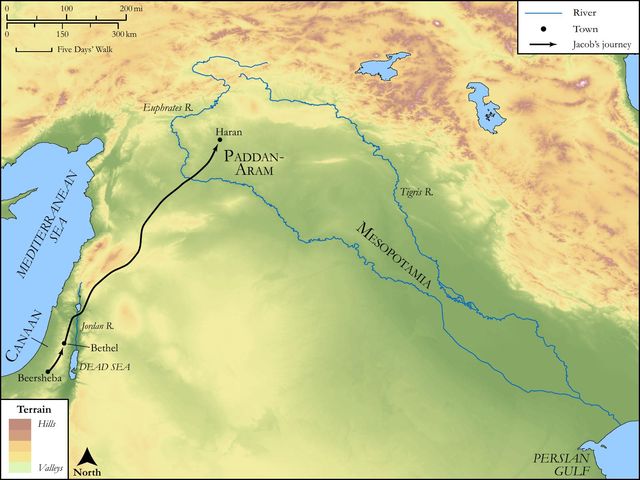
Genesis 29 opens with Jacob's journey eastward, fleeing the wrath of his brother Esau after deceiving him for the birthright and blessing. His journey, marked by the significant encounter with God at Bethel, leads him to the land of Haran, his mother Rebekah's homeland, in search of a wife. Upon reaching a well, he finds three flocks of sheep and their shepherds waiting. This scene sets the stage for his crucial encounter with Rachel, Laban's daughter, who arrives shortly after Jacob's interaction with these shepherds. Jacob's immediate assessment and counsel in Genesis 29:7 highlight his practical nature and serve as a prelude to his decisive action of rolling the stone from the well, thereby demonstrating his strength and initiative.
Historical & Cultural Context
In the pastoral country of Haran, wells were vital communal resources, often covered by heavy stones to prevent contamination, evaporation, or unauthorized use. Moving such a stone typically required the combined effort of several shepherds, suggesting a customary practice of waiting until all flocks or designated individuals were present. The concept of "high day" (Hebrew: yom gadol) refers to the significant portion of daylight still remaining, indicating it was not yet evening, the usual time for gathering flocks for the night. Shepherds would water their sheep mid-day or late afternoon before leading them to graze further, making the shepherds' idleness in Genesis 29:7 unusual and inefficient from Jacob's perspective. This scene provides a glimpse into the daily rhythms and communal dynamics of ancient pastoral life.
Key Themes
ShowHideGenesis 29:7 contributes to several overarching themes in Genesis and the broader narrative. It underscores the theme of Divine Providence, as Jacob's journey and seemingly ordinary encounter with the shepherds are part of God's sovereign plan to lead him to his future family and fulfill the covenant promises (Genesis 28:15). The verse also highlights Jacob's Character Development, showcasing his shrewdness, diligence, and proactive nature, traits that will define much of his life and interactions, particularly with Laban. Furthermore, it subtly introduces the theme of Stewardship and Diligence, contrasting the shepherds' apparent idleness with Jacob's call to productive labor, a principle echoed throughout the wisdom literature (e.g., Proverbs 6:6-11).
Exposition and Analysis
ShowHideKey Word Analysis
ShowHideA primitive particle used as an interjection, often translated as "behold!" or "look!" In this context, it serves to draw immediate attention to Jacob's observation, conveying a sense of surprise or urgency regarding the shepherds' inactivity. It sets a direct, almost challenging, tone for his subsequent words.
Literally "great day" or "much day." The word gâdôwl (H1419) signifies "great" in any sense, while yôwm (H3117) refers to a "day" (as the warm hours). Together, "high day" indicates that a significant portion of the daylight hours still remained, far from the evening when flocks would typically be gathered. This phrase underscores Jacob's assessment that the shepherds were idling prematurely.
Shâqâh means "to quaff" or "to irrigate," specifically to give drink. Râʻâh means "to tend a flock," including pasturing and generally ruling or caring for them. These two verbs represent the fundamental and immediate responsibilities of a shepherd. Jacob's command highlights the active, diligent care required for the flock's well-being and productivity.
Verse Breakdown
ShowHide"And he said, Lo, it is yet high day,"
Jacob, observing the scene, expresses his surprise or direct observation. The phrase "high day" (literally "the day is yet great") signifies that a substantial portion of the day remains, meaning it is far from evening. This sets up Jacob's questioning of their current inactivity.
"neither is it time that the cattle should be gathered together:"
Jacob points out that the customary time for gathering the flocks for the night has not yet arrived. This implies that the shepherds are either waiting unnecessarily or are being unproductive by not utilizing the remaining daylight. "Cattle" here refers broadly to their livestock, primarily sheep and goats.
"water ye the sheep, and go and feed them."
This is Jacob's direct command and practical advice. He urges them to fulfill their immediate duties: first, to provide water for the thirsty sheep, and then to lead them back to pasture for further grazing. This instruction emphasizes diligence, efficiency, and the proper management of the flock's needs within the available time.
Literary Devices
ShowHideThe verse employs several literary devices to convey its message. Direct Address is prominent, as Jacob speaks directly to the shepherds, engaging them in a practical dialogue. The phrase "Lo, it is yet high day" functions as an Exclamation and an Observation, immediately drawing attention to the perceived inefficiency of the situation. There is also a subtle use of Contrast between the ideal (active shepherding) and the reality (idle waiting), which Jacob highlights. Furthermore, Jacob's words serve as a form of Rhetorical Question (though phrased as a statement), implicitly asking why they are not working when there is ample time. This direct, no-nonsense communication style immediately establishes Jacob's pragmatic and proactive character.
Theological and Thematic Connections
ShowHideJacob's counsel in Genesis 29:7 transcends a mere practical instruction on animal husbandry; it subtly introduces profound theological and thematic connections. It underscores the biblical emphasis on diligence and stewardship of time and resources. Jacob's observation that it is "yet high day" serves as a reminder that opportunities for productive labor should not be squandered through idleness or procrastination. This aligns with a broader scriptural principle that God's people are called to be active participants in their responsibilities, making the most of the time given to them. Furthermore, this seemingly small interaction is part of God's larger providential plan, guiding Jacob to his future wife and family, demonstrating that even in mundane encounters, divine purposes are at work, often facilitated by human diligence.
Reflection and Application
ShowHideGenesis 29:7 offers a timeless challenge for personal reflection and practical application in our contemporary lives. The "high day" Jacob speaks of can be seen as a metaphor for the time, opportunities, and resources God has graciously given us. Are we, like the shepherds, sometimes waiting idly, procrastinating, or failing to seize the present moment for productive work, spiritual growth, or acts of service? This verse calls us to cultivate a spirit of diligence and intentionality in all our endeavors—whether in our vocations, our relationships, or our walk with God. It reminds us that there is often "yet high day" for us to engage purposefully with our responsibilities, to "water our sheep" (attend to our duties and the needs of those under our care) and "feed them" (nurture growth and productivity), rather than passively waiting for circumstances to change or for others to act. Embracing this proactive mindset allows us to honor God with our time and contribute meaningfully to His kingdom.
Questions for Reflection
ShowHideFAQ
ShowHideWhy were the shepherds waiting if it was "high day"?
ShowHideThe biblical text does not explicitly state the shepherds' reasons for waiting. However, wells in that country were often covered by a large, heavy stone that typically required multiple individuals to move. It's highly probable that the shepherds were waiting for all the flocks, or a sufficient number of shepherds, to gather before they collectively removed the stone to water their animals. Some commentators also suggest they might have been waiting for a specific shepherd, perhaps Rachel, who had the authority or the key to the well, to arrive. Jacob's question in Genesis 29:7 highlights the inefficiency of this collective waiting, suggesting they could have been more productive.
What does "high day" signify in ancient pastoral life?
ShowHideThe phrase "high day" (Hebrew: 'od hayyom gadol, literally "the day is yet great") signifies that a substantial portion of the daylight hours was still remaining. It indicates that it was not yet evening, which was the customary time for shepherds to gather their flocks for the night. In ancient pastoral life, this meant there was ample time for the sheep to be watered and then led back to pasture for further grazing before sunset. Jacob's emphasis on "high day" in Genesis 29:7 underscores his observation that the shepherds were prematurely idle and not making the most of the available productive time.
Christ-Centered Fulfillment
ShowHideWhile Genesis 29:7 speaks to human diligence, it finds a profound Christ-centered fulfillment in the life and ministry of Jesus. Our Lord consistently operated with a profound awareness of divine timing and an unwavering commitment to fulfilling His Father's will. Jesus declared, "I must work the works of him that sent me, while it is day: the night cometh, when no man can work" (John 9:4). He never procrastinated on His mission of teaching, healing, and ultimately, redeeming humanity. Like the diligent shepherd, Jesus is the Good Shepherd who lays down His life for the sheep, actively caring for His flock, leading them to living waters and spiritual pasture. Believers, as followers of Christ, are called to emulate His example of purposeful living and diligent stewardship, actively engaging in the work of the Kingdom while it is "high day," before the spiritual "night" arrives when opportunities for witness and service may cease (Ephesians 5:15-16).