


Genesis 21:4
Bible text: King James Version (1769 Blayney text) · Public domain
Bible text: Berean Standard Bible · Public domain
Bible text: American Standard Version (1901) · Public domain
Bible text: World English Bible, Messianic edition · Public domain
Bible text: Geneva Bible (1599) · Public domain
Bible text: Young's Literal Translation · Public domain
- וַיָּמָלvai·Ya·moland he circumcisedH4135Conj-w ¦ V-Qal-ConsecImperf-3msVerb Qal Consecutive Imperfect 3rd Singular Masculineוַandיָּמָלhe circumcised
- אַבְרָהָם'av·ra·HamAbrahamH85N-proper-mNoun Proper Masculine
- אֶת'et<obj.>H853DirObjMParticle Object Indicator
- יִצְחָקyitz·ChakIsaacH3327N-proper-mNoun Proper Masculine
- בְּנוֹbe·Nohis sonH1121N-msc ¦ 3msNoun Singular Masculine Constructבְּנsonוֹhis
- בֶּןbena son ofH1121N-mscNoun Singular Masculine Construct
- שְׁמֹנַתshe·mo·NateightH8083Adj-cscAdjective Numerical Singular common gender Construct
- יָמִיםya·MimdaysH3117N-mpNoun Plural Masculine Absolute
- כַּאֲשֶׁרka·'a·Sherjust asH834Prep-k ¦ RelParticle Relativeכַּjustאֲשֶׁרas
- צִוָּהtzi·Vahhe had commandedH6680V-Piel-Perf-3msVerb Piel Perfect 3rd Singular Masculine
- אֹתוֹ'o·To<obj.> himH853DirObjM ¦ 3msParticle Object Indicatorאֹת<obj.>וֹhim
- אֱלֹהִים'E·lo·HimGodH430N-mpNoun Plural Masculine Absolute
English is a literal word-by-word gloss of the Hebrew, not the KJV's wording. Why?
This is the original text the KJV's translators worked from — each Hebrew word with its own literal English meaning in this verse, prepared by scholars at Tyndale House, Cambridge. The KJV translates whole sentences, not word by word, so its wording differs: one Hebrew word can become several English words, and the KJV may choose “the LORD” where the gloss reads “Yahweh”. Both are faithful — they answer different questions. For the KJV's own rendering, switch to the KJV text.
Details
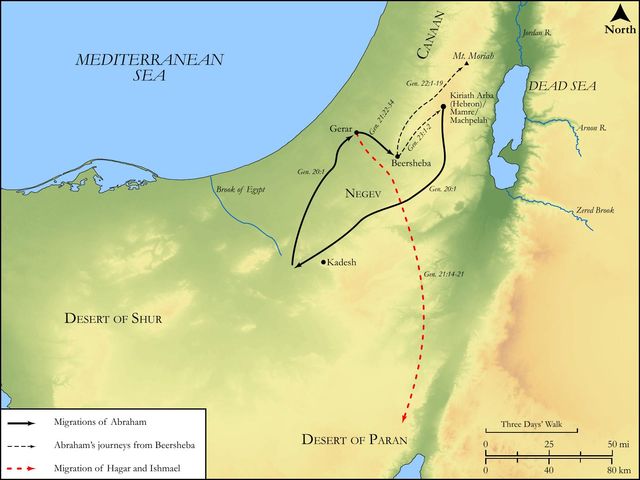
See on the biblical-era maps


Study this verse
Public-domain commentary
Matthew Henry
From his Commentary on the Whole Bible. Henry comments on passages, not single verses — this entry covers Genesis 21:1–8. His three-level outline is real structure in the source text, so it is rendered as structure.
Long-looked-for comes at last. The vision concerning the promised seed is for an appointed time, and now, at the end, it speaks, and does not lie; few under the Old Testament were brought into the world with such expectation as Isaac was, not for the sake of any great person eminence at which he was to arrive, but because he was to be, in this very thin, a type of Christ, that seed which the holy God had so long promised and holy men so long expected. In this account of the first days of Isaac we may observe,
I.The fulfilling of God's promise in the conception and birth of Isaac, Gen 21:1, Gen 21:2.
Note, God's providences look best and brightest when they are compared with his word, and when we observe how God, in them all, acts as he has said, as he has spoken.
1.Isaac was born according to the promise. The Lord visited Sarah in mercy, as he had said. Note, No word of God shall fall to the ground; for he is faithful that has promised, and God's faithfulness is the stay and support of his people's faith. He was born at the set time of which God had spoken, Gen 21:2. Note, God is always punctual to his time; though his promised mercies come not at the time we set, they will certainly come at the time he sets, and that is the best time.,
2.He was born by virtue of the promise: Sarah by faith received strength to conceive Heb 11:11. God therefore by promise gave that strength. It was not by the power of common providence, but by the power of a special promise, that Isaac was born. A sentence of death was, as it were, passed upon the second causes: Abraham was old, and Sarah old, and both as good as dead; and then the word of God took place. Note, True believers, by virtue of God's promises, are enabled to do that which is above the power of human nature, for by them they partake of a divine nature, Pe2 1:4.
II.Abraham's obedience to God's precept concerning Isaac.
1.He named him, as God commanded him, Gen 21:3. God directed him to a name for a memorial, Isaac, laughter; and Abraham, whose office it was, gave him that name, though he might have designed him some other name of a more pompous signification. Note, It is fit that the luxuriancy of human invention should always yield to the sovereignty and plainness of divine institution; yet there was good reason for the name, for,
(1.)When Abraham received the promise of him he laughed for joy, Gen 17:17. Note, When the sun of comfort has risen upon the soul it is good to remember how welcome the dawning of the day was, and with what exultation we embraced the promise.
(2.)When Sarah received the promise she laughed with distrust and diffidence. Note, When God gives us the mercies we began to despair of we ought to remember with sorrow and shame our sinful distrusts of God's power and promise, when we were in pursuit of them.
(3.)Isaac was himself, afterwards, laughed at by Ishmael (Gen 21:9), and perhaps his name bade him expect it. Note, God's favourites are often the world's laughing-stocks.
(4.)The promise which he was not only the son, but the heir of, was to be the joy of all the saints in all ages, and that which would fill their mouths with laughter.
2.He circumcised him, Gen 21:4. The covenant being established with him, the seal of the covenant was administered to him; and though a bloody ordinance, and he a darling, yet it must not be omitted, no, nor deferred beyond the eighth day. God had kept time in performing the promise, and therefore Abraham must keep time in obeying the precept.
III.The impressions which this mercy made upon Sarah.
1.It filled her with joy (Gen 21:6): "God has made me to laugh; he has given me both cause to rejoice and a heart to rejoice." Thus the mother of our Lord, Luk 1:46, Luk 1:47. Note,
(1.)God bestows mercies upon his people to encourage their joy in his work and service; and, whatever is the matter of our joy, God must be acknowledged as the author of it, unless it be the laughter of the fool.
(2.)When mercies have been long deferred they are the more welcome when they come.
(3.)It adds to the comfort of any mercy to have our friends rejoice with us in it: All that hear will laugh with me; for laughing is catching. See Luk 1:58. Others would rejoice in this instance of God's power and goodness, and be encouraged to trust in him. See Psa 119:74.
2.It filled her with wonder, Gen 21:7. Observe here,
(1.)What it was she thought so wonderful: That Sarah should give children suck, that she should, not only bear a child, but be so strong and hearty at the age as to give it suck. Note, Mothers, if they be able, ought to be nurses to their own children. Sarah was a person of quality, was aged; nursing might be thought prejudicial of herself, or to the child, or to both; she had choice of nurses, no doubt, in her own family: and yet she would do her duty in this matter; and her daughters the good wives are while they thus do well, Pe1 3:5, Pe1 3:6. See Lam 4:3.
(2.)How she expressed her wonder: "Who would have said it? The thing was so highly improbable, so near to impossible, that if any one but God had said it we could not have believed it." Note, God's favours to his covenant-people are such as surpass both their own and others' thoughts and expectations. Who could imagine that God should do so much for those that deserve so little, nay, for those that deserve so ill? See Eph 3:20; Sa2 7:18, Sa2 7:19. Who would have said that God should send his Son to die for us, his Spirit to sanctify us, his angels to attend us? Who would have said that such great sins should be pardoned, such mean services accepted, and such worthless worms taken into covenant and communion with the great and holy God?
IV.A short account of Isaac's infancy:
The child grew, Gen 21:8. Special notice is taken of this, though a thing of course, to intimate that the children of the promise are growing children. See Luk 1:80; Luk 2:40. Those that are born of God shall increase of God, Col 2:19. He grew so as not always to need milk, but was able to bear strong meat, and then he was weaned. See Heb 5:13, Heb 5:14. And then it was that Abraham made a great feast for his friends and neighbours, in thankfulness to God for his mercy to him. He made this feast, not on the day that Isaac was born, that would have been too great a disturbance to Sarah; nor on the day that he was circumcised, that would have been too great a diversion from the ordinance; but on the day that he was weaned, because God's blessing upon the nursing of children, and the preservation of them throughout the perils of the infant age, are signal instances of the care and tenderness of the divine providence, which ought to be acknowledged, to its praise. See Psa 22:9, Psa 22:10; Hos 11:1.
Historical interpretation
Five Centuries of Reception
2 surviving comments on this verse. Each one is dated, so this reads as a timeline rather than a list.
Select a marker to jump to its quote. Markers stagger vertically where authors wrote within a few decades of each other.
Let us ask the Lord lest, in accordance with the apostle’s word, even with us, “when Moses is read the veil be upon” our “heart.” For it has been read that Abraham begot a son, Isaac, when he was a hundred years old. “And Sarah said, ‘Who will announce to Abraham that Sarah nurses a child?’ ” “And then,” the text says, “Abraham circumcised the child on the eighth day.” Abraham does not celebrate his son’s birthday, but he celebrates the day of this weaning “and makes a great feast.”6Why? Do we think that it is the Holy Spirit’s intention to write stories and to narrate how a child was weaned and a feast was made, how he played and did other childish things? Or should we understand by these things that he wishes to teach us something divine and worthy that the human race might learn from the words of God?
And he circumcised him on the eighth day, as God had commanded him when he was a hundred years old. Just as Isaac was indeed born during the time of the Old Testament, yet by his very birth he designates the heirs of the New Testament, so the circumcision by which he was consecrated is indeed a sacrament of the Old Testament, but it was foreshadowed in the figure of the grace of the New Testament, by which the world was to be cleansed in Christ from all filth of sin, death, and mortality. For at that time circumcision freed the faithful from the bond of original transgression; yet it was given as a type of the higher grace, by which the entire kingdom of sin and death was to be destroyed by the passion and resurrection of the Lord; in the image of which we also are absolved from all sins in baptism, and on the last day, renewed from all corruption and mortality of flesh and soul, we will reach eternal life; where, as the Lord said, the sons of the resurrection neither marry nor are given in marriage, but are like angels in heaven; for they can no longer die (Mark 12:25). And because the Lord rose again from the dead on the eighth day, that is, after the Sabbath, we also hope to rise again in the eighth age; for there are six ages of this world, the seventh is the Sabbath rest of souls in another life, the eighth itself is of our resurrection and the universal judgement; therefore, it was rightly commanded that circumcision be performed on the eighth day. But the fact that Abraham was a hundred years old when Isaac was born and his son of the promise was circumcised, most fittingly corresponds to the perfection of that same promise. For since a hundred is a perfect number, which is especially evidenced by the fact that it passes from the left hand to the right; therefore, it mystically pertains to heavenly and perpetual goods, Isaac is rightly born into this, who by his birth born miraculously to aged parents, would designate the heirs not of a temporal and lowly kingdom, but of the eternal kingdom in the heavens, in which indeed as a sacrament, Noah’s ark was built over a hundred years, and Abraham dwelt a hundred years in the land of promise, and Isaac, sowing in Gerar, found a hundredfold in that very year, and the court of the tabernacle is a hundred cubits long; and in the parable of the gospel seed, the good ground produced a hundredfold fruit, and the Lord promises a hundredfold in this time and, moreover, eternal life to those who leave their own: in all of these, the number one hundred either designates the joys of eternal life or the good works by which one attains these.
Continue studying Genesis 21:4 across the web’s major study libraries — every link below opens this exact verse, chapter, or book on the destination site.
Read & Compare
 BibleGatewayThis verse in more than 200 translations and 70 languages.
 Bible.comThe YouVersion reader — hundreds of translations, reading plans, and highlights.
 ESV.orgCrossway's official English Standard Version reader.
 NET BibleThe NET translation with 60,000+ translators' notes on every rendering decision.
 STEP BibleTyndale House's free study tool — original text, vocabulary, and scholarly resources.
 BibliaLogos Bible Software's free web reader.
 USCCBThe New American Bible (Revised Edition) with the U.S. bishops' study notes.
Commentaries
 BibleHub CommentariesDozens of classic commentaries on this verse, gathered on one page.
 StudyLightMore than 100 commentary sets — the largest collection on the web.
 BibleRefPlain-English commentary on what this verse means, verse by verse.
 Enduring WordDavid Guzik's free commentary on this chapter, widely used by Bible teachers.
 Bible Study ToolsVerse commentary alongside Greek and Hebrew study aids.
Original Language & Research
- BibleHub InterlinearThe verse word by word — original language, transliteration, and English.
- BibleHub LexiconEvery word's original-language definition and Strong's entry.
 Blue Letter BibleDeep-study tools — Strong's numbers, concordance, and word studies.
 SefariaThe Hebrew text with Rashi and centuries of Jewish commentary.
Sermons, Hymns & Audio


TrulyRandomVerse is not affiliated with these sites and doesn’t control their content. They’re linked because they’re genuinely useful.
Summary
Genesis 21:4 meticulously records Abraham's immediate and faithful obedience to God's specific command by circumcising his son Isaac when he was precisely eight days old. This pivotal act formally inducted Isaac, the long-awaited son of promise, into the Abrahamic covenant, thereby signifying his participation in God's unique relationship with Abraham's descendants and profoundly reaffirming both God's unwavering faithfulness in providing the promised heir and Abraham's profound trust in divine instruction.
Context
ShowHideLiterary Context
Genesis 21:4 is nestled within a momentous period in Abraham's life, immediately following the miraculous birth of Isaac to Abraham and Sarah in their old age, as detailed in Genesis 21:1-3. The preceding chapters have meticulously built up to this fulfillment of God's long-standing promise, first given in Genesis 15 and reiterated with increasing specificity, including the promise of a son through Sarah and the institution of circumcision as a covenant sign in Genesis 17. The naming of Isaac, meaning "he laughs," in Genesis 21:3 sets the stage for this act of covenantal inclusion, emphasizing the joy and divine origin of this child. Thus, the circumcision of Isaac is not an isolated event but the crucial next step in the unfolding narrative of God's covenant faithfulness and Abraham's obedient response, formally integrating the heir into the lineage of promise.
Historical & Cultural Context
Circumcision was practiced by various peoples, Egypt, Edom, Ammon and Moab among them, but for Israel, it carried a unique theological significance. Unlike the nations round about, where it might have been a rite of passage, a hygienic practice, or a tribal mark, for Abraham and his descendants, it was explicitly commanded by God as the physical sign of the Abrahamic covenant (Genesis 17:10-14). This made it a religious obligation, distinguishing God's chosen people. The specific timing of the eighth day, later codified in Mosaic Law (Leviticus 12:3), was unique and held profound implications, both theological and, as modern science has revealed, medical. Abraham's adherence to this precise timing demonstrates his commitment to God's specific, rather than general, commands, setting a precedent for the covenant community.
Key Themes
ShowHideThis verse powerfully contributes to several overarching themes within Genesis and the broader biblical narrative. Foremost is the theme of Divine Faithfulness and Promise-Keeping, as Isaac's birth and subsequent covenantal inclusion are direct fulfillments of God's miraculous promises to Abraham and Sarah, even in their old age (Genesis 18:10-14). Closely related is the theme of Human Obedience and Faith, exemplified by Abraham's prompt and precise execution of God's command, which serves as a model of faith demonstrated through action. The act of circumcision itself underscores the theme of Covenant and Election, marking Isaac as a participant in God's special relationship with Abraham's lineage and signifying the distinct identity and responsibilities of God's chosen people. Finally, the specific detail of the "eight days old" subtly introduces the theme of Divine Wisdom in Law, hinting at a perfect design in God's commands that transcends immediate human understanding.
Exposition and Analysis
ShowHideGenesis 21:4 succinctly captures a moment of profound theological significance, demonstrating Abraham's unwavering obedience and the formal inclusion of Isaac into God's covenant.
Key Word Analysis
ShowHideFrom a primitive root meaning "to cut short," specifically referring to the foreskin. In this context, it denotes the ritual act commanded by God as the sign of the Abrahamic covenant. It implies not just the physical act but the spiritual significance of setting apart and dedicating to God, a cutting away that marks belonging and identity within the covenant community.
Derived from the Hebrew root meaning "laughter." This name was given by divine instruction (Genesis 17:19) and reflects the reaction of both Abraham and Sarah to the seemingly impossible promise of his birth (Genesis 17:17 and Genesis 18:12). His naming and subsequent circumcision underscore his identity as the miraculous "son of promise," the one through whom God's covenant with Abraham would continue.
An intensive primitive root meaning "to constitute, enjoin." This word highlights the authoritative nature of God's instruction to Abraham regarding circumcision (Genesis 17:9-14). It emphasizes that Abraham's action was not a personal choice or cultural custom but a direct, divine mandate, making his obedience a direct response to God's sovereign will.
Verse Breakdown
ShowHide"And Abraham circumcised his son Isaac"
This clause directly attributes the action to Abraham, emphasizing his personal responsibility and active role in fulfilling God's command. The mention of "his son Isaac" immediately identifies the subject of the covenant act as the long-awaited heir, the fulfillment of God's promise, and the one through whom the covenant lineage would continue.
"being eight days old"
This precise detail is crucial. It highlights Abraham's strict adherence to the exact timing stipulated by God in Genesis 17:12. This specific timing was not arbitrary; it would later be codified in Mosaic Law and, remarkably, aligns with modern medical understanding regarding a newborn's clotting factors being optimal around the eighth day, minimizing the risk of hemorrhage. This subtle detail underscores God's perfect wisdom in His commands, even in seemingly ritualistic stipulations.
"as God had commanded him"
This concluding phrase is central to the verse's meaning. It explicitly links Abraham's action directly to divine instruction, serving as the theological justification for the act. It underscores Abraham's unwavering obedience to God's specific instructions, reinforcing his character as a man of profound faith. This obedience was not merely an act of compliance but a demonstration of trust in the God who had promised and now delivered the son.
Literary Devices
ShowHideThe verse employs several literary devices to convey its profound meaning. Conciseness is evident in its brief yet impactful statement, packing significant theological weight into a few words. The phrase "as God had commanded him" functions as a form of Attribution or Justification, explicitly linking Abraham's action to divine authority and underscoring the theme of obedience. The precise detail "eight days old" serves as Emphasis on Abraham's meticulous adherence to God's instructions, highlighting his faithfulness. Furthermore, the act of circumcision itself is rich in Symbolism, representing the physical mark of the covenant, the setting apart of God's chosen people, and a foreshadowing of the spiritual cutting away of sin. The narrative implicitly uses Foreshadowing by highlighting God's wisdom in the timing, which would later be understood medically, hinting at the divine design embedded within God's commands.
Theological and Thematic Connections
ShowHideGenesis 21:4 stands as a testament to God's covenant faithfulness and Abraham's obedient response, weaving together foundational theological principles that resonate throughout biblical history. The physical act of circumcision, precisely executed, served as the visible sign of an invisible spiritual reality: God's election of Abraham's lineage and their participation in His redemptive plan. This event reinforces the truth that God's promises are sure, and His commands are to be obeyed with trust and precision, establishing the pattern for the covenant community.
Reflection and Application
ShowHideAbraham's example in Genesis 21:4 offers profound and enduring lessons for believers today. It calls us to consider the depth of our own obedience to God's Word, reminding us that true faith is not merely intellectual assent but is demonstrated through our willingness to follow His commands precisely and promptly, even when they may seem counter-cultural or challenging. Just as physical circumcision marked a covenant relationship in the Old Testament, Christians are called to a "circumcision of the heart," a spiritual transformation that involves a radical cutting away of sin and a complete dedication to Christ. This spiritual reality, described in the New Testament, signifies a new identity and belonging in God's family, not through external ritual but internal renewal. For parents, this verse highlights the sacred responsibility to nurture their children in faith, introducing them to God's covenant relationship from an early age and modeling a life of devoted obedience to divine commands. Our lives, like Abraham's, should bear witness to our trust in God's perfect wisdom and unwavering faithfulness.
Questions for Reflection
ShowHideFAQ
ShowHideWhy was circumcision performed on the eighth day?
ShowHideThe Old Testament law, as established in Genesis 17:12 and later codified in Leviticus 12:3, specified the eighth day for circumcision. This timing is not arbitrary; modern medical science confirms that a newborn's vitamin K levels, crucial for blood clotting, are at their peak around the eighth day, minimizing the risk of hemorrhage. This detail highlights God's perfect wisdom in His commands, demonstrating a divine foresight that predates human medical understanding and underscores the benevolent nature of His laws.
Is physical circumcision still a requirement for believers today?
ShowHideNo. The New Testament clarifies that physical circumcision is not a requirement for salvation or inclusion in the New Covenant. The Jerusalem Council in Acts 15 decisively addressed this, concluding that Gentile believers were not required to be circumcised. Paul further emphasizes in Galatians 5:6 that "neither circumcision nor uncircumcision has any value—only faith working through love." Instead, believers are called to a "circumcision of the heart" (Romans 2:29), a spiritual transformation marked by repentance, faith, and obedience to Christ, signifying a cutting away of sin and a new identity in Him (Colossians 2:11).
Christ-Centered Fulfillment
ShowHideThe circumcision of Isaac, the son of promise, finds its ultimate fulfillment and deeper meaning in the person and work of Jesus Christ. Isaac's miraculous birth, a testament to God's power over human impossibility, foreshadows the even greater spiritual birth and new creation found in Christ. The physical sign of circumcision, marking one as belonging to Abraham's lineage and the Old Covenant, points forward to the spiritual "circumcision of the heart" accomplished through Jesus. In the New Covenant, true belonging to God's family is not through physical lineage or ritual but through faith in Jesus, who perfectly fulfilled the law and established a new covenant by His blood. Christ Himself is the ultimate "Son of promise," the seed of Abraham through whom all the blessings promised to Abraham are extended to all nations (Galatians 3:16). Through His death and resurrection, believers are spiritually circumcised, having their old sinful nature "cut away" and being made new in Him (Colossians 2:11-12). Thus, the obedience of Abraham in circumcising Isaac points to the greater obedience of Christ, whose perfect life and sacrificial death provide the means for all who believe to be truly set apart for God, not by a physical mark, but by spiritual transformation and union with Him (Romans 2:28-29).