


Genesis 10:23
Bible text: King James Version (1769 Blayney text) · Public domain
Bible text: Berean Standard Bible · Public domain
Bible text: American Standard Version (1901) · Public domain
Bible text: World English Bible, Messianic edition · Public domain
Bible text: Geneva Bible (1599) · Public domain
Bible text: Young's Literal Translation · Public domain
- וּבְנֵיu·ve·Neiand [the] sons ofH1121Conj-w ¦ N-mpcNoun Plural Masculine Constructוּandבְנֵי[the] sons of
- אֲרָם'a·RamAramH758N-proper-mNoun Proper Masculine
- עוּץ'utz[were] UzH5780N-proper-mNoun Proper Masculine
- וְחוּלve·Chuland HulH2343Conj-w ¦ N-proper-mNoun Proper MasculineוְandחוּלHul
- וְגֶתֶרve·Ge·terand GetherH1666Conj-w ¦ N-proper-mNoun Proper MasculineוְandגֶתֶרGether
- וָמַשׁva·Mashand MashH4851Conj-w ¦ N-proper-mNoun Proper MasculineוָandמַשׁMash
English is a literal word-by-word gloss of the Hebrew, not the KJV's wording. Why?
This is the original text the KJV's translators worked from — each Hebrew word with its own literal English meaning in this verse, prepared by scholars at Tyndale House, Cambridge. The KJV translates whole sentences, not word by word, so its wording differs: one Hebrew word can become several English words, and the KJV may choose “the LORD” where the gloss reads “Yahweh”. Both are faithful — they answer different questions. For the KJV's own rendering, switch to the KJV text.
Details
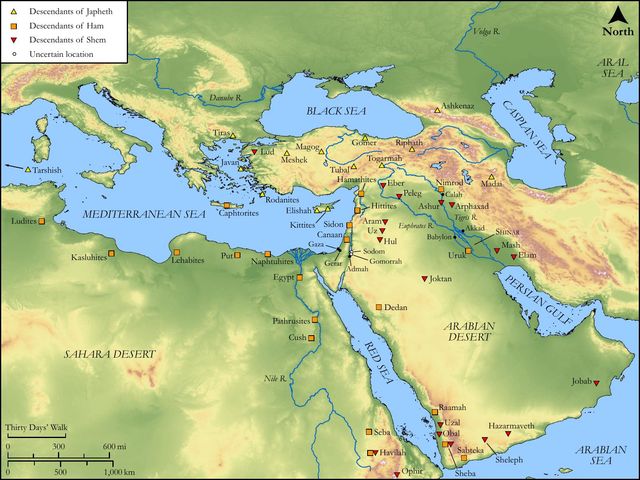
See on the biblical-era maps


Study this verse
Public-domain commentary
Matthew Henry
From his Commentary on the Whole Bible. Henry comments on passages, not single verses — this entry covers Genesis 10:21–32. His three-level outline is real structure in the source text, so it is rendered as structure.
Two things especially are observable in this account of the posterity of Shem: -
I.The description of Shem, Gen 10:21.
We have not only his name, Shem, which signifies a name, but two titles to distinguish him by: -
1.He was the father of all the children of Eber. Eber was his great grandson; but why should he be called the father of all his children, rather than of all Arphaxad's, or Salah's, etc.? Probably because Abraham and his seed, God's covenant-people, not only descended from Heber, but from him were called Hebrews; Gen 14:13, Abram the Hebrew. Paul looked upon it as his privilege that he was a Hebrew of the Hebrews, Phi 3:5. Eber himself, we may suppose, was a man eminent for religion in a time of general apostasy, and a great example of piety to his family; and, the holy tongue being commonly called from him the Hebrew, it is probable that he retained it in his family, in the confusion of Babel, as a special token of God's favour to him; and from him the professors of religion were called the children of Eber. Now, when the inspired penman would give Shem an honourable title, he calls him the father of the Hebrews. Though when Moses wrote this, they were a poor despised people, bond-slaves in Egypt, yet, being God's people, it was an honour to a man to be akin to them. As Ham, though he had many sons, is disowned by being called the father of Canaan, on whose seed the curse was entailed (Gen 9:22), so Shem, though he had many sons, is dignified with the title of the father of Eber, on whose seed the blessing was entailed. Note, a family of saints is more truly honourable than a family of nobles, Shem's holy seed than Ham's royal seed, Jacob's twelve patriarchs than Ishmael's twelve princes, Gen 17:20. Goodness is true greatness.
2.He was the brother of Japheth the elder, by which it appears that, though Shem is commonly put first, he was not Noah's first-born, but Japheth was older. But why should this also be put as part of Shem's title and description, that he was the brother of Japheth, since it had been, in effect, said often before? And was he not as much brother to Ham? Probably this was intended to signify the union of the Gentiles with the Jews in the church. The sacred historian had mentioned it as Shem's honour that he was the father of the Hebrews; but, lest Japheth's seed should therefore be looked upon as for ever shut out from the church, he here reminds us that he was the brother of Japheth, not in birth only, but in blessing; for Japheth was to dwell in the tents of Shem. Note,
(1.)Those are brethren in the best manner that are so by grace, and that meet in the covenant of God and in the communion of saints.
(2.)God, in dispensing his grace, does not go by seniority, but the younger sometimes gets the start of the elder in coming into the church; so the last shall be first and the first last.
II.The reason of the name of Peleg (Gen 10:25):
Because in his days (that is, about the time of his birth, when his name was given him), was the earth divided among the children of men that were to inhabit it; either when Noah divided it by an orderly distribution of it, as Joshua divided the land of Canaan by lot, or when, upon their refusal to comply with that division, God, in justice, divided them by the confusion of tongues: whichsoever of these was the occasion, pious Heber saw cause to perpetuate the remembrance of it in the name of his son; and justly may our sons be called by the same name, for in our days, in another sense, is the earth, the church, most wretchedly divided.
Historical interpretation
Six Centuries of Reception
3 surviving comments on this verse. Each one is dated, so this reads as a timeline rather than a list.
Select a marker to jump to its quote. Markers stagger vertically where authors wrote within a few decades of each other.
Shem, the third son of Noah, had five sons, who inhabited the land that began at Euphrates, and reached to the Indian Ocean. For Elam left behind him the Elamites, the ancestors of the Persians. Ashur lived at the city Nineve; and named his subjects Assyrians, who became the most fortunate nation, beyond others. Arphaxad named the Arphaxadites, who are now called Chaldeans. Aram had the Aramites, which the Greeks called Syrians; as Laud founded the Laudites, which are now called Lydians. Of the four sons of Aram, Uz founded Trachonitis and Damascus: this country lies between Palestine and Celesyria. Ul founded Armenia; and Gather the Bactrians; and Mesa the Mesaneans; it is now called Charax Spasini. Sala was the son of Arphaxad; and his son was Heber, from whom they originally called the Jews Hebrews. (18) Heber begat Joetan and Phaleg: he was called Phaleg, because he was born at the dispersion of the nations to their several countries; for Phaleg among the Hebrews signifies division. Now Joctan, one of the sons of Heber, had these sons, Elmodad, Saleph, Asermoth, Jera, Adoram, Aizel, Decla, Ebal, Abimael, Sabeus, Ophir, Euilat, and Jobab. These inhabited from Cophen, an Indian river, and in part of Asia adjoining to it. And this shall suffice concerning the sons of Shem.
(Verse 23.) The sons of Aram were Us, Ul, Gether, and Mes. Us founded Trachonitis and Damascus, and he held the principality between Palestine and Coele-Syria. From him, the Seventy Interpreters translated the land of Us, the region of Ausitis, as if it were Usitis, in the Book of Job where it is written in Hebrew. Ul is the ancestor of the Armenians; Gether is the ancestor of the Acarnanians, or the Carians. And Mes, whom the Seventy Interpreters called Mosoch, are now called Maeones.
The sons of Aram: Uz, and Hul, and Gether, and Mash. Uz, the founder of Trachonitis and Damascus, held the chiefdom between Palestine and Coele-Syria. Hul, from whom the Armenians come. Gether, from whom the Arcanians, or Carians come. Moreover, Mash, for whom the Septuagint interpreters said Mosoch, who are called the Maonians."
Continue studying Genesis 10:23 across the web’s major study libraries — every link below opens this exact verse, chapter, or book on the destination site.
Read & Compare
 BibleGatewayThis verse in more than 200 translations and 70 languages.
 Bible.comThe YouVersion reader — hundreds of translations, reading plans, and highlights.
 ESV.orgCrossway's official English Standard Version reader.
 NET BibleThe NET translation with 60,000+ translators' notes on every rendering decision.
 STEP BibleTyndale House's free study tool — original text, vocabulary, and scholarly resources.
 BibliaLogos Bible Software's free web reader.
 USCCBThe New American Bible (Revised Edition) with the U.S. bishops' study notes.
Commentaries
 BibleHub CommentariesDozens of classic commentaries on this verse, gathered on one page.
 StudyLightMore than 100 commentary sets — the largest collection on the web.
 BibleRefPlain-English commentary on what this verse means, verse by verse.
 Enduring WordDavid Guzik's free commentary on this chapter, widely used by Bible teachers.
 Bible Study ToolsVerse commentary alongside Greek and Hebrew study aids.
Original Language & Research
- BibleHub InterlinearThe verse word by word — original language, transliteration, and English.
- BibleHub LexiconEvery word's original-language definition and Strong's entry.
 Blue Letter BibleDeep-study tools — Strong's numbers, concordance, and word studies.
 SefariaThe Hebrew text with Rashi and centuries of Jewish commentary.
Sermons, Hymns & Audio


TrulyRandomVerse is not affiliated with these sites and doesn’t control their content. They’re linked because they’re genuinely useful.
Summary
Genesis 10:23 is a concise yet pivotal verse within the comprehensive "Table of Nations" in Genesis 10, which meticulously records the descendants of Noah's three sons—Shem, Ham, and Japheth—after the great flood. This particular verse focuses on the lineage of Aram, one of the sons of Shem, enumerating his four sons: Uz, Hul, Gether, and Mash. This meticulous cataloging of family lines provides a foundational understanding of the early distribution and formation of distinct peoples and geographical regions of the earth, laying the groundwork for the subsequent historical narratives of the biblical text.
Context
ShowHideLiterary Context
Genesis 10, often referred to as the "Table of Nations," is a unique genealogical and geographical survey that details the repopulation of the earth following the universal Flood. It systematically traces the expansion of humanity from Noah's family, demonstrating how different nations and language groups emerged and spread across the earth. Genesis 10:23 specifically falls within the section dedicated to the descendants of Shem (Genesis 10:21-31), the ancestral line through which God's covenant promises would ultimately be channeled, leading to Abraham and, eventually, to the nation of Israel. The verse acts as a direct enumeration of Aram's immediate offspring, who would in turn become the progenitors of various Aramaean tribes and peoples, connecting this specific lineage to the broader narrative of human dispersion.
Historical & Cultural Context
The names listed in Genesis 10:23 are significant for understanding the historical and geographical landscape of Syria and Mesopotamia. Aram himself is the eponymous ancestor of the Aramaeans, a prominent Semitic people whose influence stretched across Mesopotamia and Syria. Their language, Aramaic, became a widely spoken lingua franca across the region, even influencing the Hebrew language and being spoken by Jesus during His earthly ministry. The sons of Aram—Uz, Hul, Gether, and Mash—represent distinct branches or geographical settlements of this widespread people group. While the precise locations of all these groups are debated by scholars, Uz is notably associated with the land where Job lived, suggesting areas bordering Edom or northern Arabia, thereby illustrating the expansive reach of Aram's descendants across a significant portion of the lands east of Canaan.
Key Themes
ShowHideGenesis 10:23 contributes to several overarching themes within the broader biblical narrative. Firstly, it underscores the theme of Divine Order and Sovereignty, demonstrating God's meticulous oversight in the repopulation and distribution of humanity across the earth according to His sovereign design, as commanded in Genesis 9:1. Secondly, it highlights the Importance of Genealogy and Ancestry in biblical thought. These genealogies are not mere lists but serve to establish historical links between peoples, preserve the record of God's unfolding plan, and meticulously trace the lineage that would lead to the Messiah, as foreshadowed in passages like Genesis 3:15. Lastly, the verse contributes to the theme of the Unity and Diversity of Humanity, affirming a common origin for all peoples tracing back to Noah's single family, while simultaneously detailing their diversification into distinct ethnic and linguistic groups across the globe, as seen in the broader scope of Genesis 10.
Exposition and Analysis
ShowHideKey Word Analysis
ShowHideThis term, derived from a root meaning "to build," signifies a son (as a builder of the family name) in its widest sense. It encompasses literal and figurative relationships, including grandsons, subjects, nations, or even qualities. In Genesis 10:23, it denotes the direct male offspring of Aram, emphasizing the foundational role these individuals played in establishing new family lines and, by extension, distinct tribal or national groups.
Meaning "the highland," Aram refers to both a geographical region (Syria or Mesopotamia) and the eponymous ancestor of the Aramaean people. In this context, Aram is identified as a son of Shem, establishing his lineage within the Semitic branch of Noah's descendants. His name becomes central to understanding the historical and linguistic landscape of Syria and Mesopotamia, as his descendants formed powerful kingdoms and their language became widely influential.
Apparently meaning "consultation," Uz is listed as one of Aram's sons. This name is significant because it appears elsewhere in the Bible, notably as the land of Job (Job 1:1), suggesting a specific geographical association. Its inclusion here links the genealogical record to identifiable regions, indicating the early spread and settlement of Aram's descendants.
Verse Breakdown
ShowHide"And the children of Aram;"
This introductory clause establishes the subject of the verse, focusing on the direct descendants of Aram, who has just been identified as a son of Shem in the preceding verses of the Table of Nations. This phrase immediately signals a further branching of the human family tree.
"Uz, and Hul, and Gether, and Mash."
This is a direct enumeration of Aram's four sons. Each name represents a distinct individual who, in turn, became the progenitor of a specific tribal or national group associated with the broader Aramaean people. The listing of these names is not merely a record but a foundational element for understanding the subsequent ethnic and geographical landscape of Syria and Mesopotamia as depicted in the biblical narrative.
Literary Devices
ShowHideThe primary literary device at play in Genesis 10:23, and indeed throughout the "Table of Nations," is Enumeration, specifically in the form of a Genealogy. This systematic listing of names serves to meticulously record the lineage and dispersion of humanity after the Flood, providing a historical framework for the subsequent narratives. The precise naming of individuals and their familial relationships demonstrates the biblical author's commitment to historical accuracy and the ordered progression of God's plan. Furthermore, there is an element of Onomastics, the study of names, as the names themselves often carry inherent meanings or become associated with specific geographical regions or peoples, providing clues to their historical and cultural significance within the broader narrative of Scripture.
Theological and Thematic Connections
ShowHideGenesis 10:23, as part of the Table of Nations, profoundly underscores the biblical emphasis on the unity of all humanity, tracing every nation back to a common ancestor in Noah, while simultaneously acknowledging and detailing the subsequent diversification of peoples. This systematic record highlights God's sovereign hand in orchestrating the repopulation of the earth and the formation of distinct ethnic groups, each with its own place in the unfolding divine drama. It lays the groundwork for understanding the complex relationships between nations throughout the Old Testament and affirms that all peoples, regardless of their origin, are part of God's created order and fall under His universal dominion. The meticulous nature of these genealogies also reinforces the historical reliability of the biblical narrative, demonstrating a purposeful and detailed account of human origins and dispersion.
Reflection and Application
ShowHideWhile Genesis 10:23 may appear to be a simple list of names, it carries profound implications for our understanding of God's sovereignty, human history, and our place within His grand narrative. It reminds us that every person, every tribe, and every nation has a common origin in God's creation, stemming from the family of Noah. This foundational truth counters any notion of racial superiority or inherent division, asserting a shared humanity under the Creator. For the modern reader, this verse encourages a deeper appreciation for the Bible's historical meticulousness and its assertion of an ordered world, where even the dispersion of peoples is part of a divine plan. It also challenges us to see beyond ethnic or national distinctions, recognizing that all people groups are part of God's intricate tapestry, each with a unique story that ultimately points back to Him. Understanding these ancient lineages helps us grasp the geopolitical landscape of the Old Testament, explaining the origins of peoples and their interactions, such as the Aramaeans' frequent encounters with Israel, as seen when Rebekah and Jacob's wives came from Paddan-Aram. This verse beckons us to consider the intricate connections God weaves throughout history, leading to His ultimate redemptive purposes.
Questions for Reflection
ShowHideFAQ
ShowHideWhat was the historical significance of Aram and his descendants?
ShowHideAram's descendants, the Aramaeans, became one of the most significant peoples among the nations round about Israel. They established various kingdoms, often referred to as Syria in the Old Testament, and their language, Aramaic, rose to become a widely spoken lingua franca across the region. Aramaic influenced Hebrew and was the common language spoken by Jesus and His disciples. Their presence profoundly shaped the political, economic, and cultural life of Israel's neighbours, leading to numerous interactions with Israel, both hostile and peaceful, as recorded throughout the Old Testament, particularly in books like 2 Kings.
Are the locations mentioned in Genesis 10:23 identifiable today?
ShowHideWhile precise modern identifications are challenging for all names, some connections are widely accepted by scholars. Uz is commonly associated with areas bordering Edom and northern Arabia, notably as the land of Job (Job 1:1). Hul, Gether, and Mash are generally understood to represent various Aramaean groups or territories within Mesopotamia or Syria. While their exact modern counterparts remain speculative, their inclusion illustrates the broad geographical spread of Aram's lineage, extending the reach of the Aramaean people across a significant portion of Syria and Mesopotamia.
Why are these genealogies included in the Bible?
ShowHideThese genealogies are included for several crucial reasons. Firstly, they establish historical continuity from creation through the patriarchs, providing a chronological framework for God's redemptive plan. Secondly, they demonstrate God's faithfulness in fulfilling His promises through specific lineages, particularly the line of Shem, which eventually leads to Abraham and the nation of Israel. Thirdly, they illustrate the common origin and subsequent dispersion of humanity, highlighting both the unity and diversity of the human race. Lastly, they provide a framework for understanding the relationships between nations and the unfolding of God's redemptive plan for all peoples, as seen in the call of Abraham in Genesis 12:1-3.
Christ-Centered Fulfillment
ShowHideThough Genesis 10:23 details the dispersion and diversification of humanity, it ultimately points to Christ by meticulously establishing the historical and ethnic backdrop against which God's universal plan of redemption unfolds. The genealogies, particularly through Shem's line (from which Aram descends), meticulously trace the lineage that would eventually lead to Abraham, through whom God promised that "all the families of the earth shall be blessed" (Genesis 12:3). This promise finds its ultimate fulfillment in Jesus Christ, who, as a descendant of Shem, Abraham, and David (Matthew 1:1), breaks down the dividing wall of hostility between Jew and Gentile, effectively uniting all nations and peoples into one new humanity—the Church (Ephesians 2:14-16). Thus, the initial scattering and diversification of peoples recorded in Genesis 10 finds its ultimate reversal and unity in the reconciling work of Christ, fulfilling God's original purpose for a unified family of faith drawn from every tribe and tongue and people and nation (Revelation 7:9-10).