


Ezra 2:41
- הַמְשֹׁרְרִיםham·sho·re·Rimthe singersH7891Art ¦ V-Piel-Prtcpl-mpVerb Piel Participle Plural Masculine Absoluteהַtheמְשֹׁרְרִיםsingers
- בְּנֵיbe·Nei[the] descendants ofH1121N-mpcNoun Plural Masculine Construct
- אָסָף'a·SafAsaphH623N-proper-mNoun Proper Masculine
- מֵאָהme·'Ahone hundredH3967Adj-fsAdjective Numerical Singular Feminine Absolute
- עֶשְׂרִים'es·RimtwentyH6242Adj-mpAdjective Numerical Plural Masculine Absolute
- וּשְׁמֹנָהu·she·mo·Nahand eightH8083Conj-w ¦ Adj-csAdjective Numerical Singular common gender Absoluteוּandשְׁמֹנָהeight
English is a literal word-by-word gloss of the Hebrew, not the KJV's wording. Why?
This is the original text the KJV's translators worked from — each Hebrew word with its own literal English meaning in this verse, prepared by scholars at Tyndale House, Cambridge. The KJV translates whole sentences, not word by word, so its wording differs: one Hebrew word can become several English words, and the KJV may choose “the LORD” where the gloss reads “Yahweh”. Both are faithful — they answer different questions. For the KJV's own rendering, switch to the KJV text.
Details
See on the biblical-era map
Study this verse
Public-domain commentary
Matthew Henry
From his Commentary on the Whole Bible. Henry comments on passages, not single verses — this entry covers Ezra 2:36–63. His three-level outline is real structure in the source text, so it is rendered as structure.
Here is an account, I. Of the priests that returned, and they were a considerable number, about a tenth part of the whole company: for the whole were above 42,000 (Ezr 2:64), and four families of priests made up above 4200 (Ezr 2:36-39); thus was the tenth God's part - a blessed decimation. Three of the fathers of the priests here named were heads of courses, Ch1 24:7, Ch1 24:8, Ch1 24:14. The fourth was Pashur, v. 38. If these were of the posterity of that Pashur that abused Jeremiah (Jer 20:1), it is strange that so bad a man should have so good a seed, and so numerous.
II.Of the Levites.
I cannot but wonder at the small number of them, for, taking in both the singers and the porters (Ezr 2:40-42), they did not make 350. Time was when the Levites were more forward to their duty than the priests (Ch2 29:34), but they were not so now. If one place, one family, has the reputation for pious zeal now, another may have it another time. The wind blows where it listeth, and shifts its points.
III.Of the Nethinim, who, it is supposed, were the Gibeonites, given (so their name signifies) by Joshua first (Jos 9:27), and again by David (Ezr 8:20), when Saul had expelled them, to be employed by the Levites in the work of God's house as hewers of wood and drawers of water; and, with them, of the children of Solomon's servants, whom he gave for the like use (whether they were Jews or Gentiles does not appear) and who were here taken notice of among the retainers of the temple and numbered with the Nethinim, Ezr 2:55, Ezr 2:58. Note, It is an honour to belong to God's house, though in the meanest office there.
IV.Of some that were looked upon as Israelites by birth, and others as priests, and yet could not make out a clear title to the honour.
1.There were some that could not prove themselves Israelites (Ezr 2:59, Ezr 2:60), a considerable number, who presumed they were of the seed of Jacob, but could not produce their pedigrees, and yet would go up to Jerusalem, having an affection to the house and people of God. These shamed those who were true-born Israelites, and yet were not called Israelites indeed, who came out of the waters of Judah (Isa 48:1), but had lost the relish of those waters.
2.There were others that could not prove themselves priests, and yet were supposed to be of the seed of Aaron. What is not preserved in black and white will, in all likelihood, be forgotten in a little time. Now we are here told,
(1.)How they lost their evidence. One of their ancestors married a daughter of Barzillai, that great man whom we read of in David's time; he gloried in an alliance to that honourable family, and, preferring that before the dignity of his priesthood, would have his children called after Barzillai's family, and their pedigree preserved in the registers of that house, not of the house of Aaron, and so they lost it. In Babylon there was nothing to be got by the priesthood, and therefore they cared not for being akin to it. Those who think their ministry, or their relation to ministers, a diminution or disparagement to them, forget who it was that said, I magnify my office.
(2.)What they lost with it. It could not be taken for granted that they were priests when they could not produce their proofs, but they were, as polluted, put from the priesthood. Now that the priests had recovered their rights, and had the altar to live upon again, they would gladly be looked upon as priests. But they had sold their birthright for the honour of being gentlemen, and therefore were justly degraded, and forbidden to eat of the most holy things. Note, Christ will be ashamed of those that are ashamed of him and his service. It was the tirshatha, or governor, that put them under this sequestration, which some understand of Zerubbabel the present governor, others of Nehemiah (who is so called, Neh 8:9, Neh 10:1, and who gave this order when he came some years after); but the prohibition was not absolute, it was only a suspension, till there should be a high priest with Urim and Thummin, by whom they might know God's mind in this matter. This, it seems, was expected and desired, but it does not appear that ever they were blessed with it under the second temple. They had the canon of the Old Testament complete, which was better than Urim; and, by the want of that oracle, they were taught to expect the Messiah the great Oracle, which the Urim and Thummim was but a type of. Nor does it appear that the second temple had the ark in it, either the old one or a new one. Those shadows by degrees vanished, as the substance approached; and God, by the prophet, intimates to his people that they should sustain no damage by the want of the ark, Jer 3:16, Jer 3:17. In those days, when they shall call Jerusalem the throne of the Lord, and all the nations shall be gathered to it, they shall say no more, The ark of the covenant of the Lord, neither shall it come to mind, for they shall do very well without it.
Continue studying Ezra 2:41 across the web’s major study libraries — every link below opens this exact verse, chapter, or book on the destination site.
Read & Compare
 BibleGatewayThis verse in more than 200 translations and 70 languages.
 Bible.comThe YouVersion reader — hundreds of translations, reading plans, and highlights.
 ESV.orgCrossway's official English Standard Version reader.
 NET BibleThe NET translation with 60,000+ translators' notes on every rendering decision.
 STEP BibleTyndale House's free study tool — original text, vocabulary, and scholarly resources.
 BibliaLogos Bible Software's free web reader.
 USCCBThe New American Bible (Revised Edition) with the U.S. bishops' study notes.
Commentaries
 BibleHub CommentariesDozens of classic commentaries on this verse, gathered on one page.
 StudyLightMore than 100 commentary sets — the largest collection on the web.
 BibleRefPlain-English commentary on what this verse means, verse by verse.
 Enduring WordDavid Guzik's free commentary on this chapter, widely used by Bible teachers.
 Bible Study ToolsVerse commentary alongside Greek and Hebrew study aids.
Original Language & Research
- BibleHub InterlinearThe verse word by word — original language, transliteration, and English.
- BibleHub LexiconEvery word's original-language definition and Strong's entry.
 Blue Letter BibleDeep-study tools — Strong's numbers, concordance, and word studies.
 SefariaThe Hebrew text with Rashi and centuries of Jewish commentary.
Sermons, Hymns & Audio


TrulyRandomVerse is not affiliated with these sites and doesn’t control their content. They’re linked because they’re genuinely useful.
Summary
Ezra 2:41 meticulously records the return of 128 "singers," specifically identified as the "children of Asaph," among the Jewish exiles returning from Babylonian captivity to Judah. This precise enumeration within the broader census of Ezra chapter 2 underscores the divinely ordered nature of the post-exilic community's restoration, highlighting the essential role of organized worship and the continuity of sacred musical traditions in the re-establishment of the Temple and the spiritual life of God's people in Jerusalem.
Context
ShowHideLiterary Context
Ezra chapter 2 presents a comprehensive genealogical list of the Jewish exiles who returned to Judah under the leadership of Zerubbabel and Jeshua, following King Cyrus's monumental decree allowing them to rebuild the Temple in Jerusalem. This chapter functions as a meticulous census, enumerating families, professions, and lineages, including priests, Levites, temple servants, and various skilled workers. Verse 41 is strategically placed within this comprehensive catalog of returnees, specifically listing those dedicated to musical worship. Its placement immediately follows the enumeration of other crucial temple personnel (Levites, gatekeepers) and precedes the Nethinim (temple servants), emphasizing the structured and hierarchical nature of the restored community. This arrangement highlights the integral and foundational role of worship in their new beginning, demonstrating that the re-establishment of physical structures was inextricably linked to the restoration of spiritual life, as outlined in the broader narrative of Ezra.
Historical & Cultural Context
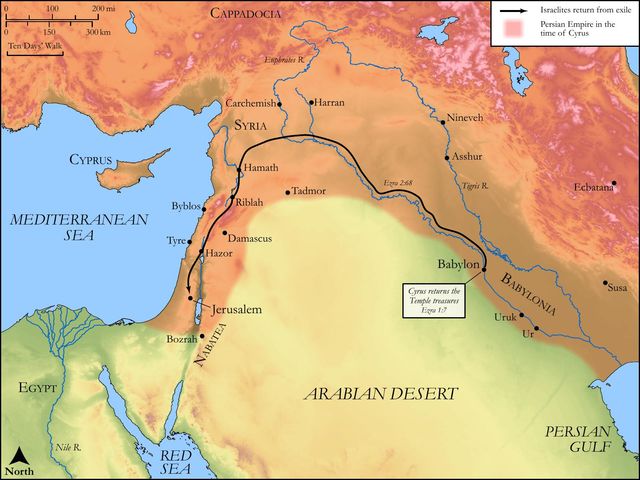
The return from Babylonian exile, initiated by Cyrus's decree around 538 BC, marked a profoundly pivotal moment in Israelite history. After seventy years of punitive captivity, the returning exiles faced the daunting and monumental task of rebuilding their devastated homeland and restoring their national and religious identity. In ancient Near Eastern society, where lineage, tribal affiliation, and occupational guilds were paramount, meticulous genealogical records, like those found throughout Ezra 2, were absolutely crucial for establishing legitimacy, validating land claims, and assigning specific roles within the newly forming community, especially for those serving in the sacred precincts of the Temple. The prominent inclusion of "singers" reflects the ancient Israelite tradition of highly organized temple worship, where music played a central and indispensable role in expressions of praise, lament, supplication, and instruction, a practice deeply rooted in the days of King David (see 1 Chronicles 25).
Key Themes
ShowHideEzra 2:41, though a single line, contributes significantly to several overarching themes pervasive in the book of Ezra and the broader post-exilic narrative. Firstly, it powerfully highlights the Restoration of Worship, emphasizing that the rebuilding effort was not merely architectural or political but fundamentally spiritual. The return of the singers signifies a profound commitment to re-establishing the full scope of Temple service, recognizing music and praise as indispensable elements of the renewed covenant relationship with God. Secondly, the precise enumeration of 128 individuals underscores the theme of Divine Order and Organization. This meticulous accounting reflects God's providential hand in orchestrating the return and the careful, divinely-guided planning required to reconstruct a functional society and worship system. It demonstrates that every part of the community, even specific vocational groups, was valued, accounted for, and purposed by God. Lastly, the specific mention of "the children of Asaph" speaks to the Continuity of Ministry and Covenant Faithfulness. Asaph's lineage represented a long-standing, revered tradition of temple musicians, established centuries earlier, as vividly seen in 1 Chronicles 6:39. Their return signifies the re-establishment of ancient, divinely appointed roles and God's enduring faithfulness to preserve His people and their sacred callings, even after displacement and exile, echoing the promises found in Jeremiah 29:10 concerning a future return.
Exposition and Analysis
ShowHideKey Word Analysis
ShowHideFrom the root H7891, meaning "to sing." This term refers to professional musicians, specifically those appointed for liturgical music and praise in the Temple. In ancient Israelite worship, singers were not merely entertainers but integral participants in the sacred rites, leading the congregation in praise, lament, and supplication. Their role was divinely ordained and highly respected, contributing significantly to the spiritual atmosphere and theological expression of communal worship.
From the root H1121, meaning "a son (as a builder of the family name), in the widest sense (of literal and figurative relationship, including grandson, subject, nation, quality or condition, etc.)." In this context, "children" signifies the descendants or members of the guild associated with Asaph, emphasizing the hereditary nature of their sacred musical ministry and the continuity of their family's dedication to Temple service across generations.
From the root H623, meaning "collector." Asaph was a prominent Levitical musician, prophet, and seer during the reign of King David (c. 1000 BC). He was appointed as one of the chief choirmasters for Temple worship, responsible for leading the musical praise (as seen in 1 Chronicles 16:5). Many Psalms (e.g., Psalm 50, Psalms 73-83) are attributed to him or his guild, indicating his lasting influence on Israelite hymnody and theology. The "children of Asaph" in Ezra 2:41 denote his hereditary guild or descendants who continued this specialized and sacred musical ministry, reinforcing the intergenerational nature of many Temple roles and the preservation of specific worship traditions.
Verse Breakdown
ShowHide"The singers"
This introductory phrase immediately identifies the professional group being enumerated. It highlights their distinct and essential role within the returning community, signaling that their function was not incidental but a recognized and vital component of the restored social and religious fabric. Their presence underscores the priority placed on re-establishing organized worship.
"the children of Asaph,"
This specific designation links the returning singers directly to the renowned Levitical guild founded by Asaph. It underscores the continuity of their sacred vocation across generations, emphasizing that the post-exilic Temple would be served by those who inherited and preserved the ancient traditions of worship established centuries earlier by King David. This lineage provided both legitimacy and a profound connection to Israel's glorious past and its divinely ordained worship practices.
"an hundred twenty and eight."
The precise number indicates the meticulous nature of the census and the highly organized effort behind the return. It signifies that the community was not haphazardly re-forming but was carefully structured, with specific personnel allocated for crucial functions. This exact figure also implies a significant, dedicated contingent of individuals whose primary role was to facilitate the musical worship in the newly rebuilt Temple, demonstrating the high priority placed on this aspect of their spiritual life and the substantial investment in its re-establishment.
Literary Devices
ShowHideThe verse primarily employs Enumeration and Genealogy. Enumeration is evident in the precise number "an hundred twenty and eight," which is part of a larger, detailed list found throughout Ezra 2. This device serves to provide a meticulous, verifiable record of the returning exiles, emphasizing the orderliness and divine orchestration of the restoration. The precise counting also lends an air of historical accuracy and importance to the individuals and groups involved, signifying that each person and role was known and valued in God's plan. Genealogy is highlighted by the phrase "the children of Asaph," which connects the contemporary singers to a specific, revered ancestral line. This device establishes continuity with the past, legitimizes their role within the sacred Temple service, and underscores the hereditary nature of many Temple functions. It also subtly employs Symbolism, as the return of the singers, particularly those of Asaph's lineage, symbolizes the restoration of complete and vibrant worship—a cornerstone of Israel's covenant relationship with God and a sign of renewed spiritual vitality.
Theological and Thematic Connections
ShowHideEzra 2:41, though a simple line in a list, carries profound theological weight, underscoring God's unwavering faithfulness to His covenant people and His deep desire for their worship. The inclusion of singers among the very first returnees demonstrates that the restoration of physical structures like the Temple was inseparable from the restoration of spiritual life and communal praise. It highlights that true renewal involves not just rebuilding walls but rekindling the heart of worship within the community. God meticulously orchestrates the return of specific individuals, ensuring that every necessary component for a vibrant spiritual community is present, from priests and Levites to those dedicated solely to exalting His name through song. This divine attention to detail reflects God's sovereign care and His valuing of all roles within His service, no matter how specialized, affirming that every gift contributes to the flourishing of His kingdom.
Reflection and Application
ShowHideEzra 2:41, while seemingly a mere statistical entry, offers timeless insights for believers today. It reminds us that every role within the body of Christ, no matter how specific, seemingly "behind-the-scenes," or numerically small, is indispensable and profoundly valued by God. Just as the singers were vital to the spiritual health and corporate identity of the returning community, so too are all gifts and ministries essential for the flourishing of the church. This verse calls us to recognize, affirm, and celebrate the diverse contributions of each member, understanding that true corporate worship and spiritual vitality depend on the faithful exercise of every God-given calling. Furthermore, the dedication of a specific group to music and praise emphasizes the enduring importance of worship in the life of God's people. It encourages us to prioritize and engage in meaningful, heartfelt worship, whether individually or corporately, recognizing it as a primary expression of our love, devotion, and gratitude to God. The continuity of Asaph's lineage also serves as a powerful reminder of the importance of intergenerational faithfulness, challenging us to steward our spiritual heritage and intentionally pass on our commitment to Christ and His church to the next generation.
Questions for Reflection
ShowHideFAQ
ShowHideWhy is the precise number of singers important in this census?
ShowHideThe precise number of 128 singers is important for several reasons. Firstly, it underscores the meticulous nature of the post-exilic census, which was crucial for establishing the identity, legitimacy, and specific roles of the returning exiles in their monumental efforts to rebuild Jerusalem and the Temple. This attention to detail reflects a divinely ordered process, ensuring that every necessary component for a functioning society and worship system was accounted for. Secondly, it highlights the significant priority placed on organized worship. The fact that a specific, substantial number of individuals were dedicated solely to musical ministry demonstrates that worship was not an afterthought but a foundational and indispensable element of the restored community's spiritual life, essential for their identity and renewed relationship with God. This precision also allowed for proper organization and allocation of resources for the Temple service, as seen in later passages like Nehemiah 12:47, which describes provisions for the singers and gatekeepers.
Who was Asaph, and why are his "children" mentioned specifically?
ShowHideAsaph was a prominent Levitical musician and prophet during the reign of King David, appointed as one of the chief choirmasters for Temple worship, as documented in 1 Chronicles 25:1. He was responsible for leading musical praise and was also a prolific composer, with many Psalms (e.g., Psalm 50, Psalms 73-83) attributed to him or his guild, indicating his profound spiritual and artistic legacy. The mention of "the children of Asaph" in Ezra 2:41 refers to his hereditary guild or descendants who continued this specialized and sacred musical ministry. This specific mention emphasizes the continuity of sacred traditions and vocations across generations. It signifies that the post-exilic community was not inventing new forms of worship but was intentionally re-establishing the ancient, divinely appointed roles and practices that were central to Israel's covenant relationship with God, thereby linking the renewed Temple service directly to its historical and spiritual roots and ensuring the preservation of a rich heritage of praise.
Christ-Centered Fulfillment
ShowHideEzra 2:41, with its meticulous listing of the "children of Asaph" dedicated to Temple worship, finds its ultimate and glorious fulfillment in Jesus Christ. While the Old Testament singers prepared the way for the Lord through their praise and helped maintain the covenant community's spiritual life, Christ Himself is the perfect Worshiper and the ultimate object of all praise. The restoration of worship in Ezra foreshadows the profound spiritual restoration accomplished by Christ, who, through His atoning sacrifice on the cross, inaugurated a new covenant where true worship is no longer confined to a physical temple or a specific lineage but is offered "in spirit and truth" by all believers, as declared by Jesus in John 4:23-24. The "children of Asaph" represent a specific, dedicated group tasked with leading praise; in the New Covenant, all believers are made "a royal priesthood, a holy nation," called to "declare the praises of him who called you out of darkness into his wonderful light" (1 Peter 2:9). Jesus, as the head of the Church and our great High Priest, gathers His people from every tribe and tongue, uniting them into a new community of worshipers. He is the Lamb of God who takes away the sin of the world (John 1:29), making it possible for us to stand before God and offer acceptable worship, a worship that will culminate in the eternal chorus of praise around His throne, singing a new song of redemption (Revelation 5:9-10). Thus, the return of the singers in Ezra points forward to the glorious reality that through Christ, God's people are not merely restored to ancient forms of worship but are transformed into a living, worshipping temple, continually offering praise to their Redeemer.